Get The Ultimate Guide To Rebuilding Civilization at https://mdsh.io/hyperspacepirate and use promo code PIRATE10 to get 10% off!
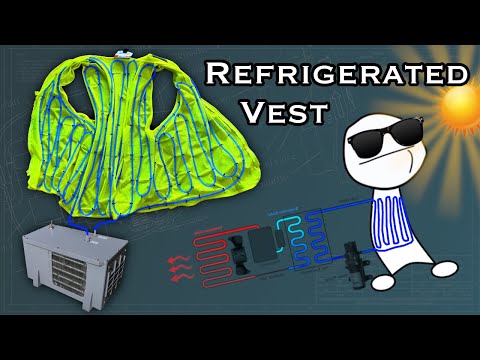
In this video, I’ll be building on the work done in my last video on making a portable battery powered A/C unit (here: https://www.youtube.com/watch?v=2hSkXNEV-GU) to make a wearable personal air conditioner that circulates refrigerated water around a vest with about ~15m of silicone tubing woven into it.
The refrigeration system in this video uses the same brushless-DC compressor and 8-cell lithium (32V) power supply, but instead of blowing cool air, the system acts as a water chiller, using a pair of 40mm copper CPU cooling blocks brazed together. One of the blocks is the evaporator of the refrigerant loop, while the other one has water circulated through it.
I measured a peak refrigeration power of 24W with 26.4W of input power, which was done by measuring the time rate of temperature change of a known quantity of water. This wasn’t done with a well insulated test setup, so there’s probably a few watts more than what i measured, and it’s likely that the system has a COP of around 1.0 like the A/C unit from the previous video.
The two major advantages of the liquid-cooled vest approach are:
– Almost all the cooling is applied directly to the body (as opposed to a system blowing cold air), allowing heat relief with the absolute minimum amount of power input
– Using water as the coolant instead of air requires less of a temperature drop from ambient to achieve the same cooling effect, which in turn increases the potential efficiency of the system because of the smaller temperature differential
The cooling vest was made from a porous reflective vest with 3/16 inch silicone tubes “woven” into the mesh with tiny zipties. Outdoors at 25C, after several minutes of running, the vest causes me to feel uncomfortably cool, but not shivering cold. I imagine it might need a bit more power for the brutal Florida summers, but it definitely works.
The last thing i experimented with was running the system off solar power. Where there’s heat, there’s likely sunlight, so it seems like a natural choice to take advantage of the solar energy on a hot day for personal cooling. I did this with a pair of 25-watt solar panels wired in series. Open circuit voltage was just under 50V, but the compressor ESC and LM2596 buck converters used for the fan and pump have a maximum input voltage of 40V, so I had to use an N-channel MOSFET as a linear regulator in series with the panels to clip the voltage at 40V.
The other challenge with solar power was that the system needed some sort of “cut-in” and “cut-out” points based on available power. Since open-circuit voltage isn’t a good indicator of power available from the power, I instead opted to keep the panels shorted through a 50-ohm load resistor, which would allow me to measure current and turn on power to the refrigeration system based on that current value. Both the load resistor and refrigeration system and connected via. a relay controlled by an Arduino Uno.
Overall I’d consider the project a success, and the next step I want to take is to use several hundred watts of solar power to run a larger refrigeration system and store the solar energy as cooling power in a block of ice. To recover the cooling power later in the day, I’ll circulate glycol through a heat exchanger in the ice and a coil with a fan over it, which will only require a few watts of power to operate.
Leave a Reply