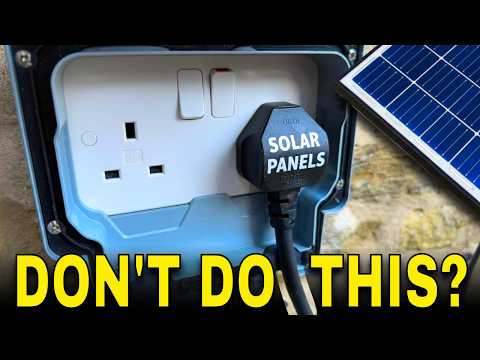
Plugging solar panels into a standard UK socket sounds completely wrong… yet that’s exactly what we’ve done.
Across Europe, plug-in solar (often called balcony solar) is exploding in popularity, with nearly a million installations in Germany alone. But in the UK it’s still not officially permitted, largely because of concerns about exporting power through a standard plug socket.
So instead of debating it, we tested it.
In this video we install a plug-in solar system connected to the DJI Power 2000 with expanded 6 kWh battery storage to see how it performs in the real world. We test safety concerns like anti-islanding protection, reverse power flow through RCBOs, and DC leakage issues, while also exploring the economics of solar generation combined with battery arbitrage.
Could plug-in solar paired with portable battery storage like the DJI Power 2000 become the next evolution of home energy in the UK?
Let us know what you think in the comments.
Check Price & Availability
👉 https://hub.efixx.co.uk/DJIP2000
Plug-In Solar: Banned Today, Legal Tomorrow?
👉 https://www.efixx.co.uk/Articles/plug-in-solar-uk-regulations
=======================
Time Stamps ⏱️
00:00 – Plugging solar panels into a UK socket
00:42 – Why plug-in solar is booming in Germany
01:25 – How much energy an 800 W balcony solar system generates
02:05 – Pairing the system with plug-in battery storage
02:50 – Is exporting power through a socket dangerous?
03:35 – Anti-islanding protection explained
04:15 – Testing an RCBO with reverse power flow
05:05 – DC leakage concerns and RCD types
05:40 – The real risk: uncontrolled installations
06:20 – Integrating solar with the DJI Power 2000 battery
07:10 – Battery efficiency and overnight energy arbitrage
07:45 – Could plug-in solar work in the UK?
=======================
Time Stamps ⏱️
#DJIPower2000 #DIYsolar #balconysolar
Leave a Reply