Progressive groups denounce move as effort to suppress millions of voters who do not have ready access to government ID.
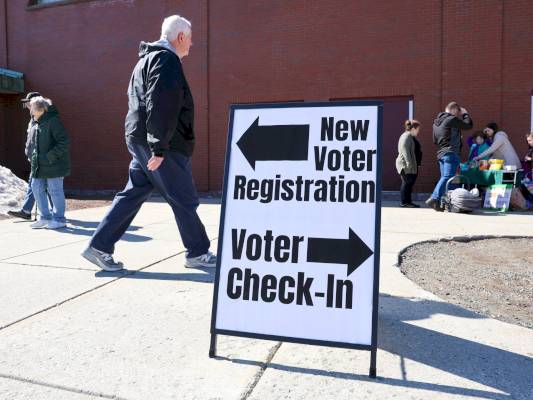
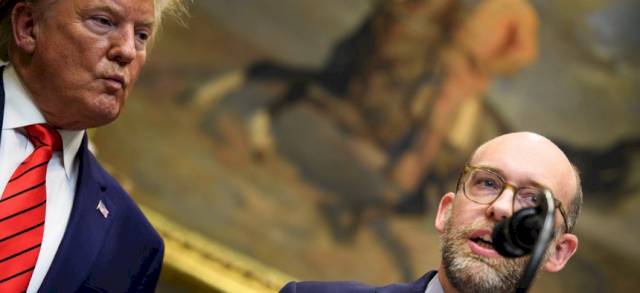
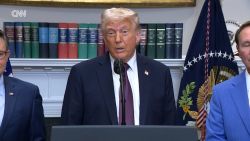
United States President Donald Trump has signed an executive order requiring Americans to provide proof of citizenship to vote, claiming the move is necessary to “straighten out” election fraud.
Trump’s order signed on Tuesday calls on the Election Assistance Commission to require prospective voters to produce a US passport or other valid government ID when registering for federal elections.
The order also directs US states to receive all votes by election day and not count mail-in ballots that arrive after the polls have closed.
Trump said his order would “hopefully” end election fraud, while repeating his false claim that he won the 2020 presidential election in a “landslide”.
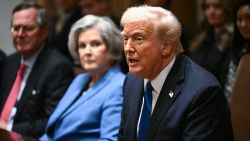
“At least this will go a long way toward ending it, there are other steps that we will be taking in the coming weeks, and we think we will be able to end up getting fair elections,” Trump said as he signed the order at the White House.
“We’ve got to straighten out our election,” Trump added.
“This country is so sick because of the election, the fake elections, and the bad elections, And we’re going to straighten it out, one way or the other.”
Trump’s order continues his long history of railing against alleged election fraud, including voting by non-citizens, which is illegal and shown in studies to be extremely rare.
Trump has often questioned the outcomes of elections that have not gone his way, including his 2020 defeat to former US President Joe Biden, which he falsely attributed to widespread voting irregularities.
Democrats and progressive groups have long opposed Republican-led efforts to require voters to produce ID on the grounds that poor and older voters may not have easy access to documents such as passports and birth certificates.
Lisa Gilbert, co-president of Public Citizen, a progressive advocacy group, described Trump’s order as a “blatant attack on democracy” and “an authoritarian power grab”.
“Donald Trump’s executive order would compromise our election systems, suppress the votes of millions of Americans, especially voters of colour, and pave the way for still more Trumpian false claims of election fraud,” Gilbert said in a statement.
Richard Hasen, a law professor at the University of California who runs Election Law Blog, also denounced the move, saying it would disenfranchise potentially millions of voters.
“This would prevent only a tiny amount of noncitizen voter registration but stop millions of eligible voters, who do not have easy access to documents such as passports from registering to vote,” Hasen said on his blog.
“The aim here is voter suppression pure and simple,” he added.
The Trump administration seems like it just doubled down on Greenland.
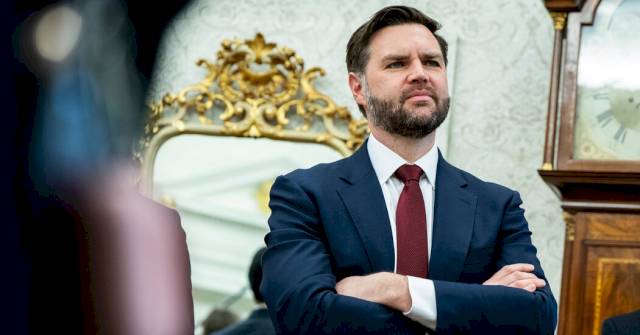
Vice President JD Vance announced on Tuesday that he was headed to the island later this week, taking over a controversial visit that officials in Greenland have made very clear they don’t want at all.
Originally, the Trump administration said that Usha Vance, the second lady, and Michael Waltz, the national security adviser, would make the trip to Greenland, a semiautonomous territory of Denmark that President Trump wants for the United States.
Officials from Denmark and Greenland immediately branded the move “aggressive” and part of the president’s plan to get the island, as he recently put it, “one way or the other.”
Image
Nuuk, Greenland, in January.Credit…Ivor Prickett for The New York Times
The White House then issued a statement on Tuesday afternoon changing up the visit. The new itinerary is for Mr. and Ms. Vance to visit Pituffik Space Base, high above the Arctic Circle, “to receive a briefing on Arctic security issues and meet with U.S. service members.”
In a post on X, Mr. Vance said he would “just check out what’s going on with the security there of Greenland.”
Anti-Trump sentiment has been rising steadily on the island, and activists were already preparing to protest the arrival of the American delegation, starting at the international airport in the capital, Nuuk. But now it seems that the Vances might not even set foot in Nuuk.
The United States has a longstanding defense agreement with Denmark to station troops in Greenland, and American officials can visit the base at will. Foreign-policy analysts said on Tuesday night that they expected the Vances to travel directly to the space base, which is nearly 1,000 miles north of Nuuk, and avoid the cauldron that is brewing in the capital.
Greenland officials have emphasized that they never invited the Americans in the first place but they have little control over who visits the American base.
Image
President Trump, Vice President JD Vance, Secretary of Defense Pete Hegseth and Michael Waltz, national security adviser, at the Oval Office this month.Credit…Doug Mills/The New York Times
Initially, the plan was for Ms. Vance and one of her sons to watch a dog sled race, a cherished Greenland tradition, in Sisimiut, one of Greenland’s bigger towns. But the organizers of the race made a pointed statement on Sunday that while the race was open to the public, they had not asked the Vances to attend.
A spokeswoman for Ms. Vance denied that, saying she had received “multiple invitations for her attendance to the Greenland national dog sled race.” Still, the White House announced on Tuesday that she would no longer be going to the race.
U.S. administration officials had originally planned for Mr. Waltz to visit the space base, which is an important piece of the United States’ missile defense. But with Mr. Waltz now embroiled in a controversy over his use of a mobile messaging application to discuss sensitive war plans, his participation seems up in the air.
As the news broke on Tuesday night that Mr. Vance would be arriving, Greenland’s government wasn’t pleased. Politicians there are embroiled in delicate talks over who will form the island’s next administration. Earlier this month, the island held parliamentary elections, but the outcome was mixed, with no party winning a clear majority.
“We’ve asked for peace and quiet and no international visits while negotiations are ongoing, and that should be respected,” said Pipaluk Lynge-Rasmussen, a leading member of the departing ruling party.
Some political analysts in Denmark said that the decision to send Mr. Vance was an “escalation.”
“They choose to double down on it — massively escalate, in fact — this provocative show of force by sending JD Vance,” said Lars Trier Mogensen, a political commentator in Copenhagen. “That is many times more significant than either Mike Waltz or Usha Vance.”
“In Denmark, people are starting to see this as a kind of hybrid warfare,” he added, pointing to comparisons with Crimea, the region annexed by Russia in 2014, where lines between diplomacy and provocation were deliberately blurred.
But others saw the decision to visit the American base and ditch the dog sled race as perhaps less provocative.
“If the visit to Nuuk has been canceled, the Trump administration may be stepping back by avoiding imposing itself on civilian Greenland,” said Ulrik Pram Gad, a researcher at the Danish Institute for International Studies. “Focusing solely on the military base brings the conversation back to security.”
The headquarters of Radio Free Europe/Radio Liberty in Prague last week.Credit…David W Cerny/Reuters
A federal judge on Tuesday temporarily blocked President Trump’s push to close down Radio Free Europe/Radio Liberty, a federally funded news organization that was born out of the American efforts to counter Soviet propaganda during the Cold War.
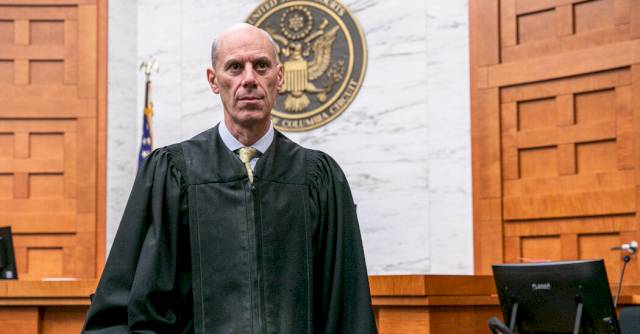
The judge, Royce C. Lamberth of the U.S. District Court for the District of Columbia, issued a temporary restraining order, saying that the Trump administration cannot unilaterally shut down RFE/RL, even if the president has ordered the closure.
Judge Lamberth said the administration cannot overrule Congress, which gave the news outlet a statutory mandate to promote the freedom of opinion and expression, with “one sentence of reasoning offering virtually no explanation.”
Judge Lamberth was referring to a March 15 letter to RFE/RL from the Trump administration that said the broadcaster was no longer needed as the government’s priorities had shifted. The letter did not elaborate, other than citing Mr. Trump’s directives to shut down federal agencies.
The temporary restraining order will allow RFE/RL to stay open at least until March 28. After that, Judge Lamberth would decide whether to issue a preliminary injunction that would allow the news outlet to continue operating until the court reaches a final verdict.
Radio Free Europe and Radio Liberty were founded in the 1950s as a U.S. intelligence operation covertly funded through the Central Intelligence Agency. The broadcaster sought to foment anti-communist dissent behind the Iron Curtain.
Since the early 1970s, it has been funded by Congress and has had editorial independence. Today RFE/RL reports in nearly 30 different languages, reaching 47 million people every week in 23 countries, including Afghanistan, Russia and Hungary.
“The court concludes, in keeping with Congress’s longstanding determination, that the continued operation of RFE/RL is in the public interest,” Judge Lamberth wrote.
Judge Lamberth was appointed by President Ronald Reagan.
His ruling partly blocks the Trump administration’s push to shut down the news organization’s parent agency, the U.S. Agency for Global Media, which oversaw five federally funded news networks including Voice of America.
The letter to RFE/RL was sent a day after Mr. Trump signed an executive order dismantling the media agency, as an effort to terminate nearly $7.5 million in grants. The news organization is a private nonprofit that receives most of its funding from the federal government.
“The award no longer effectuates agency priorities,” the letter said.
Judge Lamberth wrote on Tuesday that the letter did not provide sufficient explanation for why the congressionally-established news outlet needed to be shut down in such a unilateral fashion.
The officials at the Trump administration “have acted arbitrarily and capriciously,” he wrote. “The ‘explanation’ offered by U.S.A.G.M. can scarcely be characterized as an explanation.”
The letter was signed by Kari Lake, a special adviser at the agency who appears to be leading the push to gut it. Ms. Lake, who was hired in February, is a former Senate candidate and local news anchor who peddled false claims that the 2020 election was rigged.
Ms. Lake was initially named in December to be the next director of Voice of America by Mr. Trump. She was hired as the media agency’s special adviser instead, as legal experts questioned whether Mr. Trump would be able to fire Voice of America’s current director.
Her appointment stoked fears that the Trump administration would meddle in the editorial decisions of federally funded news organizations. The global media agency has also opened investigations into its journalists for reporting on criticisms of Mr. Trump or making comments that were perceived as critical of him.
During his first term, Mr. Trump attacked the media outlets under the global media agency over their editorial decisions, and his appointees were accused of trying to weaken journalistic safeguards.
In 2020, Mr. Trump appointed Michael Pack, an ally of his former aide Stephen K. Bannon, to run the media agency.
Mr. Pack was accused of trying to turn Voice of America into a mouthpiece for the Trump administration, and a federal judge ruled that Mr. Pack had violated the First Amendment rights of the outlet’s journalists. A federal investigation later found that Mr. Pack had grossly mismanaged the media agency, repeatedly abusing his power by sidelining executives he felt did not sufficiently support Mr. Trump.
On Monday, Mr. Trump withdrew the nomination of L. Brent Bozell III, a conservative media critic and fierce defender of Israel, to lead the media agency. He instead named Mr. Bozell as the next U.S. ambassador to South Africa.
President Trump said during an interview on Newsmax that he would look into the case of Ashli Babbitt, who was shot and killed during the Jan. 6 riots. She was among the Trump supporters who stormed the Capitol in an attempt to stop the certification of the 2020 election that he lost.
Image
Credit…Todd Heisler/The New York Times
The interviewer said the Justice Department was still defending the government against the wrongful death lawsuit Babbitt’s family filed, and asked Trump if it should be settled. Trump said he was “going to take a look at it,” along with the fact that the Capitol Police officer who shot her is still a federal employee.
Trump, asked whether he believed that Russia was “dragging its feet” in getting to a ceasefire with Ukraine, gave two different answers, saying he believed that Russia wanted to see the war end, but could also be stalling. He added that he had done it over the years, when he didn’t want to sign a contract but wanted to “stay in the game.”
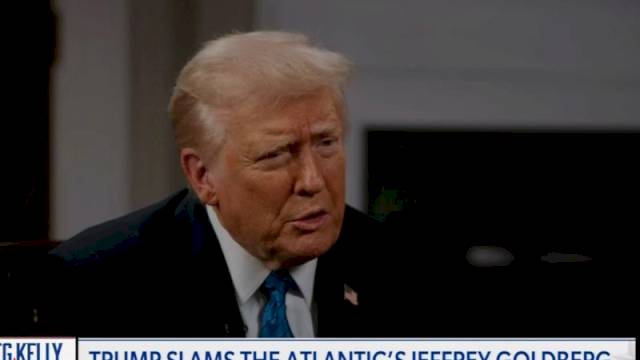
During an interview with Newsmax tonight, Trump was asked whether the Signal leak raised any concerns that members of his staff were talking to the Atlantic editor, Jeffrey Goldberg. Trump largely deflected by continuing his attacks on Goldberg, calling him “bad news.” He also repeated the claim that the leak was a result of actions of a staffer, which Waltz contradicted during his own interview with Fox tonight, when he took “full responsibility.”
The White House notified Congress earlier today that it was withdrawing the nomination of L. Brent Bozell III to lead the United States’ global media agency, and that he has instead been nominated to be the U.S. ambassador to South Africa. Bozell, a former anti-Trump Republican who is now a firm supporter of the president, would be stepping into the diplomatic post as the relationship between South Africa and the United States is at its worst in recent memory.
A federal judge in the U.S. District Court for the District of Columbia temporarily blocked the Trump administration’s push to close down Radio Free Europe/Radio Liberty, a federally funded news organization that was born during the Cold War out of the American efforts to counter Soviet propaganda with factual reporting. The judge, Royce C. Lamberth, a Reagan appointee, ruled that the Trump administration couldn’t force the news media to shut down “even if the president has ordered them to do so,” as Congress established the organization through a law it passed, the International Broadcasting Act of 1973.
Image
Credit…Alexey Vitvitsky/Sputnik, via Associated Press
The judge’s ruling partly blocks the Trump administration’s push to shut down the news organization’s parent agency, the U.S. Agency for Global Media, which oversaw four other federally funded news networks including Voice of America. Last month, President Trump named Kari Lake, an unsuccessful Senate candidate and a former local news anchor who peddled false claims that the 2020 election was rigged, to serve as a special adviser at the agency, stoking fears that she would meddle in editorial decisions of its news organizations. Earlier this month, Trump signed an executive order dismantling the media agency in its entirety, prompting a lawsuit from Radio Free Europe employees.
An earlier version of this post misstated the number of federally funded news outlets overseen by the U.S. Agency for Global Media in addition to Radio Free Europe/Radio Liberty. It has been corrected above.
President Trump still trumpets the false claim that he won the 2020 election.Credit…Doug Mills/The New York Times
President Trump signed an executive order on Tuesday that will require proof of U.S. citizenship on election forms, in an aggressive push to catch and combat voter fraud, which is exceedingly rare but constantly cited by Mr. Trump as a reason he lost the 2020 election.
The order calls for the Election Assistance Commission to require people to show government-issued proof of U.S. citizenship to register to vote in federal elections, and directs state or local officials to record and verify the information. It also seeks to require states to count ballots by Election Day.
Administration officials, who cast the order as one of the most far-reaching in American history related to elections, cited cracking down on immigrants illegally on voter rolls as one of the order’s main goals, amplifying Mr. Trump’s longstanding grievances about election integrity. He has falsely claimed that illegal votes contributed to his losing the 2020 election and the popular vote in 2016.
Like many of Mr. Trump’s orders, this one is likely to face legal challenges for executive overreach.
Rick Hasen, a political science professor and director of the Safeguarding Democracy Project at the University of California, Los Angeles, School of Law, said that Mr. Trump had no authority to dictate how states ran their elections, such as requiring them to count their ballots by Election Day.
Mr. Hasen added that Mr. Trump’s exertion of power over the commission — which was created by legislation passed in Congress — would need to be tested in court, since what he is ordering them to do is “either contrary to law or at best disputed.”
“This executive order is important for what it tries to do on requiring voters to provide proof of citizenship when registering to vote, but it is even more important for what it means for Presidential power,” Mr. Hasen wrote in an email. “Trump is trying to assert power over an independent, bipartisan agency that Congress created to deal fairly and evenhandedly with assisting states in administering elections.”
The order claimed that current rules that prohibited states from allowing noncitizens to register to vote were not “adequately enforced,” and suggested that elections were also compromised by states that counted ballots received after Election Day.
This is standard practice in states that require that mail ballots are only postmarked by Election Day. But even in the weeks after his decisive victory in November, Mr. Trump continued to complain that ballots were still being counted.
The order threatens to withdraw federal funding in states that do not comply.
“Free, fair and honest elections unmarred by fraud, errors or suspicion are fundamental to maintaining our constitutional Republic,” the order stated. “The right of American citizens to have their votes properly counted and tabulated, without illegal dilution, is vital to determining the rightful winner of an election.”
At the signing, Mr. Trump — who still falsely claims he won the 2020 election — noted that some may not understand why he was complaining since he won “in a landslide” last year.
“There are other steps that we will be taking as the next in the coming weeks, and we think we’ll be able to end up getting fair elections,” Mr. Trump said on Tuesday at the signing. “This country is so sick because of the election, the fake elections and the bad elections, and we’re going to straighten it out one way or the other.”
Waltz’s admission contradicts what President Trump has said in his defense of Waltz. Trump claimed that “It was one of Michael’s people on the phone. A staffer had his number on there.” Waltz confirmed the account provided by Goldberg, saying during the interview “Look, a staffer wasn’t responsible. I take full responsibility.”
Michael Waltz, President Trump’s national security adviser, said in an appearance on Fox News that “I take full responsibility” for the sharing of military plans on the messaging app Signal, adding that he had “built the group” and added the journalist Jeffrey Goldberg to it.
Image
Credit…Haiyun Jiang for The New York Times
Waltz suggested in his remarks that Goldberg’s number was saved under another person’s contact information in his phone, and that was how Goldberg was mistakenly added to the group chat saying that “I’m sure everybody out there has had a contact where it was said one person and then a different phone number.”
Devon Archer, a former business associate of Hunter Biden, provided congressional testimony in 2023 when House Republicans investigated former President Biden’s ties to his son’s business dealings.Credit…J. Scott Applewhite/Associated Press
President Trump signed a full and unconditional pardon on Tuesday for Devon Archer, a former business partner of Hunter Biden whose congressional testimony two years ago helped fuel House Republicans’ investigation into the Biden family.
Mr. Archer had been convicted in a fraud case, and was sentenced in 2022 to a year and a day in prison.
The pardon erases the conviction and also tens of millions of dollars in forfeitures and restitution that Mr. Archer had been ordered to pay. Mr. Archer was pardoned before he served any of his prison sentence.
Mr. Archer earned fans on the right — including in Mr. Trump’s circle — after he testified in a congressional investigation in 2023 into Hunter Biden’s business dealings. He accused the Bidens of abusing “soft power” through business deals in which then-President Joseph R. Biden Jr.’s son Hunter made millions of dollars. Supporters of Mr. Archer had argued that he was treated more harshly by prosecutors after he started cooperating with investigations into the Bidens.
Before signing the pardon, Mr. Trump on Tuesday said that Mr. Archer “was treated very unfairly” and “was a victim of a crime, as far as I’m concerned, so we’re going to undo that.”
The pardon is the latest example of Mr. Trump’s aggressive use of his clemency power to reward allies or highlight his own grievances about what he sees as the political weaponization of the justice system.
Mr. Archer, who had a background in international finance and Democratic fund-raising, partnered with Hunter Biden in 2009, helping arrange introductions to foreign business interests. In 2014, they joined the board of Burisma Holdings, a Ukrainian energy company that some in the State Department viewed as corrupt, at a time when Joseph R. Biden Jr. was serving as vice president and overseeing the administration’s Ukraine portfolio. The overlap would become a focus for Republicans.
Mr. Archer left the board and started severing his business connections with Hunter Biden after being charged in 2016 in connection with a scheme to defraud pension funds and an Indian tribe of tens of millions of dollars. He was initially convicted in 2018, but later that year a judge set aside the conviction and ordered a new trial, only to be reversed in 2020 by a federal appeals court ruling that reinstated the fraud conviction.
Matthew L. Schwartz, Mr. Archer’s lawyer, portrayed the presidential pardon as fixing a flawed decision by a jury.
“The American jury system is an amazing thing, but as the trial judge held in finding serious questions about Devon Archer’s innocence, sometimes juries get it wrong,” Mr. Schwartz said in a statement. “Today’s pardon corrects a serious injustice, and finally allows an innocent man to be free of the threat of misguided prosecution. Mr. Archer is deeply appreciative of the President.”
Mr. Archer’s congressional testimony was not a clean win for either Republicans or Democrats.
While he provided an unflattering portrayal of how Hunter Biden conducted business, Mr. Archer told congressional investigators he saw no wrongdoing by the elder Mr. Biden. The G.O.P.’s congressional investigation ultimately did not result in an impeachment case against the former president.
“Are you aware of any wrongdoing by Vice President Biden?” Mr. Archer’s lawyer asked him at one point during the closed-door testimony.
“No, I’m not aware of any,” Mr. Archer replied.
But Mr. Archer also said he believed Burisma stayed in business during tough times through its associations with influential figures in Washington, and the “brand” that Hunter Biden brought to the board.
Asked what he meant, Mr. Archer said, “Because people would be intimidated to mess with them.”
Mr. Archer testified that he could recall about 20 times when he and Hunter Biden were meeting with business associates, and Hunter Biden put his father on speakerphone. The conversations, Mr. Archer said, discussed only niceties — “How’s the weather? How’s the fishing?” — but the signal from Hunter Biden was clear, he said.
“There was not business content in these conversations,” Mr. Archer told the Trump-allied pundit Tucker Carlson in an interview after his testimony. “The idea of signals and influence — the prize is enough in speaking or hearing or knowing you have that proximity to power.”
At one point, Mr. Archer told Mr. Carlson, “In the rearview, it’s an abuse of soft power.”
Mr. Archer also said he believed it was false for defenders of the former president to say that he had no knowledge of his son’s business activities. “He was aware of Hunter’s business,” said Mr. Archer, who played golf with both Bidens. “He met with Hunter’s business partners.”
In addition to the congressional testimony, Mr. Archer in 2021 was interviewed by prosecutors and subpoenaed for documents as part of an investigation into Hunter Biden’s finances and foreign business.
Last year, Hunter Biden was convicted of gun crimes, and pleaded guilty to tax crimes related to millions of dollars in income from Burisma and other foreign businesses.
With less than two months left before he left office, President Biden issued a broad pardon for Hunter Biden for those convictions, and any other crimes he might have committed in the past 11 years, a period coinciding with the beginning of his work for Burisma.
The pardon, which troubled clemency experts, was cited by Mr. Archer’s supporters as additional justification for granting clemency to him.
Dr. Jay Bhattacharya, left, and Dr. Martin A. Makary.
The Senate on Tuesday confirmed Dr. Martin A. Makary as commissioner of the Food and Drug Administration and Dr. Jay Bhattacharya as director of the National Institutes of Health, installing two critics of the medical establishment to influential posts amid a Trump administration campaign to cut spending at health agencies.
In a 56-to-44 vote, Dr. Makary was confirmed to lead an agency with broad regulatory authority over products including drugs and vaccines, putting him at the center of debates about the safety of the abortion pill and a wide range of inoculations.
Dr. Bhattacharya’s confirmation — 53 to 47, on a party-line vote — places him at the head of the world’s premier medical research agency, which lately has been battered by cuts to staffing and orders to pause or cancel vast research funding.
Dr. Makary, a pancreatic cancer surgeon and health policy researcher at Johns Hopkins University, drew attention from the Trump team as a Fox News personality and commentator on Covid who in 2021 incorrectly predicted that the nation was “racing toward an extremely low level of infection.”
At a confirmation hearing this month, Dr. Makary signaled that he shared Republican concerns about expanded access to the abortion pill, which the Biden administration made available for people to obtain without an in-person medical appointment.
He also expressed support for vaccines, even as he suggested that the F.D.A. needed to review the role of vaccine experts whom the agency turns to for advice.
Lawmakers have warned that staff cuts and hiring freezes by the Trump administration could weaken F.D.A. efforts to ensure the safety of the food supply.
The N.I.H., which has a $48 billion budget and funds medical research on diseases like cancer and diabetes, has also been whipsawed by layoffs and Trump administration moves to block key parts of its grant-making process and scrap some grants outright.
Dr. Bhattacharya, a health economist and professor of medicine at Stanford, largely dodged questions about those decisions at a confirmation hearing in early March.
He burst into the public spotlight in 2020, when he was among the authors of an anti-lockdown treatise, the Great Barrington Declaration, which argued for protecting older and more vulnerable people from Covid while letting the virus spread among younger, healthier people.
He has also argued for reforms to scientific funding practices, including applying greater scrutiny to research findings that are not borne out by subsequent studies and directing money toward the most far-reaching and innovative research rather than incremental studies.
Questioned by lawmakers this month about the safety of vaccines, Dr. Bhattacharya said that he supported children’s inoculation against diseases like measles, but also that scientists should conduct more research on autism and vaccines, a position at odds with extensive evidence showing no link between the two.
Robert F. Kennedy Jr., the health secretary, who has faced criticism for his reluctance to explicitly recommend vaccinations in the midst of a deadly measles outbreak in West Texas, oversees both the F.D.A. and the N.I.H.
President Trump signed an executive order on Tuesday that targeted a prominent white-shoe law firm where Andrew Weissmann, who served in a senior role on an investigation into Mr. Trump’s possible links to Russia, once worked.Credit…Doug Mills/The New York Times
President Trump initiated a fresh attack on lawyers on Tuesday, singling out a firm where a former prosecutor who investigated him once worked as the White House pursues vengeance against the profession he blames for his legal troubles.
An executive order from Mr. Trump focused on Jenner & Block, a prominent white-shoe firm that once employed Andrew Weissmann, a longtime deputy to Robert S. Mueller III, who as a special counsel investigated Mr. Trump in his first term over possible links to Russia.
The order underscored the extent to which the president, who faced four criminal indictments after he left office in 2021, now aims to exact a steep price from anyone associated with past investigations of him.
Days earlier, Mr. Trump significantly expanded his campaign of retaliation against lawyers he dislikes, issuing a far-reaching memorandum that threatened to use government power to punish any firms that, in his view, unfairly challenged his administration. Mr. Trump has declared his efforts will clean up a legal profession that has become tainted by politics and unethical behavior.
At the White House on Tuesday, Mr. Trump called Mr. Weissmann a “bad guy” and said he would also declassify additional documents from the Russia investigation, known as Crossfire Hurricane, that began in 2016.
After serving in a senior role for the special counsel investigation, Mr. Weissmann spent many years as a television pundit, sharply criticizing Mr. Trump’s conduct. Mr. Weissmann, who left Jenner & Block in 2021, did not immediately respond to a request for comment.
The executive order signed Tuesday declares that many big law firms “take actions that threaten public safety and national security, limit constitutional freedoms, degrade the quality of American elections, or undermine bedrock American principles.”
The order also criticizes firms for doing pro bono work, or representing clients who are indigent or have limited financial resources to afford lawyers, charging that such work is often for what he called “destructive causes.”
Image
Mr. Weissmann, who spent many years as a television pundit criticizing Mr. Trump’s conduct, left Jenner & Block in 2021.Credit…Hilary Swift for The New York Times
Jenner & Block, the president’s order decreed, “has abandoned the profession’s highest ideals” and therefore its employees should not have security clearances, federal government contracts, access to federal government buildings or be hired by the government.
In a statement, a spokesperson for the law firm described its storied history of paid and pro bono work and pointed out that a federal judge had temporarily blocked the administration from imposing penalties on at least one firm subject to Mr. Trump’s orders, Perkins Coie. “We remain focused on serving and safeguarding our clients’ interests with the dedication, integrity and expertise that has defined our firm for more than 100 years and will pursue all appropriate remedies,” the statement continued.
Mr. Trump’s accusations against the firm range from the personal to the political, claiming that Jenner & Block rehired Mr. Weissmann after he worked on the Mueller investigation, which Mr. Trump called “entirely unjustified.” The order also accuses Mr. Weissmann of misconduct.
Last week, one of the targeted firms, Paul, Weiss, Rifkind, Wharton & Garrison, struck a deal with the administration to spare itself from a punitive order Mr. Trump had issued.
As part of that deal, the law firm agreed to provide $40 million worth of legal work in support of Mr. Trump’s efforts to fight antisemitism on college campuses, as well as other issues.
The president has embarked on his campaign against lawyers by denouncing what he calls “lawfare” or the “weaponization” of the legal system against him.
He and his allies have long claimed that Democrats asserted improper control over prosecutors’ offices to bring cases against him. Current and former law enforcement officials say those accusations are baseless, and that what the president and his senior aides are doing is stripping away the ability of institutions like the F.B.I. and Justice Department to pursue such cases again.
His ever-growing list of targets in the legal world has led to a heated debate among lawyers about how best to respond. Some have sharply criticized the president’s actions, and the decision by Paul, Weiss to cut a deal rather than fight in court, as Perkins Coie chose to do.
Vanita Gupta, who is a civil rights lawyer and a former Justice Department official, said Saturday that Mr. Trump is attacking “the very foundations of our legal system by threatening and intimidating litigants who aim to hold our government accountable to the law and the Constitution.”
The executive branch “should neither fear nor punish those who challenge it,” Ms. Gupta said, “and should not be the arbiter of what is frivolous — there are protections in place to address that. This moment calls for courage and collective action, not capitulation, among lawyers and the legal profession.”
Mr. Trump also signed an executive order declassifying some documents from the Russia investigation, while ordering that two separate categories of documents from that work remain classified.
Representative Chris Deluzio of Pennsylvania in January. “Too many in our party have lost their way and it’s time to wake the heck up,” he said of Democrats on Tuesday.Credit…Kenny Holston/The New York Times
A number of frustrated House Democrats who said their party had a “weak and undefined brand” announced on Tuesday that they were seeking to form a new group to dig out of their crisis, informally referred to as the New Economic Patriots.
The group is the brainchild of Representative Chris Deluzio, a 40-year-old second-term congressman from a competitive district in Pennsylvania, who criticized members of his own party as wimps in a speech on the House floor on Tuesday and called for Democrats to channel a “fighting spirit of economic populism” that he argued could lead them out of the political wilderness.
“Too many in our party have lost their way and it’s time to wake the heck up,” Mr. Deluzio said, later declaring: “The era of a spineless Democratic Party must end.”
The answer, he said, was for the party to focus on appealing to working people on economic issues, but it was not immediately clear how his plan was different from what many in the party have already been advocating. Still, Mr. Deluzio’s effort is the latest sign that Democrats, relegated to the minority in Washington and desperate to find a more coherent message after their devastating 2024 losses, are still mired in a politically fraught debate about how to move forward.
Mr. Deluzio has highlighted his status as a young lawmaker who outperformed former Vice President Kamala Harris in the 2024 election in a critical district in a key battleground state as he makes the case for why he is the right person to help lead his party out of its funk.
In an interview, Mr. Deluzio said the “progressive” and “moderate” labels did not work anymore given that his entire tattered party needed to be restructured around an economic populist message that he said had been co-opted by the right.
“I am not interested in a wimpy Democratic Party,” Mr. Deluzio said. “The party for years has put too much stock in avoiding fights, avoiding naming big corporate villains.” It is time for Democrats to turn back to their working-class roots, he said.
The new group includes a disparate group of Democrats, including Representative Pramila Jayapal of Washington, a former chairwoman of the Progressive Caucus, and Representative Pat Ryan, a moderate New York Democrat from a swing district. The group who spoke on the House floor notably did not yet include any Democrats who won Trump districts in 2024, or any members whom the Democratic Congressional Campaign Committee has identified as its “frontline” members who are considered the most vulnerable.
“What people are asking for is to transform the party in a more populist direction,” said Representative Greg Casar, Democrat of Texas and the chairman of the Progressive Caucus, who is also a member of the new group. “Populist means we are for working people across the spectrum, even if they disagree with us. The way we bring in conservatives is that we’re economic populists that are willing to be on their side.”
Mr. Casar, who made his debut appearance on Fox News over the weekend in an attempt to reach out to conservative-leaning voters, argued that Democrats could not be the party representing vulnerable people until they were seen as the party for all working people.
The New Economic Patriots have been meeting every other week to hash out a new platform, and some have been circulating among their colleagues a five-page memo trying to address what they see as a crisis in the party.
“A few of us believe that we have to focus on the economy,” said Representative Ro Khanna, Democrat of California, who is a member. “We have to focus on issues that affect people’s pocketbooks, and the Democrats haven’t done this effectively for many years.”
Mr. Khanna added: “Our message in 2024 did not recognize how much anger there was with the status quo. We did not recognize that offshoring of jobs was taking place, we did not recognize the pain people were still feeling, and our message wasn’t transformational enough.”
Mr. Deluzio said Democrats had both a messaging and policy problem to fix.
“Voters don’t think Democrats put lowering costs first, and this group does,” he said. “It’s not just putting the economy first; it’s being clear about why you’re being ripped off. We’re very clear about who those villains are.”
But Democrats for months have been talking about Elon Musk, President Trump’s billionaire ally who is leading an aggressive campaign of slashing government, as the main villain of the young administration.
On Tuesday as the group made its debut by delivering a series of speeches on the House floor, Representative Rosa DeLauro, Democrat of Connecticut, made remarks that did not sound any different from dozens of others that she and other Democrats have given in recent weeks railing against Mr. Trump’s policies.
Mr. Deluzio brought with him a poster board that read, simply and unspecifically, “Anti corruption, pro American Dream.”
Some of their colleagues were skeptical of what, exactly, the group was trying to achieve. Representative Marie Gluesenkamp Perez, Democrat of Washington, has for years been making the argument that her party is not in tune with the needs of working-class voters. Ms. Gluesenkamp Perez was invited to participate in the new group’s meetings and its performance on the House floor, but she declined to speak on Tuesday, according to a person familiar with her thinking.
Mr. Deluzio said that Tuesday’s floor action was simply an “opening salvo” and that the group would put forward a clear platform to resuscitate the Democratic Party at a moment when voters are desperate for leaders to show an effective way to push back against the Trump administration.
Over the weekend, the progressive stars Senator Bernie Sanders of Vermont and Representative Alexandria Ocasio-Cortez of New York drew tens of thousands of supporters on their “fight oligarchy” tour, focusing on the needs of working people.
Mr. Deluzio and his colleagues said theirs was the right message for Democrats, and that voters were primed for a bigger revamp of the party. (Neither Mr. Sanders nor Ms. Ocasio-Cortez is part of his group.)
“Too many Americans felt Democrats had become the party of the elites and stopped meeting people where they are,” Mr. Ryan said on the House floor. “This moment is not ideological. It’s about who fights for the people and who fights for the elites.”
Michael Waltz, the national security adviser, at the White House on Tuesday.Credit…Doug Mills/The New York Times
Despite President Trump’s insistence on Tuesday morning that his national security adviser, Michael Waltz, “has learned a lesson” after inadvertently including the editor of The Atlantic in a cabinet-level chat session, speculation continues to build about Mr. Waltz’s job security.
Mr. Trump vigorously defended Mr. Waltz in front of television cameras during an event a few hours later, saying he should not have to apologize for the breach.
“That man is a very good man, right there, that you criticized,” Mr. Trump said, pointing to Mr. Waltz after a reporter asked if the president would order practices to be changed. “So he’s a very good man, and he will continue to do a good job. In addition to him, we had very good people in that meeting, and those people have done a very, very effective job.”
Mr. Waltz said later on Tuesday that “I take full responsibility” for the sharing of military plans on the messaging app Signal, telling Laura Ingraham on Fox News that he had “built the group” and added the Atlantic editor, Jeffrey Goldberg, to it.
Most of the Republican Party has leaped to Mr. Waltz’s defense, seeking to blame the news media for the uproar.
But in interviews, several close allies of the president characterized the national security adviser’s standing as precarious, more so than it already was when The New York Times reported on his uneasy status over a week ago. Those who discussed Trump administration views on Mr. Waltz did so on the condition of anonymity to speak candidly. His fate, they say, rests on Mr. Trump’s caprices, with several competing factors coming into play.
On the one hand, it is Mr. Trump’s nature to defy a media firestorm rather than try to quell it by offering up a sacrificial lamb. He parted from this tendency at the beginning of his first administration when he fired his national security adviser, Michael T. Flynn, for not divulging his encounters with Russian officials to the F.B.I. According to one adviser from that era, Mr. Trump soon regretted that act of acquiescence.
This time around, according to several people who have spoken to Mr. Trump over the first two months of his term, he wants to avoid firing people because of the narrative of chaos that it will quickly engender. Once he starts firing people, one person familiar with his thinking said, it will be very hard to draw a line if problems arise with other aides down the line. And Mr. Trump has appeared increasingly more concerned with holding his perceived enemies at bay than anything else.
Mr. Waltz also benefits from a much closer relationship to the president than Mr. Flynn had. As a Republican congressman from 2019 until his current appointment, Mr. Waltz had been an unflagging defender of Mr. Trump throughout his political and legal travails. He spent much of last year campaigning for Mr. Trump, often traveling aboard the candidate’s private plane. He aggressively questioned the director of the Secret Service at a hearing after an assassination attempt on Mr. Trump at a rally near Butler, Pa., and became a defender of Mr. Trump against the agency.
Perhaps more significantly, Mr. Waltz frequently served as a campaign surrogate on Fox News, thereby passing the eyeball test for Mr. Trump, who prefers his senior aides be telegenic.
But Mr. Waltz has now given Mr. Trump reason to second-guess his loyalty, two people familiar with the matter suggested. The detail that Mr. Goldberg, the editor of The Atlantic, appeared to be in Mr. Waltz’s list of contacts to begin with — and possibly mistaken for another “JG” to be invited into the Signal group chat — has sent up alarms among the president’s allies, according to people familiar with their thinking.
In his appearance on Ms. Ingraham’s Fox News show Tuesday evening, Mr. Waltz suggested that Mr. Goldberg’s number had been saved under another person’s contact information in his phone. “I’m sure everybody out there has had a contact where it was said one person and then a different phone number,” he said.
In The American Conservative, a founding editor, Scott McConnell, wrote Tuesday, “I don’t see how National Security Adviser Mike Waltz organizing a group chat with The Atlantic’s Jeffrey Goldberg goes away without Waltz’s resignation.”
In The Atlantic article, Mr. Goldberg recounted that Mr. Waltz had sent him a connection request on Signal on March 11, adding that he “didn’t find it particularly strange that he might be reaching out to me.” Asked about the Signal fiasco in a news conference with Mr. Trump Tuesday, Mr. Waltz described Mr. Goldberg as someone “I’ve never met, don’t know, never communicated with.” In an interview for this article, Mr. Goldberg said that he had met Mr. Waltz a few years ago at two events but had never interviewed him.
Ironically, it was Mr. Waltz’s familiarity with members of the U.S. foreign policy establishment, including Mr. Goldberg, that provided relief to some quarters after he was named to the second Trump administration. A former Green Beret and four-time recipient of the Bronze Star, Mr. Waltz had served in the national security apparatus for the Bush and Obama administrations before working for a defense contracting firm and then running for Congress.
“Mike’s exceptionally well-rounded,” said Peter Bergen, an author and national security analyst who wrote the foreword to one of Mr. Waltz’s books. “I saw it as an inspired choice on Trump’s part.”
Others saw Mr. Waltz as a curious selection. An avowed hawk, he staunchly defended the wars in Iraq and Afghanistan in his 2014 book “Warrior Diplomat.” In a podcast interview in 2021, he warned that withdrawing U.S. troops from Afghanistan, as Mr. Trump had proposed doing, was “the best way to cause another 9/11 to happen.” Mr. Waltz instead advocated a sustained troop presence like the one that has been in Colombia — “a great model” — for over three decades. Such views have caused Mr. Waltz to be branded a “neocon” in right-wing circles.
Many of those who have heralded Mr. Waltz’s capabilities now find themselves at pains to explain his breach of security protocol. At the news conference on Tuesday, Mr. Trump reiterated that Mr. Waltz was “a very good man” and that attacks on him were “very unfair.” But some of the president’s allies have speculated that this appraisal could change if his national security adviser is increasingly viewed with ridicule.
Those who have known Mr. Trump throughout the years point to a striking constant: While he has a high tolerance for lightning rods, he has a very low one for laughingstocks.
Maggie Haberman and Chris Cameron contributed reporting.
Fair housing groups sued the Department of Housing and Urban Development and the Elon Musk-led Department of Government Efficiency this month.Credit…Erin Schaff/The New York Times
A judge in Massachusetts on Tuesday blocked the federal government from terminating dozens of grants to fair housing organizations across the country, a move that had left groups who fight housing discrimination scrambling to pay their bills and, in many cases, wondering if they could keep their doors open.
Sixty-six housing nonprofits received a letter in late February informing them that their grants were being cut off, with around $30 million in grants being suddenly rescinded across the country. Local fair housing organizations generally have annual budgets of less than $1 million, and in many cases the grants made up the bulk of their funding.
Four of the groups — in Massachusetts, Idaho, Texas and Ohio — sued the Department of Housing and Urban Development and the Elon Musk-led Department of Government Efficiency, or DOGE, earlier this month on behalf of a proposed class of the groups.
After a hearing on Tuesday, Judge Richard G. Stearns of the United States District Court in the District of Massachusetts granted a temporary injunction, which blocks the termination of the grants.
“The action DOGE directed is endangering everyday people while empowering wealthy landlords and others to discriminate,” said Lisa Rice, the president and chief executive of the National Fair Housing Alliance, in a statement. “We are grateful for today’s decision.”
A federal judge in Washington denied a request by the nonprofit group Public Citizen to depose Elon Musk on an expedited timeframe in a case focused on transparency into the Department of Government Efficiency operation. The group had moved to have Musk, who is leading the Trump administration’s efforts to downsize the federal government, sit for a deposition within 20 days.
In a statement following Vance’s announcement that he would be visiting Greenland on Friday, the vice president’s office said that Vance’s wife, Usha, had cancelled a scheduled appearance at a marquee dogsled race on the island this week. The organizers of the race had previously said that Usha had not been invited, but added that the event was open to the public and that she and her son “may attend as spectators.”
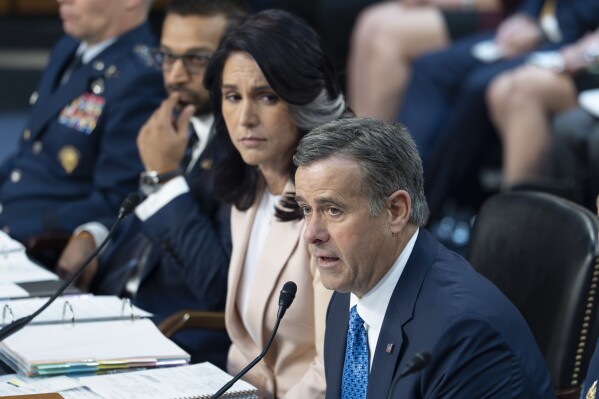
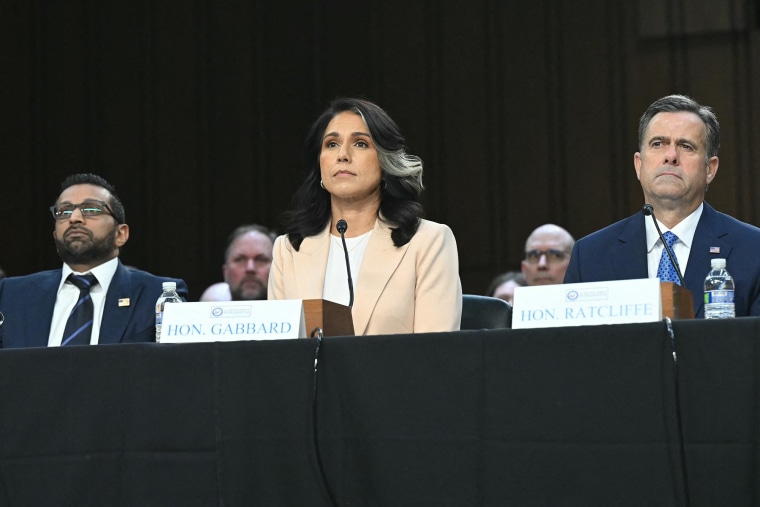
In the hearing on global threats on Tuesday, Tulsi Gabbard, the director of national intelligence, described Russia as a “formidable competitor” but avoided calling it an adversary.Credit…Kenny Holston/The New York Times
While the Trump administration has drastically changed how it talks about the danger posed by Russia, American intelligence agencies said in an annual report on Tuesday that Russia remained an “enduring potential threat to U.S. power, presence and global interests.”
On the same day the report was released, the director of national intelligence, Tulsi Gabbard, appearing before the Senate Intelligence Committee, described Russia as a “formidable competitor” but avoided calling Moscow an adversary.
The intelligence report — an annual assessment by federal agencies of global threats — found that Russia has the upper hand in its three-year-old full-scale invasion of Ukraine and has greater leverage now to press Kyiv and its supporters to negotiate “an end to the war that grants Moscow concessions it seeks.”
The report was not overly optimistic about the Trump administration’s efforts to push for a quick cease-fire to end the war, even though President Volodymyr Zelensky of Ukraine understands his position is weakening as his army’s battlefield position erodes, and President Vladimir V. Putin of Russia knows the damage an extended conflict would do to his economy.
Still, it said, “both leaders for now probably still see the risks of a longer war as less than those of an unsatisfying settlement.”
“For Russia, positive battlefield trends allow for some strategic patience, and for Ukraine, conceding territory or neutrality to Russia without substantial security guarantees from the West could prompt domestic backlash and future insecurity,” the report said.
The report said Mr. Putin’s hold on power was extremely strong. The possibility of an alternative leader emerging “probably is less likely now than at any point in his quarter-century rule.”
While U.S. officials frequently talk about how much American military experts have learned from the war, the intelligence report said Moscow has also learned a huge amount about American capabilities, since the United States has armed Ukraine and has provided it with battlefield intelligence.
“The war in Ukraine has afforded Moscow a wealth of lessons regarding combat against Western weapons and intelligence in a large-scale war,” the report said. “This experience probably will challenge future U.S. defense planning, including against other adversaries with whom Moscow is sharing those lessons learned.”
Supporters of a lawsuit challenging an executive order aimed at refugees gathered outside the federal courthouse in Seattle last month.Credit…Ryan Sun/Associated Press
An appeals court ruled on Tuesday that the Trump administration must admit thousands of people granted refugee status before Jan. 20, but declined to stop President Trump from halting the admission of new refugees.
The ruling, issued by a three-judge panel from the U.S. Court of Appeals for the Ninth Circuit, often a reliably liberal court, did not directly address the question of whether the government must restore billions of dollars in funding to nonprofit groups that help resettle refugees after they have reached the United States.
But the decision was framed as a victory by Melissa Keaney, an attorney for the International Refugee Assistance Project, one of the groups representing the plaintiffs. She said that “tens of thousands” of people who were overseas would be processed and admitted to the United States as refugees.
“The Ninth Circuit’s ruling insures that U.S. refugee admission remains open in part,” she said.
But it was a rare victory as well for the Trump administration and its efforts to clamp down on immigration. Appellate judges have largely upheld rulings by the district courts blocking the president’s agenda. In contrast, Tuesday’s decision reversed in part an earlier ruling by Judge Jamal N. Whitehead of the U.S. District Court for the Western District of Washington, who was nominated to the bench by President Joseph R. Biden Jr.
Judge Whitehead’s ruling effectively required the government to reinstate the U.S. Refugee Admissions Program, which has admitted more than three million refugees to the United States since it was established by statute in 1980.
Billions of dollars in funding for nonprofit groups that assist refugees with resettlement remain in limbo. After Judge Whitehead ordered the government to restore funding to the groups, the State Department terminated their contracts. A second order by Judge Whitehead, filed on Monday, ordered the government to reinstate the terminated funding. That order has not yet been considered by the appeals court.
Tuesday’s ruling by the appeals court is preliminary, and the court could eventually choose to either uphold or reverse Mr. Trump’s executive order in full.
WASHINGTON (AP) — President Donald Trump on Tuesday downplayed the texting of sensitive plans for a military strike against Yemen’s Houthis this month to a group chat that included a journalist, saying it was “the only glitch in two months” of his administration as Democratic lawmakers heaped criticism on the administration for handling highly sensitive information carelessly.
Trump told NBC News that the lapse “turned out not to be a serious one,” and expressed his continued support for national security adviser Mike Waltz.
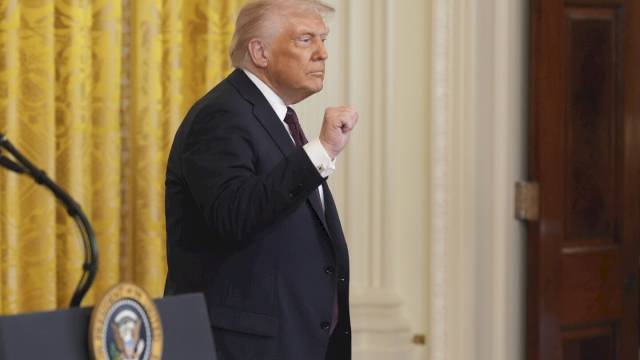
President Donald Trump gestures as he departs a reception celebrating Greek Independence Day in the East Room of the White House, Monday, March 24, 2025, in Washington. (AP Photo/Jacquelyn Martin)
President Donald Trump gestures as he departs a reception celebrating Greek Independence Day in the East Room of the White House, Monday, March 24, 2025, in Washington. (AP Photo/Jacquelyn Martin)
Waltz, according to an article posted online Monday by The Atlantic, appeared to have mistakenly added the magazine’s editor-in-chief, Jeffrey Goldberg, to a chat that included 18 senior administration officials discussing planning for the strike.
“Michael Waltz has learned a lesson, and he’s a good man,” Trump said. He also appeared to point blame on an unnamed Waltz aide for Goldberg being added to the chain. “It was one of Michael’s people on the phone. A staffer had his number on there.”
But the use of messaging app Signal to discuss a sensitive operation has opened the administration to blistering criticism from Democratic lawmakers who expressed outrage at the White House’s and senior administration officials’ insistence that no classified information was shared. Senior administration officials have struggled to explain why the publicly available app was used to discuss such a delicate matter.
AP AUDIO: Trump downplays national security team texting military operation plan on Signal as a minor ‘glitch’
AP Washington correspondent Sagar Meghani reports the Trump administration is downplaying the sharing of sensitive military strike information on a Signal group chat that included a journalist.
Waltz makes his first public comments
Waltz said Tuesday he was not sure how Goldberg ended up on the chat.
“This one in particular, I’ve never met, don’t know, never communicated with,” Waltz said.
Later Tuesday, Waltz said in an appearance on Fox News Channel’s “The Ingraham Angle” that he built the message chain and that White House technical experts were trying to figure out how Goldberg’s contact “may have been sucked in.”
“We made a mistake. We’re moving forward,” said Waltz, who added that he took “full responsibility” for the episode.
White House National Security Adviser Mike Waltz listens to a question from a reporter in the James Brady Press Briefing Room at the White House, in Washington, Feb. 20, 2025. (AP Photo/Alex Brandon, file)
White House National Security Adviser Mike Waltz listens to a question from a reporter in the James Brady Press Briefing Room at the White House, in Washington, Feb. 20, 2025. (AP Photo/Alex Brandon, file)
Trump, for his part, continued to attack The Atlantic and Goldberg and sent mixed messages on whether the administration would change how it goes about sharing sensitive information going forward.
“We won’t be using it very much” in the future, Trump said of Signal. “That’s one of the prices you pay when you’re not sitting in the Situation Room with no phones on, which is always the best, frankly.”
Trump added, “If it was up to me everybody would be sitting in a room together. The room would have solid lead walls and a lead ceiling and lead floor.”
One official reported to be on the Signal chain, Director of National Intelligence Tulsi Gabbard, acknowledged during a Senate Intelligence Committee hearing on Tuesday that she was traveling overseas during the exchange. She wouldn’t say whether she was using her personal or government-issued phone because the matter is under review by the White House National Security Council.
One Democrat calls the mistake ‘an embarrassment’
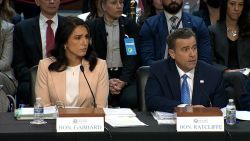
Both Gabbard and CIA Director John Ratcliffe, who also was a participant in the Signal exchange and also testified at Tuesday’s intelligence hearing, faced blistering criticism from lawmakers.
“Director Ratcliffe, this was a huge mistake, correct?” Sen. Jon Ossoff, a Georgia Democrat, asked.
After a brief pause, Ratcliffe shook his head. “No,” he said.
Ratcliffe attempted to interject as Ossoff asked a follow-up question, leading the two men to speak over each other.
“This is an embarrassment,” Ossoff said, silencing Ratcliffe. “This is utterly unprofessional. There’s been no apology. There has been no recognition of the gravity of this error.”
CIA Director John Ratcliffe, joined at center by Director of National Intelligence Tulsi Gabbard, testifies as the Senate Intelligence Committee holds its worldwide threats hearing, on Capitol Hill in Washington, Tuesday, March 25, 2025. (AP Photo/J. Scott Applewhite)
CIA Director John Ratcliffe, joined at center by Director of National Intelligence Tulsi Gabbard, testifies as the Senate Intelligence Committee holds its worldwide threats hearing, on Capitol Hill in Washington, Tuesday, March 25, 2025. (AP Photo/J. Scott Applewhite)
In the run-up to his 2016 election victory over Democrat Hillary Clinton, Trump urged criminal prosecution of the former secretary of state for communicating about classified information with her aides on a private email server she set up. The matter was investigated, but the FBI ultimately recommended against charges. None were brought.
Clinton was among Democrats this week to criticize Trump administration officials’ use of Signal.
“You have got to be kidding me,” Clinton said in an X post that spotlighted The Atlantic article and included an eyes emoji.
Trump also faced charges for mishandling classified information at his Mar-a-Lago resort following his first White House term. Those charges were later dismissed.
Administration says Democrats shouldn’t be outraged
But on Tuesday, top administration officials were insistent the Democratic outrage was misplaced.
Ratcliffe and Gabbard told lawmakers that no classified information was included in the texts about U.S. attack plans in the message chain.
But The Atlantic reported that the messages included precise information about weapons packages, targets and timing, but did not publish those details.
Pressed on whether such information should be classified, Gabbard hedged. “I defer to the secretary of defense, the National Security Council, on that question,” she said.
Ratcliffe in one exchange with lawmakers said Defense Secretary Pete Hegseth held the authority on determining whether the information in the message chain was classified.
Hegseth has dodged questions about whether the information he put in a Signal chat was classified. On Tuesday while in Hawaii, he repeated almost word for word his short statement from the day before that “nobody’s texting war plans, and that’s all I have to say about that.”
Democrats pushed back, saying the leaked military plans show a sloppy disregard for security, but Ratcliffe insisted no rules were violated.
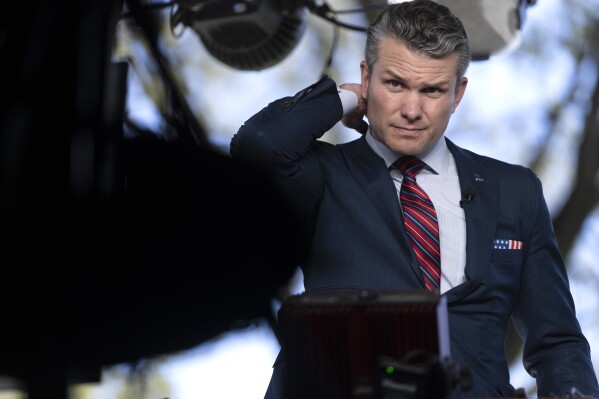
Defense Secretary Pete Hegseth prepares to give a television interview outside the White House, Friday, March 21, 2025, in Washington. (AP Photo/Mark Schiefelbein)
Defense Secretary Pete Hegseth prepares to give a television interview outside the White House, Friday, March 21, 2025, in Washington. (AP Photo/Mark Schiefelbein)
“My communications to be clear in the Signal message group were entirely permissible and lawful and did not include classified information,” Ratcliffe told lawmakers in the hearing that was supposed to be focused on global security threats.
Facing heated questions from Democratic Sen. Mark Warner of Virginia, Gabbard said there’s a difference between “inadvertent” releases of information and intentional leaks. “There was no classified material that was shared,” Gabbard said.
Warner, though, said the lapse in security could have cost lives.
“If this information had gotten out, American lives could have been lost. If the Houthis had this information they could reposition their defensive systems,” Warner said.
Waltz in his appearance on Fox said that while all the information in the exchange was unclassified he’d prefer it remain out of the public eye. “I certainly want our deliberations to stay confidential,” he said.
Calls for an investigation
In response to questions from Democratic Sen. Ron Wyden of Oregon, Gabbard and Ratcliffe said they would participate in an audit looking into administration officials’ use of Signal. Wyden said it must be investigated.
“I’m of the view that there ought to be resignations,” Wyden said.
FBI Director Kash Patel, appearing with Ratcliffe and Gabbard at the hearing, said he was only recently briefed on the Signal chat matter and doesn’t have an update on whether the FBI has opened an investigation into it. Warner asked for an update by the end of the day.
Director of National Intelligence Tulsi Gabbard, center, is flanked by FBI Director Kash Patel, left, and CIA Director John Ratcliffe, as the Senate Intelligence Committee holds its worldwide threats hearing, on Capitol Hill in Washington, Tuesday, March 25, 2025. (AP Photo/J. Scott Applewhite)
Director of National Intelligence Tulsi Gabbard, center, is flanked by FBI Director Kash Patel, left, and CIA Director John Ratcliffe, as the Senate Intelligence Committee holds its worldwide threats hearing, on Capitol Hill in Washington, Tuesday, March 25, 2025. (AP Photo/J. Scott Applewhite)
The White House in a statement Tuesday called the uproar a “coordinated effort to distract from the successful actions taken by President Trump and his administration to make America’s enemies pay and keep Americans safe.”
Examining the security of Signal
Signal is an app that can be used for direct messaging and group chats as well as phone and video calls. It uses end-to-end encryption for its messaging and calling services that prevents any third party from viewing conversation content or listening in on calls.
In other words, messages and calls sent on Signal are scrambled; only the sender and recipient at each end will have the key to decipher them.
Signal’s encryption protocol is open source, meaning that it’s freely available for anyone to inspect, use or modify. The encryption protocol is also used by another popular chat service, social media company Meta’s WhatsApp platform.
Government officials have used Signal for organizational correspondence, such as scheduling sensitive meetings.
Sen. Angus King, a Maine Independent, said he was flummoxed by Ratcliffe and Gabbard’s assertion that no classified information was included in the chat.
“It’s hard for me to believe that targets and timing and weapons would not have been classified,” he said.
___
AP writer Kelvin Chan in London and Darlene Superville contributed reporting.
While some professors rallied to criticize the changes, federal officials called the university’s actions a “positive first step” in maintaining a financial relationship.
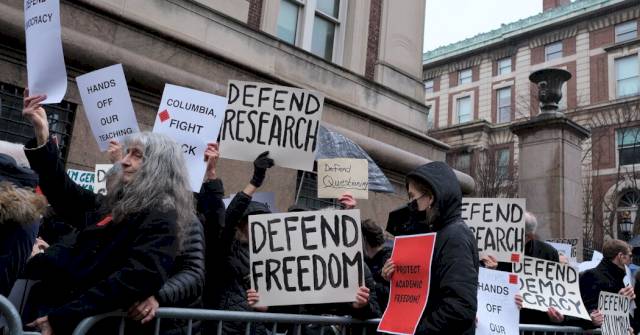
Columbia University faculty members on Monday condemned the university’s response to demands from the Trump administration.Credit…Marco Postigo Storel for The New York Times
The Trump administration on Monday welcomed concessions by Columbia University to tighten disciplinary procedures and assert more control over academic departments in response to charges of antisemitism, saying the actions represent a “positive first step in the university maintaining a financial relationship with the United States government.”
Facing the loss of about $400 million in federal research funding, Columbia has pledged that masked demonstrators must show identification when asked, that protests will generally not be allowed in academic buildings and that several dozen public security officers will be empowered to make arrests. The Trump administration’s statement on Monday was its first extensive response to Columbia’s announcement about concessions three days earlier.
The changes are being made in response to Trump administration claims that antisemitism, particularly as a part of pro-Palestinian demonstrations, has been insufficiently checked on campus.
“Columbia is demonstrating appropriate cooperation with the Trump administration’s requirements, and we look forward to a lasting resolution,” Secretary of Education Linda McMahon said in a statement. She added that she had been communicating with Columbia’s interim president, Katrina Armstrong, during the last few weeks and that she appreciated “her leadership and commitment to advance truly meaningful reforms on campus.”
Still, the road to restoring funding is long. The Trump administration regards the actions Columbia has announced as a “precondition” to formal talks to restore canceled federal grants and contracts, which largely affect scientific and medical research.
“Columbia’s early steps are a positive sign, but they must continue to show that they are serious in their resolve to end antisemitism and protect all students and faculty on their campus through permanent and structural reform,” said Josh Gruenbaum, commissioner of the Federal Acquisition Service, which is part of the General Services Administration, one of the agencies calling for changes at Columbia.
Earlier on Monday, at least 50 professors turned out in a steady drizzle outside the campus gates to protest the funding cuts and what they criticized as Columbia’s conciliatory response. The professors said they hoped to be the vanguard of a resistance movement among academics that remains, for now, at an early stage.
“We need to stand up, all of us,” said Michael Thaddeus, a mathematics professor at Columbia and vice president of the campus chapter of the American Association of University Professors, speaking to the crowd. “We need to organize, from the grass roots to the national level. If we lead, our leaders will follow.”
The protesting professors included a biomedical researcher who spoke on behalf of colleagues who had been laid off because of the funding cuts and a professor who studies autocratic regimes and protest movements. They held up signs with slogans including “Protect Academic Freedom” and “Columbia Fight Back.”
“What is happening to Columbia now is what the erosion of democracy looks like,” said Virginia Page Fortna, a political science professor.
Calling on their knowledge of history and university governance, the professors said that the attacks against Columbia resembled steps commonly taken by authoritarian leaders. They said that Columbia’s concessions had weakened academic independence by consolidating power in the office of the university president.
“We’ve studied what’s happened to universities in authoritarianism,” said Anya Schiffrin, a senior lecturer at Columbia’s School of International and Public Affairs. “We’ve seen what happened in Spain under Franco, in Turkey, in India and in Hungary. It’s a mistake to think it won’t happen here.”
The professors said they were particularly upset at the concessions that reduced faculty power, a concept that academics call “shared governance.” They said those changes would make it easier for the university to bend to political will.
The Columbia University Judicial Board, which federal officials have said was too slow and lenient in its punishment of pro-Palestinian demonstrators, will now be overseen by the school’s administration, not by its University Senate, a 111-member deliberative body that includes faculty and staff members and students. The Columbia president will decide all appeals.
A new vice provost will review curriculum and hiring processes for several university departments, including a Middle East Studies department that the Trump administration demanded be put into “academic receivership.”
Samantha Slater, a Columbia spokeswoman, said in a statement that the university “is fully committed to the steps we announced last week to continue to combat antisemitism and all forms of discrimination and harassment. Our focus will always be on our core mission to teach, create, and advance knowledge while protecting free expression.”
The professors demonstrating on Monday, who said they were working on recruiting more people to the ranks of academic freedom activism, acknowledged that they could not operate at the speed of Elon Musk’s so-called Department of Government Efficiency and other Trump White House “shock and awe” tactics. But they said they wanted to try.
“Institutions respond more slowly, and that’s just the reality,” Professor Thaddeus said. “We are going to respond vigorously, just on a time frame of weeks or months, not days.”
Sharon Otterman is a Times reporter covering higher education, public health and other issues facing New York City.More about Sharon Otterman
A version of this article appears in print on , Section
Justice Dept. Refuses to Give Judge Flight Data, Citing State Secrets
The extraordinary move by the Justice Department was an escalation of its conflict with the judge in the case and, by extension, the federal judiciary.
Judge James E. Boasberg of the Federal District Court in Washington has tried for almost 10 days to get the Trump administration to give him information about flights deporting Venezuelans to El Salvador.Credit…Valerie Plesch/Bloomberg
The Trump administration told a federal judge on Monday night that it would not disclose any further information about two flights of Venezuelan migrants it sent to El Salvador this month despite a court order to turn back the planes, declaring that doing so would jeopardize state secrets.
The move sharply escalated the growing conflict between the administration and the judge — and, by extension, the federal judiciary — in a case that legal experts fear is precipitating a constitutional crisis.
For almost 10 days, the judge, James E. Boasberg of the Federal District Court in Washington, has been trying to get the Trump administration to give him information about the two flights in an effort to determine whether officials allowed them to continue on to El Salvador in violation of his order to have them return to the United States.
But in a patent act of defiance, the Justice Department told Judge Boasberg that giving him any further information about the flights — which the Trump administration maintains were carrying members of a Venezuelan street gang called Tren de Aragua — would “undermine or impede future counterterrorism operations.”
“The court has all of the facts it needs to address the compliance issues before it,” the department wrote in a filing. “Further intrusions on the executive branch would present dangerous and wholly unwarranted separation-of-powers harms with respect to diplomatic and national security concerns that the court lacks competence to address.”
The state secrets privilege is a legal doctrine that can allow the executive branch to block the use of evidence in court — and sometimes shut down entire lawsuits — when it says litigating such matters in open court would risk revealing information that could damage national security.
Typically, however, the executive branch confidentially provides a detailed description of the sensitive evidence to a judge to show why it is too sensitive to discuss in open court. The Trump administration’s move is extraordinary in part because it is refusing to provide information to Judge Boasberg — a former presiding judge of the nation’s national security surveillance court — even privately and in a secure facility for handling classified information.
Indeed, the administration has not even claimed the information at issue is classified.
Instead, it submitted statements from Marco Rubio and Kristi Noem, the secretaries of state and homeland security, saying that sharing the information with a court would jeopardize national security and foreign policy, including by making foreign partners less likely to trust the Trump administration to keep confidential negotiations and operational details secret, and by fueling public speculation about the matter.
The Justice Department’s stubborn response to Judge Boasberg came on the same day that he reaffirmed his initial order barring the Trump administration from using a wartime law, the Alien Enemies Act, to summarily deport scores of Venezuelan migrants it deemed to be members of Tren de Aragua.
The judge’s order said that the block should remain in place so the migrants could have the opportunity to challenge accusations that they belong to the gang before being flown out of the country to a prison in El Salvador.
Also on Monday, a federal appeals court in Washington held a nearly two-hour hearing on the Trump administration’s request to nullify Judge Boasberg’s underlying order, taking up many of the same issues.
The three-judge panel did not issue an immediate ruling. But during questioning, a Justice Department lawyer acknowledged that if the court were to reverse Judge Boasberg’s order, the administration could immediately resume transferring people to the Salvadoran prison.
From the moment Judge Boasberg, the chief judge of the Federal District Court in Washington, entered his original order pausing the deportation flights on March 15, Mr. Trump and his allies have accused him of overstepping his authority by intruding on the president’s prerogative to conduct foreign affairs.
The question at the heart of the case turns equally on the issue of whether Mr. Trump himself overstepped by ignoring limits set out in the text of the Alien Enemies Act and in the Constitution for when and how wartime deportations can take place.
The law, passed in 1798, gives the government wide latitude during an invasion or wartime to summarily round up subjects of a “hostile nation” who are over the age of 14 and remove them from the country with little or no due process.
The administration has repeatedly claimed that the Venezuelan migrants in question are members of Tren de Aragua and should be considered subjects of a hostile nation because Mr. Trump has said they were acting at the direction of the Venezuelan government.
The White House has also insisted that the arrival of dozens of members of the gang to the United States constitutes an invasion or a “predatory incursion” under the law, which can prompt a president’s wartime deportation powers even without a declared war.
Lawyers for Venezuelan migrants have maintained that the law cannot be used against Tren de Aragua members because the gang is not a government and its activities do not amount to an invasion. Notably, the U.S. intelligence community circulated an assessment last month concluding that the gang is not under the control of the Venezuelan government, contrary to what Mr. Trump has since contended.
The lawyers have also questioned whether many of the migrants the Trump administration has accused of belonging to Tren de Aragua are actually members of the gang. They have argued that the Venezuelans should be able to challenge those determinations before being flown out of the country.
When Judge Boasberg initially paused the flights, he said his decision was based on both the lack of due process the migrants received and on the larger question about whether Mr. Trump’s use of the Alien Enemies Act truly fit the situation at hand.
But in keeping the restraining order in place, the judge wrote that he had relied solely on the issue of due process. He added that he did not need to “resolve the thorny question of whether the judiciary has the authority to assess” Mr. Trump’s claim that the Alien Enemies Act can be legitimately used against Tren de Aragua as a group.
During the hearing on Monday before the appeals court panel, two of the judges seemed to agree that the migrants the government wants to remove under the law could go to court to challenge whether they were actually members of Tren de Aragua.
But it was unclear what those challenges might look like.
One of the judges, Patricia A. Millett, a Democratic appointee, signaled skepticism with the government’s position that the panel should stay Judge Boasberg’s restraining order.
She grilled a Justice Department lawyer, suggesting that if the Venezuelans could be deported without due process, then anyone — herself included — could simply be declared a national security threat and flown out of the country. And Judge Millett pointed out that even German citizens arrested under the Alien Enemies Act during World War II had the opportunity to argue in hearings that the law did not apply to them.
“Nazis got better treatment under the Alien Enemies Act,” she said.
A second judge, Justin R. Walker, a Republican appointee, agreed that the migrants could challenge whether they were covered by Mr. Trump’s invocation of the wartime act, but he appeared to be skeptical of allowing Judge Boasberg’s order to stay in place for technical reasons.
He repeatedly suggested that if migrants wanted to challenge their removal they should do so not in Washington, but in places where they are being held, like Texas.
The third judge on the panel, Karen L. Henderson, a Republican appointee, said almost nothing at the hearing.
The Justice Department’s invocation of the state secrets privilege was only its latest effort to stonewall Judge Boasberg’s attempts to understand whether the government had violated his order.
Last week, just hours before a hearing in which they were going to have to discuss the flight, department lawyers moved to cancel the proceeding. On the same day, they took the even bolder step of trying to having Judge Boasberg removed from the case.
But the invocation of the state secrets privilege in this context was a new level of aggression.
The Supreme Court first recognized the state secrets privilege in a 1953 decision that approved the withholding of information whenever there is “reasonable danger” of exposing information that should not be divulged for national security reasons.
After the Bush administration frequently invoked the state secrets privilege to block lawsuits on topics like torture and warrantless wiretapping, the Justice Department in the Obama era imposed new limits on the power.
The policy called for the department to reject a request to use the privilege if officials decide the motivation for doing so is to “conceal violations of the law, inefficiency or administrative error,” to “prevent embarrassment” or to block information “the release of which would not reasonably be expected to cause significant harm to national security.”
Attorney General Pam Bondi told Judge Boasberg in a filing that she was satisfied that the Trump administration’s new invocation of the privilege was “adequately supported and warranted.”
Alan Feuer covers extremism and political violence for The Times, focusing on the criminal cases involving the Jan. 6 attack on the Capitol and against former President Donald J. Trump. More about Alan Feuer
A version of this article appears in print on , Section
Hear Trump’s response when asked about compensation for pardoned Jan. 6 rioters
President Donald Trump was asked about whether pardoned January 6 rioters are entitled to financial compensation for their convictions during an interview on Newsmax.
a journalist get added to a group chat about highly sensitive Yemen strike plans? Former Trump national security adviser John Bolton joins CNN’s Brianna Keilar to share his reaction to the CIA director’s testimony and more.
“Golden Dome” defense system that can protect the country from long-range missile strikes and have been told by the White House that no expense will be spared in order to fulfill one of President Donald Trump’s top Pentagon priorities, according to multiple sources familiar with the matter. CNN’s military analyst retired Col. Cedric Leighton joins Jessica Dean to discuss.
signed an executive order attempting to dismantle the Department of Education. President George W. Bush’s former Education Secretary Margaret Spellings joins CNN’s John Berman to discuss what impact Trump’s move could have on students.
Senate confirms Martin Makary to lead Food and Drug Administration
The Senate tonight confirmed Dr. Martin Makary, a pancreatic surgeon who has made controversial claims about Covid-19, as commissioner of the Food and Drug Administration.
Makary, a surgeon at Johns Hopkins and a former Fox News personality, was confirmed in a 56-44 vote.
As FDA commissioner, Makary will be tasked with regulation and oversight related to drugs, vaccines, food and other products.
During the Covid pandemic, Makary voiced support for natural immunity. He incorrectly predicted in February 2021 that the United States would hit herd immunity by that April.
How encrypted app Signal can leave the door open for spies and hackers
Signal, the most secure widely available messaging app, has become a go-to resource for journalists, leakers and other people concerned about privacy. But it’s not infallible. And its shortcomings and limitations are precisely why its use by Defense Secretary Pete Hegseth and other top Trump administration defense officials has rocked the worlds of politics and national security.
The app made headlines yesterday after Atlantic editor-in-chief Jeffrey Goldberg published the bombshell news that the Trump administration had accidentally added him to a Signal group chat this month to discuss military strikes on Houthi targets in Yemen.
At first glance, it might not seem a major problem. Cybersecurity experts widely consider Signal to be the leading easy-to-use encrypted messaging service, and there are no public reports of its ever having been compromised by hackers.
Signal’s encryption protocol — the complicated algorithm that scrambles messages as they’re sent, then descrambles them for recipients — is the basis for some of the most popular messaging apps, including WhatsApp and iMessage. In 2023, Signal began updating its encryption to address the hypothetical threat of a quantum computer that could break less complicated encryption codes.
But Signal can’t protect people, even Cabinet members, if they accidentally tell it to message the wrong person.
Environmental Protection Agency workers in Chicago stepped out during their lunch periods to protest recent cuts at the agency.
Speaker Mike Johnson floats eliminating federal courts as GOP ramps up attacks on judges
+2
Scott Wong, Melanie Zanona and Rebecca Kaplan
Facing pressure from his right flank to take on judges who have ruled against Trump, House Speaker Mike Johnson, R-La., today floated the possibility of Congress eliminating some federal courts.
It’s the latest attack from Republicans on the federal judiciary, as courts have blocked a series of actions taken by the Trump administration. In addition to funding threats, Trump and his conservative allies have called for the impeachment of certain federal judges who have ruled against him, most notably U.S. District Judge James Boasberg, who tried to halt Trump’s using the Alien Enemies Act to deport Venezuelan migrants.
Mike Waltz says he wants contents of text chain to ‘stay confidential’
National security adviser Mike Waltz said in tonight’s Fox News interview that he does not support releasing a chain of messages about military planning that inadvertently included The Atlantic’s top editor.
“I certainly want our deliberations to stay confidential,” Waltz told host Laura Ingraham. “Of course, I don’t want it all out there, because these were conversations back and forth that you should be able to have confidentially.”
Waltz was responding to a question about whether Waltz would object to the public release of the messages if the contents were not classified, as Trump and his allies have claimed.
The Atlantic’s editor-in-chief, Jeffrey Goldberg, wrote in his article yesterday that plans in the group text “included precise information about weapons packages, targets, and timing,” but that he had not included those details because of national security concerns.
Earlier today, Trump diminished the seriousness of the leak, saying the chat included “no classified information, as I understand it.”
Musk’s super PAC jumps into Florida’s special elections
A super PAC tied to billionaire Elon Musk has started spending in two deeply Republican House seats in Florida ahead of next week’s special elections, according to a new campaign finance report.
America PAC, which has not filed a financial disclosure yet this year but was almost entirely funded by Musk in 2024, is spending $20,000 on “texting services” to boost Florida Chief Financial Officer Jimmy Patronis in the 1st Congressional District and state Sen. Randy Fine in the 6th District, according to a report filed tonight with the Federal Election Commission, which was first reported by The New York Times.
America PAC’s spending in the special elections is minimal so far compared with the millions of dollars that have already been spent there. But it is a sign that Musk may be paying attention to the contests, as he continues to ramp up his political engagement while serving as a key White House adviser. America PAC has also spent millions of dollars on next week’s state Supreme Court race in Wisconsin.
Tuesday’s special elections in Florida are taking place in deeply Republican territory. Trump carried the 1st District by 37 points in November and the 6th District by 30 points, according to election result calculations from the NBC News Decision Desk.
Attorneys ask judge to add plaintiff in CFPB case to fulfill his late wife’s dying wish
Pastor Eva Steege was one of the named plaintiffs in a lawsuit the National Treasury Employees Union filed last month against the Consumer Financial Protection Bureau and acting CFPB Director Russell Vought. At the time, Steege was in hospice care with a terminal illness, according to court filings.
But she had been working with the student loan ombudsman of the CFPB to fulfill a dying wish: to secure a discharge of her student loans before she died through the Public Service Loan Forgiveness Program to avoid putting a financial burden on her surviving family.
“That important and time-sensitive work was immediately halted by Acting Director Vought’s work-stoppage order of February 10, and his decision to summarily terminate the Student Loan Ombudsman, along with all other term employees of the Bureau, three days later,” attorneys for Steege wrote.
Steege died March 15. She was 83.
“The thing that she feared has thus come to pass: She died without securing the discharge of her student loan debt,” the filing says. “The plan to shutter the CFPB has thus permanently deprived Eva of the ‘timely assistance’ that the CFPB was required to provide.”
Attorneys asked U.S. District Judge Amy Berman Jackson to include Steege’s husband, Ted Steege, as a plaintiff in the lawsuit as the person responsible for administering his wife’s estate.
The ombudsman who was working with Eva Steege, Julia Barnard, said she would love to help if she were still employed by the agency.
“If I were still able to perform the duties of the Student Loan Ombudsman, I would be able to meet with Ted to help him talk through his remaining options and fill out any remaining paperwork,” she wrote in a court filing. “I would also be able to meet with other partners, such as staff at the Office of Federal Student Aid and federal student loan servicers, to check on the status of Pastor Eva Steege’s outstanding Public Service Loan Forgiveness application, explore the family’s options, and escalate the case if necessary.”
Trump signs executive order requiring proof of citizenship to register to vote in federal elections
Trump today signed a sweeping executive order attempting a major overhaul of American elections, requiring people to prove their citizenship when they register to vote.
The order — which also includes an array of other changes, from mail-in ballot deadlines to election equipment — could risk disenfranchising tens of millions of Americans. Election law experts questioned whether Trump had the authority to make the changes, saying the order is all but certain to be met with legal challenges.
Federal law currently requires that voters swear under penalty of perjury that they are citizens and eligible to vote when they register, and courts have prevented states from adding documentary proof-of-citizenship requirements for voters in federal races because of such laws.
Trump’s order directs the Election Assistance Commission, an independent, bipartisan commission that supports election officials,to redo its voter registration form and require voters to show U.S. passports or other government ID that shows citizenship to register to vote.
Mike Waltz says he takes ‘full responsibility’ for putting together text group that included a journalist
National security adviser Mike Waltz said in a Fox News interview tonight that he takes “full responsibility” for organizing a text group on the messaging app Signal that accidentally leaked plans for U.S. airstrikes on Houthi militants in Yemen to the editor of The Atlantic.
“I take full responsibility. I built the — I built the group,” Waltz told host Laura Ingraham. “My job is to make sure everything’s coordinated.”
Waltz’s comments were in response to a question about whether a staffer was responsible for adding The Atlantic’s editor-in-chief, Jeffrey Goldberg, to the group.
Waltz also suggested, without evidence, that Goldberg might have “deliberately” appeared in the group, which included top administration officials.
“Now, whether he did it deliberately or it happened in some other technical means is something we’re trying to figure out,” Waltz said, adding that he had spoken with Elon Musk today and that “we’ve got the best technical minds looking at how this happened.”
The Atlantic has pushed back against efforts by Trump and his allies to attack its reporting.
“Attempts to disparage and discredit The Atlantic, our editor, and our reporting follow an obvious playbook by elected officials and others in power who are hostile to journalists and the First Amendment rights of all Americans. Our journalists are continuing to fearlessly and independently report the truth in the public interest,” Anna Bross, a spokesperson for the publication, said in a statement today.
GOP lawmaker and Speaker Mike Johnson clash over proxy voting for new parents
+2
Scott Wong, Melanie Zanona and Rebecca Kaplan
Reporting from Washington
Rep. Anna Paulina Luna, R-Fla., is clashing with House Speaker Mike Johnson, R-La., over her push to pass legislation that would allow lawmakers who are new parents to vote remotely.
In a closed-door meeting today, Johnson discouraged rank-and-file Republicans from supporting Luna’s proxy voting bill, warning that it was unconstitutional, a source in the meeting said.
“We want to make it as easy as possible for young parents to be able to participate in the process,” Johnson told reporters after the meeting. “But proxy voting, in my view, is unconstitutional.”
Luna then took to X and posted a photo of three documents showing when Johnson had himself voted by proxy in 2022.
Watchdog group sues Signal group chat members over adherence to Federal Records Act
Government watchdog group American Oversight sued Trump administration officials involved in a group chat discussion of military plans that mistakenly included a journalist.
“Messages in the Signal chat about official government actions, including, but not limited to, national security deliberations, are federal records and must be preserved in accordance with federal statutes, and agency directives, rules, and regulations,” the lawsuit says.
“Defendants’ use of Signal presents a substantial risk that they have used and continue to use Signal in other contexts, thereby creating records that are subject to the [Federal Records Act] and/or the [Freedom of Information Act], but are not being preserved as required by those statutes,” it adds.
American Oversight also noted that under State Department and Treasury Department recordkeeping rules, “officials do not forward Signal messages, including messages from the Signal chat, to their official email accounts, thereby barring American Oversight and other FOIA requesters from obtaining responsive records to which they are otherwise entitled under FOIA, particularly if such Signal messages are set to auto-delete.”
The lawsuit asks the judge to declare, among other things, that messages and communications sent via Signal in conducting official business are records subject to the Federal Records Act.
Trump signs order punishing law firm that hired a prosecutor from the Mueller investigation
Dareh Gregorian and Jesse Rodriguez
Trump signed an executive order today punishing a law firm that hired Andrew Weissmann, a Trump critic who was a prosecutor on former special counsel Robert Mueller’s team that investigated Russian interference in the 2016 election.
The order directs that employees of the firm Jenner & Block be stripped of security clearances and have their access to federal buildings limited and that federal agencies terminate any contracts with the firm. The order repeatedly singles out Weissmann, an NBC News & MSNBC legal analyst. “Andrew Weissmann is the main culprit with respect to this,” Trump said as he signed the order in the White House. “He’s a bad guy.”
Weissmann declined to comment this evening.
“Today, we have been named in an Executive Order similar to one which has already been declared unconstitutional by a federal court,” a spokesperson for the firm said in a statement. “We remain focused on serving and safeguarding our clients’ interests with the dedication, integrity, and expertise that has defined our firm for more than one hundred years and will pursue all appropriate remedies.”
Trump has taken similar action against other law firms that hired prosecutors who worked on Trump cases or supported Democratic causes. He revoked an order involving the powerful firm Paul Weiss last week after it agreed to perform $40 million in free legal work for causes Trump supports and, according to a social media post from Trump, get rid of any internal diversity, equity and inclusion policies.
House Democratic leader urges Trump to ‘immediately’ fire Pete Hegseth
Rebecca Kaplan and Zoë Richards
House Minority Leader Hakeem Jeffries, D-N.Y., urged Trump in a short letter today to “immediately” fire Defense Secretary Pete Hegseth, citing the military plans that were inadvertently shared with a journalist in a group text.
“Pete Hegseth is the most unqualified Secretary of Defense in American history. His continued presence in the top position of leadership at the Pentagon threatens the nation’s security and puts our brave men and women in uniform throughout the world in danger,” Jeffries wrote.
“His behavior shocks the conscience, risked American lives and likely violated the law,” Jeffries added.
Jeffries appealed to House Republicans in a statement yesterday to “join Democrats in a swift, serious and substantive investigation into this unacceptable and irresponsible national security breach.”
Hegseth told reporters yesterday that “nobody was texting war plans.”
Appeals court weighs in on Trump refugee admissions order
Gary Grumbach and Dareh Gregorian
The 9th U.S. Circuit Court of Appeals ruled today that a lower court’s preliminary injunction on refugee admissions will remain in effect, but only for refugees who were conditionally approved as of Jan. 20, when Trump took office for his second term.
The appeals court ruled that Trump’s executive order halting refugee admissions “does not purport to revoke the refugee status of individuals who received that status under the United States Refugee Admissions Program prior to January 20, 2025.”
U.S. District Judge Jamal Whitehead last month blocked the Trump administration from suspending refugee processing, decisions and admissions across the board. The appeals court today issued a partial stay of the order while it considers the government’s appeal.
Whitehead issued a second preliminary injunction in the case yesterday, blocking the administration from terminating agreements with agencies that serve refugees and ordering the restoration of funding to those agencies. The administration announced today it’s appealing that decision, as well.
Senate Armed Services Committee weighing whether to call Hegseth to testify
Senate Armed Services Committee members are weighing how they intend to get more information from Defense Secretary Pete Hegseth about the information he shared on the Signal chat with Jeffrey Goldberg, with Democrats urging Republicans to call Hegseth to testify before the committee.
“Well, I think it would be helpful, certainly,” Sen. Jack Reed, D-R.I., the committee’s ranking member, told NBC News today about whether he wants Hegseth to testify. “And also, it would reaffirm his assertions that there was nothing unusual or inappropriate about the conversation.”
The committee’s chair, Roger Wicker, R-Miss., said no decision has been made on the path forward.
Wicker and Reed discussed having Hegseth testify before the committee before the worldwide threats hearing, and Wicker signaled openness, according to a Democratic source with knowledge of the discussions. But Wicker suggested he wants to get Hegseth on the phone or receive a copy of the full Signal chat.
The Democratic source believes that could be an off-ramp to avoid having the spectacle of a hearing held by a Republican-controlled committee.
Reed said getting a copy of the Signal chat was a priority for Democrats, saying, “There is no legitimate basis for him to withhold information from the committee that he claims is unclassified and has already been shared with a journalist.”
Sens. Mike Rounds, R-S.D., and John Cornyn, R-Texas, both members of the Intelligence Committee, said they would like to see copies of the Signal chat.
Trump taps conservative leader L. Brent Bozell III as U.S. ambassador to South Africa
Trump is nominating Media Research Center founder L. Brent Bozell III to be the U.S. ambassador to South Africa, according to Congress’ website.
Bozell must be confirmed by the Senate for the role.
Trump had picked Bozell — who wrote a letter last year defending his son, at the time a convicted Jan. 6 rioter — to run the U.S. Agency for Global Media, but his nomination was withdrawn. Bozell and his father were key architects of the American conservative movement.
Trump signed an executive order last month halting U.S. aid to South Africa and promoting the resettlement of Afrikaners who, the order said, faced “government-sponsored race-based discrimination, including racially discriminatory property confiscation.”
Elon Musk, the de facto head of the Trump administration’s Department of Government Efficiency, was born in South Africa and has repeatedly posted criticism about the South African government on social media.
Vice president to join second lady Usha Vance on trip to Greenland
Sydney CarruthSydney Carruth is a digital assistant for NBC News.
Vice President JD Vance announced on X this afternoon that he will join his wife, second lady Usha Vance, as part of a U.S. delegation to Greenland this week as Trump escalates calls for a U.S. takeover of the Danish territory.
“You know, there was so much excitement around Usha’s visit to Greenland this Friday that I decided I didn’t want her to have all that fun by herself, and so I’m going to join her,” Vance said in a video posted to his official X account.“I’m going to visit some of our guardians in the Space Force on the northwest coast of Greenland and also just check out what’s going on with the security there.”
Vance said the Trump administration believes leaders in the United States and Denmark have “ignored” the island, which is rich in coveted critical mineral resources and is along key North Atlantic shipping routes, for “far too long.”
“Speaking for President Trump, we want to reinvigorate the security of the people of Greenland because we think it’s important to protecting the security of the entire world,” he said.
Outgoing Greenlandic Prime Minister Múte B. Egede has questioned the motives of the trip, arguing it could be a show of force by the Trump administration to intimidate local leaders.
Senate Finance Committee advances Mehmet Oz’s nomination in party-line vote
Reporting from Washington
The Senate Finance Committee voted 14-13 to advance Dr. Mehmet Oz’s nomination to be administrator of the Centers for Medicare and Medicaid Services.
A confirmation vote in the full Senate has not been scheduled yet.
U.S. funding cuts could lead to ‘surge’ in global AIDS deaths, U.N. warns
There could be an additional 6.3 million AIDS-related deaths globally in the next four years if U.S. funding cuts are not reversed, the United Nations warned.
Almost all U.S. foreign aid has been put on hold since Trump returned to office on Jan. 20, though his administration says there is an exemption for the President’s Emergency Plan for Aids Relief, which is estimated to have prevented 25 million early AIDS-related deaths since President George W. Bush launched it in 2003.
Still, the program has been affected by cuts to the U.S. Agency for International Development, which could lead to a “real surge” in HIV/AIDS cases, said Winnie Byanyima, executive director of the U.N. AIDS agency.
“This sudden withdrawal of U.S. funding has led [to the closure] of many clinics, laying off of thousands of health workers,” she told reporters in Geneva yesterday.
The world will see the disease “come back, and we see people dying the way we saw them in the ’90s and in 2000s,” she added, saying that “we have not heard of other governments pledging to fill the gap.”
Appeals court temporarily halts USAID re-opening
A federal appeals court today temporarily halted a lower court’s order that the U.S. Agency for International Development reopen its headquarters.
The 4th U.S. Circuit Court of Appeals issued an administrative stay of U.S. District Judge Theodore Chuang’s order until Thursday, an indication it will decide in the next 48 hours on the administration’s request for a stay while a full appeal is heard.
The Baltimore judge found last week that the efforts of Elon Musk and his Department of Government Efficiency to largely dismantle USAID “likely violated the United States Constitution in multiple ways.”
The judge issued a preliminary injunction ordering the agency to reopen its headquarters and restore access to email, payment and other electronic systems for all USAID employees and contractors.
Trump says aides ‘probably’ won’t use Signal anymore
Speaking from the White House in a lengthy back-and-forth with reporters, Trump downplayed the events and said the chat contained “no classified information, as I understand it.”
“They were using an app, as I understand it, that a lot of people in government use, a lot of people in the media use,” he said.
Trump said he didn’t want Waltz to be “hurt” by the breach and saw no need for him to apologize, even as the president said aides would “probably” not use Signal any longer.
“If it was up to me, everybody would be sitting in a room together,” Trump said. “The room would have solid lead walls and a lead ceiling and a lead floor. But you know, life doesn’t always let you do that.”
Waltz, who was in the room for a meeting of ambassadors, defended himself amid repeated questions about when Trump learned of the chat and how. Waltz said they planned to look into how Goldberg got added to the chat and whether Signal is secure enough to use for high-level discussions.
“We are we have our technical experts looking at it,” he said. “We have our legal teams looking at it. And of course, we’re going to keep everything as secure as possible.”
South Korea hosts Alaska governor amid talk of gas pipeline
South Korea is hosting the governor of Alaska and other state representatives this week amid talk of a long-stalled $44 billion pipeline supported by Trump that would transport gas from Alaska to U.S. allies in Asia.
The delegation led by Alaska Gov. Mike Dunleavy, which is visiting today and tomorrow, also includes representatives from the Glenfarne Group, the lead developer of the project, and the Alaska Gasline Development Corporation, according to the American Chamber of Commerce in Korea.
The chamber said Dunleavy was scheduled to meet with South Korean Industry Minister Ahn Duk-geun; Joseph Yun, the acting U.S. ambassador to South Korea; and acting President Han Duck-soo, who was reinstated in the role yesterday after the Constitutional Court overturned his impeachment amid continuing political turmoil in the country over impeached President Yoon Suk Yeol’s attempt in December to declare martial law.
Judge blocks Trump administration from canceling Radio Free Europe funding
Reporting from Washington
A federal judge in Washington, D.C., issued a temporary restraining order this afternoon against the U.S. Agency for Global Media and its acting CEO, Kari Lake, blocking the Trump administration from canceling funding for Radio Free Europe/Radio Liberty.
“Congress has found that ‘it is the policy of the United States to promote the right of freedom of opinion and expression’ and that ‘open communication of information and ideas among the peoples of the world contributes to international peace and stability,’” Judge Royce Lamberth wrote in his opinion. “The leadership of USAGM cannot, with one sentence of reasoning offering virtually no explanation, force RFE/RL to shut down—even if the President has told them to do so.”
The line Lamberth appeared to be referring to is “The award no longer effectuates agency priorities,” a sentence by Lake included in a notice of grant termination sent to Radio Free Europe/Radio Liberty.
“The Court concludes, in keeping with Congress’s longstanding determination, that the continued operation of RFE/RL is in the public interest,” Lamberth wrote.
Rep. Jasmine Crockett facing scrutiny for calling Texas Gov. Abbott ‘Governor Hot Wheels’
Melanie ZanonaMelanie Zanona is a Capitol Hill correspondent for NBC News.
Rebecca Kaplan and Melanie Zanona
Rep. Jasmine Crockett, D-Texas, is coming under fire from Republicans for referring to Texas Gov. Greg Abbott as “Governor Hot Wheels” at a Human Rights Campaign dinner in Los Angeles over the weekend. Abbott is paralyzed from the waist down and uses a wheelchair.
“Y’all know we got Governor Hot Wheels down there, come on now. And the only thing hot about him is that he is a hot ass mess, honey,” she said.
Several Republicans, including the NRCC and Rep. Marjorie Taylor Greene. R-Ga., have amplified and criticized the remarks. Rep. Randy Weber, R-Texas, is planning to introduce a resolution to censure Crockett over her remarks about Abbott, according to Weber’s office.
In a post on X, Crockett denied that she was making a reference to Abbott’s wheelchair use.
“I was thinking about the planes, trains, and automobiles he used to transfer migrants into communities led by Black mayors, deliberately stoking tension and fear among the most vulnerable,” she said. “Literally, the next line I said was that he was a “Hot A** Mess,” referencing his terrible policies. At no point did I mention or allude to his condition.”
Thune says Senate Armed Services Committee may hold hearings on leaked military plans
Senate Majority Leader John Thune told reporters that he “suspects” the Senate Armed Services Committee may hold hearings and have national security officials testify who were involved in the signal group chat discussing strikes on the Houthis.
“I suspect the Armed Services Committee may want to have some folks testify and have some questions answered as well,” Thune said. “I think everybody has acknowledged, including the White House, that, yeah, mistakes were made, and what we want to do is make sure that something like that doesn’t happen again.”
Trump signs pardon for Hunter Biden’s ex-business partner
Trump has signed a pardon for Devon Archer, Hunter Biden’s ex-business partner. Trump says Archer was targeted politically for cooperating with a probe into the Bidens and called him the “victim of a crime, as far as I’m concerned.”
Democrats grill Social Security nominee over disruptions as GOP defends Trump
Sahil Kapur and Victoria Ebner
Trump’s nominee to lead the Social Security Administration, Frank Bisignano, got an earful from Senate Democrats at his confirmation hearing Tuesday, in the wake of early actions by Elon Musk and the Department of Government Efficiency to downsize the agency.
Democratic senators pressed Bisignano on whether he was involved in discussions about DOGE operations regarding onboarding personnel, which he denied. They grilled him on whether he agrees with Musk’s rhetorical attacks on the program, which he sidestepped. They asked him to reassure them that Trump is telling the truth when he says he doesn’t want to slash benefits for seniors, and that he’d protect the program if confirmed.
States say some FEMA money still frozen after successful lawsuit
States that successfully sued the Trump administration over its federal funding freeze say the government has yet to release some disaster relief money, and are asking a judge to force the Federal Emergency Management Agency to release the cash.
“The parties remain at an impasse as to millions of dollars in obligated FEMA awards, which are and have remained frozen dating to as early as February 7,” the coalition of states with Democratic attorneys general said in a court filing yesterday.
“Plaintiff States will need to wind down important programmatic emergency services, including disaster relief to people and communities affected by the Maui wildfires, in short order if funding is not immediately unfrozen.”
The filing says 4,000 individual wildfire survivors could lose services soon if the funds aren’t released, and that Oregon and Colorado are facing imminent major disruptions as well.
The states said that as of two weeks ago, “at least 215 FEMA grants to at least nineteen plaintiff states remain frozen or otherwise rendered inaccessible.”
In a court filing earlier this month, the Justice Department contended the “vast majority” of the funding holds “relates to the manual review process that FEMA is utilizing,” and that the agency is permitted to carry out such reviews.
GOP Sen. Ron Johnson says military plans leak ‘obviously not a great look’
Sen. Ron Johnson, R-Wis., claimed in an interview today with right-wing commentator Charlie Kirk that the reaction to the inadvertent leak of military plans to a magazine journalist has been “embellished,” but added, “It’s obviously not a great look.”
Johnson said the inclusion of Jeffrey Goldberg, the editor-in-chief of The Atlantic, on a high-level Trump administration chat about plans for a military strike against Houthis in Yemen was “a mistake,” adding, “a mistake that I’m sure is being corrected — has been corrected immediately.”
“It’ll be up to the president to decide exactly what action to take,” he said, adding that he believed the situation was being blown out of proportion by Democratic members of Congress.
Johnson has previously been critical of Hillary Clinton for her use of a private email server while she was secretary of state during the Obama administration, which drew tremendous GOP criticism during her 2016 run for president. The Wisconsin senator continued to pursue that information even after Clinton lost the election.
China invites U.S. business leaders to Beijing as it tries to decipher Trump’s trade plans
Eunice Yoon, CNBC
Eunice Yoon, CNBC and Evelyn Cheng, CNBC
Trump’s top intelligence officials claim no classified information was shared in group chat that included a journalist
Daniel Arkin and Dan De Luce
Trump’s top intelligence officials claimed on Tuesday that they did not share any classified materials in a group text about U.S. military plans that inadvertently included a journalist.
Director of National Intelligence Tulsi Gabbard and Central Intelligence Agency Director John Ratcliffe both downplayed the mishap during a Senate Intelligence Committee hearing a day after The Atlantic’s Jeffrey Goldberg reported that he had been added to a text thread about U.S. military plans to strike Houthi militias in Yemen.
The incident has raised questions about the Trump administration’s handling of classified information as well as its use of Signal and other electronic communications.
Russia and Ukraine agree to Black Sea ceasefire, Trump administration says
The White House said Tuesday that Russia and Ukraine had agreed to a ceasefire in the Black Sea and to implement a ban on attacks on energy facilities by the two neighbors, an apparent breakthrough after American negotiators held separate talks with both countries.
Negotiators had agreed with both countries “to ensure safe navigation, eliminate the use of force, and prevent the use of commercial vessels for military purposes in the Black Sea,” the White House said in two separate but similar statements.
Top Intelligence Committee Democrat questions administration’s claim that leaked military plans were unclassified
Sydney CarruthSydney Carruth is a digital assistant for NBC News.
During morning testimony at the Senate Intelligence Committee hearing, Sen. Mark Warner, D-Va., repeatedly questioned Gabbard and Ratcliffe’s denials that the military strike plans that were leaked in a Signal group chat were classified.
“The idea somehow, ‘Well, none of this was classified but we can’t talk about it here,’ you can’t have it both ways,” Warner told the officials.
Gabbard and Ratcliffe had repeatedly deflected questions at the hearing about Signal group chat they were both reportedly part of, arguing the subject should not be discussed in a public forum. But central to their arguments on the gravity of the leak, they also denied that any of the information in the group chat was classified for security reasons.
“It strains my mind to think, it strains my mind, if the shoe had been on the other foot, what my colleagues would be saying about this,” Warner said, referring to Republican senators.
During the 2016 election, Democratic presidential nominee Hillary Clinton drew immense Republican backlash for her use of a private email server for communications when she was secretary of state in the Obama administration. National security adviser Mike Waltz and Secretary of State Marco Rubio have both condemned the past mishandling of classified information by Democrats.
“If it’s not classified, again, we’d ask you to give it to the public today,” Warner said. “If you got it here it’s not classified, stand by your position, or is this just one more example of a careless approach to how we keep our secrets in this administration?”
Pete Hegseth comes under scrutiny
As the hearing continued, the role of Defense Secretary Pete Hegseth became a primary focus.
During questioning, Ratcliffe and Gabbard both said that Hegseth was the “original classifying authority” on the chat. That was a reference to the fact that, according to The Atlantic, Hegseth was the governmental official who shared the targeting information that Democrats argue was classified.
While initial questions after the Atlantic story broke focused on why Waltz set up the chat, Hegseth is likely to face further scrutiny about why he chose to share military targeting information on the chat.
As the investigation continues, Hegseth, as the person who posted the military information, may face the most intense criticism.
CIA director answers ‘no’ when asked if chat mishap was ‘a huge mistake’
Sen. Jon Ossoff, D-Ga., asked Ratcliffe whether he remembered various details in The Atlantic’s report on the Signal chat about the military plans to attack the Houthis in Yemen, including whether Vice President JD Vance initially disagreed with the strike plans, as the magazine had reported.
The CIA director answered that he did not recall those details.
Ossoff then asked, “Director, this was a huge mistake, right?”
“No,” Ratcliffe said.
That prompted Ossoff to remark that a national political journalist had been privy to sensitive information and “there has been no apology.”
Sen. Mark Warner, D-Va., then chimed in, saying in his final remarks in the public portion of the hearing that putting the information out in the Signal chat could have allowed adversaries to reposition their defenses.
“And the unwillingness of the individuals on this panel who were on the chat to even apologize for acknowledging what a colossal screw-up this is speaks volumes,” Warner said.
Gabbard won’t say whether she was using personal phone in Signal chain
Questioned by Sen. Jack Reed, D-R.I., at the hearing, Gabbard refused to say whether she was using her personal or work phone in the Signal text chain on planned strikes against Houthi forces in Yemen.
“Were you using your private phone or public phone for the Signal discussions?” Reed asked.
Gabbard replied: “I won’t speak to this because it’s under review by the National Security Council. Once that review is complete, I’m sure we’ll share the results with the committee.”
Reed followed up: “What is under review? It’s a very simple question, were you using a private phone or officially issued phone? What could be under review?”
Gabbard declined to answer directly. “The National Security Council is reviewing all aspects of how this came to be, how the journalist was inadvertently added to the group chat and what occurred within that chat across the board,” she said.
Senate Intelligence Committee hearing on global threats adjourned ahead of a private session
Sydney CarruthSydney Carruth is a digital assistant for NBC News.
The public portion of the Senate Intelligence Committee oversight hearing on global threats has adjourned. The committee will move to a closed session, where several lawmakers have said they will question Director of National Intelligence Tulsi Gabbard and CIA Director John Ratcliffe in more detail about the leak of sensitive military information to journalist Jeffrey Goldberg during a high-level group chat on the messaging app Signal.
Bennet grills Ratcliffe: ‘You need to do better’
Sen. Michael Bennet, D-Colo., posed the most pointed questions of the hearing so far, demanding that Ratcliffe answer whether Trump’s special envoy, Steve Witkoff, was in Moscow during the group chat. Russia is widely known for its ability to gain access to electronic devices and eavesdrop in sophisticated ways.
“Did you know that the president’s Middle East adviser was in Moscow on this thread while you were, as director of the CIA, participating in this thread, were you aware of that? Are you? Are you aware of that today?”
Ratcliffe replied, “I’m not aware of that.”
Sen. Michael Bennet, D-Colo., at the hearing today.Bill Clark / CQ Roll Call via AP
Bennet, shouting, said, “This sloppiness, this incompetence, this disrespect for our intelligence agencies and the personnel who work for him is entirely unacceptable. It’s an embarrassment.” He added, “You need to do better. You need to do better.”
Gabbard acknowledges ‘discussion around targets in general’ in Signal chat
Gabbard acknowledged under questioning from Sen. Mark Kelly, D-Ariz., that the administration officials in the Signal chat discussed targets, although she had previously declined to say whether she was in the group chat.
“I believe there was discussion around targets in general,” Gabbard testified after saying moments earlier that she did not “remember mention of specific targets.”
“I think that’s consistent with my recollection,” Ratcliffe added when being asked the same question.
In answer to a string of questions from Kelly on whether those on the chat discussed the timing of airstrikes, weapons systems or military units, Gabbard and Ratcliffe repeatedly answered that they did not recall.
Sen. John Cornyn drills down on Russia’s threats to Ukraine
Andrea Mitchell and Rebecca Shabad
Sen. John Cornyn, R-Texas, drilled down in his questioning on Russia’s threats to Ukraine and Europe’s response.
Cornyn said the annual threat assessment says “Russia views its ongoing war with Ukraine as a proxy conflict with the West, and its objective to restore Russian strength and security,” adding that Russia’s perceptions on “U.S. and Western encroachment has increased the risks of unintended escalation between Russia and NATO. Do you agree with that statement?”
Gabbard said she agreed.
Cornyn suggested that the perceptions of U.S. leadership receding on security matters in Europe could lead to nuclear proliferation.
Sen. John Cornyn, R-Texas, speaks at the hearing today.Andrew Harnik / Getty Images
“I know the incoming chancellor of Germany has talked about the possibility that Germany might share its nuclear weapons with Ukraine, and suggested that the U.K. would be part of that,” Cornyn said. “I know that Poland has talked about acquiring nuclear weapons and perhaps other European countries to make up for what they view as a receding of the American umbrella of protection.”
Sen. Angus King presses Gabbard over why global climate change is not included in worldwide threats report
Sen. Angus King, I-Maine, asked Gabbard why global climate change was not included in this year’s worldwide threats report, despite it being included in prior reports.
“Every single one of these reports that we have had has mentioned global climate change as a significant national security threat, except this one. Has something happened, has global climate change been solved?” King asked, noting that the effects of climate change include famine, mass migration and political conflicts.
“This annual threat assessment has been focused very directly on the threats that we deem most critical to the United States and our national security,” Gabbard said. “Obviously, we’re aware of occurrences within the environment and how they may impact operations, but we’re focused on the direct threats to Americans’ safety, well-being and security.”
In answer to his question of who was responsible for leaving the subject out of the assessment, Gabbard said she did not recall instructing her team to not include climate change in it.
Gabbard and Ratcliffe say they would be open to audits of their communications
In response to questions from Sen. Ron Wyden, D-Ore., Gabbard and Ratcliffe said they would be open to audits of their communications after they said that they haven’t participated in classified discussions on Signal.
“To be clear, I haven’t participated in any Signal group messaging that relates to any classified information at all,” Ratcliffe said.
“Senator, I have the same answer,” Gabbard said. “I have not participated in any Signal group chat, or any other chat on another app that contained any classified information.”
They said they would comply with an audit of their communications or other appropriate actions related to the issue.
Top Senate Foreign Relations Republican calls Signal group chat a ‘serious leak’
Sydney CarruthSydney Carruth is a digital assistant for NBC News.
Republican Sen. James Risch, chairman of the Senate Foreign Relations Committee, said he had spoken with Secretary of State Marco Rubio “at length” about how a reporter was inadvertently added to a Signal group chat in which the nation’s top intelligence officials, Rubio reportedly included, shared classified plans for military action.
“He is really aware of these kinds of things. We have leakage that happens from time to time,” Risch, of Idaho, said of Rubio, a former member of the committee, during his opening statement at a Senate Foreign Relations Committee hearing this morning. “I can assure you that his knowledge is such and his commitment is such that he had no knowledge of there being the tap on that, that there was when he was communicating.”
The committee’s top Democrat, Sen. Jeanne Shaheen, of New Hampshire, expressed concern over the information leak and that no State Department personnel were aware of The Atlantic editor-in-chief Jeffrey Goldberg’s accidental inclusion in the Signal group chat, or of the information that was leaked to him as a result.
Risch called the incident a “serious leak,” and said, “I don’t think there’s anybody that wouldn’t be concerned. … We’ll move on as best we can.”
Republican congresswoman on Signal mishap: ‘People make mistakes’
Rep. Marjorie Taylor Greene, R-Ga., said the addition of Goldberg to the White House officials’ Signal chat was “incredibly sloppy” but added that “it was a mistake, and I am, I can say for certain, they’re going to put protocols in place so that doesn’t happen again.”
Rep. Maria Salazar, R-Fla., said “people make mistakes” and to give Defense Secretary Pete Hegseth “a pass.”
Rep. Tim Burchett, R-Tenn., called his former colleague Mike Waltz a “patriot.”
These members were all going in and out of the weekly House Republican conference meeting.
Republicans downplay and sidestep Signal chat
The Republican strategy so far in the hearing appears to be to ignore, minimize and downplay the Signal chat.
No Republican senator has asked about it so far. Instead, Republican senators have focused their questions on migrants, cartels and China.
Gabbard did not mention the call in her opening statement. When Sen. Mark Warner, the ranking Democrat on the committee, asked her about the call, she downplayed its importance, saying, “There was no classified material shared.” Ratcliffe gave a similar answer.
When Warner asked Gabbard if she planned to hand over the Signal exchange to the committee, she gave an unclear answer. When Warner asked FBI Director Kash Patel if he had launched an investigation into the call, he said he had only been briefed on it late last night.
CIA Director John Ratcliffe says Signal was loaded onto his computer upon being confirmed
Ratcliffe defended the use of Signal to discuss military plans, saying it was loaded onto his computer shortly after he was confirmed as CIA director.
Ratcliffe acknowledged that he was in the Signal group chat that was reported by The Atlantic, but said that he had been previously briefed about “the use of Signal as a permissible work use.” He said he was informed that any decisions made needed to be recorded in “formal channels.”
“It is permissible to use to communicate and coordinate for work purposes, provided, senator, that any decisions that are made are also recorded through formal channels. So those were procedures that were implemented,” Ratcliffe said.
Ratcliffe said that his communications on Signal did not include classified information.
Gabbard dodges questions about the Signal chat
Gabbard dodged a question from Warner about whether she was the user, reported as “TG,” in the Signal chat with Atlantic editor-in-chief Jeffrey Goldberg in which senior Trump administration shared military plans.
“Senator, I don’t want to get into this,” Gabbard said, who repeated the same response after Warner kept pressing her.
Gabbard said that she didn’t want to talk about the magazine’s report because it’s still under review.
She later claimed in response to follow-up questions by Warner that, in the Signal chat, there was “no classified material that was shared.”
Anti-Israel protester interrupts Senate hearing
An anti-Israel protester interrupted the Senate hearing on worldwide threats, yelling, “Stop funding Israel” and the “greatest threat to global security” is Israel.
Cotton began addressing the protest when another protester began shouting.
The hearing resumed moments after, when the protesters left.
Capitol Police remove a pro-Palestinian protester from the hearing today.Saul Loeb / AFP – Getty Images
Gabbard doesn’t address Signal chat in opening statement
In her opening statement, Director of National Intelligence Tulsi Gabbard didn’t address the Signal chat at the center of the story yesterday in which The Atlantic’s Jeffrey Goldberg revealed that he was invited to the discussion with her and other senior Trump administration officials.
Gabbard delivered her opening statement on behalf of the other witnesses, including FBI Director Kash Patel and CIA Director John Ratcliffe.
She listed the number of threats facing the U.S., including those from “several nonstate actors, cartels, gangs and other transnational criminal organizations” in their “illicit activity, from narcotics trafficking to money laundering, to smuggling of illegal immigrants and human trafficking.”
From left, FBI Director Kash Patel, Director of National Intelligence, Tulsi Gabbard and CIA Director John Ratcliffe prepare to testify today.Saul Loeb / AFP – Getty Images
Gabbard said that Islamist extremists like ISIS and Al Qaeda continue to pursue and inspire attacks against the U.S. domestically and abroad. She said that China is the U.S.’s most “capable strategic competitor,” and also said Russia has developed cyber capabilities that pose a threat to U.S. infrastructure.
“Among Russia’s most concerning developments is a new satellite intended to carry a nuclear weapon as an anti-satellite weapon, violating long-standing international activity and putting the U.S. and global economy at risk,” Gabbard said.
Gabbard also said that the U.S. intelligence community has assessed that Iran is not building a nuclear weapon, and that the country’s supreme leader hasn’t authorized the nuclear program.
Sen. Warner begins remarks slamming officials included in The Atlantic’s report
Sen. Mark Warner, D-Va., began his opening remarks at the Senate hearing on worldwide threats by slamming the White House officials whom The Atlantic’s Jeffrey Goldberg reported as having been involved in a Signal group chat discussing military plans that inadvertently included him.
Warner called the group chat mishap an example of “sloppy, careless, incompetent behavior, particularly towards classified information.”
“Putting aside for a moment that classified information should never be discussed over an unclassified system, it’s also just mind-boggling to me that all these senior folks were on this line, and nobody bothered even to check,” Warner said, referring to Goldberg having been included in the discussion. “Security hygiene 101: Who are all the names?”
Senate Intelligence Chairman Tom Cotton doesn’t mention leak of military plans in opening remarks
Senate Intelligence Committee Chairman Tom Cotton, R-Ark., did not address the Signal group chat that inadvertently included The Atlantic’s editor-in-chief, Jeffrey Goldberg, on plans for strikes against the Iranian-backed Houthis in Yemen.
Cotton, however, did applaud Trump’s “decisive action” against the Houthis this month — which was discussed in the Signal chat — and said he commends White House national security adviser Mike Waltz, Defense Secretary Pete Hegseth and others on the administration’s national security team — some of whom the magazine reported were represented in the chat.
Cotton also said in his opening statement that U.S. intelligence agencies are not fully capable of handling the threats facing the nation.
From left, Sens. Mark Warner, D-Va., and Tom Cotton, R-Ark., during the hearing today.Andrew Harnik / Getty Images
“We have to ask, are our intelligence agencies well-postured against these threats? I’m afraid the answer is no, at least not yet,” he said. “As the world became more dangerous in recent years, our intelligence agencies got more politicized, more bureaucratic, and more focused on promulgating opinions rather than gathering facts.”
He continued, “As a result of these misplaced priorities, we’ve been caught off guard and left in the dark too often. I know that all of you agree that the core mission of the intelligence community is to steal our adversaries’ secrets and convey them to policymakers to protect the United States. At the same time, it’s not the role of intelligence agencies to make policy, to justify presidential action or to operate like other federal agencies. After years of drip, the intelligence community must recommit to its core mission of collecting clandestine intelligence from adversaries, whose main objective is to destroy our nation and our way of life.”
Republican congressman on White House group chat claim: ‘That’s baloney’
Asked about the White House’s claim that no military plans were shared on the Signal chat with Jeffrey Goldberg, Rep. Don Bacon, R-Neb., said, “That’s baloney.”
“That’s baloney,” he said to reporters this morning as he left the weekly House Republican conference meeting. “Just be honest and own up to it.”
Sen. Mark Warner says intelligence leaders owe Americans answers about Trump’s actions
Rebecca Shabad and Frank Thorp V
Sen. Mark Warner, D-Va., wrote in an op-ed this morning that U.S. intelligence community leaders owe Americans answers about the Trump administration’s actions, including federal worker layoffs and cuts to U.S. aid, since the inauguration.
“How does ending foreign assistance make us safer?” Warner said in the op-ed published by Fox News. “How does firing our most experienced FBI agents make us safer?”
He also asked how America is made more secure by firing people who oversee the nation’s nuclear stockpile, monitor cyberattacks and prevent disease from spreading to the U.S., as the administration has done, although some who held those critical positions were rehired.
“Can anyone tell me how firing probationary officers — without cause, and apparently without regard for merit, accomplishment, expense already incurred by the taxpayer in vetting and training, or the difficulty posed in filling the intelligence gaps left behind — makes us safer, or is an efficient use of taxpayer dollars?” he wrote.
“The instability of the last two months also undermines a critical component of our intelligence gathering capabilities: the trust of allies,” Warner said.
He suggested that he wants answers to these questions during the worldwide threats hearing this morning before the Senate Intelligence Committee.
Trump stands by national security adviser Mike Waltz though he disclosed military plans, saying he’s ‘learned a lesson’
Garrett Haake and Megan Lebowitz
Trump stood by his national security adviser, Mike Waltz, after The Atlantic’s editor-in-chief was accidentally added to a private, high-level chat on the messaging app Signal in which military plans were being discussed.
“Michael Waltz has learned a lesson, and he’s a good man,” Trump said today in a phone interview with NBC News.
Top Democrats on prominent House committees sent a letter to four White House officials whom The Atlantic identified as potentially being in the Signal chat, asking for answers about the information shared.
“We are especially concerned that the reported deliberations may have constituted a security breach, because they relied upon an electronic messaging application that is not approved as a secure method for communicating classified information and because they inadvertently included at least one non-governmental party,” read the letter, which was addressed to Defense Secretary Pete Hegseth, Director of National Intelligence Tulsi Gabbard, Secretary of State Marco Rubio and national security adviser Mike Waltz.
Separately, a group of 14 Senate Democrats sent a letter to Trump, calling the situation “an astonishingly cavalier approach to national security.”
“It does not take much imagination to consider the likely ramifications if this information had been made public prior to the strike — or worse, if it had been shared with or visible to an adversary rather than a reporter who seems to have a better grasp of how to handle classified information than your National Security Advisor,” the senators wrote.
The lawmakers asked that Trump and the officials share other instances in which officials may have discussed sensitive information using Signal and what steps the White House is taking to ensure this does not happen again.
“In how many instances has the National Security Council held discussions on national security matters involving Principals Committee members or any other relevant executive branch officials using the Signal messaging service or any other messaging service application that has not been approved for the transmission of classified information?” read the letter from the top Democrats on the Armed Services, Intelligence, Foreign Affairs and Oversight committees.
Job applications from workers at agencies targeted by DOGE are up 75% compared with 2022, according to the report’s data. And while job applications among all workers increased after the Trump transition, the spike in applications from DOGE-targeted workers is especially pronounced.
Senate committee to hold confirmation hearing for Social Security Administration nominee
Reporting from Washington
The Senate Finance Committee will hold a confirmation hearing today on Frank Bisignano’s nomination to be commissioner of the Social Security Administration.
The hearing is scheduled to start at 10:10 a.m. ET and last about two and a half hours.
Bisignano will likely face questions on the future of the SSA as talk of privatizing the agency have ramped up. The hearing also comes on the heels of threats from the acting commissioner to shut down the agency after a federal judge barred the Department of Government Efficiency from accessing sensitive personal data.
The top Democrat on the Finance Committee, Sen. Ron Wyden of Oregon, and Sen. Elizabeth Warren, D-Mass., sent a letter to Bisignano yesterday asking whether he supports privatizing Social Security, and whether he would be willing to undo recent changes made, such as the closure of dozens of Social Security offices, mass agency layoffs and new administrative requirements for beneficiaries.
“These new developments leave us deeply concerned that DOGE and the Trump Administration are setting up the SSA for failure — a failure that could cut off Social Security benefits for millions of Americans — and that will then be used to justify a ‘private sector fix.’ Republicans have flirted with the idea of privatizing Social Security for over two decades,” the senators wrote in the letter.
“The latest changes at the Social Security Administration leave us worried that Elon Musk — with his clear disdain for the program that provides financial security to millions of Americans — has taken up the mantle as the latest privatization crusader,” they added.
The hearing will likely get heated, as Democrats are expected to press Bisignano on whether he agrees with the approach DOGE and the acting commissioner have taken so far, as well as his thoughts on threats to customer service and timely benefits, and Elon Musk and Trump’s claims about fraud in Social Security.
“The Social Security administrator nominee needs to come clean with the American people. Is he in favor of the cuts that Elon Musk and his DOGE boys are trying to execute at the Social Security Administration? Or does he plan, once he has the power, to put a stop to it? Is he in favor of the privatization of Social Security that many Republicans are still advancing? Or does he plan to make a stand and put a stop to it? That’s what I want to hear from him,” Warren said.
Bisignano is the chief executive officer of payments technology at Fiserv, which some Democrats have raised concerns since the company could benefit from any privatization of Social Security.
Trump to sign more executive orders today
Trump is scheduled to sign more executive orders today at 2 p.m. ET, the White House said.
No details were provided on the focus of the orders.
Senate Intelligence Committee to hold hearing on worldwide threats
Reporting from Washington
The Senate Intelligence Committee will meet today at 10 a.m. ET for its “Worldwide Threats” hearing, an annual intelligence community oversight hearing with testimony from the heads of the intel agencies.
The open hearing, expected to run almost three hours, will be followed by a classified, closed session. Director of National Intelligence Tulsi Gabbard is the only official who will give an opening statement, but all officials participating will take questions from senators.
The hearing comes less than 24 hours after The Atlantic reported that Jeffrey Goldberg was added to a Signal group chat with Trump administration officials about U.S. military strikes against the Houthis in Yemen. The group chat reportedly included two of the officials scheduled to testify today: Gabbard and CIA Director John Ratcliffe. Senators said they expect questions regarding The Atlantic’s reporting.
“I would expect it would, and I would expect our Democrat colleagues would raise it. And I suspect some of my Republican colleagues may raise it just as an issue to be very concerned about,” Sen. Mike Rounds, R-S.D., said yesterday.
Donald Trump’s national security adviser, Mike Waltz, said he took full responsibility for a stunning leak of military plans in a Signal chat, while Trump intervened to defend him, saying it was “the only glitch in two months”.
“I take full responsibility. I built the group. My job is to make sure everything is coordinated,” Waltz said in an interview with Fox News, in which he conceded: “it’s embarrassing”.
The Trump administration has scrambled to contain the fallout since the Atlantic published a story on Monday revealing that its editor-in-chief, Jeffrey Goldberg, had been inadvertently added to a chat with Waltz and other senior White House officials – including vice-president JD Vance, defense secretary Pete Hegseth and secretary of state Marco Rubio. The group discussed sensitive operational information about planned US airstrikes on Yemen.
Mike Waltz claims ‘full responsibility’ for Signal, but can’t explain how it happened
When pressed by Fox News’s Laura Ingraham, Waltz accepted responsibility for making the Signal group, though he continued to deflect blame, insulted Goldberg and said he couldn’t explain how the mistake had occurred.
“It’s embarrassing, yes. We’re going to get to the bottom of it,” Waltz said, adding that he was consulting with Elon Musk: “We’ve got the best technical minds looking at how this happened.”
Democrats demand answers over ‘careless’ Signal blunder
Democratic senators demanded answers from leaders of the US intelligence community on Tuesday over the Signal breach, arguing that the “sloppy, careless” leak put national security at risk.
Tulsi Gabbard, the director of national intelligence, and CIA director John Ratcliffe appeared before the Senate intelligence committee, in which Democratic senator Michael Bennet lambasted the security lapse as “swampiness”, “incompetence” and “an embarrassment”. Senior intelligence officials will face another round of questioning Wednesday by lawmakers.
Leak shows Five Eyes allies must ‘look out for ourselves’, says Mark Carney
Canada’s prime minister, Mark Carney, has said the Signal leak means that allied nations must increasingly “look out for ourselves” as trust frays with a once-close ally. Carney said the intelligence blunder was a “serious, serious issue and all lessons must be taken”. He said it would be critical to see “how people react to those mistakes and how they tighten them up”.
The Pentagon recently warned its employees against using Signal, due to a technical vulnerability. According to a Pentagon “OPSEC special bulletin” seen by NPR reporters and sent on 18 March, Russian hacking groups may exploit the vulnerability in Signal to spy on encrypted organizations, potentially targeting “persons of interest”.
Trump administration claims details of mass deportations are state secrets
The Trump administration invoked the “state secrets” privilege to avoid providing more information to a federal judge regarding this month’s highly contentious immigrant expulsions to El Salvador under the Alien Enemies Act.
Judge rules Columbia protester can’t be detained as she fights deportation
A federal judge in Manhattan blocked immigration officials from detaining Yunseo Chung, a Columbia University student and legal permanent resident the Trump administration is trying to deport for taking part in Gaza solidarity protests.
The 21-year-old green card holder, who has lived in the US since she was seven years old, filed a lawsuit against the Trump administration on Monday, arguing the government is “attempting to use immigration enforcement as a bludgeon to suppress speech that they dislike”.
Trump signs executive order that will upend US voter registration processes
Donald Trump has signed a far-reaching executive order that promises to fundamentally disrupt American voter registration processes, introducing measures so restrictive they could in effect disenfranchise millions of citizens if enacted.
Described by Will Scharf, the White House staff secretary, on Tuesday as “the farthest reaching executive action taken” in the nation’s history, the order represents the latest in a long list of assaults against immigration, but also on current voting systems.
Trump outburst prompts removal of his ‘distorted’ portrait
A portrait of Donald Trump that was commissioned by fellow Republicans – but which he evidently came to believe had been “purposefully distorted” – was removed from a wall at the Colorado state capitol where it had been since 2019.
The University of Southern California announced an immediate hiring freeze for all staff positions, “with very few critical exceptions” as US universities brace for Trump administration cuts to funding.
US consumer confidence plunged to the lowest level in more than four years in March, with households fearing a recession in the future and higher inflation because of Trump’s tariffs.