Blog

  • Trump’s law firm memo and wildfires burn in the Carolinas: Morning Rundown – NBC News

    Trump’s law firm memo and wildfires burn in the Carolinas: Morning Rundown – NBC News

    Donald Trump escalates his assault on law firms. Wildfires have burned thousands of acres in the Carolinas. And Canada’s prime minister calls for snap elections amid a trade war with the U.S.

    Here’s what to know today.

    Trump targets law firms that file ‘frivolous’ suits against his administration

    President Donald Trump escalated his assault on law firms with the release of a new memo that authorizes the attorney general and homeland security secretary to sanction firms that file lawsuits the two officials deem “frivolous,” legal experts and former Justice Department officials said. 

    The presidential memorandum, issued Saturday, is titled “Preventing Abuses of the Legal System and the Federal Court,” also ordered AG Pam Bondi to recommend revoking attorneys’ security clearances or terminating law firms’ federal contracts if she deems their lawsuits against the administration “unreasonable” or “vexatious.”

    This is Morning Rundown, a weekday newsletter to start your day. Sign up here to get it in your inbox.

    The memo follows executive orders against three law firms — Covington & Burling, Perkins Coie, and Paul Weiss — calling on federal contracts of the firms’ clients to be reviewed, suspending some employees’ security clearances and barring them from some federal buildings. Trump rescinded the order against Paul Weiss last week after the firm struck a deal with the president. 

    David Laufman, a former head of the DOJ’s counterintelligence section who served in both Republican and Democratic administrations, described the move as “an authoritarian plan to silence and punish the legal profession” that would have triggered swift intervention.

    “He’s chilling the very sector of society that stands between Trump and tyranny,” said a former federal prosecutor and senior lawyer at a law firm that has sued the administration. 

    Legal experts accused Trump of hypocrisy, noting that his own lawyers have violated Rule 11 of the federal rules of civil procedure, which bars lawyers from making false or frivolous claims in court, when falsely saying Trump won the 2020 election.

    Read the full story here.

    More politics news:

    • Second lady Usha Vance will travel to Greenland this week along with two other administration officials as Trump ramps up calls for U.S. ownership of the Danish territory. 
    • The Republican-led Congress is eyeing an April deadline to pass Trump’s multitrillion-dollar agenda, which includes extending his 2017 tax cuts and a debt ceiling increase. 
    • In an unusual case before the Supreme Court today, civil rights groups are in a tentative alliance with Republican officials to defend a Louisiana congressional map that includes two majority Black districts.

    Wildfires burn in the Carolinas

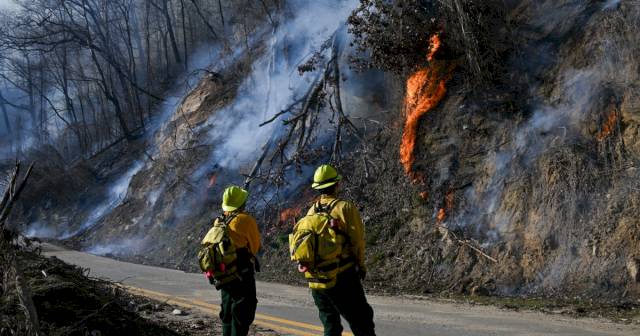
    Wildfires feeding on dry woodlands that were damaged by Hurricane Helene last year have together burned thousands of acres in North Carolina and South Carolina over the weekend. Despite possible rain in the region today, federal forecasters warn that fire weather could return this week. 

    A trio of fires is burning in Polk County, in the western part of North Carolina. The Black Cover Fire was more than 2,000 acres as of Sunday afternoon and 0% contained, while evacuations were ordered for some residents in the area, according to the state Department of Agriculture and Consumer Services. The Deep Woods Fire nearby has burned more than 2,500 acres and was 0% contained. And the Fish Hook Fire has burned 199 acres and was 50% contained. 

    In South Carolina, a fire is burning in Table Rock State Park, in the northern part of the state. The fire was over 300 acres as of yesterday afternoon and was still growing, the state Forestry Commission said. Here’s what else we know.

    U.S. and Russia start new Ukraine peace talks on a tricky footing

    Russian drone strike in Kyiv
    An apartment building hit by a Russian drone strike in Kyiv, Ukraine on March 23, 2025. Vladyslav Musiienko / Reuters

    The United States and Russia began a new set of talks aimed at a partial Ukraine ceasefire this morning — even as the two sides disagreed over how well the talks in Saudi Arabia were going and after another night of drone strikes. American negotiators say they are hopeful of achieving “real progress” at the talks in Saudi Arabia, while Kremlin spokesman Dmitry Peskov has warned of “difficult negotiations.”

    The White House is attempting a strategy of “shuttle diplomacy,” one source familiar with the negotiations told NBC News — meeting with Russian delegates having already spoken with Ukrainian officials in Saudi Arabia a day before. Both sides sounded upbeat following those talks, with Ukraine’s President Volodymyr Zelenskyy calling the discussions “quite useful,” and Trump’s special envoy Steve Witkoff telling several broadcast shows that he was hopeful of “real progress.”

    However, yesterday also brought another reality check to the White House’s optimism. Russia launched 99 drones into Ukraine, killing three people in the capital of Kyiv including a father and his 5-year-old daughter, according to Zelenskyy.

    Read the full story here.

    Read All About It 

    Staff Pick : For Gen Z, what’s ‘cringe’ is charming

    Photo illustration of Barack Obama and Hannah Horvath (character from HBO Girls) surrounded by stickers that read
    Leila Register / NBC News; Getty Images

    Good news, fellow millennials: Gen Z likes us. Or they at least like that “millennial era of like BuzzFeed quizzes,” hipsters, mustaches and nerdcore, which one TikTok creator called “delightfully cringe, but in a very wholesome way.” (So, maybe “like” is a strong word to describe how Gen Z feels about their millennial elders.) News associate Kyla Guilfoil spoke to experts and young people who explained why Gen Z is feeling a certain type of way about the era of Barack Obama, Tumblr, the TV show “Girls” and clubbing culture. — Elizabeth Robinson, newsletter editor

    NBC Select: Online Shopping, Simplified

     Face taping is exactly what it sounds like. But does the viral trend actually diminish the appearance of wrinkles? The NBC Select team spoke to experts to find out. Plus, students can get 50% off any Paramount+ plan, a perfect deal for enjoying March Madness. Here’s how to get the discount. 

    Sign up to The Selection newsletter for hands-on product reviews, expert shopping tips and a look at the best deals and sales each week.

    Thanks for reading today’s Morning Rundown. Today’s newsletter was curated for you by Elizabeth Robinson. If you’re a fan, please send a link to your family and friends. They can sign up here.

    Elizabeth Robinson

    Elizabeth Robinson is a newsletter editor for NBC News, based in Los Angeles.
  • ‘The authoritarian playbook’: Trump targets judges, lawyers … and law itself – The Guardian US

    ‘The authoritarian playbook’: Trump targets judges, lawyers … and law itself – The Guardian US

    As Donald Trump aggressively seeks revenge against multiple foes in the US, he’s waging a vendetta using executive orders and social media against judges, law firms, prosecutors, the press and other vital American institutions to stifle dissent and exact retribution.

    Legal scholars say the president’s menacing attacks, some of which Trump’s biggest campaign backer, the billionaire Elon Musk, has echoed, are aimed at silencing critics of his radical agenda and undercut the rule of law in authoritarian ways that expand his own powers.

    “Trump’s moves are from the authoritarian playbook,” said the Harvard law school lecturer and retired Massachusetts judge Nancy Gertner. “You need to delegitimize institutions that could be critics. Trump is seeking to use the power of the presidency to delegitimize institutions including universities, law firms, judges and others. It’s the opposite of American democracy.”

    In a stunning move on Tuesday, Trump railed that a top Washington DC judge ought to be impeached for ruling to halt the deportation of hundreds of Venezuelans allegedly including gang members, sparking the chief justice of the supreme court, John Roberts, hours later to issue a strong statement against calls to impeach judges for their rulings.

    Legal scholars sharply criticize other attacks by Trump and the Maga world on judges who have issued rulings against executive orders or Musk’s “department of government efficiency” (Doge), with the goal of weakening the judicial branch to boost Trump’s powers.

    Fears about Trump’s war on his critics rose this month as the president issued executive orders penalizing three big law firms including Covington & Burling and Perkins Coie. Critics say Trump’s sanctions against the firms were sparked by their clients, respectively ex-special counsel Jack Smith, who brought charges against Trump for trying to subvert his 2020 election loss, and Hillary Clinton’s 2016 presidential campaign, which hired the firm that helped pay for a dossier alleging collusion between Russia and Trump’s campaign.

    Those executive orders, which included barring some firms from entering federal buildings, interacting with agencies and taking away security clearances from some lawyers, were widely seen as punitive measures to hurt them financially.

    District Judge Beryl Howell on 12 March blocked the Trump administration from enforcing key parts of its order against Perkins Coie, which she stated “runs head-on into the wall of first amendment protections”.

    The third law firm Trump targeted with an executive order was Paul Weiss Rifkind, Wharton & Garrison, whose former partner Mark Pomerantz later tried to build a criminal case against Trump when he worked at the Manhattan district attorney’s office. But Trump’s executive order was reversed on 19 March after the firm agreed to provide $40m in pro bono services to support administration priorities.

    Legal scholars have also denounced justice department firings or demotions of some two dozen lawyers who worked on cases against Trump allies convicted for attacking the Capitol on 6 January 2021 in an attempt to prevent Congress from certifying Joe Biden’s election victory.

    In a stark show of vindictiveness and historical revisionism about his role inciting the January 6 attack on the Capitol and baseless claims that his 2020 election loss to Joe Biden was rigged, Trump addressed a justice department gathering on 14 March and proclaimed he intended to end the “weaponization” of the law against him.

    In an angry and rambling talk, Trump singled out among others Jack Smith, to whom Covington provided pro bono help, and the former Perkins lawyer Marc Elias, a key figure in fighting Trump’s false claims that the 2020 election was fraudulent.

    Trump blasted them and others who had investigated him as “bad people, really bad people … They tried to turn America into a corrupt communist and third-world country, but in the end, the thugs failed and the truth won.”

    Shortly after Trump spoke, the Democratic congressman Jamie Raskin of Maryland, who taught constitutional law for two decades, gave a sharp rebuttal at a rally outside the justice department. “No other president in American history has stood in the Department of Justice to proclaim an agenda of criminal prosecution and retaliation against his political foes,” Raskin said.

    Legal experts say Trump’s attacks on lawyers and judges are dangerous.

    “The sheer vindictiveness with which Trump and his allies have targeted lawyers – both in government service and in private practice – and judges has disrupted lives, inflicted costs and even raised security concerns,” said Daniel Richman, a Columbia law professor and former federal prosecutor.

    “I’m sure some are intimidated, and that certainly seems the intent. Others will cozy up to him. But the more this occurs – and I don’t imagine it will stop – the more it will look like Trump’s problem is less with those who practice law and more with law itself. Even allies who cheer his tactics may soon wonder how they would fare in a lawless world.”

    Other legal scholars express grave concerns with Trump’s widening attacks on law firms, judges and other institutions that have criticized his policies and power grabs.

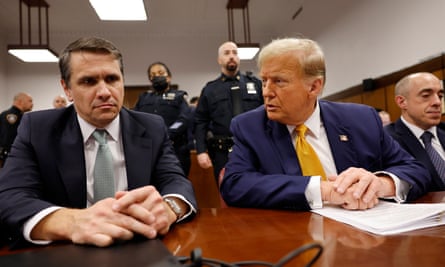
    three men in suits sit at a table
    Trump at his hush-money trial with his lawyers Todd Blanche, left, and Emil Bove, right. Blanche is now deputy attorney general and Bove is principal associate deputy attorney general. Photograph: Michael M Santiago/AP

    “Trump’s sanctions against Covington and Perkins serve two purposes. In the immediate term, he gets revenge against two firms that have offended him,” said NYU law professor Stephen Gillers.

    Gillers stressed that these orders also “warn other law firms that they face the same punishment if they cross Trump by representing plaintiffs challenging his executive orders. In fact, the executive orders should be called by their rightful name: vendettas.”

    Gillers added that the “only remaining institutional threat to Trump’s quest for total power is the judiciary … Lawyers are the gatekeepers for access to judicial power. We see a double-barreled strategy: attack the judges who criticize or rule against Trump as a warning to other judges, and attack law firms as a warning to other law firms that might take Trump to court.”

    The surge in Trump administration attacks on judges has been fueled by multiple court rulings that have delayed or scuttled Trump’s executive orders and Musk’s Doge operation to shrink the federal government with scant regard for congressional and judicial powers

    For instance, Stephen Miller, Trump’s deputy chief of staff, last week wrote on X: “Under the precedents now being established by radical rogue judges, a district court in Hawaii could enjoin troop movements in Iraq. Judges have no authority to administer the executive branch. Or to nullify the results of a national election.”

    skip past newsletter promotion

    Judges who have ruled against Trump have witnessed an uptick in threats. A bomb threat was even made in March against a sister of the conservative supreme court justice Amy Coney Barrett after she joined three liberal justices and Chief Justice Roberts in a ruling that went against Trump.

    Trump’s rightwing allies in Congress have jumped into the legal fray with calls to impeach certain judges who have ruled against the administration and some of Doge’s radical cost-cutting moves

    After the New York district judge Paul Engelmayer blocked Doge on 8 February from gaining access to millions of sensitive and personal treasury records, Musk baselessly accused him of being a “corrupt judge protecting corruption” on X, the social media site he owns where he has about 200 million followers.

    “He needs to be impeached NOW!” Musk said on 9 February.

    With Musk nearby in the Oval Office last month, Trump echoed these attacks by the world’s richest man, who donated close to $300m to his campaign:

    “It seems hard to believe that a judge could say, ‘We don’t want you to do that,’ so maybe we have to look at the judges because I think that’s a very serious violation,” Trump said.

    To bolster those charges, Derrick Van Order, a Wisconsin Republican congressman, filed an impeachment resolution against the judge, whose ruling came after more than a dozen Democratic state attorneys general filed a lawsuit arguing Doge could not legally access treasury records with personal details of millions of Americans.

    Former federal judges and scholars say that Trump and Musk have pushed the legal envelope in ways that are unprecedented in the US.

    “When you flood the zone with scores of executive orders, many of which were clearly based on questionable legal grounds, no one should be surprised that they’re not withstanding judicial scrutiny,” said John Jones, an ex-federal judge who is now president of Dickinson College.

    “An additional problem the administration has is that it’s losing credibility with the courts by continually making disingenuous arguments in support of these orders.”

    Other critics voice similar concerns.

    “Trump’s actions aimed at the role of lawyers and the courts appear to be part of a battle to reduce the judicial branch to being subordinate to the president,” said Larry Noble, a former general counsel at the Federal Election Commission who now teaches law at American University. “If Trump is able to punish lawyers who oppose him and ignore the courts, he will be only steps away from becoming the king he seems to want to be.”

    On another front where Trump is eager to snuff out criticism and dissent, the president escalated his attacks on the media in his recent justice department speech by asserting without evidence that some major reporting outlets are “illegal” and “corrupt”.

    “These networks and these newspapers are really no different than a highly paid political operative,” Trump added, lashing out at CNN and MSNBC as corrupt.

    Trump added in conspiratorial fashion: “It has to stop, it has to be illegal, it’s influencing judges and it’s really changing law, and it just cannot be legal.”

    Trump’s widening attacks on the press, the courts, law firms and other American institutions damage the rule of law in Raskin’s eyes.

    “Trump is attacking any source of potential institutional opposition,” Raskin said. “Anyone who offers any kind of resistance is a target of Trump’s. We’re seeing an explosion of Trump’s incorrigible lawlessness.”

  • Trump’s Dream Logic – The Atlantic

    Trump’s Dream Logic – The Atlantic

    That is what the American experience is beginning to feel like in 2025: not as if we are living in President Donald Trump’s reality, but as if we are living in his dream.

    A star on the American flag melting
    Illustration by The Atlantic

    In Ursula Le Guin’s novel The Lathe of Heaven, George Orr wakes to discover that he has the power to control reality through his dreams. Each night while he sleeps, the world changes in profound and unexpected ways. In the morning, Orr alone remembers reality as it was. Soon, Orr (named, one would assume, for George Orwell) finds himself under the care of a psychiatrist, who, realizing that Orr has these powers, tries to use them to turn the world into a utopia. This does not go well for the world.

    It doesn’t go well because dreams have their own logic. They are nonlinear and to some degree nonsensical, and so directing oneself to dream of world peace may result in an alien invasion. Technically the dream has been fulfilled. Earthlings have stopped fighting with one another, but only because all of Earth is now ruled by an alien species. In this new dream reality, a world ruled by aliens becomes the only world you have ever known.

    That is what the American experience is beginning to feel like in 2025: Not as if we are living in President Donald Trump’s reality, but as if we are living in his dream. As the showrunner and director of TV shows including Fargo, Legion, and the upcoming Alien: Earth, I think a lot about how audiences navigate the tension between horror and the absurd. Now we’re all in this liminal space of the president’s devising.

    When the Trump administration pretends that the three branches of government are not and never have been equal, it creates a state of unreality in the minds of everyday Americans, similar to that of a dreamer in a dream. When the president and his proxies ignore both laws passed by Congress and Supreme Court decisions, they seek to replace the vérité of our shared history and experience with a fantasy, turning the stabilizing force of precedent into the quicksand of dream.

    Only in a dream could the bicycle you’re riding become a pony. But if you tell the pony in the dream that he used to be a bicycle, he will deny it. I’ve always been a pony, he will say. And because this is a dream, you will accept that. But what if you’re awake and your government is doing things and saying things that seem nonsensical? What are you supposed to think when you search for the Gulf of Mexico on Google Maps and discover that it no longer exists? What happens if, as a next step, the history books are revised to erase all records of the name? In this new reality, that body of water has only ever been called the “Gulf of America.” You can imagine the argument that will happen years from now, where you swear there was once a Gulf of Mexico, but, for the life of you, you just can’t prove it.

    Over the past two months, the rule of law in this country has been replaced by the rule of whim. The whim is not just that of one man but of a loose cabal of Cabinet members and “special advisers” who are combining revenge fantasies with small-government dreams, xenophobic visions, and cryptocurrency delusions. And so former national-security officials have had their security clearances revoked, government agencies have been fed into the wood chipper, “alien enemies” have been deported despite a judge’s court order, and a vaccine denier and pseudoscience champion has been confirmed as the secretary of Health and Human Services.

    The only thing these dreamers have in common is that they want to control reality itself, to rewrite the past, present, and future simultaneously. Their actions create a maelstrom of daily news and revisionist history that the mind struggles to combine into a coherent reality. As a result, we are moving from a waking state to a dream state, where logic is flexible and anything can happen.

    The movie Inception introduced us to a world in which corporate spies infiltrate the dreams of CEOs. Once inside, they steal secrets or, in the central action of the film, seek to implant an idea that the dreamer will, upon waking, turn into a reality. Inception, as they call this process, is considered almost impossible because of how difficult it is to make someone believe that an outside idea is their own. In this framework, however, the logic of the waking world is distinctly different from that of the dream. It assumes a waking world in which things make sense. Where facts have meaning. Not a world whose richest man brandishes a chain saw onstage and hires teenagers nicknamed “Big Balls” to gut the federal government, while the president of the United States reposts an AI video of the Gaza Strip as a luxury resort destination.

    Inception did not envision a world in which only dream logic exists even when the dreamer is awake; a world where the federal government is trying to both shut down the Department of Education and weaponize it in order to remake how and what children in this country are taught. A world in which the president signs an executive order invoking the Alien Enemies Act against immigrants from Venezuela, even though the country is not at war with Venezuela. In the administration’s dream logic, the executive order itself creates a preexisting state of war, allowing it to issue the order. The logic is circular. Without being at war, the administration cannot use the act to justify the deportations. Or whatever. The bicycle is a pony. The logic is dream logic.

    In the past century, authors in Russia, China, and other countries with totalitarian regimes have written about how absurd life becomes under autocracy. But until you experience it yourself, you can’t fully comprehend the illogic of it—or, I should say, the dream logic of it. It is a feeling as much as an idea, a surreal sense of unreality, from which the dreamer wills himself to wake up.

    As the Austrian-born psychologist Bruno Bettelheim wrote about life under fascism: “Thus has tyranny robbed men of their sleep and pursued them even in their dreams.”

    In this warped reality, rather than dreading sleep, we begin to dread waking up, because every day there is a new dream, one that, like George Orr’s, threatens to fracture our reality yet again. Our job over the next four years is to remember what life was like before the dream so that one day we can make the world a logical place again.

    About the Author

    Noah Hawley is the creator of the FX series Fargo and the author of the novel Anthem.

  • Changing the narrative: How Trump 2.0 is reframing George Floyd and the 2020 protests – USA TODAY

    Changing the narrative: How Trump 2.0 is reframing George Floyd and the 2020 protests – USA TODAY

    Hubert Rodell startled his 2-year-old bernedoodle when he leapt from his couch to give Donald Trump a standing ovation during his joint address to Congress this month.

    The president had touted to lawmakers an executive order seeking the death penalty for anyone who kills a police officer, which he asked House and Senate members to put, “into permanent law.”

    Rodell, 69, knows how difficult a job it is keeping a community safe. For nearly two decades his father served as mayor of his hometown, Jonesboro, Arkansas.

    “I know that dad tried his best to give the police as much money as they could get,” he said.

    But Rodell, a registered Democrat, who supported Trump last fall and would “vote for him 100 more times, too,” he said, isn’t as enthusiastic about a push by conservative activists to pardon a white Minneapolis police officer convicted of murdering George Floyd, an unarmed 46-year-old Black man, almost five years ago.

    The Bear State native, who retired from the lumber business, remains torn about what unfolded during the May 25, 2020, incident which reminded the country of its racial wounds.

    “It’s a two sorted blade,” Rodell, who is white, told USA TODAY in an interview. “(Floyd) shouldn’t have played so stupid and the police should have stood back and said, ‘well, let’s listen.’ But everybody just got stupid at the same time and they killed the man, then all of a sudden, our cities are burning up everywhere.”

    Part of Trump’s campaign last year focused on retribution, and since returning to power, some of the president’s allies have tried to recast the 2020 protests in support of Floyd. Millions of people demonstrated in the streets amid a global pandemic to speak out against police violence.

    Whether its congressional Republicans pressuring the mayor of D.C. to remove a Black Lives Matter mural down the street from the White House or tech billionaire Elon Musk voicing support to free former Minneapolis Officer Derek Chauvin, who was convicted of killing Floyd, some of the president’s supporters are looking for symbolic and substantive ways to change the narrative about the movement that engulfed the nation in 2020.

    As the face of that movement, Floyd’s character and actions have long been a focal point of BLM critics, who regularly call out the violence of left-wing groups while seeking to strengthen law enforcement’s hand.

    USA TODAY spoke with several voters about these moves, and what it could mean for future police reform propoposals that failed during the Biden administration and what’s changed about their thinking over time.

    Trump applies push for 2020 revenge

    The George Floyd mural in downtown Palm Springs, which has been defaced with graffiti, will be restored after the city allocated funds for that purpose.

    In the aftermath of Chauvin kneeling on Floyd’s neck for 9 minutes 29 seconds, which gripped the nation’s attention in a viral video, some pundits on the right expressed dismay at the officer’s actions.

    Among them was Ben Shapiro, founder of the Daily Wire, who at time said “everyone should be on the same side” of the issue and that Chauvin should “go to jail for assault.” But this month he launched an online petition, arguing the officer had received an unfair trial fueled by protests that led to millions in property damage in some cities and divided the nation.

    Trump said he wasn’t considering a pardon for Chauvin, who was sentenced to 21 years for depriving Floyd of his federal civil rights in addition to being sentenced to 22 years in prison for second- and third-degree murder in Minnesota.

    The fact that Musk, who works closely with Trump, quickly embraced the idea on X has some of the president’s supporters thinking it’s worth considering.

    “I don’t believe that (Chauvin) should be able to be in a place of authority amongst his peers and his community, but I do believe that he should not have his life stripped away based off of one mistake,” said Jordyn Joyce, a registered Republican who hails from Ocala, Florida.

    Joyce, a physician’s assistant, who is white, said what happened to Floyd was tragic. However, she believes Chauvin did what his training called for and she points out that traces of fentanyl were found in Floyd’s system.

    Expert witnesses said the amount wasn’t enough to be considered fatal, but the 28-year-old physician’s assistant said it should matter in the context of discussing a potential pardon because drug abuse affects a person’s ability to think clearly.

    “It should absolutely play a role to their decision,” on pardoning Chauvin, she said.

    Police and protesters face off during a Justice for George Floyd rally in downtown Phoenix, on May 28, 2020.

    Other voters of different political stripes, however, said the president should think twice about getting involved.

    Floyd’s background was no reason for him to be killed, said Chris Carson, 52, a former corrections officer who now works as an insurance claims adjuster in Byram, Mississippi.

    “When we handcuffed a person, once you subdue them, you back up off of them, you give them an opportunity,” said Carson, a Democrat, who is Black.

    “That’s the cockiness of some of our law enforcement,” he added. “You’re not gonna let anybody tell you what to do while you’re doing your job, and in this case that particular officer was completely in the wrong.”

    Eden Kassa, 37, a government contract from Alexandria, Virginia, said Chauvin’s actions were “irresponsible” and pardoning him would say you can get away with killing if a powerful person, such as a president or governor, thinks you should.

    “They can exonerate you just because they want to, that’s the message that would send to me,” Kassa, who is Black and a registered Democrat, said.

    Trump hasn’t shied away from using his executive pen to give out controversial pardons since returning to the White House.

    Days after his inauguration, for instance, he pardoned two D.C. police officers who were each convicted and sentenced to multiple years in prison, following their fatal pursuit of Karon Hylton-Brown, a 20-year-old Black man, in 2020 – five months after the murder of Floyd. 

    Asbury Park activists attend a rally pushing for racial justice in the wake of the Derek Chauvin trial in Minneapolis and other recent instances of police violence. Teon Willis, executive director, The Centers for Black Excellence, addresses the crowd in Asbury Park, NJ, May 8, 2021.

    ‘Remember how we got here’ BLM mural removal conjures up reflection, dismissal of 2020 protests

    52-year-old independent Jedd Smith echoed that Trump shouldn’t interfere in the Chauvin case because the officer “went too far,” but he is equally critical of the Black Lives Matter movement, which he believes was “radicalized” by left-leaning groups.

    “It lost its effectiveness,” he said.

    But Smith, an engineer who lives in Allegan, Michigan, admits he looks at the issue of police violence a bit differently as a result of Black friends and co-workers who were outspoken about their experiences as the BLM-led demonstrations intensified.

    The words Black Lives Matter in yellow paint on two blocks of 16th Street NW, between K and H streets, near the White House, June 5, 2020.

    “I didn’t realize how real it was for a Black person that when they see the cops, they’re afraid, they’re nervous and they’re afraid they’re going to get hassled,” said Smith, who voted for Robert F. Kennedy Jr. last fall. “I grew up in white. I didn’t realize that it’s a very real thing for them, a fear of police, and my growing up, I didn’t fear the police.”

    As jackhammers continue to pound away at removing of the Black Lives Matter mural in Washington, those who hold a negative view of the grassroots groups associated with the mass protests launched in multiple cities during the summer of 2020 say it is about time.

    James Helin, 30, a Navy veteran who lives in Rockingham, North Carolina, said Floyd’s death remains a touchy situation, but that he dislikes the BLM movement for “taking advantage of race relations” in the country.

    Helin said he finds it hard time to believe that racism was as big an issue as it was being made out to be given his personal experience in the military. He said a person’s skin color doesn’t matter as much as trust, adding he believes many BLM activists tried to “enrich themselves” as a result of the racial division.

    “So getting rid of that mural, to me, means trying to put that in the past, and say we don’t need people trying to stoke fires. We need people trying to put fires out,” Helin, a registered independent, who is white, said in an interview.

    Among those who were supportive of the BLM movement there is a slight split, with some arguing the symbols were an empty gesture by Democrats to co-opt its grassroots message for political gain.

    Jecorey Arthur, a former city councilman in Louisville, Ky., where Breonna Taylor was shot and killed by police weeks before Floyd in 2020, said that he doesn’t regret the BLM movement, but thinks it failed to keep momentum after raking in real policy wins locally during that time period.

    “We had demonstration, we had legislation, but I think we lacked organization following those two phases,” he said. “We should have been able to sustain those people and go deeper or higher up the ladder of engagement, but that kind of fell apart the further we got away from 2020.”

    Arthur, who changed his party registration from Democrat to independent while in office, said removing the mural is largely a symbolic act eclipsed by larger policy attacks, such as targeting diversity and equity programs.

    But for others the mural’s public prominence was asserting the value Black life that some activists said was an important demonstration of the country’s values.

    “The right has been up in arms for years having conniption fits because Confederate statues were coming down,” Christi Rangel, 51, a legal secretary and registered independent in Baton Rogue, Louisiana, said. “So symbols do mean things to people.”

    As tourists stopped at the intersection of 16th and H in Washington, D.C., where the mural was prominently featured, a couple took a selfie with the White House in the background. One pointed in front of them: “That’s the Black Lives Matter mural.”

    Jeremy Ives, a 39-year-old commercial photographer, was also outside documenting the ongoing destruction with his camera. As part of his job, he said he works with a nonprofit teaching kids photography, using images from the Civil Rights Movement. 

    “So, when I see stuff like this, it reminds me how impactful it is to capture what we see,” he said.

    Even more impactful was the chalked graffiti on the sidewalks running alongside the mural with iterations of the chants and phrases used during the protests covering the pavement in various colors. In yellow chalk, someone wrote: “Remember how we got here.”

    Ives, who moved to D.C. in 2019, remembers watching fellow artists, some friends of his, paint the thoroughfare in large, bright yellow block letters spelling out “Black Lives Matter.” He said the removal, five years later, is not surprising to him but that no one will forget that historic summer.

    “You can cut a nose off a Sphinx, you can deface art, you can rewrite history, but I think this reminds me that everybody is watching it happen,” Ives said. 

    Contributing: Joey Garrison

  • Tiger Woods confirms relationship with Vanessa Trump, President Trump’s former daughter-in-law – NBC News

    Tiger Woods confirms relationship with Vanessa Trump, President Trump’s former daughter-in-law – NBC News

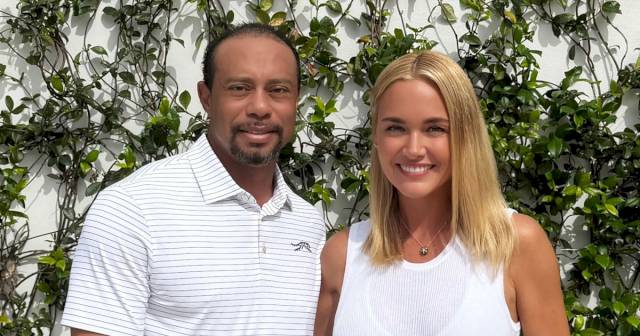
    Golfing hero Tiger Woods on Sunday confirmed his relationship with Vanessa Trump, the former daughter-in-law of President Donald Trump, by declaring that “love is in the air.”

    Woods posted a picture of him alongside Trump to his Instagram and X accounts, with the caption: “Love is in the air and life is better with you by my side! We look forward to our journey through life together. At this time we would appreciate privacy for all those close to our hearts.”

    Vanessa Trump was married to Donald Trump Jr. from 2005 to 2018, and the couple has five children together.

    One of those children, Kai, goes to the same school as Woods’ two children, Sam and Charlie. Kai is due to play golf at the University of Miami in 2026 and competed in an invitational golf tournament against Charlie Woods last week.

    The Instagram post from the normally very private Woods confirms weeks of rumors and tabloid speculation about the relationship.

    The tactic is reminiscent of when the golfer confirmed his relationship with Olympic skier Lindsey Vonn in 2013, saying on social media that he’d gone public to “limit the ‘stalkerazzi’ and all those sleazy websites that are out there following us.” Woods confirmed his breakup with Vonn in 2015.

    Woods’ two children are from his marriage to Elin Nordegren, which ended in divorce in 2010 after his extra-marital affairs.

    President Trump has played golf with Woods on several occasions, most recently in February at the Trump International Golf Club in West Palm Beach, Florida. During his first term in 2019, Trump also gave Woods the Presidential Medal of Freedom.

    Woods, a legendary figure in golf and a world-famous sports star, announced earlier this month that he had undergone surgery after rupturing his Achilles tendon, keeping him out of this year’s Masters tournament and likely the rest of the year.

    Barack and Michelle Obama’s production company is in talks to produce an upcoming biopic on the rise of Woods, according to a Deadline report earlier this month.

    Snoop Dogg was among those to comment on Woods’ Instagram post, adding the message “Check ya d m.” It was unclear what the rapper wished to privately tell Woods.

    Patrick Smith

    Patrick Smith is a London-based editor and reporter for NBC News Digital.

  • A ‘dumpster fire’: Angry voters bash lawmakers over Trump and DOGE – USA TODAY

    A ‘dumpster fire’: Angry voters bash lawmakers over Trump and DOGE – USA TODAY

    BLOOMINGTON, Minn. – The questions lobbed at freshman Democratic Rep. Kelly Morrison during a packed down hall Thursday night were meaty. 

    “What is the plan to enforce court rulings against Trump and Musk in the event that they disregard court orders?”

    “If Trump ends Social Security, we will be unable to pay our mortgage. We will become homeless at age 70. What can or should we do?”

    “How will Democrats rehabilitate their standing as the only hope to save the country?” followed by: “Why does Chuck Schumer still have a job?”

    Morrison, who represents a liberal-leaning district in the Minneapolis suburbs, echoed back outrage at the administration and sympathy with the queries, which were written on paper and passed to the stage for a moderator to read.

    But ultimately, she admitted she has few cards to play in a federal government dominated by Republicans in the House, Senate and White House.

    “I had big plans that are on hold,” Morrison said.

    President Donald Trump’s efforts to transform the federal government at a breakneck pace have upturned norms and tested legal limits. The impacts are rippling across the country and lawmakers are hearing about it.

    During the week-long break from Congress to visit their districts, Democrats like Morrison faced voters demanding answers on what the party is doing to stand up to a president who is pushing the bounds of executive power, especially after several Democratic senators joined with Republicans to advance a GOP-led government funding extension and avoid a shutdown.

    And the few Republicans who have opted to hold town halls after their leadership advised against it have been met with questions about the speed and scope of the cuts, even if their voters are generally supportive of the president’s agenda.

    The party has dismissed the raucous town halls in conservative districts as the work of liberal activist groups, which have encouraged people to flood public forums in an attempt to highlight frustrations with the administration. But multiple Republican lawmakers who spoke with USA TODAY said they are hearing concerns from constituents and are communicating them to the administration.

    “You get into Social Security offices closing, you get into the federal employees that are dispersed out through the state – we’re hearing of some concerns. Some are coming from employees that are affected, some are coming from the community. Those ones we have to pay attention to,” said Sen. Thom Tillis, R-N.C., one of the most vulnerable Republican senators up for reelection in 2026.

    “That’s why I’m glad that the president has said it’s time to move into a surgeon’s versus a lumberjack’s approach to DOGE. I think that was good advice from the president.”

    More than 2,000 people waited in line to attend Democratic Rep. Kelly Morrison's town hall in suburban Minneapolis Thursday night.

    ‘Let’s let the dumpster fire burn out’

    In Trump’s first 60 days in office, the administration has gutted agencies like the Consumer Financial Protection Bureau and the U.S. Agency for International Development, attempted to withhold congressionally-appropriated funding, downsized agencies like the Department of Education, sought to close dozens of Social Security offices, and laid off tens of thousands of federal employees.

    Trump has argued that the administration is seeking to root out “waste, fraud and abuse” from a bloated federal government, and said he is fighting an “administrative state” staffed by “unelected bureaucrats” disloyal to Trump and to the American people. In a statement to USA TODAY on the pushback at town halls, spokesperson Karoline Leavitt said Trump “will not be deterred from delivering on the promises he made to make our federal government more efficient and more accountable.”

    Democratic voters, shocked by the rapid changes and without their party in power in Washington, are begging their lawmakers to do something. After Democrats held protest signs and walked out of Trump’s joint address to Congress earlier this month, their supporters complained that the effort was performative and fell flat.

    The volume of those complaints ratcheted up significantly after Senate Minority Leader Chuck Schumer, D-N.Y., led a group of senate Democrats to help Republicans pass a partisan funding extension, arguing the consequences of a shutdown would be much worse than the bill itself, which gives the administration more leeway over spending decisions.

    Rep. Nydia Velázquez, D-N.Y., holds a protest sign with fellow Democratic congressional members as President Donald Trump addresses a joint session of Congress at the U.S. Capitol on March 4, 2025.

    The full force of their voters’ discontent bubbled up at town halls when Democrats returned to their districts for a weeklong recess.

    Attendees to a town hall in Golden, Colorado shouted for a full minute at Democratic Sen. Michael Bennet, who faced questions on why he voted to confirm several of Trump’s Cabinet nominees, such as Energy Secretary Chris Wright and Interior Secretary Doug Burgum.

    A woman at a town hall in Maryland screamed at Democratic Rep. Glenn Ivey, who was explaining Democrats’ constraints until the 2026 midterm elections: “You are talking about voting, the house is on fire!”

    The approximately 2,000-person crowd in suburban Minnesota Thursday night was decidedly more reserved. The event opened with a warning from the moderator that town halls elsewhere had “gotten out of hand” and a request to “be respectful.”

    Russ and Theresa Borchardt attend a town hall for Democratic Rep. Kelly Morrison in Bloomington, Minnesota on March 20, 2025.

    Still, multiple people attending Morrison’s town hall told USA TODAY they showed up in search of hope and an indication that Democrats are fighting. 

    “I’m a little disappointed” with Democrats’ response to the first months of the Trump administration, said Alisha O’Shaughnessy of Brooklyn Park, 43. “I feel the lack of action is scary.”

    “None of us know what to do, and I know that they’re struggling with it,” said Russ Borchardt, 71, a U.S. Army veteran who typically voted for Republicans until Trump first ran for office in 2016. “But somehow, we need more. We need more out of the party.”

    His wife Theresa Borchardt, 68, added: “We just hope that the Democrats can coalesce and do something. ‘Let’s let the dumpster fire burn out and see what happens’ is not an effective strategy.”

    Republican members meet angry crowds

    The vast majority of Republican lawmakers have cheered on the changes to the federal government spearheaded by Trump’s advisor, billionaire entrepreneur Elon Musk, under the Department of Government Efficiency (DOGE) project.

    But during their first break from Congress in February, their town halls were overrun with angry constituents livid at the changes. Republican leadership has accused Democratic groups of paying protesters to create chaos at the events. While Democratic groups have promoted the Republican events, there is no evidence attendees are being paid.

    The chair of the National Republican Congressional Committee, which helps Republicans win seats in the House of Representatives, advised members to hold virtual town halls instead to avoid more viral confrontations. However, a few Republicans still held public forums over the last week.

    A man shouts at Rep. Chuck Edwards (R-NC) during a congressional town hall meeting on March 13, 2025 in Asheville, North Carolina.

    Rep. Chuck Edwards, R-N.C., was booed and hissed at during a town hall in Asheville, and one man was escorted out of the room for yelling at the congressman. Rep. Mike Flood, R-Neb., was shouted down as he defended the changes as making progress in reducing spending. And Rep. Harriet Hageman, R-Wyo., heard concerns about Musk the “unelected billionaire” making decisions, even from constituents who otherwise support the president’s agenda.

    Nearly a dozen Republican lawmakers told USA TODAY that they’ve heard from plenty of constituents who applaud the effort to pare down federal government costs. But they also said they’re watching closely to make sure the changes don’t cut too close to the bone – and are flagging Musk’s team when that happens.

    Members cited multiple federal services and employees they’re looking out for in their districts, from military bases and border patrol outposts to passport processing centers, Social Security offices, forest service agents, and Veterans Affairs clinics.

    “The art is going to be to make sure you right-size,” said Rep. Ryan Zinke, R-Mont. “So a right-size is, from a former (Navy) SEAL perspective: Make sure the front line is fine.”

    Pushback in one Republican district

    As Republicans shy away from in-person town halls, Democrats are hosting their own events in GOP-held parts of the country to point the finger at Trump and his party.

    Former 2024 Democratic vice presidential nominee and Minnesota Gov. Tim Walz held a town hall-style event on Tuesday in GOP Rep. Derrick Van Orden’s district, a battleground seat in western Wisconsin.

    It came after other liberal groups organized their own town halls and invited Van Orden to join, or attempted to join other group’s meetings with the congressman.

    On Capitol Hill last week, Van Orden told USA TODAY he’s met with DOGE staff to ensure “every single tax dollar that’s allocated or appropriated for the Veterans Affairs administration goes to the veteran.”

    Cyndi Greening wears a paper crown reading

    He also argued that the people turning up to Republican town halls across the country are “agitators” disrupting constituents’ ability to speak to their lawmakers.

    “That’s incredibly disrespectful and I’m not going to allow that to take place,” he said, explaining why he would instead hold virtual town halls.

    Cyndi Greening, 68, is a retired professor who said she decided to start a chapter of the progressive activist group Indivisible in western Wisconsin last fall shortly before the presidential election. After a month of mourning the results, she said, “I got up and said, I gotta do something.”

    Now the group hosts a weekly protest with other Democratic groups in downtown Eau Claire, the largest city in Van Orden’s district. On Wednesday, people showed up wrapped up in mittens and hats as the snow fell, holding homemade signs: “DOGE smells dodgy” or “Dump Trump and his Musk-rat.”

    The Chippewa Valley Indivisible group started with 28 people in January and now has more than 500 members, Greening said.

    “People were counting on the guardrails. They were counting on the courts, they were counting on our congressional representatives to stand up. The checks and balances,” she said. “They’re letting us down horribly.”

    Twelve miles north, Caroline Haas, 72, waited in her car outside the Veterans Affairs clinic in Chippewa Falls while her husband, Gale Haas, was seeing the doctor inside.

    Caroline Haas waits in her car outside the Veterans Affairs clinic in Chippewa Falls, Wisconsin while she waits for her husband's medical appointment to conclude. Her family has

    Gale served in the U.S. Air Force in Thailand during the Vietnam War, Caroline Haas said, and he’s had care from the V.A. for multiple medical issues over decades since leaving the service.

    “He’s always had good care” through the VA clinic, she said, adding that the clinic is more important than ever because multiple hospitals in the area have closed in recent years. “That kind of put this area in a crisis for medical.”

    But asked what she thinks about the changes the administration has made, she added that she’s open to making sure the government works better, especially so it doesn’t “go broke” by the time her kids and grandkids might need support.

    “Maybe some of this needs to come out, how some of the money’s been spent,” she said.

  • US stock futures jump after reports that Trump will narrow tariffs – USA TODAY

    US stock futures jump after reports that Trump will narrow tariffs – USA TODAY

    U.S. stock index futures are pointing to a higher opening after reports that President Donald Trump will narrow the scope of tariffs he plans to impose on April 2.

    Trump had planned to enact widespread reciprocal tariffs against longtime trading partners, but now, those tariffs will likely be narrower than originally threatened, reports said. That likely comes as a relief to investors and economists who feared an all-out trade war.

    Still, officials in China and Australia warned U.S. trade policy could cause shocks to the global economy.

    Futures tied to the blue-chip Dow added 0.72%; the broad S&P 500 futures gained 0.94%; and the tech-heavy Nasdaq 100 futures rose 1.14%.

    FILE PHOTO: The Wall Street entrance to the New York Stock Exchange (NYSE) is seen in New York City, U.S., November 15, 2022. REUTERS/Brendan McDermid/File Photo

    Cryptocurrency

    On Sunday, Strategy co-founder Michael Saylor posted on X a bitcoin chart suggesting he may be contemplating buying more bictoin.

    Medora Lee is a money, markets, and personal finance reporter at USA TODAY. You can reach her at mjlee@usatoday.com and subscribe to our free Daily Money newsletter for personal finance tips and business news every Monday through Friday.

  • Here’s What 6 Voters Think of Trump’s Latest Actions – The New York Times

    Here’s What 6 Voters Think of Trump’s Latest Actions – The New York Times

    Advertisement

    SKIP ADVERTISEMENT

    Things have not slowed down since The New York Times last talked with a panel of voters about President Trump’s first 100 days of his second term.

    His tariff policies have sown further economic uncertainty — and fears of a recession. The president also called for the impeachment of a judge who sought to pause the deportation of more than 200 migrants to El Salvador. And there were deadly Israeli missile strikes on Gaza. The voters had wildly different reactions — which reflect a divided country.

    Image

    Veronica McCloud sits at a table with her fingers interlaced in front of her while wearing a red long-sleeved shirt, multicolored glasses and a necklace.
    Credit…Nora Williams for The New York Times

    Veronica McCloud, a retired teacher and Kamala Harris supporter, was trying to remain open — even agreeing that the federal government needed trimming.

    Then came the bumps, that to her, struck a similar theme: drastic action without sufficient explanation.

    She quickly grew frustrated with the handling of mass cuts to the federal work force and the lack of specifics about claims of government fraud and waste.

    Ms. McCloud was also troubled by what she saw as Mr. Trump’s open defiance of federal deportation court orders. “I think that you should have to follow the judge’s orders. I would have to,” she said. “I think it is our civic duty.”

    But her biggest fears centered on inflation and the uncertain economy, and were exacerbated in part by Mr. Trump’s new trade policies. She wasn’t sure his strategy would work in the long term and worried the country might plunge into a recession.

    With a fixed retirement income, Ms. McCloud was reconsidering her spending habits. She started purchasing less expensive meats and snacks, and cooked more at home. And to save gas, she has canceled day trips to visit friends, catching up by phone instead.

    She said Mr. Trump didn’t make “perfectly clear” what possible hardships the American people might face.

    “People who are well off, they can handle it — but people like me are having conversations about tightening our purse strings,” she said, adding, “That’s causing anxiety.”

    — Audra D. S. Burch

    Image

    Credit…Brittany Greeson for The New York Times

    The abrupt end of the cease-fire between Israel and Hamas and who was to blame were top of mind for Dave Abdallah.

    “I’ll put it on the current administration,” he said, noting that he believed that the White House could have demanded the Israeli government not reopen hostilities that recently killed over 400 people in Gaza.

    Mr. Abdallah, a real estate agent, didn’t see why Mr. Trump couldn’t have put the same kind of pressure on Israel that he was putting on allies like Canada and Mexico with tariffs.

    The war pushed Mr. Abdallah to cast his vote for Jill Stein, the Green Party candidate, because he did not like how President Joseph R. Biden Jr. had backed Israel. He said he would have voted for Mr. Trump but didn’t trust him to handle things better.

    This week, he said, proved that he was right.

    What Mr. Abdallah does like so far, albeit with reservations, is that “he’s taking action.” He added, “He’s not just treading water.”

    But Mr. Abdallah doesn’t like Mr. Trump’s battles against federal court rulings, noting that flights carrying migrants to Central America were not turned around midair, defying an order. The administration said the order came too late.

    “When a president, or a judge, or a senator, or a congressman or woman, feels that they are above the law or above the country, that is wrong,” he said.

    Mr. Abdallah is especially worried about the effect of tariffs on the automobile industry and Michigan’s economy.

    “The tariffs are just too extreme,” he said.

    — Kurt Streeter

    Image

    Credit…Daniel Lozada for The New York Times

    Many of the glass vases in Darlene Alfieri’s flower shop come from China, so she has known the effects of tariffs firsthand. The higher costs are “not too God-awful bad” — about a 10 percent hike — but enough that she has asked people to return unused vases so she can keep prices down.

    None of this was ideal but neither was the status quo, Ms. Alfieri said, when she felt that so many other countries were taking advantage of the United States in their trade policies.

    “I think the things that he’s trying to address need to be addressed,” she said of Mr. Trump’s tariffs. “I’m still not on board necessarily with how he’s addressing it, because I don’t think they’re giving out enough accurate, detailed information. I am a person who needs the details.”

    Ms. Alfieri said she understood that sacrifices were needed, and she was willing to endure some short-term disruption. But she would welcome a little more communication about what the country may be in for.

    “I think he’ll end up making it better, but I think it’s gonna get worse before it gets better,” she said. Maybe not worse, she clarified, but certainly the country would be different. And sometimes, she said, it’s hard to know right away whether big changes were good or bad.

    But the good thing about democracy, she felt, was that in four years, the country would get to assess matters. “We get to re-evaluate and say, ‘OK, so he’s done these things,’” she said. “‘Do we want to keep going with this?’”

    — Campbell Robertson

    Image

    Credit…David Kasnic for The New York Times

    To Perry Hunter, people have been outraged over Mr. Trump’s recent actions just because they don’t like him, and not, he felt, over whether Mr. Trump had done something unconstitutional or unnecessary.

    “The division is getting stronger because those that oppose him are so emotionally invested, and anything and everything he does, they’re against it,” he said. “That probably bothers me more than anything.”

    Mr. Perry, a high school teacher, argued that there appeared to him to be gray areas in what Mr. Trump was doing, pointing to the president’s recent deportation, against a judge’s orders, of about 200 people, including members accused of being in a Venezuelan gang. Mr. Hunter said that he was struggling with the fact that those who were deported were most likely not being afforded due process, and he added that the administration needed to be transparent about the details so the public could consider whether it had done something wrong.

    He felt strongly that Mr. Trump shouldn’t defy judges because separation of powers was important. The president needed to “go about doing it constitutionally,” he said.

    There have been moments, though, when he has felt Mr. Trump was in the right. Mr. Hunter said that, in light of pro-Palestinian protests, he had been heartened to see how the administration punished Columbia University financially. That came after the administration accused the institution of failing to protect students and faculty members “from antisemitic violence and harassment.”

    He said he thought Mr. Trump’s cancellation of $400 million in federal grants and contracts to the university made sense. (On Friday, Columbia agreed to yield to many of the administration’s most substantial demands.)

    “That was one of the things that had me lean towards President Trump because I don’t like discrimination,” he said.

    — Juliet Macur

    Image

    Credit…Caroline Gutman for The New York Times

    In the weeks after the election, Hamid Chaudhry saw a notable jump in traffic at the farmers’ market he runs. This burst of spending seemed to reinforce his decision to vote for Mr. Trump.

    But more recently foot traffic has been down and people haven’t been spending as much as they were in December and January.

    “It’s a little concerning but not the doom and gloom,” Mr. Chaudhry said. He was willing to wait and see.

    He believed that the United States had long been exploited by other countries’ trade practices and that it was well past time to get tough, even if that meant risking a recession. “It’s a game of chicken,” he said.

    But while his faith in Mr. Trump’s fiscal management remained, so did his concerns about his approach to immigration. Though he still supported Mr. Trump generally, Mr. Chaudhry was troubled by the news that scores of immigrants had been sent to a prison in El Salvador without the opportunity to contest the accusation that they were members of the Venezuelan gang.

    “The beauty of this country is, no matter what, everybody gets a fair chance,” he said.

    — Campbell Robertson

    Image

    Credit…Mark Abramson for The New York Times

    The return of the dozens of Israeli hostages still held by Hamas was of primary concern for Tali Jackont, an educator in Los Angeles who was raised in Israel.

    She appreciated that Mr. Trump recently hosted freed hostages at the White House and that he seemed to show a certain level of concern for them.

    But she also linked Mr. Trump’s incendiary rhetoric against Hamas to how Prime Minister Benjamin Netanyahu of Israel, whom she opposes, later broke the cease-fire.

    None of it was necessary, said Ms. Jackont, a longtime Democrat who voted for Mr. Trump partly in the hopes he would bring peace to the Middle East. And she felt that now the hostages were perhaps more endangered than ever.

    The president had her worried about other issues, too. For example, she found troubling how Mr. Trump had blasted judges who had ruled against him.

    “He’s not above the law,” she said.

    But Ms. Jackont approved of his effort to streamline the federal government and felt good about his moves to upend the education system.

    And the economy?

    “I trust him,” she said, adding that she felt the president knew more about “the economy than any other area.”

    Ms. Jackont said she could accept it if Mr. Trump’s plans led to a significant slowdown — but not for too long. She noted the economy began struggling years ago, during his first administration.

    But if a recession lasted, for example, three years, she would feel differently.

    “I’ll be very disappointed,” she said. “Super-disappointed. I mean, super, super, super.”

    — Kurt Streeter

    A version of this article appears in print on  , Section

    A

    , Page

    14

    of the New York edition

    with the headline:

    Six Voters Weigh In on Trump’s Tariffs and Immigration Fights. Order Reprints | Today’s Paper | Subscribe

    Advertisement

    SKIP ADVERTISEMENT