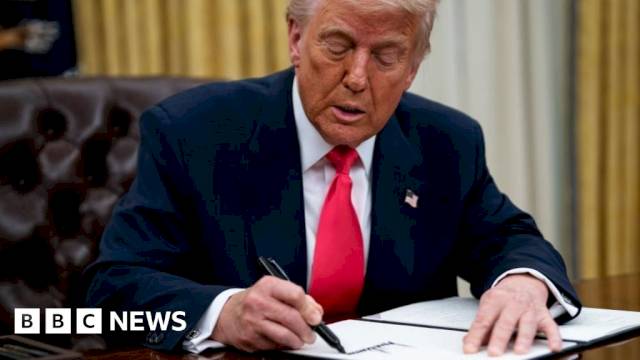
Watch: President Trump signs order to shut education department ‘once and for all’
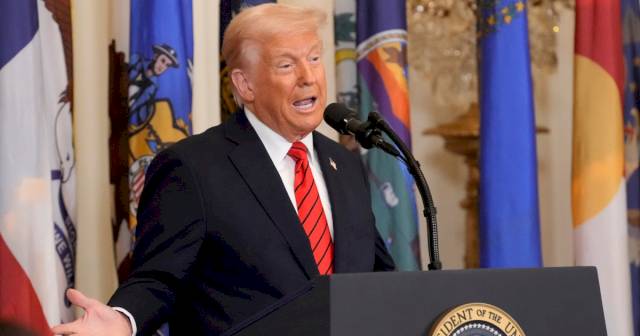
US President Donald Trump has signed an executive orderto dismantle the Department of Education, fulfilling a campaign pledge and a long-cherished goal of some conservatives.
Accusing the agency of “breath-taking failures”, the Republican president vowed to return the money it controls to individual states.
“We’re going to shut it down as quickly as possible,” Trump said, although the White House acknowledged that closing the agency outright would require an act of Congress.
The move is already facing legal challenges from those seeking to block the agency’s closure as well as sweeping cuts to its staff announced last week.
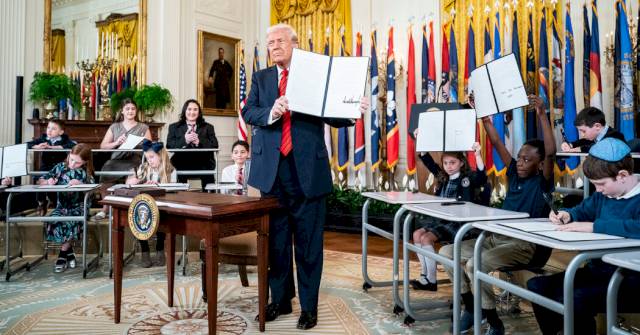
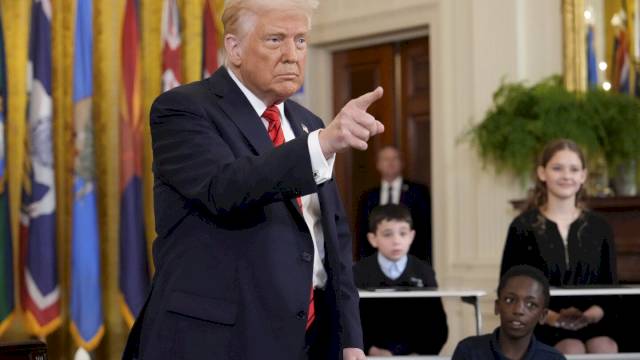
Surrounded by children seated at school desks in the White House on Thursday, Trump said “the US spends more money on education by far than any other country”, yet he added that students rank near the bottom of the list.
The White House stated that his administration would move to cut parts of the department that remain within legal boundaries.
The executive order is likely to face legal challenges, like many of the Trump administration’s efforts to shrink the size of the federal government.
At the signing ceremony, Trump praised Linda McMahon, whom he appointed to lead the department, and expressed his hope she would be the last secretary of education.
He said he would find “something else” for her to do within the administration.
After Trump signed the order, Louisiana Republican Senator Bill Cassidy announced plans to bring legislationaimed at closing the department.
But Republicans hold a slim 53-47 majority in the Senate, and closing a federal department would require 60 votes, making such a goal a longshot.
But even if the department is not formally closed, the Trump administration could decimate its funding and staff as it has done with the US Agency for International Development (USAID), which subsequently stopped many of its programmes and humanitarian work.
The text of the executive order does not include specifics on what actions the administration will take and which programmes might be axed.
It orders McMahon to “take all necessary steps to facilitate the closure” of the department and give authority of such matters to state and local governments.
It also directs her to ensure “the effective and uninterrupted delivery of services, programs, and benefits on which Americans rely”.
Established in 1979, the education department administers student loans and runs programmes that help low-income students.
But Trump has accused it of indoctrinating young people with racial, sexual, and political material.
Most US children attend public schools, which are free and run by local officials. A common misconception is that the federal education department operates US schools and sets curriculum, but that is primarily done by states and local districts.
And a relatively small percentage of funding for primary and secondary schools – about 13% – comes from federal funds. Most of the money comes from state and local taxes.
The agency also plays a prominent role in administering and overseeing the federal student loans used by millions of Americans to pay for higher education.
White House: Students falling behind a ‘national security issue’
Soon after she was sworn in, McMahon sent the department’s 4,400 employees a memo titled “Our Department’s Final Mission”, a possible reference to Trump’s aim to shut the department.
“This is our opportunity to perform one final, unforgettable public service to future generations of students,” she wrote.
“I hope you will join me in ensuring that when our final mission is complete; we will be able to say that we left American education freer, stronger, and with more hope for the future.”
Earlier reports suggested Trump would look to end some of the department’s programmes and send others to different departments, such as the Treasury, something that still may happen but wasn’t made clear in his executive order.
America’s largest teachers’ union recently decried Trump’s plans, saying he “doesn’t care about opportunity for all kids”.
In its statement, the American Federation of Teachers said: “No-one likes bureaucracy, and everyone’s in favour of more efficiency, so let’s find ways to accomplish that.
“But don’t use a ‘war on woke’ to attack the children living in poverty and the children with disabilities.”
For more than 40 years, conservatives have complained about the department and floated ideas to abolish it.
Just two years after it was established by Democratic President Jimmy Carter, his Republican replacement, Ronald Reagan, led calls to undo it.
It is the smallest agency in the president’s cabinet and takes up less than 2% of the total federal budget.
Some of those staff have already been affected by the Trump administration’s sweeping workforce cuts, led by the Department of Government Efficiency (Doge).
Nearly 2,100 people at the agency are set to be placed on leave from Friday.
Efforts by Doge to slash federal spending and radically restructure – or simply abolish – many government agencies have been overseen by tech billionaire Elon Musk.
Food banks across the country recently learned that the shipments they had expected to receive this spring through a federal program had been suspended. They were left with little time to identify new funds and supplies, and with no assurance that the aid would ever be restored.Credit…Sophie Park for The New York Times
Food banks across the country are scrambling to make up a $500 million budget shortfall after the Trump administration froze funds for hundreds of shipments of produce, poultry and other items that states had planned to distribute to needy residents.
The Biden administration had slated the aid for distribution to food banks during the 2025 fiscal year through the Emergency Food Assistance Program, which is run by the Agriculture Department and backed by a federal fund known as the Commodity Credit Corporation. But in recent weeks, many food banks learned that the shipments they had expected to receive this spring had been suspended.
Vince Hall, chief of government relations for Feeding America, a nationwide network of over 60,000 food pantries and other distributors, said that when he asked U.S.D.A. officials about the suspended shipments, he was told that the department was reviewing the food aid programs funded through the Commodity Credit Corporation.
It was unclear whether the review was related to the activities of Elon Musk’s DOGE team, which has sought to curtail spending across the government.
The halt to the funds, which was first reported by Politico, comes in addition to other recent cuts to federal food assistance. Earlier this month, the Agriculture Department halted two other programs that distributed food to banks and schools. Lawmakers are also mulling cuts to the Supplemental Nutrition Assistance Program, better known as food stamps, which were used by about 42 million people in the 2023 fiscal year.
Food bank directors fear that an across-the-board contraction to federal food assistance could drive more people to food banks just as they are losing access to critical supplementary funds.
“This is perhaps the first moment in the history of food banking that we have seen record low unemployment and record high demand at food banks,” Mr. Hall said. “Any circumstance that would cause even a modest increase in demand at food distributions will result in a food crisis.”
Representatives of the Agriculture Department did not respond to requests for comment.
Mr. Hall said that Feeding America had struggled to get clear guidance from U.S.D.A. about how long the review will take, and whether the funds would ever be restored. Food banks have been left with little time to identify new funds and supplies, and with no assurance that the aid would ever be restored.
In the meantime, Mr. Hall added, rural communities would most likely feel the deepest immediate impact. Emergency food assistance programs, including those funded through the Commodity Credit Corporation, are “the food lifeline for rural America,” he explained, because they come with funding to improve food storage and distribution, which can be more challenging in rural areas.
The direct impact to communities across the country is likely to vary by state.
“It’s really hard to make up that volume that C.C.C. had been providing, especially at a time when the need is so great,” said Danny Faccinetti, vice president of Oregon Food Bank, which is expecting to lose access to 30 truckloads of food under the freeze.
Oregon’s food banks reported a 31 percent increase in use of their services in the 2024 fiscal year, which ended in June, compared with the year before. In late 2024, the funds in question made up 18 percent of all food aid they had distributed.
“It’s going to be a really, really big hit for certain areas,” Mr. Faccinetti continued, adding: “We’re already maximizing some of the donations that were available to us, so it would be difficult to make that up.”
In Maryland, food bank officials were notified that the U.S.D.A.’s freeze would deprive them of 12 truckloads of items like chicken, eggs, collard greens and blueberries. They are expecting to have four additional shipments frozen as well, for a total of almost $1.3 million in lost goods. But they seem relatively certain they will be able to weather the immediate impact of that cut without having to shortchange the approximately one million people who rely on their distribution centers.
In nearby Virginia, however, Eddie Oliver, the executive director of the Federation of Virginia Food Banks, said one food bank lost a scheduled shipment of seven loads of food, accounting for about a third of what the food bank was expecting this year through the Emergency Food Assistance Program.
“It’s going to be hard for us to replace that,” he said, noting the current economic climate. “Collectively, Virginia food banks are spending five times more money on food than we did in 2019, both because of higher food prices and greater demand at our pantries.”
Cynthia D. Kirkhart, the chief executive of Facing Hunger food bank, which manages about 250 pantries in West Virginia, put the losses her state is facing in more quantifiable terms.
“One thousand fifty cases of cheese; boned chicken by the can, 600 cases; fresh milk, 1,200 cases — all that stuff’s not coming,” she said.
In New Mexico, food bank officials are also doing some fast calculations in order to weather the unexpected suspension of federal assistance.
Food bank administrators there are bracing for missing 24 truckloads of food, including milk, cheese, cranberries and meats, that they had expected to receive between April and June. Officials are contemplating canceling contracts for future food purchases in order to free up funds needed immediately, according to Sonya Warwick, the communications director for Roadrunner Food Bank, part of the Feeding America network.
New Mexico’s network of food pantries includes several rural areas that are experiencing significant food insecurity, Ms. Warwick said, citing places like McKinley County, which includes tribal land and has a large Native American population, and where more than 30 percent of children are at risk of hunger.
While the state has allocated some extra funds for food aid, it is not enough to meet the growing need amid dwindling resources, Ms. Warwick added.
“None of us have crystal balls, but what we can do is encourage the community to get involved and get engaged,” she said.
If they cannot find resources through private donors, some food banks worry that they may need to cut back on the assistance they can offer the needy.
“Essentially, we had anticipated receiving many truckloads of U.S.D.A. food over the next few months,” said Cathy Kanefsky, the president and chief executive officer of the Food Bank of Delaware.
“Now it’s uncertain whether we will receive this food, meaning less meals we can provide to our neighbors,” she said, adding: “The effect on our neighbors could be devastating.”
Campbell Robertson, Chris Cameron and Linda Qiu contributed reporting from Washington.
Long-standing tensions between the United States and Mexico over water-sharing rights have escalated, after the State Department said that the U.S. would for the first time reject a special request from Mexico for water. The countries share water from the Colorado and Rio Grande Rivers through a treaty. The State Department said in a statement that it denied the request because of “Mexico’s continued shortfalls in its water deliveries” under its treaty obligations.
President Trump with Elon Musk and Mr. Musk’s son X, at the White House this month. It is unclear what the reasoning is for providing Mr. Musk such a sensitive briefing.Credit…Doug Mills/The New York Times
The Pentagon was scheduled on Friday to brief Elon Musk on the U.S. military’s plan for any war that might break out with China, two U.S. officials said on Thursday.
Another official said the briefing would be China focused, without providing additional details. A fourth official confirmed Mr. Musk was to be at the Pentagon on Friday, but offered no details.
Hours after news of the planned meeting was published by The New York Times, Pentagon officials and President Trump denied that the session would be about military plans involving China. “China will not even be mentioned or discussed,” Mr. Trump said in a late-night social media post.
It was not clear if the briefing for Mr. Musk would go ahead as originally planned. But providing Mr. Musk access to some of the nation’s most closely guarded military secrets would be a dramatic expansion of his already extensive role as an adviser to Mr. Trump and leader of his effort to slash spending and purge the government of people and policies they oppose.
It would also bring into sharp relief the questions about Mr. Musk’s conflicts of interest as he ranges widely across the federal bureaucracy while continuing to run businesses that are major government contractors. In this case, Mr. Musk, the billionaire chief executive of both SpaceX and Tesla, is a leading supplier to the Pentagon and has extensive financial interests in China.
Pentagon war plans, known in military jargon as O-plans or operational plans, are among the military’s most closely guarded secrets. If a foreign country were to learn how the United States planned to fight a war against them, it could reinforce its defenses and address its weaknesses, making the plans far less likely to succeed.
The top-secret briefing that exists for the China war plan has about 20 to 30 slides that lay out how the United States would fight such a conflict. It covers the plan beginning with the indications and warning of a threat from China to various options on what Chinese targets to hit, over what time period, that would be presented to Mr. Trump for decisions, according to officials with knowledge of the plan.
A White House spokesman did not respond to an email seeking comment about the purpose of the visit, how it came about, whether Mr. Trump was aware of it, and whether the visit raises questions of conflicts of interest. The White House has not said whether Mr. Trump signed a conflicts of interest waiver for Mr. Musk.
The chief Pentagon spokesman, Sean Parnell, initially did not respond to a similar email seeking comment about why Mr. Musk was to receive a briefing on the China war plan. Soon after The Times published this article on Thursday evening, Mr. Parnell gave a short statement: “The Defense Department is excited to welcome Elon Musk to the Pentagon on Friday. He was invited by Secretary Hegseth and is just visiting.”
About an hour later, Mr. Parnell posted a message on his X account: “This is 100% Fake News. Just brazenly & maliciously wrong. Elon Musk is a patriot. We are proud to have him at the Pentagon.”
Defense Secretary Pete Hegseth also commented on X late on Thursday, saying: “This is NOT a meeting about ‘top secret China war plans.’ It’s an informal meeting about innovation, efficiencies & smarter production. Gonna be great!”
Roughly 30 minutes after that social media post, The Wall Street Journal confirmed that Mr. Musk had been scheduled to be briefed on the war planning for China.
Whatever the meeting will now be about, the planning reflected the extraordinary dual role played by Mr. Musk, who is both the world’s wealthiest man and has been given broad authority by Mr. Trump.
Mr. Musk has a security clearance, and Mr. Hegseth can determine who has a need to know about the plan.
Image
Defense Secretary Pete Hegseth has already received part of the China war plan and is expected to present the information to Mr. Musk alongside top U.S. government and military officials.Credit…Kenny Holston/The New York Times
Mr. Hegseth; Adm. Christopher W. Grady, the acting chairman of the Joint Chiefs of Staff; and Adm. Samuel J. Paparo, the head of the military’s Indo-Pacific Command, were set to present Mr. Musk with details on the U.S. plan to counter China in the event of military conflict between the two countries, the officials said.
The meeting had been set to be held not in Mr. Hegseth’s office — where an informal discussion about innovation would most likely take place — but in the Tank, a secure conference room in the Pentagon, typically used for high-level meetings of members of the Joint Chiefs, their senior staff and visiting combatant commanders.
Operational plans for major contingencies, like a war with China, are extremely difficult for people without extensive military planning experience to understand. The technical nature is why presidents are typically presented with the broad contours of a plan, rather than the actual details of documents. How many details Mr. Musk had wanted or expected to hear was unclear.
Mr. Hegseth received part of the China war plan briefing last week and another part on Wednesday, according to officials familiar with the plan.
It was unclear what the impetus was for providing Mr. Musk such a sensitive briefing. He is not in the military chain of command, nor is he an official adviser to Mr. Trump on military matters involving China.
But there is a possible reason Mr. Musk might have needed to know aspects of the war plan. If Mr. Musk and his team of cost cutters from the Department of Government Efficiency, or DOGE, want to trim the Pentagon budget in a responsible way, they may need to know what weapons systems the Pentagon plans to use in a fight with China.
Take aircraft carriers, for example. Cutting back on future aircraft carriers would save billions of dollars, money that could be spent on drones or other weaponry. But if the U.S. war strategy relies on using aircraft carriers in innovative ways that would surprise China, mothballing existing ships or stopping production on future ships could cripple that plan.
Planning for a war with China has dominated Pentagon thinking for decades, well before a possible confrontation with Beijing became more conventional wisdom on Capitol Hill. The United States has built its Air Forces, Navy and Space Forces — and even more recently its Marines and Army forces — with a possible fight against China in mind.
Critics have said the military has invested too much in big expensive systems like fighter jets or aircraft carriers and too little in midrange drones and coastal defenses. But for Mr. Musk to evaluate how to reorient Pentagon spending, he would want to know what the military intends to use and for what purpose.
Mr. Musk has already called for the Pentagon to stop buying certain high-priced items like F-35 fighter jets, manufactured by one of his space-launch competitors, Lockheed Martin, in a program that costs the Pentagon more than $12 billion a year.
Image
Mr. Musk’s company SpaceX has become so valuable to the Pentagon that the Chinese government has suggested that it might target SpaceX assets if a war with China were to break out.Credit…Valerie Plesch for The New York Times
Yet Mr. Musk’s extensive business interests make any access to strategic secrets about China a serious problem in the view of ethics experts. Officials have said revisions to the war plans against China have focused on upgrading the plans for defending against space warfare. China has developed a suite of weapons that can attack U.S. satellites.
Mr. Musk’s constellations of low-earth orbit Starlink satellites, which provide data and communications services from space, are considered more resilient than traditional satellites. But he could have an interest in learning about whether or not the United States could defend his satellites in a war with China.
Participating in a classified briefing on the China threat with some of the most senior Pentagon and U.S. military officials would be a tremendously valuable opportunity for any defense contractor seeking to sell services to the military.
Mr. Musk could gain insight into new tools that the Pentagon might need and that SpaceX, where he remains the chief executive, could sell.
Contractors working on relevant Pentagon projects generally do have access to certain limited war planning documents, but only once war plans are approved, said Todd Harrison, a senior fellow at the American Enterprise Institute, where he focuses on defense strategy. Individual executives rarely if ever get exclusive access to top Pentagon officials for such a sensitive briefing, Mr. Harrison said.
“Musk at a war-planning briefing?” he said. “Giving the CEO of one defense company unique access seems like this could be grounds for a contract protest and is a real conflict of interest.”
Mr. Musk’s SpaceX is already being paid billions of dollars by the Pentagon and federal spy agencies to help the United States build new military satellite networks to try to confront rising military threats from China. SpaceX launches most of these military satellites for the Pentagon on its Falcon 9 rockets, which take off from launchpads SpaceX has set up at military bases in Florida and California.
The company separately has been paid hundreds of millions of dollars by the Pentagon that now relies heavily on SpaceX’s Starlink satellite communications network for military personnel to transmit data worldwide.
In 2024, SpaceX was granted about $1.6 billion in Air Force contracts. That does not include classified spending with SpaceX by the National Reconnaissance Office, which has hired the company to build it a new constellation of low-earth orbit satellites to spy on China, Russia and other threats.
Mr. Trump has already proposed that the United States build a new system the military is calling Golden Dome, a space-based missile defense system that recalls what President Ronald Reagan tried to deliver. (The so-called Star Wars system Mr. Reagan had in mind was never fully developed.)
Perceived missile threats from China — be it nuclear weapons or hypersonic missiles or cruise missiles — are a major factor that led Mr. Trump to sign an executive order recently instructing the Pentagon to start work on Golden Dome.
Image
The site of SpaceX Starbase in Boca Chica, Texas. The Pentagon briefing could help Elon Musk gain insight into new tools that the Pentagon might need and that SpaceX, where he remains the chief executive, could sell.Credit…Callaghan O’Hare for The New York Times
Even starting to plan and build the first components of the system will cost tens of billions of dollars, according to Pentagon officials, and most likely create large business opportunities for SpaceX, which already provides rocket launches, satellite structures, and space-based data communications systems, all of which will be required for Golden Dome.
Separately, Mr. Musk has been the focus of an investigation by the Pentagon’s inspector general over questions about his compliance with his top-secret security clearance.
The investigations started last year after some SpaceX employees complained to government agencies that Mr. Musk and others at SpaceX were not properly reporting contacts or conversations with foreign leaders.
Air Force officials, before the end of the Biden administration, started their own review, after Senate Democrats asked questions about Mr. Musk and asserted that he was not complying with security clearance requirements.
The Air Force, in fact, had denied a request by Mr. Musk for an even higher level of security clearance, known as Special Access Program, which is reserved for extremely sensitive classified programs, citing potential security risks associated with the billionaire.
In fact, SpaceX has become so valuable to the Pentagon that the Chinese government has said it considers the company to be an extension of the U.S. military.
“Starlink Militarization and Its Impact on Global Strategic Stability” was the headline of one publication released last year from China’s National University of Defense Technology, according to a translation of the paper prepared by the Center for Strategic and International Studies.
Mr. Musk and Tesla, an electric vehicle company he controls, are heavily reliant on China, which houses one of the auto maker’s flagship factories in Shanghai. Unveiled in 2019, the state-of-the-art facility was built with special permission from the Chinese government, and now accounts for more than half of Tesla’s global deliveries. Last year, the company said in financial filings that it had a $2.8 billion loan agreement with lenders in China for production expenditures.
In public, Mr. Musk has avoided criticizing Beijing and signaled his willingness to work with the Chinese Communist Party. In 2022, he wrote a column for the magazine of the Cyberspace Administration of China, the country’s censorship agency, trumpeting his companies and their missions of improving humanity.
That same year, the billionaire told The Financial Times that China should be given some control over Taiwan by making a “special administrative zone for Taiwan that is reasonably palatable,” an assertion that angered politicians of the independent island. In that same interview, he also noted that Beijing sought assurances that he would not sell Starlink in China.
The following year at a tech conference, Mr. Musk called the democratic island “an integral part of China that is arbitrarily not part of China,” and compared the Taiwan-China situation to Hawaii and the United States.
On X, the social platform he owns, Mr. Musk has long used his account to praise China. He has said the country is “by far” the world leader in electric vehicles and solar power, and has commended its space program for being “far more advanced than people realize.” He has encouraged more people to visit the country, and posited openly about an “inevitable” Russia-China alliance.
President Trump has issued an executive order invoking a Cold War-era law to increase U.S. mineral production. The law, the Defense Production Act of 1950, could help finance American production efforts and reduce the nation’s reliance on China for critical minerals, which are needed for electric vehicles and other technologies. President Joseph R. Biden Jr. invoked the law in 2022 with the same aim.
Linda McMahon, the education secretary who has been tasked with dismantling her own department, said in an interview on Fox News that she would work to persuade lawmakers to sign off on President Trump’s plan, knowing that the agency can only be eliminated with approval of Congress.
Image
Credit…Haiyun Jiang for The New York Times
Speaking to reporters at the White House, McMahon also said that many details of the planned shutdown had not been finalized. For example, it is unclear what would happen to the Office for Civil Rights, which investigates allegations of racial discrimination and antisemitism. Recent mass firings at the Department of Education had already gutted the Office of Civil Rights.
“The executive order did not specify what happens with any of the departments within Education,” McMahon said. “So we are looking at where best those those departments can be located.”
President Trump has escalated his attack on the judiciary in a pair of social media posts Thursday evening. After already calling for the impeachment of Judge James E. Boasberg, who has ordered the administration to provide him with flight data regarding the deportation of Venezuelans to El Salvador, Trump said the judge was “doing everything in his power to usurp the presidency.” Another post called out Chief Justice John G. Roberts Jr., who put out a rare statement this week that condemned the impeachment of judges.
In the latest twist in the battle over New York City’s congestion pricing, with less than 24 hours to go before the Trump administration’s deadline for ending the tolling program the transportation secretary has given the state another 30 days. Gov. Kathy Hochul of New York and the Metropolitan Transportation Authority have vowed to keep collecting the tolls until a court orders them to stop.
Brad Karp, head of the law firm Paul, Weiss, Rifkind, Wharton & Garrison LLP, recently met with President Trump at the White House to discuss a resolution.Credit…New York Times photographs by Carly Zavala and Eric Lee
President Trump and the head of the law firm Paul, Weiss, Rifkind, Wharton & Garrison LLP have reached a deal under which Mr. Trump will drop the executive order he leveled against the firm, Mr. Trump said on Thursday.
In the deal, Mr. Trump said, the firm agreed to a series of commitments, including to represent clients no matter their political affiliation and contribute $40 million in legal services to causes Mr. Trump has championed, including “the President’s Task Force to Combat Antisemitism, and other mutually agreed projects.”
It’s unclear how the money will be used to help the task force. The firm, Mr. Trump said, also agreed to conduct an audit to ensure its hiring practices are merit based “and will not adopt, use, or pursue any DEI policies.”
The deal materialized after the head of the firm, Brad Karp, went to the White House this week and had a face-to-face meeting with Mr. Trump to discuss a resolution. Members of the legal profession said in interviews that they were surprised by the deal, as it appears as if the firm — which is dominated by Democrats and has long prided itself in being at the forefront of the fight against the government for civil rights — was capitulating to Mr. Trump over an executive order that is likely illegal.
The agreement is a significant development in the retribution campaign Mr. Trump has opened against several top law firms that he sees as having supported efforts to help his opponents or unfairly prosecute him. And it is the latest demonstration of how Mr. Trump has used his power to extract concessions or public signs of support for his agenda from corporate leaders, news organizations and others since his election victory in November.
The White House said that Mr. Karp had acknowledged “wrongdoing” by one of the firm’s former partners, Mark F. Pomerantz. Mr. Pomerantz had tried to build a criminal case against Mr. Trump several years ago while working at the Manhattan district attorney’s office. It was not clear what wrongdoing Mr. Trump was referring to.
“The president is agreeing to this action in light of a meeting with Paul, Weiss Chairman, Brad Karp, during which Mr. Karp acknowledged the wrongdoing of former Paul, Weiss partner, Mark Pomerantz, the grave dangers of Weaponization, and the vital need to restore our System of Justice.”
In a statement, Mr. Pomerantz denied he had done anything wrong.
“I engaged in no wrongdoing by working as a prosecutor to uphold the rule of law,” Mr. Pomerantz said on Thursday evening.
Along with Mr. Pomerantz’s status as a former partner, the firm represented him as recently as 2023 in connection with efforts by congressional Republicans to question him as they sought to undermine charges brought against Mr. Trump by prosecutors in Manhattan.
Thursday’s deal applies only to the executive order against Paul, Weiss. It’s not clear what effect, if any, it will have on the orders targeting other firms or whether it will lead Mr. Trump to back off his stated intention to go after more of them.
Among the many accusations Mr. Trump and his allies have leveled at big law firms, like Paul, Weiss, is that they refused to represent conservative defendants like Mr. Trump because of their politics. In the meeting, Mr. Karp said that his firm — which has done legal work for Trump allies like Rupert Murdoch’s Fox — would represent clients no matter their political affiliations.
The firm has long prided itself on breaking barriers and standing up to the government on issues like civil rights. Its website trumpets how it was the first major New York City firm to have Jewish lawyers working alongside Gentiles, to hire a Black associate and to have a female partner.
Throughout the legal community, the firm is well known for having a stable of Democratic-leaning partners and has prominent former Obama administration officials in its ranks. Mr. Karp helped host a “Lawyers for Biden” fund-raiser for President Joseph R. Biden Jr.’s re-election campaign in 2023 and one of its top lawyers oversaw then-Vice President Kamala Harris’s preparation for her debates with Mr. Trump.
As part of the agreement, the firm committed to working with the Trump administration on helping veterans, combating antisemitism, and on fairness in the justice system. In a statement posted on social media by Mr. Trump, Mr. Karp said he is looking forward “to an engaged and constructive relationship with the president and his administration.”
The deal on Thursday follows a series of moves by companies that found themselves at odds with Mr. Trump.
This year, Meta, the parent company of Facebook, agreed to pay $25 million to settle a lawsuit Mr. Trump filed in 2021 over the suspension of his Facebook and Instagram accounts after the Jan. 6 riot at the Capitol. In that case, most of the money went to Mr. Trump’s future presidential library.
ABC News agreed in December to to pay $15 million to settle a defamation lawsuit Mr. Trump brought, with the money also going to his presidential library fund.
Mr. Trump’s executive orders targeting top law firms introduced a new element to his retribution campaign. They have raised deep concerns among legal experts and threatened to pose serious financial problems for the firms, creating a chilling effect that has deterred them from taking on clients at odds with the Trump administration.
The first order targeted Covington & Burling, a large firm that had done legal work for Jack Smith, who as special counsel during the Biden administration had brought two federal indictments against Mr. Trump.
Last week, a federal judge in Washington ruled that a subsequent executive order Mr. Trump signed targeting the law firm Perkins Coie, which is also aligned with Democrats, was likely unconstitutional and issued a restraining order halting it.
But two days later, Mr. Trump signed a nearly identical executive order against Paul, Weiss. Mr. Trump said he was taking the action to punish the firm for its ties to a lawyer who had pushed for him to be indicted and another who had brought a lawsuit against Jan. 6 rioters. The order barred the firm’s lawyers from dealing with the federal government and raised the possibility that its clients would lose their government contracts.
Over the weekend, the leaders of the top law firms in New York and Washington were in constant contact as they tried to figure out how to respond. A range of possibilities were discussed. Amid those discussions, Paul, Weiss reached out to Bill Burck, the co-managing partner of the firm Quinn Emanuel Urquhart & Sullivan, LLP, to represent it.
Quinn Emanuel, one of the few large law firms that has done work for Mr. Trump’s company and top officials in his administration, prepared to represent Paul, Weiss in bringing a suit against the president. At the same time, Mr. Burck engaged in discussions with the White House to potentially broker a deal between Mr. Karp and Mr. Trump. On Wednesday, Mr. Karp and Mr. Trump met in the Oval Office to discuss the framework for an agreement.
In the day that followed, White House aides and Mr. Karp finalized the terms of the agreement.
According to two people familiar with the matter, the White House and Mr. Karp had reached an agreement on the wording of the statement. But despite that agreement, the wording of the statement changed, including a reference to the fact that the firm would “not adopt, use, or pursue any DEI policies.”
A spokesperson for Paul, Weiss did not respond to a message seeking comment on how the statement changed and Mr. Trump’s statement about how Mr. Karp had criticized Mr. Pomerantz.
Jonah E. Bromwich contributed reporting from New York.
The president said he wanted the American school system to be like successful systems abroad.Credit…Philip Cheung for The New York Times
The Trump administration’s plan to eliminate the U.S. Department of Education is based in part on claims that student outcomes have not improved since the department was founded more than 40 years ago.
Despite increases in student spending since 1979, “there has been virtually no measurable improvement in student achievement,” the administration said in a posting on the White House website on Thursday.
This claim is far from true.
While it is true that reading scores for 13-year-olds are about the same as they were in the 1970s and math scores are only slightly better, this is because of recent, sharp declines that accelerated during the pandemic.
For most of the last half-century, American student achievement had been steadily climbing. This is best seen in long-term national data testing of 9-year-olds and 13-year-olds, which tracks performance over time.
From the 1970s to the early 2010s, students made particularly strong progress in math, which many experts believe is more influenced by what happens at school. Reading, which can be more influenced by students’ home lives, saw smaller gains.
By 2012, the share of 13-year-olds who could do complex math problems had nearly doubled to 34 percent, up from 18 percent in 1978. Students at this level can find averages, compute with fractions and solve the area of a rectangle.
There are a number of factors that experts say helped boost student achievement during this time frame, including the racial integration of public schools, which peaked in 1988. During the 2000s, a push for school accountability during the No Child Left Behind era also coincided with a rise in test scores.
The White House release also noted that school spending has also increased significantly. (Only about 10 percent of funding for K-12 schools comes from the federal government.)
There are intense debates about whether spending more money on schools helps achievement. But a wide body of research has shown that increases in money spent per pupil is associated with test score gains and increases in going to college. It matters how money is spent, however. Investments in low-income students and teacher quality are associated with greater improvements.
In arguing that education reform is needed, President Trump pointed out that United States is not a top performer internationally. This is true.
While there are many reasons for that, one problem is the wide variety in both funding and outcomes seen across different states and districts.
Mr. Trump’s vision would further empower states, which could lead to even more variation. On Thursday, he vowed that states like Texas, Florida and Iowa would have “education that will be as good as Norway, Denmark, Sweden, Finland, those top countries,” while other states, he said, would be “laggards” that his administration would seek to help.
Elon Musk at the Capitol.Credit…Haiyun Jiang for The New York Times
A federal judge on Thursday issued a temporary restraining order barring the Social Security Administration from granting Elon Musk and members of his Department of Government Efficiency access to sensitive records stored in the agency’s systems, or from holding onto sensitive data they had already taken.
The order, issued by Judge Ellen L. Hollander of the U.S. District Court for the District of Maryland, was the latest ruling aimed at preventing Mr. Musk’s team from sifting through an agency’s databases because of privacy concerns.
While Judge Hollander blocked Social Security’s top officials — Leland Dudek and Michael Russo — and the agency’s employees from granting Mr. Musk’s team of engineers entry to their systems, her order focused only on documents, such as tax records, that would allow Mr. Musk’s team to analyze people at an individual level. The order stated that the agency could provide Mr. Musk’s team with redacted or anonymized data that facilitated broader analysis without running afoul of federal privacy laws.
In other lawsuits challenging Mr. Musk’s aggressive incursions into the Treasury and Education Departments, judges have issued similar orders barring officials there from handing over sensitive data. As President Trump has escalated efforts to deport students and other foreign nationals, including some with valid visas, lawyers have argued that agencies’ data systems could be used to aid a broader immigration crackdown.
In sworn statements, Treasury officials have insisted that they have not given sensitive tax data stored in their systems to the Department of Homeland Security.
As in other cases, lawyers for the government had argued that the risks of data being improperly disclosed were still speculative, since the groups that filed the suits had not shown clear evidence that Mr. Musk’s team’s access to Social Security data had led to identity theft or political retaliation. The lawyers also argued that letting Mr. Musk’s team audit the agency’s books did not amount to an unlawful “disclosure,” such as a leak that could result in identity theft.
But Judge Hollander said in a 137-page opinion accompanying the order that the intrusion into Social Security data was concerning enough to justify the two-week restraining order while the lawsuit continued. She said that retirees, when submitting their bank information and other financial data to the agency to receive common benefits, had a reasonable expectation that their records would not be used to inform a governmentwide effort to slash spending.
“The unrestricted access to PII that SSA provided to the DOGE Team, without specified need, and/or without adequate training, detail agreements, and/or background investigations of all DOGE Team members,” she wrote, using abbreviations for personally identifiable information and the Social Security Administration, “would be highly offensive to an objectively reasonable person.”
She added: “The expectation of privacy shared by plaintiffs’ members is objectively reasonable. It is almost self-evident that, in our society, PII, such as SSNs, medical information, and certain financial records, are regarded as private, sensitive, and confidential information.”
Judge Hollander’s order came roughly a month after a coalition of labor unions sued to stop Mr. Musk, who has called Social Security a Ponzi scheme, from targeting the agency’s data. Mr. Musk has also backed cuts to the agency’s call centers, and other changes that critics have warned could make customer support less accessible, and even make it easier for fraudsters to impersonate Social Security beneficiaries.
The order will expire in 14 days. Judge Hollander asked both sides to file motions by March 27 so she can schedule the next steps, such as extending the injunction that would keep Mr. Musk’s team barred from accessing the databases.
The Trump administration declared that the gang had been invading the United States at the direction of the Venezuelan administration under President Nicolás Maduro. A U.S. intelligence assessment concluded the gang was not controlled by or acting on the orders of Venezuela’s government.Credit…The New York Times
President Trump’s assertion that a gang is committing crimes in the United States at the direction of Venezuela’s government was critical to his invocation of a wartime law last week to summarily deport people whom officials suspected of belonging to that group.
But American intelligence agencies circulated findings last month that stand starkly at odds with Mr. Trump’s claims, according to officials familiar with the matter. The document, dated Feb. 26, summarized the shared judgment of the nation’s spy agencies that the gang was not controlled by the Venezuelan government.
The disclosure calls into question the credibility of Mr. Trump’s basis for invoking a rarely used wartime law, the Alien Enemies Act of 1798, to transfer a group of Venezuelans to a high-security prison in El Salvador last weekend, with no due process.
The intelligence community assessment concluded that the gang, Tren de Aragua, was not directed by Venezuela’s government or committing crimes in the United States on its orders, according to the officials, speaking on the condition of anonymity to discuss internal deliberations.
Analysts put that conclusion at a “moderate” confidence level, the officials said, because of a limited volume of available reporting about the gang. Most of the intelligence community, including the C.I.A. and the National Security Agency, agreed with that assessment.
Only one agency, the F.B.I., partly dissented. It maintained the gang has a connection to the administration of Venezuela’s authoritarian president, Nicolás Maduro, based on information the other agencies did not find credible.
“Multiple intelligence assessments are prepared on issues for a variety of reasons,” the White House said in a statement. “The president was well within his legal and constitutional authority to invoke the Alien Enemies Act to expel illegal foreign terrorists from our country.”
A spokesman for the Office of the Director of National Intelligence declined to comment.
Mr. Trump’s extraordinary use of wartime powers to advance his immigration crackdown has edged the administration closer to a constitutional clash with the judiciary. A judge in Washington is considering whether the administration violated his order blocking, for now, the expulsion of migrants under the law. The Justice Department denounced the order as infringing on Mr. Trump’s national security powers and asked an appeals court to overturn it.
The Alien Enemies Act empowers the executive branch to summarily remove foreign citizens whose government is in a declared war with the United States or is otherwise invading or engaged in a “predatory incursion” into American territory. The government last used the law in the internment and repatriation of Japanese, Italian and German citizens during and after World War II.
On its face, the law appears to require not just an invasion or incursion, but a link to the actions of a foreign government.
Image
German immigrants being prepared for deportation in Hoboken, N.J., during World War I in 1918. The Alien Enemies Act has been used to repatriate immigrants during World War I and II.Credit…Universal History Archive/Universal Images Group, via Getty Images
In his proclamation, Mr. Trump effectively summoned such a link into legal existence by saying that he had determined that Tren de Aragua was a proxy for the Venezuelan government and committing crimes in the United States at its direction because Mr. Maduro sought to destabilize the country.
“I make these findings using the full extent of my authority to conduct the nation’s foreign affairs under the Constitution,” Mr. Trump said.
But Mr. Trump’s key factual assertions contradicted the earlier intelligence assessment, the officials said. It concluded that the gang was not acting at the direction of the Maduro administration and that the two are instead hostile to each other, citing incidents in which Venezuelan security forces exchanged gunfire with gang members.
Because available information in the world of intelligence is often imperfect or incomplete, analysts assign levels of confidence to factual assertions and conclusions. Such caveats indicate that even if most or all the currently available evidence points in one direction, it remains possible that something else might turn up that would change their minds.
The overall conclusion was put at “moderate” confidence, and some supporting points put at “low” confidence, the officials said, because there was not as much reporting as analysts typically want to have “high” confidence. The United States has long scrutinized the government of Venezuela, but only recently has it begun to focus on Tren de Aragua, they said.
The assessment, according to one official, also portrayed the gang as lacking the resources and being too disorganized — with little in the way of any centralized command-and-control — to be able to carry out any government orders. And, the official said, the assessment says that while a handful of corrupt Venezuelan officials have ties to gang members, that does not amount to the gang’s being under the sway of the government as a whole.
The assessment, this official also said, asserts that when the State Department designated the gang as a foreign terrorist organization last month at Mr. Trump’s direction, a minister in the Maduro administration publicly praised the action. (The administration’s move broke with the practice of limiting “terrorism” designations to organizations that are clearly ideologically motivated.)
Federal courts typically defer to the executive branch’s factual declarations about what is happening and why, rather than probing for what may actually be going on. That is particularly the case in matters of national security and foreign policy.
But such deference is premised on the idea that officials are making determinations in good faith and drawing on executive branch resources like intelligence agencies to evaluate fast-moving and sometimes dangerous situations. Mr. Trump’s pattern of distorting the truth is testing that practice.
The administration’s insistence that all the men it sent to El Salvador are members of Tren de Aragua has also been challenged. In one court filing, an official acknowledged that many have no criminal records but said the dearth of details only underscored that “they are terrorists with regard to whom we lack a complete profile.”
The lawyer said U.S. officials accused him of being a Tren de Aragua member based on a tattoo and on a hand gesture he made in a picture on social media. But, she said, the tattoo was a version of a soccer team logo, and the hand gesture was a common “rock ’n’ roll” symbol.
Mr. Trump’s proclamation cited scant evidence for his core finding that Tren de Aragua as an organization has been committing crimes to destabilize the United States “at the direction, clandestine or otherwise, of the Maduro regime in Venezuela.”
Its most concrete detail was that the gang had expanded from 2012 to 2017, when Tareck El Aissami served as governor of the region of Aragua, and in 2017 Mr. Maduro appointed him as vice president. But the proclamation omitted that Mr. Aissami is no longer part of the Maduro administration, which is prosecuting him on corruption charges.
Image
Tareck El Aissami was appointed as vice president by Mr. Maduro in 2017, after serving as governor of the Venezuelan region of Aragua. Mr. Aissami is now being prosecuted by the Maduro administration.Credit…Matias Delacroix/Associated Press
On Saturday, as planeloads of Venezuelan migrants were being flown to El Salvador, Judge James E. Boasberg, the chief judge of the Federal District Court for the District of Columbia, temporarily barred the administration from summarily removing people based on the Alien Enemies Act.
A former prosecutor, he was first appointed to the bench by a Republican president and elevated to his current role by a Democratic one. His decision to block the Trump administration’s deportations under the law has outraged the president and his allies, prompting Mr. Trump to call for his impeachment.
The administration has appealed to the Court of Appeals for the District of Columbia Circuit. The case is now before Judges Karen Henderson and Justin Walker, both Republican appointees, and Patricia Millett, a Democratic appointee.
Appeals courts typically reject challenges to temporary restraining orders. But the panel has ordered expedited briefings and scheduled arguments, suggesting it is considering deciding on the legal merits of Mr. Trump’s invocation of Alien Enemies Act powers.
Any ruling could turn in part on whether the judges accept Mr. Trump’s assertions about Tren de Aragua and its supposed ties to the Venezuelan government, as the administration has insisted.
The Justice Department wrote that “the determination of whether there has been an ‘invasion’ or ‘predatory incursion,’ whether an organization is sufficiently linked to a foreign nation or government, or whether national security interests have otherwise been engaged so as to implicate the A.E.A., is fundamentally a political question to be answered by the president.”
Impeachment advocates have pointed to the Constitution’s high crimes and misdemeanors clause as the basis for trying to remove Judge James E. Boasberg of the District of Columbia, who temporarily blocked President Trump’s plan for deportations.Credit…Eric Lee/The New York Times
President Trump, Elon Musk and a handful of House Republicans have intensified their calls to impeach federal judges who have made rulings unfavorable to the Trump administration. But taking such a step over a court finding would break new ground in the relationship between the legislative and judicial branches, and draw condemnation as a violation of the separation of powers.
No federal judge has been impeached strictly for the outcome of a case. But the House does have broad power to act against federal judges.
House Republicans, facing demands from Mr. Trump, could press the Judiciary Committee to at least explore the idea. But Democrats and some Republicans are certain to resist. And even if the House were to summon the necessary majority to impeach a judge, persuading the required 67 senators to convict and remove a judge over a ruling would be highly unlikely.
Here is how the process works, and a sense of how the politics of the issue could play out.
What power does the House have to impeach a federal judge?
The Constitution says that “civil officers” of the United States can be impeached for “treason, bribery or other high crimes and misdemeanors,” some of which federal judges have previously been removed over.
But it is the more subjective high crimes and misdemeanors clause that impeachment advocates are pointing to as the basis for trying to remove James E. Boasberg, a veteran judge in the District of Columbia who temporarily blocked Mr. Trump’s plan for deportations under a rarely invoked 18th-century wartime law.
After Mr. Trump urged Judge Boasberg’s ouster, Representative Brandon Gill, a hard-right first-term Republican from Texas, filed articles of impeachment. Mr. Gill said the judge had used his position “to advance political gain while interfering with the president’s constitutional prerogatives and enforcement of the rule of law.”
Three other federal judges have also had articles of impeachment filed against them by House Republicans.
What would be the next steps in the House?
The Judiciary Committee would need to decide if articles of impeachment merited review by the panel. Representative Jim Jordan, the Ohio Republican who leads the panel, did not reject the idea of impeachment hearings in a recent appearance on CNN, saying “all options are on the table” with Judge Boasberg.
Mr. Jordan said the panel would take initial steps by convening hearings examining the breadth of judicial resistance to Mr. Trump’s actions in office so far. The impeachment of a federal judge would traditionally require an in-depth investigation and a hearing with an array of witnesses. Impeaching a judge would be decided by a majority vote on the House floor.
Would the Senate be required to act if the House impeached a judge?
Yes, the Senate would have to act on the articles of impeachment in some way. It could simply dismiss them, a move that would most likely infuriate the White House and House conservatives.
Unlike presidential impeachments, for which the full Senate conducts a trial, lawmakers can organize a smaller panel to hold the proceeding and make a recommendation to the full body. A conviction would require 67 votes, or two-thirds of the Senate.
With Republicans holding only 53 seats in the Senate, it would be difficult to convict a judge over what Democrats would see as a legal dispute and an abuse of the impeachment process.
What is the Senate’s view of the push for judicial impeachment?
Senior Republican senators have been much less enthusiastic than their House counterparts about pursuing impeachments over judicial rulings.
Two senior Republicans on the Senate Judiciary Committee, Lindsey Graham of South Carolina and John Cornyn of Texas, told The New York Times in interviews recently that they were opposed to the idea, and said that appeals were the proper way to challenge judicial rulings.
Senator Charles E. Grassley, an Iowa Republican who leads the panel, had been quiet on the issue, but said on Sunday on social media that the committee would be “taking action.” It was unclear what action he meant.
Senator Mike Lee, Republican of Utah and another member of the committee, has endorsed the possibility of impeachment.
But with conviction unlikely, Senate Republican leaders would not relish devoting much time to the issue, which would be a distraction from other legislative issues. It would also cause a difficult political vote for Senate Republicans who don’t view impeachment as warranted.
If the removal of a judge is so unlikely, why are Republicans making it an issue?
Mr. Trump and others around him have a long history of assailing judges who rule against his interests. Many legal observers say that the current impeachment campaign is an attempt to cow judges and discourage them from taking on the administration while they face heightened security threats.
The push to impeach also keeps the public’s focus on the Trump administration’s efforts to deliver on the president’s campaign promises, such as mass deportations. It shows that Mr. Trump is forging ahead despite resistance from the judicial branch.
How many federal judges have been impeached?
Fifteen federal judges have been impeached, the first in 1803. Eight have been convicted and removed, mainly for serious criminal acts such as bribery and conflicts of interest.
As Chief Justice John G. Roberts Jr. suggested in an unusual rebuke of Mr. Trump and others calling for impeachments, there has been an accepted view in the United States for two centuries that disagreement over decisions is not grounds for impeachment.
The last judicial impeachment was of Judge G. Thomas Porteous Jr. of Louisiana in 2010, on charges of bribery and perjury. He was convicted and removed. One impeached and convicted federal judge, Alcee L. Hastings of Florida, was later elected to the House of Representatives.
If the removal of judges targeted for impeachment is unlikely, could other legislative approaches arise from the debate?
Yes. In his CNN interview, Mr. Jordan noted that other legislative remedies could emerge. He noted that his panel recently approved legislation that would prevent district court judges from issuing orders that extend beyond their jurisdiction. Mr. Jordan said that he hoped for a floor vote on the bill.
Others have pushed for restricting the ability of those going to court from so-called judge shopping, or the practice ofsteering cases to sympathetic judges in friendly jurisdictions. And some lawmakers have suggested that because Congress established the federal courts below the Supreme Court, it could abolish some districts.
Democrats and some Republicans would see those acts as gross violations of the constitutional separation of powers. Any legislation restricting the courts would have to clear a filibuster in the Senate, where Democrats could block it.
In response to a judge’s ruling that Elon Musk and his DOGE team are likely subject to public disclosure laws and must comply with a Freedom of Information Act request submitted by a public interest group, the government said in a filing that, by an initial tally, it could be required to produce roughly 105,043 documents and internal records.
Before the judge’s ruling, the government had argued that it should not have to comply with the request because, among other reasons, it estimated that it would take around three years to produce all the documents at a standard pace. The court has directed both sides to propose a timeline for expedited processing.
Lawyers representing the State Department said in a filing that they expected to finish paying a group of aid organizations that had their funding frozen by U.S.A.I.D., by Friday, as a judge had ordered. The agency said that by April 29 it would pay out the rest of the roughly $670 million owed to other groups not involved in the lawsuit for work they completed before mid-February.
A federal judge in Virginia has ordered the U.S. government not to deport a Georgetown University academic pending further litigation. The scholar, Badar Khan Suri, an Indian citizen, was detained Monday night, his lawyer said. The Homeland Security Department said he was spreading Hamas propaganda, but did not provide evidence to support that claim, and he has not been charged with a crime.
After President Trump signed an executive order to start the process of gutting the Education Department, Senator Bill Cassidy, chair of the Senate Committee on Health, Education, Labor, and Pensions, said he would submit legislation to eliminate the department altogether. “I agree with President Trump that the Department of Education has failed its mission,” Cassidy said in a statement. “Since the Department can only be shut down with congressional approval, I will support the president’s goals by submitting legislation to accomplish this as soon as possible.”
Students at the University of California, Berkeley. The Education Department lends tens of billions of dollars to students and parents each year and oversees the collection of outstanding loans.Credit…John G Mabanglo/EPA, via Shutterstock
“We are sending education back to the states, where it so rightly belongs,” Secretary of Education Linda McMahon said in a statement after Mr. Trump signed the order.
But they are not about to let debtors off the hook. Those states, after all, are not banks, and the Education Department is a big bank in all but name. It lends tens of billions of dollars to students and parents each year and oversees the collection of roughly $1.6 trillion in outstanding loans for over 40 million borrowers.
The debt-ridden federal government isn’t going to give up that money. So if the Education Department closed, another federal entity would take the loan system over. In the short term, any agency inheriting the loan portfolio would need to keep the servicers that collect and track payments.
What else might change? Here are some possible answers.
Can the president shut down the Education Department with an executive order?
Probably not. Congressional approval is needed to shut down a federal agency, as Ms. McMahon noted in her confirmation hearing.
“This is political theater, not serious public policy,” said Ted Mitchell, a former undersecretary of education who is now the president of the American Council on Education, a university membership group.
This could be true or largely so — unless the White House shuts the department down without congressional approval and tries to win the lawsuits that would most likely ensue. President Trump signaled Thursday that he may also ask Congress to act.
What if a shutdown happens anyway — whether via a vote in Congress, a court ruling or some other way?
Some other federal entity will need to take over debt issuance and collection. Speaking to reporters in early March, Mr. Trump said that the Small Business Administration was one possibility. The Treasury Department is another, given that many student loan debtors must regularly verify their incomes and Treasury has that data.
In either instance, Education Department employees could change departments in order to preserve institutional memory on how to run the often complex loan programs and interpret their terms.
Just how messy could any transfer of my loans end up being?
Pretty messy. The debt repayment system is complicated, with highly technical rules and repayment plans and many student loan servicers tracking and collecting payments. Borrowers should always maintain records of their loans and all previous payments.
Could disbursements of new loans be delayed?
It’s possible. Presumably, any new overseer would aim to make the transition orderly and schedule the handover during a part of the year when not many people were getting new loans.
On March 11, the Education Department sent layoff notices to over 1,000 employees as part of its effort to reduce its work force by half (including people who have already left since Mr. Trump’s inauguration).
While those layoffs are the subjectof lawsuits, other employees with relevant student loan expertise may have already left or will walk out under their own volition. It could be difficult for borrowers to get a speedy resolution to many complicated issues for an indefinite period to come.
“Claiming that eliminating half the department won’t affect its services — without any clear plan to redistribute the workload — is, at best, naïve and, at worst, deliberately misleading,” said Beth Maglione, the interim president of the National Association of Student Financial Aid Administrators. “It also raises serious concerns about how billions of dollars in federal student aid will continue to be disbursed to students without interruption.”
Should I keep making my student loan payments?
Yes.
My loans have been on pause. What now?
Read every communication from your loan servicer carefully, and follow instructions to the letter. Check your spam folders frequently, and double check to make sure the servicer has your correct paper mail address. If your servicer is no longer going to administer your debt, it should let you know months before any switch.
Will I be able to take out federal loans in the future?
If the Education Department closes, some other department or entity could become the lender.
Republicans have made it a long-term goal to have private companies handle student lending, with the federal government as a kind of guarantor backstopping the debt.
What will happen to popular programs like income-driven repayment, Public Service Loan Forgiveness and Pell Grants?
All of these programs exist because of laws.
“We certainly should honor those programs,” Ms. McMahon said of Public Service Loan Forgiveness during her confirmation hearing. She also promised to maintain Pell grants and said she supported their expansion.
So presumably some governmental entity would continue to oversee each of them. But Congress may well try to alter or end any one of them.
What other changes might come?
Mr. Trump issued an executive order in an attempt to prevent borrowers enrolled in the Public Service Loan Forgiveness program from having their loans canceled if they work for organizations disfavored by his administration.
This would include any entities supporting terrorism, “engaging in violence for the purpose of obstructing or influencing federal government policy,” child abuse “including the chemical or surgical castration or mutilation of children,” employers “engaging in a pattern of aiding and abetting illegal discrimination” and those that are violating state tort laws “including laws against trespassing, disorderly conduct, public nuisance, vandalism and obstruction of highways.”
Anything this sweeping is certain to trigger lawsuits. It is not clear how soon the Education Department will attempt to put any of it in place.
Allies of Elon Musk, who embedded themselves at Education Department headquarters soon after Mr. Trump’s inauguration, have also discussed using software-enabled chatbots to replace workers who help answer questions for parents and borrowers.
President Trump said Thursday that the department would continue to provide critical functions, such as the administration of federal student aid, including loans and grants, and funding for special education and districts with high levels of student poverty.Credit…Haiyun Jiang for The New York Times
President Trump on Thursday instructed Education Secretary Linda McMahon to begin shutting down her agency, a task that cannot be completed without congressional approval and sets the stage for a seismic political and legal battle over the federal government’s role in the nation’s schools.
Surrounded by schoolchildren seated at desks in the East Room of the White House, Mr. Trump signed a long-awaited executive order that he said would begin dismantling the department “once and for all.” The Trump administration has cited poor test scores as a key justification for the move.
“We’re going to shut it down, and shut it down as quickly as possible,” Mr. Trump said.
The department, which manages federal loans for college, tracks student achievement and supports programs for students with disabilities, was created by an act of Congress. That means, according to Article I of the Constitution, that only Congress can shut it down. That clear delineation of power, a fundamental component of democracy from the inception of the United States, underscores why no other modern president has tried to unilaterally shutter a federal department.
Mr. Trump’s order contains potentially contradictory guidance for Ms. McMahon. On the one hand, the order directs her to facilitate the elimination of the agency. On the other, she is also mandated to rigorously comply with federal law. The order offers no guidance on how to square those two points.
Mr. Trump said Thursday that the department would continue to provide critical functions that are required by law, such as the administration of federal student aid, including loans and grants, as well as funding for special education and districts with high levels of student poverty. The department would also continue civil rights enforcement, White House officials said.
Mr. Trump called those programs “useful functions,” and said they’re going to be “preserved in full.” He added that some functions would be “redistributed to various other agencies and departments that will take very good care of them.”
Higher education leaders and advocacy groups immediately condemned the executive order.
“This is political theater, not serious public policy,” said Ted Mitchell, the president of the American Council on Education, an association that includes many colleges and universities in its membership. “To dismantle any cabinet-level federal agency requires congressional approval, and we urge lawmakers to reject misleading rhetoric in favor of what is in the best interests of students and their families.”
Lawyers for supporters of the Education Department anticipated they would challenge Mr. Trump’s order by arguing that the administration had violated the Constitution’s separation of powers clause and the clause requiring the president to take care that federal laws are faithfully executed.
These lawyers, who requested anonymity to describe private deliberations about impending litigation, have also discussed the possibility of using a Supreme Court ruling from June 2024 to block Mr. Trump’s action. That ruling, 6 to 3 with all the conservative justices in the majority, swept aside a long-established precedent by limiting the executive branch’s ability to interpret statutes and transferring power to Congress and the courts.
“See you in court,” said Randi Weingarten, president of the American Federation of Teachers, the trade union for educators. Her group is among those that intend to sue.
While many conservatives support Mr. Trump’s desire to close the agency, the order presents a predicament for congressional Republicans, who must balance their eagerness to please Mr. Trump and their constituents’ wishes. Public opinion polls for the past two months have consistently shown nearly two-thirds of voters oppose closing the department.
While local education departments primarily control how their schools are run already, the federal department has been influential in setting academic standards, guiding schools through regulatory compliance and interpreting civil rights laws.
Mr. Trump told the audience, which included several Republican governors, that the order’s goal was to “return our students to the states.”
“Democrats want federal bureaucrats to control your child’s school,” Representative Jim Jordan, an Ohio Republican who chairs the House Judiciary Committee, said Thursday on social media. “Republicans want to give parents the choice to do what’s best for their children.”
Senator Bill Cassidy, a Louisiana Republican who chairs the chamber’s Health, Education, Labor and Pensions Committee, said he would submit legislation to eliminate the Education Department.
“I agree with President Trump that the Department of Education has failed its mission,” Mr. Cassidy said in a statement. “Since the department can only be shut down with congressional approval, I will support the president’s goals by submitting legislation to accomplish this as soon as possible.”
In remarks before signing the order, Mr. Trump signaled he might press lawmakers to move on the issue, adding that he hoped Democrats would join Republicans in supporting the department’s elimination.
“I hope they’re going to be voting for it,” Mr. Trump said, “because ultimately it may come before them.”
Mr. Trump’s plans to gut the department have drawn fierce criticism from Democrats and education advocacy groups who say that the measure — even if largely symbolic — signals the federal government’s retreat from its duties of protecting and serving the most vulnerable students.
“Let’s be clear: Before federal oversight, millions of children — particularly those with disabilities and those from our most vulnerable communities — were denied the opportunities they deserved,” said Keri Rodrigues, president of the National Parents Union.
Representative Bobby Scott, a Virginia Democrat who is the ranking member of the House Committee on Education and Workforce, urged his Republican colleagues to join him in opposing the changes in the order.
Mr. Trump, he said, was “implementing his own philosophy on education which can be summed up in his own words, ‘I love the poorly educated,’” Mr. Scott said in a statement, referring to a remark Mr. Trump made in 2016.
Mr. Trump has gone further than any president in seeking to overhaul what Republican administrations have long bemoaned as a bloated bureaucracy. Mr. Trump’s order also amplifies an argument that stagnant student test scores demonstrate that billions in federal spending have not yielded results.
“The status quo has very clearly failed American children and done little more than line the pockets of bureaucrats and activists,” Nicole Neily, president and founder of Parents Defending Education, said.
While it is true that reading scores for 13-year-olds are about the same as they were in the 1970s and math scores are only slightly better, this is because of recent, sharp declines that accelerated during the coronavirus pandemic.
Under the Biden administration, the department was fiercely criticized as being overly deferential to teachers’ unions and overreaching on certain issues, such as student loan forgiveness and its interpretations of civil rights laws on behalf of transgender students.
Frederick M. Hess, the director of education policy studies at the American Enterprise Institute, a right-leaning think-tank, said that he believes both the right and the left exaggerate the department’s influence, but that the order does little to address the issues like overreach and red tape that drove the movement to rein in the department.
“We’re going to have this whole huge national debate and not solve the practical problems along the way,” he said. “Because we’re so focused on the 30,000-foot conversation that we’re not changing, that we’re not fixing, the stuff that’s actually making life tougher for educators and parents.”
Sarah Mervosh contributed reporting.
It is rare to hear Trump talk about teachers other than to slam unions, but here he gives them a shout-out. “Teachers, to me, are among the most important people in this country, and we’re going to take care of our teachers,” he said. “And I don’t care if they’re in the union or not in the union, that doesn’t matter.”
Attorney General Pam Bondi has called such destruction at Tesla dealerships a form of domestic terrorism. Credit…Godofredo A. Vásquez/Associated Press
In highlighting the Trump administration’s efforts to defend Elon Musk’s flagship company, Attorney General Pam Bondi on Thursday cited past arrests of people charged with trying to torch Tesla products.
Announcing what she described as severe charges against people in Colorado, South Carolina and Oregon, Ms. Bondi said in a news release: “Let this be a warning: if you join this wave of domestic terrorism against Tesla properties, the Department of Justice will put you behind bars.”
Two of the three arrests, in fact, happened weeks ago, and the other happened one week ago. But Ms. Bondi’s statement underscored the extent to which the administration has publicly defended and embraced Mr. Musk, one of President Trump’s chief allies and the billionaire leading efforts to slash the federal bureaucracy.
Ms. Bondi has called such destruction at company dealerships a form of domestic terrorism. Her assessment roughly corresponds to how federal law enforcement officials have characterized attacks by animal rights activists on testing laboratories as a niche form of terrorism.
But Ms. Bondi has also gone further, suggesting that these are not isolated attacks by like-minded people but rather part of a larger plot by people “operating behind the scenes to coordinate and fund these crimes.”
The announcement did not identify the individuals or the charges they faced, but law enforcement officials have said they were: Adam Lansky in Salem, Ore., who was charged by federal authorities two weeks ago; Lucy Nelson, who was arrested in February in Loveland, Colo.; and Daniel Clarke-Pounder in Charleston, S.C., who was charged a week ago.
The individuals have been charged with arson or attempted arson that affects interstate commerce.
Over the last few weeks, several acts of vandalism and arson have been committed against Tesla property. Law enforcement officials said none have caused serious injuries.
The attacks have coincided with Mr. Musk’s efforts to drastically shrink the federal government, firing tens of thousands of federal employees and shutting down entire agencies.
The department employed a maneuver that could protect the president from legal and financial consequences in a series of civil suits.
Supporters of Mr. Trump outside the Capitol during the attack on Jan. 6, 2021, in Washington.Credit…Kenny Holston for The New York Times
The Justice Department made an unusual effort on Thursday to short-circuit a series of civil lawsuits seeking to hold President Trump accountable for his supporters’ attack on the Capitol on Jan. 6, 2021.
Department lawyers argued in court papers filed to the judge overseeing the cases that Mr. Trump was acting in his official capacity as president on Jan. 6 and so the federal government itself should take his place as the defendant. That move, if successful, could protect Mr. Trump from having to face judgment for his role in the Capitol attack and from having to pay financial damages if he were found liable.
The legal maneuver appeared to be Mr. Trump’s latest effort to use the powers of the Justice Department to his advantage by effectively having himself removed from the lawsuits, which were brought against him by groups of Capitol Police officers and lawmakers who claim they were injured when the mob stormed the building.
The department’s attempt to place the federal government itself in the lawsuits’ line of fire instead of Mr. Trump hinges on whether lawyers can persuade the federal judge overseeing the suits, Amit P. Mehta, that Mr. Trump was in fact acting in his official capacity as president on Jan. 6.
The department has argued that under the law federal officials acting within the scope of their office or employment cannot be sued personally, and that in such instances the government is the only entity that can be targeted.
But whether Mr. Trump was acting on Jan. 6 in his official role as an officeholder — and not in his unofficial role as a candidate in the 2020 election — is an open question. Judge Mehta is already considering a separate motion by Mr. Trump’s lawyers to dismiss the lawsuits altogether on the grounds that he was acting in his formal role as president.
Three years ago in an earlier round of motions, Judge Mehta rejected those same claims, saying that the lawsuits could move forward to trial. The following year, a federal appeals court largely agreed with him but said there needed to be more fact-finding about whether Mr. Trump’s speech near the White House on Jan. 6 and several messages he posted on or around that day were presidential acts or the acts of a candidate seeking re-election.
For more than a year, lawyers for both Mr. Trump and the plaintiffs have been digging into that exact issue, and only recently submitted their findings to Judge Mehta. If the judge ultimately finds, in the context of the motion to have the cases thrown out, that Mr. Trump was not performing official duties on Jan. 6, it would throw a significant wrench into the Justice Department’s new effort to get him out of the case.
In September 2020, during the first Trump administration, the department tried a similar move to try to protect Mr. Trump from a defamation lawsuit filed against him by the writer E. Jean Carroll, who accused him of raping her in a Manhattan department store in the 1990s.
When the Biden administration took over, the Justice Department reversed itself. Mr. Trump ultimately went to trial, was found liable for defaming Ms. Carroll and was forced to pay a judgment of more than $80 million.
Alan Feuer covers extremism and political violence for The Times, focusing on the criminal cases involving the Jan. 6 attack on the Capitol and against former President Donald J. Trump. More about Alan Feuer
Donald Trump rescinded an executive order targeting a prominent Democratic-leaning law firm after it agreed to provide $40m in free legal services to support his administration’s goals.
The White House has targeted law firms whose lawyers have provided legal work that Trump disagrees with. Last week, he issued an order threatening to suspend active security clearances of attorneys at Paul, Weiss and to terminate any federal contracts the firm has.
But the president suddenly reversed course following a meeting between Trump and Brad Karp, the chair of the law firm Paul, Weiss, Rifkind, Wharton & Garrison, over the White House order.
Trump’s order singled out the work of Mark Pomerantz, who previously worked at the firm and who oversaw an investigation by the Manhattan district attorney’s office into Trump’s finances before Trump became president. Pomerantz once likened the president to a mob boss.
To avoid the consequences of Trump’s order, the White House said, the firm had agreed to “take on a wide range of pro bono matters that represent the full spectrum of political viewpoints of our society”. The firm reportedly agreed to disavow the use of diversity, equity and inclusion considerations in its hiring and promotion decisions and to dedicate the equivalent of $40m in free legal services to support Trump administration policies on issues including assistance for veterans and countering antisemitism.
The firm, the White House claimed, also acknowledged the wrongdoing of Pomerantz, the partner involved in the investigation into Trump’s hush-money payments to an adult film actor. It was unclear whether Karp was aware of that claim.
In a statement issued by the White House, Karp said: “We are gratified that the President has agreed to withdraw the Executive Order concerning Paul, Weiss. We look forward to an engaged and constructive relationship with the President and his Administration.”
The firm becomes the latest corporate target to make concessions to the president to avoid his ire.
Meta and ABC made settlement payments to Trump’s future presidential library to end lawsuits filed by Trump. Other tech and financial firms have publicly rolled back DEI programs in line with Trump’s policy interests.
US president invokes wartime powers to boost production of rare earths and other critical minerals.
United States President Donald Trump has said his administration will sign a rare earths deal with Ukraine “very shortly,” after invoking wartime powers to boost domestic production of critical minerals.
In an address at the White House on Thursday, Trump said his administration was forging agreements in “various locations” to gain access to rare earth minerals, which are used in the manufacturing of electronics, batteries and magnets, among other items.
“One of the things we are doing is signing a deal very shortly with respect to rare earths with Ukraine … They have tremendous value in rare earths, and we appreciate that,” Trump said.
Trump made the remarks shortly after signing an executive order directing federal agencies to identify mines and government-owned land that could be exploited to boost the production of critical minerals.
The order invokes powers contained in the Defense Production Act, a Korean War-era law that grants Washington sweeping authority to mobilise industrial resources in the service of national security.
The US and Ukraine had been due to sign a deal granting Washington access to Kyiv’s natural resources until a public bust-up between Trump and Ukrainian President Volodymyr Zelenskyy last month derailed the plan.
Zelenskyy on Wednesday said Kyiv had agreed to a US proposal to pause attacks on energy infrastructure, a day after Russian President Vladimir Putin accepted the plan.
WASHINGTON (AP) — A little more than 23 years ago, Republican President George W. Bush sat at a desk at a high school in Hamilton, Ohio, and signed a law that would vastly expand the role of the Education Department and transform American schooling. On Thursday, his Republican successor, President Donald Trump, signed a very different document — this one an executive order designed to dismantle the department.
For years, as right-wing activists called for eliminating the agency, many Republicans paid lip service to the cause but still voted to fund it. Now Trump, emboldened and unapologetic in his drastic remaking of the federal government, has brushed aside concerns that deterred his predecessors.
Thursday’s announcement follows other aggressive decisions, including the enlistment of billionaire Elon Musk to downsize the federal bureaucracy at startling speed, or the review of scientific findings that are foundational for fighting climate change.
Dismantling the Education Department was always high on Trump’s list. He talked about it repeatedly during his campaign, often to cheers from his supporters, including the conservative group Moms for Liberty.
But despite telegraphing his goals, Trump’s executive order was a stunner, even for a president who thrives on audacity. Margaret Spellings, education secretary under Bush, said she was indeed surprised he was following through on his campaign vow.
For years, Spellings said, talk of about eliminating the department was a way for Republicans to signal their adherence to party orthodoxy, even as they voted to send billions of dollars to support its mission. Much of that money ended up at schools in their own districts, funding extra teachers for impoverished schools, for example. As recently as 2023, 60 House Republicans voted against a bill to close the department.
“It was always a little bit of a wink and a nod deal,” Spellings said. “Donald Trump has called the bluff.”
Trump, in remarks at the White House, said: “People have wanted to do this for many, many years, for many, many decades. And I don’t know, no president ever got around to doing it. But I’m getting around to doing it.”
He held the executive order up for photos while standing next to Education Secretary Linda McMahon. He’s joked that he’ll need to find another job for her once her department is gone.
The executive order is likely to get mired in legal challenges, and members of Congress on both sides of the aisle said closing the department can’t move forward without their approval. But Trump, through the Department of Government Efficiency, has already shrunk the department’s imprint, moving to eliminate about half of its staff.
The first talk of eliminating the department came just a year after its formation from President Ronald Reagan, who opposed its efforts to integrate schools. However, calls to get rid of the new department fell out of favor by the end of Reagan’s first term. By the time George W. Bush became president, it was seen as a vehicle to implement his policy vision of a federal government that required states to closely monitor student progress, and hold schools accountable that fell short.
Calls to eliminate the department reemerged with the Tea Party, whose adherents made it a symbol of bloated bureaucracy that usurped power that belonged to local governments.
The most recent push to close the department emerged from the COVID-19 pandemic, when right-leaning parents, infuriated by what they saw as unnecessary school closures, began arguing that the government was indoctrinating their children.
Tiffany Justice, co-founder of Moms for Liberty, was in the White House audience and was recognized by Trump in his remarks. She said the department allowed teacher unions to exert undue influence over schools, a problem that became more apparent while schools were closed and students were learning over Zoom.
“The American people woke up and recognized the fact there were a lot of people that were making decisions that were not in the best interest of their children,” she said.
Former House Speaker Newt Gingrich, who as a young lawmaker voted for the 1979 bill to create the department, praised Trump’s move and argued the agency has not accomplished its original mission.
“It seemed like a good idea at the time,” Gingrich said of backing Democratic President Jimmy Carter, his fellow Georgian, in a 215-201 vote.
Two generations later, Gingrich argued, “If you take what the scores were then and how much we were spending on education then and compare it now, it’s impossible to escape the reality that it’s been an abject failure.”
For all the talk of overreach, federal law explicitly bars the federal government from telling schools what to teach their students. Day-to-day operations of schools are largely handled by state and local authorities.
And while Trump has talked about eliminating the department, he envisions a more muscular role for the federal government in schools, moving swiftly and aggressively to punish schools that do not fall in line with the administration’s interpretation of civil rights laws.
Early in his administration, he has already taken unprecedented action to sever federal grants from the University of Pennsylvania and from Columbia University over its handling of pro-Palestinian protests.
The executive order to close the department also included language to take federal funding away from schools that promote “diversity, equity and inclusion,” a term that has come to encompass everything from highlighting the achievements of Black Americans to allowing transgender athletes to compete.
Advocates and Democratic strategists have warned that Trump’s efforts could backfire with voters. According to recent polling, six out of ten registered voters oppose the closure of the department.
Democratic pollster John Anzalone, who has worked for multiple presidential campaigns, including Joe Biden’s 2020 victorious effort over Trump, said the president’s moves are a base pleaser likely to backfire for Republicans with the broader electorate.
First and foremost, he said, “education is generally popular with voters” as a priority. Anything that allows Democrats to position themselves as better reflective of those values, he said, works against Trump.
The states whose schools are most reliant on federal dollars include Mississippi, South Dakota, Montana, Alaska, Arkansas and North Carolina — all of which backed Trump. Any disruption in federal funding will hit them hardest.
Spellings said there’s long been a bipartisan consensus that “education is the route to the American dream, and it ought to be afforded to everyone, and the federal role was to level the playing field.”
“If that’s still true, we’re in the process of finding out.”
__
Sharon Lurye and Linley Sanders contributed.
The Associated Press’ education coverage receives financial support from multiple private foundations. AP is solely responsible for all content. Find AP’s standards for working with philanthropies, a list of supporters and funded coverage areas at AP.org.
Just hours after President Trump called for the impeachment of a judge who sought to pause the removal of more than 200 migrants to El Salvador, Chief Justice John G. Roberts Jr. issued a rare public statement.
“For more than two centuries,” the chief justice said, “it has been established that impeachment is not an appropriate response to disagreement concerning a judicial decision. The normal appellate review process exists for that purpose.”
Mr. Trump had called the judge, James E. Boasberg, a “Radical Left Lunatic” in a social media post and said he should be impeached. On Saturday, Judge Boasberg ordered the administration to return planes carrying migrants said to be members of a Venezuelan gang to the United States while he considered whether their removal was lawful. The planes did not turn around.
The case has emerged as a flashpoint in a larger debate over presidential power and the role of the courts in reviewing the actions of the executive branch. The chief justice’s statement did not take sides on that debate, and he has often taken a broad view of the president’s authority, notably in his majority opinion in July granting Mr. Trump substantial immunity from prosecution.
His statement instead made a modest point. But it came in the face of rising calls for impeachment not just by Mr. Trump but also by his network of supporters, which has complained that judges have blocked a series of the president’s initial policy moves.
The correct reaction to a ruling that a party disagrees with, the chief justice wrote, is to file an appeal.
Just weeks ago, Chief Justice Roberts’s point would have been uncontroversial. There is no modern tradition of impeaching judges for their rulings. Just eight federal judges have been impeached, convicted and removed in the history of the country, most for egregious criminal and personal behavior.
It takes just a majority vote in the House of Representatives to impeach a judge or other official. But two-thirds of the Senate must vote to convict, meaning its Republican members would need substantial support from Democrats.
That math makes clear that the talk of impeachment is largely performative.
Still, Representative Brandon Gill, Republican of Texas, said on social media on Tuesday that he had filed articles of impeachment against Judge Boasberg, asserting that the judge’s rulings amounted to “high crimes and misdemeanors.”
Chief Justice Roberts’s statement on Tuesday was reminiscent of two earlier ones.
In 2018, he defended the independence and integrity of the federal judiciary after Mr. Trump called a judge who had ruled against his administration’s asylum policy “an Obama judge.”
The chief justice said that was a profound misunderstanding of the judicial role.
“We do not have Obama judges or Trump judges, Bush judges or Clinton judges,” he said in a statement then. “What we have is an extraordinary group of dedicated judges doing their level best to do equal right to those appearing before them. That independent judiciary is something we should all be thankful for.”
Two years later, he denounced Senator Chuck Schumer of New York, the Democratic leader, for comments at a rally outside the Supreme Court.
Mr. Schumer, speaking while the court heard arguments in a major abortion case, attacked two of Mr. Trump’s appointees, Justices Neil M. Gorsuch and Brett M. Kavanaugh. “You have released the whirlwind, and you will pay the price,” Mr. Schumer said. “You will not know what hit you if you go forward with these awful decisions.”
Chief Justice Roberts condemned those remarks.
“Justices know that criticism comes with the territory, but threatening statements of this sort from the highest levels of government are not only inappropriate, they are dangerous,” he said in a statement. “All members of the court will continue to do their job, without fear or favor, from whatever quarter.”
Mr. Schumer walked his comments back the next day, saying he had meant there would be political consequences.
In his year-end report on the state of the federal judiciary, issued weeks before Mr. Trump took office, the chief justice seemed to anticipate some of what was coming.
“Attempts to intimidate judges for their rulings in cases are inappropriate and should be vigorously opposed,” Chief Justice Roberts wrote. “Public officials certainly have a right to criticize the work of the judiciary, but they should be mindful that intemperance in their statements when it comes to judges may prompt dangerous reactions by others.”
Mr. Trump did not square his attack on Judge Boasberg with comments he made last week while visiting the Justice Department. Then, he complained about people who have criticized judges, declaring that “it has to stop, it has to be illegal, influencing judges.”
In that case, he was complaining about criticisms of Judge Aileen M. Cannon, who had dismissed one of the criminal cases that had been pending against him.
Later Tuesday, Laura Ingraham, the Fox News host, taped a segment with President Trump to air on her nightly show. Ingraham asked the president about the chief justice’s statement. “Well, he didn’t mention my name in the statement,” Trump said. “I just saw it quickly. He didn’t mention my name.”
The Social Security Administration said on Tuesday that people who want to file for benefits or change the bank where their payments are deposited can no longer do so by phone and must first verify their identity online or go into a field office.
In an interview with Laura Ingraham on Fox News, President Trump maintained his view that his administration is not actually defying the courts because, in his estimation, the judge who ruled against him should not have been allowed to do so. “That’s not for a local judge to be making that determination,” he said. He vowed that he wouldn’t defy a court order, but he then said, “We have very bad judges, and these are judges that shouldn’t be allowed.”
Mahmoud Khalil attended a student protest at Barnard College in New York on March 5. He was detained a few days later.Credit…Marco Postigo Storel for The New York Times
Mahmoud Khalil, the recent Columbia University graduate who was detained by federal immigration agents, on Tuesday called his arrest a “direct consequence of exercising my right to free speech” about the Palestinian cause in his first public statement since being detained.
Mr. Khalil, a prominent figure in pro-Palestinian demonstrations at Columbia who has been held in a Louisiana detention facility since last week, criticized the university for yielding to “federal pressure” and argued that the Trump administration had targeted him “as part of a broader strategy to suppress dissent.”
“I am a political prisoner,” Mr. Khalil wrote in a letter shared by several groups including the New York Civil Liberties Union. “Visa holders, green card carriers and citizens alike will all be targeted for their political beliefs.”
Mr. Khalil, a green card holder and legal permanent resident, emerged as a lead spokesman for students during the demonstrations that engulfed Columbia’s Manhattan campus last spring. He was arrested on March 8 upon returning home from dinner with his wife, a U.S. citizen.
In his letter on Tuesday, Mr. Khalil said that he did not know what was happening as he was handcuffed and “forced” into an unmarked car by federal authorities, who “refused to provide a warrant.” He said that he feared his wife “would be taken, too,” and that he waited hours to learn the reason for his arrest or whether he would face immediate deportation.
Mr. Khalil, who is of Palestinian heritage, described his birth in a refugee camp in Syria to a family that “has been displaced from their land since the 1948 Nakba.” That term is used by Palestinians to refer to their people’s expulsion and mass flight amid Israel’s declaration of independence almost 77 years ago.
“I have always believed that my duty is not only to liberate myself from the oppressor, but also to liberate my oppressors from their hatred and fear,” Mr. Khalil wrote.
The White House has accused Mr. Khalil of siding with terrorists and has said that it plans to detain and deport many other current and recent students. Mr. Khalil’s lawyers have denied the accusation, and Mr. Khalil has not been charged with any crime.
President Trump’s executive order claimed that the presence of transgender troops in the military was “harmful to unit cohesion.”Credit…Brendan Smialowski/Agence France-Presse — Getty Images
A federal judge blocked the Trump administration on Tuesday from banning transgender people from serving in the military.
In a forcefully written opinion that rebuked the president’s effort, U.S. District Judge Ana C. Reyes issued an injunction that allows trans troops to keep serving in the military, under rules that were established by the Biden administration, until their lawsuit against the Trump administration’s ban is decided.
“The ban at bottom invokes derogatory language to target a vulnerable group in violation of the Fifth Amendment,” Judge Reyes wrote.
The government had argued that courts must defer to military judgment, but in a 79-page opinion, the judge said the government had thrown together a ban based on next-to-no evidence and that “the law does not demand that the Court rubber-stamp illogical judgments based on conjecture.”
According to the Defense Department, about 4,200 current service members, or about 0.2 percent of the military, are transgender. They include pilots, senior officers, nuclear technicians and Green Berets as well as rank-and-file soldiers, sailors, airmen and Marines. Despite their relatively small numbers, they have been a disproportionate focus of the Trump administration.
In January, President Trump signed a caustically worded executive order saying that trans troops had afflicted the military with “radical gender ideology,” and that the “adoption of a gender identity inconsistent with an individual’s sex conflicts with a soldier’s commitment to an honorable, truthful and disciplined lifestyle, even in one’s personal life.”
In February, the Defense Department issued new policies that included the same language, and said that all trans troops, regardless of merit, would be forced out of the military.
Several service members immediately sued, saying the policy amounted to illegal discrimination that violated their Constitutional right to equal protection under the law.
The military was still finalizing its plans for putting the ban into effect, and had not yet forced any trans troops out, though it had encouraged them to “voluntarily separate,” and had even offered payments to encourage their fast departure. The Navy had set a deadline of March 28 for trans sailors to request voluntary separation.
In the six weeks since Mr. Trump’s executive order was signed, troops say, they have been forced to use the pronouns and conform to the grooming standards of their birth sex, and have been denied medical care, passed over for assignments sent home from deployments and put on administrative leave.
“Their lives and careers are completely disrupted,” said Shannon Minter, a lawyer who represents the service members and is the legal director of the National Center for Lesbian Rights. “That’s why getting them immediate relief is so important.”
Mr. Minter said Mr. Trump’s executive order was so loaded with illegal ill will — known in the legal world as animus — toward a specific group of people that he felt it was unlikely to survive the scrutiny of a federal court.
At a contentious hearing on March 12, Judge Reyes, who was appointed by President Biden in 2023, spent a full day firing questions at Justice Department lawyers who were defending the policy, and she often showed frustration with their responses
The judge went line by line through reports on transgender service members that the government had cited when the ban was issued, noting that data were years out of date and that the Defense Department’s conclusions were “totally, grossly misleading,” because they “cherry-picked one part, and misrepresented even that.”
The evidence presented was so thin, she said at one point, that the Defense Department might have well cited the latest Beyoncé album.
“How can you even say that — that a whole group of people lack humility?” the judge said to the government’s lawyers about one claimed justification for the ban. “It just makes no sense.”
One of the government lawyers, Jason Manion, argued in the hearing that federal law gives special leeway to the military to make decisions, and that it was not the court’s job to decide on the merit of the Defense Department’s evidence. “At the end of the day we are asking you to defer to military judgment,” Mr. Manion said.
“You keep assuming that judgment is embedded in this,” the judge responded. “The only judgment in this case, far as I can tell,” she said, is that the administration believed that transgender people lack integrity, humility, judgment and a warrior ethos.
The judge repeatedly hinted that the apparent lack of evidence that trans troops in the ranks had any negative effect suggested that the administration’s policy was driven by animus.
Mr. Manion argued that showing that animus influenced the policy would not be enough to justify finding it illegal. Citing a Supreme Court ruling that upheld President Trump’s 2017 executive order banning travelers from seven majority-Muslim nations, he said the order regarding trans troops would be illegal only if it were based solely on animus, and nothing else.
“Just having evidence of animus,” he said, “doesn’t get over the hump.”
Trans troops have already prevailed in court once against a similar order. Early in his first term in office, President Trump announced a transgender ban on Twitter, but the policy was quickly blocked by two federal judges.
The resulting injunction remained in place for two years, until a 2019 ruling by the Supreme Court allowed a reconfigured ban to take effect while the court considered the constitutionality of the policy. The case was dropped after President Joe Biden rescinded Mr. Trump’s ban in 2021, leaving unsettled the question of whether a ban on transgender service members would be constitutional.
The Trump administration’s latest effort is a remarkable departure from a 77-year trend in the military toward welcoming an increasingly diverse variety of Americans. Over that time, it was generally the White House that was pushing for more inclusion, and the military that was resisting. Now the roles have flipped.
The transgender order is part of a sweeping effort to roll back diversity efforts in the military. efforts that the Trump administration sees as counterproductive. The rollback has included firing some top military leaders, ending recognition of Gay Pride and Black History months, and purging content mentioning diversity and inclusion efforts from Defense Department websites — even removing a photo of the B-29 bomber that dropped the first atomic bomb, presumably because its name, Enola Gay, was flagged in a search for words the department wanted to scrub.
This week the Department of Veterans Affairs announced it would end gender affirming care for trans veterans.
“If veterans want to attempt to change their sex, they can do so on their own dime,” Doug Collins, the Secretary of Veterans Affairs said Monday.
Though the new injunction has spared trans service members from dismissal for now, many say it will be difficult to go on with their careers as if nothing had happened.
Sgt. First Class Julia Becraft, assigned to an Army armor battalion in Texas, was slated to be promoted to platoon leader this coming July, but since the ban was announced, the promotion has been put on hold.
She was so distraught over the president’s order that she decided to take vacation time to focus on her mental health, and has been attending therapy sessions.
“Everyone in my unit has been really supportive, but my world has been turned upside down,” she said.
Sergeant Becraft has served in the Army for 14 years, deployed to Afghanistan three times, and been awarded a Bronze Star. Now she faces being forced out of the service with no retirement benefits.
Even if she is ultimately allowed to stay, she said, the actions of the president have her wondering whether she can still commit to serving her country.
“It’s not just because they came after me and want me out,” she said. “It’s a culmination of all the other things they are doing: take down the D.E.I. efforts, firing of all these great leaders for no reason. I wish I could stay strong and fight, but, honestly, I’m just scared.”
Days after President Trump suggested that the government would charge those who vandalize Tesla products as domestic terrorists, the attorney general, Pam Bondi, released a statement saying that attacks on Tesla property were “nothing short of domestic terrorism.” She added that “the Department of Justice has already charged several perpetrators with that in mind.”
She went on, “We will continue investigations that impose severe consequences on those involved in these attacks, including those operating behind the scenes to coordinate and fund these crimes.”
Image
Credit…Steve Marcus/Las Vegas Sun, via Associated Press
A federal judge in Washington blocked an order by President Trump to remove transgender military service members, ruling that the directive banning transgender people from serving was “a violation of their constitutional rights.”
“Indeed,” Judge Ana C. Reyes wrote, “the cruel irony is that thousands of transgender servicemembers have sacrificed — some risking their lives — to ensure for others the very equal protection rights the military ban seeks to deny them.”
Elon Musk’s Department of Government Efficiency had removed identifying information on federal grants it had canceled from the public source code of its website, before re-adding some of the missing details on Tuesday.Credit…Al Drago for The New York Times
Elon Musk’s Department of Government Efficiency on Tuesday reversed a change that had made some of its claims far more difficult to fact-check.
In early March, the group — which had been caught in a series of high-profile errors — began posting itemized claims about the savings it had achieved from canceling federal grants. Its website interface provided only minimal details about those grants but the site’s public source code included identification numbers, making it possible to glean more information from other official sources.
On March 5, however, the group removed those identifiers from the code, while also adding thousands more grants, making it very difficult to verify the figures provided. A White House official said the group had withheld identifying information “for security purposes.”
On Tuesday, the group added some of the missing details, providing links to many of the grants’ entries in a federal spending database, USAspending.gov. Now, fact-checkers will have the ability to match the claims with other sources.
The White House did not respond to a question about the change.
The new details provided by the group made clear that its claims about these canceled grants also contained the same kind of errors that had marred its previous work.
For instance, the group said that it had saved $1.75 billion by cutting a U.S. Agency for International Development grant to a nonprofit called Gavi, the Vaccine Alliance.
The New York Times reported last week that Gavi had said that the website’s claims were wrong. The nonprofit said that its grant had not been canceled and that, even if it was, all the money it was owed had already been paid. So canceling the grant would save nothing.
The Times had identified that grant using the details that Mr. Musk’s group had briefly embedded in the source code of its website.
On Tuesday, that erroneous claim about the $1.75 billion grant was still on DOGE’s website, which the group calls its “wall of receipts,” — its line by line accounting of the group’s purported cost savings.
Location of deportation flights when a judge ordered them to stop
This map shows the planes’ positions at 6:48 p.m. on March 15. ICE had chartered the planes, which carried hundreds of Venezuelans from Texas to El Salvador with a stop in Honduras.
Source: Flightradar24
Note: All times Eastern.
By Albert Sun
As the Trump administration used three flights bound for El Salvador to deport hundreds of Venezuelans over the weekend — one of the planes left a Texas airport after a federal judge issued a written order halting any deportations carried out under an obscure wartime law from the 18th century to deport people without a hearing.
That the third plane left after the judge’s order is not in dispute.
Judge James E. Boasberg of the Federal District Court in Washington had ordered a halt to deportations carried out under the executive order signed by President Trump invoking wartime powers on Saturday. From the bench, he verbally ordered planes that were already in the air to return the detainees to the United States.
In a declaration filed Tuesday, Robert L. Cerna, the acting field office director for enforcement and removal operations at the U.S. Immigration and Customs Enforcement, said the third flight had not violated the judge’s order because all migrants on the flight had already received their due process rights. Immigration courts had already approved their removals from the country, he said.
In the filing, Mr. Cerna acknowledged the third flight removed migrants from the country after the judge’s written order.
Mr. Cerna said he understood Mr. Trump’s invocation of wartime powers targeting Venezuelan members of the Tren de Aragua gang took effect around 3:53 p.m. on March 15 when it was posted to the White House website. He noted that the judge’s written order halting the deportation flights was posted around 7:25 p.m. that day.
“After the Proclamation was publicly posted and took effect, three planes carrying aliens departed the United States for El Salvador International Airport (SAL),” Mr. Cerna wrote. “Two of those planes departed U.S. territory and airspace before 7:25 PM EDT. The third plane departed after that time, but all individuals on that third plane had Title 8 final removal orders and thus were not removed solely on the basis of the Proclamation at issue.”
Mr. Cerna’s statement refers to the authority of immigration judges, under U.S. code, to order the removal of migrants from the United States. He said those on the third plane had been ordered to be removed.
Mr. Cerna said his agency “carefully tracks” which detainees are subject to the president’s order to expedited removal.
He said the administration is poised to remove more than 200 additional Venezuelans covered by Mr. Trump’s order should the judge allow the removals to proceed.
Laura Ingraham, the Fox News host, taped a segment with President Trump to air on her show tonight. Ingraham asked the president about Chief Justice John Roberts’s rare public statement after Trump said that a judge should be impeached for defying him. “Well, he didn’t mention my name in the statement,” Trump said of the chief justice. “I just saw it quickly. He didn’t mention my name.”
A new court filing in a case challenging President Trump’s use of a rarely invoked wartime statute from 1798 called the Alien Enemies Act to deport people suspected of being members of a violent Venezuelan criminal gang to El Salvador suggests the broader import of his policy. Lawyers for some of the suspected gang members say that Trump’s attempts to use the 227-year-old law could have an impact that goes beyond the recent deportations. “The implications of the government’s position are staggering,” the lawyers wrote in the filing. “If the president can designate any group as enemy aliens under the act, and that designation is unreviewable, then there is no limit on who can be sent to a Salvadoran prison, or any limit on how long they will remain there.”
The White House says that President Trump just signed a memorandum directing the secretary of state to remove all diversity, equity and inclusion policies from the Foreign Service. The memo goes on to say that “Biden’s State Department conditioned eligibility for promotions on an employee’s ability to pass a D.E.I. loyalty test,” citing specific policies and iniatives enacted under the last administration. This memo signed by Trump effectively merges two of his priorities since returning to office: eliminating D.E.I. from government and reforming the Foreign Service.
The order also calls for “appropriate action” against any officials found to have taken actions motivated by “discriminatory equity ideology.” It adds that federal policy toward “hiring in foreign policy positions, like hiring in all other parts of the Government, shall be based solely on merit.” The order was directed to other federal offices that employ Foreign Service workers, including the departments of commerce and agriculture.
President Trump, shown in the Oval Office last month, fired Rebecca Kelly Slaughter and Alvaro Bedoya from the Federal Trade Commission on Tuesday.Credit…Haiyun Jiang for The New York Times
President Trump fired the two Democratic members of the Federal Trade Commission on Tuesday, a rejection of the corporate regulator’s traditional independence that may clear the way for the administration’s agenda.
The White House told the Democrats, Rebecca Kelly Slaughter and Alvaro Bedoya, that the president was terminating their roles, according to statements from the pair. The F.T.C., which enforces consumer protection and antitrust laws, typically has five members, with the president’s party holding three seats and the opposing party two.
Members of the F.T.C. and other independent regulatory boards are protected from removal under a 1935 Supreme Court precedent that says the president may not fire them solely over policy disagreements. Ms. Slaughter and Mr. Bedoya said they planned to challenge Mr. Trump’s decision in court.
“Today the president illegally fired me from my position as a federal trade commissioner, violating the plain language of a statute and clear Supreme Court precedent,” Ms. Slaughter, whom Mr. Trump nominated to the F.T.C. during his first term in 2018, said in a statement. “Why? Because I have a voice. And he is afraid of what I’ll tell the American people.”
In an interview, Mr. Bedoya, who became a commissioner three years ago, said he was worried that an F.T.C. without independence from the president would be subject to the whims of Mr. Trump’s business world allies.
“When people hear this news, they need to not think about me,” he said. “They need to think about the billionaires behind the president at his inauguration.”
Image
Mr. Bedoya had served on the F.T.C. since 2022. Credit…Tom Williams/CQ-Roll Call, via Getty Images
The firings are Mr. Trump’s latest attempt to assert the power of the presidency over independent regulators at agencies inside the U.S. government, including those that Congress set up to be independent from direct White House control. While regulators are appointed by the president, many of them have traditionally held wide latitude to determine the direction of their agencies.
But the Trump administration has disregarded their traditional protections.
“I am writing to inform you that you have been removed from the Federal Trade Commission, effective immediately,” said a letter sent to one of the commissioners, which was reviewed by The New York Times. “Your continued service on the F.T.C. is inconsistent with my administration’s priorities.”
The Republican chairman of the F.T.C., Andrew Ferguson, said in a statement on Tuesday that the agency would continue protecting consumers but backed Mr. Trump’s authority to fire the commissioners.
“President Donald J. Trump is the head of the executive branch and is vested with all of the executive power of our government,” Mr. Ferguson said. “I have no doubts about his constitutional authority to remove commissioners, which is necessary to ensure democratic accountability for our government.”
A spokesman for the White House did not immediately respond to a request for comment.
The firings followed an executive order from Mr. Trump last month that sought greater authority over the F.T.C., the Securities and Exchange Commission, the Federal Communications Commission and the National Labor Relations Board.
The order required the independent agencies to submit their proposed regulations to the White House for review, asserted a power to block such agencies from spending funds on projects or efforts that conflict with presidential priorities, and declared that they must accept the president’s and the Justice Department’s interpretation of the law as binding.
In January, Mr. Trump fired Gwynne A. Wilcox, a Democratic member of the N.L.R.B. She sued to challenge her dismissal, and a judge reinstated her early this month. The administration has appealed that ruling.
Image
Gwynne A. Wilcox was reinstated to the National Labor Relations Board by a judge this month after Mr. Trump fired her.Credit…FM Archive/Alamy Stock Photo
The Justice Department no longer plans to defend as constitutional the Supreme Court precedent on firing regulators only for cause, according to a Feb. 12 letter that the acting solicitor general, Sarah M. Harris, sent to Senator Richard J. Durbin, Democrat of Illinois. The department’s analysis applies to the F.T.C., the N.L.R.B. and the Consumer Product Safety Commission, according to the letter, which was first reported by Reuters.
The letter sent to one of the F.T.C. commissioners on behalf of Mr. Trump on Tuesday reiterated that position. The Supreme Court protections do not fit “the principal officers who head the F.T.C. today,” the letter said.
Rebecca Haw Allensworth, a professor at Vanderbilt Law School who studies antitrust, said the F.T.C. had been established as an independent agency in 1914 “on the theory that consumer protection and the various goals of the F.T.C. were better addressed through less political means.”
“If we introduce the idea of political hirings and firings there, that serves to really undermine both the things the F.T.C. can do and also its legitimacy as a bipartisan institution,” she said.
Corporate executives and their advisers are closely watching the direction of the F.T.C. under Mr. Ferguson, its new chairman. During the Biden administration, the F.T.C. sued to block corporate mergers, aggressively punished companies for user-privacy failures and filed a sweeping lawsuit accusing Amazon of squeezing small businesses. It is set to face off with Meta during a trial in April scrutinizing the social media company’s strategy in acquiring Instagram and WhatsApp to cement its dominance.
Ms. Slaughter and Mr. Bedoya have consistently voted in favor of actions to rein in the power of the tech giants.
After Mr. Trump nominated Ms. Slaughter to the majority-Republican commission in 2018 to fill an unexpired term, President Joseph R. Biden Jr. nominated her for a full seven-year term in February 2023. She previously served as chief counsel to Senator Chuck Schumer of New York, the current minority leader, and led his congressional work on telecommunications and tech legislation.
Mr. Bedoya, a former head of a tech and privacy center at Georgetown University and Senate aide, joined the F.T.C. in May 2022 after Mr. Biden nominated him.
Mr. Bedoya said in the interview that he had learned of Mr. Trump’s decision when he received a call from Ms. Slaughter while at his daughter’s gymnastics class.
“He’s trying to fire me,” Mr. Bedoya said. “I am still an F.T.C. commissioner, and I am going to go to court to make sure that’s clear to everybody.”
Image
Ms. Slaughter had been serving her second term on the F.T.C.Credit…Susan Walsh/Associated Press
Senator Amy Klobuchar, Democrat of Minnesota, called the firings “outrageous” and “illegal,” and warned that the actions would harm consumers. The agency’s 2023 orders on hidden and junk fees resulted in a return of $330 million to consumers, she said.
“Illegally gutting the commission will empower fraudsters and monopolists, and consumers,” said Ms. Klobuchar, who serves on the Senate Judiciary subcommittee on antitrust and consumer rights.
Judge Theodore D. Chuang said that Elon Musk’s rapid assertion of power over executive agencies was in violation of the Constitution’s appointments clause.Credit…Jason Andrew for The New York Times
Efforts by Elon Musk and his team to permanently shutter the U.S. Agency for International Development likely violated the Constitution “in multiple ways” and robbed Congress of its authority to oversee the dissolution of an agency it created, a federal judge found on Tuesday.
The ruling, by Judge Theodore D. Chuang of U.S. District Court for the District of Maryland, appeared to be the first time a judge has moved to rein in Mr. Musk and his Department of Government Efficiency directly. It was based on the finding that Mr. Musk has acted as a U.S. officer without having been properly appointed to that role by President Trump.
Judge Chuang wrote that a group of unnamed aid workers who had sued to stop the demolition of U.S.A.I.D. and its programs was likely to succeed in the lawsuit. He agreed with the workers’ contention that Mr. Musk’s rapid assertion of power over executive agencies was likely in violation of the Constitution’s appointments clause.
The judge also ordered that agency operations be partially restored, though that reprieve is likely to be temporary. He ordered Mr. Musk’s team to reinstate email access to all U.S.A.I.D. employees, including those on paid leave. He also ordered the team to submit a plan for employees to reoccupy a federal office from which they were evicted last month, and he barred Mr. Musk’s team from engaging in any further work “related to the shutdown of U.S.A.I.D.”
Given that most of the agency’s work force and contracts were already terminated, it was not immediately clear what effect the judge’s ruling would have. Only a skeleton crew of workers is still employed by the agency.
And while the order barred Mr. Musk from dealing with the agency personally, it suggested that he or others could continue to do so after receiving “the express authorization of a U.S.A.I.D. official with legal authority to take or approve the action.”
As early as Feb. 3, Secretary of State Marco Rubio said he had assumed control of the agency and had directed a variety of cuts in his own authority. The judge noted that Mr. Rubio could declare his intent to permanently close the agency’s headquarters within 14 days of his order, and the offices would remain closed.
Last week, Mr. Rubio said in an announcement on social media that he had canceled 83 percent of the agency’s programs, and that the State Department would administer the roughly 1,000 grants and contracts remaining.
“Thank you to DOGE and our hardworking staff who worked very long hours to achieve this overdue and historic reform,” he wrote.
Judge Chuang said that it appeared clear that Mr. Rubio had effectively surrendered control over the agency’s operations to Mr. Musk in a move that essentially resulted in the elimination of the agency.
“Defendants also likely lack congressional authorization to take even the primary specific steps toward abolition of U.S.A.I.D. already conducted,” he wrote. “In relation to the most recent appropriation for U.S.A.I.D., Congress placed certain restrictions on any ‘reorganization, redesign or other plan’ relating to U.S.A.I.D., which consists of any actions to ‘expand, eliminate, consolidate or downsize’ the agency or its bureaus or offices.”
The finding that Mr. Musk had personally, and unlawfully, overseen the dismantling of the agency offered a firm rejection of his operation’s authority. In the sternly worded order, Judge Chuang warned that any skirting of its requirements could result in him holding Mr. Musk or members of his team in contempt.
“Today’s decision is an important victory against Elon Musk and his DOGE attack on U.S.A.I.D., the U.S. government and the Constitution,” said Norm Eisen, executive chair of State Democracy Defenders Fund, a group representing the aid workers. “They are performing surgery with a chain saw instead of a scalpel, harming not just the people U.S.A.I.D. serves but the majority of Americans who count on the stability of our government. This case is a milestone in pushing back on Musk and DOGE’s illegality.”
Lawyers representing the government had previously argued in that case that the Department of Government Efficiency, or the U.S. DOGE Service, was in fact not headed by Mr. Musk and that he and his associates were serving in an advisory capacity only. They said Mr. Musk had no authority to steer decisions on his own.
But Judge Chuang appeared to dismiss those claims entirely, noting that Mr. Musk had targeted and celebrated actions to dramatically downsize U.S.A.I.D., including the firing of a vast majority of its workers and the cancellation of most of its contracts and grants.
“DOGE has taken numerous actions without any apparent advanced approval by agency leadership,” the judge wrote, reeling off a list of examples at the Education Department, the National Institutes of Health and the Energy Department, where Mr. Musk’s associates apparently recommended cuts on their own.
The judge noted that Mr. Musk, during a cabinet meeting he attended at the White House last month, acknowledged that his team had accidentally slashed funding for Ebola prevention administered by U.S.A.I.D. He also cited numerous instances in which Mr. Trump and Mr. Musk have both spoken publicly about their reliance on Mr. Musk’s team to effectuate goals like eliminating billions in federal contracts.
And he cited Mr. Musk’s own comments on social media taking credit for the aid agency’s dismantling. On X, the social media platform he owns, Mr. Musk wrote in February that it was time for U.S.A.I.D. to “die,” that his team was in the process of shutting the agency down, and that he had “spent the weekend feeding U.S.A.I.D. into the wood chipper.”
The judge also quoted Mr. Musk talking about the need to “delete entire agencies” and pointed to a post Mr. Musk shared stating “DOGE can now DISMANTLE U.S.A.I.D.” after a judge lifted an order blocking the agency from carrying out mass firings.
“Taken together, these facts support the conclusion that U.S.A.I.D. has effectively been eliminated,” Judge Chuang wrote.
“Based on the present record, the only individuals known to be associated with the decisions to initiate a shutdown of U.S.A.I.D. by permanently closing U.S.A.I.D. headquarters and taking down its website are Musk and DOGE team members,” he added.
A federal judge on Tuesday ordered the Education Department to restore some federal grants that were terminated as part of the Trump administration’s purge of diversity, equity and inclusion programs.
Judge Julie R. Rubin of the Federal District Court for the District of Maryland said in an opinion that the department had acted arbitrarily and illegally when it slashed $600 million in grants that helped place teachers in underserved schools. The judge also ordered the administration to cease future cuts to those grants.
The grants fund programs that train and certify teachers to work in struggling districts that otherwise have trouble attracting talent. The programs cited goals that included training a diverse educational work force, and provided training in special education, among other areas.
The department, led by Education Secretary Linda McMahon, argued that the grants trained teachers in “social justice activism” and other “divisive ideologies” and should be eliminated.
A coalition of educator organizations sued to stop the Education Department from terminating the grants. The coalition included groups, such as the American Association of Colleges for Teacher Education and the National Center for Teacher Residencies, whose members depend on the grants at issue.
The judge found that the loss of the federal dollars would harm students and schools with the fewest resources.
“The harms plaintiffs identify also implicate grave effect on the public: fewer teachers for students in high-need neighborhoods, early childhood education and special education programs,” she wrote. “Moreover, even to the extent defendants assert such an interest in ending D.E.I.-based programs, they have sought to effect change by means the court finds likely violate the law.”
In early February, schools involved in the programs received a letter from the Education Department notifying them that the grants had been canceled as part of the agency’s initiative to “eliminate discrimination in all forms of education throughout the United States.”
The grants, made through the Supporting Effective Educator Development, or SEED, program and the Teacher Quality Partnership Program, among others, are competitive for the states and school districts seeking the assistance. The grants also help states set up specialized college programs to train educators with the goal of placing them in schools where literacy rates or performance gaps are deemed key issues.
For example, last year, Miami-Dade County received a nearly $10 million grant to set up a partnership between Miami Dade College and Miami-Dade County Public Schools through which the college would help train 180 teachers to “break the cycle of teacher shortages” and help prepare future educators for work in high-need schools over five years.
In another case last year, Sacred Heart University in Connecticut, where Ms. McMahon previously served on the board of trustees, received nearly $3.5 million to enroll around 20 teaching residents per year, who would team up with mentors and help staff local schools facing teacher shortages. The grant noted a focus on “emphasizing outreach to recruit teachers of color.”
The preliminary injunction issued on Tuesday also covered the Teacher and School Leader Incentive Program, which provided performance-based financial incentives for teachers and principles who were able to close achievement gaps in high-need schools. It stopped short of a nationwide injunction, but required the department to reinstate the funding that was previously awarded to any members of the groups behind the lawsuit.
Taken together, Congress had appropriated well over $200 million to fund the three programs in past years. The continuing resolution, passed last week, provides less clarity than a full budget on specific grant programs, giving the Education Department more discretion in how to spend congressionally appropriated funds.
Vice President JD Vance has had significant relationships with some conservative donors, particularly in Silicon Valley.Credit…Haiyun Jiang for The New York Times
Republicans named Vice President JD Vance on Tuesday to lead the party’s fund-raising operation as it gears up for the 2026 midterm elections, a posting that could also help him position himself for the 2028 Republican presidential primary race.
Mr. Vance will serve as the finance chair of the Republican National Committee, an unusual arrangement for a sitting vice president. In both national parties, the finance chair role has typically gone to a reliable party fund-raiser who has time on his or her hands, not someone with significant governing responsibilities.
The R.N.C. said that Mr. Vance would be the first sitting vice president to serve in that role. In a statement, President Trump praised Mr. Vance as someone who “knows how to fight and win tough races” and said he would do a “fantastic job.”
“To fully enact the MAGA mandate and President Trump’s vision that voters demanded, we must keep and grow our Republican majorities in 2026,” Mr. Vance said in a statement. He pledged to “build the war chest we need to deliver those victories next November.”
At this early juncture, Mr. Vance is widely considered one of the strongest contenders for the Republican presidential nomination in 2028. His new fund-raising role will give him a great deal of face time with the sort of heavyweight Republican donors who could bankroll a national campaign.
Mr. Vance has had significant relationships with some conservative donors, particularly in Silicon Valley, including Peter Thiel, who was also at one point Mr. Vance’s employer. But he has not always been universally embraced by the party’s contributor class: Some G.O.P. donors have recoiled from some of his positions on foreign affairs and trade.
Still, Mr. Vance was a workhorse for Mr. Trump on the fund-raising trail after he joined the national ticket, headlining many events in smaller cities that would not raise enough to be worth Mr. Trump’s time as the presidential nominee.
Mr. Trump has not wanted for cash since his victory. He has continued to raise money for his political committees and presidential library, including from business leaders eager to get on the good side of his administration.
Mr. Vance will take over as finance chairman from Duke Buchan III, an investment banker and early Trump backer who served as ambassador to Spain in the first Trump administration and was nominated this month to serve as ambassador to Morocco.
There has been another update on how a federal judge in Washington intends to handle the Trump administration’s reluctance to provide key facts about two planes carrying suspected members of a Venezuelan street gang from the United States to El Salvador on Saturday.
The judge, James E. Boasberg, ordered the Justice Department to send him a sealed declaration by tomorrow at noon detailing the times the planes took off, left U.S. airspace and landed.
Judge Boasberg is trying to figure out if the immigrants were flown out of the United States after he issued his order stopping them.
The Justice Department has repeatedly said that the flights left before a written version of the order was posted at 7:25 p.m. on Saturday night. But department lawyers have so far refused to give any additional details about the timing of the flights.
Gary Shapley, left, and Joseph Ziegler, testified about the Biden family before a House committee in 2023.Credit…Kenny Holston/The New York Times
The Treasury Department is elevating two Internal Revenue Service agents who claim that the investigation into Hunter Biden’s taxes was soft-pedaled, an unusual promotion that will empower officials embroiled in a high-profile political battle with Democrats.
Gary Shapley and Joseph Ziegler, two veteran I.R.S. agents, brought their concerns about the tax case against Hunter Biden to lawmakers on Capitol Hill. House Republicans later turned the two men into key witnesses in their unsuccessful attempt to impeach former President Joseph R. Biden Jr.
The I.R.S. officials accused the Justice Department of holding back on the Hunter Biden case, an allegation that prosecutors have denied. Mr. Shapley and Mr. Ziegler have also said that the I.R.S. retaliated against them for airing their concerns about Hunter Biden’s tax case, including by taking them off the investigation.
It was unclear exactly what positions Mr. Shapley and Mr. Ziegler will play within Treasury. Treasury Secretary Scott Bessent said in a statement announcing them as senior advisers that the two men will “drive much-needed cultural reform within the I.R.S.”
“These veteran civil servants join us to help further the agency’s focus on collections, modernization, and customer service, so we can deliver a more effective and efficient I.R.S. experience for hardworking American taxpayers,” Mr. Bessent said.
The Trump administration has been undertaking an aggressive overhaul of the I.R.S., pushing to dramatically slash its staff and instead rely on automated technology to run the agency.
Many top leaders at the typically apolitical agency have left or been demoted under President Trump, who has nominated Billy Long, a former Republican congressman with little background in taxes, to run the I.R.S.
Judge James E. Boasberg ruled the Trump administration could not use an obscure wartime law to deport people without a hearing.Credit…Erin Schaff/The New York Times
As chief judge of the Federal District Court of the District of Columbia since 2023, Judge James E. Boasberg has been responsible for setting the tone of the court through some of its highest-profile dealings with President Trump, including overseeing the end of grand jury inquiries in both federal cases against Mr. Trump, the 2020 elections case and the president’s handling of classified documents.
But in the last several days, Judge Boasberg and his court have been drawn into a battle with the Trump administration over immigration enforcement that threatens, more than anything to date, to pitch the branches of government into a constitutional crisis.
Over the weekend, the Trump administration sent three planes carrying 238 migrants from Venezuela to El Salvador, even as Judge Boasberg ordered a halt to the deportations and to turn the planes around. Shortly before the migrants were expelled, Mr. Trump signed an executive order invoking the Alien Enemies Act, a law from 1798 that gives the president power to deport citizens and subjects of any foreign nation with which the United States is at war or which are in the process of an invasion. Mr. Trump’s order justified the deportations by accusing the migrants of being members of Tren de Aragua, a Venezuelan gang that he charged with “conducting irregular warfare against the territory of the United States both directly and at the direction, clandestine or otherwise,” of President Nicolas Maduro of Venezuela.
On Monday, the threat of a showdown between the executive and the judicial branches appeared to grow, as Justice Department lawyers stonewalled Judge Boasberg and tried to get him removed from the case, refusing to answer any of his questions about the deportation flights and claiming Mr. Trump had unfettered power to remove immigrants from the United States that could not be questioned by the courts. It worsened still after Mr. Trump called for Judge Boasberg’s impeachment on his social media platform, Truth Social, and the Supreme Court’s chief justice, John G. Roberts Jr., rebuked the idea in a public statement.
Here’s more about Judge Boasberg, the jurist going toe-to-toe with the Trump administration.
Who is Judge Boasberg?
Judge Boasberg, who goes by the nickname Jeb, spent his formative years in Washington, D.C., while his father worked for Lyndon B. Johnson’s administration. He went to St. Albans, an all-boys prep school, and attended Yale University, where he played basketball and was a member of the secretive Skull and Bones club. During law school at Yale, he lived with Brett Kavanaugh, the Supreme Court justice.
Before Judge Boasberg wore robes, he was a homicide prosecutor in Washington, D.C. President George W. Bush, a fellow Yale and Skull and Bones member, gave him his first job on the bench in 2002, as an associate judge of the Superior Court of the District of Columbia. Nine years later, former President Barack Obama nominated him to the federal bench in the capital, a position for which he was unanimously confirmed.
In the years since, Judge Boasberg has served on a number of specialized courts. He was on the United States Foreign Intelligence Surveillance Court, which approves surveillance warrants, for seven years, rising to become its presiding judge during the first Trump administration. During the first Trump administration, he was also appointed to the U.S. Alien Terrorist Removal Court as its chief judge, a term that ended earlier this year. He took over as chief judge for the Federal District Court of the District of Columbia in 2023, succeeding Beryl A. Howell.
What are some of his notable rulings?
Judge Boasberg has fielded several polarizing cases that were significant for Mr. Trump. In 2016, he ordered the Federal Bureau of Investigation to release nearly 15,000 emails belonging to Hillary Clinton, the former senator and presidential candidate. But he also dismissed lawsuits trying to force the State Department to recover more of her correspondence, upsetting Mr. Trump.
The following year, Judge Boasberg ruled against a group seeking the release of Mr. Trump’s tax returns, stating that only Congress or Mr. Trump could choose to publicize them.
He is also the judge that ruled in 2012 against the public release of photos of a deceased Osama bin Laden, finding there were reasonable national security grounds to keep them private.
As the chief judge on the Foreign Intelligence Surveillance Court, Judge Boasberg was also responsible in 2020 for handling the fallout of the F.B.I.’s wiretapping of Carter Page, who had once been an adviser to the Trump campaign. He delivered an opinion that effectively barred the F.B.I. officials who had worked on Mr. Page’s case from pursuing other national security wiretaps.
Why is Judge Boasberg in conflict with the administration?
Judge Boasberg delivered the order that prompted the standoff with the Trump administration on Saturday night, stating from the bench that the deportations of Venezuelans should be stopped and the planes brought back to the United States. He made the ruling during a swiftly organized hearing to challenge Mr. Trump’s invocation of the Alien Enemies Act. Less than an hour later, he delivered a written ruling following up on that order, though the instruction to turn back planes was left out.
The Trump administration maintains that it did not flout a court order because the written order — which they argue is the important one — came only after the flights of migrants had already taken off for El Salvador. They have also argued that the judge has no power to question the president’s deportation authority.
On Monday, Justice Department lawyers wrote a letter to the federal appeals court asking it to remove Judge Boasberg from the case, and arguing that he had engaged in “highly unusual and improper procedures.” They also refused to answer several of Judge Boasberg’s questions regarding the flights in question, asserting that they could not for national security reasons.
What happens next?
Members of the Trump administration, including Tom Homan, his border czar, have promised to continue the deportations, regardless of court rulings. But the case against Mr. Trump’s efforts to use the Alien Enemies Act, in a case brought by five Venezuelan migrants in federal custody who fear they could be among the administration’s targets, continues.
Judge Boasberg gave the administration a Wednesday deadline to detail in a sealed declaration specifics about the flights that carried Venezuelan migrants to El Salvador, which the administration had refused to disclose. The judge also has asked Justice Department lawyers how many migrants could theoretically be covered under the Alien Enemies Act. The parties are due in court again on Friday to argue the merits of the case.
It is unclear what may flow from Mr. Trump’s Tuesday morning post asserting that Judge Boasberg “should be impeached.” One House Republican, Representative Brandon Gill of Texas, filed an article of impeachment Tuesday accusing Judge Boasberg of abusing his power by overstepping his authority and interfering with the president’s constitutional prerogatives.
Mr. Trump’s demand prompted a rare statement from Chief Justice John G. Roberts of the Supreme Court, who admonished the idea in a statement saying, “For more than two centuries it has been established that impeachment is not an appropriate response to disagreement concerning a judicial decision.”
Today’s live updates have ended. Find more coverage at APNews.com.
A federal judge blocked President Donald Trump’s executive order banning transgender people from military service on Tuesday. U.S. District Judge Ana Reyes in Washington, D.C., ruled that Trump’s order to exclude transgender troops likely violates their constitutional rights.
She delayed her order by three days to give the administration time to appeal. The judge issued a preliminary injunction requested by attorneys for six transgender people who are active-duty service members and two others seeking to join the military.
Trump says he didn’t discuss US aid to Ukraine during call with Putin
Speaking to Fox News, Trump said his conversation with Putin was “great” adding that, “We didn’t talk about aid. We didn’t talk about aid at all.”
That contradicts a readout of the conversation released by the Kremlin.
The Kremlin said Putin reiterated to Trump his demand for an end to foreign military and intelligence assistance to Ukraine as a condition for halting the fighting.
The U.S. has been the largest supplier of military and intelligence assistance to Ukraine since the war began, but Trump has withheld some assistance in an effort to pressure Ukraine to make concessions to end the war.
Judge blocks Trump administration from banning transgender people from military service
U.S. District Judge Ana Reyes in Washington, D.C., ruled that Trump’s order to exclude transgender troops likely violates their constitutional rights.
She delayed her order by three days to give the administration time to appeal.
The judge issued a preliminary injunction requested by attorneys for six transgender people who are active-duty service members and two others seeking to join the military.
On Jan. 27, Trump signed an executive order that claims the sexual identity of transgender service members “conflicts with a soldier’s commitment to an honorable, truthful, and disciplined lifestyle” and is harmful to military readiness.
JUST IN: Federal judge blocks President Donald Trump’s executive order banning transgender people from military service
Previously classified files related to JFK assassination released
Previously classified documents related to the 1963 assassination of President John F. Kennedy were released Tuesday following an order by Trump shortly after he took office.
The documents were posted on the website of the U.S. National Archives and Records Administration. The vast majority of the National Archives’ files related to the assassination have previously been released.
Trump told reporters Monday that his administration will be releasing 80,000 files, though it’s not clear how many of those are among the millions of pages that have already been made public.
Researchers have estimated that around 3,000 records hadn’t been released, either in whole or in part. And last month, the FBI said it had discovered about 2,400 new pertinent records.
JUST IN: Previously classified files related to the 1963 assassination of President John F. Kennedy have been made public
Trump administration removes surgeon general declaration calling gun violence a public health crisis
Dr. Vivek Murthy, the surgeon general under then-President Joe Biden, made the declaration last year, citing the fast-growing number of U.S. injuries and deaths involving firearms.
The removal was noticed this week by advocates, who decried the move as a sign that Trump and his political appointees are prioritizing the gun industry over the health of children and families.
A U.S. Department of Health and Human Services spokesperson did not immediately respond to a request for comment.
ABC News said an agency representative told the news organization that the department was complying with a Trump executive order designed to protect Second Amendment rights.
Trump fires two Democratic FTC members
The dismissal of the Federal Trade Commission members potentially will allow Trump to fill their slots on the independent corporate regulator with officials more sympathetic to his administration.
Commissioner Alvaro Bedoya posted on X, “The president just illegally fired me. This is corruption plain and simple.”
Another commissioner, Rebecca Kelly Slaughter, released her own statement saying she’d been fired in violation of Supreme Court precedent. Past rulings have sought to solidify the FTC’s independence and only allowed commissioners to be removed for a specific, justifiable reason.
The FTC was created by Congress, and it enforces consumer protections and anti-trust legislation. Its five seats are typically comprised of three members of the president’s party and two from the opposing party.
Vance tapped to serve as top fundraiser at the RNC
It is the first time in the Republican National Committee’s history that a sitting vice president has held the position of finance chair, giving JD Vance a prominent, direct role in next year’s midterm elections and further cementing his status as the torchbearer of Trump’s “MAGA” movement.
Vance headlined numerous fundraisers during the 2024 campaign, making the job an extension of those efforts.
In a statement, Vance said that “to fully enact the MAGA mandate and President Trump’s vision that voters demanded, we must keep and grow our Republican majorities in 2026.” He will focus, he said, on building “the war chest we need to deliver those victories next November.”
Trump signs executive order empowering state and local officials in disaster response
The order follows Trump vowing to do away with the Federal Emergency Management Agency.
His order seeks to inject “common sense into both infrastructure prioritization and strategic investments through risk-informed decisions” and will make “our infrastructure, communities, and economy more resilient to global and dynamic threats and hazards.”
Trump also signed a directive eliminating diversity, equity and inclusion measures at the State Department, mirroring similar efforts around the government.
Largest defense bar in US speaks out against recent deportation flights
The National Association of Criminal Defense Lawyers joined in the protest of the deportation flights of Venezuelan individuals accused of gang membership and condemned Trump’s disparagement of District Judge James E. Boasberg, who ordered the administration not to carry out the deportations.
In a statement, NACDL President Christopher A. Wellborn said the legal system is based on the presumption of innocence.
“Accusations without evidence, the denial of access to legal counsel, and the apparent defiance of court orders not to deport accused individuals without a hearing represent a dangerous departure from these principles,” he said.
Putin offers Trump to stage ice hockey games between US and Russian players
The suggestion, which reflected the Russian leader’s efforts to establish warm ties with Trump, came during their call that focused on a peaceful settlement in Ukraine.
The Kremlin said in a readout of the call that Putin proposed that American and Russian players who play for the NHL and the Kontinental Hockey League (KHL) could take part in the games. The Kremlin said Trump supported the idea.
The KHL is a Russia-dominated championship that also involves clubs from Belarus, China and Kazakhstan.
Putin, an avid amateur ice hockey player, has promoted the KHL since it was founded on his initiative in 2008.
The NHL said it was aware of the Trump-Putin conversation but had no immediate comment.
The @WhiteHouse account began posting on Trump’s social media platform Tuesday with a video showing Trump surrounded by the trappings of the presidency, along with images of a flying bald eagle and a message: “The Golden Age of America has arrived on Truth Social! The White House is proud to be here—direct, unfiltered, and for The People.”
Truth Social is the media network Trump created when he was banned from X, then known as Twitter, following the Jan. 6, 2021, riot at the U.S. Capitol by his supporters. It is the primary way he likes to announce news.
Judge says government has made ‘meaningful progress’ in reinstating fired federal workers
Judge James Bredar wrote Tuesday that he had carefully reviewed a status report from the 18 agencies filed Monday night. The report says the agencies have reinstated or taken steps to reinstate more than 24,000 fired employees.
Nineteen states and the District of Columbia contended that Trump’s administration illegally fired thousands of federal workers, causing burdens and expenses for the states. The judge granted a temporary restraining order last week requiring those workers be reinstated to their jobs.
Bredar has set a new Monday deadline for the agencies to file an updated status report. The judge wrote that the court expects the next report to show that the agencies “have achieved substantial compliance” with the terms of the order.
The federal agencies are appealing the case.
The administration filed a similar update in a separate California case, where a federal judge also ordered agencies to rehire probationary workers who were let go in mass firings.
IRS agents who investigated Hunter Biden given promotions
IRS Supervisory Special Agent Gary Shapley, left, and IRS Criminal Investigator Joseph Ziegler, are sworn in at a House Oversight and Accountability Committee hearing with IRS whistleblowers, Wednesday, July 19, 2023, in Washington. (AP Photo/Jacquelyn Martin)
IRS Supervisory Special Agent Gary Shapley, left, and IRS Criminal Investigator Joseph Ziegler, are sworn in at a House Oversight and Accountability Committee hearing with IRS whistleblowers, Wednesday, July 19, 2023, in Washington. (AP Photo/Jacquelyn Martin)
The two whistleblowers, who testified publicly about the investigations, have been promoted to new roles as senior advisers at the Treasury Department.
Gary Shapley and Joseph Ziegler, two IRS employees who testified to Congress as Republicans reviewed the business dealings of Joe Biden’s son, say they were retaliated against for cooperating in the investigations.
Shapley and Ziegler say they were removed from the Hunter Biden case in December 2022 after they told their bosses the Justice Department and former Delaware U.S. Attorney David Weiss had engaged in a pattern of “slow-walking investigative steps” and delaying enforcement actions in the months before the 2020 presidential election won by Democrat Joe Biden.
Now, Shapley is being promoted to Deputy Chief of IRS Criminal Investigations and Ziegler is assigned to the secretary’s office as a senior adviser for IRS reform.
Judge rules DOGE’s USAID dismantling likely violates the Constitution
A federal judge ruled Tuesday that the dismantling of the U.S. Agency for International Development likely violated the Constitution and blocked billionaire Elon Musk’s Department of Government Efficiency from further cuts.
U.S. District Judge Theodore Chuang in Maryland ordered the Trump administration to restore email and computer access to all employees of USAID, including those who were placed on administrative leave.
The lawsuit singled out Musk as a defendant covered by the preliminary injunction. Lawyers for USAID employees and contractors had requested the order.
Trump and Putin agreed during a lengthy call Tuesday to an immediate pause in strikes against energy and infrastructure targets in the Ukraine war, but the Russian leader stopped short of backing a broader 30-day pause in fighting the U.S. administration is pressing for.
The White House described it as the first step in a “movement to peace” it hopes will eventually include a maritime ceasefire in the Black Sea and a full and lasting end to the fighting.
The White House added negotiations would “begin immediately” in the Middle East on those steps. Shortly after the call between Trump and Putin, air raid alerts sounded in Kyiv, followed by explosions in the city. Local officials urged people to seek shelter.
It wasn’t immediately clear whether Ukraine is on board with the limited ceasefire plan.
JUST IN: Federal judge rules USAID dismantling likely violated the Constitution, blocks Elon Musk’s DOGE from further cuts
Reader question: What is Trump doing with the Department of Education?
I work at a University and the narrative around the DOE is incredibly confusing. Why is trump going to close the DOE instead of changing it?
Ian C.
Hey, Ian, thanks for your question. In short, it’s not clear yet how much of the Department of Education Trump wants to leave intact. During his campaign, he promised to wind the agency down, but eliminating it altogether would likely require approval from Congress.
Trump has said he wants his new education chief, Linda McMahon, to “put herself out of a job,” and already his administration has overhauled much of the Department of Education’s work and cut its staff in half. DOGE has cut dozens of contracts it dismissed as “woke” and wasteful within the department.
Ultimately, the DOE’s main role is to distribute billions of dollars in federal funds to colleges and schools, as well as manage the student loan portfolio. Closing the department would mean redistributing each of those duties to another agency and redistribute federal education money. His goal is to cut off funding to schools that teach critical race theory, as well as other topics, and instead reward states and schools that end teacher tenure and support universal school choice programs.
JUST IN: Trump and Putin agree to an immediate 30-day ceasefire on all energy infrastructure, no word yet from Ukraine
They worked to prevent violence and terrorism at the agency created after 9/11. Then they got fired
The Department of Homeland Security logo is seen during a news conference in Washington, Feb. 25, 2015. (AP Photo/Pablo Martinez Monsivais, File)
The Department of Homeland Security logo is seen during a news conference in Washington, Feb. 25, 2015. (AP Photo/Pablo Martinez Monsivais, File)
A federal program designed to prevent targeted violence and terrorism in the U.S. has lost 20% of its staff after layoffs hit its probationary staffers.
The Center for Prevention Programs and Partnerships was a redefined version of programs created after the Sept. 11, 2001, attacks as a way to identify people who could pose new terrorism threats or carry out violence and get them help. It has a mission enlisting parents, coaches, teachers and ministers to head off trouble before it starts by training them to look for signs of trouble in advance.
That job became far more difficult after eight members of the center’s staff were fired in early March as part of the Trump administration’s efforts to trim the government by getting rid of probationary staffers. According to a Department of Homeland Security employee and a center employee who was fired, the staffers were rehired late Monday but were then put on administrative leave, following two March 13 court decisions ordering the Republican administration to rehire fired probationary staffers.
Pentagon aims to cut up to 60,000 civilian jobs. About a third of those took voluntary resignations
Roughly 50,000 to 60,000 civilian jobs will be cut in the Defense Department, but fewer than 21,000 workers who took a voluntary resignation plan are leaving in the coming months, a senior defense official told reporters Tuesday.
To reach the goal of a 5% to 8% cut in a civilian workforce of more than 900,000, the official said the department aims to slash about 6,000 positions a month by simply not replacing workers who routinely leave.
A key concern is that service members may then be tapped to fill those civilian jobs. But the official, who spoke on the condition of anonymity to provide personnel details, said Defense Secretary Pete Hegseth wants to ensure the cuts don’t hurt military readiness.
EPA set to eliminate scientific research office and fire more than 1,000 employees
A sign on the headquarters of the Environmental Protection Agency is photographed Wednesday, March 12, 2025, in Washington. (AP Photo/Mark Schiefelbein)
A sign on the headquarters of the Environmental Protection Agency is photographed Wednesday, March 12, 2025, in Washington. (AP Photo/Mark Schiefelbein)
The Environmental Protection Agency plans to eliminate its scientific research office, which helps provide the scientific foundation for rules safeguarding human health and the environment.
The Office of Research and Development — EPA’s main science arm — currently has 1,540 positions. A majority of staff — ranging from 50% to 75% — “will not be retained,’’ according to a memo reviewed by Democratic staff on the House Committee on Science, Space and Technology. Remaining employees would be reassigned to other parts of the agency, the memo says.
Democrats and environmental groups assailed the planned action as a massive dismantling of the EPA’s longstanding mission to protect public health and the environment.
The planned layoffs were first reported by The New York Times.
JUST IN: Defense official: Pentagon will cut up to 60,000 civilian jobs, but fewer than 21,000 accepted voluntary resignations
Kremlin: Putin emphasized need to halt mobilization and rearming of Ukraine under proposed ceasefire
The Kremlin said in its readout of the call with Trump that Putin noted a key condition for settling the conflict is a full halt to foreign military aid and intelligence assistance to Kyiv.
It said Putin had a positive response to Trump’s proposal for Russia and Ukraine to halt strikes on energy infrastructure for 30 days and gave relevant orders to the Russian military.
The Kremlin added that the Russian leader told Trump that Russia was ready to guarantee that Ukrainian soldiers blocked in Russia’s Kursk region will save their lives and be treated in line with international law if they surrender.
It said Putin also responded constructively to Trump’s proposal to ensure safe shipping in the Black Sea, and the two leaders agreed to start talks to discuss details of the agreement.
White House says Trump, Putin are to seek limited ceasefire on energy, infrastructure in Ukraine war
Trump and Putin agreed during their call Tuesday to seek a limited ceasefire against energy and infrastructure targets in the Russia-Ukraine war, according to the White House.
The White House described it as the first step in a “movement to peace” it hopes will eventually include a maritime ceasefire in the Black Sea and a full and lasting end to the fighting.
The White House said negotiations would “begin immediately” on those steps. It was not immediately clear whether Ukraine is on board with the phased ceasefire plan.
Putin also called on Trump to end foreign military and intelligence assistance to Ukraine as the U.S. looks to bring an end to Russia’s invasion of Ukraine, according to the Kremlin.
Reader question: Do autopen signatures make executive orders void?
How many of Trump’s executive orders and pardons have been signed with an autopen and are now presumably void?
Joey H.
Trump on Monday claimed that pardons issued by former PresidentJoe Biden to lawmakers and staff on the congressional committee that investigated the Jan. 6, 2021, Capitol riot have no force becauseBiden signed them with an autopen instead of by his own hand, at least according to Trump. Trump didn’t offer any evidence to support his claims. Nor did the White House.
But presidents have broad authority to pardon or commute the sentences of whomever they please, and the Constitution doesn’t specify that pardons must be in writing. There is no law governing a president’s use of an autopen, and the signatures have been used before for substantive actions by presidents.
We don’t know how many times Trump has used the autopen himself. He said Monday that he has used the autopen but “only for very unimportant papers.”
JUST IN: White House: Trump, Putin agree to seek limited ceasefire on energy, infrastructure, in first step to ending Ukraine war
JUST IN: Kremlin: Putin tells Trump that US, allies must end military and intelligence assistance to Ukraine to halt hostilities
Meanwhile, Sen. Schumer continued to defend his decision on the spending bill
“No one wants to fight more than me, no one fights more than me,” Schumer said in an interview on ABC’s “The View” on Tuesday. “But you’ve got to fight smart.”
House Democratic Leader Hakeem Jeffries says he has confidence in Sen. Chuck Schumer’s leadership
That’s several days after declining to answer a question about his support of the Senate Democratic leader.
The two New York lawmakers met Sunday after a public rift over a Republican spending bill last week. Jeffries said Tuesday that they had a “good conversation about the path forward.” Asked if he supports Schumer’s leadership, he said “yes, I do.”
Last week, after Schumer announced he would vote to move forward on the Republican spending bill, Jeffries declined to answer a similar question, responding instead, “next question.”
House Democrats vehemently opposed the bill and were willing to risk a government shutdown if it didn’t pass the Senate. Schumer argued that a shutdown would be worse than the Republican legislation as President Trump has overseen mass firings across the government.
Trump and Putin spoke for more than an hour as US seeks Russian sign-off on plan to end Ukraine war
Trump and Putin have concluded the more than hour-long call as the White House pushes its 30-day ceasefire with Ukraine aimed at ending the grinding war.
The White House and Kremlin did not offer any immediate details about the substance of the conversation, but both have confirmed the call has ended.
Trump said before the call that he expected to discuss with Putin land and power plants that have been seized during the three-year war.
JUST IN: Russia’s state news agency Tass quotes Kremlin spokesman as saying that the Putin-Trump phone call has ended
WATCH: AP explains the conflict between Trump and Roberts
The AP’s Chris Megerian explains the display of conflict between the executive and judiciary branches on Tuesday, Mar. 18, 2025.
Trump cuts to Voice of America and other US government-run media may be welcomed by China
The Voice of America building, Monday, June 15, 2020, in Washington. (AP Photo/Andrew Harnik, File)
The Voice of America building, Monday, June 15, 2020, in Washington. (AP Photo/Andrew Harnik, File)
A Chinese Foreign Ministry spokesperson refrained from commenting on Trump’s decision Tuesday but took the opportunity to criticize the outlets.
“I do not comment on U.S. domestic policy changes,” Mao Ning said when asked about it. “But as for the media you mentioned, their bad records in reporting on China are not a secret.”
The Trump’s administration put almost the entire staff of Voice of America on leave last weekend and ended grants to Radio Free Asia and other media with similar news programming.
Radio Free Asia has an extensive Chinese-language service and frequently reports on human rights issues, including the detention of activists and repression of ethnic groups in Xinjiang and Tibet. The government refutes allegations of abuse.
Roberts rejects Trump’s call for impeaching judge who ruled against his deportation plans
In an extraordinary display of conflict between the executive and judiciary branches, Supreme Court Chief Justice John Roberts rejected calls for impeaching federal judges shortly after Trump demanded the removal of the judge who ruled against his deportation plans.
“For more than two centuries, it has been established that impeachment is not an appropriate response to disagreement concerning a judicial decision,” Roberts said in a rare statement. “The normal appellate review process exists for that purpose.”
In a Tuesday morning social media post, Trump described U.S. District Judge James E. Boasberg as an unelected “troublemaker and agitator.” Boasberg recently issued an order blocking deportation flights under wartime authorities from an 18th century law that Trump invoked to carry out his plans.
JUST IN: Chief Justice Roberts rebukes Trump, saying impeachment isn’t ‘appropriate response’ to disagreeing with judge’s ruling
Social Security Commissioner nominee to receive a confirmation hearing
The Senate Finance Committee Chairman will hold the hearing to consider Frank Bisignano to lead the Social Security Administration on March 25.
The hearing comes as the agency institutes across-the-board cuts, which have prompted questions about the possible effects on benefits for tens of millions of recipients.
Among the changes at the agency are layoffs for more than 10% of the workforce and the closure of dozens of offices throughout the country. It’s all part of the Trump administration’s efforts to shrink the size of the federal workforce.
Judge orders Trump administration to restore federal grants for teacher training programs
The order applies to more than 100 teacher preparation and training programs the administration canceled in February.
The judge in Maryland issued the preliminary injunction in a lawsuit filed by the American Association of Colleges for Teacher Education and the National Center for Teacher Residencies.
The administration cut $600 million in grants to teacher training programs, saying they ran afoul of its policies against diversity, equity and inclusion programs. Grantees rejected the notion that their work was tied to DEI. Many programs used the money to hire teachers, to pay for college scholarships, and to address retention issues leading to staff shortages.
Trump and Putin hold a call as US seeks Russian sign-off on plan to end Ukraine war
The White House says President Trump and Russian President Vladimir Putin have begun a highly anticipated call as the U.S. administration looks to persuade the Russian leader to sign-off on a 30-day ceasefire proposal as a possible pathway to end the war.
Tuesday’s call comes after Ukrainian officials last week agreed to the American proposal during talks in Saudi Arabia led by Secretary of State Marco Rubio. Ukrainian President Volodymyr Zelenskyy, however, remains skeptical that Putin is ready for peace as Russian forces continue to pound Ukraine.
Trump, before the call, said he expected to discuss with Putin land and power plants that have been seized during the grinding three-year war.
JUST IN: White House says Trump and Putin are speaking as US seeks Russian sign-off on plan to end war against skeptical Ukraine
Vance says lower taxes, regulations and energy prices will help bring back manufacturing
The Trump administration’s “great plan” to jumpstart a resurgence of manufacturing in the United States is simple, the vice president said.
“We’re going to cut your taxes, we’re going to slash regulations, we’re going to reduce the cost of energy so that you can build, build, build,” he said at a summit on American dynamism in Washington.
Vance said innovation will be a key component and there’s too much fear that artificial intelligence will replace jobs. He recalled early concerns that ATMs would replace bank tellers.
People in the US illegally should use new app and ‘self-deport,’ Trump says
“People in our country illegally can self-deport the easy way, or they can get deported the hard way. And that’s not pleasant,” Trump said in a video posted to the White House account on the X social media platform.
He said his administration is repurposing a Customs and Border Protection app first launched under the Biden administration into one people can use to voluntarily leave the country and avoid being forcibly removed as he executes on his promise of mass deportations.
Venezuelan migrant Yender Romero shows the U.S. Customs and Border Protection (CBP) One app on his cell phone at a migrant tent camp outside La Soledad church in Mexico City, Monday, Jan. 20, 2025. (AP Photo/Fernando Llano, File)
Venezuelan migrant Yender Romero shows the U.S. Customs and Border Protection (CBP) One app on his cell phone at a migrant tent camp outside La Soledad church in Mexico City, Monday, Jan. 20, 2025. (AP Photo/Fernando Llano, File)
Trump said anyone leaving the country on their own could potentially return legally at a future date.
But if they don’t, he said “they will be found, they will be deported and they will never be admitted again to the United States ever, ever again.”
Trump escalates his attacks on the judiciary
On Tuesday, the president called for the impeachment of a federal judge who has tried to stop deportations to El Salvador.
“This judge, like many of the Crooked Judges’ I am forced to appear before, should be IMPEACHED!!!” Trump wrote on Truth Social.
The Republican president’s latest post aligns him more with allies like Elon Musk, who has made similar demands.
On Monday, White House press secretary Karoline Leavitt said “I have not heard the president talk about impeaching judges.”
Trump administration set to release a trove of JFK files with no redactions
FILE – The limousine carrying mortally wounded President John F. Kennedy races toward the hospital seconds after he was shot, Nov. 22, 1963, in Dallas. The 60th anniversary of President Kennedy’s assassination, marked on Wednesday, Nov. 22, 2023, finds his family, and the country, at a moment many would not have imagined in JFK’s lifetime. (AP Photo/Justin Newman, File)
FILE – The limousine carrying mortally wounded President John F. Kennedy races toward the hospital seconds after he was shot, Nov. 22, 1963, in Dallas. The 60th anniversary of President Kennedy’s assassination, marked on Wednesday, Nov. 22, 2023, finds his family, and the country, at a moment many would not have imagined in JFK’s lifetime. (AP Photo/Justin Newman, File)
Shortly after taking office, Trump directed his national intelligence director and attorney general to come up with a plan to release the sought-after records related to the 1963 assassination of President John F. Kennedy. The killing has spawned countless conspiracy theories.
Trump said Monday that some 80,000 files will be released, but it wasn’t clear how many of them are among the millions of JFK records that have already been made public.
He said his instructions to his staff were, “don’t redact.”
Trump hangs a copy of Declaration of Independence in Oval Office
Trump has hung a copy of the Declaration of Independence in the Oval Office, according to images he shared on social media.
The Republican president’s official account on X showed two images Monday of a framed copy of the historical document hanging on the wall not far from the president’s desk.
It was not immediately clear where the copy came from and when it was installed.
“The Nationals Archives delivered the Declaration of Independence to the White House at the President’s request. It is displayed in the Oval Office where it will be carefully protected and preserved,” press secretary Karoline Leavitt said in a statement.
The original version of the Declaration of Independence is very faded and displayed in the Archives’ building. On the version hanging in the White House, according to the images posted, the words are clear and legible.
The White House and National Archives did not respond to messages inquiring what version of the document was in the White House.
Vice President JD Vance’s speech will focus on support for American industry and workers, according to his office.
The summit is taking place at the Waldorf Astoria hotel in Washington. It used to be a Trump hotel when Trump was president the first time.
Tuesday’s White House schedule
According to the White House press office, Trump plans to sign executive orders in the Oval Office at 3:30 p.m. ET.
The White House has also confirmed Trump and Russian President Vladamir Putin will hold a call to discuss a ceasefire in Ukraine on Tuesday, which is expected to happen between 9 a.m. and 11 a.m. ET.
Trump administration guts board of US Institute of Peace. Group says DOGE arrives
The United State Institute of Peace building is seen, Monday, March 17, 2025, in Washington. (AP Photo/Jose Luis Magana)
The United State Institute of Peace building is seen, Monday, March 17, 2025, in Washington. (AP Photo/Jose Luis Magana)
The Trump administration fired most of the board of the U.S. Institute of Peace and sent its new leader into the Washington headquarters of the independent organization on Monday, in its latest effort targeting agencies tied to foreign assistance work.
The remaining three members of the group’s board — Defense Secretary Pete Hegseth, Secretary of State Marco Rubio and National Defense University President Peter Garvin — fired President and CEO George Moose on Friday, according to a document obtained by The Associated Press.
An executive order that President Donald Trump signed last month targeted the organization, which was created by Congress over 40 years ago, and others for reductions.
Current USIP employees said staffers from Elon Musk’s Department of Government Efficiency entered the building despite protests that the institute is not part of the executive branch. USIP called the police, whose vehicles were outside the building Monday evening.
In this photo provided by El Salvador’s presidential press office, prison guards transfer deportees from the U.S., alleged to be Venezuelan gang members, to the Terrorism Confinement Center in Tecoluca, El Salvador, Sunday, March 16, 2025. (El Salvador presidential press office via AP)
In this photo provided by El Salvador’s presidential press office, prison guards transfer deportees from the U.S., alleged to be Venezuelan gang members, to the Terrorism Confinement Center in Tecoluca, El Salvador, Sunday, March 16, 2025. (El Salvador presidential press office via AP)
District Judge James E. Boasberg was incredulous over the administration’s contentions that his verbal directions did not count, that only his written order needed to be followed, that it couldn’t apply to flights that had left the U.S. and that the administration could not answer his questions about the deportations due to national security issues.
“That’s one heck of a stretch, I think,” Boasberg replied, noting that the administration knew as the planes were departing that he was about to decide whether to briefly halt deportations being made under a rarely used 18th century law invoked by Trump about an hour earlier.
Deputy Associate Attorney General Abhishek Kambli contended that only Boasberg’s short written order, issued about 45 minutes after he made the verbal demand, counted. It did not contain any demands to reverse planes, and Kambli added that it was too late to redirect two planes that had left the U.S. by that time.
WASHINGTON — Chief Justice John Roberts issued a rare statement Tuesday rebuking President Donald Trump and his allies for calling to impeach judges who have ruled against the administration.
“For more than two centuries, it has been established that impeachment is not an appropriate response to disagreement concerning a judicial decision. The normal appellate review process exists for that purpose,” Roberts said in the statement.
Trump allies have called for various judges to be impeached for blocking administration policies in the first months of his second term.
But Trump himself raised the stakes Tuesday, when he called for the impeachment of U.S. District Judge James Boasberg after he blocked the deportation of Venezuelan migrants.
“This judge, like many of the Crooked Judges’ I am forced to appear before, should be IMPEACHED!!!” Trump posted.
Trump responded to Roberts’ during a Fox News interview that aired Tuesday night, saying “many people” have called for Boasberg’s impeachment.
Trump added that he “never did” defy a court order.
When asked by Fox News host Laura Ingraham whether he would defy a court order going forward, Trump said: “No, you can’t do that. However, we have bad judges. We have very bad judges, and these are judges that shouldn’t be allowed. I think they, I think at a certain point you have to start looking at, what do you do when you have a rogue judge?”
Trump said he believes the Supreme Court will ultimately rule in favor of his administration in this matter.
Soon after Roberts issued his statement, Rep. Brandon Gill, R-Texas, wrote on X that he had introduced articles of impeachment against Boasberg.
He claimed Boasberg had committed an impeachable offense by issuing a temporary restraining order against the administration over its novel invocation of a wartime law called the Alien Enemies Act to deport certain illegal immigrants.
While a handful of federal judges have been removed from office in the past, it has been because of gross misconduct in office, such as taking bribes, not as a result of individual decisions they have made.
Federal judges have frequently intervened on Trump’s agenda since he took office again in January and implemented a set of aggressive policies that raised several novel legal issues. That has angered the administration and the broader MAGA base, leading to increasingly frequent calls for impeachment and raising concerns within the judiciary.
Just last week, federal judges raised the alarm about security concerns and urged public officials to use caution when they criticize court rulings.
Roberts’ statement is not the first time he has publicly clashed with Trump. In 2018, he criticized Trump for singling out an “Obama judge” who had ruled against the administration.
“We do not have Obama judges or Trump judges, Bush judges or Clinton judges. What we have is an extraordinary group of dedicated judges doing their level best to do equal right to those appearing before them,” Roberts said.
The statement had little impact on Trump, who has continued to use harsh rhetoric against judges.
In the meantime, Roberts has on several occasions played key roles in various Trump dramas. He also presided over the first of two Trump impeachment trials in the Senate, each of which led to acquittals, and in January, he handled Trump’s swearing-in as president for the second time.
Although Roberts himself has cast votes against Trump in various Supreme Court cases, he also authored the ruling last year that found Trump had broad criminal immunity for his actions contesting the 2020 election results.
Trump was caught on camera speaking to Roberts just after he gave his recent address to a joint session of Congress.
“Thank you again. Thank you again. Won’t forget it,” Trump said. It was not clear what Trump was referring to, but some commentators speculated that he may have been talking about the immunity ruling.