Blog

  • Key federal agencies refuse to comply with Musk’s latest demand in his cost-cutting crusade – The Associated Press

    Key federal agencies refuse to comply with Musk’s latest demand in his cost-cutting crusade – The Associated Press

    WASHINGTON (AP) — Key U.S. agencies, including the FBI, State Department and the Pentagon, have instructed their employees not to comply with cost-cutting chief Elon Musk’s latest demand that federal workers explain what they accomplished last week — or risk losing their job.

    The pushback from appointees of President Donald Trump marked a new level of chaos and confusion within the beleaguered federal workforce, just a month after Trump returned to the White House and quickly began fulfilling campaign promises to shrink the government.

    Administration officials scrambled throughout the weekend to interpret Musk’s unusual mandate, which apparently has Trump’s backing despite some lawmakers arguing it is illegal. Unions want the administration to rescind the request and apologize to workers, and are threatening to sue.

    Some officials are resisting. Others are encouraging their workers to comply. At some agencies, there was conflicting guidance.

    One message on Sunday morning from the Department of Health and Human Services, led by Robert F. Kennedy Jr., instructed its roughly 80,000 employees to comply. That was shortly after the acting general counsel, Sean Keveney, had instructed some not to.

    “I’ll be candid with you. Having put in over 70 hours of work last week advancing Administration’s priorities, I was personally insulted to receive the below email,” Keveney said in an email viewed by The Associated Press that acknowledged a broad sense of “uncertainty and stress” within the agency.

    Keveney laid out security concerns and pointed out some of the work done by the agency’s employees may be protected by attorney-client privilege: “I have received no assurances that there are appropriate protections in place to safeguard responses to this email.”

    Musk’s team sent an email to hundreds of thousands of federal employees on Saturday giving them roughly 48 hours to report five specific things they had accomplished last week. In a separate message on X, Musk said any employee who failed to respond by the deadline — set in the email as 11:59 p.m. EST Monday — would lose their job.

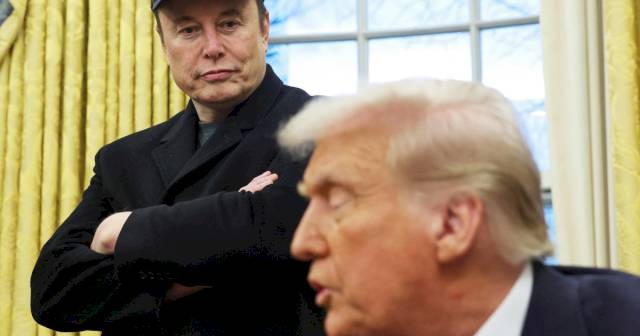
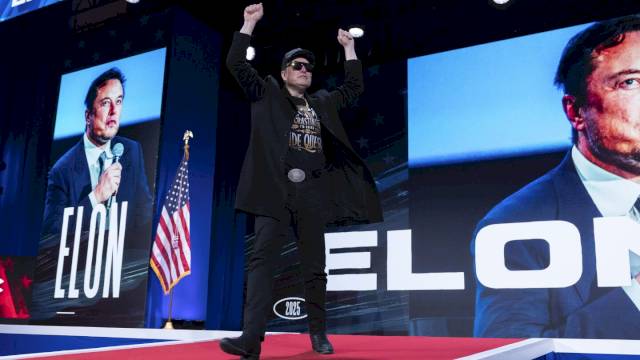
    Democrats and even some Republicans were critical of Musk’s ultimatum, which came just hours after Trump encouraged him on social media to “get more aggressive” in reducing the size of the government through his so-called Department of Government Efficiency, or DOGE. The day before, Musk celebrated his new position by waving a giant chainsaw during an appearance at a conservative conference.

    Sen. John Curtis, R-Utah, was among the members of Trump’s own party who had concerns. Utah has 33,000 federal employees.

    “If I could say one thing to Elon Musk, it’s like, please put a dose of compassion in this,” Curtis said. “These are real people. These are real lives. These are mortgages. … It’s a false narrative to say we have to cut and you have to be cruel to do it as well.”

    Rep. Mike Lawler, R-N.Y., questioned the legal basis the Trump administration would have for dismissing tens of thousands of workers for refusing to heed Musk’s latest demand, though the email did not include the threat about workers losing their jobs.

    For Sen. Chris Van Hollen, D-Md., there was no doubt: “The actions he’s taking are illegal, and we need to shut down this illegal operation.”

    Trump mocked the affected workers in a meme he posted Sunday on his social media network. The post featured a cartoon character writing a list of accomplishments from the previous week led by, “Cried about Trump,” “Cried about Elon,” “Made it into the office for once,” and “Read some emails.”

    Newly confirmed FBI Director Kash Patel, an outspoken Trump ally, instructed bureau employees to ignore Musk’s request, at least for now.

    “The FBI, through the Office of the Director, is in charge of all of our review processes, and will conduct reviews in accordance with FBI procedures,” Patel wrote in an email confirmed by the AP. “When and if further information is required, we will coordinate the responses. For now, please pause any responses.”

    Ed Martin, the interim U.S. attorney for the District of Columbia, sent his staff a message Sunday that may cause more confusion. Martin noted that he responded to Musk’s order.

    “Let me clarify: We will comply with this OPM request whether by replying or deciding not to reply,” Martin wrote in the email obtained by the AP, referring to the Office of Personnel Management.

    “Please make a good faith effort to reply and list your activities (or not, as you prefer), and I will, as I mentioned, have your back regarding any confusion,” Martin continued. “We can do this.”

    The night before, Martin had instructed staff to comply. “DOGE and Elon are doing great work. Historic. We are happy to participate,” Martin wrote at that time.

    Officials at the Departments of State and Defense were more consistent.

    Tibor Nagy, acting undersecretary of state for management, told employees in an email that department leadership would respond on behalf of workers. “No employee is obligated to report their activities outside of their Department chain of command,” Nagy wrote in an email.

    Pentagon leadership instructed employees to “pause” any response to Musk’s team as well. “The Department of Defense is responsible for reviewing the performance of its personnel and it will conduct any review in accordance with its own procedures,” according to an email from Jules Hurst, the deputy undersecretary of defense for personnel and readiness. “When and if required, the Department will coordinate responses.”

    Everett Kelley, president of the 800,000-member American Federation of Government Employees, said in a letter Sunday to the administration that it should rescind Musk’s original email request and apologize to all federal workers by the end of the day.

    “We believe that employees have no obligation to respond to this plainly unlawful email absent other lawful direction,” he wrote, describing Musk as “unelected and unhinged.”

    Thousands of government employees have already been forced out of the federal workforce — either by being fired or through a “deferred resignation’’ offer — during the first month of Trump’s second term.

    There is no official figure available for the total firings or layoffs so far, but the AP has tallied hundreds of thousands of workers who are being affected. Many work outside of Washington.

    Musk on Sunday called his latest request “a very basic pulse check.”

    “The reason this matters is that a significant number of people who are supposed to be working for the government are doing so little work that they are not checking their email at all!” Musk wrote on X. “In some cases, we believe non-existent people or the identities of dead people are being used to collect paychecks. In other words, there is outright fraud.”

    He has provided no evidence of such fraud. Separately, Musk and Trump have falsely claimed in recent days that tens of millions of dead people over 100 years old are receiving Social Security payments.

    Meanwhile, thousands of other employees are preparing to leave the federal workforce this coming week, including probationary civilian workers at the Pentagon and contractors at the U.S. Agency for International Development. The USAID move escalates a monthlong administration assault on the international humanitarian agency that has frozen its funding.

    Curtis and Van Hollen were on CBS’ “Face the Nation” and Lawler appeared on ABC’s `This Week.”

    ___

    Peoples reported from New York. Associated Press writers Byron Tau, Ellen Knickmeyer and Tara Copp contributed to this report.

  • Trump’s Frustration With Generals Led to Picking Dan Caine for Joint Chiefs Chairman – The New York Times

    Trump’s Frustration With Generals Led to Picking Dan Caine for Joint Chiefs Chairman – The New York Times

    Advertisement

    SKIP ADVERTISEMENT

    You have a preview view of this article while we are checking your access. When we have confirmed access, the full article content will load.

    Trump’s Frustration With Generals Resulted in an Unconventional Pick

    Lt. Gen. Dan Caine, a retired three-star Air Force officer, quickly moved up the list of candidates to be the next chairman of the Joint Chiefs of Staff.

    Two men in camouflage uniforms.
    Lt. Gen. Dan Caine with an Iraqi general in Mosul, Iraq, in 2018. General Caine graduated from the Virginia Military Institute in 1990 with a degree in economics and became an F-16 pilot.Credit…Spc. Keisha Brown/U.S. Army

    By late last week, President Trump had decided to fire Gen. Charles Q. Brown Jr., the chairman of the Joint Chiefs of Staff, and replace him with one of two very different candidates, according to two administration officials.

    One was Gen. Michael E. Kurilla, a hard-charging Army four-star general who oversees U.S. military operations in the Middle East, one of the Pentagon’s highest-profile assignments.

    The other was a little-known retired three-star Air Force officer, Dan Caine, with an unorthodox career path that included time as a fighter pilot, the top military liaison to the C.I.A. and an Air National Guard officer who founded a regional airline in Texas.

    Mr. Trump and General Caine met for an hour at the White House on Feb. 14. The president largely made up his mind during a meeting with Defense Secretary Pete Hegseth on Thursday, aides said.

    And in a message on social media the next evening, Mr. Trump announced that he had picked General Caine, calling him “an accomplished pilot, national security expert, successful entrepreneur, and a ‘warfighter’ with significant interagency and special operations experience.”

    Image

    When President Trump announced that he had picked General Caine, he called him “an accomplished pilot, national security expert, successful entrepreneur, and a ‘warfighter’ with significant interagency and special operations experience.”Credit…U.S. Air Force

    Thank you for your patience while we verify access. If you are in Reader mode please exit and log into your Times account, or subscribe for all of The Times.


    Thank you for your patience while we verify access.

    Already a subscriber? Log in.

    Want all of The Times? Subscribe.

    Advertisement

    SKIP ADVERTISEMENT

  • Trump’s tariffs and rhetoric strain historic Windsor-Detroit friendship – NPR

    Trump’s tariffs and rhetoric strain historic Windsor-Detroit friendship – NPR

    Trump’s tariffs and rhetoric strain historic Windsor-Detroit friendship

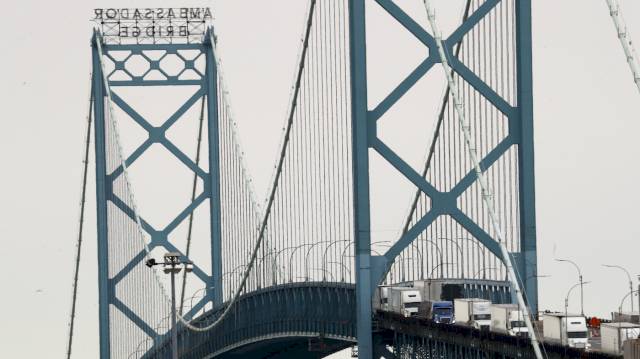
    Vehicles move across the Ambassador Bridge between Detroit and Windsor, Ontario. Paul Sancya/AP hide caption

    toggle caption

    Paul Sancya/AP

    Vehicles move across the Ambassador Bridge between Detroit and Windsor, Ontario.

    Paul Sancya/AP

    President Donald Trump’s tariffs and comments about turning Canada into the 51st state have tested U.S. relations with the country. One example is the deterioration of longstanding bonds between Detroit, Michigan and its neighbor across the river, Windsor, Ontario.

    NPR’s Don Gonyea is a Detroit native and current resident of the city. He’s had a front row view to changing attitudes between the two populations who have long enjoyed a friendly, symbiotic relationship.

    For sponsor-free episodes of Consider This, sign up for Consider This+ via Apple Podcasts or at plus.npr.org.

    Email us at considerthis@npr.org.

    This episode was produced by Lauren Hodges and edited by Megan Pratz. Our executive producer is Sami Yenigun.

  • Trump and Elon Musk’s ‘DOGE dividends’ might not benefit low-income Americans – NBC News

    Trump and Elon Musk’s ‘DOGE dividends’ might not benefit low-income Americans – NBC News

    James Fishback said the whole idea came to him in a recent dream: Send American taxpayers dividend checks with whatever money Elon Musk’s Department of Government Efficiency saves as it dismantles parts of the federal government.

    The idea took off on Tuesday when Fishback tweeted about it and Musk responded, pledging to share the idea with Trump. The president himself promoted the specifics of Fishback’s idea from the stage at the FII Priority Summit in Miami Beach on Wednesday.

    “There’s even under consideration a new concept where we give 20% of the DOGE savings to American citizens, and 20% goes to paying down debt, because the numbers are incredible, Elon,” Trump said.

    But if Trump follows through with the plan as Fishback envisions it, low-income Americans may not benefit.

    Fishback, CEO of the investment firm Azoria who briefly worked with former presidential candidate Vivek Ramaswamy as DOGE was just getting off the ground, told NBC News in an interview that he awoke from that dream and, working with the lead researcher at his firm, composed a brief proposal to send millions of American households checks.

    “We fleshed this thing out in about two and a half hours,” Fishback said Wednesday. “We sent it to [White House chief of staff] Susie [Wiles], sent it to some folks in the admin, sent it to some folks at Treasury, and here we are a day or so later, with it being shared with President Trump from Elon. And so it’s exciting.”

    The episode illuminated the speed with which Musk can help draw the president’s attention to seemingly random ideas — even one from a little-known 30-year-old investor — that are floating around on his social media platform X.

    Something like a “DOGE dividend” wouldn’t be an entirely foreign concept to Trump; it follows the playbook of a pandemic-era program from his first term. Then, the government sent direct payments to Americans with the president’s name attached.

    “The president of the United States should sign the checks, and the checks should include the word DOGE, very simply, because we have to be honest,” Fishback said, adding: “If I’m the CEO of Azoria and I cut our employees a check every month, my name is on it. President Trump is the leader of the country, the duly elected president of the United States. His name should be on the checks. As should DOGE, because that is what’s responsible for these savings.”

    The difference during the pandemic was that people who made below a certain amount all received the checks.

    In his proposal, Fishback starts from the presumption that DOGE will achieve $2 trillion in cuts to the government. He takes 20% of those savings, or $400 billion, and divides them among 79 million taxpaying households, to receive $5,000 each. Importantly, the rebate would be sent only to households that are net-income taxpayers — people who pay more in taxes than they get back — with lower-income Americans not qualifying for the return. According to the Pew Research Center, most Americans who have an adjusted gross income of under $40,000 pay effectively no federal income tax.

    Since the dividend checks would be funded by dollars that have already been appropriated rather than the deficit-financed stimulus checks, Fishback writes, they would not worsen inflation.

    “The DOGE Dividend is different from past stimulus checks (e.g. 2021 American Rescue Plan) because only tax-paying households receive it,” he writes. “Tax-paying households are more likely to save (not spend) a transfer payment like the DOGE Dividend as consumption is a lower share of their income. … There is nothing inflationary about paying off debt, saving for emergencies, or investing in college or retirement. In fact, debt paydowns are actually deflationary.”

    In an interview, Fishback said the dividend only going to households above a certain income threshold should ease concerns about any inflationary pressure the rebates would cause, adding that the pandemic-era checks were sent “indiscriminately.”

    “A lot of low-income households essentially saw transfer payments of 25 to 30% of their annual … income,” Fishback said, adding, “This exclusively goes to households that are net-payers of federal income tax, and what that means is that they have a lower propensity to spend and a higher propensity to save a transfer payment like the DOGE dividend.”

    Yet even among Republicans, there is no consensus for sending Americans checks with money DOGE is able to save — the total amount of which is, so far, unclear. The group claims on its website that it has saved $55 billion so far, but some claims about its work have not stood up to the most basic scrutiny. In one example, DOGE claimed to have saved $8 billion from a single canceled contract at the Department of Homeland Security. It turns out, that contract clearly stated it was for just $8 million.

    Musk initially pledged that DOGE would find $2 trillion in savings before the middle of next year, but has softened his expectations since.

    “We have to actually figure out if any money is saved at all before promising people checks in the mail,” said Mark Zandi, the chief economist at Moody’s Analytics, adding: “I thought this was about taking a crack at reducing our deficit. So if you give a dividend, that certainly doesn’t help in that regard. It just feels like putting the cart way before the horse. I’ve got the cart. I don’t even see the horse yet.”

    As for the idea that the rebates will be reserved for American households above a certain income threshold, Zandi agreed that such a model would lead to a higher rate of receivers saving the payments rather than spending them immediately.

    “We’re slicing a hair,” he said. “These are things really on the margin. The broader point is … DOGE has got a long way to go here to see if DOGE saves anything and ultimately is a benefit for the economy or not before you start talking about dividend checks.”

    Asked about the idea at the Conservative Political Action Conference on Thursday, House Speaker Mike Johnson, R-La., did not appear warm to the proposal.

    “Well, look. I mean, politically that would be great for us, you know. It gives everybody a check,” Johnson said. “But if you think about our core principles, right, fiscal responsibility is what we do as conservatives. That’s our brand. And we have a $36 trillion federal debt, we have a giant deficit that we’re contending with. I think we need to pay down the credit card, right?”

    From the stage at CPAC that same day, Musk said he discussed the proposal with Trump and that the president is on board. Musk, the world’s richest man who has become perhaps the single most influential presidential adviser, said “it sounds like … that’s something we’re going to do.”

    The White House declined to comment on the proposal.

    Fishback traveled to Washington this week and said he had a number of promising conversations on the proposal with stakeholders, though he would not divulge with whom. He did post a video showing him having a brief conversation with Musk on Thursday.

    “Now look, for folks who want to criticize this plan and say, well, DOGE would never deliver $2 trillion in total savings, we disagree, but let’s just assume that they’re right on that,” Fishback said. “Let’s say it’s only $1 trillion. OK, so then the check goes from $5,000 to $2,500. Let’s assume that it’s only $500 billion. … Then the check is $1,250. That’s real money.”

    “I’ve got to tell you the truth here. It’s not necessarily about the dollar amount,” he added. “It’s about the symbolism of the government sending money back in the form of restitution to compensate hardworking Americans, whether they’re in East Baltimore or whether they’re in East Palestine that the government misused and abused their hard-earned tax dollars.”

    But as Zandi noted, the cuts themselves do not come free of any potential economic consequences.

    “It’s not like there’s a free lunch here,” he said. “So if you fire people, that’s going to be a hit to the economy. That has a cost. You’ve got to see exactly what the fallout of all this is on the broader economy, and that’s just the near term. What about the longer term? You’re making the assumption here, at least the implicit assumption, that the jobs you’re cutting and the work you’re scaling back really was not important, [that] there was no benefit from those folks working in the FAA or USAID or the FTC and FDA.”

    “That’s a pretty strong position to take that these jobs have no benefit and no importance in the long run, that they’re not doing things that are important to the well functioning of our economy and the nation,” he added. “I don’t pretend to know, but I don’t think anyone else knows that either.”

    Allan Smith

    Allan Smith is a political reporter for NBC News.

  • Trump fires Gen. Charles Q. Brown as chair of the Joint Chiefs of Staff, other senior officers – CBS News

    Trump fires Gen. Charles Q. Brown as chair of the Joint Chiefs of Staff, other senior officers – CBS News

    / CBS/AP

    Trump fires U.S. highest-ranking military officer

    Trump fires top-ranking military officer in an unprecedented move 02:01

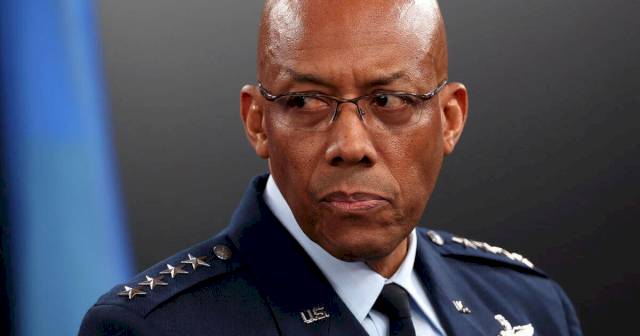
    President Trump abruptly fired Air Force Gen. Charles Q. Brown as chairman of the Joint Chiefs of Staff on Friday, sidelining a history-making fighter pilot and respected officer as part of a campaign to rid the military of leaders who support diversity and equity in the ranks.

    The ouster of Brown, only the second Black general to serve as chairman, sent shock waves through the Pentagon. His 16 months on the job were consumed with the war in Ukraine and the expanded conflict in the Middle East.

    DOD Secretary Austin Hosts Ukraine Defense Contact Group Meeting
    Former U.S. Chairman of the Joint Chiefs of Staff General Charles Q. Brown Jr. / Getty Images

    “I want to thank General Charles ‘CQ’ Brown for his over 40 years of service to our country, including as our current Chairman of the Joint Chiefs of Staff. He is a fine gentleman and an outstanding leader, and I wish a great future for him and his family,” Mr. Trump posted on social media.

    Mr. Trump says he is nominating retired Air Force Lt. Gen. Dan “Razin” Caine to be the next chairman.

    A U.S. defense official told CBS News that Brown was informed of the decision to fire him via a phone call from Secretary Pete Hegseth before Mr. Trump’s Truth Social post.

    Hegseth also announced in a statement Friday evening that Chief of Naval Operations Lisa Franchetti and Vice Chief of Staff of the Air Force James Slife were also being fired. Admiral James W. Kilby, Vice Chief of Naval Operations, was appointed Acting Chief of Naval Operations on Saturday. 

    Franchetti made history in 2023 when she became the first woman to lead the Navy. She was informed in a call from Hegseth that he intended to replace her, a defense official told CBS News. The call occurred before Hegseth’s statement was issued. 

    Judge advocates general for the Army, Navy and Air Force were also being replaced, Hegseth said. A source familiar with the matter told CBS News on Sunday that Lt. Gen. Jennifer Short, who was the senior military assistant to the defense secretary, was also let go from her position over the weekend.

    Mr. Trump acted despite support for Brown among key members of Congress and a seemingly friendly meeting with him in mid-December when the two were seated next to each other for a time at the Army-Navy football game. Brown had been meeting regularly with Hegseth, who took over the top Pentagon job just four weeks ago.

    Hegseth said in his statement that Caine “embodies the warfighter ethos and is exactly the leader we need to meet the moment. I look forward to working with him.”

    Hegseth said Brown “served with distinction in a career spanning four decades of honorable service,” and praised him as a “thoughtful adviser.”

    Caine was sworn in as associate director for Military Affairs at the Central Intelligence Agency in November 2021, according to his biography on the Air Force’s website, and his most recent post was as director of special programs for the Defense Department’s Special Access Program Central Office at the Pentagon. As a command pilot, he has logged more than 2,800 hours in an F-16, including more than 150 combat hours.

    He earned a bachelor’s degree in economics from the Virginia Military Institute in 1990.

    Caine is a three-star general. Traditionally, four-star generals are nominated to chair the Joint Chiefs of Staff. 

    Charlie D’Agata and Eleanor Watson contributed to this report.

  • Trump envoy Steve Witkoff describes 3.5-hour meeting with Putin in Moscow – CBS News

    Trump envoy Steve Witkoff describes 3.5-hour meeting with Putin in Moscow – CBS News

    face-the-nation

    By Kaia Hubbard

    / CBS News

    Trump envoy on Israel-Hamas talks, meeting with Putin

    Trump envoy Steve Witkoff on Israel-Hamas talks, meeting with Putin 08:46

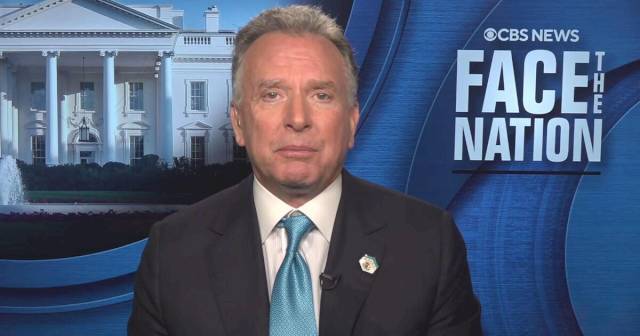
    Washington — Steve Witkoff, President Trump’s special envoy to the Middle East, described on Sunday a three-and-a-half hour meeting he had with Russian President Vladimir Putin earlier this month, part of what he said was a “trust-building” assignment given to him by President Trump.

    Witkoff traveled to Moscow to bring home Marc Fogel, an American who had been serving a 14-year sentence in Russia for traveling with medical marijuana. Russia freed Fogel on Feb. 11. Witkoff told a conference last week that he met with Putin before leaving the country with Fogel.

    Appearing on “Face the Nation with Margaret Brennan,” Witkoff said there were two translators at the meeting with Putin, and he was the only U.S. official present. He said he was “intent on carrying a message from the president to President Putin” and that he was told that the Russian leader “had something for me to transmit back to the president.”

    “The meeting ended, I looked at my watch and it was close to three and a half hours that we were in there. And hopefully that suggests that a lot of good things got accomplished,” Witkoff said.

    A real estate investor and friend of Mr. Trump’s who has taken an outsized role in his foreign policy, Witkoff noted that Mr. Trump believes that “trust-building begins with good, proper communication.”

    “We just had a great discussion, me and President Putin, and now it will be up to President Putin and President Trump to work something out, and I think they’re going to be successful,” Witkoff said. 

    In addition to his trip to Moscow, Witkoff also joined Russian and U.S. representatives at a meeting in Saudi Arabia last week, where the officials agreed to begin working toward an end to the war in Ukraine and related economic opportunities, though no Ukrainian officials were present.

    Witkoff said the officials did not discuss lifting American sanctions on Russia, but he noted that if a peace deal is reached, “there would be an expectation” that American companies could return to the country to do business.

    Meanwhile, Mr. Trump has argued that Ukraine should give something to the U.S. in return for the American aid the country has received, pointing to U.S. interest in Ukraine’s rare minerals. And the president has escalated a public feud with Ukrainian President Volodymyr Zelenskyy in recent days, calling Zelenskyy a “dictator.” Preparations are underway for a meeting between Mr. Trump and Putin, Russia’s deputy foreign minister told state media on Saturday.

    Witkoff said the president’s agenda is “to end this carnage,” adding that the war in Ukraine “didn’t need to happen, and it doesn’t need to continue.”

    “So we’re on it at his direction,” Witkoff said. “And I think there is, you’re going to see some real positive developments in the near-term future.”

    Kaia Hubbard

    Kaia Hubbard is a politics reporter for CBS News Digital, based in Washington, D.C.

    Twitter

  • A federal worker tried to take Trump’s ‘Fork’ resignation offer. Here’s what happened – NPR

    A federal worker tried to take Trump’s ‘Fork’ resignation offer. Here’s what happened – NPR

    Liz Goggin, a licensed clinical social worker with the Veterans Health Administration (VA), accepted the Trump administration's deferred resignation offer before learning she was exempt.

    Liz Goggin, a licensed clinical social worker with the Veterans Health Administration (VA), accepted the Trump administration’s deferred resignation offer before her agency said her position was exempt. Justine Kenin/NPR hide caption

    toggle caption

    Justine Kenin/NPR

    The “Fork in the Road” email arrived in Liz Goggin’s inbox around 11 p.m. on Jan. 28th.

    The email blast from the U.S. Office of Personnel Management (OPM) went to nearly all federal employees — some 2.3 million people across the U.S.

    The memo presented federal workers with a choice: Offer your resignation by Feb. 6, in exchange for pay and benefits through the end of September. Or remain in your position, with the understanding that you may be laid off.

    Goggin is among roughly 75,000 federal employees who agreed to resign, according to OPM. But she is also one of an unknown number of people who have since learned they can’t take the deal, because their positions are exempt.

    Even as a federal judge has cleared the way for the Trump administration’s deferred resignation program to go forward, there remains much confusion over who agreed to exactly what — and what they’ll get in return.

    For now, Goggin assumes her resignation is off.

    “But like, who knows?” she says, “I had regrets about telling my supervisor given the whole thing is kind of unraveling.”

    A good offer “in the abstract”

    By the time Goggin received the “Fork in the Road” offer, her household was already in upheaval. The Trump administration’s freeze on foreign aid was directly impacting her husband’s position with a nongovernmental organization.

    “It became pretty clear that he was very likely to lose his job,” says Goggin, a scary prospect given the couple has two young children and a mortgage.

    Still, she wasn’t immediately drawn to the resignation offer.

    “My initial reaction, honestly, was kind of like fear,” she says. “If a lot of people take this, what’s going to happen to services — both at my place of work at the VA, but also other agencies that are doing important work?”

    Like many federal employees, she was also a bit skeptical of the deal.

    But in the days that followed, OPM issued an FAQ clarifying that employees who resigned wouldn’t be expected to work during the “deferred resignation period” and would be allowed to get a second job.

    “In the abstract, it did sound like a good offer,” she says. “My husband and I talked about it, and if this offer was legitimate, it seemed like, wow… I could potentially be making double salary for six months, which would give him some time to regroup and find a job he cares about.”

    That weekend, she made her decision. She replied to the original email with the word “Resign” and hit send.

    The following week, in an effort to be transparent, Goggin emailed her supervisor about her decision.

    But a few days later, she got another surprise in her inbox: an email from the VA, exempting scores of positions from the resignation offer, including social workers.

    “Which didn’t surprise me,” says Goggin. “Of course, the VA is a health care agency trying to fulfill its mission.”

    She has still not received any direct communication from OPM informing her that her acceptance of the “Fork” deal has been canceled.

    For now, she assumes she still has a job.

    A mission at odds with Trump’s executive actions?

    Goggin originally came to the VA through a postgraduate fellowship, where she worked with incarcerated veterans. The experience was so rewarding she decided to stay.

    These days, she works with veterans of all ages, including Vietnam War vets as well as those who deployed to Iraq and Afghanistan.

    “Their life experiences are quite unique, and they also have a lot of worldly intelligence, having kind of been scattered all over the planet serving their country,” she says.

    Most of her current clients are Black. As a White clinician, she says, she relies on trainings and discussions with colleagues to work through issues and figure out how to provide the best care. She says those sessions increase her awareness and understanding of other people’s experiences, including how they may be impacted by racism and other forms of oppression.

    But since President Trump’s second term began, people have been pulled from trainings and discouraged from gathering to discuss such topics.

    “At this point, those meetings aren’t happening,” she says.

    She even wonders whether support groups for her clients, centered around race and gender, can continue.

    Challenging social injustices while respecting individuals’ inherent dignity and worth are core values of social work, embedded in the profession’s code of ethics.

    Now, Goggin worries whether social workers at the VA will be able to abide by that code, given Trump’s executives actions to end diversity, equity and inclusion initiatives and to recognize male and female as the only two sexes.

    “There’s been some vagueness as to what this actually means,” she says. “I think the atmosphere has been pretty tense, and people are really uncertain and questioning like, what is okay now?”

    She says she doesn’t know what this means for the future. And, she’s worried about that.

    Have information you want to share about ongoing changes across the federal government? Reach out to the author. Andrea Hsu is available through encrypted communications on Signal at andreahsu.08.

  • Trump’s Gaza takeover ‘plan’ puts Egypt in a tough spot – Al Jazeera English

    Trump’s Gaza takeover ‘plan’ puts Egypt in a tough spot – Al Jazeera English

    The meeting on Tuesday between Jordan’s King Abdullah II and US President Donald Trump ended in tense anticipation of what will come next for the Gaza Strip.

    At stake was Trump’s suggestion that the United States “take over” the enclave and expel Palestinians to Egypt and Jordan.

    King Abdullah mentioned during an impromptu news conference that an alternative plan to rebuild Gaza without ethnically cleansing it would be crafted by Arab countries, including Egypt, which was already planning an emergency Arab summit on Gaza on February 27.

    Hours later, Egypt issued a statement confirming it would present “a comprehensive vision for rebuilding Gaza while ensuring Palestinians remain on their land” and reiterated its commitment to working with the US to reach “a just settlement to the Palestinian issue”.

    What is at stake for Egypt?

    “It’s hard to know how seriously to take Trump’s proposed US takeover of Gaza,” Jacob Eriksson, lecturer of post-war recovery studies at the University of York, told Al Jazeera.

    “If Trump persists, however, it could put Egypt in a difficult position,” he added, referring to Trump’s threats that he would freeze aid funds to Egypt if it does not cooperate.

    “At a time when Egypt continues to face mounting economic challenges linked to debt and inflation, this could have a significant impact.”

    Since 1946, the United States has given Egypt more than $85bn in bilateral foreign aid, including military and economic assistance, according to the American Chamber of Commerce in Egypt.

    And Egypt was the fifth-largest recipient of US foreign aid in 2023, receiving $1.45bn, 85 percent of which was for the military sector.

    Egyptian journalist Hossam El-Hamalawy said that the aid Cairo receives “is a statement that Egypt is a close ally and is a partner for Washington” and signifies strong political backing from Washington.

    But money isn’t everything.

    Although foreign support is vital for the survival of the current Egyptian administration, so is internal political peace, which could be destabilised if the expulsion of Palestinians is allowed.

    “Generation after generation of Egyptian youth have had Palestine as their gateway into politics,” El-Hamalawy said.

    “In addition … [Egyptian President Abdel Fattah el-Sisi] is very worried about the replication of the Beirut scenario where Palestinian resistance operations in one way or another gave Israel a justification to go into Lebanon and occupy chunks of it for a very long time,” El-Hamalawy added, referring to Israeli attacks on Lebanon and occupation of its territory for different periods, including today.

    Counter-offer

    For now, until Trump stops talking about forcing the displacement of Palestinians, el-Sisi has reportedly said that he will not attend any talks at the White House.

    Egypt has little choice but to work with other Arab states on a counter-proposal that they can defend together.

    “Any drastic action could endanger important agreements,” political analyst Abdallah Nasef, who believes Cairo will have to compromise a little in the proposal, told Al Jazeera.

    “Egypt could, similar to Jordan, offer to take in injured individuals and their families, albeit at a larger rate and number than that proposed by Jordan,” Nasef suggested.

    King Abdullah said on Tuesday that Jordan could “right away” take 2,000 sick children.

    Egypt has been treating injured Palestinians in its hospitals since the start of the war, and will likely continue to do so in larger numbers when the crossing opens.

    “While any significant economic contribution to the reconstruction of Gaza is likely to prove difficult given aforementioned economic challenges, Egyptian officials … would undoubtedly continue to offer its services as a mediator and a political partner,” researcher Jacob Eriksson said, doubtful of how much Egypt could financially contribute.

    Reconstruction efforts

    Israel has said that it will not compensate Palestinians or help to pay to fix the damage it has wrought in Gaza. Instead, it would be up to regional countries and the international community to implement any plan put forward by Egypt and Jordan.

    “One can speculate that, definitely, [this plan] will involve enlisting massive amounts of cash and finances from the Gulf … to speed up the reconstruction process for the Palestinians without displacing them,” El-Hamalawy said.

    Egyptian construction companies do appear ready to cooperate with an international effort to rebuild Gaza. For instance, real estate and construction tycoon Hisham Talaat Moustafa, said in a TV interview on February 9 that he has been working on a reconstruction plan that would require the participation of about 40 to 50 construction companies from Egypt and other countries.

    “Egypt could contribute to reconstruction efforts while simultaneously guaranteeing that Gazans don’t need to be forced out,” Nasef said, adding that “They won’t have to if caravans and tents, which Israel continues to block, are allowed into the Strip.” He agreed with El-Hamalawy, though, that Egypt’s efforts would have to be bankrolled by the Gulf, due to Egypt’s economic problems.

    Gulf countries have played a significant role in funding the aid reaching the Gaza Strip in the last few months, with the Gulf Cooperation Council announcing in December that its member states – Bahrain, Kuwait, Oman, Qatar, Saudi Arabia, and the United Arab Emirates – had collectively given $650m in humanitarian aid to Gaza, along with the occupied West Bank, since October 2023.

    The reconstruction of Gaza, where the vast majority of buildings and infrastructure has been destroyed by Israel, will cost far more.

    But with Trump’s Gaza displacement plan complicating matters and a ceasefire deal in Gaza that has threatened to collapse in the past week, Arab countries are under pressure to respond.

  • Mitch McConnell: Kentuckians can’t afford the high cost of Trump’s tariffs – Courier Journal

    Mitch McConnell: Kentuckians can’t afford the high cost of Trump’s tariffs – Courier Journal

    • Tariffs are bad policy that make it more expensive to do business in America, driving up consumer costs.
    • The Trump administration’s broad-based tariffs could have long-term consequences for Kentucky businesses that sell their products around the globe or rely on global supply chains.
    • Preserving the long-term prosperity of American industry and workers requires working with our allies, not against them. Trade wars hurt working people the most.

    Little under a century ago, an ill-fated law helped spiral the Wall Street crash of 1929 into a worldwide depression. The Smoot-Hawley Tariff encompassed roughly one-quarter of all imports, flaring tensions with U.S. trading partners and halving American imports and exports as a result. Caught in the crosshairs, Americans learned the hard way that trade wars are expensive, and today, we ought to be careful deciding with whom to pick them.

    In recent weeks, the president sought to impose sweeping tariffs on Mexico, Canada and China, as well as key imports, such as steel and aluminum. While the administration walked back plans to levy 25% duties on imports from Mexico and Canada — paused now for 30 days as both nations brokered deals to tighten border security and crack down on illegal drugs — the president’s aggressive proposals leave big, lingering concerns for American industry and workers.

    Indeed, it’s high time for America’s closest neighbors to take the crisis at our border seriously. But no matter our best intentions, tariffs are bad policy. As Sen. Rand Paul, put it: “Tariffs are simply taxes… Taxing trade will mean less trade and higher prices.” So Republicans ought to be clear-eyed about the full, unadulterated impact of tariffs as we work to restore sound fiscal policy to our government.

    Blanket tariffs make it more expensive to do business in America, driving up costs for consumers across the board. These aren’t just abstract concerns. Broad-based tariffs could have long-term consequences right in our backyard. Consider our state’s 75,000 family farms that sell their crops around the globe, or the hardworking Kentuckians who craft 95% of the world’s bourbon, or our auto industry that relies on global supply chains to support the livelihoods of thousands of workers in the commonwealth.

    Bourbon whiskey barrels are filled at the Buffalo Trace Distillery in Frankfort, Kentucky. A full barrel weighs anywhere between 500 and 550 pounds. Bourbon barrels are usually made from American white oak, which can give bourbon flavors such as vanilla, caramel, and coconut. January 29, 2025.

    Tariffs could cost average Kentuckian $1,200 a year

    In Kentucky, local storeowners are already hearing about their suppliers’ prices going up. One estimate suggests the president’s tariffs could cost the average Kentuckian up to $1,200 each year. And it’s not just about rising prices here at home. During the last Trump administration, retaliatory tariffs from trade partners set off a broader trade war that hit wide swaths of American industry, from agriculture to manufacturing to aerospace and motor vehicles to distilled spirits. Already, Canada announced retaliatory measures that take direct aim at Kentucky production, targeting products like peanut butter and whiskey.

    Need a break? Play the USA TODAY Daily Crossword Puzzle.

    Hundreds of thousands of U.S. jobs are tied up, directly or indirectly, in trade with Canada and Mexico. Our neighbors to the north and south buy over half a trillion dollars’ worth of our goods and services each year — including nearly $10 billion in manufactured goods and $300 million in agricultural exports from Kentucky alone. These economic tailwinds touch virtually every family and every industry.

    International trade is a two-way street

    America’s open markets also fuel billions in capital investment from businesses abroad. In Kentucky, over 60% of all counties are home to at least one international business. These are industrial suppliers, auto manufacturers and makers of consumer goods from across the world that support roughly 100,000 jobs in the commonwealth. But these investments don’t happen on their own. Foreign businesses choose America because they can count on our commitment to free markets and free enterprise. Sudden shifts to protectionism undermine the certainty these companies rely on to do business in the United States.

    When we engage with our allies and partners, we unlock new sources of economic strength — lower prices, more choices for consumers, and greater innovation. And we ought to remind ourselves that trade is a two-way street.

    Take our work on the USMCA under the first Trump administration. This landmark deal with Canada and Mexico leveled the playing field for American workers, reduced the incentives to ship American jobs to Mexico, and expanded American producers’ access to sell goods to these neighboring markets — including Kentucky-made products like bourbon, cars, aerospace parts and agricultural commodities.

    Trade wars with our partners hurt working people the most

    That doesn’t mean the system is perfect. For the adversaries coordinating to threaten America’s security and undermine our interests, economic predation is a weapon. And holding China and other anti-competitive countries accountable for predatory practices that abuse our system should absolutely be an urgent priority. We should continue to push back against unfair competition and shore up critical supply chains.

    But preserving the long-term prosperity of American industry and workers requires working with our allies, not against them. Trade wars with our partners hurt working people most. And the president has better tools to protect American workers without forcing our families and businesses to absorb higher costs.  

    As the president and Republicans work to undo the damage of the last four years, we ought to strengthen our friendships abroad, and reinforce our allies as pillars of American prosperity and security. At a time when Americans are tightening their belts, we would do well to avoid policies that heap on the pain.

    Mitch McConnell

    Mitch McConnell is the senior senator of Kentucky. He is the longest-serving Senate Party Leader in American history. Chair of Senate Rules and Defense Appropriations. Senior member of Senate Agriculture Committee.