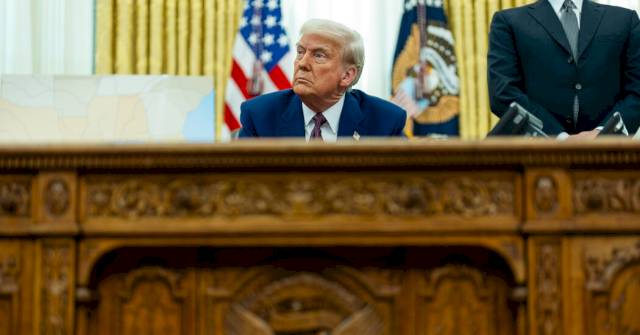
Donald Trump’s second term has only just begun, but he and his allies are already teasing the prospect of seeking a third. “I suspect I won’t be running again,” Trump told his Republican colleagues in the House last November, before caveating: “Unless you say, ‘He’s so good we’ve got to figure something else out.’”
The 22nd Amendment has already had its say: “No person shall be elected to the office of the President more than twice, and no person who has held the office of President, or acted as President, for more than two years of a term to which some other person was elected President shall be elected to the office of the President more than once.”
But the Constitution hasn’t proved to be a deterrent for Trump before.
Trump’s not the first President to think he should have more than eight years in the White House. Democrat Franklin Delano Roosevelt was elected to a fourth term in 1944 before he died in 1945, prompting Republicans in Congress to seek a constitutional amendment to formalize term limits—which had before been just a norm established by George Washington to step aside after two terms, though several sought more. Ulysses Grant and Theodore Roosevelt both unsuccessfully vied for third terms, and Woodrow Wilson planned to, too, until he died during his second.
Even after the 22nd Amendment’s ratification in 1951, some Presidents have toyed with the idea of a third term. In 1986, Ronald Reagan half-jokingly raised “giving it one more try,” according to a TIME report at the time, which added: “Reagan has come to see the 22nd Amendment as limiting presidential leverage, and believes it should be repealed, effective after he leaves office. ‘It’s only democratic,’ he said, for citizens to vote for a President as many times as they want. Some future President, that is.”
And Barack Obama said in 2015 that he believed he would win if he could run for a third term, but he admitted that he couldn’t because “the law’s the law.”
Trump, however, doesn’t seem so sure about that.
Here’s what to know about a potential Trump third term and what legal experts have to say about it.
What Trump has said about a third term
One of the earliest times Trump has floated the concept of extending his presidency beyond a second term was in 2020, while campaigning for reelection in Reno, Nev. “We’re going to win Nevada and we’re going to win four more years in the White House,” he said. “And then after that we’ll negotiate. Right? Because we’re probably—based on the way we were treated—we’re probably entitled to another four after that.”
In an interview with TIME in April 2024, however, Trump dismissed the idea of challenging the 22nd Amendment. “I’m going to serve one term, I’m gonna do a great job,” he said. “And then I’m gonna leave.”
But on the trail again in May, at the National Rifle Association’s annual meeting, Trump then said: “You know, FDR 16 years—almost 16 years—he was four terms. I don’t know, are we going to be considered three-term? Or two-term?”
On Jan. 25, after his second-term inauguration, Trump, at an event in Las Vegas, said: “It will be the greatest honor of my life to serve, not once but twice—or three times or four times.” After cheers from his supporters, Trump smiled and said, “headlines, for the fake news,” before clarifying, “no, it will be to serve twice.”
But two days later Trump, speaking to House Republicans in Florida, said: “I’ve raised a lot of money for the next race, that I assume I can’t use for myself, but I’m not 100% sure because—I don’t know, I think I’m not allowed to run again. I’m not sure. Am I allowed to run again, Mike?” He referred to House Speaker Mike Johnson, who was in the audience, before saying, “I better not get you involved in that argument.”
And at the National Prayer Breakfast on Feb. 6, Trump said: “They say I can’t run again. That’s the expression. ‘Sir…’ Then somebody said, ‘I don’t think you can.’ Oooh…”
How Trump could bend the Constitution
Politico Magazine recently outlined four ways Trump could “snatch a third term—despite the 22nd Amendment,” which it summarized as: change the Constitution, sidestep the Constitution, ignore the Constitution, or defy the Constitution.
Trump’s Attorney General Pam Bondi acknowledged during her confirmation hearing that a third Trump term would require changing the Constitution. And Trump ally Rep. Andy Ogles (R, Tenn.) introduced a joint resolution to try to kickstart that process on Jan. 23. The resolution seeks to amend the Constitution such that “no person shall be elected to the office of the President more than three times, nor be elected to any additional term after being elected to two consecutive terms.” (Critics have suggested the latter clause was included to prevent Obama from taking advantage of such an amendment to seek a third term.)
But despite Republicans holding a majority in both the House and Senate, amending the Constitution has a much higher threshold than normal bill passage. It requires two-thirds support from both chambers and then ratification by three-fourths of the states.
There is “no way” such an amendment would meet those thresholds, says renowned constitutional scholar and dean of UC Berkeley Law Erwin Chemerinsky. Even political opposition aside, David Schultz, political science and legal studies professor at Hamline University, tells TIME: “All of this would have to occur within about a two to three year period at most” in order for Trump to mount a third-term campaign. “Just the logistics and the politics of this renders it—I want to say—nearly impossible.”
The second pathway, according to Politico, is for Trump to “exploit a little-noticed loophole” in the Constitution: the 22nd Amendment says a President who has served two terms cannot be elected to a third one, but it does not say such a President cannot serve a third term. Some have read this as to mean that someone like Trump could ascend to the presidency again from the vice presidency.
Attempting that may run into issues with the 12th Amendment, which says “no person constitutionally ineligible to the office of President shall be eligible to that of Vice-President.” Bruce Peabody, professor of government and politics at Fairleigh Dickinson University in Madison, N.J., tells TIME: “You have to read that eligibility language in kind of creative ways that I think depart a bit from the constitutional text. You have to say, ‘Well, really, what eligibility means is nobody unelectable to the office of President is electable to the office of Vice President.’ Maybe—but why doesn’t it say that then, right?” And even then Trump would have to be appointed Vice President, like Gerald Ford was, before ascending to the Presidency. But Peabody doesn’t rule out Trump giving it a try nonetheless: “We’ve already seen some—to put it lightly—unusual legal arguments from the Trump Administration.”
How Trump could ignore or defy the Constitution
Barring a new constitutional amendment, if Trump tries to run or serve again, it would be up to the courts to stop him.
The Supreme Court—with six of nine justices appointed by Republicans, including three by Trump—could rule in his favor, whether interpreting the 22nd Amendment, as some conservatives have proposed, to only apply to consecutive terms; acceding to the vice-presidential ascension loophole by brushing away 12th Amendment concerns; or otherwise.
Laurence Tribe, professor emeritus of constitutional law at Harvard University and one of the country’s leading experts on the Constitution, rules that possibility out. “The court is extremely pro-Trump, but it’s not insane,” he tells TIME. “This Court would vote nine to nothing that the 22nd Amendment is what it says and means what it was intended to mean.”
Michael Klarman, professor of legal history at Harvard University, is more cautious, given how the Supreme Court ruled on presidential immunity last year. “Bad arguments can win in the Supreme Court when someone wants them to win badly enough,” he says.
There’s also the possibility that Trump could simply refuse to leave office in 2029, Constitution and courts be damned. Vice President J.D. Vance has already put forth the idea that the executive branch should simply ignore the judicial branch—a concept that runs counter to the republic’s foundational separation of powers. And it’s not like Trump didn’t try to cling onto power after losing the 2020 election.
“There definitely are scenarios where he doesn’t even need to embrace this kind of legalistic loophole strategy, and he just tries to hold onto power,” says Peabody, “because that’s what people who like authority sometimes do.”
But that path would likely require significant public support, something legal experts like Klarman and Tribe say is unlikely Trump, who would be 82 by 2029, will be able to maintain.
Tribe thinks there’s little chance of Trump serving more than eight years, by any means: (“Less than the likelihood of an asteroid hitting Singapore tomorrow morning,” he says of the vice-presidential pathway.)
So why then does Trump bring it up so much? “Holding up the third term possibility is a shiny object to distract public attention,” Tribe says.
What matters more, suggests Klarman, is what Trump does over the next four years. “He can easily have gutted democracy in a way that it hardly matters whether he, Don Jr., Elon Musk (yes, there are ways around birthright citizenship as a requirement), or J.D. Vance is formally the President in 2029.”
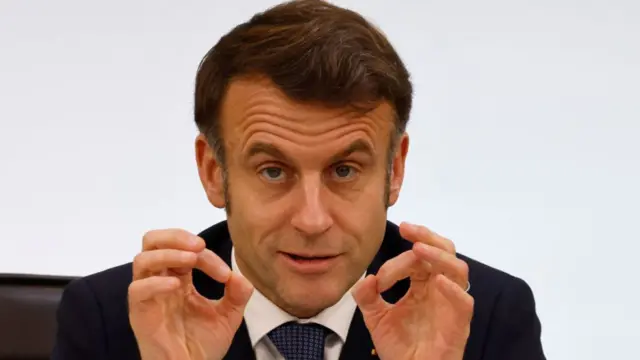
Emmanuel Macron has warned against a peace deal over the Ukraine war that would amount to “capitulation” as Donald Trump suggested Russia might not make any concessions in negotiations.
The French president said only the Ukrainian president, Volodymyr Zelenskyy, could negotiate on behalf of his country with Russia to end the war, warning in an interview with the Financial Times that a “peace that is a capitulation” would be “bad news for everyone”, including the US.
The comments come amid fears in Europe that Trump and Russia’s president, Vladimir Putin, are trying to negotiate the future of the continent’s security over the heads of European leaders themselves, with the US president already making a raft of concessions.
“The only question at this stage is whether President Putin is genuinely, sustainably and credibly willing to agree to a ceasefire on this basis. After that, it’s up to the Ukrainians to negotiate with Russia,” Macron told the FT.
Trump said on Thursday that US and Russian officials would meet on Friday in Munich, where a major security conference is being held, and that Ukraine was also invited.
However, Zelenskyy’s communications adviser, Dmytro Lytvyn, said: “Talks with Russians in Munich are not expected.” Ukraine believed the US, Europe and Ukraine needed a common position before holding talks with Moscow, he said.
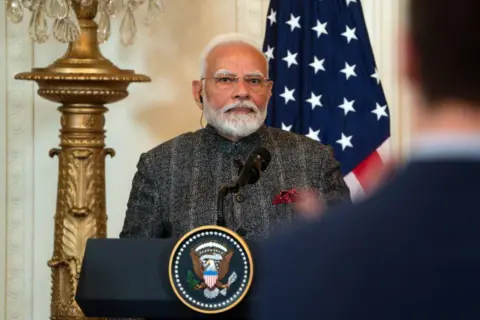
During a joint press conference with the Indian prime minister, Narendra Modi, at the White House on Thursday evening, the US president was asked what, if anything, he expected Russia to give up.
“Russia has gotten themselves into something that I think they wish they didn’t,” Trump replied. “If I were president, it would not have happened, absolutely would not have happened. And it didn’t happen for four years.”
‘Too early to say’ what will happen in negotiations on Ukraine, says Trump – video
He added: “Now Russia has taken over a pretty big chunk of territory and they also have said from day one, long before President Putin, they’ve said they cannot have Ukraine be in Nato. They said that very strongly. I actually think that was the thing that caused the start of the war, and [Joe] Biden said it and Zelenskyy said it.”
It was “too early” to say what would happen in the talks, Trump insisted. “Maybe Russia will give up a lot. Maybe they won’t. And it’s all dependent on what is going to happen. The negotiation really hasn’t started.”
Zelenskyy is expected to meet the US vice-president, JD Vance, at a security conference in Germany on Friday. Trump on Thursday announced plans to begin negotiations with Russia, saying he thought Putin “wants peace” in Ukraine and “would tell me if he didn’t”.
Macron told the FT it would be up to Ukraine to discuss issues of territory and sovereignty but added that Europe had a role to play in regional security.
“[It] is up to the international community, with a specific role for the Europeans, to discuss security guarantees and, more broadly, the security framework for the entire region,” he said. “That is where we have a role to play.”
Ukrainians voiced unease after it emerged Trump has been privately speaking to Putin to negotiate a ceasefire, with some pondering whether they have a future in their own country.
That unease has been shared by some Republicans in the US Senate. “Ukraine ought to be the one to negotiate its own peace deal,” said John Cornyn, a foreign relations committee member, according to the Hill. “I don’t think it should be imposed upon it by any other country, including ours. I’m hopeful.”
Mike Rounds was quoted as saying: “There are concerns I think all of us have that Russia be recognised for the aggressor that they are.” Susan Collins said: “I appreciate that the president is trying to achieve peace, but we have to make sure that Ukraine does not get the short end of a deal.”
On Thursday evening, Trump also used the press conference with Modi to again accuse Europe of falling short in its support for Ukraine. Trump said: “We had some talks and we told the European Union, we told the Nato people – largely they overlap – you have to pay more money because it’s unfair what we’re doing.
“We’re doing a tremendous amount more, we’re probably $200bn more going into Ukraine, using for Ukraine to fight, and Europe has not really carried its weight in terms of the money. It’s not equitable and we want to see a counterbalance. We want to have them put up more money. They have to do that.”
Last month the EU said that since the start of the war it had made available close to $145bn in financial, military, humanitarian and refugee assistance to Ukraine.
Putin’s shadow hovers over Munich conference againpublished at 10:46 Greenwich Mean Time
Paul Kirby Europe digital editor
Image source, Getty Images
Image caption,
Putin rejected a US-led “unipolar world” at Munich in 2007, and invaded Georgia a year later
Vladimir Putin is not there, and the organisers of the Munich Security Conference say there is no Russian delegation representing him either, despite what President Trump suggests.
But now that Trump has said he’s talked to Russia’s leader and that peace talks on the war in Ukraine will start soon, he is very much on people’s minds in Munich, yet again.
It was back in 2007 that Putin stunned the world with a speech to the Munich conference that attacked the US and rejected the post-Cold War world order. A year later he invaded Georgia.
In 2022, Munich hosted Ukraine’s Volodymyr Zelensky, five days before Putin sent troops across his borders in a bid to capture Kyiv. Zelensky’s speech to the conference via video-link the following year pleaded for more Western weapons to fight Russia, saying “Goliath must lose”.
Last year’s event was also overshadowed by Putin, when Yulia Navalnaya addressed delegates hours after the death of her opposition leader husband in a Russian jail. Putin and his “horrific regime” should be fought by the international community, she said.
Russia not sending officials to Munich, foreign ministry sayspublished at 10:35 Greenwich Mean Time
Image source, Getty Images
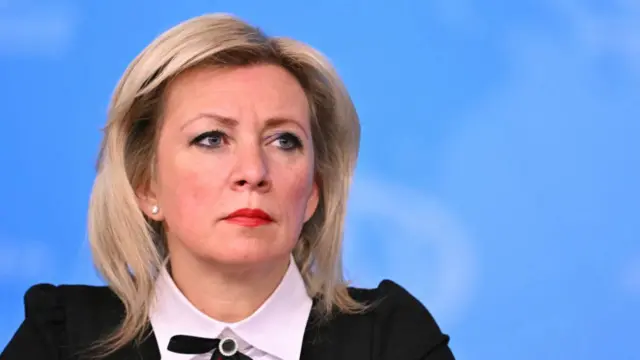
There will be no Russian delegation at the Munich security conference, according to Russia’s foreign ministry spokeswoman Maria Zakharova.
There had been some uncertainty over whether a Kremlin delegation would attend.
While they had not been expected to, Donald Trump’s remark that talks could be held between Ukrainian and Russian officials at the summit sowed some doubt.
However, neither Moscow or Kyiv had given any indication they expected talks to take place – and the BBC was told earlier that no Russian officials were in attendance.
Ukrainian President Volodymyr Zelensky arrives in Munichpublished at 10:27 Greenwich Mean Time
Daniel Wittenberg Reporting from Munich
Image source, Getty Images
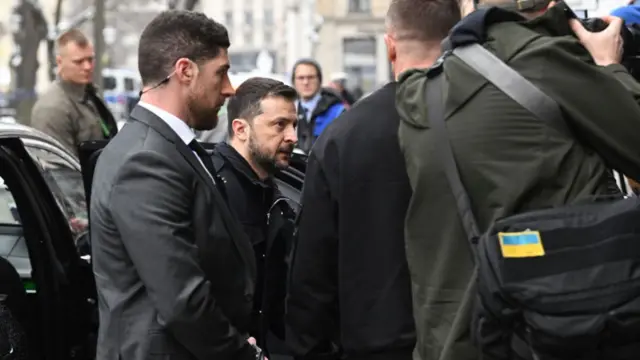
President Zelensky has just arrived at the Munich Security Conference.
He walked in through the front entrance of the Bayerischer Hof Hotel flanked by security.
The expectation was that he would have met US Vice President JD Vance by now, but that bilateral has reportedly been delayed.
The Ukrainian president is due to appear on the main conference stage later this afternoon.
No contact between US and Russian officials – Kremlinpublished at 10:25 Greenwich Mean Time
Earlier this week, Donald Trump said peace talks would start immediately – but the Russian side says negotiations are not under way quite yet.
It will still take a “number of days” until contact between US and Russian officials is established, the Kremlin says.
Spokesperson Dmitry Peskov told reporters “there is no news yet” on how negotiations between Moscow and DC will be arranged, according to Russian state-owned news agency Tass.
Ukraine on ‘irreversible path’ to Nato, Downing Street sayspublished at 10:09 Greenwich Mean Time
Image source, Getty Images
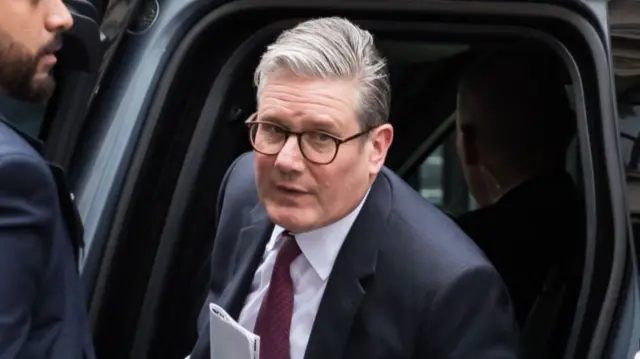
UK Prime Minister Sir Keir Starmer spoke to President Volodymyr Zelensky this morning, renewing the country’s support for Ukraine “for as long as it’s needed”.
Starmer also “reiterated the UK’s commitment to Ukraine being on an irreversible path to Nato, as agreed by Allies at the Washington Summit last year,” a spokeswoman for No 10 said.
With his words, Starmer echoes those agreed upon by Nato members last year in July when they pledged their support for an “irreversible path” to future membership for Ukraine. A formal timeline for it to join the military alliance was not agreed.
The PM’s comments come a day after US Defence Secretary Pete Hegseth rejected the idea of Ukraine joining Nato when talking to leaders in Brussels earlier in the week.
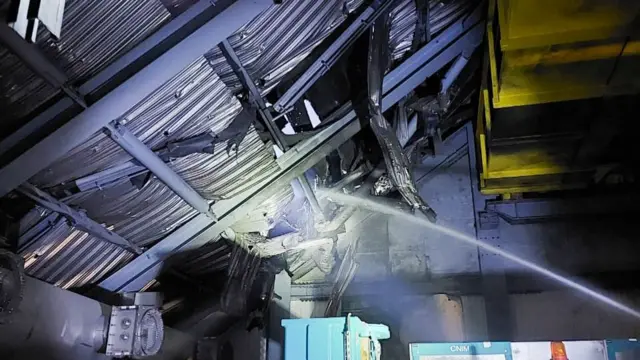
Images show damage to Chernobyl nuclear plant shieldpublished at 09:52 Greenwich Mean Time
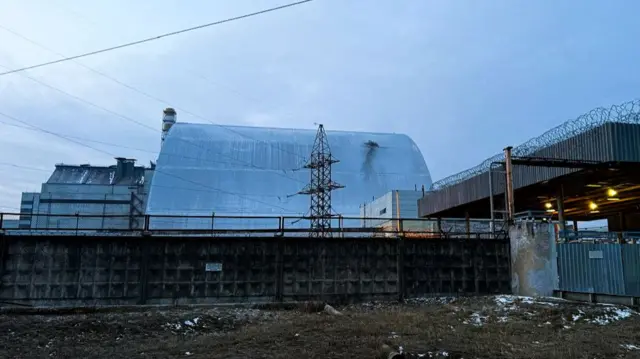
We can bring you more images now from the Chernobyl nuclear power plant – Ukraine says a protective structure at the nuclear power plant has been hit by a Russian drone, but that there are no signs of increased radiation.
These images come from Ukraine’s State Emergency Service.
Ukraine says a Russian drone was responsible – Russia is yet to comment.
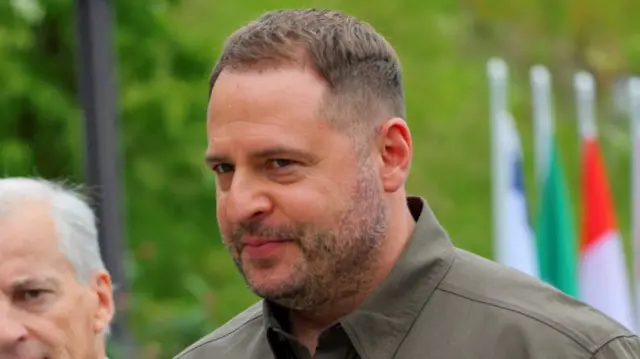
“Everyone here at Munich is angry at the news. Not concerned, as they often are, but truly angry,” Yermak writes on Telegram. “Because back in the 80s the whole world helped the Kremlin clean up after the tragedy.”
He adds: “The whole world invested in the shelter, and now these Russian idiots fired a drone at it.”
Echoing him, Ukrainian Foreign Minister Andrii Sybiha writes on X: “A Russian drone struck Chernobyl, damaging the New Safe Confinement and causing a fire at the site of one of history’s worst nuclear disasters.
“Leaders gathering today in Munich face a choice: stop Russia or face a global disaster. Russia must be forced to peace through strength.”
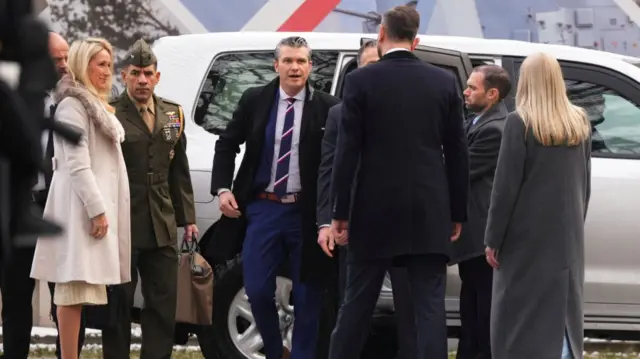
Hegseth arrives in Poland after incendiary comments on Ukrainepublished at 09:35 Greenwich Mean Time
Will Vernon Reporting from Warsaw
Image source, Reuters
The US Secretary of Defence is in Warsaw for talks with the Polish defence minister and the Polish president as part of his first overseas tour.
Pete Hegseth comes here leaving a trail of incendiary comments in his wake that have alarmed many in this part of Europe. Speaking at meetings in Brussels, he said returning Ukraine to its internationally-recognised borders was “unrealistic”. He cast doubt on Nato’s Article Five on collective defence, and he played down any prospect of Ukraine joining the alliance.
Those comments, together with Donald Trump’s proposals to hold direct talks with Vladimir Putin, led to a cacophony of criticism – that Hegseth and his boss had given Putin what he wanted before peace talks had even begun.
Hegseth yesterday rejected that accusation, saying Donald Trump wouldn’t let anyone turn “Uncle Sam” into “Uncle Sucker”.
But Polish officials have joined their European colleagues in voicing their support for Ukraine. Privately, officials are absolutely furious that the US President appears to be planning to hold talks with Russia without any sign of involvement of European countries, but mostly importantly of all of course, without Ukraine.
But for a country that shares borders with both Ukraine and Russia, Warsaw is also keen to secure the future of the US military presence in Poland.
Vance and Hegseth expected to unveil US plans for Ukrainepublished at 09:23 Greenwich Mean Time
Image source, Reuters
US government officials are continuing their visit to Europe as frictions between the two allies grow following controversial comments on Ukraine.
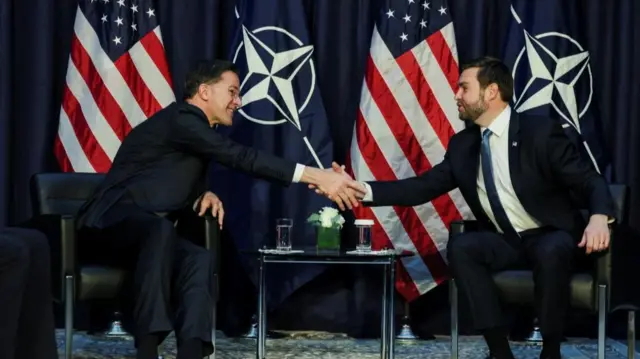
Vice President JD Vance has now arrived in Munich where he met Nato Secretary General Mark Rutte and is expected to present US plans to end the war in Ukraine later today.
Defence Secretary Pete Hegseth has also arrived in Warsaw where he is meeting members of the Polish government to discuss military arrangements and the situation in Ukraine.
Image source, Reuters
Ukraine braces for new bitter pill to swallow as Zelensky meets Vancepublished at 09:15 Greenwich Mean Time
Anthony Zurcher North America correspondent
Volodymyr Zelensky’s goals in his meeting with Vice-President JD Vance seem clear – to encourage the US to continue to stand by Ukraine and keep the beleaguered nation’s best interests in mind as the it tries to negotiate an end to the war.
What the Americans want from this meeting with Zelensky is more uncertain. Vance may try to assure Zelensky that the Ukrainians will be involved in the upcoming peace negotiations, even if lately it seem as though they will be a junior partner.
Zelensky reportedly was not given a heads-up about this week’s call between Vladimir Putin and Donald Trump. The American president, who conducts a free-wheeling style of diplomacy, only contacted his Ukrainian counterpart after the 90-minute US-Russia dialogue had been completed.
Vance, in fact, may be delivering a blunt message – one that Defence Secretary Pete Hegseth said publicly on Monday, even if he later walked it back somewhat.
The US does not envision a Nato that includes Ukraine. And in order to end the war, Ukraine will have to give up territory that is currently under Russian control.
It might be a bitter pill for Zelensky to swallow, but the kind of additional US military aid to Ukraine that it eventually would need to keep up the fight seems unlikely at this point.
Neither Trump nor Republicans in Congress have much interest in keeping the support going. That’s another message Vance may deliver – and it will be a bitter pill for the Ukrainian leader to swallow.
How did we get here?published at 09:05 Greenwich Mean Time
Image source, EPA
After almost three years of Russia’s war in Ukraine, a possible peace deal is front of mind as world leaders gather for the annual Munich Security Conference.
Before it gets under way, let’s remind ourselves how we got here:
In the run up to the US presidential election, now President Donald Trump promised to end the war in Ukraine within 24 hours of taking office
Earlier this week, Trump announced that he and Putin had agreed in a phone call to begin talks to end the war
Meanwhile, Ukrainian President Volodymyr Zelensky said his country must be involved in negotiations – the Kremlin said Ukraine will “one way or another be taking part”
Zelensky will be in Munich today, and is due to meet Trump’s Vice-President, JD Vance, and US Secretary of State Marco Rubio
Chernobyl’s radiation levels remain normal – International Atomic Energy Agencypublished at 08:57 Greenwich Mean Time
Image source, International Atomic Energy Agency
Image caption,
An image posted online by the IAEA alongside an update on the Chernobyl nuclear power plant
The International Atomic Energy Agency (IAEA) says its team on the ground heard an explosion overnight coming from the “New Safe Confinement, which protects the remains of reactor 4” causing a fire.
It says this happened at 01:50 – which, if that is local time in Ukraine, would be 11:50 GMT on Thursday night.
“At this moment, there is no indication of a breach in the NSC’s inner containment. Radiation levels inside and outside remain normal and stable. No casualties reported. IAEA continues monitoring the situation,” the international body says in a message on social media site X, external.
Its director general, Rafael Mariano Grossi, says the incident and a recent increase in military activity around Zaporizhzhia nuclear power plant underline persistent nuclear safety risks, according to the message on social media.
“There is no room for complacency, and the IAEA remains on high alert,” he says.
Europe worries about Trump’s unilateral actions on Ukrainepublished at 08:47 Greenwich Mean Time
Lyse Doucet Chief international correspondent
It’s hailed as “the transatlantic partnership.” Wolfgang Ischinger has seen its highs and lows up close as the German diplomat who chaired the Munich Security Conference for 14 years.
And this year it’s at its lowest.
“The biggest worry is what we’ve been trying to build for decades – a rules-based, institutions-based international system – is more or less shattered,” he tells me as the annual Munich Security Conference begins under the shadow of President Trump’s sudden unilateral intervention to end the war in Ukraine.
“The good news is what we’ve all wanted, discussions about how to end this war, have started” says Ischinger, who is now the President of the Munich Security Conference Foundation.
“But there is a lot of worry here in Europe,” he says, reflecting the chorus of criticism from European leaders which is certain to be amplified here in Munich.
Describing himself as an optimist, he emphasises “hopefully we can see at the end of this weekend an agreed path, not a unilateral path by President Trump with President Putin”.
He speaks of the need to avoid a “huge transatlantic crisis of mutual mistrust” with an outcome “that will reinforce the awareness on both sides of the Atlantic that we need each other”.
That’s a huge challenge but with so much at stake for Europe, the mood in Munich is the urgent need to do everything possible to resolve this deepening crisis.
‘Disturbing’ communication between the US and Russia gives Putin what he wantspublished at 08:39 Greenwich Mean Time
Image source, Getty Images
US President Donald Trump is giving Putin what he wants with the way discussions are taking place, Sam de Bendern, associate fellow at Chatham House and former Nato Ukraine officer, tells the BBC’s 5 Live Breakfast.
“The statements that have been coming out of various US officials in the past few days are striking in one thing – they are using elements of language that is exactly what Vladimir Putin has been saying for years,” de Bendern says.
She adds that throughout the war, communication between Russian and US officials has taken place behind the scenes, but “what is disturbing in the way these discussions have taken place is that Trump has given Putin what he wants, which is a return to the international arena”.
“He agreed to meet him before negotiations even begin; he’s given Putin the prize win of the negotiation,” de Bendern adds.
Ukrainian MP says ‘highly unlikely’ Russia, US will impose bilateral peace dealpublished at 08:25 Greenwich Mean Time
Ukrainian MP Lesia Vasylenko says it is “highly unlikely” Russia and the US will be able to impose their version of peace.
Her comments comes after US Defence Secretary Pete Hegseth told Nato defence ministers yesterday that the Trump administration envisaged Ukraine giving up territory in exchange for peace.
“This is two major superpowers who have a lot of weight over what goes on Ukraine. But let me just remind you that in 2022, when Russia escalated the aggression, Ukraine had no military aid, Ukraine had no financial aid,” Vasylenko tells the BBC’s Newsday programme.
“The world – including the United States – were expecting Ukraine to collapse, and yet we stood. And this is what will happen in this case as well,” Vasylenko says, adding Ukraine is ready to discuss peace talks.
Asked whether regaining all its territory was still a red line for Ukraine in any peace talks, she says it’s a choice for the entire international community.
Organisers say there’s no Russian delegation in Munichpublished at 08:12 Greenwich Mean Time
Frank Gardner Security correspondent, in Munich
There is no Russian delegation here at the Munich Security Conference, the organisers say.
US President Donald Trump has said they are at the talks in Munich – it’s possible they could be somewhere else in the city but officials here tell me the German government is unlikely to have given them visas.
Chernobyl’s protective shield damaged by Russian strike – Ukrainepublished at 08:08 Greenwich Mean Time
Ukrainian President Volodymyr Zelensky has claimed a Russian drone armed with a “high-explosive warhead” struck a protective shield over the Chernobyl nuclear plant.
He says initial assessments show the damage to the shelter is “significant” but that “as of now, radiation levels have not increased”.
“The only country in the world that attacks such sites, occupies nuclear power plants, and wages war without any regard for the consequences is today’s Russia. This is a terrorist threat to the entire world,” Zelensky says in a message on social media, external.
And the Ukrainian leader also says that Russia is continuing to expand its army and “shows no change in its deranged, anti-human state rhetoric”.
“This means that Putin is definitely not preparing for negotiations — he is preparing to continue deceiving the world. That is why there must be unified pressure from all who value life – pressure on the aggressor. Russia must be held accountable for its actions,” he says.
A reactor explosion at Chernobyl nuclear power station in 1986 spread radiation across Europe. This plant has long be decommissioned but still contains dangerous radioactive material.
Russia has not yet commented.
Life on the front line: ‘If I wake up in the morning, that’s already pretty good’published at 07:58 Greenwich Mean Time
“I have no plans for the future at all,” says Oleksandr Bezhan, standing next to an empty, frozen paddock where he used to work as a fisherman on the bank of the Dnipro river in southern Ukraine.
“If I wake up in the morning, that’s already pretty good,” he says.
Malokaterynivka sits just 15km (9 miles) north of the front line in Ukraine’s Zaporizhzhia region.
If US President Donald Trump succeeds in halting the war, Malokaterynivka is hoping to end up on the right side of that front line. But ending the war will not be as simple as blowing a full-time whistle.
“If the front line becomes a border, it would be scary… fighting could break out at any moment,” explains Oleksandr.
‘Peace talks far more likely to be in Putin’s favour than Ukraine’s’ – former army commanderpublished at 07:45 Greenwich Mean Time
Image source, Getty Images
Russian President Vladimir Putin is unlikely to want to continue fighting in Ukraine due to the “pretty dire economic state” Russia is in, a former British Army officer says.
Richard Kemp, who commanded British troops in Afghanistan, suggests Russia can keep on fighting but “it’s unclear how long it will be able to do this for”.
“I think Russia needs to end the conflict. But I think the outcome of peace talks is far more likely to be in Putin’s favour than Ukraine’s,” Kemp tells BBC Radio 5 Live Breakfast.
“We might end up with an occupied or partially occupied Ukraine and Russia in a position where it can lick its wounds and then potentially rebuild its armed forces, hope to rebuild its economy so that it can start again perhaps on Ukraine or perhaps on somewhere else in the future.”
He adds: “The tragic reality is that its going to look like a victory for Russia than for Ukraine or NATO.”
Macron reacts to Trump’s ‘electro-shock’ return as he weighs in on Ukrainepublished at 07:30 Greenwich Mean Time
Image source, Getty Images
French President Emmanuel Macron warns that a peace agreement to end the war in Ukraine that was in effect a capitulation to Russia would be “bad news for everyone”, including the United States.
Macron tells the Financial Times, external that only Ukraine’s president Volodymyr Zelensky could negotiate on behalf of his country.
He also agrees with the Trump administration’s position that Europe has a responsibility to ensure Ukraine’s security – adding the US president’s return to the White House has been a “electro-shock”.
Macron also tells its European partners they need to “muscle up” on defence and the economy.
The Office of Personnel Management in Washington last week.Credit…Valerie Plesch for The New York Times
Layoffs cascaded through the federal government on Thursday after its human resources division advised agencies to terminate most of an estimated 200,000 workers on probation, a sharp escalation in the Trump administration’s drive to overhaul and shrink the federal work force.
Among the largest layoffs reported on Thursday was one announced by the Department of Veterans Affairs, which dismissed more than 1,000 employees, including probationary workers who had worked at the agency for less than two years. Employees at several other agencies also reported receiving termination notices, though the full extent of the cuts in many departments was not immediately clear.
Regardless, the layoffs could mark a major increase in the scale of the Trump administration’s efforts to shed federal workers and reshape government. The administration had already said that about 75,000 workers had accepted an offer to resign in exchange for being paid through September, but the removal of most workers on probation, generally recent hires who have been in their roles less than a year, could cut much deeper into the federal government’s civilian work force of 2.3 million.
The cuts even extended to the agency ordering them, the Office of Personnel Management, which manages the federal civilian work force. It laid off dozens of employees on Thursday, according to people familiar with the move.
The dismissals came on the same day that leaders at O.P.M. met with agency representatives and urged them to lay off most probationary employees, according to a person familiar with the matter who was not authorized to speak about the issue publicly.
Many employees on fixed-term assignments at the Consumer Financial Protection Bureau were also terminated on Thursday, according to several people familiar with the matter. The dismissals came after more than 70 probationary workers at the bureau were laid off earlier this week.
Workers on probation do not receive the same protections that many other federal employees have. Probationary periods tend to last a year, but they can be longer for certain positions. According to the most recent data as of May, the federal government employed roughly 220,000 employees who were serving in their roles for less than a year.
A spokesperson for the Office of Personnel Management said the probationary period was “not an entitlement for permanent employment,” and that agencies were taking independent action in support of President Trump’s broader efforts to reduce the size of the federal government.
The terminations were swiftly condemned by union leaders representing federal workers.
“These firings are not about poor performance — there is no evidence these employees were anything but dedicated public servants,” Everett Kelley, the president of the American Federation of Government Employees, said in a statement. “They are about gutting the federal government, silencing workers, and forcing agencies into submission to a radical agenda that prioritizes cronyism over competence.”
The exact number of workers who were fired at the Office of Personnel Management was unclear, but three people at the agency familiar with the matter, who spoke on condition of anonymity because they were not authorized to speak publicly, said that those affected included probationary employees who had worked there for less than two years, members of the agency’s communications office and Schedule A workers — individuals, including veterans, with severe physical, psychiatric or intellectual disabilities.
The affected O.P.M. employees were locked out of their computer systems and asked to leave the building less than an hour after they were informed of the layoffs in a group call, according to audio of the call, which was shared with The New York Times. An email to staff, also shared with The Times, said that the agency’s communications office was being dissolved as part of wider cuts at the Office of Personnel Management.
Officials at the Department of Veterans Affairs said that workers who accepted the resignation offer were exempt from the terminations on Thursday. There are currently more than 43,000 probationary employees across the department, and the vast majority were exempt from the terminations because they serve in “mission-critical positions” or are covered under a collective bargaining agreement, according to department officials.
The dismissals came after other agencies had already moved to lay off workers in recent days. On Wednesday, the General Services Administration — which manages the federal real estate portfolio and much of the government’s tech work force — told dozens of employees across its technology division that they were losing their jobs. On the same day, at least 60 probationary employees at the Education Department were laid off, according to officials at the American Federation of Government Employees, the largest federal employee union.
Dozens of probationary employees at the Small Business Administration were also told on Tuesday that they would be terminated, officials at A.F.G.E. said.
Mr. Trump signed an executive order on Tuesday directing agencies to start initiating plans for “large scale” reductions in staffing. The order gave Elon Musk and his so-called Department of Government Efficiency substantial power to reshape the federal work force and approve which career officials are hired in the future.
The Trump administration has also collected information from agencies like the F.B.I., the C.I.A. and others about their new hires, raising the specter of more mass firings in coming weeks. More than 1,100 Environmental Protection Agency employees who had been hired in the last year and still had probationary status were warned last week that they could be fired at any time.
Kate Conger, Stacy Cowley and Matthew Goldstein contributed reporting.
President Trump has accused Taiwan of spending too little on its own security and of gaining an unfair dominance in semiconductors. Lai Ching-te, the president of Taiwan, said Friday that it would boost defense spending from 2.5 percent to over 3 percent of its gross domestic product.
“Taiwan’s government will communicate and discuss with the semiconductor industry and come up with good strategies. Then we will come up with good proposals and engage in further discussions with the United States,” Mr. Lai said at a news conference in Taipei.
Mr. Lai added that Taiwan would encourage its companies to increase investment in the United States. Taiwan Semiconductor Manufacturing Company, the maker of the world’s most advanced chips, currently operates a factory in Arizona. Another is under construction and the company has announced plans for a third.
A liquid oxygen storage tank installed at Bir Hospital by the U.S. Agency for International Development in Kathmandu, Nepal.Credit…Navesh Chitrakar/Reuters
A federal judge ordered the Trump administration on Thursday night to unfreeze foreign aid spending President Trump halted during his first week in office, the latest of several legal roadblocks to Mr. Trump’s aggressive first-month agenda.
The ruling by Judge Amir H. Ali of the Federal District Court in Washington found that Mr. Trump’s executive order imposing a blanket freeze on U.S. foreign aid spending was based on dubious logic. He said it was also probably causing irreparable harm to aid groups, which face devastating financial shortfalls and, in some cases, shutdown.
In response, Judge Ali, a Biden appointee, issued a temporary injunction saying that the Trump administration could not freeze foreign aid spending that predates Mr. Trump’s inauguration, nor could it fire or suspend workers associated with those spending projects.
The ruling reverses a decision that had thrown into turmoil programs that provide shelter for millions of people and fight hunger and illness around the globe. Other court decisions have also blocked the administration from carrying out its plan to virtually dismantle the U.S. Agency for International Development, the main government organization that provides humanitarian aid, and put its employees on administrative leave.
In his 15-page ruling, Judge Ali said that the plaintiffs — a coalition of aid groups, businesses, and health and media nonprofits — had “made a strong preliminary showing of irreparable harm.”
He cited the example of one nonprofit that protects refugees and asylum seekers. It reported having to lay off 535 staff members after losing federal grants, shutter program offices and defer payments to its vendors.
Judge Ali was unpersuaded that the administration’s use of waivers to allow some foreign aid programs to continue was a meaningful defense. He cited testimony indicating that even in some cases when funding had been deemed essential and granted a waiver by Secretary of State Marco Rubio, the money remained stalled.
“Such waivers do not address the problem, because a business cannot halt global supply chains midstream and then resume operations with uncertainty as to whether it will have to halt again in 30 days,” he wrote. Trump administration lawyers, he wrote, “pointed to the waiver process but did not rebut this evidence, acknowledging that the waiver process may have had ‘hiccups.’”
Judge Ali was also skeptical about the Trump administration’s stated rationale for the freeze: to allow for a review in part to locate what it claims is hidden wasteful spending.
Trump administration lawyers “have not offered any explanation for why a blanket suspension of all congressionally appropriated foreign aid, which set off a shock wave and upended reliance interests for thousands of agreements with businesses, nonprofits and organizations around the country, was a rational precursor to reviewing programs,” he wrote.
Judge Ali did not entirely embrace the plaintiffs’ request, denying their request that he entirely block Mr. Trump’s executive order. Judge Ali said there was no reason to block, for instance, Mr. Trump’s call for an internal review of foreign aid spending.
The judge ordered the Trump administration to file a status report by Tuesday showing its compliance with his order.
Joe Gebbia attending the Met Gala at Metropolitan Museum of Art in Manhattan, in 2023.Credit…Nina Westervelt for The New York Times
One of Elon Musk’s closest friends, a billionaire co-founder of Airbnb, is taking a role in President Trump’s administration to help Mr. Musk carry out his drive to slash the federal bureaucracy, according to a person with knowledge of the matter.
Joe Gebbia, the Airbnb co-founder, is a board member at Tesla who lives in Austin, where Mr. Musk, Tesla’s chief executive, keeps a large compound. He is planning to start shortly in the federal government as part of Mr. Musk’s team, which has been called the Department of Government Efficiency, according to the person with knowledge of the matter.
It is not clear what precisely Mr. Gebbia will do or how formal his role will be. Many members of Mr. Musk’s government-overhaul effort float among agencies depending on the day’s tasks. Many of them consider their center of gravity to be the Office of Personnel Management or the General Services Administration.
Mr. Musk and his allies have taken over the United States Digital Service, now renamed the “United States DOGE Service.” The agency was established in 2014 to fix the federal government’s online services. Many of his foot soldiers are young software engineers with no government experience who have parachuted into federal agencies seeking to overhaul or even dismantle them.
Mr. Gebbia was until recently a Democratic donor, spending over $200,000 each to boost Hillary Clinton and Joe Biden in the 2016 and 2020 general elections, and $20,000 to support Mr. Biden’s re-election run in 2023.
Mr. Gebbia has said his politics have shifted toward Republicans, in major part because of the advocacy of Robert F. Kennedy Jr., whom Mr. Gebbia considers a political ally. Mr. Gebbia attended Mr. Kennedy’s confirmation hearing last month, writing on X that morning that it was a “big day ahead for the future of health in America.”
Mr. Gebbia did not immediately respond to a request for comment on Thursday evening.
Mr. Trump has embraced leaders and donors in the tech industry, and many in Silicon Valley have rallied around him since he won the presidency.
In a post on X the day before Mr. Trump’s inauguration, Mr. Gebbia said he had voted for Democrats dating back to Al Gore in 2000 but acknowledged supporting Mr. Trump in November. “I did a bad thing. Something the younger me would hate myself for doing. Something that only a few people (and maybe ByteDance) know: I voted Republican last November,” he wrote, referring to TikTok’s parent.
Mr. Gebbia’s net worth approaches $9 billion, according to the Bloomberg Billionaires Index, thanks to his shares in Airbnb, which he founded in 2008. One of Mr. Gebbia’s co-founders, Brian Chesky, the C.E.O., has developed a close relationship with former President Barack Obama. But Mr. Gebbia has been considered among the three founders to have the most interest in — and time for — politics. He was originally the company’s chief product officer and has gradually stepped away from company operations to focus on personal pursuits, such as his stake in the N.B.A. team the San Antonio Spurs. He remains on Airbnb’s board.
Mr. Gebbia, whose background like Mr. Chesky’s is in industrial design, has become one of Mr. Musk’s closest friends in recent years. Mr. Musk had discussed buying a home from Mr. Gebbia’s new startup, Samara, and Mr. Gebbia’s texts to Mr. Musk have come up in recent Musk-related litigation. Mr. Musk frequently engages with Mr. Gebbia on X.
Mr. Gebbia has also posted admiringly on X about Mr. Musk’s new project in Washington, writing shortly after the election that there was a “historic corporate turnaround about to take place: DOGE.” This week, he praised the Musk team’s efforts to claw back $80 million that the Federal Emergency Management Agency had sent to New York City to cover some of the costs of housing migrants.
Kate Conger contributed reporting.
The Department of Veterans Affairs has laid off more than 1,000 employees, including probationary employees who were serving in their roles for less than two years. Officials said the cuts would save the department more than $98 million a year.
Leaders at the Office of Personnel Management met with federal agency representatives on Thursday and advised them to lay off most probationary employees, according to a person familiar with the matter who was not authorized to speak publicly. According to the most recent data, the federal government employs roughly 220,000 employees in their one-year probationary period
A federal judge has issued a temporary injunction saying that, until further notice, the Trump administration cannot freeze foreign aid spending that predates President Trump’s inauguration, nor fire nor suspend workers associated with those spending projects.
The ruling by Washington, D.C., District Court Judge Amir H. Ali found that Trump administration lawyers “have not offered any explanation for why a blanket suspension of all congressionally appropriated foreign aid, which set off a shockwave and upended reliance interests for thousands of agreements with businesses, nonprofits, and organizations around the country, was a rational precursor to reviewing programs.” Trump officials have argued that they froze all U.S. foreign aid to allow for a review of what they called hidden wasteful spending. A lawsuit filed by the AIDS Vaccine Advocacy Coalition challenged the freeze on the grounds that it was causing needless irreparable harm.
Judge Ali ordered the Trump administration to file a status report by Tuesday showing its compliance with his order, and told the parties to file a joint status report by 5 p.m. Friday “proposing an expedited preliminary injunction briefing schedule.” His ruling states that it “appears, at least at this early stage, that Plaintiffs are likely to succeed on the merits” of the case.
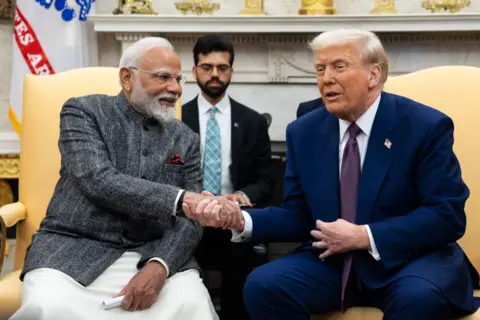
President Trump and Prime Minister Narendra Modi of India meeting in the Oval Office on Thursday.Credit…Eric Lee/The New York Times
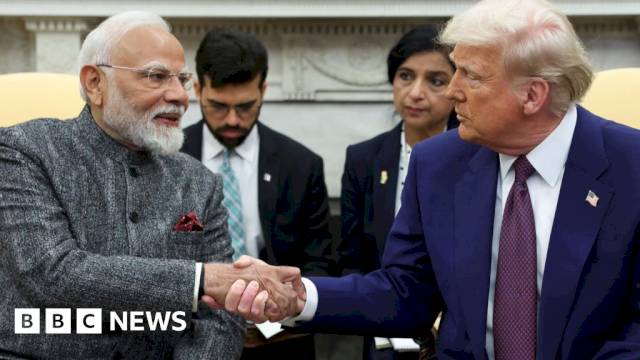
Hours after President Trump paved the way for upending the United States’ trade relationship with India with broad “reciprocal” tariffs, he and Prime Minister Narendra Modi presented a united front during a news conference on Thursday at the White House.
Mr. Modi became the latest head of state to seek to placate an increasingly power-flexing Mr. Trump by trying to accommodate his demands — even as Mr. Trump’s promised tariffs hung over the White House meeting. Mr. Modi heaped praise on Mr. Trump, using his motto “Make America Great Again” in English, despite mostly speaking through a translator, and applying the motto to India. “Make India Great Again,” Mr. Modi crowed.
The warm greetings also extended to Elon Musk, the constant Trump companion barreling through the federal government as the head of an initiative to reshape and cut down the federal government: The two had a meeting and photo op. Mr. Musk, the wealthiest man in the world, owns a number of companies, including Starlink, a high-speed internet service, that have sought to make an entry in India.
All the flattery concealed a number of tensions between the two nations, including on two of Mr. Trump’s signature issues, trade and immigration. Mr. Trump hinted at the biggest thorn when he said at the news conference that the United States had a nearly $100 billion trade deficit with India, though he inflated the number — in 2024, the figure was nearly $50 billion.
Just hours earlier, Mr. Trump had directed his advisers to devise new tariff levels for countries around the world that take into account a range of trade barriers and other economic approaches adopted by America’s trading partners. India is among the nations that could face particularly significant consequences from the tariffs.
At the news conference, Mr. Trump said that he had toyed with that idea during his first term, and noted that he could not get India to lower tariffs against the United States then. Now, “we’re just going to say, ‘whatever you charge, we charge,’” Mr. Trump said.
“I think that’s fair for the people of the United States,” Mr. Trump said. “And I think it’s actually fair for India.”
Despite the looming economic punishment, Mr. Modi opened his remarks by saying he was focusing on doubling bilateral trade to $500 billion by 2030 and “concluding very soon a mutually beneficial trade agreement” with the United States.
Mr. Modi also said that India and the United States would create a framework for defense cooperation for the next decade and added that the two countries would also collaborate to develop semiconductors, quantum technology and artificial intelligence.
Even on an issue that has infuriated some of his constituents in India, Mr. Modi sought to placate Mr. Trump. At one point, Mr. Modi was asked about a U.S. military plane filled with migrants from India that the United States sent to the Indian state of Punjab last week.
Video posted by a top U.S. border official showed migrants in shackles, and prompted outrage in India.
Mr. Modi made no acknowledgment of that. “We are of the opinion that anybody who enters another country illegally, they have absolutely no right to be in that country,” he said.
Earlier in the afternoon, Mr. Trump met with Mr. Modi in the Oval Office, joined by some of the president’s cabinet secretaries. The two leaders sat in chairs, fielding questions from reporters.
Mr. Modi and Mr. Trump have enjoyed a generally friendly relationship. Mr. Modi welcomed Mr. Trump with an enormous rally during a presidential visit to India during Mr. Trump’s first term.
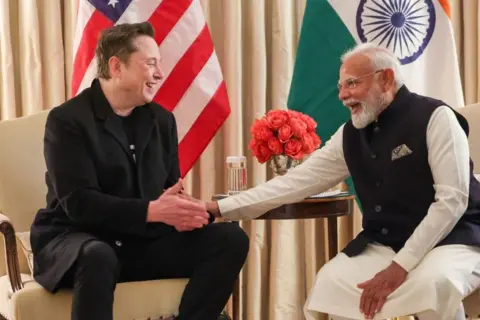
Before Mr. Trump and Mr. Modi met, the Indian prime minister sat down with Mr. Musk.
Mr. Modi shared photos on Mr. Musk’s social media site, X, that underscored Mr. Musk’s power within the Trump administration: The billionaire sat in front of an American flag next to the prime minister and the Indian flag, the kind of pose usually struck by a head of state and that Mr. Trump himself has assumed in recent weeks. Mr. Musk was accompanied by Shivon Zilis, who is a longtime adviser and the mother to some of his children, as well as three of his children, who appeared to exchange gifts with Mr. Modi.
At the news conference, Mr. Modi said he had known Mr. Musk for some time.
It was Mr. Trump’s fourth visit from a foreign leader in rapid succession in the past few weeks, as he approaches foreign policy with an expansionist mind-set and a firm desire to push other countries to reimburse the United States for its military spending. He had already met with the leaders of Israel, Japan and Jordan.
Theodore Schleifer contributed reporting.
Secretary of State Marco Rubio’s government plane en route to Munich turned around midflight because of “a mechanical issue,” the State Department spokeswoman, Tammy Bruce, said. The Air Force jet is returning to Joint Base Andrews just outside of Washington.
Image
Credit…Evelyn Hockstein/Reuters
“The Secretary intends to continue his travel to Germany and the Middle East on a separate aircraft,” Bruce said. Public flight tracking data posted by multiple users on social media showed that the plane turned around about an hour after takeoff, off the coast of central Maine.
Rubio plans to attend the Munich Global Security Conference before moving on to Israel and three Arab nations. The secretary of state is traveling with his staff and about a dozen members of the media, as is typical.
Robert F. Kennedy Jr., the new health secretary who was confirmed earlier today, said in an interview on Fox News that President Trump had asked him to “study the safety signals” of abortion pills, something that Kennedy said “is worth doing.”
Trump distanced himself from a proposed federal ban on abortion during his campaign, but his advisers have previously recommended using the long-dormant Comstock Act to block the sale of abortion pills. Earlier today, a Texas judge ordered a provider of abortion pills to stop sending them to patients in Texas, in a case that is widely expected to reach the Supreme Court.
The acting U.S. attorney for the Southern District of New York resigned rather than follow an order to drop the corruption case against Mayor Eric Adams of New York.Credit…Dave Sanders for The New York Times
President Trump had just taken office when lawyers for Mayor Eric Adams of New York went to the White House with an extraordinary request: They formally asked in a letter that the new president pardon the mayor in a federal corruption case that had yet to go to trial.
Just a week later, one of Mr. Trump’s top political appointees at the Justice Department called Mr. Adams’s lawyer, saying he wanted to talk about potentially dismissing the case.
What followed was a rapid series of exchanges between the lawyers and Mr. Trump’s administration that exploded this week into a confrontation between top Justice Department officials in Washington and New York prosecutors.
On Monday, the acting No. 2 official at the Justice Department sent a memo ordering prosecutors to dismiss the charges against the mayor. By Thursday, the acting U.S. attorney in Manhattan, Danielle Sassoon, had resigned in protest over what she described as a quid pro quo between the Trump administration and the mayor of New York City. Five officials overseeing the Justice Department’s public integrity unit in Washington stepped down soon after.
The conflagration originated in the back-and-forth between Mr. Adams’s lawyers, Alex Spiro and William A. Burck, and the Justice Department official, Emil Bove III, exchanges which have not been previously reported.
The series of events — in which the acting No. 2 official at the Justice Department seemed to guide criminal defense lawyers toward a rationale for dropping charges against a high-profile client — represents an extraordinary shattering of norms for an agency charged with enforcing the laws of the United States.
It also sends a message that, under the Trump administration, the Justice Department will make prosecutorial decisions based not on the merits of a case but on purely political concerns, longtime prosecutors and defense lawyers said.
Prompted by Mr. Bove, the mayor’s lawyers refined their approach until they landed on a highly unorthodox argument, records and interviews show — one that was ultimately reflected in Mr. Bove’s memo to prosecutors on Monday. That memo stated that the criminal case had “unduly restricted Mayor Adams’s ability” to address illegal immigration and violent crime. It also pointedly said that the decision had nothing to do with the evidence or the law.
Image
The order to drop the case came from the acting No. 2 official of the Justice Department, Emil Bove.Credit…Pool photo by Todd Heisler
This account of what led to Mr. Bove’s memo and the internal resistance with which it was met is based on interviews with five people with direct knowledge of the matter, as well as documents related to the case against Mr. Adams.
There remain several unanswered questions about the lead-up to the extraordinary decision, including how many times Mr. Spiro and Mr. Bove interacted.
But the sudden push to dismiss the case against Mr. Adams came even as Manhattan prosecutors were preparing to move forward with more charges against him.
Just weeks before the order to drop the case, prosecutors had said in a court filing submitted on Jan. 6, during the presidential transition, that they had uncovered unspecified “additional criminal conduct by Adams.”
In a letter to Attorney General Pam Bondi on Wednesday, Ms. Sassoon said that prosecutors in her office had been prepared to seek a new indictment of the mayor, “based on evidence that Adams destroyed and instructed others to destroy evidence and provide false information to the F.B.I., and that would add further factual allegations regarding his participation in a fraudulent straw donor scheme.”
Mr. Spiro shot back in a public statement, saying that if the Manhattan prosecutors “had any proof whatsoever that the mayor destroyed evidence, they would have brought those charges — as they continually threatened to do, but didn’t, over months and months.”
But in private, far from a courtroom, the picture was different. Amid rumblings of potential new charges, Mr. Spiro, Mr. Burck and Mr. Bove appear to have structured what the defense lawyers likely hoped would be the end of the corruption case against Mr. Adams.
On Wednesday, the same day that the acting U.S. attorney was privately saying she would not comply with the Justice Department’s directive, Mr. Spiro held a news conference and repeatedly called the charges politically motivated, saying that the Justice Department’s dismissal order was the only legitimate conclusion it could have reached.
The directive from Mr. Bove was like a neon sign signaling that a connection within Mr. Trump’s orbit matters as much as the facts. Until recently, Mr. Bove was a criminal defense lawyer for Mr. Trump. Mr. Spiro also represents Elon Musk, a close adviser to Mr. Trump and the world’s richest man. And Mr. Burck recently became the outside ethics adviser to Mr. Trump’s company.
“The message is getting out that if you want to save yourself from prosecution, it’s best to find someone from Trumpworld,” said Daniel C. Richman, a law professor at Columbia University and former federal prosecutor in Manhattan. “Why is that bad? Generally, we like to think criminal prosecutions are resolved on the merits, not political intervention.”
The White House did not respond to several requests for comment. Officials at the Justice Department declined to engage with questions about the reporting.
Mr. Adams was indicted in September after a yearslong investigation. Manhattan prosecutors charged him with conspiracy, bribery and other crimes, saying that he had accepted more than $100,000 in flight upgrades and airline tickets; pressured the city’s Fire Department to sign off on the opening of a new high-rise Turkish consulate building despite safety concerns; and fraudulently obtained millions of dollars in public funds for his campaign.
Alex Spiro, left, and William A. Burck, lawyers for Mr. Adams. Mr. Spiro has said without providing evidence that the mayor was targeted in a politically motivated prosecution. Credit…Kent Nishimura for The New York Times
The formal, legal effort to kill the case began immediately after Mr. Trump took office. Mr. Spiro sent a letter directly to the White House counsel, David Warrington, requesting a pretrial pardon from Mr. Trump. On his first day in office, Mr. Trump signed roughly 1,500 pardons, all prepared by Mr. Warrington, for people convicted in connection with the Jan. 6, 2021, attack on the Capitol by a pro-Trump mob.
The letter from Mr. Spiro appeared to be focused on appealing to Mr. Trump’s own grievances with how the Justice Department treated him. It echoed the president’s arguments about the federal cases against him. It said that Mayor Adams was the victim of a “weaponized” Justice Department and leaks to the news media, particularly to The New York Times. It also mounted a lengthy attack on the merits of the case.
“President Trump has made clear his desire to reform the Department of Justice so that it is an agency that once again seeks justice and truth above all else,” Mr. Spiro wrote. “This case is a prime example.”
Mr. Trump had said in December that he would consider pardoning the mayor. But in the days after the letter was sent, the White House had been silent on the matter.
Around that time, the acting deputy attorney general, Mr. Bove, who represented Mr. Trump in three of his criminal indictments, reached out to Mr. Spiro.
In one of the conversations, Mr. Bove said that he would like to know how the prosecution was affecting Mr. Adams’s ability to do his job. Mr. Bove also said he wanted to have a meeting in Washington with prosecutors and Mr. Spiro to discuss dismissing the case.
That meeting occurred on Jan. 31, 11 days after Mr. Trump was sworn in.
Mr. Spiro — a brash defense lawyer with a record of representing celebrity clients like Mr. Musk — had repeatedly angered prosecutors with his contentious style, outlandish claims and unsupported accusations that the authorities were leaking confidential grand jury evidence.
But he was accompanied at the meeting by Mr. Burck, who is known for having a softer touch and has become increasingly close to Mr. Trump, his aides and his political appointees. Along with his appointment last month as the outside ethics adviser to the Trump Organization, Mr. Burck helped lead the confirmation process of the Treasury secretary.
The meeting was attended by Ms. Sassoon and several of her deputies.
During the meeting, Mr. Bove signaled that the decision about whether to dismiss the case had nothing to do with its legal merits.
Image
Danielle Sassoon, second from left, the acting U.S. attorney in Manhattan, wrote a letter to Attorney General Pam Bondi arguing that the case against Mr. Adams should not be dismissed.Credit…Kent Nishimura for The New York Times
Instead, Mr. Bove said he was interested in whether the case was hindering Mr. Adams’s leadership, particularly with regard to the city’s ability to cooperate with the federal government on Mr. Trump’s crackdown on illegal immigration.
Mr. Bove also said he was interested in whether the case, brought by the former U.S. attorney, Damian Williams, was a politically motivated prosecution meant to hurt Mr. Adams’s re-election prospects.
In her letter to Ms. Bondi, Ms. Sassoon said that she was “baffled by the rushed and superficial process by which this decision was reached, in seeming collaboration with Adams’s counsel and without my direct input on the ultimate stated rationales for dismissal.”
She also said that when she and other prosecutors attended the meeting, Mr. Adams’s lawyers “repeatedly urged what amounted to a quid pro quo, indicating that Adams would be in a position to assist with the department’s enforcement priorities only if the indictment were dismissed.” She said that Mr. Bove had chastised a member of her team for taking notes and directed that they be confiscated when the meeting ended.
Asked to respond, Mr. Spiro said, “The idea that there was a quid pro quo is a total lie. We offered nothing and the department asked nothing of us.
“We were asked if the case had any bearing on national security and immigration enforcement, and we truthfully answered it did,” he added.
Four days after the meeting, Mr. Adams’s team sent a letter to Mr. Bove at the Justice Department, this one signed by both Mr. Spiro and Mr. Burck. The letter showed the issues Mr. Bove was focused on.
“We wanted to address questions you have raised with respect to the indictment’s impact on Mayor Adams’s ability to lead New York City, including by working with the federal government on important issues of immigration enforcement and national security,” the letter said.
The letter went on to make a more refined argument about how the indictment was impinging on Mr. Adams’s role as mayor, while also attacking Mr. Williams for what it said was a politically motivated investigation.
The letter also said that trial preparation would unduly restrict Mr. Adams and that the trial itself would keep him stuck in court, potentially for more than a month. It said that Mr. Adams’s loss of a security clearance during the inquiry had hurt his ability to cooperate with federal authorities on important national security investigations.
And it asserted that Mr. Adams was aligned with the Trump administration on public safety and illegal immigration. If the prosecution proceeded, the letter said, Mr. Adams could not be an active partner to the Department of Homeland Security.
Despite those arguments — or perhaps in light of them — Mr. Bove’s directive to Manhattan federal prosecutors included an unusual footnote.
“The government is not offering to exchange dismissal of a criminal case for Adams’s assistance on immigration enforcement,” it said.
Mr. Spiro has asserted that the case against Mr. Adams, if dropped, will not be revived, but the Justice Department memo left open the possibility that it could be brought again. It said that Mr. Trump’s pick for U.S. attorney in Manhattan, who has yet to be confirmed by the Senate, will review the case after the mayoral election in November.
Mr. Spiro insisted on Wednesday that the plan would not give the Trump administration leverage over Mr. Adams.
“This isn’t hanging over anybody’s head,” he said. “This case is over. I think everybody knows this case.”
The mayor met on Thursday with Mr. Trump’s “border czar,” Tom Homan.
Hours after Trump set in motion a plan for new tariffs that would upend the rules of global trading, including with India, President Trump and Prime Minister Modi presented a united front at their joint news conference. As it wrapped up, it became clear that Modi was the latest leader to placate Trump, who has threatened a number of nations with tariffs just weeks into his second term.
A reporter noted that when Trump has spoken about negotiations, he has mainly talked about what Ukraine will need to give up. Trump recently said it was unlikely Ukraine would get NATO membership in the future or return to its pre-2014 borders. Asked what Russia should give up, Trump responds by arguing the war never would have started under his watch. “Maybe Russia will give up a lot, maybe they won’t,” Trump says.
Image
Credit…Eric Lee/The New York Times
Trump says “we had some talks” with the European Union and NATO. He adds that they need to increase security spending and that Europe “has not really carried its weight.” He says he had good discussions with Russia’s president, Vladimir Putin, and Ukraine’s leader, Volodymyr Zelensky, but he doesn’t address a question about critics who say he’s more eager to engage with the U.S. adversaries than its allies.
“We are of the opinion that anybody who enters another country illegally, they have absolutely no right to be in that country,” Prime Minister Modi says after he is asked about Trump deporting undocumented immigrants to India. The Trump administration recently sent deportees back to India on military flight, causing outrage in India.
Video
Trump said at the end of his first term he “wasn’t really in the mood” to impose his new “reciprocal” tariffs that he announced today. “We felt that now it was finally time after 45 or 50 years of abuse,” Trump says. “I had discussions with India in the first term about the fact their tariffs were really high, and I wasn’t able to get a concession.”
Trump says he had discussions with India in his first term about tariffs being too high and that now his reciprocal tariff rates are the right approach.
Employees and supporters of U.S.A.I.D. attend a rally in Washington earlier this month.Credit…Haiyun Jiang for The New York Times
A federal judge on Thursday moved to extend by one week a temporary restraining order preventing the Trump administration from carrying out plans that would all but dismantle the U.S. Agency for International Development.
The order, which Judge Carl Nichols of the U.S. District Court for the District of Columbia said he would file later Thursday, continues to stall a directive that would put a quarter of its employees on administrative leave while forcing those posted overseas to return to the United States within 30 days.
Judge Nichols said he would rule by the end of next week on whether to grant the plaintiffs’ request for a preliminary injunction that would indefinitely block key elements of the high-profile Trump administration effort.
The plan was driven in large part by Elon Musk, the billionaire tech entrepreneur tasked with making cuts to the federal budget, to shutter an agency he and Mr. Trump have vilified. The temporary restraining order applies to about 2,700 direct hires of U.S.A.I.D., including hundreds of Foreign Service officers, who would have been put on administrative leave under the directive, which also warned that contractors’ jobs could be terminated.
The lawsuit was filed by two unions representing the affected U.S.A.I.D. employees: the American Foreign Service Association, to which aid workers in global missions belong, and the American Federation of Government Employees, which represents other direct hires. They have argued that President Trump’s executive order freezing foreign aid for 90 days and subsequent directives to dismantle certain U.S.A.I.D. operations and reduce staff were unconstitutional, and have asked the court to overturn them.
Democratic lawmakers, U.S.A.I.D. workers, and the aid organizations that depend on U.S. foreign assistance have decried any moves to unilaterally shut down the agency as unlawful, as its role in the federal government was established by law and Congress funded it, like the rest of the government, through March 14.
During a hearing on Thursday, Judge Nichols pressed Karla Gilbride, the lawyer for the plaintiffs, on why being placed on administrative leave would cause irreparable harm to the employees.
He also asked Ms. Gilbride a series of questions about why the unions and the employees they represent had not first sought relief through established arbitration processes for the federal work force — an argument that the Justice Department had made in its responses to the lawsuit.
Ms. Gilbride said that if employees went through an arbitration process, there might not be a U.S.A.I.D. left to employ them by the time their cases were considered.
“This court is the only forum that can address these harms on the time scale that this urgent situation demands,” she said, noting that the administrative processes in question were designed to handle the grievances of individual employees, not an entire federal agency on the brink of dissolution.
Whether federal employee unions can experience the direct harm necessary to file a lawsuit — a concept known as standing — became an issue in another case against the Trump administration.
Unions, including the American Federation of Government Employees, challenged an offer to pay federal workers through September if they agreed to resign. The judge in that case, George A. O’Toole of the U.S. District Court for the District of Massachusetts, ruled on Wednesday that the unions did not have the standing to sue because they had not been directly affected by the offer.
Judge O’Toole also noted that Congress had established administrative processes for raising the type of claims at issue in the case.
Eric Hamilton, the Justice Department lawyer, made a similar argument about the U.S.A.I.D. employees on Thursday, pointing to the existence of administrative processes for settling labor disputes involving the federal work force.
“We certainly don’t think unions coming to district court is the right form to litigate,” he said.
But those administrative processes can take years, and Mr. Trump has also targeted some of them. On Monday, he fired the chairwoman of the Merit Systems Protection Board, which hears appeals to firings and other disciplinary actions against federal employees.
Ms. Gilbride on Thursday made a series of arguments about the uncertainties and dangers facing workers stranded overseas and in bureaucratic limbo, some of whom submitted testimonials about being in physical danger and struggling to get security guidance because they were unable to access their accounts to receive official communications. These included several officers posted to the Democratic Republic of Congo, who described how they were left to determine whether and how to flee Kinshasa amid protests, as demonstrators approached their houses and, in one case, looted all of one officer’s belongings.
Ms. Gilbride said they and the rest of the U.S.A.I.D. Foreign Service officers had been “forced under extreme time pressure” to choose whether to uproot their families and return to the United States, with the understanding that the Trump administration would not extend relocation assistance to those who resisted departing on the U.S. government’s timeline.
Mr. Trump’s political appointees and Mr. Musk, labeled a “special government employee” by the White House, are aiming to cut most of the around $70 billion of annual foreign aid money that is allocated through congressional mandates and legislation. About $40 billion of that amount is funneled through U.S.A.I.D., accounting for less than 1 percent of the annual federal budget.
Mr. Hamilton defended planned cuts to the agency’s work force as falling within Mr. Trump’s purview. He acknowledged the unique safety risks employees in high-risk locations faced and assured Judge Nichols that the administration was taking steps to protect them.
“You can understand, I’m sure, why I would not want to be in the position of having government employees overseas be at risk because they are placed on administrative leave,” Judge Nichols said.
“We share the concern about the security of U.S.A.I.D. employees,” Mr. Hamilton said.
Pressed by the judge to detail those additional measures, Mr. Hamilton said he did not know what they were.
Judge Nichols instructed him to provide the court with details about the safety measures. He also asked Mr. Hamilton to give the court information about what the administrative leave status meant for other nonsalary benefits that come with an overseas employee’s post, such as diplomatic housing and school tuitions.
The government has said employees on administrative leave would continue to be paid, but U.S.A.I.D. Foreign Service officers expect that they would lose many of the additional benefits afforded to those who work globally if they are forced to return to the United States. For an officer without a home base in the United States, losing those benefits could force a dip into savings to keep a roof over their head.
It is also not clear how long employees put on administrative leave would remain on that status.
Lawyers for the Trump administration have said that officials had determined that only 611 of U.S.A.I.D.’s approximately 10,000 workers were too “essential” to be put on administrative leave or terminated, for now. They defended the drastic planned cuts by arguing in court documents that “the president’s powers in the realm of foreign affairs are vast and generally unreviewable.”
The lawsuit is one of several seeking to beat back the Trump administration’s efforts to severely restrict foreign aid, which has affected not just U.S.A.I.D.’s work force, but the global network of aid organizations that depend on the U.S. to carry out humanitarian, health and development programs.
Another suit pending before the U.S. District Court for the District of Columbia, brought by a group of contractors and nongovernmental organizations who lost funding, asks the court to order the administration to restart disbursements of foreign aid funds and stop the dismantling of U.S.A.I.D.
A separate lawsuit is arguing that Elon Musk’s attempts to stop the payment of congressionally approved funds, have access to sensitive government data and dismantle agencies exceed his authority.Credit…Eric Lee/The New York Times
Fourteen Democratic state attorneys general sued Elon Musk and President Trump on Thursday to challenge what they called the “unlawful delegation of executive power” granted to Mr. Musk and his cost-cutting initiative, the so-called Department of Government Efficiency.
The lawsuit came on the same day that Mr. Musk and his team were sued by a group of government employees represented by the State Democracy Defenders Fund, a nonprofit watchdog. The coalition argued that Mr. Musk’s attempts to dismantle agencies, stop the payment of congressionally approved funds and have access to sensitive government data exceeded his authority.
DOGE, which is not an official department but an entity housed within the executive office of the president, has already faced numerous legal challenges over its attempts to overhaul government agencies and cut spending. Since Mr. Trump’s inauguration, Mr. Musk’s team has inserted itself into at least 19 agencies, according to a tally by The New York Times.
The White House and representatives of Mr. Musk did not immediately respond to a request for comment.
The 14 states argued that Mr. Trump had violated the appointments clause of the Constitution by granting sweeping powers to Mr. Musk, who has “transformed a minor position that was formerly responsible for managing government websites into a designated agent of chaos without limitation,” according to the complaint, which was filed in the Federal District Court for the District of Columbia.
“Mr. Musk’s seemingly limitless and unchecked power to strip the government of its work force and eliminate entire departments with the stroke of a pen or click of a mouse would have been shocking to those who won this country’s independence,” the complaint reads. “The sweeping authority now vested in a single unelected and unconfirmed individual is antithetical to the nation’s entire constitutional structure.”
The states also asserted that Mr. Musk’s actions could harm their residents by disrupting billions of dollars in federal funding for critical services like law enforcement, education and health care. They argued that, for instance, Mr. Musk’s desire to dismantle the Consumer Financial Protection Bureau could require states to invest far more resources and personnel to “protect their citizens.”
The suit was filed by the attorneys general in New Mexico, Arizona, Michigan, California, Connecticut, Hawaii, Maryland, Massachusetts, Minnesota, Nevada, Oregon, Rhode Island, Washington and Vermont.
The State Democracy Defenders Fund, which filed its lawsuit with the firm Marziani, Stevens & Gonzalez, also argued that Mr. Musk wielded an “extraordinary amount of power” and that his actions had violated the Constitution’s appointments clause.
The plaintiffs are seeking to prevent Mr. Musk and his team from continuing their work until Mr. Musk is “properly appointed,” according to the complaint, which was filed in the U.S. District Court for the District of Maryland.
Over the past three weeks, Mr. Musk’s team has helped effectively shutter the U.S. Agency for International Development; announced various cuts at the Education Department, totaling more than $900 million; and gained access to the Treasury Department’s payments system. Several attorneys general have filed a separate lawsuit challenging that access, and a federal judge on Saturday temporarily restricted it.
On Tuesday, Mr. Trump further empowered Mr. Musk by signing an executive order giving his team more authority to shape the federal work force and approve the hirings of career officials in the future. White House officials have defended Mr. Musk’s actions, which they say are helping taxpayers by identifying wasteful and fraudulent spending.
“Our government has rules to protect the American people from executive overreach,” Norman Eisen, the executive chair of State Democracy Defenders Fund, said in a statement, adding: “We can and will achieve accountability through the courts.”
Prime Minister Modi is asked a question about whether Trump’s new term signals an era of “peace through strength.” Trump says he’ll answer it and says the Biden administration created weakness. “I don’t think India had a very good relationship with the Biden administration,” he adds.
Trump, asked a question from an Indian reporter, says, “I can’t understand a word you’re saying.” He adds the “accent is a little bit tough.”
President Trump is looking around the room as Prime Minister Modi speaks, with two teleprompters at Modi’s podium. Trump does not have teleprompters.
Prime Minister Modi says India and the United States will launch a framework for defense cooperation for the next decade. He adds that the two countries will also collaborate to develop semiconductors, quantum technology and artificial intelligence.
“Make India Great Again,” Prime Minister Modi says in his only English words at the podium, modifying Trump’s slogan. “MAGA plus MIGA,” he adds. President Trump smiles and nods from his own podium.
Video
transcript
transcript
If I were to say this, borrowing an expression from America, our vision for a developed India is to make India great again, or MIGA. When America and India work together, that is MAGA. When it’s MAGA plus MIGA, it becomes mega, a mega partnership for prosperity.
Trump knocks the Biden administration for not taking care of the “long-running disparities” in the trading relationship between India and the United States. He adds that the relationship between the two countries is the best it’s ever been.
President Trump said he’s “paving the way” to provide India F-35 stealth fighters.
Appearing with India’s prime minister, Narendra Modi, at the White House, President Trump said the United States this year would increase military sales to India by “many billions” of dollars. Trump also said his administration approved the extradition of one of the “plotters” of the 2008 Mumbai terrorist attack.
Video
transcript
transcript
In addition, the United States and India will be working together like never before to confront the threat of radical Islamic terrorism, a threat all over the world, actually. Today, I’m pleased to announce that my administration has approved the extradition of one of the plotters and one of the very evil people of the world, and having to do with the horrific 2008 Mumbai terrorist attack, to face justice in India. So he’s going to be going back to India to face justice.
The Associated Press said that one of its reporters had been blocked from an event by the White House for a third day, this time for a news conference on Thursday with President Trump and Prime Minister Modi. “It is a plain violation of the First Amendment, and we urge the Trump administration in the strongest terms to stop this practice,” Julie Pace, the news organization’s executive editor, said in a statement.
The Trump administration’s crackdown on immigration has prompted at least 10 lawsuits, with seven of them challenging the birthright citizenship order.Credit…Eric Lee/The New York Times
A fourth federal judge, this one in Boston, has issued an injunction blocking President Trump’s executive order seeking to end birthright citizenship for the children of undocumented immigrants.
Federal judges in Maryland, Washington State and New Hampshire have already issued similar injunctions to stop the executive order from being enacted. The order instructs the government to stop recognizing as citizens any children who are born on U.S. soil to undocumented parents, or to noncitizen parents who are in the country legally but temporarily.
A hearing on two related lawsuits was held in U.S. District Court in Boston last week before Judge Leo T. Sorokin, who was appointed by President Barack Obama. Judge Sorokin granted the injunction on Thursday; it is effective immediately, and nationwide in scope.
“First, allegiance in the United States arises from the fact of birth,” Judge Sorokin wrote in his decision. “It does not depend on the status of a child’s parents, nor must it be exclusive, as the defendants contend. Applying the defendants’ view of allegiance would mean children of dual citizens and lawful permanent residents would not be birthright citizens — a result even the defendants do not support.”
One of the lawsuits filed in Boston was brought by 18 states, the District of Columbia and the City of San Francisco. The other was filed on behalf of an expectant mother by Lawyers for Civil Rights, a legal activist group based in Boston.
The Trump administration’s crackdown on both legal and illegal immigration has prompted at least 10 lawsuits, with seven of them challenging the executive order on birthright citizenship.
The order, among the first issued by President Trump after he took office last month, would have affected children born after Feb. 19 in the United States to undocumented parents.
Mirian Albert, senior attorney for Lawyers for Civil Rights, said in a statement that the ruling on Thursday provided “protection for vulnerable communities and restores a sense of order and justice.”
Ahead of a news conference with India’s leader, Narendra Modi, Trump told reporters he expected they would speak about trade, oil and gas, among other things. Before their visit, Modi met with Elon Musk, the billionaire adviser Trump is employing to overhaul and shrink the government.
The Stonewall Inn on Christopher Street has been considered a cradle of gay rights activism since a police raid there in 1969 touched off three days of protests.Credit…Hiroko Masuike/The New York Times
The National Park Service removed references to transgender people from its Stonewall National Monument web pages on Thursday, as the Trump administration continued its push for federal agencies to recognize only two genders: male and female, as assigned at birth.
The move to strike the word “transgender” from the website for the first Park Service historic site devoted to America’s gay rights movement elicited anger in the symbolic heart of New York City’s lesbian, gay, bisexual and transgender community.
“It is outrageous,” said Erik Bottcher, the city councilman who represents the Greenwich Village neighborhood that is home to the monument. “This is the latest attempt to erase the very existence of transgender people.”
He added: “The rebellion at Stonewall would not have happened without trans people. To attempt to erase their existence is utterly shameful.”
Dr. Carla Smith, the chief executive of the L.G.B.T. Community Center, said in a statement that the website changes were “factually inaccurate” and “an affront to our entire community,” and she urged the Park Service to “immediately restore accurate and inclusive language.”
The Stonewall Inn, a tavern on Christopher Street, has been considered a cradle of gay rights activism since a police raid there in 1969 touched off three days of protests that helped galvanize a long-marginalized population into a force for political and social change.
The 7.7-acre national monument — which includes the bar, Christopher Park across the street, and several other nearby streets and sidewalks — was established under President Barack Obama in 2016.
On Wednesday, according to a version of the Park Service website saved by the Internet Archive’s Wayback Machine, the introductory text on the monument’s main page said: “Before the 1960s, almost everything about living openly as a lesbian, gay, bisexual, transgender, or queer (LGBTQ+) person was illegal.”
By Thursday afternoon, the word “transgender” and the letter T in the abbreviation had been removed from the page. By Thursday evening, the word “queer” and “Q+” had also been removed from the website.
A Park Service ranger at the monument’s visitor center said on Thursday afternoon that she had not been informed about the changes to the website and had just noticed that the “T” was missing. She declined to provide her name and would not comment further.
The Park Service’s public affairs department said the agency took the actions to implement an executive order signed by President Trump, “Defending Women From Gender Ideology Extremism and Restoring Biological Truth to the Federal Government,” and a second order signed by the former acting secretary of the interior.
Image
Stacy Lentz, right, an owner of the Stonewall Inn, with Angelica Christina, a trans woman and board member of an affiliated nonprofit. Ms. Lentz called the stripping of transgender references from the Park Service’s Stonewall site “insanity.” Credit…Hiroko Masuike/The New York Times
In addition to being part of the national monument, the Stonewall Inn is a New York State historic site. A plaque on the facade of the building identifies it as a place associated with “monumental change for lesbian, gay, bisexual, transgender and queer” Americans.
Gov. Kathy Hochul, in a statement posted online, condemned the changes to the monument website as “cruel and petty.”
“Transgender people play a critical role in the fight for L.G.B.T.Q.+ rights, and New York will never allow their contributions to be erased,” she said.
The website changes included the virtual elimination of a page listing interpretive flags associated with the L.G.B.T.Q. movement, including the pink, blue and white one representing transgender people, and the times when the flags typically fly in Christopher Park.
On Thursday, the transgender pride flag still waved over the park.
Randy Wicker, an L.G.B.T. activist since 1958, was close to Marsha P. Johnson and Sylvia Rivera, two transgender women who are widely seen as mothers of the movement and as pivotal figures in the Stonewall uprising. The scrubbing of the monument website left him aghast.
“It’s frightening what is happening, the extent of it and the venom of it,” Mr. Wicker, 87, said, adding that “the idea that they would try to take transgender people out of the Stonewall National Monument — you can’t just erase history.”
Raquel Willis, a founder of the Gender Liberation Movement, a trans activist group, echoed that sentiment.
“The Stonewall riots happened because trans people, particularly of color, rose up against state violence,” she said. “You can’t tell the story without us.”
The changes to the monument website followed a series of other moves by the Trump administration to strip transgender people of federal recognition, including by altering other government websites. The effort began with an executive order Mr. Trump signed on his first day in office that was described as “restoring biological truth to the federal government.”
Stacy Lentz, an owner of the Stonewall Inn and the chief executive of the nonprofit Stonewall Inn Gives Back Initiative, said she had learned about the website changes Thursday morning.
“I want to say that I’m shocked, but I am not shocked,” she said.
Still, it was almost incomprehensible to her that the anti-trans campaign had arrived at Stonewall.
“Coming into our home, into our place, and trying to erase folks who are instrumental to this movement is insanity,” she said.
Brendan A. Hurson during a hearing in 2023 after he was nominated to become a federal judge.Credit…Rod Lamkey/CNP, via Alamy
A federal judge ordered the Trump administration on Thursday to keep federal funding in place for hospitals nationwide that offer gender-transition treatments for people under the age of 19.
The temporary restraining order issued by Judge Brendan A. Hurson, of the U.S. District Court for the District of Maryland, came in a case brought by six transgender individuals between the ages of 12 and 18, along with parents and advocacy groups. They sued to block President Trump’s executive orders targeting medical treatments for trans youths.
The order is not a final decision on the legal issues but presents a setback for the Trump administration — and a second legal roadblock to Mr. Trump’s broad effort to prohibit the government and taxpayer-funded institutions from recognizing transgender Americans according to their gender identities. Earlier this month, another federal judge blocked Mr. Trump’s directive to withhold gender-transition medical treatment for federal prisoners and to house transgender women inmates with men.
“The goal is protection,” the judge, an appointee of former President Joseph R. Biden Jr., said. “But this seems to put these children at extreme risk.”
Judge Hurson said that it seemed likely that the plaintiffs would prevail in their argument that the specific provisions of Mr. Trump’s efforts exceed his authority by directing the federal agencies to withhold funds appropriated by Congress. The judge added that the plaintiffs have “unassailable documentation” that they are suffering irreparable harm, “beyond the violation of the separation of powers.”
Plaintiffs in the case, who live in Maryland, New York and Massachusetts, say that their access to gender-transition treatment is threatened by two executive orders that Mr. Trump announced after his inauguration last month.
One order directs federal agencies to ensure that grant funding for research or education does not support “gender ideology,” which it defines as the idea that “males can identify as and thus become women and vice versa.” The second order specifically directs agencies to withhold funds from medical providers that offer puberty blockers, hormone therapies and surgeries to people younger than 19 for the purpose of gender transition. After Mr. Trump issued that order, the lawsuit says, several clinics canceled appointments. The plaintiffs noted a White House news release from earlier this month, which stated that the order is “already having its intended effect,” and cited several announcements from hospitals.
The order, titled “Protecting Children From Chemical and Surgical Mutilation,” states that the goal is to protect young people from long-term effects that may cause them to regret undergoing the treatments. But on Thursday, Judge Hurson said that stopping patients’ care abruptly “really casts doubt of whether, in fact, the goals are to protect the recipients of care.”
The lawsuit names as defendants officials at the Department of Health and Human Services and several agencies that provide medical research and education grants, including the National Institutes of Health, the Health Resources and Services Administration and the National Science Foundation. The individual plaintiffs are not named in court filings, and they are described using pseudonyms.
In court documents, plaintiffs and their families said they feared negative effects, including anxiety, depression and unwanted physical changes, if treatment were withheld. A 14-year-old who lives in Maryland, known in the lawsuit as Gabe Goe, had planned to start hormone therapy in late January, court documents say, but his provider told him that it had paused gender-transition treatment for patients younger than 19.
Withholding the funds, the plaintiffs argue, violates equal protection guarantees and conflicts with federal protections against sex discrimination in the Affordable Care Act and other statutes. Four parents of transgender minors who are also plaintiffs in the case say that Mr. Trump’s orders violate due process rights under the Fifth Amendment when it comes to their decisions on medical care for their children. Two other plaintiffs — a national L.G.B.T.Q. rights group called PFLAG and G.L.M.A., an L.G.B.T.Q. medical association — sued on behalf of their members.
The government argued that the lawsuit was premature because the agencies named as defendants had not yet carried out Mr. Trump’s order. The government also argued that its interest in protecting young people from the regret that some people experience after transitioning was sufficient grounds to enact Mr. Trump’s policies. Little research exists on how often that regret happens or why. Over the last several years, a group of individuals who have “detransitioned” have testified in favor of Republican-led state bans on gender medicine for minors.
In a series of executive orders targeting transgender Americans, Mr. Trump has sought to withhold federal funds from schools that allow trans girls and women to play on girls’ and women’s sports teams; to bar trans people from serving in the military; and to prevent trans people from designating their gender identities on passports.
The topic of when treatments like puberty blockers, hormone therapies or surgery are appropriate for young people who want their bodies to better reflect their internal sense of gender has been hotly debated. Several European countries have limited the treatments after scientific reviews and, since 2021, 24 states in this country have barred minors from receiving the treatments.
The American Academy of Pediatrics has said it is conducting its own review. But the academy and most major medical groups in the United States continue to endorse them as effective in relieving the psychological distress many transgender youths experience as a result of the incongruence between their sex and their gender identities. Before Thursday’s hearing, about 50 people gathered outside the courthouse holding signs that said, “Protect Trans Youth.”
In his order on youth gender medicine, Mr. Trump used terms like “maiming,” “mutilation” and “chemical castration” to describe the treatments. Judge Hurson raised a question of whether Mr. Trump’s orders were motivated by “animus,” which could factor into the arguments over the orders’ constitutionality. The same question was raised earlier this month by another federal judge, in a case challenging Mr. Trump’s order that authorizes a ban on trans people serving in the military.
The language Mr. Trump used “seems to deny that this population exists, or even has the right to exist, and I’m struggling with how that can’t be animus,’’ Judge Hurson said.
A second federal lawsuit challenging Mr. Trump’s orders on gender-transition care was filed last week in Seattle by the state attorneys general of Washington, Oregon and Minnesota. A hearing in that case is scheduled for Friday.
Judge Hurson said that his order would be in effect for 14 days but might be extended. He directed the government to provide the court with written notice of its compliance by Feb. 20.
Ukraine’s President Volodymyr Zelensky will meet US Vice-President JD Vance for talks in Munich later, with the war expected to dominate a major security meeting of world leaders.
Zelensky is also expected to meet US Secretary of State Marco Rubio.
It comes as Ukraine and its European allies are still reacting to US President Donald Trump’s surprise announcement this week that he and Russia’s Vladimir Putin had agreed in a call to begin talks to end the war.
Trump said on Thursday that he expected Russian officials to also be at the conference in Munich and suggested they could meet with US and Ukrainian officials – but a senior Ukrainian official said talks with Russia were not expected.
“Russia is going to be there with our people,” the US president said in comments made to the reporters.
“Ukraine is also invited, by the way, not sure exactly who’s going to be there from any country – but high-level people from Russia, from Ukraine and from the United States.”
Watch: US Secretary of State Marco Rubio disembarks plane following mechanical issue
However, Zelensky adviser Dmytro Lytvyn told reporters the Ukrainian delegation had no plans to attend such a meeting.
Russia did not immediately respond to a BBC request for comment on the issue.
Trump’s announcement came a day after he held separate phone calls first with Putin, then with Zelensky.
Describing the talks as “great”, Trump said there was a “good possibility of ending that horrible, very bloody war”.
But he said it was not “practical” for Kyiv to join the Nato military alliance and also “unlikely” that Ukraine could return to its pre-invasion borders in 2014.
Zelensky – who admitted it was “not very pleasing” that Trump had spoken to Putin before him – warned that Ukraine would not agree to any peace deal proposed by the US and Russia without Kyiv’s involvement.
“We cannot accept it, as an independent country,” he said, stressing that his priority was “security guarantees”, something he did not see without US support.
Zelensky said European allies “needed to be at the negotiating table too”, amid growing fears across the continent that Trump’s overture to Putin could lead to a separate US-Russia deal on Ukraine’s and Europe’s future.
French President Emmanuel Macron told the Financial Times that only Zelensky could negotiate on behalf of his country with Russia, warning a “peace that is a capitulation” would be “bad news for everyone”.
EU foreign policy chief Kaja Kallas said: “Any quick fix is a dirty deal.”
In Munich, Zelensky’s goals in his meeting with Vance seem clear: to encourage the US to continue to stand by Ukraine and keep the beleaguered nation’s best interests in mind as it tries to negotiate an end to the war.
What the Americans want from this meeting is more uncertain. Vance may try to assure Zelensky that the Ukrainians will be involved in the forthcoming peace negotiations, even if lately it seems as though they will be a junior partner.
Vance, in fact, may be delivering a blunt message – one that Defence Secretary Pete Hegseth said publicly on Monday, even if he later walked it back somewhat. The US does not envision a Nato that includes Ukraine. And in order to end the war, Ukraine will have to give up territory that is currently under Russian control
It may be a bitter pill for Zelensky to swallow, but the kind of additional US military aid to Ukraine that it eventually would need to keep up the fight seems unlikely at this point.
Neither Trump nor Trump’s Republican Party in Congress have much interest in keeping the support going.
Following the overthrow of Ukraine’s pro-Russian president in 2014, Moscow annexed the Black Sea peninsula of Crimea and backed pro-Russian separatists in bloody fighting in eastern Ukraine.
The conflict burst into all-out war when Russia invaded Ukraine nearly three years ago.
Moscow’s attempts to take control of the capital Kyiv were thwarted, but Russian forces have taken around one-fifth of Ukraine’s territory in the east and south, and have carried out air strikes across the country.
Ukraine has retaliated with artillery and drone strikes, as well as a ground offensive against Russia’s western Kursk region.
Accurate casualty counts are hard to come by due to secrecy by both the Russian and Ukrainian governments, but it is estimated that hundreds of thousands of people, most of them soldiers, have been killed or injured, and millions of Ukrainian civilians have fled as refugees.
Modi and Trump have a strong personal rapport – but analysts say challenges lie ahead
Despite the hype, Indian Prime Minister Narendra Modi’s first visit to Washington under Donald Trump’s second term was a sober, business-first affair – unsurprising for a working visit, which lacks the pomp of a state visit.
Trump announced expanded US military sales to India from 2025, including F-35 jets, along with increased oil and gas exports to narrow the trade deficit. Both sides agreed to negotiate a trade deal and finalise a new defence framework.
He also confirmed the US had approved the extradition of Tahawwur Rana, a Chicago businessman accused of playing a role in the 2008 terror attack in Mumbai.
“That’s a lot of deliverables for an administration less than a month old,” Michael Kugelman of the Wilson Center’s South Asia Institute in Washington told the BBC
“Overall, both sides seem comfortable continuing Biden-era collaborations, particularly in tech and defence, though many will be rebranded under Trump.”
Still, major challenges lie ahead. Here are the key takeaways:
Did India dodge the reciprocal tax bullet?
Modi’s visit came as Trump ordered that US trading partners should face reciprocal tariffs – tit-for-tat import taxes to match similar duties already charged by those countries on American exports. He ordered advisers to draft broad new tariffs on US trade partners, warning they could take effect by 1 April.
India enjoys a trade surplus with the US, its top trading partner. India cut average tariffs from 13% to 11% in its federal budget in a bid to pre-empt Trump’s tariff moves.
The jury is out on whether India appears to have dodged tariff shocks for now.
Ajay Srivastava, founder of the Delhi-based think tank Global Trade Research Institute (GTRI), says he doesn’t see any “problems with tariffs”.
The main reason, he says, is that 75% of the US exports to India attract import taxes of less than 5%.
“Trump points to extreme outlier tariffs like 150% on select items, but that’s not the norm. India has little reason to fear reciprocal tariffs,” Mr Srivastava told the BBC.
Abhijit Das, former head of the Centre for WTO Studies at the Indian Institute of Foreign Trade, isn’t convinced.
“The devil lies in the details. Reciprocal tariffs won’t just mirror India’s import taxes -other factors will come into play,” he told the BBC.
Trump’s approach could go beyond import duties, factoring in value added tax (VAT), non-tariff barriers and trade restrictions. While India’s goods and services tax (GST) on imported goods aligns with WTO rules, Trump may still use it to justify higher tariffs.
A US government memo on reciprocal tariffs hints at this strategy, citing costs to American businesses from non-tariff barriers, subsidies and burdensome regulations abroad. It also cites VAT and government procurement restrictions as non-tariff barriers.
AFP
Indian and US soldiers rappel from a chopper during a joint exercise in Rajasthan – Trump says he wants India to buy more US weaponry
Mr Das says the US is expected to push for access to India’s government procurement market, which is currently protected under WTO rules.
“This will hamper India’s ability to prioritise domestic producers, posing a direct challenge to the ‘Make in India’ initiative. This is certainly not good news for us.”
Mr Das suggests that India should counter Trump’s reciprocal tariff logic, particularly in agriculture where the US imposes strict non-tariff barriers that restrict Indian exports such as stiff maximum residue limits on chemicals.
He argues that since the US “heavily subsidises” its farm sector, India should highlight these subsidies to push back against American claims.
Tariffs alone may not help bridge the trade deficit between the two countries. Defence and energy purchases will go some way in addressing the deficit, experts say.
Doubling US-India trade to $500bn by 2030
The new $500bn (£400bn) trade goal aims to more than double the $190bn trade between the two countries in 2023.
Modi and Trump committed to negotiating the first phase of a trade agreement by autumn 2025. Talks will focus on market access, tariff reductions and supply chain integration across goods and services.
“The announcement that the two sides will pursue a trade deal gives India an opportunity to negotiate for reduced tariffs on both sides. That would be a boon not only for the US-India relationship, but also for an Indian economy that’s sputtered in recent months,” says Mr Kugelman.
What is not clear is what kind of trade deal the both sides will be aiming at.
“What is this trade agreement? Is it a full blown free trade agreement or is it a reciprocal tariff deal?” wonders Mr Srivastava.
Mr Das believes we’ll have to wait for details on the trade agreement.
“It doesn’t necessarily mean a free trade deal – if that were the case, it would have been stated explicitly. It could simply involve tariff reductions on select products of mutual interest.”
Priyanka Kishore, principal economist at the Singapore-based consultancy firm, Asia Decoded, says $500bn is a “tall target but there are low hanging fruit we can immediately exploit”.
“For instance the US sanctions on Russian shadow fleet are soon going to kick in, so India can easily pivot to the US for more oil. This will not be too difficult.”
Trump said at the joint press conference that the US would hopefully become India’s number one supplier of oil and gas.
Multi-billion dollar US defence deals, including fighter jets
India’s defence trade with the US has surged from near zero to $20 billion, making the US its third-largest arms supplier.
While Russia remains India’s top source, its share has dropped from 62% to 34% (2017-2023) as India shifts toward US procurement.
In a major announcement to deepen defence ties, Trump said the US would increase military equipment sales to India “by many billions of dollars starting this year” ultimately paving the way to providing the F-35 stealth warplanes.
But this will be easier said than done, say experts.
“This sounds good, but it may be a case of putting the cart before the horse,” says Mr Kugelman.
Despite rising US arms sales to India, bureaucratic hurdles and export controls limit the transfer of sensitive technologies, he says. The new defence framework announced at the summit may help address these challenges.
Also India isn’t “taking the F-35 offer seriously” due to high maintenance demands, says strategic affairs expert Ajai Shukla.
Shukla notes that US arms deals come with challenges – private firms prioritise profit over long-term partnerships.
Yet with delays and cost overruns affecting some of India’s arms deals with Russia, Delhi’s defence ties with the US look set to deepen.
Reuters
Modi met Elon Musk to discuss AI and emerging tech
Modi meets Musk even as Tesla’s India plans still in limbo
Modi met Tesla CEO Elon Musk to discuss AI and emerging tech, India’s foreign ministry said.
It’s unclear if they addressed Musk’s stalled plans for Starlink’s India launch or Tesla’s market entry.
Musk has pushed for direct spectrum allocation, clashing with Indian billionaire Mukesh Ambani, who favours auctions. His licence remains under review.
India is also courting Tesla to set up a car factory, cutting EV import taxes for automakers committing $500m and local production within three years. Tesla has yet to confirm its plans.
Reuters
Modi joined Trump at a press conference, answering two questions
Taking questions – a rare departure for Modi
In a rare move, Modi joined Trump at a press conference, answering two questions – on illegal immigration and the US Department of Justice (DOJ) bribery charges against the Adani Group.
Indian billionaire Gautam Adani, accused of close ties with Modi, was charged with fraud in the US last November over an alleged $250m bribery scheme.
Modi said he hadn’t discussed the issue with Trump. On immigration, he stated India was ready to take back verified illegal Indian migrants.
This was only Modi’s third direct press Q&A in his almost 11-year tenure as India’s prime minister. He has never held a solo press conference. In 2019 he sat beside then party president Amit Shah as Shah answered all the questions and in 2023, he took just two questions alongside former President Joe Biden.
was $540now $319 for your first year Make up your own mind. Build robust opinions on the FT’s trusted journalism. Offer available until 27 February 2025.
Explore more offers.
Then $75 per month. Complete digital access to quality FT journalism. Cancel anytime during your trial.
$75 per month
Complete digital access to quality FT journalism with expert analysis from industry leaders. Pay a year upfront and save 20%.
$99 for your first year
FT newspaper delivered Monday-Saturday, plus FT Digital Edition delivered to your device Monday-Saturday.
Explore our full range of subscriptions.
Discover all the plans currently available in your country
Digital access for organisations. Includes exclusive features and content.
Why the FT?
See why over a million readers pay to read the Financial Times.

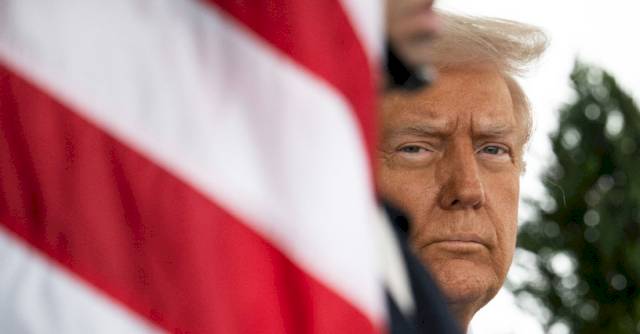
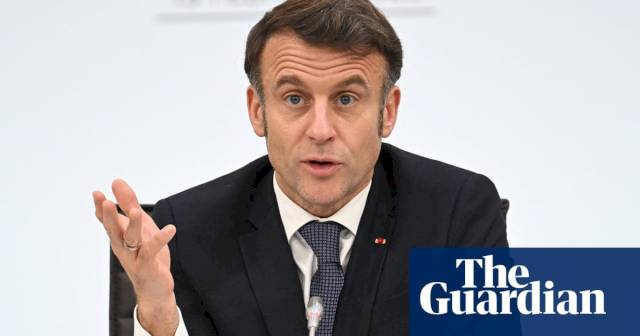
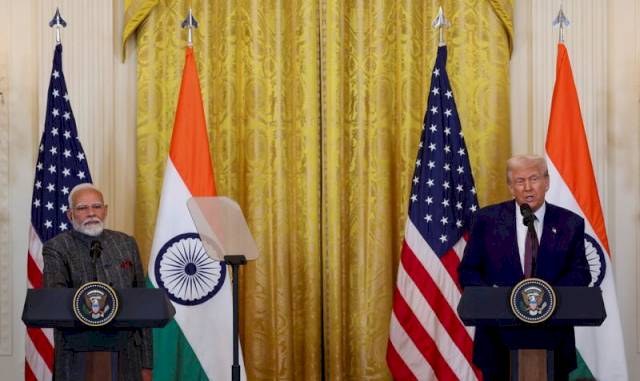

 Paul Kirby
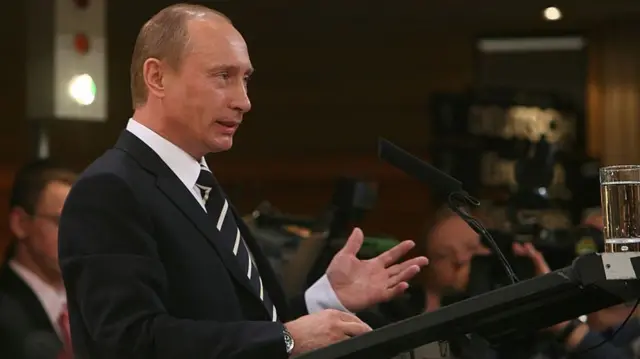 Image source, Getty Images