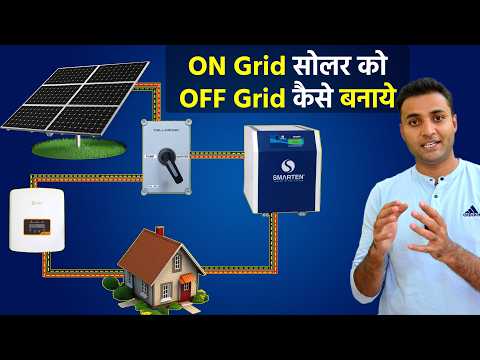
How to Convert on grid solar system to hybrid | on grid solar inverter | off grid solar inverter
Under the PM Surya Ghar Muft Bijli Yojana, many homeowners have installed on-grid solar systems. While these systems have their advantages, they also come with some limitations.
One major drawback is that on-grid solar systems stop working during a power outage. If your home doesn’t receive electricity from the grid, the solar panels become useless, and you won’t get any power. However, the advantage is that these systems do not require batteries, which saves you the cost of battery storage.
Unfortunately, many people are unaware of this limitation and later realize they need a solution to keep their solar system running even during power cuts. This video explains how you can convert your on-grid system into an off-grid system to ensure uninterrupted solar power.
Methods to Convert an On-Grid System to Off-Grid:
1. Using an Off-Grid Inverter
The simplest way to convert an on-grid system into an off-grid system is by removing the solar panels from the on-grid setup and connecting them to an off-grid inverter.
However, off-grid inverters operate at a lower Open Circuit Voltage (OCV) than on-grid inverters. On-grid inverters support a wide voltage range (160V to 1000V), while off-grid inverters generally support up to 200V or 400V.
To match the voltage requirements, you must reconfigure the panel connections.
2. Using a DC Changeover Switch
If you want to keep both systems functional, a DC changeover switch allows you to switch solar power between the on-grid inverter and the off-grid inverter.
First, check your system’s Open Circuit Voltage (OCV). For example:
A 500W panel has an OCV of 50V.
If 10 panels are connected in series, the total OCV will be 500V.
You need an off-grid inverter that supports this voltage. Transformer-less inverters or high battery-bank inverters may be suitable for this purpose.
3. Using a Battery-Less Inverter
Some modern transformer-less battery-less inverters allow you to power your home directly from solar panels without using batteries.
Example: Smarten Kranti Series Inverters
These support up to 15 solar panels in series.
Available in 5kVA, 8kVA, and 10kVA models.
Minimum 400V input is required, meaning at least 8 solar panels in series.
These inverters provide direct AC power, ensuring your home appliances run smoothly even when the grid power is down.
4. Switching to a Hybrid Inverter
The best and most efficient solution is upgrading to a hybrid inverter.
Hybrid inverters work in both on-grid and off-grid modes, ensuring:
On-grid benefits (net metering, cost savings).
Off-grid backup (solar power even during outages).
on grid solar inverter,
grid tie inverter,
how to convert on grid solar system to hybrid,
grid tied solar system,
off grid solar power system,
on grid inverter,
off grid solar inverter,
off grid inverter,
on grid solar power system,
cellcronic solar inverter,
on grid solar ko off grid kaise banaye,
on grid solar system,
convert on grid solar to off grid,
how to convert on grid solar to off grid,
polycab solar inverter,
solar grid tie inverter,
convert on grid solar to hybrid,
grid tied solar system with battery backup,
on grid vs off grid solar system
solar inverter
solar off grid system
hybrid solar inverter
off grid solar
on grid solar system with battery backup
on grid solar system without net metering
hybrid solar power system
off grid solar system
ongrid and offgrid solar
grid tied inverter
on grid inverter without grid
on grid solar
on grid solar power system ko off grid kaise banaye
solar grid tie system
solar system
cellcronic
hybrid inverter
on grid solar system installation
on grid solar with battery backup
solar inverter without battery
Leave a Reply