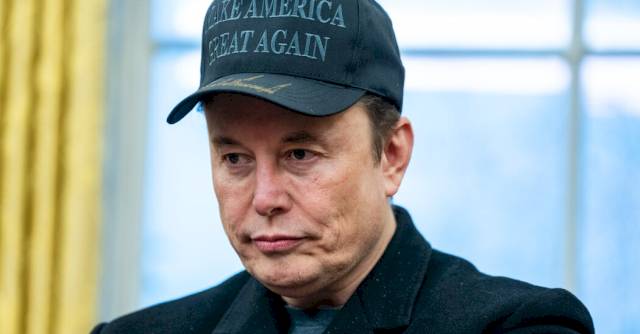


Trump officials at several agencies defy Musk’s directive on summarizing accomplishments.
Image
Several Trump-appointed agency leaders urged their staffs not to comply with Elon Musk’s order to summarize their accomplishments for the past week or be removed from their positions, even as Mr. Musk doubled down on his demand over the weekend.
Their instructions in effect countermanded the order of Mr. Musk, challenging the broad authority President Trump has given to the world’s richest man to make drastic changes to the federal bureaucracy. The standoff serves as one of the first significant tests of how far Mr. Musk’s power will extend.
As the directive ricocheted across the federal government, officials at some agencies, including the Defense Department, the F.B.I., the State Department and the office coordinating America’s intelligence agencies, bluntly told their employees not to respond.
The public pushback reflects a growing unease — and, in some cases, alarm — behind the scenes across the administration about the perception of Mr. Musk’s unchecked power.
The unease runs from lower staff to some cabinet secretaries, who have tired of having to justify specific intricacies of agency policy and having to scramble to address unforeseen controversies that Mr. Musk has ignited.
Those officials are aware that he has influence over the president privately, and they fear him using X, the social media website he owns, to single out people he views as obstructing him, according to one senior administration official.
One person who was quiet about the controversy throughout much of the weekend was Mr. Trump; after posting on social media on Saturday morning that he wanted Mr. Musk to be more “aggressive,” and then bragging about the purge of federal workers in a speech hours later, the president had remained mute on the subject through Sunday afternoon.
By then, some of the pushback against Mr. Musk from administration officials — coming in large part from the national security apparatus and law enforcement agencies — had become public and explicit.
“The Department of Defense is responsible for reviewing the performance of its personnel and it will conduct any review in accordance with its own procedures,” Darin S. Selnick, the acting Pentagon official in charge of personnel, said in a statement, instructing Pentagon employees to “for now, please pause any response.”
Tulsi Gabbard, the director of the office of national intelligence, ordered all intelligence community officers not to respond, in a message to intelligence officials reviewed by The New York Times.
“Given the inherently sensitive and classified nature of our work, I.C. employees should not respond to the OPM email,” Ms. Gabbard wrote.
Kash Patel, the F.B.I. director, wrote in an email to employees that “the F.B.I., through the office of the director, is in charge of all our review processes,” telling workers that they should “for now, please pause any responses.”
Image
At the Justice Department and F.B.I., the threatening signals from Mr. Musk were met with a mix of anger and amazement that anyone would issue such a blanket demand without consideration for sensitive areas such as criminal investigations, legal confidentiality or grand jury material.
Some law enforcement supervisors quickly told employees to wait for more guidance from managers on Monday before responding to the demand, according to current and former officials.
Other departments appeared to give conflicting guidance. The Department of Health and Human Services told its employees on Sunday morning to follow the directive. An hour later, an email from the National Institutes of Health, a subordinate agency, told employees to “hold on responding” until “we receive further guidance.” That email was signed by Matthew J. Memoli, the agency’s Trump-appointed acting director.
On Saturday, Mr. Musk posted a demand for government employees to summarize their accomplishments for the week, warning that failure to do so would be taken as a resignation. Soon after, the Office of Personnel Management, which manages the federal work force, sent an email asking civil servants for a list of accomplishments, but it did not include the threat of removal for not complying.
Unions representing federal workers suggested that Mr. Musk’s order was not valid. They advised their members to follow guidance from their supervisors on how, and whether, to respond to the email.
In a scathing letter on Sunday, Everett B. Kelley, the president of the American Federation of Government Employees — the largest federal employee union — told the acting director of the Office of Personnel Management that the email sent to federal employees was “plainly unlawful” and “thoughtless.”
Mr. Kelley demanded that the order be retracted, and noted, “By allowing the unelected and unhinged Elon Musk to dictate O.P.M.’s actions, you have demonstrated a lack of regard for the integrity of federal employees and their critical work.”
Multiple intelligence agencies, including the National Security Agency, had warned employees that responding could risk inadvertently disclosing classified work.
Although Mr. Musk’s original email told employees not to include classified material, current and former intelligence officials said that if an adversary gained access to thousands of unclassified accounts of intelligence officers’ work that it would be able to piece together sensitive details or learn about projects that were supposed to remain secret.
Representative Mike Lawler, a New York Republican whose seat may be among the most fiercely contested in 2026, raised doubt about the order even as he gave broader support to Mr. Musk’s cost-cutting effort.
“I don’t know how that’s necessarily feasible,” Mr. Lawler said of the ultimatum. “Obviously, a lot of federal employees are under union contract.”
Image
But, he continued, “There’s no question, as the Department of Government Efficiency moves ahead, what they are seeking to do is ensure that every agency and department is effectively and efficiently doing their job.”
It is unclear what legal basis Mr. Musk would have to justify mass firings based on responses to the email, and the White House and the Office of Personnel Management did not immediately answer questions about the threat of removal.
But Mr. Musk — who made similar unconventional demands during his takeover of Twitter, now known as X — insisted on Sunday morning that the order amounted to “a very basic pulse check.”
In a series of posts, Mr. Musk also promoted baseless claims of wage fraud — that a significant number of “non-existent” or dead people were employed in the federal work force, and that criminals were using the fake employees to collect government paychecks.
“They are covering immense fraud,” Mr. Musk said in response to a post by a supporter that said that “the left is flipping out about a simple email.” In another post, Mr. Musk posted a meme that imagined some federal employees to be terrorized by the order.
His claims echo a similar one that tens of millions of dead people may be receiving fraudulent Social Security payments. A recent report by the Social Security Administration’s inspector general — a watchdog that investigates the program for waste, fraud and abuse — found that “almost none” of the people in the agency’s database who had likely died were receiving payments.
Reporting was contributed by Julian E. Barnes, Devlin Barrett, Rebecca Davis O’Brien, Ken Bensinger, Kate Conger, Sheryl Gay Stolberg, Adam Goldman, Minho Kim, Lisa Friedman and Margot Sanger-Katz.

An email making a bomb threat “to honor the J6 hostages” — referring to the people charged in connection with the attack on the Capitol on Jan. 6, 2021 — briefly interrupted a conference held on Sunday by Principles First, a conservative group that has emerged as a vocal critic of President Trump, according by remarks delivered by its founder, Heath Mayo. Mayo told attendees of the conference, which is being held at the JW Marriott Hotel in Washington, that organizers received the email on Sunday afternoon and that the police were investigating who may have sent it.
The bomb threat came one day after Enrique Tarrio, the former leader of the Proud Boys, appeared at the event and heckled Michael Fanone and Harry Dunn, two former police officers who protected the Capitol during the attack by a pro-Trump mob.

Trump’s frustration with generals resulted in an unconventional pick.
Image
By late last week, President Trump had decided to fire Gen. Charles Q. Brown Jr., the chairman of the Joint Chiefs of Staff, and replace him with one of two very different candidates, according to two administration officials.
One was Gen. Michael E. Kurilla, a hard-charging Army four-star general who oversees U.S. military operations in the Middle East, one of the Pentagon’s highest-profile assignments.
The other was a little-known retired three-star Air Force officer, Dan Caine, with an unorthodox career path that included time as a fighter pilot, the top military liaison to the C.I.A. and an Air National Guard officer who founded a regional airline in Texas.
Mr. Trump and General Caine met for an hour at the White House on Feb. 14. The president largely made up his mind during a meeting with Defense Secretary Pete Hegseth on Thursday, aides said.
And in a message on social media the next evening, Mr. Trump announced that he had picked General Caine, calling him “an accomplished pilot, national security expert, successful entrepreneur, and a ‘warfighter’ with significant interagency and special operations experience.”
Image
The decision, part of an extraordinary purge at the Pentagon, resulted from intense deliberations over the past two weeks that were tightly held within a small group of senior administration officials, including Mr. Hegseth, Vice President JD Vance and Michael Waltz, the national security adviser, the officials said, speaking on the condition of anonymity to discuss internal discussions.
In Mr. Trump’s first term, he initially seemed to seek a close association with the military’s senior leaders, whom he frequently referred to as “my generals.” That soon gave way to frustration with them as he came to regard them as disloyal.
The president’s deep skepticism prompted him to pass over the more obvious choices to replace General Brown and to pluck General Caine from relative obscurity. His choice, people familiar with his thinking said, was based in part on a lack of clear association with the Biden administration and in part on a brief encounter with General Caine in Iraq six years ago that left Mr. Trump convinced he had the kind of can-do attitude the president sees as making the ideal military officer.
In recent years, Mr. Trump has publicly praised General Caine for telling him during that visit to Iraq that the Islamic State could be defeated far more quickly than more senior advisers had suggested.
Now their rekindled relationship will be tested not only by national security challenges like the war in Ukraine and a rising military threat from China, but also by whether General Caine can live up to Mr. Trump’s expectations of loyalty without politicizing the deliberately apolitical job of providing his best military advice to the commander in chief.
Mr. Trump has fixated on the position of the Joint Chiefs chairman since 2019, when he picked Gen. Mark A. Milley, General Brown’s predecessor. It was a decision the president came to regret.
The president saw General Milley as a grandstander and a traitor. General Milley had publicly apologized for walking with Mr. Trump across Lafayette Square for a photo op after the area had been cleared of peaceful demonstrators following the death of George Floyd in May 2020. The president had asked General Milley why he was not proud that he had accompanied “your president,” and it rankled Mr. Trump that the general swore allegiance to the Constitution, not to him. Their relationship was never the same.
Image
“Trump likes his generals up until the point he doesn’t anymore,” John R. Bolton, the national security adviser in Mr. Trump’s first term, said in an interview.
After Mr. Trump was elected to a second term, word soon spread that he would replace General Brown, a decorated F-16 fighter pilot who in October 2023 became only the second African-American to serve as chairman.
After Mr. Hegseth was narrowly confirmed as defense secretary last month, that likelihood became a near certainty, administration officials said. Mr. Hegseth had previously said General Brown should be fired because of what he called a “woke” focus on diversity, equity and inclusion programs in the military. Mr. Hegseth also questioned whether the general was promoted because of his race, despite his 40 years of service.
Several weeks ago, the search for a new chairman began in earnest, administration officials. Adm. Samuel J. Paparo Jr., the head of U.S. forces in the Indo-Pacific, was briefly considered, among several other initial candidates.
But the list of finalists quickly shortened to General Kurilla and General Caine.
On paper and in conventional thinking, General Kurilla seemed to have the leg up. He was meeting regularly with Mr. Trump and other top national security aides to discuss military priorities in the Middle East. Moreover, General Kurilla, whose tenure at Central Command is expected to wrap up in the next few months, had expressed interest in the job, several current and former military officials said.
General Caine, on the other hand, had retired at the end of December after completing the final job in his military career — as the Pentagon’s liaison to the C.I.A. — and joined Shield Capital, a firm in Burlingame, Calif., specializing in cybersecurity and artificial intelligence.
General Caine, 56, who graduated from the Virginia Military Institute in 1990 with a degree in economics, became an F-16 pilot — as his father had been — and was the lead aviator assigned to protect Washington on Sept. 11, 2001, after Qaeda hijackers slammed commercial jets into the Pentagon and the World Trade Center.
His career after that followed an unusual trajectory, as he parlayed one opportunity into another. He was a White House fellow at the Agriculture Department and a counterterrorism specialist on the White House’s Homeland Security Council under President George W. Bush. He served in several highly secretive intelligence and special operations assignments, some in the United States and some overseas.
And as a part-time Air National Guard officer, General Caine was a co-founder of RISE Air, a regional airline, and managed other private businesses, according to his LinkedIn page and interviews with friends and former colleagues.
But what put him on Mr. Trump’s radar was the president’s short visit to Al Asad air base in western Iraq in December 2018. In a briefing there, General Caine told the president that the Islamic State was not so tough and could be defeated in a week, not the two years that senior advisers predicted, Mr. Trump recounted in 2019.
And at a Conservative Political Action Conference meeting last year, Mr. Trump said that General Caine put on a Make America Great Again hat while meeting with him in Iraq.
The details of these accounts have shifted over time in Mr. Trump’s frequent retelling of the stories. But Mr. Bolton, who accompanied Mr. Trump on the trip to Iraq, said that General Caine and another senior general briefed the president on a plan to defeat the last remnants of the Islamic State in two to four weeks, not one week. And at no time, he said, did General Caine ever put on a MAGA hat. “No way,” Mr. Bolton said.
Image
In his social media message, Mr. Trump also noted General Caine’s nickname, “Razin,” recalling Mr. Trump’s obsession with former Defense Secretary Jim Mattis’s nickname, “Mad Dog,” a moniker Mr. Mattis hated.
General Caine’s nickname embodied the kind of hell-raiser warrior straight out of central casting that Mr. Trump was looking for in his top general, officials said. He fulfilled a fantasy vision the president has of what generals do, they added.
In his post on Friday, Mr. Trump again praised General Caine’s counterterrorism skills. “During my first term, Razin was instrumental in the complete annihilation of the ISIS caliphate,” the president said. “It was done in record setting time, a matter of weeks. Many so-called military ‘geniuses’ said it would take years to defeat ISIS. General Caine, on the other hand, said it could be done quickly, and he delivered.”
Mr. Trump revealed another reason for his unconventional choice. He said that General Caine had been passed over for promotion by President Joseph R. Biden Jr., a claim that Biden officials said on Sunday they could not address. Aides say that in Mr. Trump’s mind, that perceived snub was a great endorsement, proof that General Caine has no specific loyalty to the previous administration. To Mr. Trump, who views most senior officers as incompetent and politically correct, it also suggests that General Caine has a different mind-set.
Friends and former colleagues say that General Caine, an intensely focused but low-key, self-effacing officer, has been uncomfortable with Mr. Trump’s characterization of his role in defeating the Islamic State. General Caine did not respond to emails requesting comment on Sunday.
But when the White House called a couple of weeks ago as he was preparing to move to Dallas from Washington, friends of General Caine say, he did not hesitate to accept the meetings with Mr. Trump and his top aides, and ultimately the job — out of duty to the country.
Which raises perhaps the most important question for General Caine as he prepares to return to active duty as soon as this week, and get ready for what is expected to be a tough Senate confirmation hearing: Will he give his best unvarnished military advice to Mr. Trump, or tell the president what he wants to hear?
“He was always direct and candid in the interagency, which is no small feat,” Gen. Kenneth F. McKenzie Jr., a former head of Central Command who dealt frequently with General Caine in his C.I.A. job, said on Sunday. “I never saw him as a yes-man.”
Senator Jack Reed of Rhode Island, the senior Democrat on the Armed Services Committee, said in an interview on Sunday that he would press General Caine in his hearing on that central point: “Will he have the ability to speak truth to power?”
Jonathan Swan, Maggie Haberman and Helene Cooper contributed reporting.
Advertisement

In a scathing letter on Sunday, Everett B. Kelley, the president of the American Federation of Government Employees — the largest federal employee union — told the acting director of the Office of Personnel Management that the “What did you do last week?” email sent to federal employees on Saturday was “plainly unlawful” and “thoughtless.” Kelley demanded that the message be retracted, and noted: “By allowing the unelected and unhinged Elon Musk to dictate OPM’s actions, you have demonstrated a lack of regard for the integrity of federal employees and their critical work.”
Kelley’s letter also said that responding to the email would “pull federal employees away from their critical duties without regard for the consequences,” giving hypothetical examples of a Veterans Administration surgeon and an air traffic controller who would have to turn their attention from their work. “This request, and the resulting confusion, is not just inappropriate—it is disruptive to essential government functions.”

Tulsi Gabbard, the director of national intelligence, ordered all intelligence community officers not to respond to the email from Elon Musk directing workers to detail their accomplishments of the week or risk losing their jobs. “Given the inherently sensitive and classified nature of our work, IC employees should not respond to the OPM email,” Gabbard wrote, referring to the Office of Personnel Management. Multiple intelligence agencies, including the National Security Agency, had already warned employees that responding could risk inadvertently disclosing classified work.
Image
Although Musk’s original email told employees not to include classified material, current and former officials said that if an adversary gained access to thousands of unclassified accounts of the work of intelligence officers they would be able to piece together sensitive details or learn about projects that were supposed to remain secret.
As the conservative Christian Democrats appeared poised to win Germany’s parliamentary elections this evening, President Trump declared the election as a victory for his own conservative movement.
“Much like the USA, the people of Germany got tired of the no common sense agenda, especially on energy and immigration, that has prevailed for so many years,” Trump wrote on social media. “This is a great day for Germany, and for the United States of America.”
Image

Senator Cory Booker, Democrat of New Jersey, said today on NBC’s “Meet the Press” that the Friday dismissal of Gen. Charles Q Brown Jr., the chairman of the Joint Chiefs of Staff, sent “a dangerous message to the military” that personal loyalty to the president mattered more than “independent expertise” or years of service. General Brown received broad, bipartisan support during his confirmation process in 2023.
Advertisement
Senator Markwayne Mullin, Republican of Oklahoma, said the United States should reevaluate whether to stay in NATO, the military alliance of 32 member countries. “NATO has not always been playing in our best interest,” he said on NBC. “The definition of insanity is doing the same thing expecting different results.”
Image
Representative Jim Himes of Connecticut, the top Democrat of the House Intelligence Committee, compared President Trump’s push for a deal on rare earth minerals in Ukraine in exchange for U.S. aid to mafia extortions. “It just looks like an episode of The Sopranos,” he said on “Fox News Sunday.” “Give us your minerals, or we’re not going to help you fight a bloody butcher.”
Representative Jim Jordan, Republican of Ohio and the chairman of the House Judiciary Committee, responded to Himes on the same show, defending President Trump’s tactic as “a unique way of negotiating” that “typically gets results.” He referred to a shift in tone and some policy concessions that Mexico and Canada gave to the Trump administration after the president threatened the American neighbors with tariffs.
Hegseth defends Trump’s firing of the chairman of the Joint Chiefs of Staff.
Image
Defense Secretary Pete Hegseth on Sunday defended President Trump’s firing of the chairman of the Joint Chiefs of Staff, the nation’s top military officer, arguing that he was “not the right man for the moment.”
President Trump removed the chairman, Gen. Charles Q. Brown Jr., on Friday and nominated a retired three-star general to replace him. Mr. Hegseth followed that announcement by removing the chief of naval operations and the Defense Department’s top military lawyers.
Appearing on “Fox News Sunday,” Mr. Hegseth said “nothing about this is unprecedented,” adding that presidents from Franklin D. Roosevelt to Barack Obama have fired or dismissed officers. A chairman of the Joint Chiefs has never been fired, though when the position had two-year terms, the George W. Bush administration declined to renew the term of Gen. Peter Pace in 2007, citing opposition in Congress.
“This is a reflection of the president wanting the right people around him to execute the national security approach we want to take,” Mr. Hegseth said.
But Senator Jack Reed of Rhode Island, the top Democrat on the Armed Services Committee, said the series of firings “was completely unjustified.”
Mr. Reed said on ABC News’s “This Week” that the administration wanted the Defense Department to be beholden to the president. “They want everyone there to do what they’re told, regardless of the law,” he added.
The firing of the lawyers, he added, was startling and had prompted some talented leaders to question if they should stay in the military.
“If you’re going to break the law, the first thing you do is you get rid of the lawyers,” Mr. Reed said.
Mr. Hegseth rejected the criticism, and said that traditionally senior military lawyers had been chosen by one another. But, he said, he wanted “fresh blood,” and that he would open up the positions to a broader candidate pool to find the best military lawyers to lead each of the armed services.
“Ultimately, we want lawyers who give sound constitutional advice and don’t exist to attempt to be roadblocks,” Mr. Hegseth said.
Mr. Hegseth was also pressed on the administration’s plans for the war in Ukraine, and Mr. Trump’s criticism of President Volodymyr Zelensky of Ukraine.
He praised Mr. Trump for bringing the Kremlin toward peace talks, and defended the bilateral negotiations between Russia and the United States. Democrats, Europeans and Ukrainians have criticized those talks for leaving out Ukraine.
“Standing here and saying, ‘you’re good, you’re bad, you’re a dictator, you’re not a dictator, you invaded, you didn’t’ — it’s not useful,” Mr. Hegseth said. “It’s not productive.”
In his interview Mr. Reed, the top Democrat on the Armed Services Committee, said that Mr. Trump was essentially “surrendering to the Russians.”
“This is not a statesman or a diplomat,” Mr. Reed said. “This is just someone who admires Putin, does not believe in the struggle of the Ukrainians and is committed to cozying up to an autocrat.”
Advertisement
Gabbard accuses security agencies of eroding privacy and civil liberties.
Image
Tulsi Gabbard, the director of national intelligence, has criticized security agencies for eroding privacy and civil liberties, and said she would work to ensure that intelligence collected on Americans would not be improperly used against them.
In her first interview since being confirmed in her role on Feb. 12, Ms. Gabbard told Lara Trump of Fox News that during the 2024 election campaign, she had been put on a Transportation Security Administration list called Quiet Skies that, she said, subjected her to federal surveillance.
Ms. Gabbard said that she was put on the list after she criticized Vice President Kamala Harris. U.S. officials told The New York Times that Ms. Gabbard was added to the list after a European businessman who was on another federal watch list arranged for her travel to a conference in Rome.
But Ms. Gabbard said the experience of being subjected to extra scrutiny by federal air marshals was a clear example of the weaponization of government.
“It really speaks to how these institutions that exist to ensure the safety, security and freedom of the American people being weaponized against the American people actually creates a greater national security risk,” Ms. Gabbard told Ms. Trump in the interview, which aired on Saturday. Ms. Trump is President Trump’s daughter-in-law.
Ms. Gabbard said the federal government had for too long used security threats to undermine liberty, adding that it was her “essential” responsibility to better balance liberty and safety.
“For too long we have seen people in positions of great power say if we violate your freedom and civil liberties it’s OK because we are trying to keep you safe,” she said. “There is such a thing as threat to physical security, but our threat to our freedom and our liberty must be balanced right alongside that threat to our physical security.”
Ms. Gabbard said the Biden administration had turned its focus away from the dangers of “Islamic terrorism” in the United States and was wrongly focused on domestic terrorism, putting its attention on “our fellow Americans.” An intelligence report delivered to Congress in 2021 by the Biden administration echoed earlier analyses by the F.B.I. and Department of Homeland Security, and warned of the dangers of domestic terrorism from extremists and white supremacist groups, including after followers of Mr. Trump embraced his baseless claims of election fraud.
Ms. Gabbard said she was working with the White House to trim government spending. She noted that the Office of the Director of National Intelligence was a small organization but claimed, without providing details, that the elimination of diversity programs had saved $20 million. She added that she was “excited to be able to uncover more” spending cuts.

Steve Witkoff, President Trump’s Middle East envoy, said Sunday on CNN that he met with President Vladimir V. Putin of Russia during a recent trip to Moscow. He said they had a “positive, constructive meeting,” which he attributed to the “positive relationship” between Putin and Trump during his first term.
“The only way you’re going to end the carnage is if you have a relationship with the leaders of both countries that are involved,” he said on CNN.
Steve Witkoff, President Trump’s Middle East envoy, said Sunday on CNN that he expected Ukraine to sign a deal this week to give the United States access to valuable minerals in Ukraine. The progress toward a deal comes after President Trump ratcheted up criticism on the country and its leader, President Volodymyr Zelensky, for initially rebuffing the United States.
Image
“He’s not wavering anymore,” Witkoff said of Zelensky. “I think there’s a reason he’s not wavering. It’s because he realizes that we have done so much and that that agreement belongs being signed.”
Advertisement
Witkoff said Sunday that he still expected the second phase of the cease-fire deal between Israel and Hamas to proceed after Israel delayed the release of hundreds of Palestinian prisoners. Still, he said, they would need to extend phase one of the deal — the initial six-week cease-fire. He said he planned to travel to the region this week to work on the negotiations.

Robert Jimison, who covers Congress, reported from Trinity County in the 17th Congressional District of Texas.
Republicans are facing angry voters at town halls, hinting at a broader backlash.
Image
Some came with complaints about Elon Musk, President Trump’s billionaire ally who is carrying out an assault on the federal bureaucracy. Others demanded guarantees that Republicans in Congress would not raid the social safety net. Still others chided the G.O.P. to push back against Mr. Trump’s moves to trample the constitutional power of Congress.
When Representative Pete Sessions, Republican of Texas, arrived at a crowded community center on Saturday in the small rural town of Trinity in East Texas, he came prepared to deliver a routine update on the administration’s first month in office. Instead, he fielded a barrage of frustration and anger from constituents questioning Mr. Trump’s agenda and his tactics — and pressing Mr. Sessions and his colleagues on Capitol Hill to do something about it.
“The executive can only enforce laws passed by Congress; they cannot make laws,” said Debra Norris, a lawyer who lives in Huntsville, arguing that the mass layoffs and agency closures Mr. Musk has spearheaded were unconstitutional. “When are you going to wrest control back from the executive and stop hurting your constituents?”
Image
Louis Smith, a veteran who lives in East Texas, told Mr. Sessions that he agreed with the effort to root out excessive spending, but he criticized the way it was being handled and presented to the public.
“I like what you’re saying, but you need to tell more people,” Mr. Smith said. “The guy in South Africa is not doing you any good — he’s hurting you more than he’s helping,” he added, referring to Mr. Musk and drawing nods and applause from many in the room.
In Trinity and in congressional districts around the country over the past week, Republican lawmakers returning home for their first congressional recess since Mr. Trump was sworn in faced similar confrontations with their constituents. In Georgia, Representative Rich McCormick struggled to respond as constituents shouted, jeered and booed at his response to questions about Mr. Musk’s access to government data. In Wisconsin, Representative Scott Fitzgerald was asked to defend the administration’s budget proposals as voters demanded to know whether cuts to essential services were coming.
Many of the most vocal complaints came from participants who identified themselves as Democrats, but a number of questions pressing Mr. Sessions and others around the country came from Republican voters. During a telephone town hall with Representative Stephanie Bice in Oklahoma, a man who identified himself as a Republican and retired U.S. Army officer voiced frustration over potential cuts to veterans benefits.
“How can you tell me that DOGE with some college whiz kids from a computer terminal in Washington, D.C., without even getting into the field, after about a week or maybe two, have determined that it’s OK to cut veterans benefits?” the man asked.
Beyond town halls, some Democrats have organized a number of protests outside the offices of vulnerable Republicans. More than a hundred demonstrators rallied outside the New York district office of Representative Mike Lawler. Elected Democrats are also facing fury from within the ranks of their party. A group of voters held closed-door meetings with members from the office of Senator Chuck Schumer, Democrat of New York and the minority leader, after a demonstration at his New York offices.
Some of the scenes recalled the raucous town-hall meetings of 2009 that heralded the rise of the ultraconservative Tea Party, where throngs of voters showed up protesting President Barack Obama’s health care law and railed against government debt and taxes. It is not yet clear whether the current backlash will persist or reach the same intensity as it did back then. But the tenor of the sessions suggests that, after a brief honeymoon period for Mr. Trump and Republicans at the start of their governing trifecta, voters beginning to digest the effects of their agenda may be starting to sour on it.
Image
Mr. Sessions, who was first elected to Congress nearly three decades ago and represents a solidly Republican district, appeared unfazed by the disruptions on Saturday. Some audience members laughed at him and retorted with hushed but audible expletives when he spoke about his support of some of Mr. Trump’s policy proposals and early actions.
And some of his constituents were plainly pleased by what they had seen so far from the new all-Republican team controlling the White House and both chambers of Congress. Several cheered an executive order barring transgender women and girls from participating in school athletic programs designated for female students, applauded plans to shrink the Department of Education and welcomed calls from Mr. Sessions to end remote work flexibility for federal employees.
“Ladies and gentlemen, we are going to have a reduction in force,” Mr. Sessions told the crowd.
And while many in the room voiced displeasure over the sweeping changes underway in Washington, some were agitating for bolder action to address what they called government corruption — not for pumping the brakes.
As Mr. Sessions spoke about the administration’s efforts to streamline bureaucracy and root out wasteful spending, shouts erupted.
“Take care of it, Congressman,” one woman said, interrupting him.
“Do something about it,” another man added.
One man’s voice rose above the others railing against nongovernmental organizations that receive federal money: “They’re laundering money to NGOs. Who’s in jail?”
Still, much of the pressure came from constituents concerned about how he might be enabling Mr. Trump to enact policies that could hurt them.
Image
John Watt, the chairman of the Democratic Party in nearby Nacogdoches County, asked for guarantees from the congressman that he would oppose any cuts to Social Security if Mr. Trump and Mr. Musk turned their attention to the entitlement program.
“Will you be courageous enough to stand up to them?” Mr. Watt asked.
Mr. Sessions spoke at length about his support for the program, but said he could not promise it would be insulated from the blunt cuts Republicans in Washington are seeking across the government. Instead, he said he supported a comprehensive audit of the program that could result in some cuts.
“I’m not going to tell you I will never touch Social Security,” Mr. Sessions said, parting ways with Mr. Trump, who campaigned saying he never would. “What I will tell you is that I believe we’re going to do for the first time in years a top-to-bottom review of that. And I will come back, and I will do a town-hall meeting in your county and place myself before you and let you know about the options. But I don’t know what they’re proposing right now.”
It was a nod to the uncertainty surrounding the Republican budget plan, even as House leaders hope to hold a vote on it within days. Already, the level of cuts they are contemplating to Medicaid has drawn resistance from some G.O.P. lawmakers whose constituents depend heavily on the program, raising questions about whether they will have the votes to pass their blueprint at all.
The public pushback could further complicate that debate, as well as efforts to reach a spending agreement as lawmakers return to Washington this week with less than three weeks to avert a government shutdown.
Image
Republicans generally hold fewer in-person open town halls than their Democratic counterparts, opting instead for more controlled settings, such as telephone town halls, that minimize the risk of public confrontations. But even before last week, they had begun hearing frustration from voters, who have also expressed their discontent by flooding the phones of congressional offices.
With their already narrow majority in the House, G.O.P. lawmakers are in a fragile position. A voter backlash could sweep out some of their most vulnerable members in midterm elections next year. But the pushback in recent days has come not only in highly competitive districts but also in deeply Republican ones, suggesting a broader problem for the party.
And there is little sign that Mr. Trump is letting up. On Saturday, Mr. Trump said in a social media post that Mr. Musk “is doing a great job, but I would like to see him be more aggressive.” Mr. Musk responded by sending government employees emails that he said were “requesting to understand what they got done last week. Failure to respond will be taken as a resignation.”
Image
Hours later, during a speech at the Conservative Political Action Conference, Mr. Trump signaled that he was only just beginning to enact his agenda.
“I have not yet begun to fight, and neither have you,” Mr. Trump told a crowd of his supporters at the annual gathering outside in Washington.
Such remarks offer little cover for Republicans like Mr. Sessions facing tough questions from voters who are beginning to chafe at the changes Mr. Trump is pursuing.
But the congressman said that tense exchanges would not deter him from holding more events and seeking opportunities to communicate with his constituents, whether they agree with his positions or not. He said he would hold more events across the district next week, and hopes that after another week in Washington, he will be able to provide more clarity for those who show up.
“I heard them and they heard me,” he said of Saturday’s gathering. “And I don’t think there was a fight.”
Pete Hegseth, the defense secretary, said in an interview on Fox News Sunday defended the firing of Gen. Charles Q. Brown Jr., the country’s top military officer, and other senior officers from military leadership on Friday. He said there was nothing unprecedented about President Trump’s ouster of the officers. Hegseth praised General Brown but said he was “not the right man for the moment.”
Image
Hegseth defended firing the top military lawyers, saying that he wanted lawyers who did not attempt to be “roadblocks” to the Defense Department. He said a small group of military lawyers had selected the top judge advocates general in the past, and he said he would open up the process to allow more voices in the selection process.
Advertisement
Hegseth said that “we are closer to peace today than ever before” in Ukraine. He urged President Volodymyr Zelensky of Ukraine to come to the table and make a deal for Ukrainian rare earths, a group of minerals crucial for many high-tech products.


U.S.A.I.D. appointees fire hundreds working on urgent humanitarian aid.
Image
Trump administration appointees running the main United States aid agency have in recent days fired hundreds of employees who help manage responses to urgent humanitarian crises around the world, according to two U.S. officials and four recent employees of the agency.
The firings add to doubts raised about whether Secretary of State Marco Rubio is allowing employees for the United States Agency for International Development, or U.S.A.I.D., to carry out lifesaving humanitarian assistance, as he had promised to do late last month during a blanket freeze of almost all foreign aid from the U.S. government.
Trump appointees have fired or put on paid leave thousands of employees of U.S.A.I.D. A task force of young engineers working for Elon Musk, the billionaire tech businessman who is advising President Trump, has shut down many technical systems in the aid agency and barred employees from their email accounts. Mr. Musk has posted dark conspiracy theories about U.S.A.I.D. on social media, asserting with no evidence that it is a “criminal organization” and that it was “time for it to die.”
The latest round of dismissals occurred on Friday night, when hundreds of people working for the agency’s Bureau for Humanitarian Assistance got emails saying their jobs had been terminated. Two employees who got the emails said they were strange because they did not state any job titles specifically and did not have the recipients’ names in the “to” field. They were generic emails sent out in a large wave.
The New York Times obtained a copy and confirmed those descriptions. The employees who agreed to speak for this story did so on the condition of anonymity because they did not want to jeopardize the 15 days of pay they were scheduled to receive after being given a termination notice. The two U.S. officials feared retaliation.
In addition, 36 people were fired from the Office of Transition Initiatives, a unit in the agency’s conflict prevention bureau that specializes in helping partner countries with political transitions and democratic initiatives, said the U.S. officials and recent agency employees.
About 400 people were fired in recent days from humanitarian assistance positions, one U.S. official said. About 200 of those were contractors for the Bureau for Humanitarian Assistance, the officials said, and another 200 were part of a unit called the Support Relief Group, a collection of crisis experts who helped the bureau in responding quickly to natural disasters and armed conflicts. Now only about a dozen people remain in that group.
The fired employees were contractors who were employed directly by the U.S. government. Some had worked for U.S.A.I.D. in various capacities for 25 years.
Many of the contractors for the Support Relief Group had worked for the agency in war zones, including in Ukraine, Syria and Afghanistan. They often lived in different places around the world and spent weeks or months at a time in crisis areas. One employee who got the email on Friday said they were being flown home next week from a U.S. diplomatic mission overseas.
Another fired employee said the hundreds of dismissals meant that the aid agency now had only a skeleton crew to respond to humanitarian crises.
The appointee running day-to-day operations at U.S.A.I.D. is Pete Marocco, a State Department official overseeing foreign aid who was a divisive figure at the agency and other government departments in the first Trump administration. Early this month, Mr. Rubio announced he was taking over the aid agency as acting administrator.
Mr. Rubio has said all foreign aid will remain halted for 90 days during a review process. But officials and contractors working in foreign aid said they expected most of the aid to be cut permanently and many more employees to be fired, and what little remains of U.S.A.I.D. to be folded into the State Department. Although U.S.A.I.D. was created by Congress and lawmakers appropriated government money for foreign aid this year, few, if any, Republican lawmakers have raised objections to the aid freeze and the job cuts.
Foreign aid makes up less than 1 percent of the government budget.
Mr. Rubio said at the end of January that employees could apply for waivers to allow their aid programs, in particular “lifesaving humanitarian assistance,” to continue during the freeze. But few programs have gotten waivers. And even those with waivers could not operate because the U.S.A.I.D. payment system, known as Phoenix, had been rendered defunct, meaning partner groups could not get funds.
The State Department and a political appointee at U.S.A.I.D., Laken Rapier, who is said to be a press officer, did not return emails requesting comment for this story.

In his CPAC speech, Trump reveled in political payback.
Image
President Trump made a triumphant return to the Conservative Political Action Conference on Saturday, gleefully recounting his acts of retribution against the Biden administration to a crowd of loyal supporters that included people he had pardoned for their roles in the Jan. 6, 2021, attack on the Capitol.
Two years after he used an address at CPAC, an influential conservative gathering, to declare to his supporters that “I am your retribution,” Mr. Trump took a victory lap amid his wide-reaching efforts to reshape the federal government in his image, including firing thousands of federal workers and dismantling the government’s main international development agency.
“We have escorted the radical-left bureaucrats out of the building and have locked the doors behind them,” Mr. Trump said. “We’ve gotten rid of thousands.”
The speech took place against the backdrop of a conference that for several days has sought to cast Mr. Trump’s second win as a turning point in a global and increasingly successful crusade by right-wing political movements against institutions and norms that they believe have oppressed them.
Mr. Trump later added, “I ended Joe Biden’s weaponization as soon as I got in. I said, ‘I’m going to hit him with the same stuff.’”
Not only at the 2023 CPAC but throughout last year’s campaign, after he was charged with dozens of state and federal felonies, Mr. Trump had vowed revenge against his political enemies. He promised that his election would be a “judgment day” for “the liars and cheaters and fraudsters and censors and impostors who have commandeered our government.”
On Saturday, Mr. Trump declared that revenge tour to be well underway.
“The fraudsters, liars, cheaters, globalists and deep-state bureaucrats are being sent packing,” said Mr. Trump, who is presiding over an effort to drastically shrink the federal bureaucracy.
Toward the end of his speech, Mr. Trump lingered on his own criminal investigations and the scrutiny — or arrests — that people supporting his falsehoods about the 2020 election had faced.
He singled out Mike Lindell, the MyPillow founder who championed Mr. Trump’s false claims of widespread election fraud, whose phone was seized by federal agents in 2022 and who is the subject of several defamation lawsuits involving his claims. “That man suffered,” Mr. Trump said of Mr. Lindell, adding that the “F.B.I. thugs” had gone after him.
“And he never changed his mind,” Mr. Trump said. “He said that election of 2020 was rigged.” Now, Mr. Trump said, laughing, “It’s OK to say it, Mike.”
Greeting fans in the hall after the speech, Mr. Lindell recalled meeting with Mr. Trump last week at the White House. He said they met for two and a half hours to discuss voting systems and his longstanding ambition to return the country’s elections to all paper ballots.
“I’m not done yet,” said Mr. Lindell, who was sued by Dominion Voting Systems and Smartmatic for defamation. “I’m going to get rid of the machines. How many times have you heard me say that?”
A group of pardoned Jan. 6 participants stood at the back of the ballroom in which Mr. Trump spoke, cheering boisterously and holding up records from their imprisonment, chanting “J6! J6!” One woman shouted to the president, “Thank you for the pardon!”
“Thanks to that man right there, I’m no longer a felon,” Gregory Yetman, a former military policeman from Helmetta, N.J., said as Mr. Trump spoke. Mr. Yetman, 48, who had pleaded guilty to assaulting an officer at the Capitol, was serving his sentence at a federal prison in western Pennsylvania when he was released last month. Watching Mr. Trump’s speech, Mr. Yetman wore his old prison identification card on the lapel of his suit jacket.
Mr. Trump has been making appearances at CPAC off and on since 2011, when he was considering a run for the 2012 Republican primary to challenge President Barack Obama. He has used the venue at various times to lob attacks against his political rivals and to lay out his vision for his administration.
Last year, Mr. Trump turned his many legal troubles into a core part of his campaign message.
Like nearly everything else about the Republican Party since 2016, the event — formerly a gathering of staunch conservatives with a libertarian fringe represented by followers of Representative Ron Paul — has morphed into a reflection of Mr. Trump.
He had once come to CPAC as an outsider, addressing the convention as a former Democrat and political neophyte who had few allies in the Republican Party. After his victory in the 2016 election, Mr. Trump soon began to dominate the convention. By 2020, he had definitively transformed the gathering into a celebration of himself, his family and his ideology of “Make America Great Again.”
Even after his defeat in the 2020 election, Mr. Trump enjoyed overwhelming support among the convention’s attendees in 2021, and he used his address that year to settle scores with dissenters in the party. Mr. Trump drew the loudest applause during that address when he pledged to purge Republicans who had criticized him or refused to support his lies that the 2020 election had been stolen from him.
Many prominent figures from the Jan. 6 riot were fixtures at CPAC this week and attended Mr. Trump’s speech on Saturday. Among them was Enrique Tarrio, the Proud Boys leader, who had been convicted of seditious conspiracy and pardoned by Mr. Trump, before he was arrested yesterday on assault charges.
Another was Stewart Rhodes, the leader of the Oath Keepers militia, who was also convicted of seditious conspiracy for his role in the Capitol breach and was serving an 18-year prison sentence when Mr. Trump commuted his sentence to time served. Mr. Rhodes, who said he had not spoken to anyone in the new administration since his release from prison, set a high bar for Mr. Trump’s second term.
“I just hope he goes full-bore — within the constitutional bounds,” Mr. Rhodes said before the president spoke. “I hope he goes all the way.”
Advertisement
Borrowing from a tactic at X, Elon Musk says government workers must detail their workweek or lose their jobs.
Image
Elon Musk deepened the confusion and alarm of workers across the federal government Saturday by ordering them to summarize their accomplishments for the week, warning that a failure to do so would be taken as a resignation.
Shortly after Mr. Musk’s demand, which he posted on X, civil servants across the government received an email from the Office of Personnel Management with the subject line, “What did you do last week?”
The missive simultaneously hit inboxes across multiple agencies, rattling workers who had been rocked by layoffs in recent weeks and were unsure about whether to respond to Mr. Musk’s demand. Officials at some agencies, including the F.B.I. and the State Department, told their employees to pause responses to the email.
Mr. Musk’s mounting pressure on the federal work force came at the encouragement of President Trump, who has been trumpeting how the billionaire has upended the bureaucracy and on Saturday urged him to be even “more aggressive.”
In his post on X, Mr. Musk said employees who failed to answer the message would lose their jobs. However, that threat was not stated in the email itself.
“Please reply to this email with approx. 5 bullets of what you accomplished this week and cc your manager,” said the Office of Personnel Management message that went out to federal employees on Saturday afternoon. The email told employees to respond by midnight on Monday and not to include classified information.
The email was received by workers across the government, including at the F.B.I., the State Department, the Environmental Protection Agency, the Office of Personnel Management, the Food and Drug Administration, the Veterans Affairs Department, the Centers for Medicare & Medicaid Services and the Consumer Financial Protection Bureau, according to copies seen by The New York Times.
Some agency leaders welcomed Mr. Musk’s move. “DOGE and Elon are doing great work! Historic. We are happy to participate,” Ed Martin, the interim U.S. attorney for Washington, D.C., whom Mr. Trump has nominated to run the office on a permanent basis, wrote in a message to his staff.
But in a sign of the upheaval and the potential legal and security issues caused by the demand, officials at some federal agencies told their staff to hold off on responding and await further guidance.
Among them was Kash Patel, the new F.B.I. director. “The F.B.I., through the Office of the Director, is in charge of all of our review processes, and will conduct reviews in accordance with F.B.I. procedures,” Mr. Patel wrote in an email to staff obtained by The Times. “When and if further information is required, we will coordinate the responses. For now, please pause any responses.”
For rank-and-file workers, the latest move by Mr. Musk underscored a climate of instability and fear inside the government. One staff member at the National Institutes of Health, who spoke on the condition of anonymity out of fear of retaliation, said she was shocked by the message, which she said left her with a sick feeling in the pit of her stomach. When she found out more of the context, she said, she messaged a colleague: “They’re terrorizing us.”
As confusion and alarm spread on Saturday evening among workers over Mr. Musk’s demand, he said on X that there was a “low bar” to meet it.
“An email with some bullet points that make any sense at all is acceptable!” he said. “Should take less than 5 mins to write.”
In response to his threat of dismissal if workers did not comply, the American Federation of Government Employees, the largest federal employee union, said it would challenge any “unlawful” terminations.
Everett Kelley, the union’s president, accused Mr. Musk and Mr. Trump of showing “utter disdain” for federal employees.
“It is cruel and disrespectful,” he said in a statement, “to hundreds of thousands of veterans who are wearing their second uniform in the civil service to be forced to justify their job duties to this out-of-touch, privileged, unelected billionaire who has never performed one single hour of honest public service in his life.”
The union told workers that it “strongly believes” the Office of Personnel Management did not have the authority to direct employees in the manner of its emailed request and advised them to seek guidance from a supervisor.
The demands raised significant legal issues, experts said.
“There is zero basis in the civil service system for this,” said Sam Bagenstos, a law professor at the University of Michigan and a former general counsel to the Office of Management and Budget. “This is obviously designed to intimidate employees. Musk and DOGE and the Trump administration are persistently acting in a way that disregards civil service rules and they are just counting on the courts not being able to catch up and clean up after them.
“They are counting on employees saying, ‘This is too much, I can’t keep doing this,’” he added.
The message questioning workers’ output repeated a tactic Mr. Musk used to cull the work force at his social media company. He has repeatedly drawn inspiration from his 2022 takeover of X, then known as Twitter, as he works to overhaul the federal government with his so-called Department of Government Efficiency. With the support of the Trump administration, Mr. Musk has ordered layoffs across the federal government and effectively shuttered several agencies.
“Elon is doing a great job, but I would like to see him be more aggressive,” Mr. Trump said in a post Saturday on his social media site.
Mr. Musk quickly accepted the challenge. “All federal employees will shortly receive an email requesting to understand what they got done last week,” Mr. Musk wrote in a social media post on Saturday, saying his actions were “consistent” with the president’s demands. “Failure to respond will be taken as a resignation,” he added.
The White House did not immediately respond to a request for comment about the email to federal workers, and whether workers would be fired if they did not reply.
The Office of Personnel Management, which sent Mr. Musk’s deferred resignation offer to employees with the subject line “Fork in the Road” last month, sidestepped the question.
“As part of the Trump administration’s commitment to an efficient and accountable federal work force, O.P.M. is asking employees to provide a brief summary of what they did last week by the end of Monday, cc’ing their manager,” McLaurine Pinover, a spokeswoman for the agency, said in a statement on Saturday. “Agencies will determine any next steps.”
The demand left many workers reeling.
Most of the Consumer Financial Protection Bureau’s work force had recently been placed on leave as Mr. Musk gutted the agency, and have been instructed not to work — leaving them with no accomplishments to report, a worker there said.
Mr. Musk’s allies in government have suggested using artificial intelligence to identify budget cuts, and workers at several agencies worried their responses would be assessed by A.I.
The approach echoed one Mr. Musk took with executives and employees at Twitter. In April 2022, Mr. Musk was set to join the board at the social media company, but bickered with Parag Agrawal, its chief executive at the time, over his public criticism of the company. When Mr. Agrawal asked Mr. Musk not to post detrimental things about Twitter, Mr. Musk responded in a text, “What did you get done this week?” and then told Mr. Agrawal he would buy Twitter outright.
The exchange led to Mr. Musk’s $44 billion takeover of the company, which he completed in October 2022. Mr. Musk claimed he fired Mr. Agrawal immediately, although Mr. Agrawal contested the circumstances of his departure and sued Mr. Musk for withholding severance payments.
Shortly after the acquisition, Mr. Musk told employees to print out code they had written recently — an exercise intended to prove how hard they worked. When executives at the company raised privacy concerns, Mr. Musk instructed employees to shred the code they had printed.
On Saturday, Mr. Musk acknowledged the similarities. “Parag got nothing done. Parag was fired,” he wrote in an X post about the message he intended to send to federal workers.
Nicholas Nehamas, Maggie Haberman, Rebecca Davis O’Brien, Madeleine Ngo, Mattathias Schwartz, Matthew Goldstein, Erica L. Green, Eileen Sullivan, Margot Sanger-Katz, Edward Wong, Mark Walker, Kennedy Elliott, Lisa Friedman and Adam Goldman contributed reporting.

What to know about Janet Mills, the Maine governor who told Trump, ‘See you in court.’
Image
After Janet Mills, the Democratic governor of Maine, challenged President Trump during a White House meeting, she became both a folk hero to her party and a political target whose state now faces a federal investigation by the Department of Education.
Ms. Mills, 77, told Mr. Trump on Friday that she would not accede to his executive order banning transgender athletes in women’s sports. “See you in court,” she said, while seated with a group of bipartisan governors in the White House State Dining Room. The U.S. Department of Education promptly informed Maine officials that the state’s education department was under a “directed investigation.”
The Trump administration “will do everything in its power to ensure taxpayers are not funding blatant civil rights violators,” said Craig Trainor, the acting head of the U.S. Department of Education’s civil rights division. He said that Maine would lose federal funds if it did not comply.
Ms. Mills did not stand down.
“Do not be misled: This is not just about who can compete on the athletic field, this is about whether a president can force compliance with his will, without regard for the rule of law,” the governor said in a statement on the escalating conflict. “I believe he cannot.”
The fight has thrust Ms. Mills, a fixture in Maine politics, onto the national stage. And it was her opposition to the first Trump administration’s hard-line immigration and anti-abortion policies that helped her become the state’s first female governor.
But her nearly five decades in state politics has been propelled by her support for law enforcement and her record as a criminal prosecutor.
Born in Farmington, Maine, an agricultural and manufacturing center, she was raised in a political family. Her father was Sumner Peter Mills Jr., a lawyer and Republican state legislator who served as the U.S. attorney for Maine under the Eisenhower and Nixon administrations.
After graduating from the University of Massachusetts and the University of Maine School of Law, Ms. Mills became Maine’s first female criminal prosecutor in the attorney general’s office. In a 1978 interview, she said, “I like prosecuting murder trials the best.”
She then became the first woman in all of New England to win a district attorney seat, pushing for better treatment of victims of domestic violence by the criminal justice system. In 2002, she won a seat in the State Legislature, and in 2009, she became Maine’s first female attorney general.
While serving as Maine’s top prosecutor, Ms. Mills clashed with Paul LePage, the conservative governor and a Trump acolyte. When Mr. LePage vetoed legislation giving the police more access to opioid overdose medication, she used settlement funds to pay for the treatment. She refused to help Mr. LePage support Mr. Trump’s 2017 ban on immigrants from predominantly Muslim countries, instead challenging the executive order in court. Mr. LePage unsuccessfully sued her.
In 2019, with Governor LePage term limited, Ms. Mills was elected to lead the state.
Ms. Mills has focused on economic policies and expanding health insurance coverage, but she has also worked with legislators to prevent health insurers from discriminating against transgender people, to allow gender-affirming hormone therapy under some circumstances for people who are 16 and older, and to enact a law that protects providers of gender transition care from being sued by other states.
She has not enacted any bills related to trans athletes, but the governor’s office does not decide who participates in high school sports. That choice is made by the Maine Principals’ Association, an independent body that oversees student sports in the state.
Before the election, Mr. Trump did not seem to know who Ms. Mills was. While campaigning in October, he mistakenly referred to Ms. Mills as a man during a call with supporters and accused her, wrongly, of planning to bring 75,000 immigrants to the state. “He’s weak and ineffective,” Mr. Trump said.
Vice President Kamala Harris won Maine, but voters leaned more right than in the past. Ms. Mills took a measured approach to Mr. Trump’s victory, telling the Portland Press Herald that she would support policies that benefit Maine and oppose ones those that hurt it.
“It’s as simple as that,” Ms. Mills said.
After Ms. Mills clashed with Mr. Trump on Friday, she predicted that Maine will not be the last state that the president investigates for defying orders that conflict with the law.
“You must ask yourself: Who and what will he target next, and what will he do,” she said. “Will it be you? Will it be because of your race or your religion? Will it be because you look different or think differently? Where does it end?”
Leave a Reply