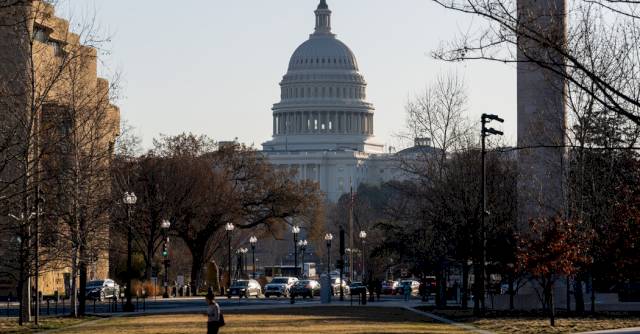

Senate Democrats balk at funding extension, raising the risk of a shutdown.
The Senate Democratic leader said on Wednesday that Democrats would refuse to back a stopgap bill to fund the government through Sept. 30, significantly raising the chances of a government shutdown at the end of the week.
After a private party meeting, Senator Chuck Schumer, Democrat of New York, instead urged Republicans to consider another extension to allow time to consider individual spending bills.
“Our caucus is unified on a clean April 11 C.R. that will keep the government open and give Congress time to negotiate bipartisan legislation that can pass,” Mr. Schumer said, using the shorthand for a continuing resolution to extend federal funding temporarily.
Democrats have been dubious about the Republican-drafted bill passed by the House on Tuesday, which would keep federal spending going at roughly current levels for the next six months, saying it would give the Trump administration too much leeway to continue efforts to drastically overhaul the government. The bill would need the support of at least eight Democrats to overcome procedural hurdles and come to a final vote.
Federal funding is set to lapse at 12:01 a.m. on March 15 if Congress does not act before then to extend it.
Any changes in the House bill or another extension would require the House to return and approve it, which is highly unlikely. Republican leaders deliberately adjourned the chamber and left town after passing the legislation on Tuesday to effectively force the Senate to accept their funding legislation.
The standoff puts Senate Democrats at risk of being blamed for any shutdown even as they complain about Trump administration disruptions to federal agencies. But they are under pressure from House Democrats and activists to stand against President Trump and Elon Musk as the new administration seeks to dismantle broad swaths of the federal bureaucracy.
With two days left before the shutdown, there is still time for a reversal by Democrats when the potential implications of a shutdown become clearer.
Image
Mr. Schumer’s announcement came as House Democratic leaders, gathered for a retreat in Virginia on Wednesday, pleaded with their Senate counterparts to follow their lead and oppose the government funding bill.
Representative Hakeem Jeffries, Democrat of New York and the minority leader, called the measure “a power grab that further unleashes and entrenches Elon Musk’s efforts” and applauded his caucus for sticking together on Tuesday in voting against it and sending a clear message of repudiation for its policies on the House floor. All but one Democrat opposed the measure in the House.
Annie Karni contributed from Leesburg, Va.

news analysis
Trump’s revenge on law firms is seen as undermining the justice system.
Image
President Trump’s retribution campaign against law firms, legal experts and analysts say, is undermining a central tenet of the American legal system — the right to a lawyer to argue vigorously on one’s behalf.
With the stroke of a pen last week, Mr. Trump sought to cripple Perkins Coie, a firm that worked with Hillary Clinton’s 2016 presidential campaign, by stripping its lawyers of security clearances needed to represent some clients and limiting the firm’s access to government buildings and officials.
That action came after he revoked security clearances held by lawyers at Covington & Burling after it was revealed that the firm was helping provide legal advice to Jack Smith, the special counsel who brought two federal indictments against Mr. Trump.
Mr. Trump’s actions, and open threats of more to come, have shaken law firms across Washington and beyond, leaving them looking at their client lists and wondering whether their representation could put them in the president’s cross hairs and endanger their business. Perkins Coie has acknowledged that in just the few days since Mr. Trump signed the executive order it “has already lost significant revenue” because of clients who have severed their relationship with the firm.
“This is certainly the biggest affront to the legal profession in my lifetime,” said Samuel W. Buell, a longtime professor of law at Duke University and a former federal prosecutor.
A federal judge on Wednesday sided with Perkins Coie in an initial courtroom skirmish with the White House, temporarily barring Mr. Trump’s executive order against the firm from taking effect.
“I am sure that many in the profession are watching in horror at what Perkins Coie is going through,” said Judge Beryl A. Howell of the Federal District Court in Washington. She added, “It sends little chills down my spine” to hear arguments that a president can punish individuals and companies like this.
Her reaction mirrored those of other legal experts who said the issues at stake go far beyond whether or not Mr. Trump will make life difficult for elite law firms and well-paid lawyers.
The experts say Mr. Trump’s actions could create a trickle-down effect in which those who find themselves under scrutiny from Mr. Trump and his administration struggle to find lawyers who are willing to defend them in the face of the vast powers of the federal government. Those facing scrutiny could be forced to turn to less skilled lawyers or firms that enjoy access or good ties to the White House, the experts say.
“If you’re a political enemy, you really need the best representation when the government comes after you for who you are,” said Daniel C. Richman, a professor of law at Columbia University and former federal prosecutor. “Chilling the lawyers who represent those people hurts the rule of law because when the government can’t be legally opposed, the law provides no protections to anyone and you start to live in an autocracy.”
Mr. Trump’s attack on Big Law comes as his administration has also gone after law schools, the American Bar Association and even lawyers inside the government itself who might question or hinder his agenda.
Image
Last week, the top federal prosecutor in Washington threatened to stop hiring graduates from Georgetown Law School if its dean, William Treanor, failed to abolish the school’s diversity programs. Mr. Treanor all but dared the prosecutor, Ed Martin, to make good on his threats, saying that the First Amendment would forbid them.
Mr. Trump has often relied on pliant lawyers to do his bidding, and last month he fired the three top lawyers in the armed forces who are supposed to advise military leaders on the legality of various policies and operations. The lawyers, known as judge advocates general, were fired without reference to their professional performance, raising concerns that the administration wanted replacements who would be more amenable to Mr. Trump’s orders.
One of the first big tests of this new era arose late last week, setting off maneuvering that shows how big firms in Washington are rushing to adapt to the new challenges they face, according to interviews with people involved in or briefed on those discussions.
In his executive order targeting Perkins Coie, Mr. Trump was going after a firm that represented Ms. Clinton’s campaign and repeatedly won election law cases in 2020 against Mr. Trump’s campaign. Mr. Trump singled out Perkins Coie’s involvement in a dossier complied during the 2016 campaign by a former British spy about Mr. Trump’s potential ties to Russia.
Amid concerns in the legal community about a chilling effect, few, if any, major firms issued statements condemning Mr. Trump’s action. And amid that silence there was a question about whether any firm would take the even bigger step of agreeing to represent Perkins Coie in its effort to challenge Mr. Trump’s executive order in court.
Perkins Coie reached out to Derek L. Shaffer, a lawyer at the firm Quinn Emanuel. Mr. Shaffer had a long history of bringing civil actions against federal and state governments, and had argued before the Supreme Court three times. Perkins Coie wanted to see if he could take on the firm as a client and quickly go to court to file a suit against the Trump administration to stop the executive order.
Convincing Mr. Shaffer to take the case would come with a major potential bonus: close links to Mr. Trump and his allies.
Lawyers at Quinn Emanuel represent Elon Musk and provide ethics advice to the Trump Organization. The firm also represents Mayor Eric Adams of New York as the Trump Justice Department has moved swiftly to drop corruption charges against Mr. Adams in exchange for his cooperation on immigration issues.
But Perkins Coie was rebuffed. Quinn Emanuel decided against taking the case. Its top leaders concluded that this was not an issue they wanted to jump into at this stage as they continue to build themselves into a power center in Mr. Trump’s Washington.
Other major law firms expressed concerns that if they represented Perkins Coie, they, too, could face Mr. Trump’s ire. Leaders of top firms asked: How would their own clients react if Mr. Trump cut off their access to the government?
In response, the elite Washington firm Williams and Connolly decided it would take on Perkins Coie as a client.
It’s unclear why Williams and Connolly was willing to take a risk that other firms were not. But lawyers at Williams and Connolly have long taken pride in their role as an adversary and check against the government, including highlighting the firm’s role in protecting high-profile defendants against prosecutorial misconduct. The firm was founded by the well-known defense lawyer Edward Bennett Williams, who built his career on vigorously representing an array of clients before the government, including those out of political favor.
On Tuesday, Williams and Connolly, on behalf of Perkins Coie, filed suit against the Trump administration in Washington. That suit led to Judge Howell’s ruling from the bench on Wednesday imposing a temporary restraining order to bar for now the actions against Perkins Coie from taking effect.
Other law firms have been discussing whether to file a joint amicus brief on behalf of Perkins Coie. While some major firms have signaled they are willing to sign onto it, others have said they are reluctant. On Wednesday, 21 state attorneys general filed their own amicus brief supporting Perkins Coie.
Covington & Burling, which had its security clearances stripped because of its representation of the special counsel Mr. Smith, has taken a different approach from that taken by Perkins Coie.
Covington has declined to fight Mr. Trump in court. Instead, the firm, concerned about a perception among its clients that it was falling out of favor with Mr. Trump, has begun discussions with other prominent law firms with fewer ties to Mr. Trump’s perceived enemies about becoming the face of some of their most important cases before the Justice Department.
But beyond what Mr. Trump has done to law firms, the political appointees he has placed at departments, agencies and commissions are taking on the legal profession in other ways.
One of Mr. Trump’s political appointees has ordered government officials under him to not renew their memberships to the American Bar Association, hold a position with the association or attend its events.
Image
At the Justice Department, the attorney general has sent a letter to the American Bar Association questioning its diversity practices.
And last week, at an annual conference on white collar crime for the American Bar Association, a slew of top officials from the Justice Department — who regularly attend the event — canceled at the last minute. That meant that a conference designed to bring together the industry about an important topic was devoid of senior department officials in charge of enforcing the law.
Abbie VanSickle and Alan Feuer contributed reporting.
Advertisement

The National Endowment for the Humanities said its chair had stepped down at Trump’s ‘direction.’
Image
The chair of the National Endowment for the Humanities, Shelly C. Lowe, left her position on Wednesday “at the direction of President Trump,” the agency said.
Ms. Lowe, a scholar of higher education and the first Native American to lead the agency, was nominated by former President Joseph R. Biden Jr. in October 2021 and confirmed by the Senate in February 2022. Michael McDonald, the agency’s general counsel, was named its acting chairman on Wednesday.
“I can confirm that, at the direction of President Trump, Shelly Lowe has departed her position as chair of N.E.H.,” a spokesman for the agency, Paula Wasley, said in a statement. She said Mr. McDonald would serve as acting chairman “until such time as the president nominates and the Senate confirms a new N.E.H. chairman.”
Agency chairs are appointed for four-year terms, though some have served across administrations. Maria Rosario Jackson, the chair of the endowment’s sister agency, the National Endowment for the Arts, announced her resignation on Jan. 17, shortly before Mr. Trump’s inauguration.
The National Endowment for the Humanities was founded in 1965 and has awarded more than $6 billion in grants to museums, historic sites, universities, libraries and other organizations, according to its website.
Ms. Lowe’s departure comes as Mr. Trump has moved to put his stamp on federal cultural agencies, most prominently the Kennedy Center, where he purged Biden appointees from the bipartisan board, fired the center’s president and had himself elected chairman.
The president has also issued sweeping executive orders banning diversity, equity and inclusion programs across the federal government while calling for the promotion of “patriotic history.” In one order issued in January, Mr. Trump included the heads of both the art and humanities endowments as members of his newly created Task Force 250, which is charged with providing “a grand celebration worthy of the momentous occasion of the 250th anniversary of American independence.”
Last month, the arts endowment, which is led by an interim chair, Mary Anne Carter, announced that it was canceling this year’s “Challenge America” grants, a relatively small program aimed at supporting projects serving underrepresented groups or communities.
Potential applicants were instead encouraged to apply for the agency’s much larger main grant program, which according to its website encouraged projects that “celebrate and honor the nation’s rich artistic heritage and creativity” during the lead-up to the 250th commemoration in July 2026.
In his first term, Mr. Trump repeatedly vowed to eliminate both agencies, which have an annual budget of roughly $200 million each. But they survived.
Information was not immediately available about any staff or budget cuts or shifts in its programs at the humanities endowment.
A federal judge on Wednesday sided with the law firm Perkins Coie, temporarily barring Trump’s executive order that crippled the firm’s ability to do business with the government. Trump signed an executive order last Thursday that essentially barred the firm’s lawyers from doing business with the federal government or entering federal buildings.
Image
Trump said that he was targeting the firm because of its role in representing Hillary Clinton’s 2016 campaign. Judge Beryl Howell said that the executive order had a chilling effect on the entire legal profession. “I am sure that many in the profession are watching in horror at what Perkins Coie is going through,” she said, adding, “It sends little chills down my spine” to hear arguments that a president can punish individuals and companies like this.

Senator Chuck Schumer of New York, the Democratic leader, says that Republicans do not have the votes in the Senate to pass the bill the House approved on Tuesday to avert a shutdown and fund the government through Sept. 30.
Schumer says that Senate Democrats are united around a 30-day stopgap bill “that will keep the government open and give Congress time to negotiate bipartisan legislation that can pass.”
Image
Advertisement
At least eight Democrats would need to join Republicans in getting the House-passed bill over the finish line. Democrats instead would like to extend current funding through April 11. But any changes would require the House to return, which is highly unlikely. House Republicans purposefully left town after passing the legislation to prevent any Senate changes.
Democrats exiting a meeting over a looming government shutdown said they were not ready to provide the necessary votes to pass a Republican stopgap spending bill, increasing the chances for a shutdown at the end of the week. “At least for now, I don’t see the votes,” said Senator Chris Van Hollen, Democrat of Maryland. The standoff puts Senate Democrats at risk of being blamed for any shutdown, but they are under pressure from House Democrats and activists to stand against President Trump and Elon Musk.

The E.P.A. canceled $20 billion in climate grants.
Image
The Environmental Protection Agency said that it was canceling $20 billion in grants for climate and clean energy programs that have been frozen for weeks, a move that was labeled illegal by nonprofit groups that were supposed to receive the funds.
The money has been caught in an escalating controversy involving the E.P.A., the Justice Department, the Federal Bureau of Investigation and Citibank, where the funds are being held and are now frozen, prompting lawsuits from three nonprofit groups.
The grants were issued to a total of eight nonprofit organizations through the Greenhouse Gas Reduction Fund, which received $27 billion in funding from Congress through the 2022 Inflation Reduction Act.
But since taking office, Lee Zeldin, the E.P.A.’s administrator, has tried to claw back the money, saying they were part of a “scheme” and citing as evidence a hidden-camera video from Project Veritas, a conservative group known for using covert recordings to embarrass its political opponents.
The E.P.A. can cancel the grant contracts if it can document examples of waste, fraud, and abuse by the grantees. But that hasn’t happened at this point.
Yesterday, Democrats on the House Energy and Commerce Committee launched an investigation into the E.P.A,’s freezing of the funds and what they said were Mr. Zeldin’s “false and misleading statements.”
Two of the nonprofit grant recipients, Climate United and the Coalition for Green Capital, said they will fight the cancellation. A court hearing on a related case is scheduled for Wednesday.
Here is what we know about the $20 billion in funding and how it became a target of the E.P.A.
How the controversy started
In February, Mr. Zeldin announced that he had found billions of dollars of “gold bars” of grant funding at Citibank, calling the Greenhouse Gas Reduction Fund (or “green bank”) grant program a “scheme” and a “rush job with no oversight.”
Mr. Zeldin has embraced the Trump administration’s emphasis on spending cuts, touting his work with the Department of Government Efficiency. He has canceled scores of other E.P.A. contracts, totaling what the agency said is around $2 billion across more than 400 initiatives.
Image
The “gold bars” comment was a reference to a video released in December by Project Veritas in which Brent Efron, then an E.P.A. employee, likened his agency’s efforts to spend federal funds on climate programs before leaving office to throwing “gold bars” off the Titanic.
Mr. Efron’s lawyer has denied his client was referring to the Greenhouse Gas Reduction Fund.
After Mr. Zeldin’s statement, Ed Martin, the interim U.S. attorney for Washington D.C., asked Denise Cheung, a top federal prosecutor, to freeze the $20 billion held by Citibank. But she abruptly resigned after determining there was not enough evidence to order the funds frozen. The F.B.I. and the Justice Department continued their investigations.
Last week, Mr. Zeldin also referred the matter to his agency’s acting inspector general for a third, concurrent investigation.
The nonprofit grant recipients began executing their legal defense this past weekend, when Climate United sued E.P.A. and Citibank, claiming they were illegally withholding the money. Two other recipients filed suits against Citibank in the following days.
A hearing on Climate United’s request for a temporary restraining order to release the funds was scheduled for Wednesday in the United States District Court for the District of Columbia.
What the nonprofits are saying
The cancellations surprised Climate United, a nonprofit organization that was awarded nearly $7 billion, said Beth Bafford, the group’s chief executive officer. She said she received an official termination letter a half-hour before the agency issued a public statement.
The nonprofits have been unable to access the funds in their Citibank accounts since mid-February. The funds have been held there under an agreement between the E.P.A. and the bank.
Without the promised funds, some groups said they are struggling to pay staff.
In a termination letter viewed by The New York Times, the E.P.A. said it had identified “material deficiencies” in the program, including the absence of adequate oversight and improper or speculative allocation of funds. It did not provide any evidence.
The Coalition for Green Capital, one of the largest recipients, called the E.P.A.’s decision “unauthorized and unlawful,” and said it was considering legal options.
What we know about the $20 billion program
The $20 billion program was designed to offer low-cost loans to businesses and developers for climate initiatives, which include things like installing solar panels and retrofitting homes to make them more energy efficient.
The E.P.A. distributed the money to eight nonprofits, which planned to distribute the money as loans as well as grants to local “green banks’” or credit unions, which would in turn make their own loans.
The idea was that the commitment of federal dollars would attract private investments to green projects.
Image
Mr. Zeldin has made much of the fact that $20 billion in grant money was held at Citibank, portraying the E.P.A.’s decision to use an outside financial institution as an intermediary as an attempt to subvert oversight.
Grant recipients and former E.P.A. officials have disputed this characterization, and said that the agency has full visibility into transactions through the Citibank accounts for the nonprofit organizations and their sub-recipients
It’s not clear how much of the $20 billion was spent before the freeze was put in place.
A spokeswoman for the E.P.A. said it could not answer how much of the money has been loaned out by the nonprofits because the funds were spent under the Biden administration.
Citibank did not respond to request for comment.
Advertisement

Karoline Leavitt, the White House press secretary, confirmed Trump will meet Thursday with the NATO secretary general, Mark Rutte.

Parents in the District of Columbia, whose budget would be slashed by more than $1 billion under the stopgap spending bill the House passed last night, are planning to stage a “Recess at the Capitol” protest on Thursday. A flier describing the protest says they plan to bring schoolchildren to the Hart Building near the Capitol to show lawmakers “exactly who they’re impacting.”
Persuading Senate Democrats to block the bill, however, will be a heavy lift. The plight of Washington residents is not top of mind for lawmakers who fear being blamed for a government shutdown if the bill is blocked.

Miguel A. Cardona, the education secretary in the Biden administration, said in an open letter that the Trump administration’s move to gut the Education Department was “deeply disturbing” and would “undoubtedly hurt students.”
Image
Cardona wrote that the cuts would sap resources for students with disabilities and that “vulnerable students in our country will feel the impacts the greatest.” He urged educators to stay “focused on your students and the great work you are doing, and know you are not alone.”

Rubio says a cease-fire in Ukraine could happen in ‘days’ if Russia agrees.
Image
Secretary of State Marco Rubio said on Wednesday that he hoped a cease-fire between Russia and Ukraine could take place within “days” if Russian leaders agreed, and that he planned to get diplomats from the Group of 7 allied nations to focus on ending the war in a meeting this week in Canada.
“Here’s what we’d like the world to look like in a few days: Neither side is shooting at each other — not rockets, not missiles, not bullets, nothing, not artillery,” he told reporters during a refueling stop in Ireland as he flew from Saudi Arabia to Canada. “The shooting stops, the fighting stops, and the talking starts.”
Mr. Rubio also downplayed any notion that he would encounter hostility from American allies because of President Trump’s recent tariffs. And he said he expected to have cordial talks with Canadian officials, despite Mr. Trump’s threat to annex Canada and make it the 51st state. The president has also imposed coercive tariffs on Canada.
“That’s not what we’re going to discuss at the G7, and that’s not what we’re going to be discussing in our trip here,” he said. “They’re the host nation, and I mean, we have a lot of other things we work on together.”
“It is not a meeting about how we’re going to take over Canada,” he added. He landed in Quebec City on Wednesday afternoon, as other foreign ministers were also flying in.
Mr. Rubio and Michael Waltz, the White House national security adviser, met for hours on Tuesday with Ukrainian officials in Jeddah, Saudi Arabia, to work out how to start a negotiation process with Russia to end the war. Hostilities began in 2014 when Russia invaded and annexed Crimea, and then launched a full-scale invasion in 2022.
After the meeting on Tuesday, Ukrainian officials said they had agreed to an American proposal for a 30-day interim cease-fire. After berating the president of Ukraine, Volodymyr Zelensky, in the White House, Mr. Trump withheld U.S. weapons and intelligence aid to the Ukrainians to try to force them into negotiations. U.S. officials said after the Jeddah meeting that aid had restarted.
Mr. Rubio said U.S. officials planned to “have contact” with Russian officials on Wednesday to discuss the proposed cease-fire.
“If their response is no, it would be highly unfortunate, and it’d make their intentions clear,” he added.
Mr. Rubio said that when he, Mr. Waltz and Steve Witkoff, Mr. Trump’s special envoy to the Middle East, met with Russian officials in Saudi Arabia last month, the Russians appeared open to the idea of a settlement to the war. “They expressed a willingness under the right circumstances, which they did not define, to bring an end to this conflict,” he said.
Image
Mr. Rubio said one of his main goals at the Group of 7 meeting was corralling the other countries — Britain, Canada, France, Germany, Italy and Japan, all supporters of Ukraine — to have a united front on encouraging peace talks. The meeting begins with a reception in Quebec City on Wednesday night.
He said a “perfect statement” to be issued from the meeting “would be that the United States has done a good thing for the world in bringing this process forward, and now we all eagerly await the Russian response and urge them strongly to consider ending all hostilities, so people will stop dying, so bullets will stop flying and so a process can begin to find a permanent peace.”
Ukrainian officials want to ensure several issues are addressed in any talks, he said, including exchanges of prisoners of war, the release of Ukrainian children abducted by Russia and humanitarian assistance.
When asked what was the American position on Ukraine’s request for security guarantees to help deter any future Russian assaults, Mr. Rubio simply said deterrence would be part of peace talks.
“There’s no way to have an enduring peace without the deterrence piece being a part of it,” he said, adding that any commercial minerals agreement between the United States and Ukraine would help enrich Ukraine, but was not a deterrent against Russian aggression.
Mr. Trump has insisted that the United States and Ukraine sign such an agreement, suggesting that investment by American companies in Ukraine would help stave off a hostile Russia.
Mr. Rubio said European promises to provide security to Ukraine would be part of peace talks as well. He said it was unclear when those nations would become more involved in negotiations, though European countries have insisted they would be central players in a settlement, if one were to happen.
“I would imagine that in any negotiation, if we get there hopefully with the Russians, that they will raise the European sanctions that have been imposed upon them,” Mr. Rubio said. “So I think that the issue of European sanctions are going to be on the table, not to mention what happens with the frozen assets and the like.”
The foreign ministers gathered in Quebec City expect to discuss the war, but Mr. Trump’s hostility to U.S. alliances, his alignment with Russia and his unpredictable tariff actions have created a host of issues that the diplomats intend to raise.
Mr. Rubio said Mr. Trump was imposing tariffs not to punish other nations but “to develop a domestic capability” for manufacturing, especially in defense industries.
Canadian officials, including the incoming prime minister, Mark Carney, are taking reciprocal actions on the tariffs and grappling with Mr. Trump’s other threats. Mr. Rubio said Mr. Trump’s statements on annexation were based on both economic and security concerns.
“What he said is they should become the 51st state from an economic standpoint,” Mr. Rubio said. “He says if they became the 51st state, we wouldn’t have to worry about the border and fentanyl coming across because now we would be able to manage that. He’s made an argument that it’s their interest to do so. Obviously, the Canadians don’t agree, apparently.”
Advertisement
Senate Democrats are closeted on Capitol Hill for a luncheon to try to settle on a strategy for dealing with the short-term spending measure squeezed through the House last evening. They face the unpalatable choice of backing legislation that all consider deeply flawed or triggering a government shutdown that would get blamed on them. It is proving to be a very difficult path to navigate with the shutdown deadline looming at midnight Friday.

President Trump was asked who his favorite Irish person was as he met with Micheál Martin, the prime minister of Ireland. Trump responded, “I do happen to like your fighter,” referring to Conor McGregor, the former U.F.C. fighter from Ireland. McGregor is not a popular figure in Ireland, where he has been held liable for sexual assault and has regularly supported far-right fringe figures.

A judge did not make any immediate decisions about the detention of Mahmoud Khalil, the recent Columbia graduate detained over the weekend by the Trump administration. But he did allow Khalil’s lawyer two phone calls, their first privileged contact with their client since his arrest. A lawyer for the government said that Khalil, a legal permanent resident, has been placed in removal proceedings in Louisiana, where he is being held.

President Trump’s border czar, Thomas Homan, said he did not know what legal justification was used for Khalil’s detention. But he told reporters on the sidelines of a meeting in Albany that Khalil was considered “a national security threat” and in “violation of our foreign policy objectives.” About two dozen protesters surrounded Homan as he left the State Capitol, and they yelled that Khalil’s arrest undermined the First Amendment.
Video
transcript
transcript
-
[chanting] “No hate, no fear, immigrants are welcome here.” “Do you believe in the First Amendment? Do you believe in the First Amendment, Tom Homan? Do you believe in the First Amendment? Do you believe in the First Amendment, Tom Homan? How many more New Yorkers will you charge without targets?”

Trump defended the deep staffing cuts to the Department of Education, telling reporters in the Oval Office that many of the employees “don’t work at all.” He provided no evidence for that claim but said, “we’re keeping the best ones.”
Advertisement
Micheál Martin, the taoiseach or prime minister of Ireland, arrived at the White House just after 11:30 a.m. Trump and Martin waved to the assembled media. Trump said the the latest report this morning showing that inflation had eased more than expected in February was “very good news.”
Image

Europe welcomes a Ukraine cease-fire offer and a revival of U.S. aid.
Image
Europeans reacted with relief to the announcement on Tuesday that Ukraine had agreed with the United States on a 30-day cease-fire in its war with Russia and anxiously awaited Moscow’s response.
They were relieved because Washington announced simultaneously that it would immediately restore military and intelligence support for Ukraine. And there was expectation that Russia must now respond in kind, or presumably President Trump would put some kind of pressure on Moscow analogous at least to the blunt instruments he used against Ukraine.
“The ball is now in Russia’s court,” said the two European Union leaders, António Costa and Ursula von der Leyen, in coordinated messages on social media welcoming the deal and echoing the statement of Secretary of State Marco Rubio.
But in the same sentence the European leaders also welcomed the resumption of U.S. security support to Ukraine, giving it equal emphasis.
“We welcome today’s news from Jeddah on the U.S.-Ukraine talks, including the proposal for a cease-fire agreement and the resumption of U.S. intelligence sharing and security assistance,” the message said on Tuesday. “This is a positive development that can be a step toward a comprehensive, just and lasting peace for Ukraine.”
They also tried to remind Mr. Trump and his team that if Washington wants Europe to guarantee any peace deal in Ukraine, Europe wants to be at the negotiating table. “The European Union,” the message said (hint, hint), “is ready to play its full part, together with its partners, in the upcoming peace negotiations.”
In general, European leaders were shocked by the anger displayed against President Volodymyr Zelensky of Ukraine in the now infamous Oval Office media gaggle on Feb. 28 and Mr. Trump’s apparent acceptance of the Russian narrative that Ukraine started the war.
Image
They were also struck when Mr. Trump’s special envoy, Keith Kellogg, said that Ukraine had to be hit in the head, “sort of like hitting a mule with a two-by-four across the nose,” to get it to comply with Mr. Trump’s demands. The lumber turned out to be the denial of lifesaving American military and intelligence support to Ukraine, its missiles and its American-built fighter jets.
That prompted some in Europe, like Nathalie Tocci, director of Italy’s Institute of International Affairs, to wonder if Washington would do the same to them some day, and whether it was such a good idea to buy so much high-tech American weaponry, like F-35 fighter jets, that depends on American software and integration with American satellites.
European leaders gathered in Paris, London and Brussels last week and this one to promise Ukraine continued and even increased support. “Ukraine is a matter of our own security,” said Norbert Röttgen, a foreign policy expert and German member of Parliament for the Christian Democrats. “If Ukraine falls, it would be a clear threat to Europe.”
But the key point, emphasized by President Emmanuel Macron of France and Prime Minister Keir Starmer of Britain, was that Ukraine needed American backing. Europe, despite all its vows to continue providing Ukraine with money and weapons, cannot replace key American capabilities like intelligence and missile defense, at least not in the near future.
So European leaders were also relieved at Mr. Zelensky’s understanding of his quandary. After the Oval Office blowup, they worked hard to convince Mr. Zelensky to kowtow to the White House with repeated expressions of gratitude to assuage Mr. Trump. Mr. Zelensky did so, while promising that he continued to support another demand of Mr. Trump for providing the United States privileged access to Ukraine’s mineral wealth, and a share of it besides.
Image
The Europeans have been urging Mr. Zelensky to go along for now to put pressure on Russia and help Mr. Trump see that its president, Vladimir V. Putin, is the problem.
The Europeans have also gathered to have preliminary discussions of what they might be prepared to do to guarantee a future longer-term deal between Ukraine and Russia. Much remains unknown, including the purpose of such a force, its size, financing and command structure. But the Europeans do know they will need American cooperation and air support to make such a mission credible.
Nor is it even clear that Moscow will relent on its current refusal to consider allowing European troops in Ukraine, given that one of the main aims of Russia’s invasion was to keep Ukraine from joining NATO and allowing NATO troops to base there.
But Mr. Macron in particular has gone further, seeing the American turnabout on Ukraine as yet another sign that Europe must do more for its own defense and not rely so much on a United States that appears indifferent to Europe, if not openly hostile to it, both economically and politically.
Now Europeans, like Ukrainians, wait for the response of Mr. Putin. So far, he and his officials have rejected the idea of a cease-fire before a final settlement of the conflict. And of course there are no guarantees that even if a 30-day cease-fire were put in place the war would not recommence, giving at least some the impression that Mr. Trump simply wanted a victory to show that he could stop the killing, even temporarily.
The Irish leader’s visit comes as ties between the U.S. and Europe are tested.
Image
President Trump hosted Micheál Martin, the taoiseach or prime minister of Ireland, at the White House on Wednesday, for a traditional annual visit ahead of St. Patrick’s Day amid deepening tensions with Europe over tariffs and the war in Ukraine.
The annual visit is seen as important to reinforce the longstanding diplomatic relationship between the two countries. But this one comes at a time when those ties are being tested — with European leaders announcing plans on Wednesday to hit back against American tariffs, tensions over the Trump administration’s approach to the war in Ukraine, and contentious statements the president has made about the United States developing and governing Gaza.
And as recent visits with world leaders have shown, a stop by the White House, even a traditional one, now comes with the heightened risk of the unexpected playing out in front of cameras. There had been questions from the Irish public about whether Mr. Martin should attend at all after the disastrous meeting between Mr. Trump and President Volodymyr Zelensky of Ukraine earlier this month.
Mr. Martin, an experienced statesman, smiled as he was greeted by Mr. Trump. The leaders were expected to head to the Oval Office before holding a closed-door bilateral meeting. According to Mr. Martin’s office, discussions were expected to cover a broad range of issues from trade to the war in Ukraine to the situation in the Middle East, as well as the Northern Ireland peace process, of which the United States has long been a crucial partner.
Earlier, Mr. Martin had a breakfast meeting with Vice President JD Vance at his official residence, with both wearing green ties in a nod to the occasion. Speaking during the breakfast, Mr. Martin first thanked the president and vice president for continuing the annual tradition, before reflecting on the longstanding relationship between the two countries.
“The United States has been a steadfast friend of Ireland’s for centuries,” he said, adding, “First and foremost, our kinship was built upon the ties between our people, especially the generations of Irish who made their homes here.”
On Wednesday evening, at around 5 p.m., the White House will hold a St. Patrick’s Day reception to mark the holiday commemorating the patron saint of Ireland, which is officially on Monday. Mr. Trump will be gifted a bowl of shamrocks, as is tradition.
Ireland has a large trade surplus with the U.S. in goods — driven in large part by the export of pharmaceutical goods manufactured in Ireland by U.S. companies, as well as agricultural products like dairy — but it has a large trade deficit with the country when it comes to services.
Advertisement

Here’s a look at judicial rulings that push back on Trump’s actions.
Image
In response to President Trump’s blizzard of executive orders and his all-out assault on government bureaucracy, federal judges around the country — especially in Washington — have issued rulings at a blistering rate for the past two months.
The decisions, much like Mr. Trump’s actions, have touched on an astonishing array of subjects: foreign aid, transgender rights and immigration, as well as whether the president can fire appointees at will, withhold spending mandated by Congress and authorize Elon Musk and his subordinates at the U.S. DOGE Service, or Department of Government Efficiency, to slash the federal work force.
While some rulings have gone the president’s way, taken as a whole, they represent an effort to push back at Mr. Trump’s serial attempts to increase his authority and the executive branch’s dominion over the government. They reflect a fraught and chaotic moment where so much seems uncertain and the federal government itself is under siege.
The Trump administration has appealed many, if not most, of the decisions, and a few have already been reversed by higher courts. More will certainly be revised or stricken down as the cases move through the judicial system.
But for now, here are key passages in several noteworthy rulings.
The president’s power to fire appointees
“A president who touts an image of himself as a ‘king’ or a ‘dictator,’ perhaps as his vision of effective leadership, fundamentally misapprehends the role under Article II of the U.S. Constitution. In our constitutional order, the president is tasked to be a conscientious custodian of the law, albeit an energetic one, to take care of effectuating his enumerated duties, including the laws enacted by the Congress and as interpreted by the judiciary.
“At issue in this case, is the president’s insistence that he has authority to fire whomever he wants within the executive branch, overriding any congressionally mandated law in his way. Luckily, the Framers, anticipating such a power grab, vested in Article III, not Article II, the power to interpret the law, including resolving conflicts about congressional checks on presidential authority. The president’s interpretation of the scope of his constitutional power — or, more aptly, his aspiration — is flat wrong.”
Judge Beryl A. Howell of Federal District Court for the District of Columbia, ruling that Mr. Trump does not have the authority to dismiss members of the National Labor Relations Board at will.
Birthright citizenship
“The loss of birthright citizenship — even if temporary, and later restored at the conclusion of litigation — has cascading effects that would cut across a young child’s life (and the life of that child’s family), very likely leaving permanent scars. The record before the court establishes that children born without a recognized or lawful status face barriers to accessing critical healthcare, among other services, along with the threat of removal to countries they have never lived in and possible family separation. That is irreparable harm.”
Judge Leo T. Sorokin of Federal District Court for the District of Massachusetts, ruling that Mr. Trump cannot enact an executive order effectively abolishing birthright citizenship.
Freezing federal funding and foreign aid
“In the simplest terms, the freeze was ill-conceived from the beginning. Defendants either wanted to pause up to $3 trillion in federal spending practically overnight, or they expected each federal agency to review every single one of its grants, loans, and funds for compliance in less than twenty-four hours. The breadth of that command is almost unfathomable. Either way, defendants’ actions were irrational, imprudent and precipitated a nationwide crisis.”
Judge Loren L. AliKhan of Federal District Court for the District of Columbia, ruling that the Trump administration cannot unilaterally freeze all government grants, loans and financial assistance.
“The provision and administration of foreign aid has been a joint enterprise between our two political branches. That partnership is built not out of convenience, but of constitutional necessity. It reflects Congress and the executive’s ‘firmly established,’ shared constitutional responsibilities over foreign policy and it reflects the division of authorities dictated by the Constitution as it relates to the appropriation of funds and executing on those appropriations.
“Congress, exercising its exclusive Article I power of the purse, appropriates funds to be spent toward specific foreign policy aims. The president, exercising a more general Article II power, decides how to spend those funds in faithful execution of the law. And so foreign aid has proceeded over the years.”
Judge Amir H. Ali of Federal District Court for the District of Columbia, ruling that Mr. Trump overstepped his constitutional authority by freezing almost all spending by the U.S. Agency for International Development.
“Stripped of its equitable flair, the requested relief seeks one thing: The conference wants the court to order the government to stop withholding the money due under the cooperative agreements. In even plainer English: The conference wants the government to keep paying up. Thus the conference ‘seeks the classic contractual remedy of specific performance.’ But this court cannot order the government to pay money due on a contract. Such a request for an order that the government ‘must perform’ on its contract is one that ‘must be resolved by the claims court.’”
Judge Trevor N. McFadden of Federal District Court for the District of Columbia, denying a request by the United States Conference of Catholic Bishops that the Trump administration uphold contracts for refugee aid funding.
Efforts to remake the federal government
“USDS’s actions to date have proceeded remarkably swiftly. In the less than two months since President Trump’s inauguration, USDS has reportedly caused 3% of the federal civilian work force to resign, shuttered an entire agency, cut billions of dollars from the federal budget, canceled hundreds of government contracts, terminated thousands of federal employees, and obtained access to vast troves of sensitive personal and financial data.
“USDS appears able to do this in part because of its access to many agency’s IT systems, which help the department carry out its objectives at warp speed. But the rapid pace of USDS’s actions, in turn, requires the quick release of information about its structure and activities. That is especially so given the secrecy with which USDS has operated.”
Judge Christopher R. Cooper of Federal District Court for the District of Columbia, ruling that the U.S. DOGE Service is subject to the Freedom of Information Act.
Funding for transgender care
“Plaintiffs have established that the hardship they are suffering, as well as the hardship PFLAG’s members are experiencing, are caused by the discontinuation of what has been deemed by medical professionals to be essential care. This hardship comes as a result of the conditioning on federal funding outlined in the executive orders and is nonspeculative, concrete and potentially catastrophic. Specifically, the sudden denial or interruption of plaintiffs’ medical care has caused or is expected to soon cause unwanted physical changes, depression, increased anxiety, heightened gender dysphoria, severe distress, risk of·suicide, uncertainty about how to obtain medical care, impediments to maintaining a social life, and fear of discrimination, including hate crimes.”
Judge Brendan A. Hurson of Federal District Court for the District of Maryland, ruling that the Trump administration cannot enforce an executive order threatening to withhold federal funding from providers of gender-affirming medical care for people under 19.
Immigration operations in places of worship
“For over 30 years, the United States government has imposed various limitations and safeguards on the execution of immigration enforcement actions in or near places of worship. In light of the First Amendment’s protections relating to religious exercise, such limitations served to mitigate the potential collision between the interests of government and religion that would inevitably arise from intrusions by armed law enforcement officers into churches, synagogues, mosques, temples and other places of worship. On Jan. 20, 2025, the United States Department of Homeland Security abruptly removed all such limitations and safeguards and instead left decisions on whether to conduct such enforcement actions to the unilateral discretion of individual officers. Three different faith communities have now challenged this action.”
Judge Theodore D. Chuang of Federal District Court for the District of Maryland, ruling that federal immigration agents cannot operate around certain places of worship.

The E.P.A. plans to close all of its environmental justice offices.
Image
The Trump administration intends to eliminate Environmental Protection Agency offices responsible for addressing the disproportionately high levels of pollution facing poor communities, according to a memo from Lee Zeldin, the agency administrator.
In the internal memo, viewed by The New York Times, Mr. Zeldin informed agency leaders that he was directing “the reorganization and elimination” of the offices of environmental justice at all 10 E.P.A. regional offices as well as the one in Washington.
Mr. Zeldin’s move effectively ends three decades of work at the E.P.A. to try to ease the pollution that burdens poor and minority communities, which are frequently located near highways, power plants, industrial plants and other polluting facilities. Studies have shown that people who live in those communities have higher rates of asthma, heart disease and other health problems, compared with the national average.
“If anybody needed a clearer sign that this administration gives not a single damn for the people of the United States, this is it,” said Matthew Tejada, a former E.P.A. official who is now a senior vice president for environmental health at the Natural Resources Defense Council, a nonprofit organization.
Molly Vaseliou, an E.P.A. spokeswoman, described the moves as “organizational improvements” that align with President Trump’s orders to end wasteful spending and diversity, equity and inclusion programs.
In a statement, Mr. Zeldin suggested that environmental justice — which the agency defined as “the fair treatment and meaningful involvement of all people regardless of race, color, national origin, or income” with respect to environmental laws — was tantamount to discrimination.
“President Trump was elected with a mandate from the American people,” Mr. Zeldin said. “Part of this mandate includes the elimination of forced discrimination programs.”
Asked to explain in what way Mr. Zeldin believes environmental justice is “forced discrimination,” Ms. Vaseliou claimed that such programs “prescribe race-conscious decision-making.”
“As Administrator Zeldin has repeatedly said, ‘We will be good stewards of tax dollars and do everything in our power to deliver clean air, land, and water to every American, regardless of race, religion, background, and creed,’” she said.
Mr. Zeldin’s order prompted an immediate backlash from Democratic lawmakers. In a letter Wednesday, 17 lawmakers led by Senators Tammy Duckworth of Illinois and Cory Booker of New Jersey, urged Mr. Zeldin to reinstate the offices.
“In the United States, communities across the country lack access to safe and reliable drinking water and sewer systems, and remain exposed to pollution that causes cancer and respiratory illnesses,” the lawmakers wrote. “Many of these areas were deliberately targeted due to their demographics for the siting of polluting activities.”
The decision comes after Mr. Zeldin canceled hundreds of grants this week, many of them designated for environmental justice.
Last month, Mr. Zeldin placed 168 employees who work on environmental justice on leave, but this week a federal judge forced him to rehire dozens of them after finding that the action had no legal basis. Several E.P.A. employees said they were bracing for many of those people to again be eliminated, as the agency and others prepared for widespread reductions in force.
Last week, the E.P.A. and the Justice Department dropped a lawsuit against a petrochemical plant that had been filed by the Biden administration. The lawsuit claimed that the plant increased the cancer risk in a predominantly Black community in Louisiana. It was one of President Joseph R. Biden Jr.’s most visible efforts to try to improve conditions in an area that is known as “Cancer Alley” because of its history with toxic pollution.
The E.P.A. withdrew its referral of the case for prosecution “to align with Administrator Lee Zeldin’s pledge to end the use of ‘environmental justice’ as a tool for advancing ideological priorities,” the Justice Department said in a news release.
The environmental justice movement is widely considered to have started in the 1980s when civil rights activists stopped the state of North Carolina from dumping 120 million pounds of soil contaminated with polychlorinated biphenyls, a carcinogen commonly known as PCBs, in Warren County, a predominantly Black community.
In 1987, a landmark study from the United Church of Christ Commission for Racial Justice documented how race was the most significant factor in predicting where such waste sites would be located. Recent studies, including from the E.P.A., have shown that Black Americans have a higher exposure to air pollution than non-Hispanic whites or Asians, regardless of income levels.
As president, Mr. Biden made it a priority to address that unequal burden. He created the White House Office of Environmental Justice and directed federal agencies to deliver 40 percent of the benefits of environmental programs to marginalized communities that face a disproportionate amount of pollution. The E.P.A.’s Office of Environmental Justice, which was created by the Clinton administration, significantly expanded under Mr. Biden.
The Trump administration has now erased all of that.
“This doesn’t make America healthier or greater,” Mr. Tejada said. “It makes us sicker, smaller and uglier than we have been in at least a generation.”
A correction was made on
March 12, 2025
:
Because of an editing error, an earlier version of this article incorrectly referred to a nonprofit organization. It is the Natural Resources Defense Council, not the Natural Resources Defense Fund.
Advertisement


Elon Musk seeks to put $100 million directly into the Trump political operation.
Image
Elon Musk has signaled to President Trump’s advisers in recent days that he wants to put $100 million into groups controlled by the Trump political operation, according to three people with knowledge of the matter.
It is unheard-of for a White House staffer, even one with part-time status, to make such large political contributions to support the agenda of the boss. But there has never been someone in the direct employ of an administration like Mr. Musk, the world’s wealthiest person, who is leading Mr. Trump’s aggressive effort to shrink the federal government, the Department of Government Efficiency.
Over the weekend, Mr. Musk traveled to and from Florida aboard Air Force One with Mr. Trump, and posted on his social media website, X, that he had dinner with Secretary of State Marco Rubio on Saturday night after some tense interactions earlier in the week.
And on Tuesday, as Mr. Musk’s electric car company, Tesla, faced some violent protests around the globe, Mr. Trump made a display of having five Teslas brought to the White House grounds in a demonstration for the news media, and checked out the cars with Mr. Musk by his side. It was an extraordinary promotion of a company by the most powerful person in the federal government.
“I think he’s been treated very unfairly by a very small group of people,” Mr. Trump told reporters, referring to Mr. Musk. “And I just want people to know that he can’t be penalized for being a patriot.”
Mr. Musk and White House officials didn’t return a request for comment.
Associates of both Mr. Musk and Mr. Trump have talked in recent days about Mr. Musk’s planned donation to a Trump-controlled entity. Mr. Musk has signaled he wants to make the donations not to his own super PAC, which is called America PAC and has spent heavily on Mr. Trump in the past, but to an outside entity affiliated with the president.
The groups that are leading Mr. Trump’s outside activities include Make America Great Again Inc., a super PAC, and Securing American Greatness, a political nonprofit. It is not clear if the money would go to those groups or to a new entity the Trump team could create.
Both MAGA Inc. and Securing American Greatness were founded by close allies of Mr. Trump, and have a diverse set of major donors aligned with the president.
Mr. Musk is still committed to his own super PAC, which has now spent $6 million to support a conservative candidate in the Wisconsin Supreme Court election next month. He spent close to $300 million on the presidential race last cycle, almost all through America PAC, which he founded last year.
But Mr. Musk is now showing a willingness to also fund some groups he doesn’t directly control. And his past giving indicates he’s willing to exceed amounts that other donors might consider excessive.
At the moment, Mr. Musk may see some political upside in showing that he is a team player of sorts.
Mr. Musk has been viewed by some Trump officials, including by members of Mr. Trump’s cabinet, as pursuing his own agenda without properly consulting the rest of the Trump administration. Mr. Musk pointedly backing some of Mr. Trump’s longer-standing, loyal groups, rather than solely his own, could help soothe those tensions.
The precise split of Mr. Musk’s money, or if he has followed through with his plans, is not known and may never be. The political nonprofit group is not required to disclose its donors.
Mr. Trump is not eligible for re-election, yet his outside groups are continuing to rake in seven-figure contributions from major donors, presumably to reward friendly lawmakers and pressure those who oppose his agenda.
A Republican referred to a transgender member as a man, cutting short a House hearing.
Video
transcript
transcript
Republican Confronted After Misgendering Trans Democrat
After the Republican lawmaker misgendered Representative Sarah McBride of Delaware, the ranking Democrat in the subcommittee spoke up in her defense.
-
“I now recognize the representative from Delaware, Mr. McBride.” “Thank you, Madam Chair. Ranking member Keating, also wonderful —” “Mr. Chairman, could you repeat your introduction again, please?” “Yes it’s a we have set the standard on the floor of the House and I’m simply —” “What is that standard, Mr. Chairman? Would you repeat what you just said when you introduced a duly elected representative from the United States of America, please?” “I will. The representative from Delaware, Mr. McBride.” “Mr. Chairman, you are out of order. Mr. Chairman, have you no decency? I mean, I’ve come to know you a little bit, but this is not decent.” “We will continue this.” “You will not continue it with me unless you introduce a duly elected representative the right way.” “This hearing is adjourned.”

A Republican lawmaker abruptly adjourned a congressional hearing on Tuesday after being challenged for referring to Representative Sarah McBride, Democrat of Delaware and the first openly transgender lawmaker in Congress, as a man.
The Europe Subcommittee of the House Foreign Affairs panel was in the middle of a hearing on arms control and U.S. assistance to Europe when its chairman, Representative Keith Self of Texas, introduced his colleague by calling her “Mr. McBride.”
Ms. McBride, who entered Congress knowing she would present a unique target for Republicans who have politicized and attacked transgender people, has generally chosen to let such moments slide. On Tuesday, she briefly registered her displeasure by returning Mr. Self’s slight, responding, “Thank you, Madam Chair,” before proceeding with her remarks.
But Representative William Keating of Massachusetts, the ranking Democrat on the subcommittee, was not willing to move on. He interrupted to request that Mr. Self repeat his introduction, which he did, again referring to the Delaware Democrat as “Mr. McBride.”
“Mr. Chairman, you are out of order,” Mr. Keating fired back. “Mr. Chairman, have you no decency? I mean, I’ve come to know you a little bit. But this is not decent.”
Mr. Self said it was time to continue the hearing. But Mr. Keating refused to let go.
“You will not continue it with me unless you introduce a duly elected representative the right way,” he said.
With that, Mr. Self adjourned the session.
On social media, Mr. Self later explained himself, writing that, “It is the policy of the United States to recognize two sexes, male and female.” One of President Trump’s early moves of his second term was to sign an executive order that the federal government would only recognize two sexes and that they were not changeable.
House Republicans moved last year to bar transgender women from Capitol Hill women’s restrooms. And during his testy exchange with Mr. Keating, Mr. Self suggested that his refusal to refer to Ms. McBride as a woman was in line with a “standard” that had been set on the House floor.
“What is that standard, Mr. Chairman?” Mr. Keating fired back.
Mr. Self did not elaborate. But House Republicans appear to have established a practice of not referring to Ms. McBride as a woman in official proceedings. In February, when Ms. McBride rose to deliver her maiden floor speech, Representative Mary Miller, Republican of Illinois, referred to her as the “gentleman from Delaware.” Ms. McBride said nothing.
On other occasions, Republicans presiding on the floor and in hearings have tried to steer clear of the issue, recognizing her as “the member from Delaware,” even though the custom is to refer to lawmakers as “gentleman” or “gentlewoman.” In those instances, Ms. McBride has simply proceeded with her remarks.
That approach is in keeping with how she conducted herself on her campaign and in her first months in Congress: She prefers to talk about economic issues and rarely discusses or calls attention to her identity. And she generally gives her G.O.P. colleagues the benefit of the doubt when it comes to dealing with her.
“Honestly, every Republican I’ve interacted with has been warm and welcoming, save for a couple,” Ms. McBride said in an interview in January.
But some who have attacked her have only doubled down. After the contentious moment at the hearing on Tuesday, Ms. Miller threw herself back into the fight with a post on social media.
“Tim ‘Sarah’ McBride is a biological man and always will be,” she wrote, using the Democrat’s birth name along with a photograph of Ms. McBride from before she transitioned. Transgender people and their allies consider it offensive to refer to them by their legal name at birth, known as their deadname, without permission.
Ms. McBride made no public comment about being misgendered during the hearing, but hours after the incident and Ms. Miller’s post, she addressed the issue obliquely in her own statement on social media.
“No matter how I’m treated by some colleagues, nothing diminishes my awe and gratitude at getting to represent Delaware in Congress,” she wrote, adding, “I simply want to serve and to try to make this world a better place.”
Leave a Reply