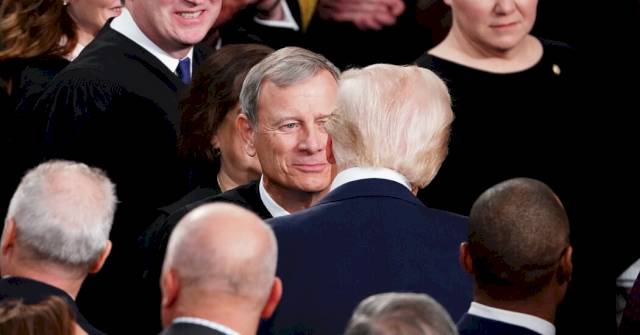

The chief justice rarely issues public statements.
Just hours after President Trump called for the impeachment of a judge who sought to pause the removal of more than 200 migrants to El Salvador, Chief Justice John G. Roberts Jr. issued a rare public statement.
“For more than two centuries,” the chief justice said, “it has been established that impeachment is not an appropriate response to disagreement concerning a judicial decision. The normal appellate review process exists for that purpose.”
Mr. Trump had called the judge, James E. Boasberg, a “Radical Left Lunatic” in a social media post and said he should be impeached. On Saturday, Judge Boasberg ordered the administration to return planes carrying migrants said to be members of a Venezuelan gang to the United States while he considered whether their removal was lawful. The planes did not turn around.
The case has emerged as a flashpoint in a larger debate over presidential power and the role of the courts in reviewing the actions of the executive branch. The chief justice’s statement did not take sides on that debate, and he has often taken a broad view of the president’s authority, notably in his majority opinion in July granting Mr. Trump substantial immunity from prosecution.
His statement instead made a modest point. But it came in the face of rising calls for impeachment not just by Mr. Trump but also by his network of supporters, which has complained that judges have blocked a series of the president’s initial policy moves.
The correct reaction to a ruling that a party disagrees with, the chief justice wrote, is to file an appeal.
Just weeks ago, Chief Justice Roberts’s point would have been uncontroversial. There is no modern tradition of impeaching judges for their rulings. Just eight federal judges have been impeached, convicted and removed in the history of the country, most for egregious criminal and personal behavior.
It takes just a majority vote in the House of Representatives to impeach a judge or other official. But two-thirds of the Senate must vote to convict, meaning its Republican members would need substantial support from Democrats.
That math makes clear that the talk of impeachment is largely performative.
Still, Representative Brandon Gill, Republican of Texas, said on social media on Tuesday that he had filed articles of impeachment against Judge Boasberg, asserting that the judge’s rulings amounted to “high crimes and misdemeanors.”
Chief Justice Roberts’s statement on Tuesday was reminiscent of two earlier ones.
In 2018, he defended the independence and integrity of the federal judiciary after Mr. Trump called a judge who had ruled against his administration’s asylum policy “an Obama judge.”
The chief justice said that was a profound misunderstanding of the judicial role.
“We do not have Obama judges or Trump judges, Bush judges or Clinton judges,” he said in a statement then. “What we have is an extraordinary group of dedicated judges doing their level best to do equal right to those appearing before them. That independent judiciary is something we should all be thankful for.”
Two years later, he denounced Senator Chuck Schumer of New York, the Democratic leader, for comments at a rally outside the Supreme Court.
Mr. Schumer, speaking while the court heard arguments in a major abortion case, attacked two of Mr. Trump’s appointees, Justices Neil M. Gorsuch and Brett M. Kavanaugh. “You have released the whirlwind, and you will pay the price,” Mr. Schumer said. “You will not know what hit you if you go forward with these awful decisions.”
Chief Justice Roberts condemned those remarks.
“Justices know that criticism comes with the territory, but threatening statements of this sort from the highest levels of government are not only inappropriate, they are dangerous,” he said in a statement. “All members of the court will continue to do their job, without fear or favor, from whatever quarter.”
Mr. Schumer walked his comments back the next day, saying he had meant there would be political consequences.
In his year-end report on the state of the federal judiciary, issued weeks before Mr. Trump took office, the chief justice seemed to anticipate some of what was coming.
“Attempts to intimidate judges for their rulings in cases are inappropriate and should be vigorously opposed,” Chief Justice Roberts wrote. “Public officials certainly have a right to criticize the work of the judiciary, but they should be mindful that intemperance in their statements when it comes to judges may prompt dangerous reactions by others.”
Mr. Trump did not square his attack on Judge Boasberg with comments he made last week while visiting the Justice Department. Then, he complained about people who have criticized judges, declaring that “it has to stop, it has to be illegal, influencing judges.”
In that case, he was complaining about criticisms of Judge Aileen M. Cannon, who had dismissed one of the criminal cases that had been pending against him.
Later Tuesday, Laura Ingraham, the Fox News host, taped a segment with President Trump to air on her nightly show. Ingraham asked the president about the chief justice’s statement. “Well, he didn’t mention my name in the statement,” Trump said. “I just saw it quickly. He didn’t mention my name.”

The Social Security Administration said on Tuesday that people who want to file for benefits or change the bank where their payments are deposited can no longer do so by phone and must first verify their identity online or go into a field office.

In an interview with Laura Ingraham on Fox News, President Trump maintained his view that his administration is not actually defying the courts because, in his estimation, the judge who ruled against him should not have been allowed to do so. “That’s not for a local judge to be making that determination,” he said. He vowed that he wouldn’t defy a court order, but he then said, “We have very bad judges, and these are judges that shouldn’t be allowed.”
Advertisement

Mahmoud Khalil, in first public remarks, says he is ‘a political prisoner.’
Image
Mahmoud Khalil, the recent Columbia University graduate who was detained by federal immigration agents, on Tuesday called his arrest a “direct consequence of exercising my right to free speech” about the Palestinian cause in his first public statement since being detained.
Mr. Khalil, a prominent figure in pro-Palestinian demonstrations at Columbia who has been held in a Louisiana detention facility since last week, criticized the university for yielding to “federal pressure” and argued that the Trump administration had targeted him “as part of a broader strategy to suppress dissent.”
“I am a political prisoner,” Mr. Khalil wrote in a letter shared by several groups including the New York Civil Liberties Union. “Visa holders, green card carriers and citizens alike will all be targeted for their political beliefs.”
Mr. Khalil, a green card holder and legal permanent resident, emerged as a lead spokesman for students during the demonstrations that engulfed Columbia’s Manhattan campus last spring. He was arrested on March 8 upon returning home from dinner with his wife, a U.S. citizen.
In his letter on Tuesday, Mr. Khalil said that he did not know what was happening as he was handcuffed and “forced” into an unmarked car by federal authorities, who “refused to provide a warrant.” He said that he feared his wife “would be taken, too,” and that he waited hours to learn the reason for his arrest or whether he would face immediate deportation.
Mr. Khalil, who is of Palestinian heritage, described his birth in a refugee camp in Syria to a family that “has been displaced from their land since the 1948 Nakba.” That term is used by Palestinians to refer to their people’s expulsion and mass flight amid Israel’s declaration of independence almost 77 years ago.
“I have always believed that my duty is not only to liberate myself from the oppressor, but also to liberate my oppressors from their hatred and fear,” Mr. Khalil wrote.
The White House has accused Mr. Khalil of siding with terrorists and has said that it plans to detain and deport many other current and recent students. Mr. Khalil’s lawyers have denied the accusation, and Mr. Khalil has not been charged with any crime.

A judge blocked a policy that would expel transgender troops.
Image
A federal judge blocked the Trump administration on Tuesday from banning transgender people from serving in the military.
In a forcefully written opinion that rebuked the president’s effort, U.S. District Judge Ana C. Reyes issued an injunction that allows trans troops to keep serving in the military, under rules that were established by the Biden administration, until their lawsuit against the Trump administration’s ban is decided.
“The ban at bottom invokes derogatory language to target a vulnerable group in violation of the Fifth Amendment,” Judge Reyes wrote.
The government had argued that courts must defer to military judgment, but in a 79-page opinion, the judge said the government had thrown together a ban based on next-to-no evidence and that “the law does not demand that the Court rubber-stamp illogical judgments based on conjecture.”
According to the Defense Department, about 4,200 current service members, or about 0.2 percent of the military, are transgender. They include pilots, senior officers, nuclear technicians and Green Berets as well as rank-and-file soldiers, sailors, airmen and Marines. Despite their relatively small numbers, they have been a disproportionate focus of the Trump administration.
In January, President Trump signed a caustically worded executive order saying that trans troops had afflicted the military with “radical gender ideology,” and that the “adoption of a gender identity inconsistent with an individual’s sex conflicts with a soldier’s commitment to an honorable, truthful and disciplined lifestyle, even in one’s personal life.”
In February, the Defense Department issued new policies that included the same language, and said that all trans troops, regardless of merit, would be forced out of the military.
Several service members immediately sued, saying the policy amounted to illegal discrimination that violated their Constitutional right to equal protection under the law.
The military was still finalizing its plans for putting the ban into effect, and had not yet forced any trans troops out, though it had encouraged them to “voluntarily separate,” and had even offered payments to encourage their fast departure. The Navy had set a deadline of March 28 for trans sailors to request voluntary separation.
In the six weeks since Mr. Trump’s executive order was signed, troops say, they have been forced to use the pronouns and conform to the grooming standards of their birth sex, and have been denied medical care, passed over for assignments sent home from deployments and put on administrative leave.
“Their lives and careers are completely disrupted,” said Shannon Minter, a lawyer who represents the service members and is the legal director of the National Center for Lesbian Rights. “That’s why getting them immediate relief is so important.”
Mr. Minter said Mr. Trump’s executive order was so loaded with illegal ill will — known in the legal world as animus — toward a specific group of people that he felt it was unlikely to survive the scrutiny of a federal court.
At a contentious hearing on March 12, Judge Reyes, who was appointed by President Biden in 2023, spent a full day firing questions at Justice Department lawyers who were defending the policy, and she often showed frustration with their responses
The judge went line by line through reports on transgender service members that the government had cited when the ban was issued, noting that data were years out of date and that the Defense Department’s conclusions were “totally, grossly misleading,” because they “cherry-picked one part, and misrepresented even that.”
The evidence presented was so thin, she said at one point, that the Defense Department might have well cited the latest Beyoncé album.
“How can you even say that — that a whole group of people lack humility?” the judge said to the government’s lawyers about one claimed justification for the ban. “It just makes no sense.”
One of the government lawyers, Jason Manion, argued in the hearing that federal law gives special leeway to the military to make decisions, and that it was not the court’s job to decide on the merit of the Defense Department’s evidence. “At the end of the day we are asking you to defer to military judgment,” Mr. Manion said.
“You keep assuming that judgment is embedded in this,” the judge responded. “The only judgment in this case, far as I can tell,” she said, is that the administration believed that transgender people lack integrity, humility, judgment and a warrior ethos.
The judge repeatedly hinted that the apparent lack of evidence that trans troops in the ranks had any negative effect suggested that the administration’s policy was driven by animus.
Mr. Manion argued that showing that animus influenced the policy would not be enough to justify finding it illegal. Citing a Supreme Court ruling that upheld President Trump’s 2017 executive order banning travelers from seven majority-Muslim nations, he said the order regarding trans troops would be illegal only if it were based solely on animus, and nothing else.
“Just having evidence of animus,” he said, “doesn’t get over the hump.”
Trans troops have already prevailed in court once against a similar order. Early in his first term in office, President Trump announced a transgender ban on Twitter, but the policy was quickly blocked by two federal judges.
The resulting injunction remained in place for two years, until a 2019 ruling by the Supreme Court allowed a reconfigured ban to take effect while the court considered the constitutionality of the policy. The case was dropped after President Joe Biden rescinded Mr. Trump’s ban in 2021, leaving unsettled the question of whether a ban on transgender service members would be constitutional.
The Trump administration’s latest effort is a remarkable departure from a 77-year trend in the military toward welcoming an increasingly diverse variety of Americans. Over that time, it was generally the White House that was pushing for more inclusion, and the military that was resisting. Now the roles have flipped.
Military leaders have repeatedly opposed the transgender ban.
The transgender order is part of a sweeping effort to roll back diversity efforts in the military. efforts that the Trump administration sees as counterproductive. The rollback has included firing some top military leaders, ending recognition of Gay Pride and Black History months, and purging content mentioning diversity and inclusion efforts from Defense Department websites — even removing a photo of the B-29 bomber that dropped the first atomic bomb, presumably because its name, Enola Gay, was flagged in a search for words the department wanted to scrub.
This week the Department of Veterans Affairs announced it would end gender affirming care for trans veterans.
“If veterans want to attempt to change their sex, they can do so on their own dime,” Doug Collins, the Secretary of Veterans Affairs said Monday.
Though the new injunction has spared trans service members from dismissal for now, many say it will be difficult to go on with their careers as if nothing had happened.
Sgt. First Class Julia Becraft, assigned to an Army armor battalion in Texas, was slated to be promoted to platoon leader this coming July, but since the ban was announced, the promotion has been put on hold.
She was so distraught over the president’s order that she decided to take vacation time to focus on her mental health, and has been attending therapy sessions.
“Everyone in my unit has been really supportive, but my world has been turned upside down,” she said.
Sergeant Becraft has served in the Army for 14 years, deployed to Afghanistan three times, and been awarded a Bronze Star. Now she faces being forced out of the service with no retirement benefits.
Even if she is ultimately allowed to stay, she said, the actions of the president have her wondering whether she can still commit to serving her country.
“It’s not just because they came after me and want me out,” she said. “It’s a culmination of all the other things they are doing: take down the D.E.I. efforts, firing of all these great leaders for no reason. I wish I could stay strong and fight, but, honestly, I’m just scared.”
Advertisement

Days after President Trump suggested that the government would charge those who vandalize Tesla products as domestic terrorists, the attorney general, Pam Bondi, released a statement saying that attacks on Tesla property were “nothing short of domestic terrorism.” She added that “the Department of Justice has already charged several perpetrators with that in mind.”
She went on, “We will continue investigations that impose severe consequences on those involved in these attacks, including those operating behind the scenes to coordinate and fund these crimes.”
Image
A federal judge in Washington blocked an order by President Trump to remove transgender military service members, ruling that the directive banning transgender people from serving was “a violation of their constitutional rights.”
“Indeed,” Judge Ana C. Reyes wrote, “the cruel irony is that thousands of transgender servicemembers have sacrificed — some risking their lives — to ensure for others the very equal protection rights the military ban seeks to deny them.”


DOGE reversed a move that made it harder to fact-check its claims.
Image
Elon Musk’s Department of Government Efficiency on Tuesday reversed a change that had made some of its claims far more difficult to fact-check.
In early March, the group — which had been caught in a series of high-profile errors — began posting itemized claims about the savings it had achieved from canceling federal grants. Its website interface provided only minimal details about those grants but the site’s public source code included identification numbers, making it possible to glean more information from other official sources.
On March 5, however, the group removed those identifiers from the code, while also adding thousands more grants, making it very difficult to verify the figures provided. A White House official said the group had withheld identifying information “for security purposes.”
On Tuesday, the group added some of the missing details, providing links to many of the grants’ entries in a federal spending database, USAspending.gov. Now, fact-checkers will have the ability to match the claims with other sources.
The White House did not respond to a question about the change.
The new details provided by the group made clear that its claims about these canceled grants also contained the same kind of errors that had marred its previous work.
For instance, the group said that it had saved $1.75 billion by cutting a U.S. Agency for International Development grant to a nonprofit called Gavi, the Vaccine Alliance.
The New York Times reported last week that Gavi had said that the website’s claims were wrong. The nonprofit said that its grant had not been canceled and that, even if it was, all the money it was owed had already been paid. So canceling the grant would save nothing.
The Times had identified that grant using the details that Mr. Musk’s group had briefly embedded in the source code of its website.
On Tuesday, that erroneous claim about the $1.75 billion grant was still on DOGE’s website, which the group calls its “wall of receipts,” — its line by line accounting of the group’s purported cost savings.
Advertisement

A third deportation plane left the U.S. after a judge’s order. The Trump administration argues there was no violation.
Location of deportation flights when a judge ordered them to stop
This map shows the planes’ positions at 6:48 p.m. on March 15. ICE had chartered the planes, which carried hundreds of Venezuelans from Texas to El Salvador with a stop in Honduras.
Source: Flightradar24
Note: All times Eastern.
By Albert Sun
As the Trump administration used three flights bound for El Salvador to deport hundreds of Venezuelans over the weekend — one of the planes left a Texas airport after a federal judge issued a written order halting any deportations carried out under an obscure wartime law from the 18th century to deport people without a hearing.
That the third plane left after the judge’s order is not in dispute.
Judge James E. Boasberg of the Federal District Court in Washington had ordered a halt to deportations carried out under the executive order signed by President Trump invoking wartime powers on Saturday. From the bench, he verbally ordered planes that were already in the air to return the detainees to the United States.
In a declaration filed Tuesday, Robert L. Cerna, the acting field office director for enforcement and removal operations at the U.S. Immigration and Customs Enforcement, said the third flight had not violated the judge’s order because all migrants on the flight had already received their due process rights. Immigration courts had already approved their removals from the country, he said.
In the filing, Mr. Cerna acknowledged the third flight removed migrants from the country after the judge’s written order.
Mr. Cerna said he understood Mr. Trump’s invocation of wartime powers targeting Venezuelan members of the Tren de Aragua gang took effect around 3:53 p.m. on March 15 when it was posted to the White House website. He noted that the judge’s written order halting the deportation flights was posted around 7:25 p.m. that day.
“After the Proclamation was publicly posted and took effect, three planes carrying aliens departed the United States for El Salvador International Airport (SAL),” Mr. Cerna wrote. “Two of those planes departed U.S. territory and airspace before 7:25 PM EDT. The third plane departed after that time, but all individuals on that third plane had Title 8 final removal orders and thus were not removed solely on the basis of the Proclamation at issue.”
Mr. Cerna’s statement refers to the authority of immigration judges, under U.S. code, to order the removal of migrants from the United States. He said those on the third plane had been ordered to be removed.
Mr. Cerna said his agency “carefully tracks” which detainees are subject to the president’s order to expedited removal.
He said the administration is poised to remove more than 200 additional Venezuelans covered by Mr. Trump’s order should the judge allow the removals to proceed.
Laura Ingraham, the Fox News host, taped a segment with President Trump to air on her show tonight. Ingraham asked the president about Chief Justice John Roberts’s rare public statement after Trump said that a judge should be impeached for defying him. “Well, he didn’t mention my name in the statement,” Trump said of the chief justice. “I just saw it quickly. He didn’t mention my name.”

A new court filing in a case challenging President Trump’s use of a rarely invoked wartime statute from 1798 called the Alien Enemies Act to deport people suspected of being members of a violent Venezuelan criminal gang to El Salvador suggests the broader import of his policy. Lawyers for some of the suspected gang members say that Trump’s attempts to use the 227-year-old law could have an impact that goes beyond the recent deportations. “The implications of the government’s position are staggering,” the lawyers wrote in the filing. “If the president can designate any group as enemy aliens under the act, and that designation is unreviewable, then there is no limit on who can be sent to a Salvadoran prison, or any limit on how long they will remain there.”
Advertisement
The White House says that President Trump just signed a memorandum directing the secretary of state to remove all diversity, equity and inclusion policies from the Foreign Service. The memo goes on to say that “Biden’s State Department conditioned eligibility for promotions on an employee’s ability to pass a D.E.I. loyalty test,” citing specific policies and iniatives enacted under the last administration. This memo signed by Trump effectively merges two of his priorities since returning to office: eliminating D.E.I. from government and reforming the Foreign Service.

The order also calls for “appropriate action” against any officials found to have taken actions motivated by “discriminatory equity ideology.” It adds that federal policy toward “hiring in foreign policy positions, like hiring in all other parts of the Government, shall be based solely on merit.” The order was directed to other federal offices that employ Foreign Service workers, including the departments of commerce and agriculture.


Trump fires Democrats on Federal Trade Commission.
Image
President Trump fired the two Democratic members of the Federal Trade Commission on Tuesday, a rejection of the corporate regulator’s traditional independence that may clear the way for the administration’s agenda.
The White House told the Democrats, Rebecca Kelly Slaughter and Alvaro Bedoya, that the president was terminating their roles, according to statements from the pair. The F.T.C., which enforces consumer protection and antitrust laws, typically has five members, with the president’s party holding three seats and the opposing party two.
Members of the F.T.C. and other independent regulatory boards are protected from removal under a 1935 Supreme Court precedent that says the president may not fire them solely over policy disagreements. Ms. Slaughter and Mr. Bedoya said they planned to challenge Mr. Trump’s decision in court.
“Today the president illegally fired me from my position as a federal trade commissioner, violating the plain language of a statute and clear Supreme Court precedent,” Ms. Slaughter, whom Mr. Trump nominated to the F.T.C. during his first term in 2018, said in a statement. “Why? Because I have a voice. And he is afraid of what I’ll tell the American people.”
In an interview, Mr. Bedoya, who became a commissioner three years ago, said he was worried that an F.T.C. without independence from the president would be subject to the whims of Mr. Trump’s business world allies.
“When people hear this news, they need to not think about me,” he said. “They need to think about the billionaires behind the president at his inauguration.”
Image
The firings are Mr. Trump’s latest attempt to assert the power of the presidency over independent regulators at agencies inside the U.S. government, including those that Congress set up to be independent from direct White House control. While regulators are appointed by the president, many of them have traditionally held wide latitude to determine the direction of their agencies.
But the Trump administration has disregarded their traditional protections.
“I am writing to inform you that you have been removed from the Federal Trade Commission, effective immediately,” said a letter sent to one of the commissioners, which was reviewed by The New York Times. “Your continued service on the F.T.C. is inconsistent with my administration’s priorities.”
The Republican chairman of the F.T.C., Andrew Ferguson, said in a statement on Tuesday that the agency would continue protecting consumers but backed Mr. Trump’s authority to fire the commissioners.
“President Donald J. Trump is the head of the executive branch and is vested with all of the executive power of our government,” Mr. Ferguson said. “I have no doubts about his constitutional authority to remove commissioners, which is necessary to ensure democratic accountability for our government.”
A spokesman for the White House did not immediately respond to a request for comment.
The firings followed an executive order from Mr. Trump last month that sought greater authority over the F.T.C., the Securities and Exchange Commission, the Federal Communications Commission and the National Labor Relations Board.
The order required the independent agencies to submit their proposed regulations to the White House for review, asserted a power to block such agencies from spending funds on projects or efforts that conflict with presidential priorities, and declared that they must accept the president’s and the Justice Department’s interpretation of the law as binding.
In January, Mr. Trump fired Gwynne A. Wilcox, a Democratic member of the N.L.R.B. She sued to challenge her dismissal, and a judge reinstated her early this month. The administration has appealed that ruling.
Image
The Justice Department no longer plans to defend as constitutional the Supreme Court precedent on firing regulators only for cause, according to a Feb. 12 letter that the acting solicitor general, Sarah M. Harris, sent to Senator Richard J. Durbin, Democrat of Illinois. The department’s analysis applies to the F.T.C., the N.L.R.B. and the Consumer Product Safety Commission, according to the letter, which was first reported by Reuters.
The letter sent to one of the F.T.C. commissioners on behalf of Mr. Trump on Tuesday reiterated that position. The Supreme Court protections do not fit “the principal officers who head the F.T.C. today,” the letter said.
Rebecca Haw Allensworth, a professor at Vanderbilt Law School who studies antitrust, said the F.T.C. had been established as an independent agency in 1914 “on the theory that consumer protection and the various goals of the F.T.C. were better addressed through less political means.”
“If we introduce the idea of political hirings and firings there, that serves to really undermine both the things the F.T.C. can do and also its legitimacy as a bipartisan institution,” she said.
Corporate executives and their advisers are closely watching the direction of the F.T.C. under Mr. Ferguson, its new chairman. During the Biden administration, the F.T.C. sued to block corporate mergers, aggressively punished companies for user-privacy failures and filed a sweeping lawsuit accusing Amazon of squeezing small businesses. It is set to face off with Meta during a trial in April scrutinizing the social media company’s strategy in acquiring Instagram and WhatsApp to cement its dominance.
Ms. Slaughter and Mr. Bedoya have consistently voted in favor of actions to rein in the power of the tech giants.
After Mr. Trump nominated Ms. Slaughter to the majority-Republican commission in 2018 to fill an unexpired term, President Joseph R. Biden Jr. nominated her for a full seven-year term in February 2023. She previously served as chief counsel to Senator Chuck Schumer of New York, the current minority leader, and led his congressional work on telecommunications and tech legislation.
Mr. Bedoya, a former head of a tech and privacy center at Georgetown University and Senate aide, joined the F.T.C. in May 2022 after Mr. Biden nominated him.
Mr. Bedoya said in the interview that he had learned of Mr. Trump’s decision when he received a call from Ms. Slaughter while at his daughter’s gymnastics class.
“He’s trying to fire me,” Mr. Bedoya said. “I am still an F.T.C. commissioner, and I am going to go to court to make sure that’s clear to everybody.”
Image
Senator Amy Klobuchar, Democrat of Minnesota, called the firings “outrageous” and “illegal,” and warned that the actions would harm consumers. The agency’s 2023 orders on hidden and junk fees resulted in a return of $330 million to consumers, she said.
“Illegally gutting the commission will empower fraudsters and monopolists, and consumers,” said Ms. Klobuchar, who serves on the Senate Judiciary subcommittee on antitrust and consumer rights.

Judge finds Musk’s role in dismantling aid agency likely violated Constitution.
Image
Efforts by Elon Musk and his team to permanently shutter the U.S. Agency for International Development likely violated the Constitution “in multiple ways” and robbed Congress of its authority to oversee the dissolution of an agency it created, a federal judge found on Tuesday.
The ruling, by Judge Theodore D. Chuang of U.S. District Court for the District of Maryland, appeared to be the first time a judge has moved to rein in Mr. Musk and his Department of Government Efficiency directly. It was based on the finding that Mr. Musk has acted as a U.S. officer without having been properly appointed to that role by President Trump.
Judge Chuang wrote that a group of unnamed aid workers who had sued to stop the demolition of U.S.A.I.D. and its programs was likely to succeed in the lawsuit. He agreed with the workers’ contention that Mr. Musk’s rapid assertion of power over executive agencies was likely in violation of the Constitution’s appointments clause.
The judge also ordered that agency operations be partially restored, though that reprieve is likely to be temporary. He ordered Mr. Musk’s team to reinstate email access to all U.S.A.I.D. employees, including those on paid leave. He also ordered the team to submit a plan for employees to reoccupy a federal office from which they were evicted last month, and he barred Mr. Musk’s team from engaging in any further work “related to the shutdown of U.S.A.I.D.”
Given that most of the agency’s work force and contracts were already terminated, it was not immediately clear what effect the judge’s ruling would have. Only a skeleton crew of workers is still employed by the agency.
And while the order barred Mr. Musk from dealing with the agency personally, it suggested that he or others could continue to do so after receiving “the express authorization of a U.S.A.I.D. official with legal authority to take or approve the action.”
As early as Feb. 3, Secretary of State Marco Rubio said he had assumed control of the agency and had directed a variety of cuts in his own authority. The judge noted that Mr. Rubio could declare his intent to permanently close the agency’s headquarters within 14 days of his order, and the offices would remain closed.
Last week, Mr. Rubio said in an announcement on social media that he had canceled 83 percent of the agency’s programs, and that the State Department would administer the roughly 1,000 grants and contracts remaining.
“Thank you to DOGE and our hardworking staff who worked very long hours to achieve this overdue and historic reform,” he wrote.
Judge Chuang said that it appeared clear that Mr. Rubio had effectively surrendered control over the agency’s operations to Mr. Musk in a move that essentially resulted in the elimination of the agency.
“Defendants also likely lack congressional authorization to take even the primary specific steps toward abolition of U.S.A.I.D. already conducted,” he wrote. “In relation to the most recent appropriation for U.S.A.I.D., Congress placed certain restrictions on any ‘reorganization, redesign or other plan’ relating to U.S.A.I.D., which consists of any actions to ‘expand, eliminate, consolidate or downsize’ the agency or its bureaus or offices.”
The finding that Mr. Musk had personally, and unlawfully, overseen the dismantling of the agency offered a firm rejection of his operation’s authority. In the sternly worded order, Judge Chuang warned that any skirting of its requirements could result in him holding Mr. Musk or members of his team in contempt.
“Today’s decision is an important victory against Elon Musk and his DOGE attack on U.S.A.I.D., the U.S. government and the Constitution,” said Norm Eisen, executive chair of State Democracy Defenders Fund, a group representing the aid workers. “They are performing surgery with a chain saw instead of a scalpel, harming not just the people U.S.A.I.D. serves but the majority of Americans who count on the stability of our government. This case is a milestone in pushing back on Musk and DOGE’s illegality.”
Lawyers representing the government had previously argued in that case that the Department of Government Efficiency, or the U.S. DOGE Service, was in fact not headed by Mr. Musk and that he and his associates were serving in an advisory capacity only. They said Mr. Musk had no authority to steer decisions on his own.
But Judge Chuang appeared to dismiss those claims entirely, noting that Mr. Musk had targeted and celebrated actions to dramatically downsize U.S.A.I.D., including the firing of a vast majority of its workers and the cancellation of most of its contracts and grants.
“DOGE has taken numerous actions without any apparent advanced approval by agency leadership,” the judge wrote, reeling off a list of examples at the Education Department, the National Institutes of Health and the Energy Department, where Mr. Musk’s associates apparently recommended cuts on their own.
The judge noted that Mr. Musk, during a cabinet meeting he attended at the White House last month, acknowledged that his team had accidentally slashed funding for Ebola prevention administered by U.S.A.I.D. He also cited numerous instances in which Mr. Trump and Mr. Musk have both spoken publicly about their reliance on Mr. Musk’s team to effectuate goals like eliminating billions in federal contracts.
And he cited Mr. Musk’s own comments on social media taking credit for the aid agency’s dismantling. On X, the social media platform he owns, Mr. Musk wrote in February that it was time for U.S.A.I.D. to “die,” that his team was in the process of shutting the agency down, and that he had “spent the weekend feeding U.S.A.I.D. into the wood chipper.”
The judge also quoted Mr. Musk talking about the need to “delete entire agencies” and pointed to a post Mr. Musk shared stating “DOGE can now DISMANTLE U.S.A.I.D.” after a judge lifted an order blocking the agency from carrying out mass firings.
“Taken together, these facts support the conclusion that U.S.A.I.D. has effectively been eliminated,” Judge Chuang wrote.
“Based on the present record, the only individuals known to be associated with the decisions to initiate a shutdown of U.S.A.I.D. by permanently closing U.S.A.I.D. headquarters and taking down its website are Musk and DOGE team members,” he added.
Advertisement
A federal judge ordered the Education Dept. to restore some grants to schools.
Image
A federal judge on Tuesday ordered the Education Department to restore some federal grants that were terminated as part of the Trump administration’s purge of diversity, equity and inclusion programs.
Judge Julie R. Rubin of the Federal District Court for the District of Maryland said in an opinion that the department had acted arbitrarily and illegally when it slashed $600 million in grants that helped place teachers in underserved schools. The judge also ordered the administration to cease future cuts to those grants.
The grants fund programs that train and certify teachers to work in struggling districts that otherwise have trouble attracting talent. The programs cited goals that included training a diverse educational work force, and provided training in special education, among other areas.
The department, led by Education Secretary Linda McMahon, argued that the grants trained teachers in “social justice activism” and other “divisive ideologies” and should be eliminated.
A coalition of educator organizations sued to stop the Education Department from terminating the grants. The coalition included groups, such as the American Association of Colleges for Teacher Education and the National Center for Teacher Residencies, whose members depend on the grants at issue.
The judge found that the loss of the federal dollars would harm students and schools with the fewest resources.
“The harms plaintiffs identify also implicate grave effect on the public: fewer teachers for students in high-need neighborhoods, early childhood education and special education programs,” she wrote. “Moreover, even to the extent defendants assert such an interest in ending D.E.I.-based programs, they have sought to effect change by means the court finds likely violate the law.”
In early February, schools involved in the programs received a letter from the Education Department notifying them that the grants had been canceled as part of the agency’s initiative to “eliminate discrimination in all forms of education throughout the United States.”
The grants, made through the Supporting Effective Educator Development, or SEED, program and the Teacher Quality Partnership Program, among others, are competitive for the states and school districts seeking the assistance. The grants also help states set up specialized college programs to train educators with the goal of placing them in schools where literacy rates or performance gaps are deemed key issues.
For example, last year, Miami-Dade County received a nearly $10 million grant to set up a partnership between Miami Dade College and Miami-Dade County Public Schools through which the college would help train 180 teachers to “break the cycle of teacher shortages” and help prepare future educators for work in high-need schools over five years.
In another case last year, Sacred Heart University in Connecticut, where Ms. McMahon previously served on the board of trustees, received nearly $3.5 million to enroll around 20 teaching residents per year, who would team up with mentors and help staff local schools facing teacher shortages. The grant noted a focus on “emphasizing outreach to recruit teachers of color.”
The preliminary injunction issued on Tuesday also covered the Teacher and School Leader Incentive Program, which provided performance-based financial incentives for teachers and principles who were able to close achievement gaps in high-need schools. It stopped short of a nationwide injunction, but required the department to reinstate the funding that was previously awarded to any members of the groups behind the lawsuit.
Taken together, Congress had appropriated well over $200 million to fund the three programs in past years. The continuing resolution, passed last week, provides less clarity than a full budget on specific grant programs, giving the Education Department more discretion in how to spend congressionally appropriated funds.

Vance will lead G.O.P. fund-raising, an apparent first for a sitting vice president.
Image
Republicans named Vice President JD Vance on Tuesday to lead the party’s fund-raising operation as it gears up for the 2026 midterm elections, a posting that could also help him position himself for the 2028 Republican presidential primary race.
Mr. Vance will serve as the finance chair of the Republican National Committee, an unusual arrangement for a sitting vice president. In both national parties, the finance chair role has typically gone to a reliable party fund-raiser who has time on his or her hands, not someone with significant governing responsibilities.
The R.N.C. said that Mr. Vance would be the first sitting vice president to serve in that role. In a statement, President Trump praised Mr. Vance as someone who “knows how to fight and win tough races” and said he would do a “fantastic job.”
“To fully enact the MAGA mandate and President Trump’s vision that voters demanded, we must keep and grow our Republican majorities in 2026,” Mr. Vance said in a statement. He pledged to “build the war chest we need to deliver those victories next November.”
At this early juncture, Mr. Vance is widely considered one of the strongest contenders for the Republican presidential nomination in 2028. His new fund-raising role will give him a great deal of face time with the sort of heavyweight Republican donors who could bankroll a national campaign.
Mr. Vance has had significant relationships with some conservative donors, particularly in Silicon Valley, including Peter Thiel, who was also at one point Mr. Vance’s employer. But he has not always been universally embraced by the party’s contributor class: Some G.O.P. donors have recoiled from some of his positions on foreign affairs and trade.
Still, Mr. Vance was a workhorse for Mr. Trump on the fund-raising trail after he joined the national ticket, headlining many events in smaller cities that would not raise enough to be worth Mr. Trump’s time as the presidential nominee.
Mr. Trump has not wanted for cash since his victory. He has continued to raise money for his political committees and presidential library, including from business leaders eager to get on the good side of his administration.
Mr. Vance will take over as finance chairman from Duke Buchan III, an investment banker and early Trump backer who served as ambassador to Spain in the first Trump administration and was nominated this month to serve as ambassador to Morocco.
Advertisement
There has been another update on how a federal judge in Washington intends to handle the Trump administration’s reluctance to provide key facts about two planes carrying suspected members of a Venezuelan street gang from the United States to El Salvador on Saturday.
The judge, James E. Boasberg, ordered the Justice Department to send him a sealed declaration by tomorrow at noon detailing the times the planes took off, left U.S. airspace and landed.
Judge Boasberg is trying to figure out if the immigrants were flown out of the United States after he issued his order stopping them.
The Justice Department has repeatedly said that the flights left before a written version of the order was posted at 7:25 p.m. on Saturday night. But department lawyers have so far refused to give any additional details about the timing of the flights.

The Treasury secretary promoted two I.R.S. agents who said an investigation of Hunter Biden was stymied.
Image
The Treasury Department is elevating two Internal Revenue Service agents who claim that the investigation into Hunter Biden’s taxes was soft-pedaled, an unusual promotion that will empower officials embroiled in a high-profile political battle with Democrats.
Gary Shapley and Joseph Ziegler, two veteran I.R.S. agents, brought their concerns about the tax case against Hunter Biden to lawmakers on Capitol Hill. House Republicans later turned the two men into key witnesses in their unsuccessful attempt to impeach former President Joseph R. Biden Jr.
The I.R.S. officials accused the Justice Department of holding back on the Hunter Biden case, an allegation that prosecutors have denied. Mr. Shapley and Mr. Ziegler have also said that the I.R.S. retaliated against them for airing their concerns about Hunter Biden’s tax case, including by taking them off the investigation.
Hunter Biden pleaded guilty to nine federal tax charges last year. The former president later pardoned his son.
It was unclear exactly what positions Mr. Shapley and Mr. Ziegler will play within Treasury. Treasury Secretary Scott Bessent said in a statement announcing them as senior advisers that the two men will “drive much-needed cultural reform within the I.R.S.”
“These veteran civil servants join us to help further the agency’s focus on collections, modernization, and customer service, so we can deliver a more effective and efficient I.R.S. experience for hardworking American taxpayers,” Mr. Bessent said.
The Trump administration has been undertaking an aggressive overhaul of the I.R.S., pushing to dramatically slash its staff and instead rely on automated technology to run the agency.
Many top leaders at the typically apolitical agency have left or been demoted under President Trump, who has nominated Billy Long, a former Republican congressman with little background in taxes, to run the I.R.S.

Meet the judge whose order to stop deportation flights drew Trump’s ire.
Image
As chief judge of the Federal District Court of the District of Columbia since 2023, Judge James E. Boasberg has been responsible for setting the tone of the court through some of its highest-profile dealings with President Trump, including overseeing the end of grand jury inquiries in both federal cases against Mr. Trump, the 2020 elections case and the president’s handling of classified documents.
But in the last several days, Judge Boasberg and his court have been drawn into a battle with the Trump administration over immigration enforcement that threatens, more than anything to date, to pitch the branches of government into a constitutional crisis.
Over the weekend, the Trump administration sent three planes carrying 238 migrants from Venezuela to El Salvador, even as Judge Boasberg ordered a halt to the deportations and to turn the planes around. Shortly before the migrants were expelled, Mr. Trump signed an executive order invoking the Alien Enemies Act, a law from 1798 that gives the president power to deport citizens and subjects of any foreign nation with which the United States is at war or which are in the process of an invasion. Mr. Trump’s order justified the deportations by accusing the migrants of being members of Tren de Aragua, a Venezuelan gang that he charged with “conducting irregular warfare against the territory of the United States both directly and at the direction, clandestine or otherwise,” of President Nicolas Maduro of Venezuela.
On Monday, the threat of a showdown between the executive and the judicial branches appeared to grow, as Justice Department lawyers stonewalled Judge Boasberg and tried to get him removed from the case, refusing to answer any of his questions about the deportation flights and claiming Mr. Trump had unfettered power to remove immigrants from the United States that could not be questioned by the courts. It worsened still after Mr. Trump called for Judge Boasberg’s impeachment on his social media platform, Truth Social, and the Supreme Court’s chief justice, John G. Roberts Jr., rebuked the idea in a public statement.
Here’s more about Judge Boasberg, the jurist going toe-to-toe with the Trump administration.
Who is Judge Boasberg?
Judge Boasberg, who goes by the nickname Jeb, spent his formative years in Washington, D.C., while his father worked for Lyndon B. Johnson’s administration. He went to St. Albans, an all-boys prep school, and attended Yale University, where he played basketball and was a member of the secretive Skull and Bones club. During law school at Yale, he lived with Brett Kavanaugh, the Supreme Court justice.
Before Judge Boasberg wore robes, he was a homicide prosecutor in Washington, D.C. President George W. Bush, a fellow Yale and Skull and Bones member, gave him his first job on the bench in 2002, as an associate judge of the Superior Court of the District of Columbia. Nine years later, former President Barack Obama nominated him to the federal bench in the capital, a position for which he was unanimously confirmed.
In the years since, Judge Boasberg has served on a number of specialized courts. He was on the United States Foreign Intelligence Surveillance Court, which approves surveillance warrants, for seven years, rising to become its presiding judge during the first Trump administration. During the first Trump administration, he was also appointed to the U.S. Alien Terrorist Removal Court as its chief judge, a term that ended earlier this year. He took over as chief judge for the Federal District Court of the District of Columbia in 2023, succeeding Beryl A. Howell.
What are some of his notable rulings?
Judge Boasberg has fielded several polarizing cases that were significant for Mr. Trump. In 2016, he ordered the Federal Bureau of Investigation to release nearly 15,000 emails belonging to Hillary Clinton, the former senator and presidential candidate. But he also dismissed lawsuits trying to force the State Department to recover more of her correspondence, upsetting Mr. Trump.
The following year, Judge Boasberg ruled against a group seeking the release of Mr. Trump’s tax returns, stating that only Congress or Mr. Trump could choose to publicize them.
He is also the judge that ruled in 2012 against the public release of photos of a deceased Osama bin Laden, finding there were reasonable national security grounds to keep them private.
As the chief judge on the Foreign Intelligence Surveillance Court, Judge Boasberg was also responsible in 2020 for handling the fallout of the F.B.I.’s wiretapping of Carter Page, who had once been an adviser to the Trump campaign. He delivered an opinion that effectively barred the F.B.I. officials who had worked on Mr. Page’s case from pursuing other national security wiretaps.
Why is Judge Boasberg in conflict with the administration?
Judge Boasberg delivered the order that prompted the standoff with the Trump administration on Saturday night, stating from the bench that the deportations of Venezuelans should be stopped and the planes brought back to the United States. He made the ruling during a swiftly organized hearing to challenge Mr. Trump’s invocation of the Alien Enemies Act. Less than an hour later, he delivered a written ruling following up on that order, though the instruction to turn back planes was left out.
The Trump administration maintains that it did not flout a court order because the written order — which they argue is the important one — came only after the flights of migrants had already taken off for El Salvador. They have also argued that the judge has no power to question the president’s deportation authority.
On Monday, Justice Department lawyers wrote a letter to the federal appeals court asking it to remove Judge Boasberg from the case, and arguing that he had engaged in “highly unusual and improper procedures.” They also refused to answer several of Judge Boasberg’s questions regarding the flights in question, asserting that they could not for national security reasons.
What happens next?
Members of the Trump administration, including Tom Homan, his border czar, have promised to continue the deportations, regardless of court rulings. But the case against Mr. Trump’s efforts to use the Alien Enemies Act, in a case brought by five Venezuelan migrants in federal custody who fear they could be among the administration’s targets, continues.
Judge Boasberg gave the administration a Wednesday deadline to detail in a sealed declaration specifics about the flights that carried Venezuelan migrants to El Salvador, which the administration had refused to disclose. The judge also has asked Justice Department lawyers how many migrants could theoretically be covered under the Alien Enemies Act. The parties are due in court again on Friday to argue the merits of the case.
It is unclear what may flow from Mr. Trump’s Tuesday morning post asserting that Judge Boasberg “should be impeached.” One House Republican, Representative Brandon Gill of Texas, filed an article of impeachment Tuesday accusing Judge Boasberg of abusing his power by overstepping his authority and interfering with the president’s constitutional prerogatives.
Mr. Trump’s demand prompted a rare statement from Chief Justice John G. Roberts of the Supreme Court, who admonished the idea in a statement saying, “For more than two centuries it has been established that impeachment is not an appropriate response to disagreement concerning a judicial decision.”
Leave a Reply