” data-timestamp-html=”
” data-check-event-based-preview data-is-vertical-video-embed=”false” data-network-id data-publish-date=”2026-02-17T16:19:44.288Z” data-video-section=”world” data-canonical-url=”https://www.cnn.com/2026/02/17/world/video/geneva-iran-nuclear-talks-ldn-digvid” data-branding-key data-video-slug=”geneva-iran-nuclear-talks-ldn-digvid” data-first-publish-slug=”geneva-iran-nuclear-talks-ldn-digvid” data-video-tags data-breakpoints=”{“video-resource–media-extra-large”: 660}” data-display-video-cover=”true” data-details data-track-zone=”top” data-sticky-anchor-pos=”bottom” data-tabcontent=”Content”>
US envoys hold Iran nuclear talks and Ukraine war negotiations in Geneva
00:55 • Source: CNN
US envoys hold Iran nuclear talks and Ukraine war negotiations in Geneva
00:55
• Iran talks: While “progress was made” during today’s discussions in Geneva, the US expects to receive detailed proposals from the Iranian government in the next two weeks to address gaps between their positions, US officials said. Iran’s foreign minister said the two sides agreed on “guiding principles” for talks, but more work is needed.
• Russia-Ukraine talks: Discussions aimed at resolving Russia’s war in Ukraine are also taking place in Geneva. They are happening as Ukraine accuses Russia of launching a large combined attack on its energy infrastructure overnight into today.
• Back in Washington: The Department of Homeland Security remains shut down over the bitter policy fight on immigration reforms. Democrats have sent a counteroffer to the White House, a spokesperson for Senate Minority Leader Chuck Schumer told CNN.
Talks between Russia and Ukraine have ended between the two sides’ political negotiators, a source within Ukraine’s delegation told CNN on Tuesday. Military negotiators are still meeting, however.
The source added that both groups will reconvene tomorrow morning, with statements expected from the negotiating parties once talks conclude.
Shortly afterwards, Russian state news agency RIA Novosti reported that talks had ended after four and a half hours.
The US expects to receive detailed proposals from the Iranian government to address gaps in the positions of the two countries following talks in Geneva today, US officials said.
The readout appeared positive, but it comes as the US military continues to build up its posture in the Middle East. President Donald Trump has warned Iran of a “very traumatic” outcome if they don’t agree to a deal in the coming weeks.
The Iranians have indicated through intermediaries leading up to the talks that they could move some of their uranium stockpiles to Russia and that they would be open to economic deals with the US as part of a new nuclear agreement, but it’s unclear if those specific issues came up at the talks on Tuesday, sources said.
The Iranians have also signaled that they would be open to halting enrichment for a period, but have said that a permanent ban on enrichment is unacceptable, sources said.

While his negotiators hash out foreign policy in Geneva, President Donald Trump has three events on his public schedule for this afternoon, none of which are open to press.
- At 2 p.m. ET, he participates in an ambassador credentialing.
- Then at 4 p.m. ET, Trump has a policy meeting.
- The president has another policy meeting at 5 p.m. ET.
We’ll let you know if we get any updates.

As talks aimed at ending the war in Ukraine proceed in a Geneva hotel, Kyiv’s mayor says that over 1,000 residential buildings there still lack heat due to Russian attacks on a power plant.
According to Mayor Vitaliy Klitschko, 1,100 residential buildings in Ukraine’s capital lack heat due to “critical damage” sustained at a nearby power plant. Klitchko said that 2,600 buildings have had heat restored after an attack on February 12.
It is currently around 16 degrees Fahrenheit in Kyiv.
Russia has frequently attacked Ukrainian energy infrastructure in recent months, forcing Ukrainian energy workers to improvise new safety procedures to make sure the power stays on. In January, an energy worker showed CNN the sandbag-lined steel capsule he’s used to take shelter during dozens of attacks on the power plant where he works.
“It’s scary, of course,” Oleksandr Adamenko told CNN. “But we overcome our fears and tell ourselves that we have to stay because of the equipment, first and foremost, to keep people warm. Otherwise, who will do it, if not us?”
After Iran’s foreign minister said Tehran and Washington had agreed on “guiding principles” for their negotiations, a leading analyst of Iranian affairs has said this would represent progress, if confirmed by the US side.
Vaez cautioned, however, that the “substance” of the negotiations would take far longer than the “scope.” In the talks that led to the 2015 Iran nuclear deal, Vaez said “it took two and a half years to negotiate the substance.” Iran’s negotiating position is weaker this time, he said, because its nuclear program was severely damaged by US and Israeli strikes in June.
Ultimately, Vaez said the success of the talks would depend on whether both sides tempered their demands.
Supporters of Ukraine gathered outside the InterContinental hotel in Geneva, Switzerland, on Tuesday — where peace talks between Russia, Ukraine and the US are currently underway.
Some people outside the venue wore Ukrainian flags and held placards with messages in support of Ukraine. In other parts of the city, protesters held up banners reading “STOP KILLING UKRAINIANS!” and “STOP THE WAR NOW.”


As talks on Iran and Ukraine are happening today overseas, here’s the latest on the partial government shutdown back in the US.
Democrats last night sent a counteroffer to the White House on Department of Homeland Security reforms they want to see, a spokesperson for Senate Minority Leader Chuck Schumer said.
It comes as negotiations to restore funding to DHS have been moving very slowly, and lawmakers are on a weeklong recess.
Ahead of the counteroffer, Trump said yesterday evening aboard Air Force One that he’s willing to meet with Democrats to negotiate lapsed DHS funding.
Trump told reporters, “I will, but you know, we have to protect our law enforcement, they’ve done a great job.”
CNN’s Donald Judd contributed reporting to this post.

Iran and the United States agreed in Geneva on “guiding principles” for talks, but more work needs to be done, Iran’s Foreign Minister Abbas Araghchi said on Tuesday.
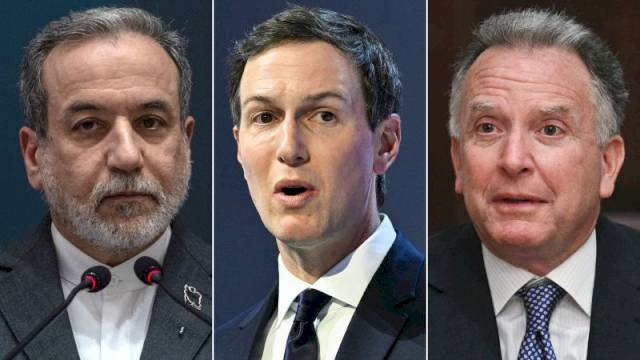
Tehran’s top diplomat said that the indirect talks with US special envoy Steve Witkoff and President Donald Trump’s son-in-law Jared Kushner were more “serious” than a previous round held earlier in Oman this month, describing them as “positive” but warning that an agreement will not be reached “quickly.”
“We are hopeful that we can get this work done quickly and we are able to spend time on it. But regardless when it comes to the text the work becomes more detailed and harder,” he told state television after a second round of talks concluded with the US in Geneva.
“We have reached understandings on the guiding principles, but the drafting and writing phase of the agreement will be more difficult,” he said, adding that the date for the next round of talks is yet to be set.
Araghchi said the two sides had agreed to prepare draft texts of an agreement and exchange them before the next round of talks.
“Right now we have a much clearer picture of what work needs to happen and what work needs to continue of course both sides still have work to do to get closer together but at least now we have a framework and a clearer path to go on,” he said.
Today’s talks between the US, Ukraine and Russia in Geneva, Switzerland are being led by US President Donald Trump’s special envoy, Steve Witkoff, and his son-in-law, Jared Kushner, on the US side.
Vladimir Medinsky, aide to Russian President Vladimir Putin, is leading the Kremlin delegation.
Meanwhile, Ukraine’s delegation is being led by Kyiv’s chief negotiator Rustem Umerov.
Umerov said Friday he would be joined by several other officials, including Kyrylo Budanov, Ukraine’s presidential chief of staff, and Andriy Hnatov, the head of the General Staff of the Armed Forces of Ukraine.
These photos have been released by Ukraine’s National Defense and Security Council, showing the peace talks now taking place at the InterContinental hotel in Geneva, Switzerland.


The US delegation, led by Trump’s special envoy Steve Witkoff and son-in-law Jared Kushner, can be seen at the head of the table, with the Ukrainian delegation on their left and the Russian delegation to their right. Several small bunches of flowers decorate each table, and three large bouquets sit in the middle of the room.
The flags of all three countries, in addition to the Swiss flag, stand behind the Americans.
A little over a mile separates today’s two hubs of diplomacy in Geneva. Jared Kushner and Steve Witkoff spent the morning locked in talks with Iranian officials at the Omani consulate, and are now at the InterContinental hotel for negotiations with Russia and Ukraine.
Holding two sets of high-stakes negotiations back-to-back is an unusual diplomatic arrangement, according to a former diplomat.
“It is not unusual for secretaries of state, or other senior officials with a span of responsibilities, to deal with many different issues in a single trip,” Daniel Fried, the former US ambassador to Poland, told CNN. “It is unusual for special envoys or negotiators to be dual-hatted like this.”
Fried, who also served as the assistant secretary of state for European and Eurasian affairs under former President George W. Bush, warned that problems can mount if overstretched envoys are not backed up by teams of experts. “The combination of dual-hatted people who may not be adequately staffed, and who don’t have – it’s not their fault – but cannot be expected to have a mastery of the details, could lead to problems,” he said.
Rather than this being an instance of the Trump administration making the most efficient use of its diplomatic resources, Fried said it is clear that the president trusts his son-in-law and special envoy to achieve results more than others in his administration.
“But the bottom line is, you have to judge by the results,” he said. “So far, the results are impressive with respect to the Ukrainians and the Europeans” – in terms of the concessions Washington has been able to exact – “and unimpressive with respect to the Russians, who have given nothing.”
Iran’s delegation attending talks with the US in Geneva today will head back to Tehran tonight, an Iranian official told CNN.
The second round of negotiations concluded in the Swiss city a short while ago.
” data-timestamp-html=”
” data-check-event-based-preview data-is-vertical-video-embed=”false” data-network-id data-publish-date=”2026-02-17T12:39:40.097Z” data-video-section=”world” data-canonical-url data-branding-key data-video-slug=”iran-militarydrills-explosion-middleeast-intldesk” data-first-publish-slug=”iran-militarydrills-explosion-middleeast-intldesk” data-video-tags data-breakpoints=”{“video-resource–media-extra-large”: 660}” data-display-video-cover=”true” data-details>
Iran carries out drills in Strait of Hormuz
00:55
Iran will close parts of the Strait of Hormuz today for what it said were safety reasons as the Islamic Revolutionary Guard Corps conducts naval exercises, according to Iranian media.
The official Islamic Republic News Agency said the exercises – which come as the US is increasing its own military assets in the region – would simulate “real maritime threats.”
Iran’s semi-official news agency Fars said the closure would be “for a few hours” in order to “observe safety and navigation protocols” in the strait.
The naval drills come as the US and Iran resume indirect talks in Geneva, Switzerland aimed at resolving their long-running dispute over Iran’s nuclear program.
The Strait of Hormuz is located between the Persian Gulf and the Gulf of Oman, and is the only way to ship crude from the oil-rich Persian Gulf to the rest of the world. Iran controls its northern side.
About 20 million barrels of oil, or one-fifth of daily global production, flow through the strait every day, according to the US Energy Information Administration, which calls the channel a “critical oil chokepoint.” Iranian officials have previously threatened to close the strait in the face of tensions with the West, a scenario that would massively disrupt global shipping.
CNN’s Anna Chernova contributed reporting.

Russia launched another series of attacks on Ukraine this morning, local officials said, hours before today’s three-way talks aimed at resolving Russia’s war in Ukraine began.
Six civilians were injured in a Russian attack on the country’s northern Sumy region, with buildings and cars also damaged, according to Oleh Hryhorov, head of the region’s military administration.
Meanwhile, at least three people were injured in the southern Ukrainian city of Kherson due to the Russian attacks, local authorities said.
A Russian drone attack on a car in Donetsk region, which was transporting employees of a power plant to work, killed three people today, Ukraine’s ministry of energy said.
Ukraine said Tuesday it had hit Russia’s Ilsky oil refinery – among the largest in the country’s south – in an overnight strike. “The target was hit, causing a fire on the premises,” the General Staff of Ukraine said in a statement Tuesday.
Today’s talks are the third such round of negotiations seeking to reach a peace deal to end almost four years of war.

Jared Kushner, Donald Trump’s son-in-law, and Steve Witkoff, the US president’s special envoy, have just wrapped talks with Iranian officials and will soon begin discussions with delegates from Russia and Ukraine.
Last night, Trump told reporters that he would be involved in the talks “indirectly.” Here’s the latest:
• Iran talks: A second round of US-Iran nuclear talks began this morning in Geneva, Switzerland. The talks are aiming to curb Iran’s nuclear program – potentially in exchange for the US lifting sanctions – and reduce tensions between the two countries.
• First round: The last round of talks, held in Oman on February 6, marked the first diplomatic engagement between the two sides since the US and Israel struck Iran last summer. Iranian officials said the Oman meeting had been a “good start.”
• Iran’s demands: Iran has restated that it wants to enrich uranium for civilian purposes, but the US and its allies warn that the regime could use the purified fuel to make a bomb. In exchange for sanctions relief, Iran has offered to place checks on its program to ensure its uranium does not reach weapons-grade purity.
• US demands: Not content merely to secure curbs on Iran’s nuclear program, the US is also seeking to include Iran’s ballistic missiles and its regional proxies – including Hezbollah in Lebanon and Hamas in Gaza – in any future agreement. Iran has previously rejected these attempts, and it is not yet clear what progress was made on Tuesday.
• Russia-Ukraine talks: This afternoon, Witkoff and Kushner have pivoted to another thorny dispute, taking part in trilateral talks with Russia and Ukraine aimed at ending the nearly four-year war. Those talks are also taking place in Geneva.
Today’s talks between Ukraine, Russia and the United States in Geneva have begun, according to Russian state media RIA.
As the talks started, Kyiv’s chief negotiator Rustem Umerov thanked the US for its “involvement and consistent work in the negotiation process.”
Russia’s delegation has arrived at the Hotel Intercontinental in Geneva, where this afternoon’s trilateral talks aimed at ending Russia’s war in Ukraine are expected to take place, Russian state news agency TASS said.
The delegation – which will be led by presidential aide Vladimir Medinsky – touched down in Geneva early Tuesday morning, Russian state media said earlier.
The trilateral Russia-Ukraine-US talks are due to last two days.
” data-timestamp-html=”
” data-check-event-based-preview data-is-vertical-video-embed=”false” data-network-id data-publish-date=”2026-02-17T13:19:58.434Z” data-video-section=”world” data-canonical-url data-branding-key data-video-slug=”us-convoy-geneva-oman-iran-talks-digivid-intldsk” data-first-publish-slug=”us-convoy-geneva-oman-iran-talks-digivid-intldsk” data-video-tags data-breakpoints=”{“video-resource–media-extra-large”: 660}” data-display-video-cover=”true” data-details>

US convoy leaves Omani ambassador’s residence near Geneva
01:06 • Source: CNN
US convoy leaves Omani ambassador’s residence near Geneva
01:06
The second round of indirect negotiations between the United States and Iran in Geneva, Switzerland, has ended, Iran’s semi-official Students’ News Agency (ISNA) reported, adding that delegations from both sides have left the venue.

While we await news from the talks taking place between the US and Iran in Geneva today, let’s look at reaction to what’s happening on the ground in Iran.
The son of the country’s last shah called Sunday for “humanitarian intervention” by the US following a brutal crackdown on protests against the regime, as President Donald Trump considers military strikes on the country.
Reza Pahlavi said the Iranian people want “freedom,” and he urged the world to increase pressure on the regime. He spoke a day after addressing a mass demonstration in Germany, where he was attending the Munich Security Conference.
“As we speak, there are people that are being executed in Iran. There are people that are being arrested and tortured,” Pahlavi told Fox News in an interview.
At least 6,490 protesters have been killed in Iran since mass demonstrations erupted in late December, the US-based Human Rights Activists News Agency (HRANA) reported as of last Wednesday. CNN cannot independently verify HRANA’s figures.
“What’s happening, this is really on a scale (that is) unimaginable,” said Pahlavi.
Pahlavi, who is based in the US, has sought to position himself as a de facto leader of the protesters who staged the most potent challenge to the Islamic Republic in years. Some chanted his name and held signs bearing his image.

Former negotiators who represented the US and Iran told CNN that despite the tensions, an agreement between the countries remains achievable if the Islamic Republic offers firm guarantees to suspend its nuclear program.
Rob Malley, a former US official who was a lead negotiator on the 2015 Iran nuclear deal, told CNN that a “short-term, fragile arrangement” is theoretically possible – one that could give both sides “a victory.”
Under the agreement with the Obama administration, Iran’s uranium enrichment and number of centrifuges were limited without completely eliminating the program.
After strikes on Iran’s nuclear facilities last year, decades of crippling economic sanctions and the deterioration of its regional proxies, Iran has weakened – giving Trump an opportunity to extract commitments from Tehran that it will indefinitely suspend enrichment or face further military action.
“Iran could make the case that its suspension was born of necessity, given the June (2025) strikes and the unsafe state of its nuclear program and claim that it needs time before being able to resume enrichment.”
“For its part, the US would maintain that it has preserved its position that Iran should never enrich on its soil. … Both sides could describe it as a victory of sorts: Iran, by pointing to the fact that it has not relinquished the right to enrich and the US by boasting that President Trump had achieved what neither Obama nor Biden could, which is a halt to Iranian enrichment.”
Seyed Hossein Mousavian, a former Iranian diplomat who served as the spokesman for Iran during its nuclear negotiations with the European Union from 2003 to 2005, told CNN that conditions now are “very different” from the past but are “more favorable” for a deal where the Islamic Republic would provide firm guarantees that it will permanently remain as a non-nuclear weapon state.
“Iran’s current negotiations are centered on survival and the preservation of its territorial integrity and national sovereignty. In this regard, Iran will under no circumstances bargain away its defensive deterrence capabilities,” Mousavian said.
Malley added, “Of course, whether President Trump is open to a nuclear-only deal, or will insist that it covers ballistic missiles, Iran’s regional partners, or even its domestic policies, is a whole other matter.”
Leave a Reply