President Trump is set to meet Chinese leader Xi Jinping in Beijing on May 14 and 15 for talks about trade, Taiwan and China’s relationship with Iran as the war in the Middle East enters its third month.
It will be Trump’s second trip to China as president — and the first for any U.S. president since his initial visit in 2017.
Trump previewed the summit while speaking to other world leaders in February, saying it’s “going to be a wild one.”
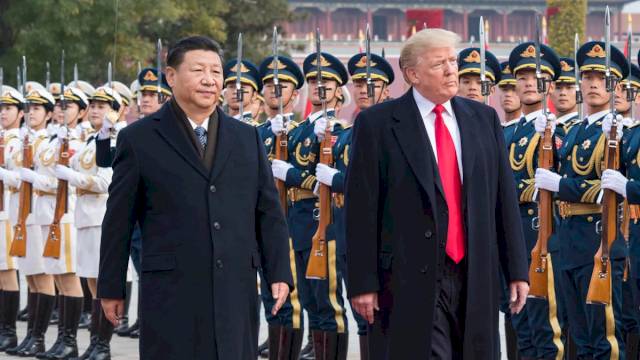
“I said, ‘But we have to put on the biggest display you’ve ever had in the history of China.’ You know, last time I went to China, President Xi, he treated me so well, he gave me a display,” he continued, before marveling at the military spectacle that greeted him in 2017.
“I never saw so many soldiers all the same height, exactly the same height, within a quarter of an inch,” the president recalled. “I said, ‘If they put their helmets down, you could have played pool on the top of their heads.’ And it was pretty amazing, but I said, ‘You’ve got to top it.’ He said, ‘I’ll top it; we’re going to top it.’
But aside from pageantry and pomp, why is Trump returning to Beijing now? Here’s what to expect — and what’s at stake.
Why now?
Trump was originally scheduled to visit Beijing from March 31 to April 2. But he decided to hit pause shortly after the start of the Iran war. Citing a source briefed on the summit, Reuters reported at the time that “the image of Trump on a lavish state visit was increasingly seen at odds with a struggling U.S. economy and the return of American service members killed in the Middle East.”
Months later, the war continues, yet the administration has ruled out any further delays. Experts see that as a signal of just how important China is to Trump — even as they question whether the U.S. currently has the leverage it needs to negotiate on a host of tense, tough issues: Taiwan, tariffs, computer chips, fentanyl, rare earths and agriculture.
Iran is “a huge distraction,” Yun Sun, director of the Stimson Center’s China program, recently told the Washington Post. “The original date had to be postponed because Trump couldn’t handle two things at the same time, so the war obviously has already had an impact. But now, the question is, is the war going to critically affect the substance of the trip?”
What’s on the agenda?
Trump wants to return to Washington, D.C., with something he can tout as a foreign-policy win. His top goal is to reduce the U.S. trade deficit with China. To that end, “U.S. and Chinese officials have been working to broker a deal that experts say is likely to include Chinese agricultural purchases, investment agreements, a consensus statement on AI guardrails and orders of U.S. commercial aircraft,” according to the Post.
Meanwhile, Chinese analysts told the paper that Beijing wants to “extend [the current] trade truce, ease sanctions and technology restrictions, and potentially secure assurances the United States will pull back on arms sales to Taiwan.”
There’s also been talk of a grander bargain, with Trump and Xi reportedly considering a deal that would let China invest $1 trillion in the U.S., largely to build factories on American soil.

Trump and Chinese President Xi Jinping greet each other as they arrive for talks at in Busan, South Korea on October 30, 2025.
(ANDREW CABALLERO-REYNOLDS via Getty Images)
“If they want to come in and build the plant and hire you and hire your friends and your neighbors, that’s great,” Trump told the Detroit Economic Club this past January, referring to Chinese automakers. “I love that. Let China come in.”
But a massive investment deal seems unlikely right now, experts say, in part because Iran has weakened Trump’s position. Yue Gang, a retired Chinese colonel, told the New York Times that Trump originally “intended to visit China with the air of a swift victor.” But the war, he argued, “has significantly diminished the U.S. military’s ability to project its combat power,” leaving Trump “unable to project the same arrogance” — or force any major concessions in return.
In contrast, Beijing has weathered the ongoing energy crisis better than expected and does not seem eager to help end the fighting in Iran. “The chance of anything of substance emerging from these talks is little more than zero,” Allen Carlson, a China expert at Cornell University, told Time magazine.
Where do U.S.-China relations stand?
That isn’t to say Trump’s visit will be pointless. “Given how rocky and fluctuant the U.S.-China relationship has been for the past decade since Trump’s first term, some real (and not ephemeral) stabilization would be welcomed,” David Shambaugh, director of the China Policy Program at George Washington University, recently explained.
Trump rose to political prominence — and first ascended to the Oval Office — as a China hawk who insisted that Beijing was ripping off the U.S. on trade. He spent much of his first term slapping new tariffs on Chinese imports, and his Democratic successor, Joe Biden, largely stayed the course, becoming the first U.S. president in decades not to visit China.
Trump’s second term began in a similar vein, with massive “Liberation Day” tariffs against Beijing. But ever since Trump and Xi struck a “trade truce” at their October summit in South Korea, Trump has seemed more determined to avoid antagonizing his Chinese counterpart. He’s argued in favor of Chinese student visas, pushed to allow China access to advanced AI chips, withheld arms packages for Taiwan, avoided the subject of human rights in China, forbid his cabinet members from criticizing the communist regime and repeatedly touted his “excellent relationship” with his “good friend” Xi.
“President Xi will give me a big, fat, hug when I get there in a few weeks,” Trump recently predicted on social media.
Whether that happens or not — and whether Trump gets the military parade and mass rally he seems to want — remains to be seen. Same goes for the “grand bargain” the U.S. president appears to be angling for. “Trump sees the problem with China as simply a bad deal,” conservative economist Oren Cass recently argued in the Times. “And what’s the remedy for a bad deal? Why, a better deal, of course.”
Either way, presidential engagement is “currently the only guardrail in U.S.-China relations,” according to retired U.S. diplomat Susan Thornton.
“For Americans, the most significant result from Trump’s upcoming visit to Beijing will be that it happened,” Thornton recently wrote. “These meetings are our best hope for preventing miscalculation and should be welcomed as such. Ongoing estrangement is too dangerous.”
Leave a Reply