Listen live as the U.S. Supreme Court hears arguments on whether the International Emergency Economic Powers Act allowed the Trump administration to impose broad tariffs without congressional approval.
The U.S. Supreme Court is hearing arguments over President Donald Trump’s sweeping tariffs, putting a tool at the center of his economic and foreign policy agendas squarely before the high court.
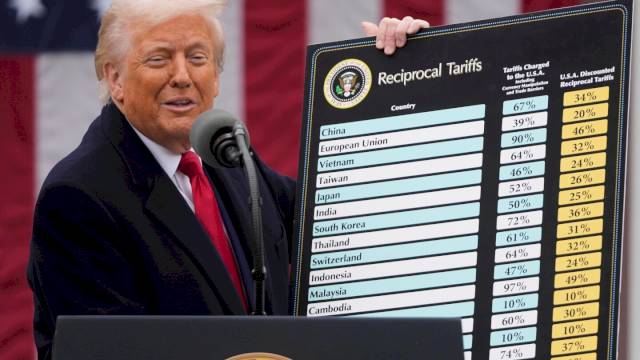
The case involves the tariffs first announced in April on almost all U.S. trading partners and the ones from February on imports from Canada, China and Mexico. Trump justified these by declaring separate national emergencies under the International Emergency Economic Powers Act, or IEEPA.
Earlier this year, however, two lower courts and a federal appeals court ruled that the emergency law he invoked doesn’t give him unlimited power to set tariffs. The Constitution says tariff power belongs to Congress.
Now, arguments on whether the president’s tariffs overstep federal law arrive before a conservative-led Supreme Court, which has thus far been reluctant to check Trump’s wide-ranging use of executive powers.
The case should be a “hot bench,” with every justice posing multiple questions on an issue of extreme importance. But when the court will issue its decision is unclear. High-profile cases can take half a year, but the court can act quickly when deadline pressure dictates.
What to know:
- What’s happened so far? As arguments near the halfway mark, Roberts, Barrett and Gorsuch have posed questions suggesting that they may not accept the administration’s arguments in favor of the tariffs. The three liberal justices also seem skeptical of the tariffs. But we haven’t heard from the other side yet.
- What does Trump’s administration argue? In its defense of the tariffs, the Justice Department has argued the law does give the president expansive tariff power during emergencies. The administration says they’re different from Biden policies the court struck down because they’re part of his approach to foreign affairs, an area where the courts should not second-guess the president.
- What’s at stake? One big question is whether the justices’ own expansive view of presidential authority allows for Trump’s tariffs without the explicit approval of Congress. Another is whether Trump will be limited under the same exacting standards the court held former President Joe Biden to. Trump can impose tariffs under other laws, but those have more limitations on the speed and severity with which he could act.
Roberts now is poking at the challengers’ arguments
The chief justice invokes the president’s broad authority over foreign affairs and, alluding to deals struck by Trump.
He notes that the tariffs “were quite effective in achieving objectives.”
The lawyer representing companies challenging the tariffs is up

FILE – Attorney Neal Katyal speaks in front of the Supreme Court in Washington, Wednesday, Dec. 7, 2022, as the Court heard arguments on a new elections case that could dramatically alter voting in 2024 and beyond. (AP Photo/Andrew Harnik)
FILE – Attorney Neal Katyal speaks in front of the Supreme Court in Washington, Wednesday, Dec. 7, 2022, as the Court heard arguments on a new elections case that could dramatically alter voting in 2024 and beyond. (AP Photo/Andrew Harnik)
Attorney Neal Katyal, in response to a question from Thomas, distinguishes between embargos, allowed by the law, and tariffs, which he says are not.
“Embargos stop the shipment, tariffs start the tax bill,” Katyal said.
He was solicitor general in the Obama administration, on an acting basis.
Legal observers weigh in on the arguments so far
“One key takeaway is the concern that Congress can’t pull back the authority because it would require a veto-proof supermajority,” said Ryan Majerus, a partner at the law firm King & Spalding who was a trade official in the first Trump administration and the Biden administration.

FILE – Supreme Court Associate Justice Amy Coney Barrett poses for a photo during an interview with The Associated Press in Washington, Wednesday, Sept. 3, 2025. (AP Photo/J. Scott Applewhite)

FILE – U.S. Supreme Court Associate Justice Neil Gorsuch walks into an auditorium to join a conversation at the Ronald Reagan Presidential Library Foundation in Simi Valley, Calif., on Thursday, Aug. 8, 2024. (AP Photo/Damian Dovarganes)
He also said Gorsuch and Barrett seem to be the swing votes.
Stratos Pahis, who teaches trade law at the Brooklyn Law School, agreed. “Lots of skepticism so far from Justices Roberts, Gorsuch, and Barrett.”
It’s nearly halftime
You can’t predict the final score when the game is only half over, but so far Roberts, Barrett and Gorsuch have posed questions suggesting that they may not accept the administration’s arguments in favor of the tariffs.
The three liberal justices also seem skeptical of the tariffs. But again, we haven’t heard from the other side yet.
Justices ask where the law gives Trump the power to tariff
Getting to a key question in the case, Justice Brett Kavanaugh asked why the president’s power under IEEPA to regulate imports included the power to impose tariffs when the law does not even mention tariffs.
Sauer responded that tariffs are the “natural’’ and “in many ways the quintessential way’’ to regulate imports.
Justice Gorsuch worries about giving limitless power to presidents
Justice Neil Gorsuch, a Trump appointee, has questions about both major questions and nondelegation. He is asking Sauer to provide limits on the broadest reading of the administration’s arguments in favor of tariffs.
Sauer agreed that another, very different president would have the authority to declare climate change an emergency and impose tariffs to deal with it.

FILE – D. John Sauer, Special Assistant Attorney General with the Louisiana Department of Justice, testifies during a House Judiciary subcommittee hearing in Capitol Hill in Washington, Thursday, July 20, 2023. (AP Photo/Patrick Semansky)

FILE – Supreme Court Justice Neil Gorsuch poses for a portrait in his office at the Supreme Court, Monday, July 29, 2024, in Washington. (AP Photo/Rod Lamkey, Jr.)
What is nondelegation?
Congress can delegate some of its powers to the executive branch, but there are limits.
Some of the conservative justices want to reinvigorate a legal doctrine that was last used in 1935.

FILE – U.S. Supreme Court Associate Justice Neil Gorsuch speaks at the Ronald Reagan Presidential Library Foundation in Simi Valley, Calif., on Thursday, Aug. 8, 2024. (AP Photo/Damian Dovarganes)
FILE – U.S. Supreme Court Associate Justice Neil Gorsuch speaks at the Ronald Reagan Presidential Library Foundation in Simi Valley, Calif., on Thursday, Aug. 8, 2024. (AP Photo/Damian Dovarganes)
Justice Neil Gorsuch voted in dissent in June to strike down a universal service fee on phone bills as an unconstitutional delegation of congressional power. The challenges hope to attract his vote on tariffs on the same basis.
Gorsuch has mostly worried about Congress giving away too much of its power to federal agencies. It’s unclear whether he’ll have the same reservation with the president involved.
What is IEEPA?
The acronym IEEPA stands for the International Emergency Economic Powers Act, which is the 1977 law at the center of the case.
Presidents have used it dozens of times over the years, often to impose sanctions on other countries.
Trump is the first president to use it to impose tariffs. The challengers say that’s unconstitutional.
What is the major questions doctrine?

FILE – President Joe Biden speaks about student loan debt, April 8, 2024, in Madison, Wis. (AP Photo/Evan Vucci, File)
FILE – President Joe Biden speaks about student loan debt, April 8, 2024, in Madison, Wis. (AP Photo/Evan Vucci, File)
Conservative majorities blocked President Joe Biden’s $500 billion student loan forgiveness plan and other of his administration’s initiatives by ruling that Congress must speak clearly on questions of “vast economic and political significance.”
The court ruled that the statutes relied upon in those cases did not clearly give the administration the power to act.
Roberts says ‘major questions’ might directly apply to this case
The chief justice sounds skeptical that Trump can use the emergency powers law for tariffs.
Roberts noted “it has never been used before to justify tariffs.” However, he may be asking about this as a way to let the Trump administration’s lawyer offer a more expansive explanation.
The tariffs would be in trouble if they don’t have Roberts’ vote.
Does regulate = tariff?
Trump-appointed Supreme Court Justice Amy Coney Barrett is drilling down to a key question in the case: Does the word “regulate” allow tariffs?
The Trump administration argues that it does, and that’s why they say he can impose and change tariffs during national emergencies.

Supreme Court Associate Justice Amy Coney Barrett speaks during an event at the LBJ Library in Austin, Texas, Thursday, Sept. 18, 2025. (AP Photo/Eric Gay)
Supreme Court Associate Justice Amy Coney Barrett speaks during an event at the LBJ Library in Austin, Texas, Thursday, Sept. 18, 2025. (AP Photo/Eric Gay)
Barrett grilled him on that point, questioning whether regulate has frequently been used to allow for tariffs.
Barrett is a conservative who’s gone her own way on some cases, and her vote will be key in the case.
Trump’s lawyer says tariffs’ main purpose is to regulate commerce, not raise revenue
Sauer provoked an objection from Justice Sonia Sotomayor after arguing that Trump’s tariffs were not designed to raise revenue for the federal government.
Trump has repeatedly boasted about how much money his import taxes are brining into the Treasury.
“You want to say tariffs are not taxes, but they are,’’ Sotomayor said.

Supreme Court Justice Sonia Sotomayor speaks at the New York Law School’s Constitution and Citizen Day Summit, in New York, Tuesday, Sept. 16, 2025. (AP Photo/Richard Drew)
Supreme Court Justice Sonia Sotomayor speaks at the New York Law School’s Constitution and Citizen Day Summit, in New York, Tuesday, Sept. 16, 2025. (AP Photo/Richard Drew)
Roberts questions Sauer
Chief Justice John Roberts jumped in fairly quickly, questioning Sauer about whether he’s relying too much on an older decision on a different part of the emergency-powers law at the center of the case.
The chief justice is always a key person to watch, but his take will be especially important in this case.
Roberts was a law clerk at the time to the justice who wrote the 1981 opinion, William Rehnquist.

Chief Justice of the United States John Roberts speaks during lecture to the Georgetown Law School graduating class of 2025, in Washington, May 12, 2025. (AP Photo/Manuel Balce Ceneta, File)
Chief Justice of the United States John Roberts speaks during lecture to the Georgetown Law School graduating class of 2025, in Washington, May 12, 2025. (AP Photo/Manuel Balce Ceneta, File)
Thomas first asks about ‘major questions’
Conservative majorities blocked President Joe Biden’s $500 billion student loan forgiveness plan and other of his administration’s initiatives by ruling that Congress must speak clearly on questions of “vast economic and political significance.”
It’s not clear whether the justices will apply the same principle in the tariffs case, but lower courts did.
Sauer says it doesn’t apply to foreign affairs issues.
Settle in for a lengthy session
It should be a “hot bench,” with every justice posing multiple questions on an issue of extreme importance.
The court has allotted 80 minutes for arguments, but they will almost certainly extend well into early afternoon. Since returning to the courtroom following the COVID-19 pandemic, the justices have routinely gone beyond the time set aside for arguments.
The Justice Department will argue first
Arguments are getting underway.
First up is Solicitor General D. John Sauer, Trump’s top Supreme Court lawyer, arguing for the Trump administration.
Justice Clarence Thomas goes first

Supreme Court Associate Justice Clarence Thomas listens to President Donald Trump speak before swearing in Pam Bondi as Attorney General in the Oval Office of the White House, Wednesday, Feb. 5, 2025, in Washington. (AP Photo/Evan Vucci)
Supreme Court Associate Justice Clarence Thomas listens to President Donald Trump speak before swearing in Pam Bondi as Attorney General in the Oval Office of the White House, Wednesday, Feb. 5, 2025, in Washington. (AP Photo/Evan Vucci)
In the post-pandemic era, the other justices allow the 77-year-old Thomas, the longest-serving member of the court, to pose a question or two before the free-for-all begins.
In a second round of questioning, the justices ask questions in order of seniority. Chief Justice John Roberts, whose center chair makes him the most senior, gets the first crack.
The process repeats for each lawyer’s appearance.
Trump won’t be at the Supreme Court
Trump has been vocal about the case and suggested at one point he might go to the arguments himself — something no other sitting president is recorded to have done.
He said Sunday he decided against it, but Treasury Secretary Scott Bessent is expected to attend.
“It’s not about me, it’s about our country,” Trump told reporters Sunday.
The justices could act more quickly than usual in issuing a decision
The court only agreed to hear the case in September, scheduling arguments less than two months later. The quick turnaround, at least by Supreme Court standards, suggests that the court will try to act fast.
High-profile cases can take half a year or more to resolve, often because the majority and dissenting opinions go through rounds of revision.
But the court can act quickly when deadline pressure dictates. Most recently, the court ruled a week after hearing arguments in the TikTok case.
The front of the court is covered in scaffolding
Workers are cleaning the building’s ornate Vermont marble facade as well as installing new lighting and a system to deter birds.

Tariff critics cross the political spectrum
The challengers aren’t the only ones urging the Supreme Court to rule against the tariffs.
Conservative-leaning groups like Cato Institute, the Chamber of Commerce and the Goldwater Institute have filed legal briefs urging the court to uphold the rulings against them.
Former national security officials, federal judges and economists also weighed in against them, as have hundreds of small businesses.
The tariffs have found some support in the docket from groups like the Trump-aligned America First Policy Institute.
Three lawyers will present arguments to the court
1 of 2 |
FILE – D. John Sauer, Special Assistant Attorney General with the Louisiana Department of Justice, testifies during a House Judiciary subcommittee hearing on what Republicans say is the politicization of the FBI and Justice Department and attacks on American civil liberties on Capitol Hill in Washington, Thursday, July 20, 2023. (AP Photo/Patrick Semansky)
2 of 2 |
FILE – Attorney Neal Katyal speaks in front of the Supreme Court in Washington, Wednesday, Dec. 7, 2022, as the Court heard arguments on a new elections case that could dramatically alter voting in 2024 and beyond. (AP Photo/Andrew Harnik)
1 of 2 |
FILE – D. John Sauer, Special Assistant Attorney General with the Louisiana Department of Justice, testifies during a House Judiciary subcommittee hearing on what Republicans say is the politicization of the FBI and Justice Department and attacks on American civil liberties on Capitol Hill in Washington, Thursday, July 20, 2023. (AP Photo/Patrick Semansky)
1 of 2
FILE – D. John Sauer, Special Assistant Attorney General with the Louisiana Department of Justice, testifies during a House Judiciary subcommittee hearing on what Republicans say is the politicization of the FBI and Justice Department and attacks on American civil liberties on Capitol Hill in Washington, Thursday, July 20, 2023. (AP Photo/Patrick Semansky)
2 of 2 |
FILE – Attorney Neal Katyal speaks in front of the Supreme Court in Washington, Wednesday, Dec. 7, 2022, as the Court heard arguments on a new elections case that could dramatically alter voting in 2024 and beyond. (AP Photo/Andrew Harnik)
2 of 2
FILE – Attorney Neal Katyal speaks in front of the Supreme Court in Washington, Wednesday, Dec. 7, 2022, as the Court heard arguments on a new elections case that could dramatically alter voting in 2024 and beyond. (AP Photo/Andrew Harnik)
Solicitor General D. John Sauer, Trump’s top Supreme Court lawyer, is defending the tariffs.
Neal Katyal, who held Sauer’s job on an acting basis in the Obama administration, represents small businesses that are challenging the tariffs.
Oregon Solicitor General Benjamin Gutman is appearing on behalf of 12 mostly Democratic-led states that also sued over the tariffs.
Little visible benefits so far from tariffs
Trump has warned that a decision by the Supreme Court to overturn his tariffs poses a nearly existential threat to the nation’s economic growth.
But so far, there is little evidence that the duties have benefited the economy.

Pedestrians walk by a “Now Hiring” sign at an electronics store in Dallas, Thursday, Aug. 28, 2025. (AP Photo/LM Otero)
Pedestrians walk by a “Now Hiring” sign at an electronics store in Dallas, Thursday, Aug. 28, 2025. (AP Photo/LM Otero)
Manufacturers have cut jobs every month since Trump’s “Liberation Day” tariff announcement in April. And a survey of manufacturers released Monday found that U.S. factory activity contracted in October for the eighth straight month.
Many respondents to the survey complained that tariffs have disrupted their business.
Trump’s policies take tariffs to 1930s levels
Since returning to the White House in January, Trump has reversed decades of U.S. policy that favored free trade and low taxes on imports.
The average U.S. tariff rate has risen to 17.9% — highest since 1934 — from around 2.5% at the beginning of the year, according to Yale University’s Budget Lab.
If the Supreme Court strikes down the tariffs Trump justified by declaring economic emergencies, the average tariff rate would drop to 9.1%, the lab reported.
Trump’s tariffs make money for the Treasury
Tariff revenue came to $195 billion in the fiscal year that ended Sept. 30, up 153% from $77 billion in fiscal 2024. The import taxes he justified under an economic emergency law — the ones being challenged in the Supreme Court — brought in $89 billion.
Still, total tariffs accounted for less than 4% of federal revenue of $5.2 trillion in fiscal 2025.

Tariffs in foreign policy
For Trump, tariffs are not just a key part of his economic agenda, they’re also a cornerstone of his foreign policy.
He has wielded the import taxes as a threat to secure ceasefires, as political pressure during the prosecution of a Trump ally, and as punishment for a television ad.
In fact, the Justice Department has pointed to their prominence in foreign policy as one reason why the Supreme Court should not strike them down, since it’s an area where courts have long given deference to the executive branch.
The challengers, on the other hand, say that tariffs amount to a domestic tax because they’re paid by American companies that import goods, and taxation belongs to Congress.
US trade deficits are nothing new
Trump justified his sweeping tariffs on most U.S. trading partners by declaring that the country’s trade deficit amounted to a national emergency.
But the U.S. has been importing more than it exports for five decades. It hasn’t run a trade surplus since 1975.
There is beefed-up security around the court
Streets around the building are closed, as has recently been the case on days the court is in session. With Treasury Secretary Scott Bessent and members of Congress expected for the arguments, security is even tighter than usual.

FILE – Treasury Secretary Scott Bessent listens as President Donald Trump speaks before a lunch with Ukraine’s President Volodymyr Zelenskyy in the Cabinet Room of the White House, Friday, Oct. 17, 2025, in Washington. (AP Photo/Alex Brandon)
FILE – Treasury Secretary Scott Bessent listens as President Donald Trump speaks before a lunch with Ukraine’s President Volodymyr Zelenskyy in the Cabinet Room of the White House, Friday, Oct. 17, 2025, in Washington. (AP Photo/Alex Brandon)
What happens if the Supreme Court rules against Trump?
The president has warned the United States will be rendered “defenseless” if he loses. But he’d actually still have plenty of options to keep taxing imports aggressively.
He can use other laws he deployed in his first term and can reach for more, including one aimed specifically at addressing trade imbalances and a previously unused Depression-era statute that allows for up to 50% tariffs against countries that treat American businesses unfairly.
He just won’t have nearly boundless authority to impose any tariff he wants anytime he wants to.
Livestream should begin a few minutes after 10 a.m., Eastern time
A buzzer and the court marshal’s cry, “All rise,” will signal the start of the session, the justices emerging from behind red curtains to take their seats at the court’s curved mahogany bench.
The livestream won’t kick in for several minutes, until after the ceremonial swearing-in of lawyers to the Supreme Court bar.
Leave a Reply