Author: admin

  • Trump’s new conditions on DEI, immigration could cut off states’ wildfire funding – Stateline

    Trump’s new conditions on DEI, immigration could cut off states’ wildfire funding – Stateline

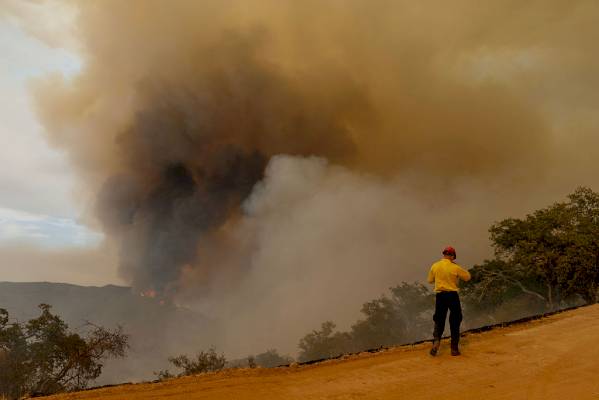
    A new effort to force states to affirm the Trump administration’s views on DEI, transgender athletes and immigration when signing contracts with the U.S. Forest Service is threatening millions of dollars in wildfire grant funding and fire reduction projects on federal lands.

    Some liberal states can’t sign the documents because the policies clash with state law, forestry experts say.

    Already, at least one state is reporting that the new rules have stalled work to reduce wildfire risk and assist with projects on national forest lands. Other states say the requirements are so vague that they don’t know how to follow them. And some timber industry leaders believe the standoff could cut into their revenues.

    “We’re kind of at an impasse,” said Washington State Forester George Geissler. “It’s already starting to slow down or shut down work.”

    The update to the requirements governing federal partnerships comes even as many Western states brace for a brutal wildfire season, following a winter that brought record high temperatures and a paltry snowpack.

    On Dec. 31, Agriculture Secretary Brooke Rollins with little fanfare issued new general terms and conditions governing partnerships for the U.S. Department of Agriculture. Spelled out in dozens of pages of fine print are new restrictions that require partner organizations to pledge compliance with President Donald Trump’s executive orders.

    The new conditions apply to all USDA agencies, but the department hasn’t yet said whether it will enforce them for food assistance programs.

    Forest Service plan to close research stations stokes fear as wildfire season approaches

    The agency, in a news release announcing the changes, framed the new terms as an effort to streamline regulations, protect national security and “eliminate radical left ideology.”

    The Department of Agriculture and the Forest Service did not grant Stateline interview requests.

    At the Forest Service, which is housed within USDA, the new policy applies to a wide range of grants and contracts aimed at reducing wildfire risk, restoring forest health and boosting timber production.

    Forestry veterans say the new conditions have created an impasse with some Democratic-led states.

    “It is significantly disruptive,” said Robert Bonnie, who served as undersecretary of agriculture for natural resources and environment during the Obama administration. “It’s clearly targeted at Democratic states and Democratic partners.”

    A coalition of 20 states and the District of Columbia filed a lawsuit in March, claiming that the restrictions are unlawful. The lawsuit has largely focused on federal food assistance programs provided by the agency, such as the Supplemental Nutrition Assistance Program and the Women, Infants, and Children Nutrition Program.

    In an April court filing, Rollins said the new conditions had not yet been applied to food assistance programs, and that the agency had not made a “final decision” to cut off nutrition funding for states that don’t comply.

    Forest Service programs

    But the policy is already having an impact on some programs managed by the Forest Service.

    Washington state has been unable to issue the latest round of Community Wildfire Defense Grants, a federal program that helps neighborhoods and towns reduce fuels and fortify homes in wildfire-prone areas.

    Geissler, the state forester, said roughly 10 communities in Washington were set to receive large grants under the program, but the federal funding has been held up by the state’s refusal to sign the new terms and conditions.

    “This is another example of the federal administration cutting off its nose to spite its face,” said David Perk, coordinator of the Washington State Lands Working Group, a coalition that weighs in on state forestry policies. “To add the additional layer of denying wildfire funding, that’s insult to injury.”

    The stalemate also threatens work that the U.S. Forest Service increasingly relies on states and other partners to do in national forests. The agency has leaned heavily on tools, such as the Good Neighbor Authority, that enable state agencies to carry out wildfire mitigation, restoration and timber projects on federal lands. Many observers believe the recently announced Forest Service reorganization signals that states will play an even bigger role in the years ahead.

    But now those partnerships are in jeopardy. According to Geissler, Washington state can’t sign new Good Neighbor Authority agreements due to the new conditions.

    Forest Service shake-up will boost states’ role — but even supporters have concerns

    “We’re trying to sign off on agreements for another chunk of work, and we can’t get it signed,” he said. “If you are looking for work to be done by the state on federal lands, we’re not doing it. If we’re not able to sign, both sides lose.”

    Washington state has spent millions of dollars on projects to reduce wildfire risk and improve forest health on national forest lands. With the new ideology requirements, the feds are essentially turning away free help, said Bonnie, the former natural resources official. That’s especially damaging, he noted, because Trump’s cuts to the Forest Service’s workforce and budget have further diminished what the agency can accomplish on its own.

    The Trump administration is “damaging their own constituents,” he said. “There are a lot of conservative voters in rural Washington who want to see partnerships that reduce the probability of extreme wildfire. This will stop that. It makes absolutely no sense.”

    Washington state is still working on Forest Service projects signed under previous agreements. But without new agreements, work on the ground could stall in six to eight months, Geissler said.

    State responses

    Nearly 20 state forestry officials contacted by Stateline did not respond or declined interview requests, citing the ongoing litigation and the need to maintain a working relationship with the Forest Service.

    But one timber industry leader said Oregon was facing similar disruptions that prevented the state from signing new agreements with the Forest Service.

    “This will lead to reduced revenues for (state forestry agencies),” Nick Smith, public affairs director with the American Forest Resource Council, a timber industry group, said in an email to Stateline. “As partners, our industry will be impacted if it disrupts or cancels current or future timber sales under these contracts.”

    While most state forestry officials have been unwilling to publicly comment about the situation, several have filed legal declarations in support of the multistate lawsuit challenging the new terms and conditions.

    Scott Bowen, director of the Michigan Department of Natural Resources, wrote in a declaration that his agency has more than $87 million from active grants with the Forest Service. Those grants cover wildfire response, forest health, invasive species, urban tree canopy and revegetation, among other issues.

    “If these funds were withheld, DNR would have to shut down critical capabilities to assist rural communities with fire preparedness and response,” Bowen wrote.

    Bowen added that the Forest Service has already said one program, a grant to protect environmentally important forests from being converted to a nonforest use, will be subject to the new terms and conditions.

    In the lawsuit, many state officials said that the new compliance requirements are so vague that they’re nearly impossible to follow. Several of the legal declarations note that the new conditions do not explain what it means to “promote gender ideology,” a practice the Department of Agriculture now seeks to ban.

    You’re going to see a bifurcation where you’ll have red states getting grants and blue states won’t.

    – Kevin Hood, executive director of Forest Service Employees for Environmental Ethics

    Many states also objected to the agency’s requirement that no one in the country illegally obtain “taxpayer-funded benefits.” Josh Kurtz, secretary of the Maryland Department of Natural Resources, noted in a declaration that it would be impossible to confirm that grants to reduce wildfire risk, expand urban tree canopy and improve forest health do not benefit Marylanders who lack legal immigration status.

    Kevin Hood, executive director of Forest Service Employees for Environmental Ethics, a nonprofit that advocates for public employees, said the new terms are aimed at directing a greater share of federal funding to Trump’s political allies.

    “You’re going to see a bifurcation where you’ll have red states getting grants and blue states won’t,” he said.

    ‘More questions than answers’

    In March, the National Association of State Foresters sent a letter to Forest Service Chief Tom Schultz expressing concerns about the new terms and conditions. Jason Hartman, the group’s president and the state forester of Kansas, described a chaotic situation.

    “To date, the (Forest Service) has not provided adequate guidance or interpretation of the new (terms and conditions),” he wrote. “National-level meetings between State Foresters and the Forest Service have resulted in more questions than answers. State Foresters around the country have been given differing instructions and interpretations in different geographic locations.”

    Hartman noted at least one instance in which a timber sale totaling 80 million board feet was held up by the new conditions. (That’s enough to build roughly 5,000 homes.) He asked the Forest Service to delay the effective date of the new conditions until the agency could provide more clarity.

    He also outlined another set of issues causing problems for states. One major complication, he said, is the requirement that states receive federal approval before issuing any subawards or contracts. That has created a massive bureaucratic hassle, he wrote, in “direct conflict” with the Forest Service’s reliance on state partnerships to cut red tape.

    The new terms also require environmental reviews for projects to be completed before partnership agreements can be signed. But Hartman noted that states often assist in those very environmental reviews, which they won’t be able to do if they can’t sign the agreements first.

    Wyoming State Forester Kelly Norris also noted that issue in an email to Stateline, saying she expected the Forest Service to update the environmental review section soon.

    Stateline reporter Alex Brown can be reached at [email protected].

    YOU MAKE OUR WORK POSSIBLE.
  • Trump scraps Scotch whisky tariffs ‘in honor’ of King Charles – CNBC

    Trump scraps Scotch whisky tariffs ‘in honor’ of King Charles – CNBC

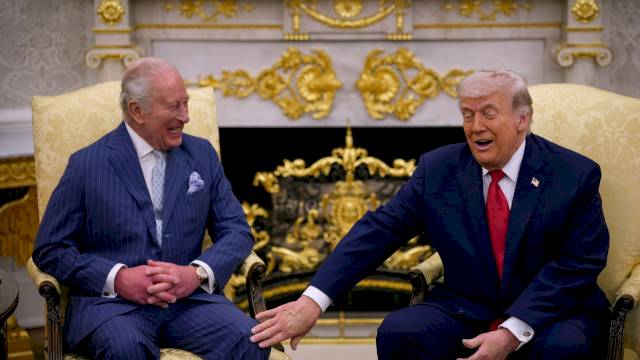
    U.S. President Donald Trump and King Charles III during a meeting in the Oval Office of the White House on April 28, 2026 in Washington, DC.

    Andrew Harnik | Getty Images News | Getty Images

    U.S. President Donald Trump repealed tariffs on a key U.K. export on Thursday, after a state visit from King Charles III and Queen Camilla appeared to help mend transatlantic relations dampened by a series of political standoffs.

    “In Honor of the King and Queen of the United Kingdom, who have just left the White House, soon headed back to their wonderful Country, I will be removing the Tariffs and Restrictions on Whiskey having to do with Scotland’s ability to work with the Commonwealth of Kentucky on Whiskey and Bourbon, two very important Industries within Scotland and Kentucky,” the president said in a Thursday Truth Social post.

    “People have wanted to do this for a long time, in that there had been great Inter-Country Trade, especially having to do with the Wooden Barrels used. The King and Queen got me to do something that nobody else was able to do, without hardly even asking!” he added.

    Queen Camilla, King Charles III, U.S. President Donald Trump, and First Lady Melania Trump pose on Grand Staircase during an official state dinner at The White House on April 28, 2026.

    Samir Hussein | Wireimage | Getty Images

    Trump later told reporters that he “took all the restrictions off, so Scotland and Kentucky can start dealing again.”

    “And I did it in honor of the King and Queen who just left,” he said.

    The U.K. government confirmed to CNBC on Friday that the changes announced the previous day would apply to all whisky tariffs, including those on Irish whiskey.

    Last year, the U.K. became the first country in the world to secure a trade deal with the Trump administration after the president’s so-called liberation day tariffs were unveiled. The terms of the U.K.’s deal included a 10% blanket tariff on goods imported to the United States.

    That meant a pre-existing zero-tariff trade environment for exporters on both sides of the Atlantic was overridden, slapping new duties onto Scotch whisky and other spirits sent to America from Britain.

    The Scotch whisky industry employs around 40,000 people in Scotland, where whisky accounted for 23% of all goods exports in 2025. The sector is also a major purchaser of used bourbon barrels from the United States.

    Distiller Donald MacLeod rolls a barrel of whisky in the warehouse of Isle of Harris Distillery in Tarbert, on the Isle of Harris, in the Outer Hebrides, in Scotland, on April 30, 2025.

    Andy Buchanan | Afp | Getty Images

    Officials from the Scottish and U.K. governments had lobbied for a return to the zero-for-zero tariff conditions on spirit exports, which the Scotch Whisky Association said in September was costing its members £4 million ($5.44 million) per week in lost exports.

    Scotland’s First Minister John Swinney, who leads the devolved government in Edinburgh, said in a statement after Trump’s announcement that he had made it his mission “to do everything possible to lift U.S. tariffs on our whisky.”

    “People’s jobs were at stake,” he said. “Millions of pounds were being lost every month from the Scottish economy … I express my thanks to the President for listening and acting to lift the tariffs. And Scotland is grateful to His Majesty the King for the key role he played in this tremendous success.”

    The whisky industry had also been facing the prospect of tariffs on single malts returning to 25% in the coming months if a deal was not made with the White House, as a five-year suspension on those tariffs was set to expire.

    In a statement on Thursday, Mark Kent, CEO of the Scotch Whisky Association, noted that the U.S. is the industry’s most valuable export market.

    “Distillers can breathe a little easier during a period of significant pressure on the sector,” he said. “For months, many have worked tirelessly to return zero-for-zero tariff trade for whisky and bourbon. The special relationship that the Scotch Whisky and American Whiskey industries share will be reinvigorated by this announcement.”

    The King and Queen concluded a four-day state visit to the U.S. on Thursday, which included a series of engagements in Washington, D.C., including an address by the king to a Joint Meeting of Congress, and a state dinner hosted by the president and First Lady.

    King Charles received a standing ovation in Congress after delivering a speech that touted the value of the so-called transatlantic “special relationship,” calling for the U.K. and the U.S. to stand united in a “volatile and dangerous” era.

    Britain’s King Charles III is applauded by U.S. Vice President JD Vance and U.S. House Speaker Mike Johnson as he arrives to address a Joint Meeting of Congress on April 28, 2026 in Washington, DC.

    Henry Nicholls-Pool | Getty Images

    “The challenges we face are too great for any one Nation to bear alone,” he said, before reminding Congress that NATO came to America’s aid in the immediate aftermath of the 9/11 terror attacks on New York City.

    Prime Minister Keir Starmer’s relationship with Trump soured in recent weeks, as the president took issue with the U.K. government pushing back against his interest in Greenland and requests for assistance in Iran.

    Earlier on in his second term, Trump had described Starmer as a friend, despite their political differences, and said the U.K. was protected from the brunt of his trade policies “because I like them.”

    Many onlookers credited King Charles with rescuing the “special relationship” from jeopardy during his four-day trip this week.

    Following Tuesday’s state dinner, Trump labeled the king a “great friend,” telling reporters: “when you like the king of a country so much, it probably helps your relationship with the prime minister.”

    In an emailed statement on Friday morning, Buckingham Palace said the king had been informed of Trump’s “warm gesture” and “sends his sincere gratitude for a decision that will make an important difference to the British whisky industry and the livelihoods it supports.”

    “His Majesty will be raising a dram to the President’s thoughtfulness and generous hospitality as he departs the U.S.,” the palace’s spokesperson said.

    Matthew Barzun, who served as U.S. Ambassador to the U.K. under President Barack Obama, told CNBC’s Tania Bryer on Thursday that King Charles’ so-called soft powercertainly increased the reservoir of trust, respect and understanding” between Britain and the United States.

    “The job of diplomacy, or a diplomat, is to leave that reservoir a bit higher than you found it,” he said. “It goes down with time, and sometimes you get big shocks to the system, and you lose a lot of trust, respect and understanding. In that context, I think there was very quantifiable benefits to this visit. I think that reservoir was raised. It is higher than before that week, and that’s important.”

  • Fill in the blank for the quiz: The Trump admin took aim at _____ this week – NPR

    Fill in the blank for the quiz: The Trump admin took aim at _____ this week – NPR

    Fill in the blank for the quiz: The Trump admin took aim at _____ this week This week, the federal government’s been busy. There are paint jobs, fresh indictments, commemorative items and more. If you’ve been paying attention — good job!

    From left: A first lady, a first-place runner and a third King Charles.

    From left: A first lady, a first-place runner and a third King Charles. Chris Jackson/Getty Images; Luis Tato/AFP via Getty Images; Chris Jackson/Getty Images hide caption

    toggle caption

    Chris Jackson/Getty Images; Luis Tato/AFP via Getty Images; Chris Jackson/Getty Images

    This week, the federal government’s been busy. There are paint jobs, fresh indictments, commemorative items and more. If you’ve been paying attention — good job!

    Loading…

  • Could the FCC yank ABC’s TV licenses amid Trump spat with Kimmel? – CBS News

    Could the FCC yank ABC’s TV licenses amid Trump spat with Kimmel? – CBS News

    / CBS News

    Add CBS News on Google

    The Federal Communications Commission would face major obstacles in stripping Disney of broadcast licenses for its ABC television stations, according to legal experts.

    The FCC on Tuesday ordered an early review of the ABC licenses, saying it is investigating the network as part of its ongoing probe into Disney’s diversity, equity and inclusion practices. ABC owns eight TV stations, including WABC-TV in New York and KABC-TV in Los Angeles.

    The timing of the expedited review is drawing scrutiny, as it occurred the day after President Trump called for Jimmy Kimmel’s firing. This followed a joke Kimmel made on his late-night ABC talk show that angered Mr. Trump and his wife, Melania Trump. 

    “This is a way to put pressure on Disney and ABC to achieve different programming and to get them to fire Jimmy Kimmel,” Katie Fallow, deputy litigation director of Columbia University’s Knight First Amendment Institute, told CBS News, adding that the timing of the FCC’s action is “highly suspect.”

    Blair Levin, a policy analyst with investment adviser New Street Research who previously worked at the FCC, said in a report that the “timing of the order is strong evidence that the motive for the early renewal process relates to the president’s call to fire Kimmel, not an ABC employment action.”

    FCC allegations against Disney

    Launched in March 2025, the FCC’s probe into Disney centers on whether the company’s DEI policies violated federal anti-discrimination rules. In a letter to then-Disney CEO Robert Iger last year, FCC Chairman Brendan Carr claimed that ABC’s mandatory “inclusion standards” may have caused racial and identity quotas at every level of production. 

    The agency also accuses ABC of using race-based hiring practices and of restricting corporate fellowships to selected demographic groups. The Disney investigation occurred during a broader effort by the Trump administration — already underway at the time — to roll back DEI initiatives across employers, federal agencies, universities and other organizations. 

    Disney did not respond to a request for comment. In a statement shared with CBS News earlier this week, a spokesperson for the entertainment company said it has a “long record” of operating in full compliance with FCC rules.

    “We are confident that the record demonstrates our continued qualifications as licensees under the Communications Act and the First Amendment and are prepared to show that through the appropriate legal channels,” the spokesperson said.

    The FCC also declined to comment, referring CBS News to Carr’s remarks at a press conference on Thursday. Asked by a reporter if the FCC’s move to ask Disney to file early license renewal applications for its ABC stations was connected to Kimmel’s joke, Carr instead focused on the agency’s allegations of discrimination.

    “You can go all the way back to more than a year ago, in March of last year, where I wrote a letter to Disney saying that there was evidence… or allegations indicating that Disney, through this sort of invidious form of DEI discrimination, was creating, as I specified in a letter to them, racially segregated spaces inside the company,” he said. 

    Carr also noted that the FCC earlier this week ordered another broadcaster, Bridge News, to file early license renewal applications for its TV stations.

    “We’ve been very clear that we’re holding broadcasters accountable to their obligations — not just public interest standards, but [equal employment opportunity] obligations,” Carr said, without commenting on Kimmel. 

    Rarely used sanction

    The FCC has only rarely denied broadcast license renewals. In 1975, however, the agency denied renewal of five radio station licenses after finding that the parent company’s owner instructed stations to provide favorable coverage of two men running for Senate, according to a research paper from Chad Raphael, a communications professor at Santa Clara University.

    The National Association of Broadcasters said in a statement on Wednesday that the license renewal process must be grounded in “predictability, fairness, and transparency.” 

    The FCC’s “nearly unprecedented request for one company to quickly reapply for all of its licenses — rather than utilize its traditional enforcement process — runs contrary to these principles and creates significant uncertainty for all broadcasters,” the trade group said.

    High legal bar

    The FCC can challenge broadcasters’ licensing in two ways. First, the agency can decline to renew a license, which involves a lengthy legal process during which the broadcaster can continue operating. Second, the FCC can revoke a license, a more severe sanction that effectively forces a broadcaster off the air. 

    The agency did not state in its order to Disney on Tuesday that it would take either measure. Yet while the FCC has the authority to revoke broadcast licenses, both actions face a high legal bar, Andrew Jay Schwartzman, a public interest lawyer specializing in media, told CBS News. 

    “There’s no way they would try to revoke the license. The legal standard is insurmountable,” he said. “Revocation places the entire burden on the FCC to demonstrate that the broadcaster is engaged in the most gross forms of abuse of rules and misconduct.”

    Due to these guardrails, the FCC has almost never exercised its power to revoke a TV station’s license; Schwartzman notes that the last such case was several decades ago.

    The FCC could also deny renewal of ABC’s broadcast licenses, which are granted for eight-year terms, legal experts said. Yet that also could require a nettlesome legal process that could drag on for years. 

    The agency would have to document how Disney’s diversity policies are discriminatory and present its case before an administrative law judge, said Robert Corn-Revere, chief counsel at the Foundation for Individual Rights and Expression, a nonprofit organization focused on protecting free speech. The judge would then have to issue a decision on each ABC station license, which could all be appealed.

    Robert Corn-Revere, chief counsel at the Foundation for Individual Rights and Expression, a nonprofit organization focused on protecting free speech, said the FCC’s allegations of discrimination against Disney seem too flimsy to challenge ABC’s licenses. 

    “If they’re really just noticing issues on DEI, then they would not be able to get into the programming issues,” Corn-Revere said. “And if they do list programming issues, they buy themselves a whole lot of trouble under the First Amendment.”

    Edited by Alain Sherter

    In:

    Why is FCC targeting Disney’s ABC license?

    Why is the FCC targeting Disney’s ABC license? 02:50

    Why is the FCC targeting Disney’s ABC license?

    (02:50)

  • It’s Day 1 of Medicaid work requirements in Nebraska. People are worried – NPR

    It’s Day 1 of Medicaid work requirements in Nebraska. People are worried – NPR

    President Donald Trump is shown proudly holding up a piece of paper that shows his distinctive large, Sharpie-penned signature. He is surrounded by many other men and one woman.

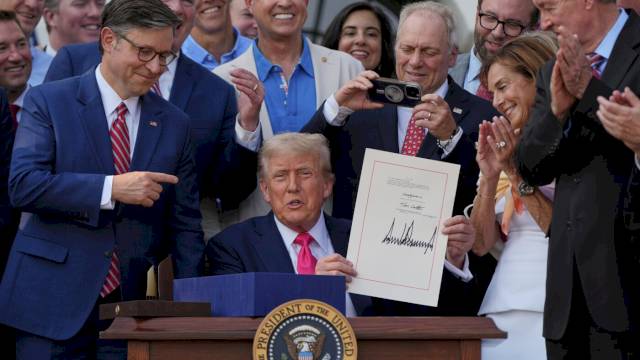
    President Donald Trump and Republican members of Congress at the signing ceremony for his tax cut and spending bill on July 4, 2025. That law makes it a requirement for many adults who get Medicaid to prove that they are working. Julia Demaree Nikhinson/AP hide caption

    toggle caption

    Julia Demaree Nikhinson/AP

    Schmeeka Simpson of Omaha works as a patient navigator for the American Civil Liberties Union and an administrative assistant at Nebraskans for Peace, plus picks up shifts at a Dunkin’ shop.

    Still, even with three jobs, she worries about losing her health coverage as Nebraska, starting Friday, May 1, becomes the first state to require certain Medicaid enrollees to work, train, or go to school under a rule mandated by congressional Republicans’ One Big Beautiful Bill Act.

    Simpson, 46, has relied on Medicaid since her divorce in 2014. None of her employers offer health coverage. She said she lost her government food assistance after technical problems caused her to miss renewing in time, and she worries that similar problems will happen again.

    “Adding more barriers won’t make the program work any better,” she said.

    A close up photograph of Schmeeka Simpson.

    Even though she works three jobs, Schmeeka Simpson worries about losing her health coverage when Nebraska becomes the first state to implement new Medicaid work requirements. Schmeeka Simpson hide caption

    toggle caption

    Schmeeka Simpson

    Nebraska Medicaid officials say they are trying to make it as easy as possible for enrollees to comply, so people don’t lose their coverage for administrative reasons, such as failing to file the proper paperwork.

    Enrollees with one of thousands of health conditions detailed by the state would be exempt.

    “Our top priority is making sure members clearly understand changes to the program and how to maintain their coverage,” Drew Gonshorowski, the state’s Medicaid director, said in an early-April news release.

    “Working out the kinks”

    In a brief interview with KFF Health News on April 28 outside the National Press Club in Washington, D.C., Centers for Medicare & Medicaid Services Administrator Mehmet Oz said he applauds Nebraska for being the first state to begin implementing the work requirements. He acknowledged that the state is still “working out the kinks,” adding that his hope is “by the end of this year they will get into a more sophisticated place.”

    But health policy analysts, advocates for the poor, and health industry groups remain skeptical, fearing thousands of Nebraska Medicaid enrollees will lose coverage and, with it, their access to health services and protection from medical debt.

    Hospitals also worry an increase in uninsured patients will hurt their bottom lines, said Jeremy Nordquist, the president and CEO of the Nebraska Hospital Association.

    “There is a lot of concern on many different levels,” he said. Many enrollees are unaware of the changes and might not realize they have to act to stay insured, he said.

    The bill President Donald Trump signed last July requires the 42 states, along with the District of Columbia, that fully or partially expanded Medicaid under the 2010 Affordable Care Act to implement a work requirement starting in 2027. The full expansion enables adults with incomes of up to 138% of the federal poverty level — amounting to $22,025 for a single person this year — to be eligible for Medicaid, the government program covering people with low incomes or disabilities.

    More than 20 million people gained coverage from Medicaid through expansion, according to KFF, a health information nonprofit that includes KFF Health News. The Congressional Budget Office estimates 4.8 million will become uninsured over the next decade as a result of the work requirement.

    Under the law, enrollees must work or volunteer at least 80 hours a month, attend school at least part-time, or participate in job training. Or they must prove they qualify for certain exemptions, such as caring for a child 13 or younger or a disabled parent, or having a health condition that prevents employment.

    Some states explored implementing work rules in the years before the GOP law passed. It gave states the option to launch their programs early.

    Nebraska’s plan

    In Nebraska, which is implementing the provision eight months before the law requires, about 70,000 Medicaid enrollees will need to meet the requirement, said Collin Spilinek, a spokesperson for the Nebraska Department of Health and Human Services.

    About 72% of them probably won’t have to do anything to keep their coverage, because the state already knows their work or exemption status via state or national databases, Spilinek said.

    To check whether enrollees meet the requirement, Nebraska and other states plan to tap into various databases, including Medicaid claims information and data controlled by credit rating agencies. Enrollees for whom Nebraska doesn’t have data will be notified and can complete an online form to confirm they meet the new rules.

    While a number of states say they plan to hire extra administrative staff, the Nebraska Medicaid agency is not adding any employees to implement its work requirement.

    “The fact that they say they do not need additional resources raises questions” as to whether “they will be able to pull this off without future headaches,” Nordquist said.

    Proving employment status will require documentation, but Nebraska officials say they will allow enrollees to self-attest that they volunteer, go to school, or qualify for exemptions, such as for poor health or caring for a disabled parent. “Supporting documentation, such as medical records, will not be required,” Spilinek said.

    That could make it easier for enrollees to get exempted under the law’s “medical frailty” exception. The long list of health conditions that can be considered for the exemption was posted last week by the state and includes many types of cancers and mental health and heart conditions.

    Kelsey Arends, senior staff attorney for Nebraska Appleseed, an advocacy group, said the state’s long list of medical billing codes for conditions that would be exempted is still not long enough. She said different levels of illness severity are not included.

    The exemption is crucial for Crystal Schroer, 30, who has been on Medicaid since 2022 and unemployed since 2024. She said it has been difficult to find work near her home in Kearney, Nebraska, that will allow her to take along her psychiatric service dog, Tarot, who helps her with anxiety.

    “I am insanely worried,” said Schroer, who lives with a friend. “It’s made my depression way worse.”

    Whether self-attestation will broadly be allowed in other states will depend on CMS’ rules for work requirements, expected to be set this summer. Oz told KFF Health News that “we don’t like self-attesting” and that “documentation is critical.”

    Several advocacy groups had asked the state to exempt enrollees with specific conditions, including the American Diabetes Association, HIV+Hepatitis Policy Institute, and National Bleeding Disorders Foundation. Losing coverage, the groups said, would mean losing access to medications that keep people healthy and out of the hospital.

    Adding a work requirement to Medicaid has been a priority for Trump since his first term. In 2018, his administration became the first to allow states to adopt the policy, but only Arkansas implemented it. In the nine months the policy was in place before a federal judge deemed it unlawful, more than 18,000 people lost coverage — nearly 1 in 4 of those subject to the requirement.

    Most lost coverage not because they did not meet the requirements but for failing to correctly submit paperwork in time.

    Georgia has had a work requirement under its partial Medicaid expansion since 2023. Only about 8,000 people signed up for the coverage in its first two years — far fewer than the 25,000 that state officials predicted for the first year alone — and many have been denied benefits because of paperwork issues.

    National mandate

    During the congressional debate over the law last year, Republicans pushed a work requirement for Medicaid as a way to get “able-bodied” adults benefiting from government assistance into the workforce. House Speaker Mike Johnson said it would help preserve Medicaid “for people who rightly deserve it,” not young men “sitting on their couches playing video games.”

    Republicans have argued mandating employment will nudge people into finding work, leaving Medicaid to help children and people who are pregnant or have disabilities.

    They were not swayed by studies showing most adults on Medicaid already work or go to school or have health conditions preventing them from doing so.

    A recent study in the Annals of Internal Medicine found about one-third of adults at risk of losing coverage under the new work requirement reported that they have a physical or mental illness or disability.

    “This is not a case that we have mostly healthy adults choosing not to work,” said Darshali Vyas, a study co-author and health policy researcher at Beth Israel Deaconess Medical Center in Boston. “It’s a vulnerable group, and I am not sure there are clear protections as we begin to roll out work requirements.”

    In Nebraska, about two-thirds of Medicaid expansion enrollees work or attend school, according to KFF. Nebraska’s unemployment rate is 3%, one of the lowest in the nation.

    Andrea Skolkin, the CEO of Omaha-based One World Community Health Centers, said it’s an unsettling time for her clinic and their patients. “We are still concerned about the expanded Medicaid folks losing coverage,” she said.

    About 4,000 of their 52,000 patients are covered under the Medicaid expansion, Skolkin said. She said many enrollees received letters from the state about the work requirement, but she worries many did not understand them.

    Losing 10% of those patients would mean $500,000 less in revenue for the nonprofit centers, she said. To help patients, they plan to add staff to help people fill out the forms to get and maintain coverage.

    Nebraska Appleseed’s Arends said she’s skeptical of the state’s promises to use automation to confirm that enrollees meet the work rules. “We remain very concerned about the early implementation,” she said.

    People who lose coverage may have a harder time getting health bills covered if they reenroll in the Medicaid program, because the federal law also reduces retroactive eligibility from three months to one month for expansion enrollees.

    Because many people sign up for Medicaid when seeking care for an emergency and it can take weeks or months to complete enrollment, hospitals are concerned the change will leave them to cover the costs when people lose coverage, Nordquist said.

    Only two other states plan to implement the work requirement early: Montana, which plans to launch in July, and Iowa, which plans to go live in December.

    Many states will be closely watching Nebraska’s implementation to see what lessons they can learn ahead of their own launches in January, said Andrea Maresca, a senior principal at Health Management Associates, a consulting firm.

    States are better prepared to enact work requirements than they were when Arkansas tried in 2018, she said. After reconfirming millions of enrollees’ eligibility post-covid, they have more experience using public and private databases to automate the process and more practice communicating with enrollees, Maresca said.

    Still, “it won’t be perfect,” and states will have to adapt as they go, she said.

    KFF Health News is a national newsroom that produces in-depth journalism about health issues and is one of the core operating programs at KFF—an independent source of health policy research, polling, and journalism. Learn more about KFF.

  • Trump says he’s lifting certain tariffs on Scotch whisky – WCAX

    Trump says he’s lifting certain tariffs on Scotch whisky – WCAX

    WASHINGTON (AP) — President Donald Trump said Thursday he is removing certain tariffs on Scotch whisky after this week’s White House visit by King Charles III and Queen Camilla of the United Kingdom.

    “The King and Queen got me to do something that nobody else was able to do, without hardly even asking!” Trump posted on social media.

    Trump said people had wanted this change, especially with regard to the wooden barrels in which the spirits of Scotch and bourbon can be aged. His post left it unclear if the tariffs were being lifted on bottles of Scotch or on the materials used to produce alcohol in both countries.

    “I will be removing the Tariffs and Restrictions on Whiskey having to do with Scotland’s ability to work with the Commonwealth of Kentucky on Whiskey and Bourbon,” Trump said.

    The White House did not respond to emails seeking clarification about the details of what Trump announced, though the post was interpreted in Scotland and by industry lobbyists as removing the tariffs on Scotch.

    U.S. Trade Representative Jamieson Greer later said in a Thursday statement that the U.S. would give “preferential duty access for whiskey produced in the United Kingdom.” The administration did not immediately respond to questions about whether that meant eliminating the tariffs or lowering them.

    The Trump administration in 2025 reached a trade framework that put a 10% tax on most goods imported from Britain. The Scotch Whisky Association said its export volume to the U.S. fell 15% after the tariffs were announced in April of last year.

    The president, answering questions from reporters in the Oval Office, said the tariffs were lifted to specifically enhance the trade of barrels between Scotland and Kentucky, which produces almost all of the world’s bourbon. The barrels are used to age the alcohol.

    “I just took all the restrictions off so Scotland and Kentucky can start dealing again,” said Trump, who added that he’s “not a big drinker.”

    Still, John Swinney, Scotland’s first minister, interpreted the president’s statement as a removal of tariffs on Scotch itself, calling it a “tremendous success” for his country.

    “People’s jobs were at stake. Millions of pounds were being lost every month from the Scottish economy,” said Swinney, expressing gratitude to both Trump and King Charles III.

    Trump has used alcohol as a pressure point in his tariff threats. Last year, he threatened a 200% tariff on European wine — a major potential blow to French and Italian vineyards that never came to fruition.

    Foreign countries have responded in turn with threats on bourbon and other American products.

    In the end, the Trump administration exempted cork from tariffs, a huge relief to Portugal, the leading supplier of the material used to cap wine bottles.

    Chris Swonger, president and CEO of the Distilled Spirits Council in the U.S., also interpreted Trump’s post as a removal of the 10% tariff on whisky from the United Kingdom.

    “We applaud President Trump for working to restore a proven zero‑for‑zero model of fair, reciprocal trade between our two nations,” Swonger said in a statement. “This action strengthens transatlantic ties, brings much‑needed certainty to our industry and allows spirits producers on both sides of the Atlantic to grow, invest and support jobs at a critical time.”

    ___

    AP correspondent Jill Lawless contributed from London.

    Copyright 2026 The Associated Press. All rights reserved.

  • Trump to draw big crowds, road closures with The Villages visit – Spectrum Bay News 9

    Trump to draw big crowds, road closures with The Villages visit – Spectrum Bay News 9

    SUMTER COUNTY, Fla. — President Donald Trump will be in Central Florida Friday, where he will visit The Villages to tout the senior bonus deduction signed into law last summer.

    More than 30 million older Americans claimed the deduction as of Tax Day, and the average deduction was more than $7,500. 

    Local, state and federal agencies are preparing for the big crowds expected to be in The Villages for the event Friday afternoon.

    The Republican Party of Florida posted on its Facebook page Monday evening that the president will be there around 3 p.m. 

    The president is also expected to speak about what that administration has been working on to reduce Social Security Administration call times and in-person wait times at field offices during his visit. 

    According to the Sumter County Sheriff’s Office, doors will open at noon to the area at The Villages High School at Middleton, also known as Middleton High School, where Trump will speak.

    People who plan to attend must RSVP online, and event coordinators said the QR code received after registering does not guarantee entrance, the sheriff’s office said in a statement. Attendees will be subject to Transportation Security Administration-style security screening, Sheriff’s Office officials said. No bags are allowed. After the venue reaches capacity, it will be closed, and people will be turned away.

    The Sheriff’s Office also warned that significant traffic delays in and around the area are expected, and detours and road closures will be set up for safety reasons. Officials urged residents and visitors to avoid the area if possible. Those driving to the event should take Central Parkway to Landstone Boulevard to access the venue, according to the Sheriff’s Office.

    Attendees should be aware that venue parking is very limited and plan accordingly, the Sheriff’s Office statement said.

    Getting around The Villages will be tough with many road closures and other security measures going into effect in the morning.

    Road Closures:

    The following roads will be closed leading up to the event, according to the Sumter County Sheriff’s Office. 

    • Dr. Randy McDaniel Way — northern portion blocked between Alder Avenue and Gartner Drive/Landstone Boulevard roundabout
    • Pettus Parkway
    • Golf Cart and Pedestrian access will be permitted

    Prohibited Items:

    • Aerosols
    • Ammunition
    • Animals other than service/guide animals
    • Bags (NO bags are allowed)
    • Balloons
    • Bicycles
    • Coolers
    • Drones and other unmanned aircraft systems
    • Explosives
    • Firearms
    • Flammable Liquids
    • Glass, thermal, or metal containers
    • Laser Pointers
    • Mace/Pepper spray
    • Packages
    • Range Finders
    • Recreational motorized mobility devices
    • Selfie Sticks
    • Signs exceeding the size restrictions (20 feet by 3 feet by 1/4 inch)
    • Structures
    • Support for signs and placards
    • Toy guns
    • Weapons of any kind
    • Any other items determined to be a potential safety hazard
  • Iran war live: Tehran says US ports siege ‘intolerable’; Trump mulls action – Al Jazeera

    Iran war live: Tehran says US ports siege ‘intolerable’; Trump mulls action – Al Jazeera

    Live updates,

    Israeli attacks on Lebanon have killed at least 2,586 people and wounded more than 8,000 since March 2, local media report.

  • Pickleball and protests: How a Trump visit is roiling the world’s largest retirement community – BBC

    Pickleball and protests: How a Trump visit is roiling the world’s largest retirement community – BBC

    Sheila FlynnThe Villages, Florida

    Watch: “It can get heated” – World’s largest retirement community talks US politics

    Some call the Villages – the largest retirement community in the world – “Disney without rollercoasters”.

    But descriptions of the Villages from residents themselves are even more effusive.

    “It’s like being at a resort on a full-time basis,” says North Carolina transplant Betty Brock, 79. “I tell all my friends that don’t live here, if you get bored in the Villages, it’s not the Villages, it’s you.”

    “The bottom line is, it’s kind of like utopia,” says 62-year-old Terri Emery, speaking against the backdrop of live music blaring from one of the Villages’ five squares.

    Spanning 30,000 acres, three counties and four zip codes, the Villages is a meticulously-landscaped master-planned community known for sunshine, socialising and an endless supply of recreational fun for those over the age of 55.

    Behind Emery, fellow Villagers are dancing to covers of Livin’ La Vida Loca and Man! I Feel Like A Woman. Nearby is a neatly parked row of colourful, personalised golf carts – the preferred mode of transport in this sprawling pensioners’ paradise.

    “You move here to be young; you don’t move here to die and become old,” says Emery, who’s just finished dinner at a steakhouse down the street.

    A row of colourful parked golf carts in the Villages

    But even utopia has its no-go zones, apparently.

    Since US President Donald Trump returned to office last year, politics have become an increasingly thorny issue in the Villages. The president is due to give a speech at a local rally on Friday, as part of his wider efforts to champion his economic policies with voters ahead of the midterm elections.

    The speech has created a buzz in the community for very different reasons. Trump supporters are thrilled and honoured the president is visiting. Democrats – along with other Trump critics – are planning protests. But one thing they all agree on, at this point, is that it’s better not to talk about it to each other.

    “Everybody does still try to get along,” says Maddy Bacher, 63, a Democrat originally from Connecticut. “You want to at least be able to say good morning and how are you and how’s the dog.

    “But… I find you don’t socialise as much, and it’s kind of difficult, because everything you do move to talk about might have a political consequence.”

    Politics, says North Carolina transplant Brock, does come up, but “not as much as you think, because you don’t ever know where that line is”.

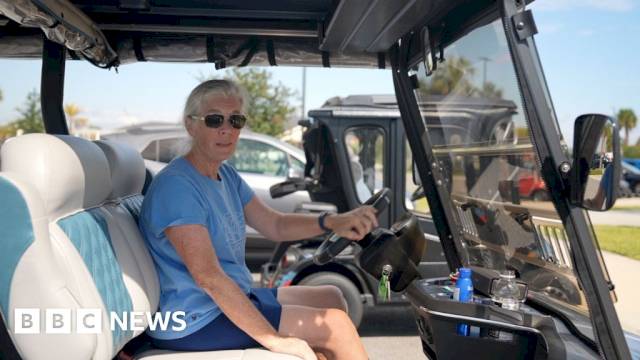
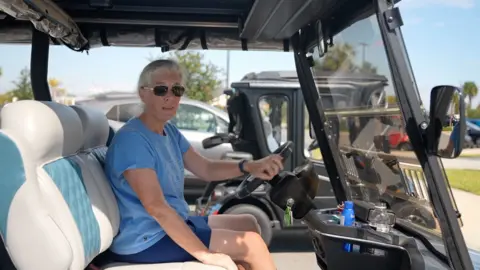
    Maddy Bacher drives a golf cart in sunglasses and a blue tank-top

    Maddy Bacher says she started a Democratic pickleball team because politics got too testy during Covid

    The community, which was founded in the 1970s, has been a reliable Republican stronghold, voting for Trump in all three of his electoral bids. While its retiree population remains heavily conservative, a whopping No Kings protest against Trump last month turned heads – with nearly 7,000 people participating across two Villages locations, according to local reports.

    “Nothing turns out Democrats like Trump,” says Democratic Club president Bill Knudson, who moved with his wife to the Villages four years ago. Knudson was “kinda stunned” at how many people appeared at a new members meeting held weeks after the president took office again.

    “They had to go out of their way to find us,” he adds.

    While throngs of Trump supporters in the Villages were scrambling to get tickets to the speech on Friday, members of the Democratic Club were making signs and planning their protest.

    The vast majority of Villagers use golf carts to get around, but the community is so expansive that it would take Knudson about an hour in his cart “going 20 miles an hour” to get to Trump’s location. Everyone is grumbling about what the effect will be on traffic, and that – along with safety concerns – is keeping some people home on both sides of the political divide.

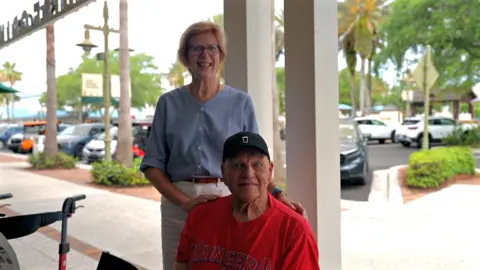
    Tom Samson sits on a patio in a red Rangers t-shirt and black baseball cap, while Dorothy Duncan stands behind him in a blue-button down shirt and glasses

    Some residents, like Dorothy Duncan and Tom Samson, manage to get along despite disagreeing about politics

    Those challenges won’t deter Democrat Dorothy Duncan, though. The retired lawyer joined the No Kings demonstration, and she is choosing from a number of her protest signs for Friday’s Trump appearance.

    “There are certain issues you cannot be silent on,” she says.

    Still, Duncan is sitting outside Starbucks with a handful of other friends, including a staunch supporter of the president.

    “What really attracted most people is his no filter,” says Pittsburgh native Tom Samson, 81, the retired owner of a pest control business. “He doesn’t have a filter and says whatever’s on his mind, and he’s not a politician.”

    The discourse is civil and the banter is friendly on this humid, overcast morning before Trump’s visit, but such across-the-aisle political discussions are few and far between, residents say.

    When Bob Carberry moved to the community 14 years ago, it was almost “apolitical,” he says. But Trump’s entry into politics changed all that, according to Carberry and nearly every resident who agreed to speak.

    “The emotional level of politics is something that’s emerged probably more so in the last five years with Trump,” Carberry says.

    Maddy Bacher recalls how one woman left her clay club – the Villages boasts more than 3,000 clubs for every pastime one could think of, from female fly fishers to parrot enthusiasts to alumni of different colleges – because of opposing opinions on the Covid booster.

    That’s part of the reason Bacher began a weekly pickleball game frequented only by fellow Democratic voters. Her husband, meanwhile, started a Democratic club golf group because “some people felt uncomfortable” with the right-leaning politics they encountered on the green.

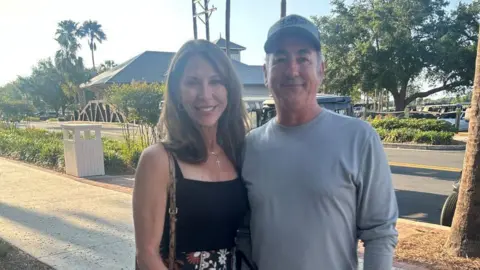
    Terri Emery and Scott Morgan smile

    Terri Emery and Scott Morgan support the president and got tickets to see him speak

    For his supporters, Trump’s arrival on Friday has become the hottest event in the calendar.

    “He’s a man that does do what he says he’s going to do, and he may not be diplomatic, and he may not be charming, may not be politically correct, but he’s doing what every president before him has promised to do when they’re out there campaigning but have never done,” says Sharlene, who declined to give her surname.

    She’s devastated that she’ll have to work during the speech, but Republicans were organising watch parties – and discussing possible golf-cart parades – for those unable to attend. Phil Montalvo, 79, started a new Villages Republican club three years ago in addition to an already established one – cutting down commute times for conservatives living at different ends of the community.

    “Everybody’s jazzed,” the retired lawyer says of Trump’s visit. The president has garnered legions of fans in the Villages, Montalvo says, particularly for his “America First” message.

    “We like America to be first, and that seems to be the glue that holds everybody together,” he says. “And Trump, he’s the orchestra leader on that, and everybody looks up to him for that reason – and strength.”

    While he acknowledges Democrats’ increasing visibility in the community, he’s not too worried about any liberal political sway.

    Getty Images The Marine One helicopter lands in front of a huge crowdGetty Images

    Trump flew into the Villages in 2020 for a rally

    He uses Sumter County – one of the three in which the Villages sits – as an example to illustrate why. There are 23,000 registered Democrats, he says, in comparison with 77,000 registered Republicans.

    “We’re not sitting on our laurels, but we’re not intimidated by that at all,” he says of displays such as the No Kings protest. “It’s great that they express themselves. We think they have the wrong message, but that’s their prerogative.”

    Other die-hard Trump supporters are less magnanimous.

    “It’s absolutely disgusting,” Emery says. “I think they’re communists. The only king is the Lord. Trump is not a king. He’s our president, and if you like him or not, he’s still your president at the end of the day.”

    At dinner the other night, Emery and her dining companion struck up a conversation with another Trump supporter who’d become embroiled in a dispute with a neighbour. The neighbour took down the resident’s Trump flag – prompting the indignant homeowner to call police.

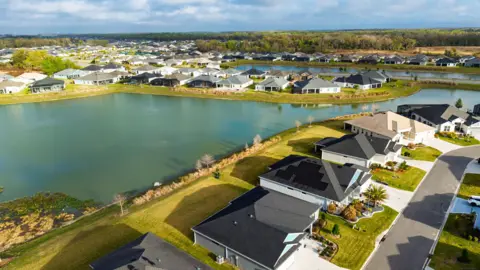
    Getty Images Aerial of the VillagesGetty Images

    There are over 150,000 people over the age of 55 living in the Villages

    It’s just another example of rising tensions that began in 2016, when Trump was first elected.

    “We’d have a block party and things like that, and then… some of the people started putting up Trump flags,” Democratic golfer Thomas Bacher says. “And that just caused a big rift. We didn’t have block parties anymore. People wouldn’t talk to each other anymore.”

    Roy Irwin, 82, moved to the Villages in 2012 – and quickly met fellow Villager Susan Prince at church. They’ve now been together 14 years.

    When socialising locally, Irwin says, “I try to talk gently with everybody, no matter what their belief – respect their opinion.” The Villages, he says, is “just like anywhere else – there’s people [feeling] very strongly on both sides.

    “It’s really a microcosm of the country,” Irwin notes.

    Not everyone, however, has firmly chosen sides. Edward Hannan, 77, acknowledges the importance of the president’s visit but won’t be going, mostly to avoid the expected hours-long wait and TSA-like screening.

    “I disagree with him on many things, but there are certain things that I like,” says Hannan, a lawyer. “He has an organisational skill that, frankly, has not been evidenced in many of our American presidents. But, offsetting that, he is very, very aggressive.

    “You should not denigrate people who disagree with you; you should reason with them.”

    He laments the absence of such discourse in the Villages; people either don’t talk politics, he says, or only discuss it with those they know well or are certain to share their views.

    “So that’s a negative, because getting diverse ideas in a small group is difficult,” he says.

    Hannan calls himself “not fixated ideologically.” When asked whether that makes him an anomaly in the Villages, he barely waits for the end of the question before resolutely blurting out his answer.