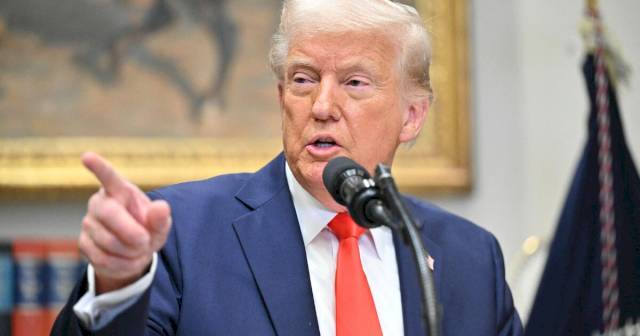
President Trump is giving a one-month exemption to U.S. automakers from the round of tariffs that took effect on March 4, White House press secretary Karoline Leavitt said on Wednesday.
The announcement comes after Mr. Trump spoke with leaders of the so-called Big Three automakers — Ford, General Motors and Stellantis, the parent company of Chrysler, Dodge, Jeep and Ram — on Wednesday, Leavitt said.
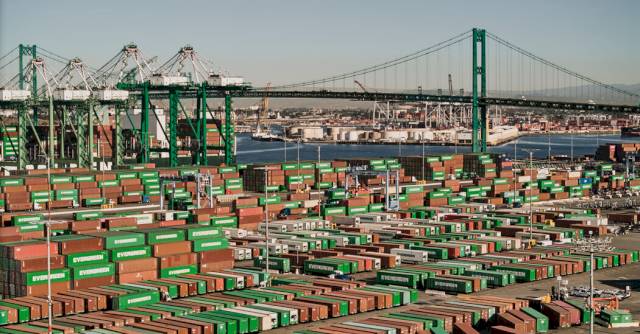
Mr. Trump’s imposition of 25% tariffs on all goods imported from Canada and Mexico, as well as an additional tariff of 10% on Chinese imports, were expected to hit the auto industry hard because many vehicle parts and components are imported from those countries to manufacture cars in the U.S.
“We spoke with the Big Three auto dealers,” Trump said in a statement read by his spokesperson. “We are going to give a one-month exemption on any autos coming through USMCA,” referencing the North American free trade agreement he renegotiated in his first term.
“Since President Trump’s successful USMCA was signed, Ford has invested billions in the United States and committed to billions more in the future to both invest in American workers and ensure all of our vehicles comply with USMCA,” Ford said in a statement. “We will continue to have a healthy and candid dialogue with the administration to help achieve a bright future for our industry and U.S. manufacturing.”
In its own statement on the tariff delay, GM said the automaker “has more vehicle assembly plants in the U.S. than any other automaker,” adding that “we continue to invest billions of dollars every year in our manufacturing base, supply chain and U.S. jobs.”
The goal of the tariff pause is to give U.S. automakers time to shift their supply chains to within the U.S., Leavitt said. Mr. Trump “told them they should get on it, start investing, start moving, shift production here to the U.S. of America, where they will pay no tariffs. That’s the ultimate goal,” she said.
The Trump administration has said the tariffs are aimed at curbing the flow of migrants and drugs such as fentanyl into the U.S., as well as redressing trade imbalances with other countries. The taxes quickly triggered retaliatory measures by Canada and China, with Mexico planning to announce its response on Sunday.
The new tariffs Canada and Mexico could drive up car costs by as much as $12,200 for some models, according to a report from Anderson Economic Group (AEG), a Michigan-based economic consultancy.
The broad-based tariffs are likely to fuel higher costs on multiple types of vehicles, including SUVs, small cars and electric vehicles, according to AEG’s analysis. Higher sticker prices would hit the auto market even as the typical car now costs close to a near-record high of $50,000, and would likely add more financial strain on inflation-weary consumers
Shares of U.S. automakers jumped on Wednesday afternoon, with Ford Motor rising 47 cents, or 5.1%, to $9.58. GM shares gained about 7%, while Stellantis climbed 9.2%.
Aimee Picchi is the associate managing editor for CBS MoneyWatch, where she covers business and personal finance. She previously worked at Bloomberg News and has written for national news outlets including USA Today and Consumer Reports.
A federal appeals court Wednesday said President Donald Trump can fire a top government watchdog in the latest round of a legal fight over the authority to dismiss federal officials.
The U.S. Circuit Court of Appeals for Washington, D.C., put on hold on a lower court’s ruling that found Hampton Dellinger’s termination at the Office of Special Counsel was “unlawful.” The court said it would expedite its review of the ruling, but in the meantime Dellinger can be removed from his post.
The White House and Dellinger did not immediately respond to requests for comment Wednesday night.
The ruling is a temporary win for Trump as his administration seeks to carry out mass firings of federal workers, including nearly two dozen government watchdog officials.
Dellinger, who was special counsel of the Office of Special Counsel, filed a lawsuit against several Trump administration officials last month challenging his dismissal. He argued it violated a federal law that says the president can remove special counsels only for “inefficiency, neglect of duty, or malfeasance in office.”
The email outlining his termination did not cite any of the those as the reason for his firing, Dellinger said in his lawsuit.
“That email made no attempt to comply with the Special Counsel’s for-cause removal protection,” the lawsuit says. “It stated simply: ‘On behalf of President Donald J. Trump, I am writing to inform you that your position as Special Counsel of the US Office of Special Counsel is terminated, effective immediately.’”
Dellinger began his post in March 2024 after he was appointed by Democratic President Joe Biden and confirmed by the Senate to a five-year term.
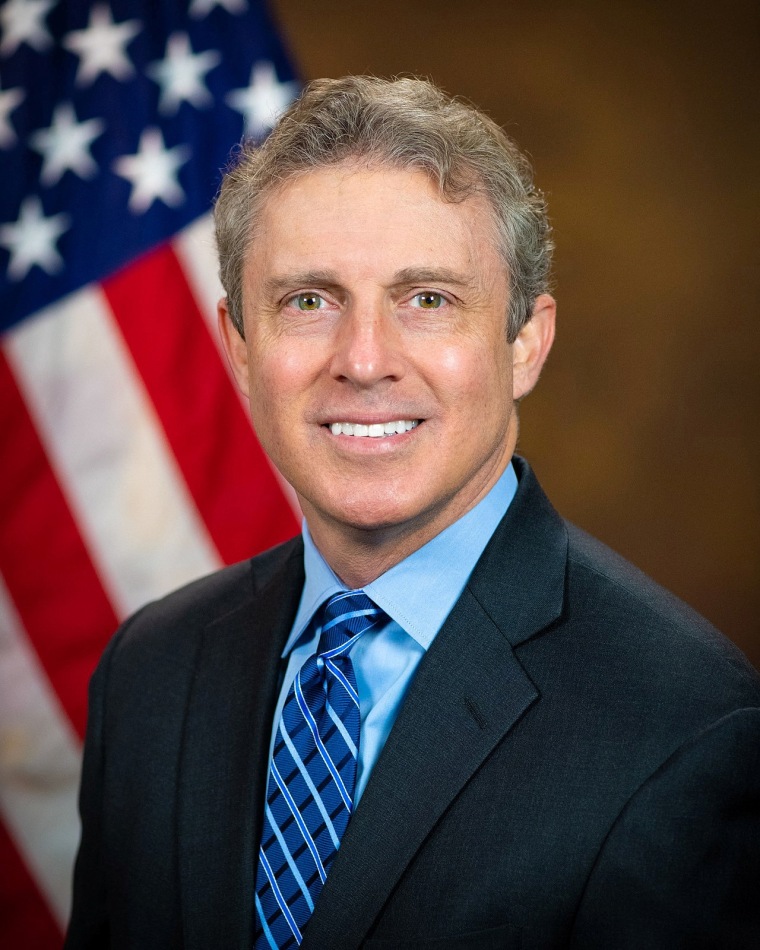
Hampton Dellinger, special counsel of the U.S. Office of Special Counsel.U.S. Office of Special Counsel via Reuters
As head of the Office of Special Counsel, Dellinger was tasked with shielding federal employees from prohibited personnel practices, including retaliation for whistleblowing. His office’s work was unrelated to the investigations into Trump led by Jack Smith, whom then-Attorney General Merrick Garland appointed as a special counsel in 2022.
Last week, U.S. District Judge Amy Berman Jackson halted Trump’s effort to remove Dellinger and ordered that he be allowed to serve until the end of his term barring inefficiency, neglect of duty or malfeasance in office. She had allowed Dellinger to remain in his post while the case moved through the courts.
Jackson appeared to agree with Dellinger’s argument that allowing his termination without cause would have a chilling effect among federal workers seeking to lodge complaints through the Office of Special Counsel.
“The Special Counsel’s job is to look into and expose unethical or unlawful practices directed at federal civil servants, and to help ensure that whistleblowers who disclose fraud, waste, and abuse on the part of government agencies can do so without suffering reprisals,” Jackson wrote in her ruling Saturday. “It would be ironic, to say the least, and inimical to the ends furthered by the statute if the Special Counsel himself could be chilled in his work by fear of arbitrary or partisan removal.”
The Justice Department had petitioned the Supreme Court to affirm what it called Trump’s right to fire Dellinger, arguing that anything less would infringe on the president’s power to manage the executive branch “in the earliest days of his Administration.”
This page either does not exist or is currently unavailable.
From here you can either hit the “back” button on your browser to return to the previous page, or visit the ABCNews.com Home Page. You can also search for something on our site below.
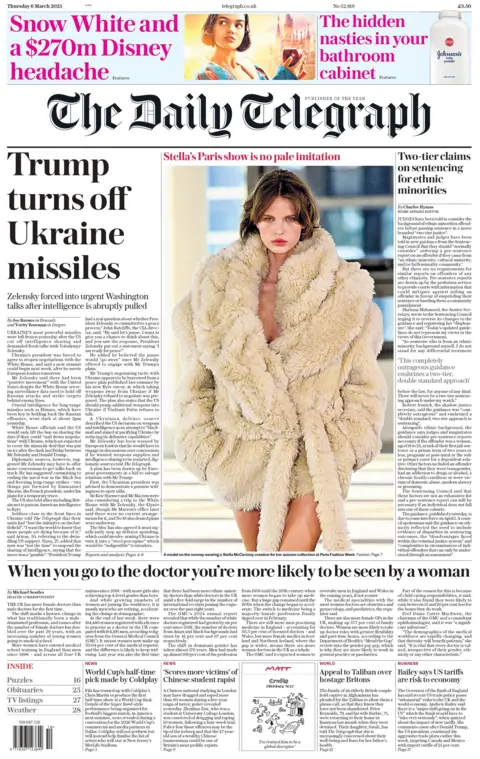
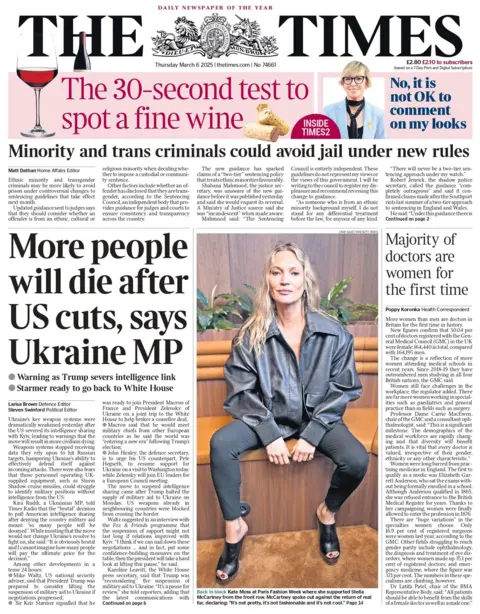
Ukraine’s President Volodymyr Zelensky has been forced into urgent talks with Washington after the US cut off intelligence-sharing, the Daily Telegraph writes. White House officials said the US would only lift the ban on sharing the data if they could “nail down negotiations” with Ukraine, the paper reports. It also carries the story that there are more female doctors than male doctors in the UK for the first time, marking a shift from a traditionally male-dominated profession.
The Guardian calls the decision to stop sharing intelligence with Ukraine “another serious blow” to Kyiv, after US President Donald Trump paused military aid. The White House has indicated both bans could be lifted if the peace talks progressed, it says.
The Times carries a warning from a Ukrainian MP that “more people will die” after the US cuts. It also picks up on changes to sentencing guidelines, set to take effect next month, under which it says ethnic minority and transgender criminals may be more likely to avoid prison. The guidelines would ask judges to consider whether an offender is from an ethnic, cultural or religious minority when deciding whether to impose a custodial or community sentence, it says.
The Daily Mail splashes on the planned changes to the sentencing guidelines, calling it a “New two-tier justice fiasco”. According to the paper, the Conservatives believe they could open the door to softer sentences for minorities, and risk making the courts “anti-white and anti-Christian”. Labour’s Justice Secretary Shabana Mahmood has called for the planned changes to be scrapped.
The Metro, along with several other papers, covers the conviction of serial rapist Zhenhao Zou at a London court. The 28-year-old PhD student was found guilty of drugging and raping 10 women and police believe there may be dozens more victims.
Five years on from the coronavirus pandemic, the Daily Mirror runs a tribute to NHS staff from the Prince of Wales. William praises their sacrifices and says “thank you” during an emotional visit to the Royal Berkshire Hospital in Reading, the paper says.
A “terrorist cop killer” is free to roam Britain’s streets, writes the Sun. It says Maksim Cela, 59, from Albania, has cost taxpayers tens of thousands of pounds fighting deportation, claiming he would be at risk from “rival mobsters” if sent home.
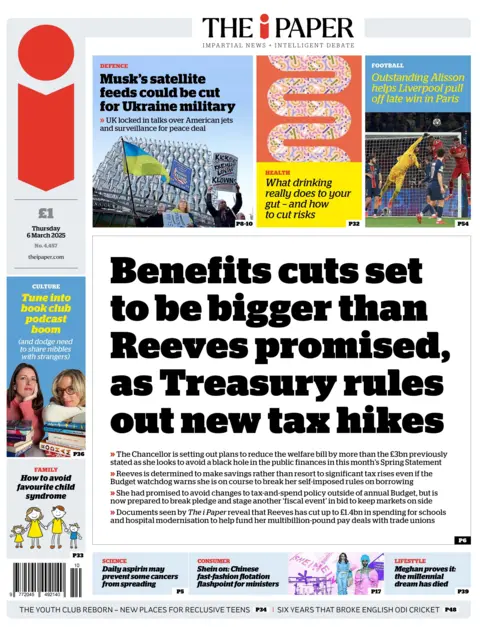
The I paper says benefit cuts are set to be bigger than Chancellor Rachel Reeves had promised. She is setting out plans to reduce welfare spending by more than the £3bn previously stated. She is “determined” to make savings rather than resort to significant tax rises, it adds.
Calls are mounting for the French to “turn Channel boats around”, reports the Daily Express. It says migrants were escorted to a British rescue ship from French waters.
Investors are betting on a “big boost” to Germany’s “ailing economy” as a result of a “historic” deal to fund military and infrastructure development, the Financial Times reports. Analysts believe the plan could boost economic growth to as much as 2% next year, the paper says.
The Daily Star brings the news that an “orange ball of fire” has been spotted in the sky. The arrival of some sun has prompted warnings from “fun-sponge forecasters… lecturing us about sunburn”, it complains.
You have a preview view of this article while we are checking your access. When we have confirmed access, the full article content will load.
Everything You Need to Know About the Trump Tariffs
They have upended diplomatic relations with America’s largest trading partners, sent markets tumbling and provoked retaliations on U.S. products.
Most economists expect fresh trade barriers to raise prices for U.S. businesses and households, which could lead to a temporary burst of higher inflation.Credit…Adam Amengual for The New York Times
President Trump has levied new tariffs on goods imported from Mexico, Canada and China, risking a damaging trade war. The three countries account for more than a third of the products brought into the United States.
The United States hadn’t seen so many tariffs in nearly 100 years, when the Smoot-Hawley Tariff Act helped deepen the Great Depression, historians say.
Mr. Trump argues that tariffs can help U.S. factories and raise revenue for the government. But his recent actions have also upended diplomatic relations with America’s largest trading partners, sent markets tumbling and provoked retaliations on U.S. products.
What are tariffs? How do they function? And who really pays for them? The answers are not always simple or obvious, and require understanding how manufacturing, trade and supply chains work.
What are tariffs, and how do they work?
A tariff is a government surcharge on products imported from other countries.
Understanding tariffs means understanding how manufacturing, trade and supply chains function — and how costs build along the way.
Thank you for your patience while we verify access. If you are in Reader mode please exit and log into your Times account, or subscribe for all of The Times.
Thank you for your patience while we verify access.
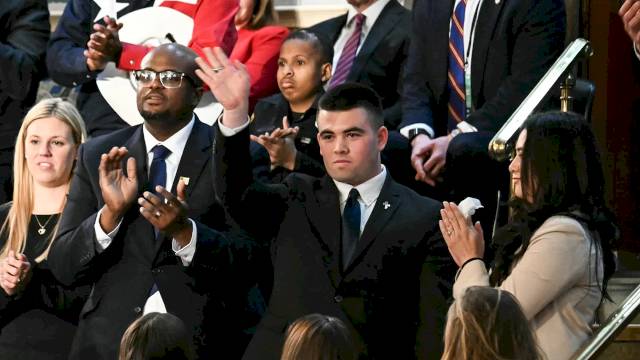
President Donald J. Trump stood before a joint session of Congress and turned a high school senior’s lifelong dream into reality, March 4, 2025.
Among the many Americans he honored during his address, Trump singled out Jason Hartley, a young man from Southern California whose ambition to attend the U.S. Military Academy at West Point had just been fulfilled.
With the chamber erupting in applause, Trump delivered the news that would change Hartley’s life forever: “That’s a hard one to get into, but I’m pleased to inform you that your application has been accepted. You will soon be joining the Corps of Cadets.”
For Jason Hartley, a senior at St. Paul High School in Santa Fe Springs, California, the moment was surreal. Sitting alongside his mother in the House gallery, he was visibly stunned as the president announced his appointment to one of the nation’s most prestigious military institutions.
“Thank you, Jason,” Trump said, “You’re going to be on ‘the Long Gray Line,’” a nod to West Point’s storied tradition.
Hartley’s acceptance into West Point is a culmination of years of dedication, a testament to his grit, and a tribute to the family legacy of service that has shaped his path.
“I’m still processing it,” Hartley told DOD News in an interview the following day. “I’ve wanted this for so long, and to hear it from the president, in front of Congress — it’s unreal. I’m just so grateful.”
Born and raised in La Mirada and Whittier, California, about 20 miles southeast of downtown Los Angeles, Hartley grew up steeped in a tradition of service. His father, an Army veteran who later served as a Los Angeles County sheriff’s deputy, was a towering influence.
“My dad had a huge impact on me wanting to join the Army,” Hartley said. “He enlisted after high school in 2002 and got medically discharged in 2008. He didn’t talk much about his service — he was quiet about it — but I could see how much he loved his country. After the Army, he still had that urge to serve, so he joined the Sheriff’s Department. That dedication, that willingness to die for what’s right, I admire that.”
Hartley’s father passed away in August 2018, a loss that only deepened his resolve to honor his family’s military legacy.
“Jason’s father, grandfather and great-grandfather all wore the uniform,” Trump noted in his address. “Jason tragically lost his dad when he was just a boy, and now he wants to carry on the family legacy of service.”
For Hartley, that legacy became a guiding light.
“Since I was young, I’ve always wanted to join the Army in some way,” he said. “But over time, I realized my grades were good enough for a good college. I thought, if there was a way to do both at the same time, that would be a dream come true.”
That dream took shape one day when Hartley stumbled across the Army-Navy game on TV.
“I was confused why there were teams with those names,” he recalled with a laugh. “My family explained they’re military academies. Ever since then, I dedicated everything I did to getting an appointment.”
Hartley’s pursuit of West Point was no small feat. A self-described “math nerd” with a 4.46 GPA, he excelled academically, but the application process tested his resilience.
“It was the most stressful thing I’ve ever done,” he admitted. “Freshman and sophomore years, I focused on grades and researching the process. The more I learned, the more I wanted it. But my candidate fitness assessment and Department of Defense medical examination review board were trouble. I was a football offensive lineman — at one point, I was 5’10” and 243 pounds. My mile time was over 10 minutes, and I couldn’t do pull-ups.”
Determined to meet West Point’s rigorous physical standards, Hartley transformed himself.
“I spent months losing body fat and improving my CFA scores,” he said. “I got down to 206 pounds, passed the CFA and [DOD medical exam, and secured a nomination to all three academies. The hardest part was waiting after that … It was nerve-wracking. Thank God it’s over now — and it ended in the craziest way possible.”
On the field, Hartley’s tenacity shone through. A six-letter varsity athlete, as Trump proudly highlighted, he played football and threw discus in track and field.
“In football, I played offensive line — center and guard — and some defensive line,” he said. “Halfway through the season, Coach Mike Moschetti moved me to fullback, which was wild. He had this term, ‘DEESH,’ that caught on with the team. It meant delivering hits and playing collision football. I loved it.”
That penchant for contact sports mirrors his attraction to the Army.
“I’m drawn to the Army because of its focus on leadership and ground combat,” Hartley explained. “West Point’s training and emphasis on character development align with my goals. I want to be part of a team that operates in tough environments and makes a difference.”
Hartley’s athleticism and academic prowess caught the president’s eye, but it’s his dedication to service that defines him.
“The Army offers early leadership opportunities and diverse career paths,” he said. “I want to be a disciplined, effective leader.” That commitment resonated with Trump, who praised him as “a really good athlete, they say, [and] a brilliant student,” before delivering the life-changing news.
The announcement wasn’t just a personal triumph — it came amid a broader narrative of military renewal under Trump’s administration and Defense Secretary Pete Hegseth.
“Secretary Hegseth’s service and appointment set a high standard,” Hartley noted. “In the Army, everyone’s expected to give their all. I’m thankful for President Trump and Secretary Hegseth, but it just raises the bar for me. I was always going to give 110%, no matter how I got in. Once you’re a plebe at West Point, it doesn’t matter how you got your appointment — everyone’s the same.”
For Hartley, the road ahead is both daunting and exhilarating. As he prepares to join the Corps of Cadets, he carries his father’s quiet strength, his family’s proud history, and a relentless drive forged on the football field and in the classroom.
“I’ve always wanted to serve,” Hartley said. “Now I get to do it in a way I never imagined.”
For the Defense Department, Jason Hartley is more than a success story — he’s a symbol of the next generation of warfighters, ready to uphold the values that define the armed services. And on March 4, 2025, with a nation watching, his dream became a promise fulfilled.
Prime Minister Keir Starmer of Britain said Sunday that he would work with the leaders of Ukraine and France on a cease-fire plan to end Russia’s war in Ukraine, as the region reels from the Trump administration’s recent moves.
The comments came ahead of a summit in London on Sunday, where Mr. Starmer met with President Volodymyr Zelensky of Ukraine and other European leaders to discuss the war. The gathering took on greater urgency after Mr. Zelensky’s heated Oval Office meeting with President Trump and Vice President JD Vance on Friday raised fears the U.S. would try to strong-arm Ukraine’s president into making a peace deal on whatever terms the Americans dictated.
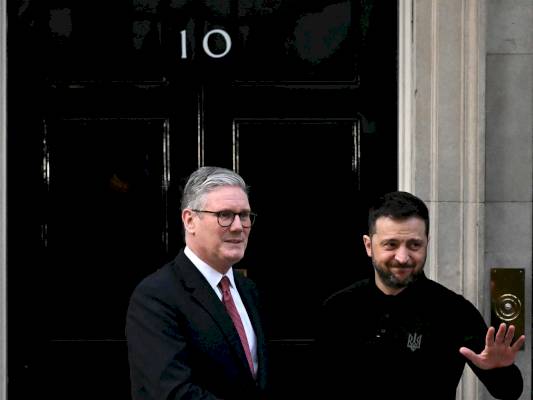
Mr. Starmer gave Mr. Zelensky a warm hug as he arrived at the summit in London. On Sunday morning, Mr. Starmer told the BBC that he had spoken to President Trump by phone a day earlier.
“I’m clear in my mind he does want lasting peace, he does want an end to the fighting in Ukraine,” said Mr. Starmer.
The prime minister said that he, Mr. Zelensky and President Emmanuel Macron of France had agreed they “would work on a plan for stopping the fighting and then discuss that plan with the U.S.” Any peace agreement “is going to need a U.S. backstop,” Mr. Starmer added, saying that British and U.S. teams were discussing the idea.
The angry exchange in the Oval Office on Friday was the latest sign that Mr. Trump was pivoting American foreign policy away from traditional allies like Ukraine and Europe. It also illustrated the seriousness of his plans to quickly end the war in Ukraine, which could result in a deal that empowers Russia.
Sunday’s summit, arranged by Mr. Starmer, was originally set up to inform other European leaders about his own meeting with Mr. Trump in Washington on Thursday. But it gained new importance after Mr. Zelensky’s Oval Office meeting, making the goals of supporting Ukraine and beefing up their defenses more critical than ever. Since Friday, European leaders have lined up behind Ukraine and lauded its embattled president.
Mr. Zelensky is also set to meet King Charles III later on Sunday.
Here’s what else to know:
British loan: Britain on Saturday announced a nearly $3 billion loan to Ukraine aimed at bolstering the war-torn country’s military capability. It will be paid back using profits generated on sanctioned Russian sovereign assets, and the first tranche of funding is expected to be disbursed to Ukraine next week, Britain’s Treasury said.
Judge’s order: A federal judge in Washington on Saturday blocked the Trump administration from ousting the top official at a federal watchdog agency, saying that its efforts to do so were unlawful. The judge’s order will allow the official, Hampton Dellinger, to remain the head of the Office of Special Counsel, which protects federal whistle-blowers. Read more ›
More troops on the border: The Pentagon is sending about 3,000 additional troops to the southwestern border, rushing to comply with Mr. Trump’s order to increase the military’s role in stemming the flow of migrants into the United States. The reinforcements announced on Saturday would bring the total number of active-duty troops on the border to about 9,000, Defense Department officials said. Read more ›
Park protests: Hundreds of people gathered on Saturday at national parks from California to Maine to protest the Trump administration’s firing of at least 1,000 National Park Service employees last month. Read more ›
Yan Zhuang contributed reporting.
House Speaker Mike Johnson, Republican of Louisiana, appeared to defend the conduct of President Trump and Vice President JD Vance during the Oval Office meeting on Friday, saying that President Volodymyr Zelensky of Ukraine “acted so inappropriately” and should have “shown more gratitude.”
“For him to act as he did was rather shocking to everyone,” Johnson said of Zelensky, speaking to CNN’s Dana Bash. “Instead of showing gratitude, he interrupted and berated his hosts at a very perilous time for his country.”
Prime Minister Keir Starmer of Britain gave President Volodymyr Zelensky of Ukraine a warm hug as he arrived at the summit meeting in London. The two men spoke intently as they posed for photographers. Starmer met Zelensky on Saturday and has been on the phone with him and President Trump a number of times since the two had their acrimonious meeting in the Oval Office.
The Kremlin’s spokesman, Dmitri S. Peskov, praised the Trump administration for changing its foreign policy in ways that “couldn’t have been imagined,” on the war in Ukraine.
“The new administration is fast changing all foreign policy configurations,” Peskov said, speaking to Russian state television in comments recorded last Wednesday and released on Sunday. He added: “This coincides with our vision in many ways.”
It’s almost a full house for the summit of European leaders in London to discuss the war in Ukraine. Chancellor Olaf Scholz of Germany and Prime Minister Justin Trudeau of Canada just arrived, as did Ursula von der Leyen, the president of the European Commission, and Mark Rutte, the secretary general of NATO. Turkey sent its foreign minister, Hakan Fidan.
Prime Minister Keir Starmer of Britain held a phone call with the leaders of Estonia, Latvia and Lithuania – three countries that were not invited to attend Sunday’s summit – in which he welcomed their support for Ukraine, Starmer’s office said in a statement. “The Prime Minister updated them on his discussions with the leaders of Ukraine, France and the United States in recent days,” the statement said.
Prime Minister Keir Starmer of Britain hosted Prime Minister Giorgia Meloni of Italy at 10 Downing Street prior to the meeting of European leaders in London to discuss Ukraine. Speaking in Downing Street, Meloni said that in a “precious moment,” it is “very important to talk to each other, to coordinate.”
President Emmanuel Macron of France has arrived for the summit meeting of European leaders taking place in London.
Sergey Lavrov, Russia’s foreign minister, said that Macron and Prime Minister Keir Starmer of Britain were “impertinent” in proposing thousands of peacekeeping troops for Ukraine. “No one is asking us,” Lavrov said in an interview with Krasnaya Zvezda, the Russian state news agency Tass reported on Sunday. Lavrov praised President Trump for “behaving correctly,” according to the report.
Prime Minister Keir Starmer of Britain and President Volodymyr Zelensky of Ukraine on Saturday in London.Credit…Toby Melville/Reuters
European leaders scrambled on Sunday to salvage Ukraine’s relationship with the United States, after a bitter rupture last week between President Volodymyr Zelensky and President Trump. They pledged to assemble a European “coalition of the willing” to develop a plan for ending Ukraine’s war with Russia, which they hope could win the backing of a skeptical Mr. Trump.
Gathering in London at the invitation of Prime Minister Keir Starmer of Britain, the leaders vowed to bolster support for Ukraine. But they also expressed hope that Mr. Zelensky and Mr. Trump could repair their breach, underscoring Europe’s reluctance to cast off a trans-Atlantic alliance that has kept the peace for 80 years.
“We have to bridge this,” Mr. Starmer said on Sunday to the BBC before the leaders began arriving at Lancaster House, near Buckingham Palace. “We have to find a way where we can all work together.”
Mr. Starmer said he believed that despite Mr. Trump’s anger toward Mr. Zelensky in the Oval Office on Friday, the president was committed to a lasting peace agreement between Ukraine and Russia. He said Britain and France, working with other European countries, would develop their own plan with Mr. Zelensky.
Details of the plan were sketchy, but Mr. Starmer suggested that the Europeans could use it as a basis to persuade Mr. Trump to commit to American security guarantees. Britain and France have already pledged to contribute troops to a peacekeeping force and are trying to enlist other countries across Europe.
“I think we’ve got a step in the right direction,” Mr. Starmer said, though he added that “this is a moment of real fragility in Europe.”
Image
Mr. Starmer said he believed that despite President Trump’s anger toward Mr. Zelensky in the Oval Office on Friday, he was committed to a lasting peace agreement between Ukraine and Russia.Credit…Doug Mills/The New York Times
His comments captured the dilemma confronting Europe two weeks after Mr. Trump’s surprise overture to President Vladimir V. Putin of Russia. Neither Europe nor Ukraine currently have seats at the table in a potential Trump-brokered peace deal. Nor has Mr. Trump agreed to give security assurances to prevent Russia from launching another invasion of its neighbor.
Mr. Trump’s acrimonious exchange with Mr. Zelensky deepened the trans-Atlantic divide. “Nobody wants to see that,” said Mr. Starmer, who had his own, much smoother meeting with Mr. Trump a day earlier.
The prime minister has tried to mediate between Mr. Zelensky and Mr. Trump. Speaking to both men by phone after their clash, he floated the idea of Mr. Zelensky returning to the White House on Friday evening to mend fences with the president, according to a senior British official.
Both leaders demurred, saying it would be better to let tempers cool and the air to clear, according to the official, who spoke on the condition of anonymity because of the sensitivity of the issue. Still, Mr. Zelensky himself has also expressed a belief that his rift with Mr. Trump was not irreparable.
On Sunday in London, Europe wrapped Mr. Zelensky in a warm embrace. He won expressions of support from the 18 assembled leaders, including President Emmanuel Macron of France, Chancellor Olaf Scholz of Germany and Prime Minister Giorgia Meloni of Italy. After meeting them, he was scheduled to visit King Charles III at his country estate, Sandringham, northeast of London.
Yet behind the carefully choreographed show of solidarity, there was a recognition that keeping the United States on board remains critical.
“Starmer has two goals,” said Mujtaba Rahman, an analyst at the political risk consultancy Eurasia Group. “Build an offer with the Ukrainians and Europeans that keeps the U.S. positively engaged in Ukraine’s security, while simultaneously preparing for a worst-case scenario where that may not prove possible.”
Image
A Ukrainian soldier on the front line in the Dnipro region of eastern Ukraine last month.Credit…Tyler Hicks/The New York Times
That will require European countries to shoulder a much heavier burden in defending the continent’s defense. Mr. Starmer is expected to push fellow European leaders to follow Britain in bolstering its military spending.
Last week, the British government announced that its defense budget would reach 2.5 percent of gross domestic product by 2027 and 3 percent within a decade. On Saturday, after meeting Mr. Zelensky at 10 Downing Street, Mr. Starmer gave Ukraine a loan of 2.26 billion pounds (about $2.8 billion) to buy additional military hardware.
The summit meeting has thrust Mr. Starmer into an unaccustomed place for a British prime minister: at the heart of Europe during a crisis. More than eight years after the country voted to leave the European Union, the rapidly changing security landscape is driving Britain closer to the continent.
Catherine Ashton, a Briton who served as the E.U.’s high representative for foreign affairs and security policy, said Mr. Starmer’s successful meeting with Mr. Trump had reinforced his credentials as a leader for Europe.
“It is unsurprising that allies in Europe are gathering in London this weekend and equally unsurprising that the U.K. is being taken much more seriously in Brussels and capitals,” Ms. Ashton said.
And yet there are limits to Mr. Starmer’s diplomacy. He was unable to extract any security guarantees from Mr. Trump for Ukraine, despite an exaggerated show of deference to the president. That included Mr. Starmer hand-delivering an invitation for a state visit from the king, a rare second time Mr. Trump has been accorded that honor.
For Mr. Trump, the king’s invitation to Mr. Zelensky to visit him at Sandringham might take some of the shine off that gesture.
For Mr. Starmer, the crisis opens an opportunity to draw closer to Europe. He has long wanted to do that on the trade front, but has approached it gingerly because of the political sensitivities at home. The Labour Party does not want to lose its core working-class voters, many of whom favored Brexit, to the anti-immigration party, Reform U.K., which is led by Nigel Farage.
Image
Nigel Farage, the leader of the Reform U.K. party. Mr. Starmer’s Labour Party does not want to lose its core working-class voters to Mr. Farage’s anti-immigration party.Credit…Eric Lee/The New York Times
But boosting military spending is popular with Reform voters, as well as with the main opposition Conservative Party. Standing behind Ukraine and against Russian aggression also puts Mr. Farage, with his history of sympathy for Mr. Putin, in a tricky position.
Whether that will allow Mr. Starmer to reintegrate Britain’s economy and trade with that of the European Union is another question. Some analysts noted that the E.U. was in no rush to overhaul its existing trade agreement with Britain, which it views as beneficial to the Continent. Mr. Starmer’s political fortunes still depend on his government turning around Britain’s ailing economy.
“The country is in such a dire state that I don’t think Starmer will be rewarded for being an international statesman,” said Mr. Rahman, the analyst. “It’s an arguably dangerous thing for a prime minister to try to build political capital abroad when the domestic agenda isn’t moving in the direction he wants.”
Britain and the E.U. are currently negotiating a defense and security agreement, which analysts view as low-hanging fruit, compared with a revised trade deal. But even that risks becoming ensnared in horse-trading over other issues. Some European countries are seeking concessions from Britain on fishing rights and allowing young people from the E.U. to live and work in Britain.
“People realize they can no longer count on a nice Russia and a generous America, and that they have to get their act together on a number of issues, including defense and security,” said João Vale de Almeida, a former E.U. ambassador to the United States and Britain.
The shock of Mr. Trump’s recent comments about Russia and Ukraine could remove roadblocks. The British, Mr. Vale de Almeida said, are being reminded that “they are more European than American in terms of what unites them to Europe and what unites them to America.”
Yet several hectic days of diplomacy have laid bare the challenge Europe faces in achieving unity. Britain struggled even to compile a manageable guest list for this meeting. After three Baltic nations, Latvia, Estonia and Lithuania, expressed frustration at being left off the list, given their proximity to Russia, Mr. Starmer held a call with their leaders on Sunday morning, before the other leaders arrived.
Britain’s prime minister Keir Starmer told the BBC on Sunday that he had spoken to President Trump by phone after his meeting on Saturday in London with President Volodymyr Zelensky of Ukraine.
“I’m clear in my mind he does want lasting peace, he does want an end to the fighting in Ukraine,” Starmer said of Trump, adding that he, Zelensky and President Macron of France had agreed they “would work on a plan for stopping the fighting and then discuss that plan with the U.S.”
Starmer, who is hosting a meeting of European leaders on Sunday in London, said that a line would have to be agreed between Ukraine and Russia and that “European countries have to do more and provide a security guarantee,” suggesting that this would likely be a coalition of willing nations. But he added that any peace agreement “is going to need a US. backstop,” and said that British and U.S. teams were discussing that idea.
Starmer said that he trusts both Zelensky and Trump but “wouldn’t trust Putin not to come again,” with military action against Ukraine, referring to President Vladimir V. Putin of Russia. “There is no point in a deal that falls apart after a number of months,” he said.
A memorial for fallen Ukrainian soldiers and volunteer fighters in Kyiv on Saturday.Credit…Nicole Tung for The New York Times
European leaders have dealt with President Trump’s return to office by trying to keep him cooperating on Ukraine while pushing to ramp up their own defense spending so they are less reliant on an increasingly fickle America.
But Friday’s meeting in the Oval Office, in which Mr. Trump berated President Volodymyr Zelensky of Ukraine, underscored for European leaders that while they still need to try to keep the United States at the table, they also might need to come up with more concrete plans of their own — and fast.
Following the heated exchange, a visibly annoyed Mr. Trump canceled a news conference with the Ukrainian leader and posted on social media that Mr. Zelensky was “not ready for peace” so long as he has American backing.
His anger — and his threat that the United States could stop supporting Ukraine if it did not accept any U.S.-brokered peace deal — was just the latest sign that Mr. Trump was pivoting American foreign policy away from traditional allies in Europe and toward Russia.
The stark shift in American strategy has left the continent’s leaders reeling. Many worry that if the war ends with a weak deal for Ukraine, it would embolden Russia, making it a greater threat to the rest of Europe. And the change in tone makes achieving greater self-reliance more urgent than ever, even if the European leaders face the same daunting challenges as before.
It would take years to build the weapons systems and capabilities that Europe would need to be truly independent militarily. And supporting Ukraine while building homegrown defenses could take the type of rapid action and united political will that the European Union often struggles to achieve.
“Everything relies on Europe today: The question is, how do they step up?” said Alexandra de Hoop Scheffer, acting president of the German Marshall Fund. “They have no alternative.”
Image
Members of Ukraine’s 148th Separate Artillery Zhytomyr Brigade preparing to fire at Russian targets in the Dnipro region last month.Credit…Tyler Hicks/The New York Times
European leaders had already been debating how they could help guarantee security in Ukraine if a peace deal were struck, what terms they would find acceptable, and what they might give Ukraine in their next aid package.
In fact, top officials are poised to meet this week to discuss defense, first in London on Sunday at a gathering organized by Keir Starmer, the British prime minister, then in Brussels on Thursday at a special summit of the European Council, which brings together E.U. leaders.
Representatives from the bloc’s 27 member countries met on Friday afternoon to come up with a draft of ideas for the meeting in Brussels. The plan included calls to beef up E.U. defenses faster than previously expected, and to more clearly define possible security guarantees for Ukraine, according to an E.U. official briefed on the matter.
And that was before Friday’s exchange between Mr. Trump and Mr. Zelensky.
The flare-up spurred an immediate outpouring of outrage and public support for Ukraine from many European officials.
“The scene at the White House yesterday took my breath away,” Germany’s president, Frank-Walter Steinmeier, told D.P.A., a German news agency, on Saturday. “I would never have believed that we would ever have to defend Ukraine from the United States.”
It also prompted calls for fast action, with some European diplomats and leaders hoping that even countries that have been reluctant to increase spending on defense and support for Ukraine will now get on board with a more ambitious approach.
“A powerful Europe, we need it more than ever,” President Emmanuel Macron of France posted on social media. “The surge is now.”
Image
President Volodymyr Zelensky of Ukraine and President Trump in the Oval Office on Friday, where Mr. Trump and his vice president berated the Ukrainian leader.Credit…Doug Mills/The New York Times
Kaja Kallas, the E.U.’s top diplomat, was even more emphatic.
“We will step up our support to Ukraine,” she wrote on social media on Friday night. “Today, it became clear that the free world needs a new leader. It’s up to us, Europeans, to take this challenge.”
Yet for all of the bracing pronouncements, speeding up Europe’s transition to greater autonomy on defense will be no easy task.
For starters, shouldering a greater part of the financial burden for aiding Ukraine is likely to be expensive. The United States alone has spent about $114 billion on military, financial and humanitarian aid for Ukraine over the past three years, according to one frequently used tracker, compared to Europe’s $132 billion.
Plus, when it comes to European defense more broadly, America provides critical weapons systems and other military equipment that would be near impossible to replace quickly.
“We still do need the U.S.,” said Jeromin Zettelmeyer, director of the Brussels-based research group Bruegel.
E.U. nations have been increasing their military spending in recent years — spending 30 percent more last year than in 2021. But some NATO countries are still short of the goal of members’ spending 2 percent or more of their gross domestic product on defense.
Part of the problem is that spending more on defense typically means spending less on other priorities, like health care and social services. And given economic challenges and budgetary limitations in Germany, France and smaller economies like Belgium, finding the political will to rapidly ramp up outlays has sometimes been a challenge.
Image
Ursula von der Leyen, president of the European Commission, in Brussels last week. Leaders of the European Union will meet in Brussels to discuss strengthening E.U. defense and more clearly defining possible security guarantees for Ukraine.Credit…Olivier Hoslet/EPA, via Shutterstock
“Decisions on massive investments are needed with regard to our common European defense capabilities,” Annalena Baerbock, Germany’s foreign minister, said on Saturday, calling for such action this week.
When it comes to finding more money to support Ukraine, Europeans are not speaking with one voice.
European officials had already been discussing a future aid package for Ukraine, one that could total tens of billions of euros. By Friday night, countries that have been pushing for more ambitious sums were hoping that Mr. Trump’s tone during the Zelensky meeting would help to prod European laggards to open their pocketbooks, according to one diplomat familiar with discussions.
But Hungary is expected to oppose the new aid package for Ukraine, which could force the E.U. to cobble together contributions from member states, rather than passing a package at the level of the bloc, since the latter would require unanimity.
In a clear sign of the disunity, Viktor Orban, Hungary’s prime minister, stood apart from many other European leaders, thanking Mr. Trump for his exchange with Mr. Zelensky. He wrote on social media that the American leader “stood bravely for peace” even if “it was difficult for many to digest.”
European officials have also been considering whether, when and how to put European peacekeeping forces on the ground in Ukraine if a deal is reached to stop the war. Britain has expressed a willingness to send troops to Ukraine, as has France. Discussions on that are expected to continue this week.
But in light of Friday’s exchange, some say the time for slow-moving deliberation may be over. While officials had just begun to talk about what security guarantees for Ukraine might look like, they may need to begin to quickly think about how to implement them, said Ms. de Hoop Scheffer at the German Marshall Fund.
“This is a time for Europe to very, very seriously step up,” she said.
Image
A funeral for a Ukrainian soldier who died in August and was recently repatriated to Ukraine in an exchange with Russia, in Kyiv on Saturday.Credit…Nicole Tung for The New York Times
She added that the Oval Office blowup had underscored that European officials will need to put forward their best mediators to try to keep the United States on board, to the extent possible.
Giorgia Meloni, the Italian prime minister, is seen as one of the closest leaders to Mr. Trump in Europe. She said in a statement on Friday night that she would try to push for a meeting among all of the allies.
“It is necessary to have an immediate summit between the United States, European states and allies to talk frankly about how we intend to face today’s great challenges,” she said. “Starting with Ukraine.”
And earlier last week, both Mr. Starmer and Mr. Macron traveled to Washington to meet with Mr. Trump, gatherings that seemed to go considerably better than the meeting with Mr. Zelensky — even if they failed to achieve major goals like getting a U.S. security “backstop” for peacekeeping troops.
In fact, Mr. Starmer’s plans to debrief European leaders on his trip during the Sunday summit highlighted one side effect of the shift in America’s tone: European Union countries and Britain are coming closer together as they draw up defense plans.
That puts Mr. Starmer in a position to play more of a leadership role in dealings with the United States, as Germany works to put together a new government and the French struggle with domestic political challenges.
Given how necessary U.S. support remains, European leaders are likely to strategize about how to keep Mr. Trump engaged as they talk this week. Already, Mr. Zelensky posted messages thankful for American support on social media.
On Sunday, before his trip to London, Donald Tusk, Poland’s prime minister, said officials were talking about the need to have the “closest possible alliance with the United States.”
But as Europe increasingly recognizes that the United States is “super unreliable,” as Mr. Zettelmeyer at Bruegel put it, the time for simply hoping for continuity in relations may be past.
“We’ve had several of these shocking moments — every time there’s a shocking moment, there’s a lot of hand wringing,” he said. “The really interesting question is: Is this time going to be different?”
President Trump leaving the White House on Friday.Credit…Eric Lee/The New York Times
A federal judge in Washington on Saturday blocked President Trump from ousting the leader of a federal watchdog agency, saying that the effort to remove the official without due cause had violated the law.
In an order on Saturday evening, Judge Amy Berman Jackson granted a permanent injunction against the government, allowing Hampton Dellinger to remain the head of the Office of Special Counsel, which protects federal whistle-blowers.
The order required the Trump administration to recognize Mr. Dellinger’s authority in that position, barring it from taking any action to “treat him in any way as if he has been removed” or otherwise interfere with his work.
The administration immediately moved to challenge the ruling, starting an appeals process that appeared likely to end at the Supreme Court.
In a 67-page opinion explaining the order, Judge Jackson, of the U.S. District Court for the District of Columbia, stressed the unique responsibilities Congress gave the office when it was created under a 1978 law. She noted its central role in protecting whistle-blowers in the federal government, a role that she said would be compromised if Mr. Dellinger were allowed to be removed without a cause stipulated under the law.
“It is his independence that qualifies him to watch over the time-tested structure that is supposed to bar executive officials from taking federal jobs from qualified individuals and handing them out to political allies — a system that Congress found intolerable over a century ago,” she wrote. “The position would be entirely ineffective if the special counsel were to be compelled to operate with the sword of at-will removal hanging over his head.”
Mr. Dellinger was confirmed by the Senate for the role in 2024 for a five-year term.
But on Feb. 7, he received a memo from the White House notifying him that he was fired, without any explanation. Several days later, Judge Jackson issued a temporary order allowing Mr. Dellinger to stay in place while litigation continued.
During a hearing on Wednesday, lawyers representing the government argued that Mr. Dellinger’s role was comparable to that of other heads of federal agencies who are appointed by the president. They said that the office Mr. Dellinger runs has significant investigatory powers, arguing that as president, Mr. Trump should be able to ensure the office is run by a person sharing his agenda.
Mr. Dellinger’s lawyers described the job as limited in scope, with only the authority to start inquiries and no power to enforce subpoenas. But they insisted that the role, as envisioned by Congress, should come with independence and some legal protections.
Earlier this week, Mr. Dellinger said the Office of Special Counsel was investigating the president’s move to fire thousands of probationary workers. The federal Merit Systems Protection Board said that it would reinstate six workers while the watchdog agency continued to investigate.
Judge Jackson’s ruling shielding Mr. Dellinger came a week after the Supreme Court declined to lift the temporary block on his removal. Lawyers for the government argued to the court that Mr. Trump had expansive executive authority to place his preferred pick in charge of the office.
While the justices’ order declining to intervene was unsigned, some on the court suggested that they might return to the matter.
Justices Sonia Sotomayor and Ketanji Brown Jackson said that they would have rejected the Trump administration’s request for Supreme Court intervention outright. Justice Neil M. Gorsuch, joined by Justice Samuel A. Alito Jr., filed a dissent, noting that it “may not yet have ripened into an appealable order” in the eyes of the majority but that the case could soon make its way back up to the court.
A future challenge before the court could provide an early test of the justices’ appetite to restrain Mr. Trump’s executive power, but Judge Jackson’s order made clear her belief that the Office of Special Counsel should be insulated from politics.
She said that without a more substantive reason related to his performance, Mr. Dellinger could not be fired “on a whim or out of personal animus.”
“The Special Counsel’s job is to look into and expose unethical or unlawful practices directed at federal civil servants,” she wrote, “and to help ensure that whistle-blowers who disclose fraud, waste, and abuse on the part of government agencies can do so without suffering reprisals.”
“It would be ironic, to say the least,” she added, if the “special counsel himself could be chilled in his work by fear of arbitrary or partisan removal.”
Brighton Beach, Brooklyn, has the city’s highest concentration of Ukrainian Americans.Credit…Ahmed Gaber for The New York Times
Brighton Beach, a Slavic enclave in Brooklyn where Ukrainians outnumber Russians two to one, voted overwhelmingly for President Trump.
But the day after Mr. Trump dressed down President Volodymyr Zelensky of Ukraine in an explosive meeting at the White House — the latest show of Mr. Trump’s declining support for Ukraine — some Ukrainian New Yorkers were left feeling divided.
“His approach may come across a bit too aggressive,” Igor Moshchinsky, 61, said of Mr. Trump at a cafe on Brighton Beach Avenue on Saturday afternoon. But Mr. Moshchinsky, who voted for Mr. Trump, said “I don’t disagree with the content” of Mr. Trump’s criticisms of Mr. Zelensky.
The local city councilwoman, Inna Vernikov, a Republican and a Trump supporter, tried to thread a needle, writing on social media that the consequences of Friday’s meeting “could be disastrous” for both countries.
“Working together to end this war and help the people of Ukraine restore their safety and sovereignty is in the best interests of both of our countries and the world,” she said.
Image
Inna Kir, a Ukrainian immigrant who owns a lingerie shop, applauded President Trump’s attack on President Volodymyr Zelensky of Ukraine.Credit…Ahmed Gaber for The New York Times
Inna Kir, 58 who owns a lingerie shop on Brighton Beach Avenue, said she “absolutely agrees” with the tough line Mr. Trump has taken against Mr. Zelensky. She echoed Mr. Trump’s criticism that Mr. Zelensky was insufficiently grateful for American aid.
“I think he should appreciate what people do for him,” said Ms. Kir, a United States citizen who arrived three decades ago. “It’s our money.”
She added: “I have faith in Trump’s ability to bring peace. When the money is not going to flow, the war is going to be over very soon.”
Igor Kozak, 59, who is from western Ukraine, and his wife Marina Kozak, 57, who is Russian, agreed that Mr. Zelensky had been “rude” and “disrespectful.”
Not all Ukrainian New Yorkers — there are about 150,000 of them — support Mr. Trump, of course.
And in another Ukrainian pocket in the East Village of Manhattan, critics of Mr. Trump were aghast at his attack.
“I’ve never been so disgusted with the president of this country,” said Ivan Makar, 52, the principal of the Self-Reliance Saturday School of Ukrainian Studies on East Sixth Street. Mr. Makar, who lives in Westchester County north of the city, said his family had fled Ukraine seeking security. The meeting on Friday left him furious and devastated, he said.
“It was typical bully behavior, and Zelensky stood up to the bullies,” Mr. Makar said. “As a Ukrainian, I’m proud. As an American, I’m disgusted.”
Jason Birchard, 58, the owner of the Ukrainian restaurant Veselka in the East Village, stood inside the restaurant on Saturday wearing a T-shirt embossed with the tryzub, Ukraine’s national symbol.
“I’ve worn this shirt many times over the last three years, and I made sure to dig deep into the closet today and pull it out because I really want to back Zelensky,” Mr. Birchard said, as a line streamed around the block at his restaurant.
Mr. Birchard said the restaurant had seen a surge in customers amid the news.
“I’m a Ukrainian American, and I try to stay positive and optimistic,” he said. “There is the false narrative that Ukraine invaded Russia. We have to understand that Ukraine has been an independent democratic state for more than 30 years, and that we need to draw the line here.”
Image
Ilia Makarov, a computing student from Ukraine, said he was distressed that many of his neighbors in Brighton Beach support President Trump’s hard line against Ukraine.Credit…Ahmed Gaber for The New York Times
In Brooklyn, on a sunny corner off Brighton Beach Avenue, Ilia Makarov, 20, vented similar frustrations as the Q train clattered overhead.
Mr. Makarov, a computer science student who came to Brighton Beach from Ukraine five years ago, said he found it “unimaginable” that the United States might now back Russia in the war.
“Usually when you think about the U.S. it is as peacemakers,” Mr. Makarov said. “Now they support literally the terrorists.”
Image
Brighton Beach and adjacent neighborhoods are home to about 15,000 Ukrainians and 7,000 Russians.Credit…Ahmed Gaber for The New York Times
Isabelle Taft reported from New York, Stacey Solie from Joshua Tree National Park in California and Erin Trieb from Yellowstone National Park in Montana.
Protesters marching around the Roosevelt Arch, at the northern entrance to Yellowstone National Park in Gardiner, Mont., on Saturday.Credit…Erin Trieb for The New York Times
Thousands of people gathered on Saturday at national parks from California to Maine to protest the Trump administration’s firing of at least 1,000 National Park Service employees last month.
A group called Resistance Rangers — consisting of about 700 off-duty rangers, including some who were fired from the National Park Service — tried to organize protests at each of the country’s 433 national park sites on Saturday to stand up against what they see as threats to public lands, including the job cuts. By the afternoon, there were protests at at least 145 sites, according to Nick Graver, a 30-year-old graduate student who helped organize the demonstration at Joshua Tree National Park in Southern California.
Protests were held in popular spots like Yosemite in Northern California, the Grand Canyon in Arizona, Acadia in Maine, Yellowstone in the Northwest, the Gateway Arch in St. Louis and Great Falls Park in Virginia, as well as lesser-known places like Effigy Mounds National Monument in northeastern Iowa. Tensions have been particularly high at Yosemite, where employees have unfurled upside-down American flags in protest across iconic sites like Yosemite Falls and El Capitan.
Mr. Graver said his group was concerned not only about the firings but also about resource extraction on public lands and possible threats to national monuments, such as a proposal to remove the president’s power to designate national monuments.
The National Park Service said it was working with protest organizers to allow people to “safely exercise their First Amendment rights,” while protecting its resources.
Image
Joshua Tree National Park in Twentynine Palms, Calif., last week.Credit…Bridget Bennett for The New York Times
At Joshua Tree, about 400 people gathered to protest. Six rangers at the park were among those dismissed last month, part of a wave of cuts targeting federal employees who had started work within the last year, in what the Trump administration said was an effort to reduce government spending.
Deborah Anderson, who lived in the area for decades, protested with a sign that said “Protect Our Parks.”
“What’s happening right now is wrong,” said Ms. Anderson, 52. “I get if people want to make the government more efficient, but how they’re doing it — these are illegal firings.”
Up north, at Yellowstone, dozens demonstrated near the Roosevelt Arch in Gardiner, Mont., chanting “Public lands are not for sale” and “Down with DOGE,” referring to the Department of Government Efficiency, Elon Musk’s outfit overseeing the job cuts.
David Uberuaga, who worked for the National Park Service for more than 30 years, including as superintendent of Grand Canyon National Park, before retiring in 2016, urged people to take action, including by protesting and calling their representatives and senators.
“We can’t continue to just let things happen,” said Mr. Uberuaga, 74. “We have to really push back very hard, and that is effective over time. And we just can’t get disillusioned.”
About 100 people protested at the Grand Canyon. Sean Adams, a 29-year-old seasonal worker who electrofishes invasive trout and conducts conservation studies on native fish, said visitors have been surprised by the park workers’ firings.
“They didn’t realize that it was affecting people like us, people who work 10-plus-hour days consistently for way too little money,” he said. “The money that they are saving by cutting people like us is a drop in the bucket.”
Image
There were protests at at least 145 national park sites on Saturday, according to an organizer.Credit…Erin Trieb for The New York Times
Halfway across the country, at Effigy Mounds, about 150 people gathered, some with signs depicting the Lorax, the Dr. Seuss character who “speaks for the trees,” and Smokey Bear, the symbol of the U.S. Forest Service’s wildfire prevention efforts. Among the demonstrators was Brian Gibbs, 41, who was fired from his job as education technician at the monument.
For Mr. Gibbs, the forested landscape along the Mississippi River that is home to the monument holds a lot of sentimental value. He said his father took him camping there when he was a child. Later in life, Mr. Gibbs told his wife he loved her for the first time in the area. And this is where they took their 4-year-old son on his first hiking trip.
After all of his experiences at the monument, Mr. Gibbs said, it was striking to see it become a protest site.
“It was just a volcanic moment to me,” Mr. Gibbs said. Regarding the parks, he added that “it never crossed my mind that they would become a target” of a presidential administration.
Mimi Dwyer contributed reporting from Yosemite National Park and Los Angeles, and Jennifer Brown from the Gateway Arch in St. Louis.
Brian Glenn at a House subcommittee hearing in Washington in February.Credit…Al Drago/Getty Images
A voice from the press section joined the chorus of people demanding answers from President Volodymyr Zelensky of Ukraine on Friday, during a meeting with President Trump and his associates.
“Why don’t you wear a suit?” a man asked Mr. Zelensky. “You’re at the highest level in this country’s office, and you refuse to wear a suit. Just want to see if — do you own a suit?” He added, “A lot of Americans have problems with you not respecting the office.”
The questions came from Brian Glenn, a correspondent for Real America’s Voice, a right-wing cable channel that has spread conspiracy theories about noncitizen voting and helped distribute Stephen K. Bannon’s “War Room” podcast after Mr. Bannon was barred from YouTube, Spotify and other mainstream platforms.
Mr. Glenn’s outlet was selected to take a “secondary TV” role in the White House press pool alongside CNN on Friday — a position that did not exist before this week. That access was granted as the White House continued to block reporters from The Associated Press from attending, according to a schedule sent out by the White House, and as it began this week to handpick the pool reporters who cover the president in small settings, such as the Oval Office meeting with Mr. Zelensky.
Pool reporters attend the events in a rotation traditionally organized by the White House Correspondents’ Association and share their observations with other outlets not present.
Mr. Glenn’s comments about Mr. Zelensky’s appearance echoed Mr. Trump’s on Friday as the Ukrainian leader stepped out of his car at the White House. “He’s all dressed up today,” Mr. Trump told reporters, indicating Mr. Zelensky’s attire.
Since the start of the war, Mr. Zelensky has regularly donned standard-issue field uniforms as a display of solidarity with his country’s armed forces. The criticism that he didn’t wear a suit drew immediate outcry online.
Lawmakers and media critics were quick to point out that just this week, Elon Musk had appeared at a cabinet meeting wearing a T-shirt emblazoned with the words “tech support” under an overcoat. And when Mr. Musk spoke alongside Mr. Trump in the Oval Office earlier this month, he appeared to be wearing a shirt that read “Occupy Mars.”
Responding to the backlash, Mr. Glenn posted a lengthy personal statement on Saturday morning expressing “extreme empathy for the people of Ukraine” but continuing to berate Mr. Zelensky.
He suggested in the post that the olive-green military fatigues that Mr. Zelensky often wears in meetings with other world leaders signaled respect, but that the black tactical sweater bearing his country’s coat of arms did not.
“For him, once again, to enter the highest office in the most powerful nation in the world, dressed as he did, reflects his inner disrespect for not only our country, the President and the US citizens that have made it possible for Ukraine to survive as long as they have to this point,” Mr. Glenn wrote.
On Friday, Representative Marjorie Taylor Greene of Georgia, who is dating Mr. Glenn, applauded the exchange on social media.
“I’m so proud of @brianglenntv for pointing out that Zelensky has so much disrespect for America that he can’t even wear a suit in the Oval Office when he comes to beg for money from our President,” she wrote.
Dr. Francis Collins on Capitol Hill to testify at a congressional hearing in 2020 when he was the director of the National Institutes of Health.Credit…Anna Moneymaker/The New York Times
Dr. Francis S. Collins, a renowned geneticist who ran the National Institutes of Health for 12 years, announced Saturday that he has retired from the institutes and the federal government, issuing a parting statement that offered a pointed, if somewhat veiled, message to the Trump administration, which has fired hundreds of N.I.H. employees.
“As I depart N.I.H., I want to express my gratitude and love for the men and women with whom I have worked side by side for so many years,” Dr. Collins wrote. “They are individuals of extraordinary intellect and integrity, selfless and hard-working, generous and compassionate. They personify excellence in every way, and they deserve the utmost respect and support of all Americans.”
Dr. Collins, 74, served under three presidents: Barack Obama, Donald J. Trump and Joseph R. Biden Jr. He became one of the nation’s most recognizable doctors during the coronavirus pandemic, when he helped steer the development of new tests, therapeutics and vaccines.
He did not give a reason for his retirement, and he said in a text message that he “was not doing any interviews.”
His announcement comes just days before the Senate confirmation hearing, scheduled for this Wednesday, for President Trump’s nominee to be the next director of the N.I.H.: Dr. Jay Bhattacharya of Stanford University, who has expressed disdain for Dr. Collins.
Dr. Bhattacharya is one of three authors of the Great Barrington Declaration, an anti-lockdown treatise that was signed in October 2020, at the height of the coronavirus pandemic. Emails that later became public showed that Dr. Collins had called Dr. Bhattacharya and his co-authors “fringe epidemiologists.”
In an interview with Fox News at the time, Dr. Collins said he stood by his statement, adding, “Hundreds of thousands of people would have died if we had followed that strategy.” Dr. Bhattacharya later assailed Dr. Collins as one of a number of scientists who “abused their power to conduct devastating takedowns of scientists who disagreed with them.”
Dr. Collins joined the institutes in 1993, during the administration of President Bill Clinton, and gained acclaim for leading the Human Genome Project, a federal effort to map the human genome, the set of genetic instructions that defines the human organism.
He also became known for his religious views: Dr. Collins is an evangelical Christian who has publicly sought to bridge the divide between science and Christianity, including in a 2006 book, “The Language of God.” Amid the political fallout over the coronavirus pandemic, he joined a group called “Braver Angels” that sought to bridge the partisan divide, and later publicly acknowledged some Covid mistakes.
His carefully crafted statement offered a forceful defense of the N.I.H. and a lament for the days when biomedical research had strong bipartisan support.
Dr. Collins noted that when he was recruited to the institutes and through many of the years that followed, “investment in medical research was seen as a high priority and a nonpolitical bipartisan effort — saving countless lives, relieving human suffering and contributing substantially to the U.S. economy.”
“N.I.H. is the largest supporter of biomedical research in the world,” he wrote. “It is the main piston of a biomedical discovery engine that is the envy of the globe. Yet it is not a household name. It should be.”
He went on: “When you hear about patients surviving stage 4 cancer because of immunotherapy, that was based on N.I.H. research over many decades. When you hear about sickle-cell disease being cured because of CRISPR gene editing, that was built on many years of research supported by N.I.H.”
Dr. Anthony S. Fauci, a longtime colleague of Dr. Collins’s who retired at the end of 2022 as director of the National Institute of Allergy and Infectious Diseases, praised Dr. Collins on Saturday, saying he has had an ”extraordinarily positive impact” on biomedical research.
But allies of Mr. Trump and his health secretary, Robert F. Kennedy Jr., cheered Dr. Collins’s departure. Among them is Katie Miller, who served as Mr. Kennedy’s spokeswoman before Mr. Trump appointed her to the Department of Government Efficiency, the Elon Musk-led effort to overhaul the federal government.
“Francis Collins was an ineffectual leader who bent at the knee to Tony Fauci and openly mocked President Trump,” Ms. Miller wrote on social media. “@DrJBhattacharya is the right leader to move @NIH forward.”
Dr. Collins’s retirement, which took effect on Friday, comes on the heels of the departure of other high-ranking N.I.H. officials, including Dr. Lawrence A. Tabak, the longtime No. 2 official at the institutes. Dr. Tabak left last month, according to a person familiar with his decision, after being confronted with a reassignment that he viewed as unacceptable.
Dr. Collins was appointed to lead the N.I.H. by Mr. Obama, and he stepped down as director in late 2021, the first year of the Biden administration, to return to his lab. “Millions of people will never know Dr. Collins saved their lives,” Mr. Biden said at the time. “Countless researchers will aspire to follow in his footsteps.”
The additional troops are expected to help build barriers and support law-enforcement agencies.Credit…Paul Ratje for The New York Times
The Pentagon is sending about 3,000 additional troops to the southwestern border, rushing to comply with President Trump’s order to increase the military’s role in stemming the flow of migrants into the United States.
Armed infantry and support troops from the 4th Infantry Division at Fort Carson in Colorado — one of the Army’s most seasoned combat units — are expected to deploy within days, two Pentagon officials said on Saturday, after Mr. Trump’s declaration on his first day in office that U.S. military forces would confront what he called an “invasion” of migrants, drug cartels and smugglers.
Combined with 1,100 support troops from the military’s Northern Command announced on Friday, and the recently arrived headquarters personnel from the 10th Mountain Division at Fort Drum, N.Y., the reinforcements announced on Saturday would bring the total number of active-duty troops on the border to about 9,000, Defense Department officials said. The Washington Post reported the additional troop mobilization earlier.
“These forces will arrive in the coming weeks, and their deployment underscores the department’s unwavering dedication to working alongside the Department of Homeland Security to secure our southern border and maintain the sovereignty, territorial integrity and security of the United States under President Trump’s leadership,” the Pentagon said in a statement on Saturday.
This will be the second major wave of active-duty troops sent to secure the border since Mr. Trump took office on Jan. 20. About 1,600 Marines and Army soldiers arrived soon after the inauguration, joining 2,500 Army reservists called to active duty who were already there.
Dispatching large numbers of frontline combat forces indicates that Mr. Trump is breaking with past presidents’ recent practice of mostly limiting deployments along the U.S.-Mexico border to small numbers of active-duty soldiers and reservists.
So far, the active-duty troops have been helping to build barriers and support law-enforcement agencies, as have active-duty and reservist forces sent to the border in past years, including during Mr. Trump’s first term.
But Defense Secretary Pete Hegseth said on his first full official day on the job in January that “whatever is needed at the border will be provided.” He did not rule out Mr. Trump’s invoking the Insurrection Act, a more than 200-year-old law, to allow the use of armed forces for law enforcement duty.
Taking such an action would plunge the military into politically charged territory that has given congressional Democrats deep concerns.
“Our military are not trained as law enforcement officers,” Senator Elissa Slotkin, Democrat of Michigan and a former Pentagon official, said recently on ABC’s “This Week.” “But you’re coming right up to that line of logistics and support, and law enforcement.”
The deployments come even as the state of the border is fairly calm, with crossings having fallen sharply in recent months after the Biden administration took steps to limit migration.
The 4th Infantry Division is among the Pentagon’s most combat-ready units, reflecting Mr. Trump’s directive that it “prioritize the protection of the sovereignty and territorial integrity of the United States along our national borders.”
The Army in January alerted brigades from the 4th Infantry and the 82nd Airborne to prepare to deploy to the border. Each brigade has more than 3,000 soldiers, although it is unclear how many troops may actually be tapped for duty, Army officials said.
The headquarters personnel of the 10th Mountain Division, including its two-star commanding general, recently arrived in Fort Huachuca in Arizona to oversee the border operation.
Defense Department officials have left open the possibility that as many as 10,000 troops could deploy in the coming days. Marine Corps planners said they could be asked to supply 2,500 or more additional Marines.
“We are dead serious about 100% OPERATIONAL CONTROL of the southern border,” Mr. Hegseth said in a post on X on Saturday.
Along with infantry, support troops specializing in supply, logistics, security and communications have already been sent to the border, the military’s Northern Command said in January.
The first two waves of active-duty troops were selected in part because they were ready to deploy on short notice. The first 500 Marines, for instance, were on standby at their base at Camp Pendleton in California to help support the firefighting efforts in Los Angeles.
Zelenskyy is in London for high-stakes talks with European leaders following his clash at the White House with US President Donald Trump.
Video Duration 02 minutes 10 seconds
02:10
UK gives Ukraine’s Zelenskyy a warm welcome after Trump confrontation
British Prime Minister Keir Starmer is hosting European leaders, including Ukrainian President Volodymyr Zelenskyy, at a summit aimed at shoring up support for “securing a just and enduring peace” in Ukraine.
The meeting in London brings together leaders from around Europe, including France and Germany, as well as Turkiye, NATO and the European Union.
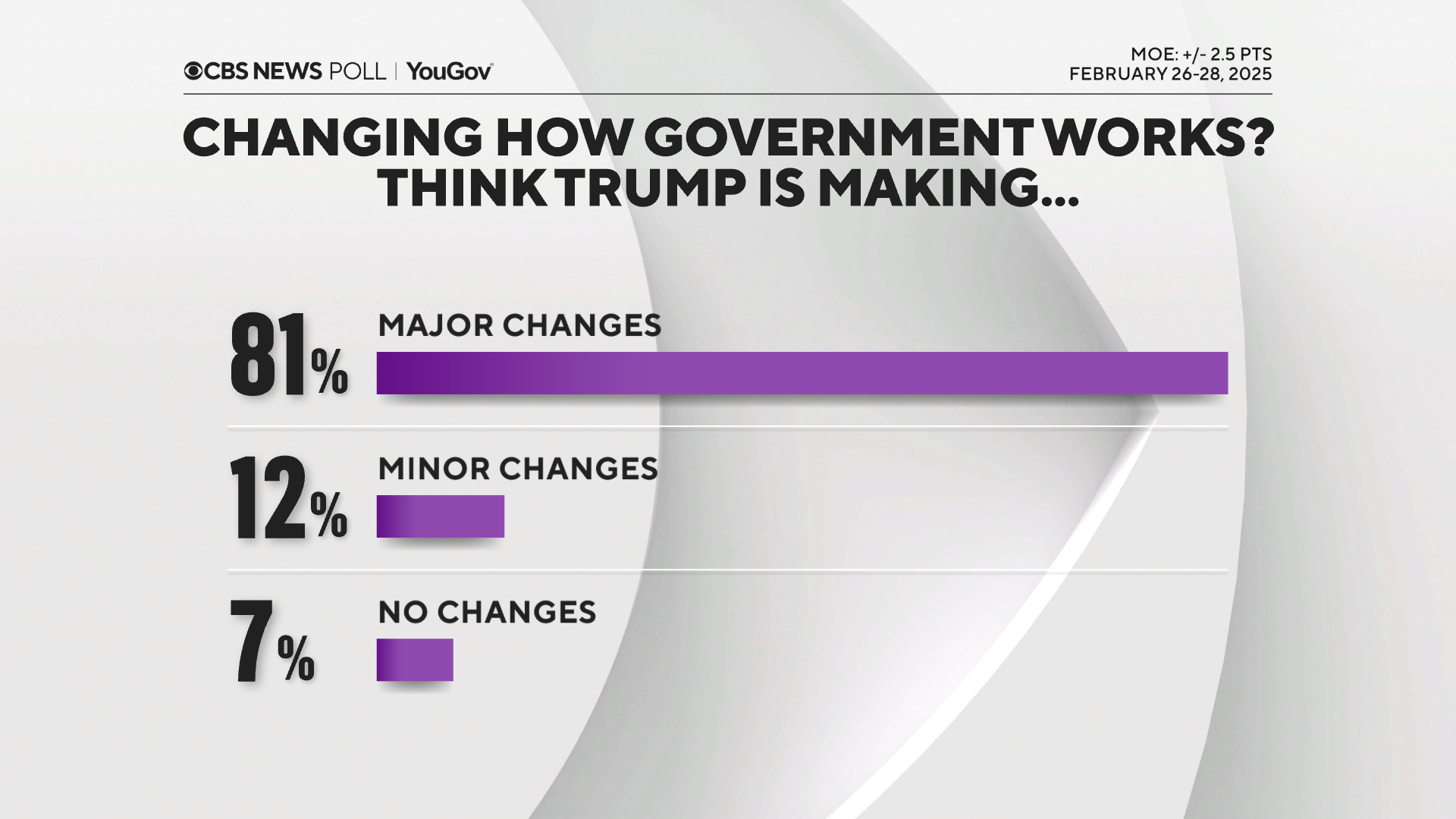
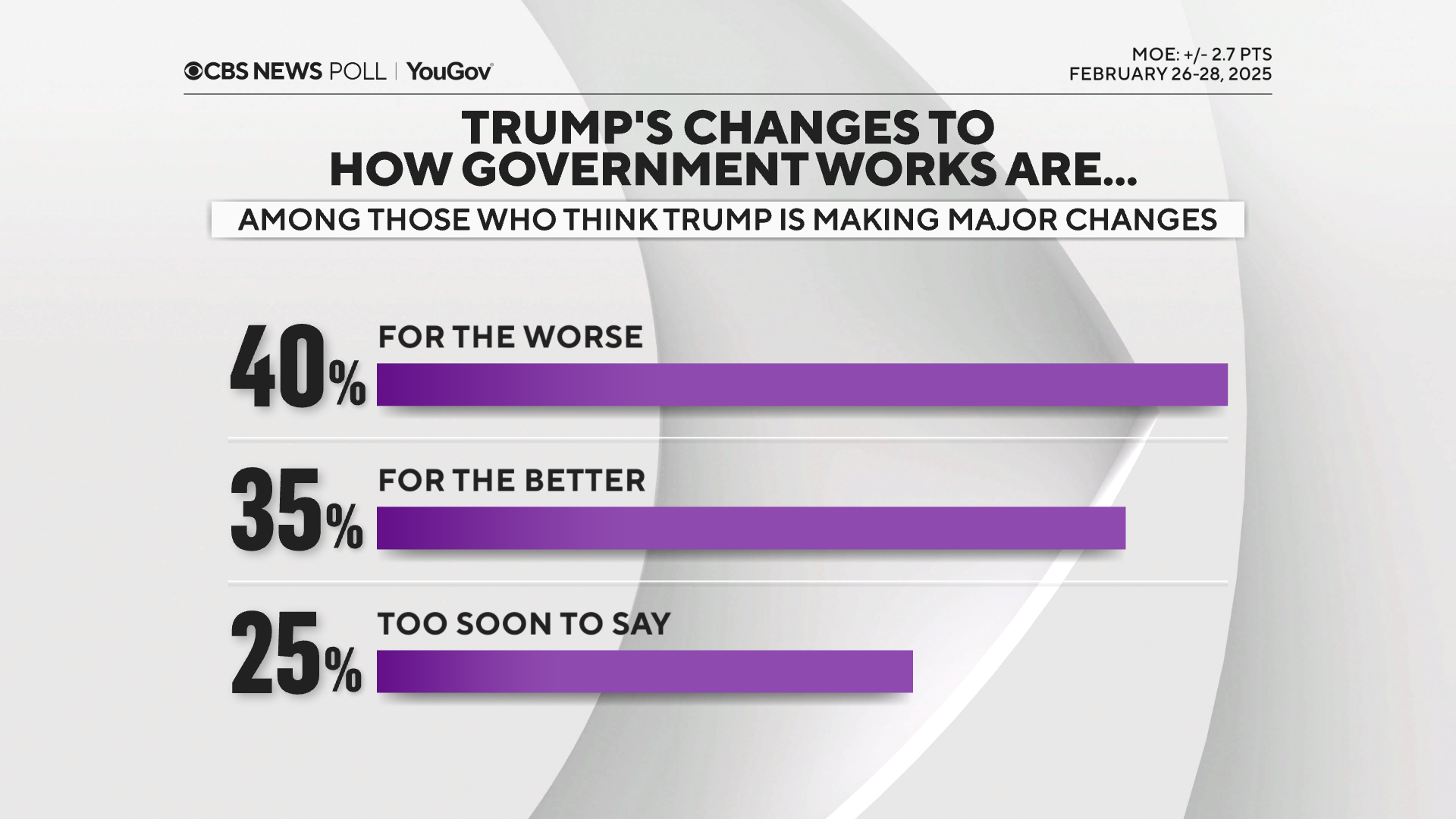
There’s at least one thing Americans widely agree on about President Donald Trump: they think he’s changing the way the government works.
But they’re more split on whether that’s for the better or worse.
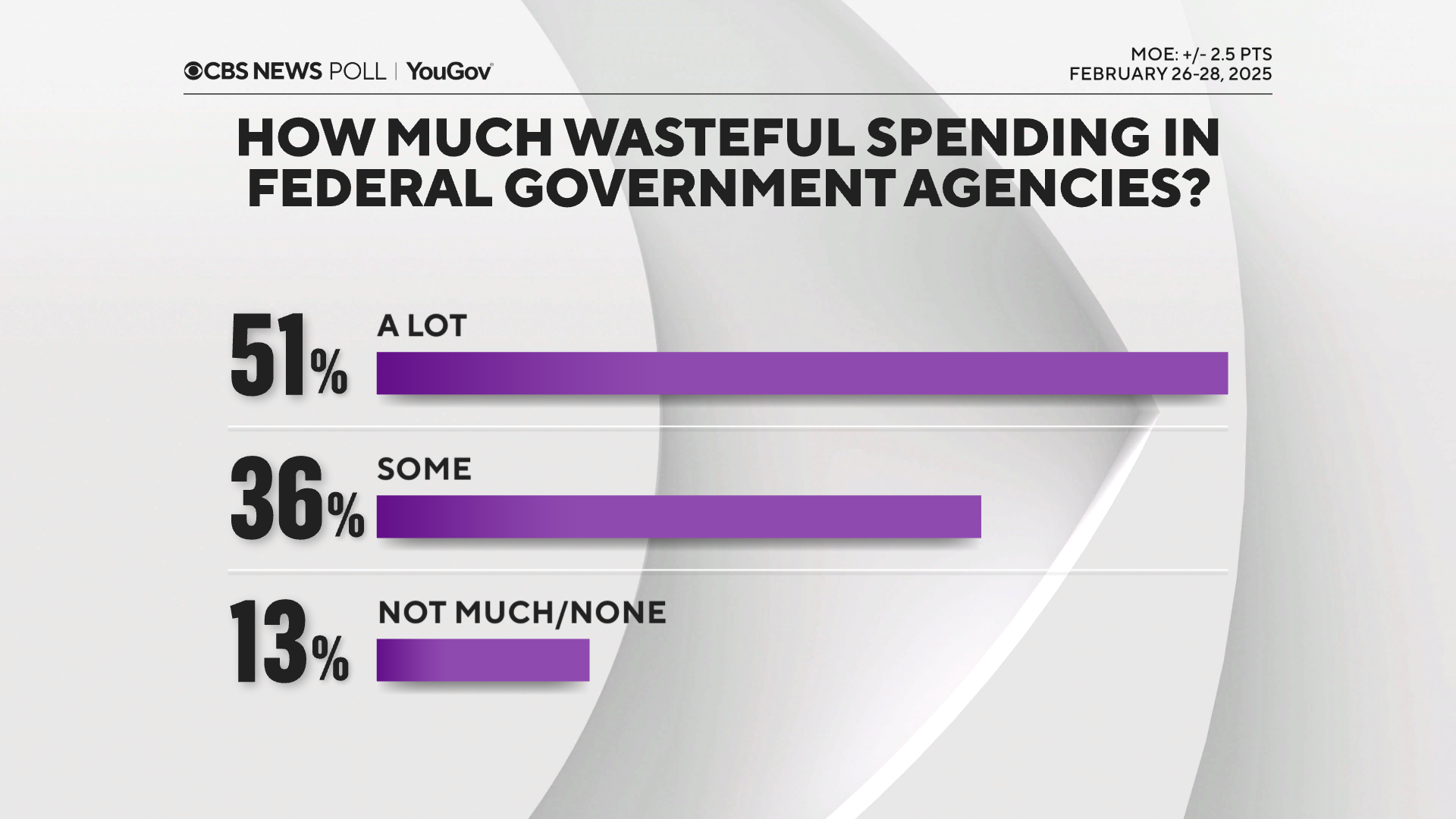
His approach to immigration and deportation continues to receive positive marks, and his border policies are seen as effective. A large majority agree there is some waste in the federal government.
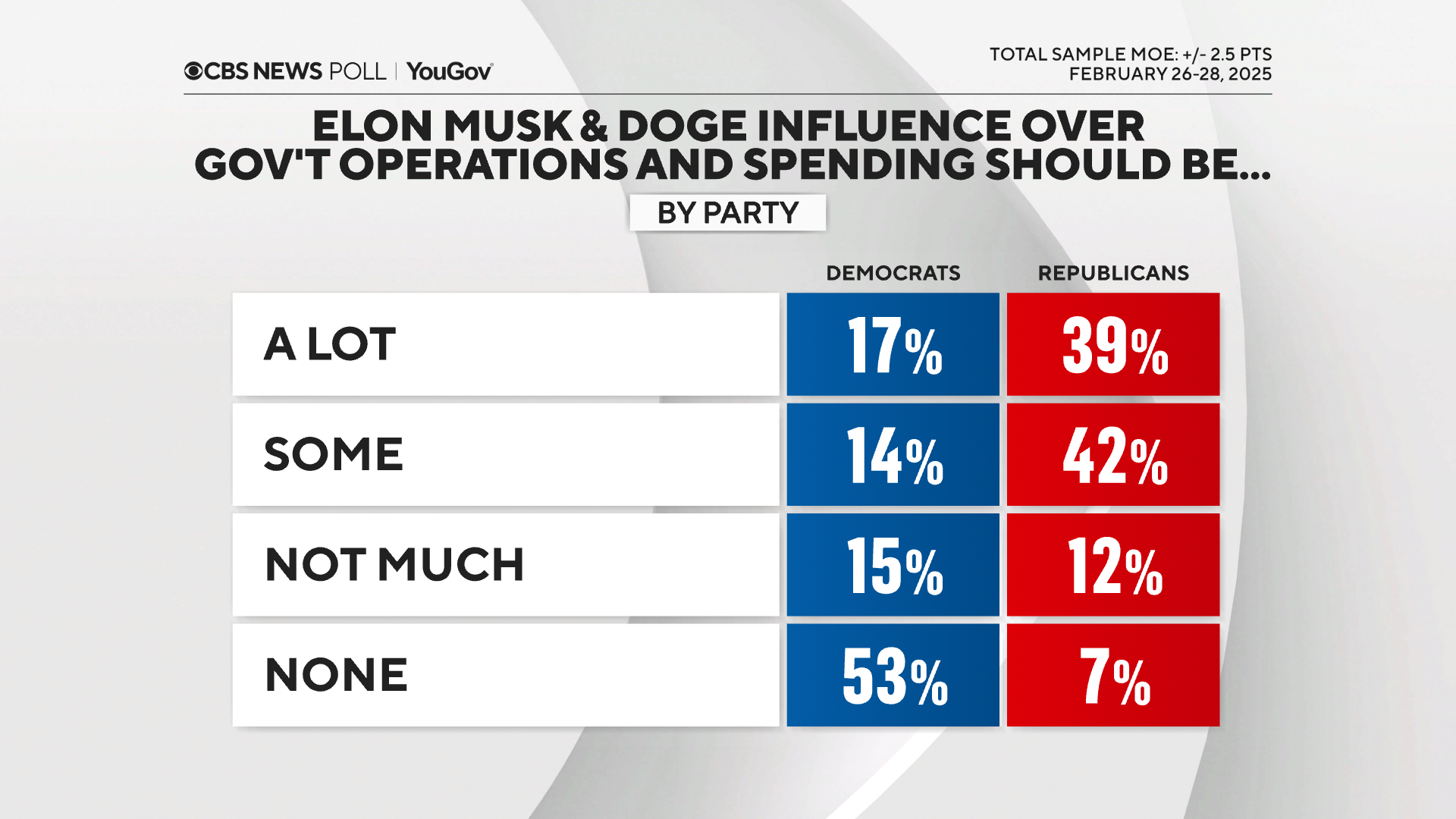
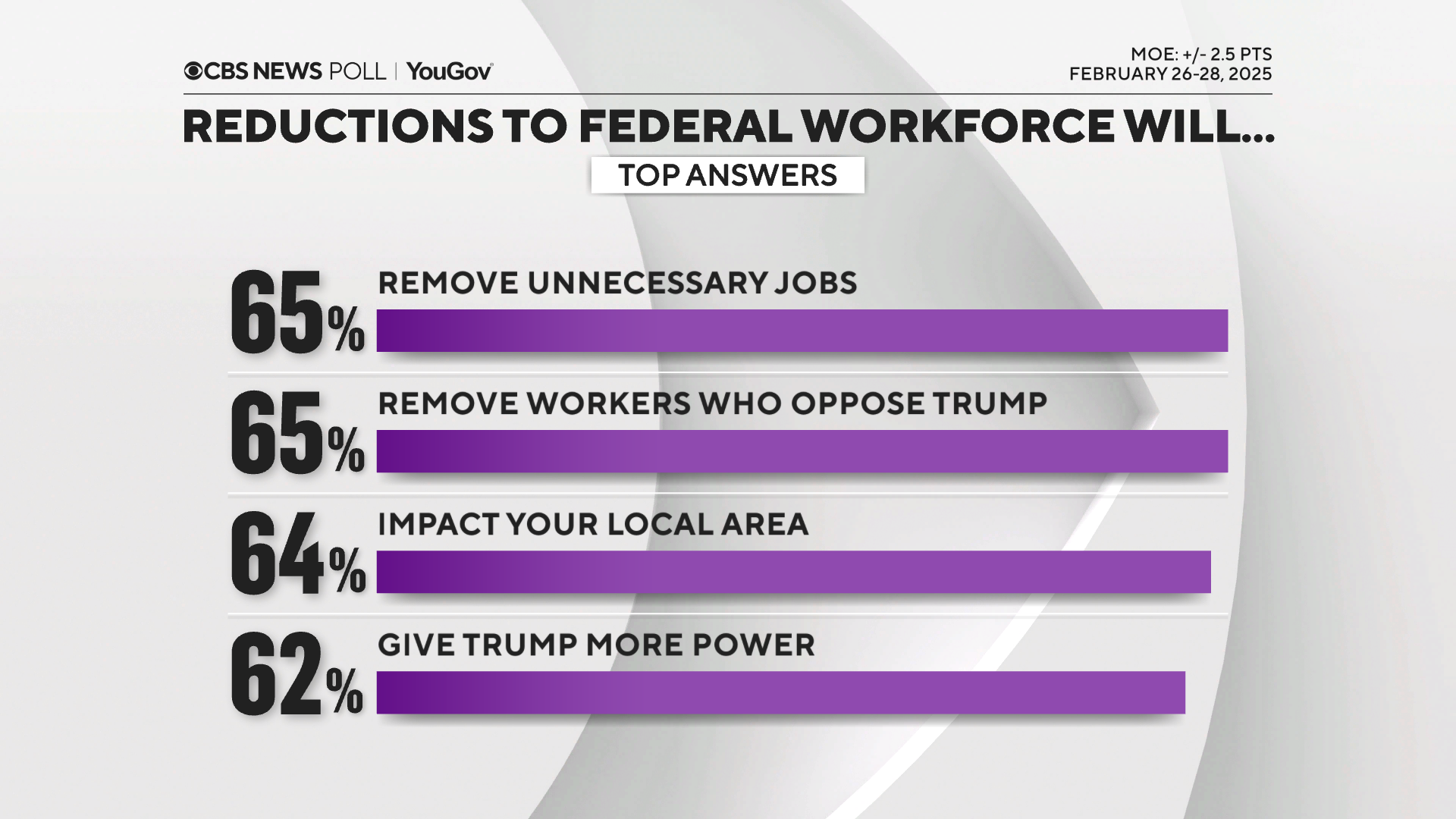
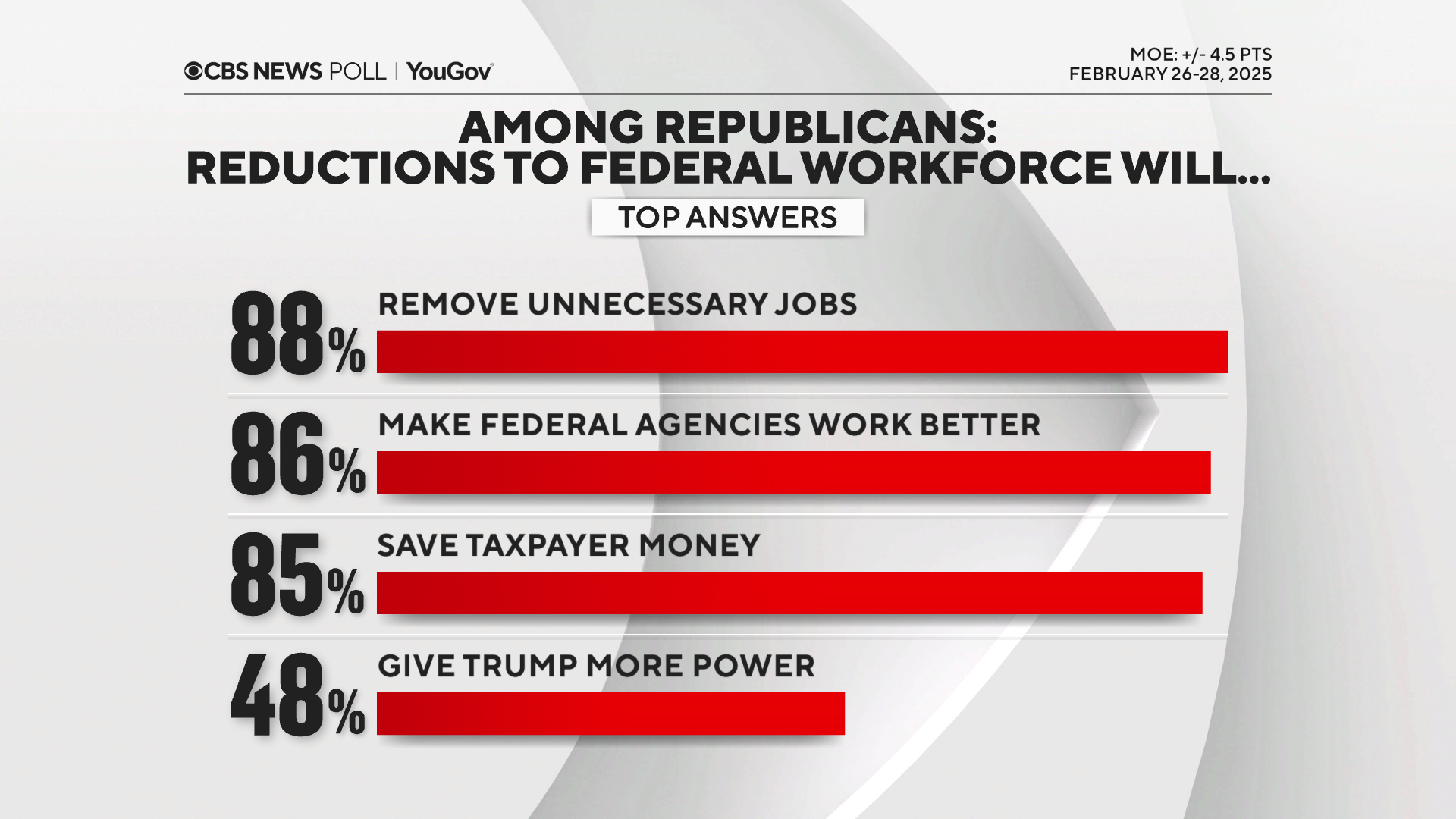
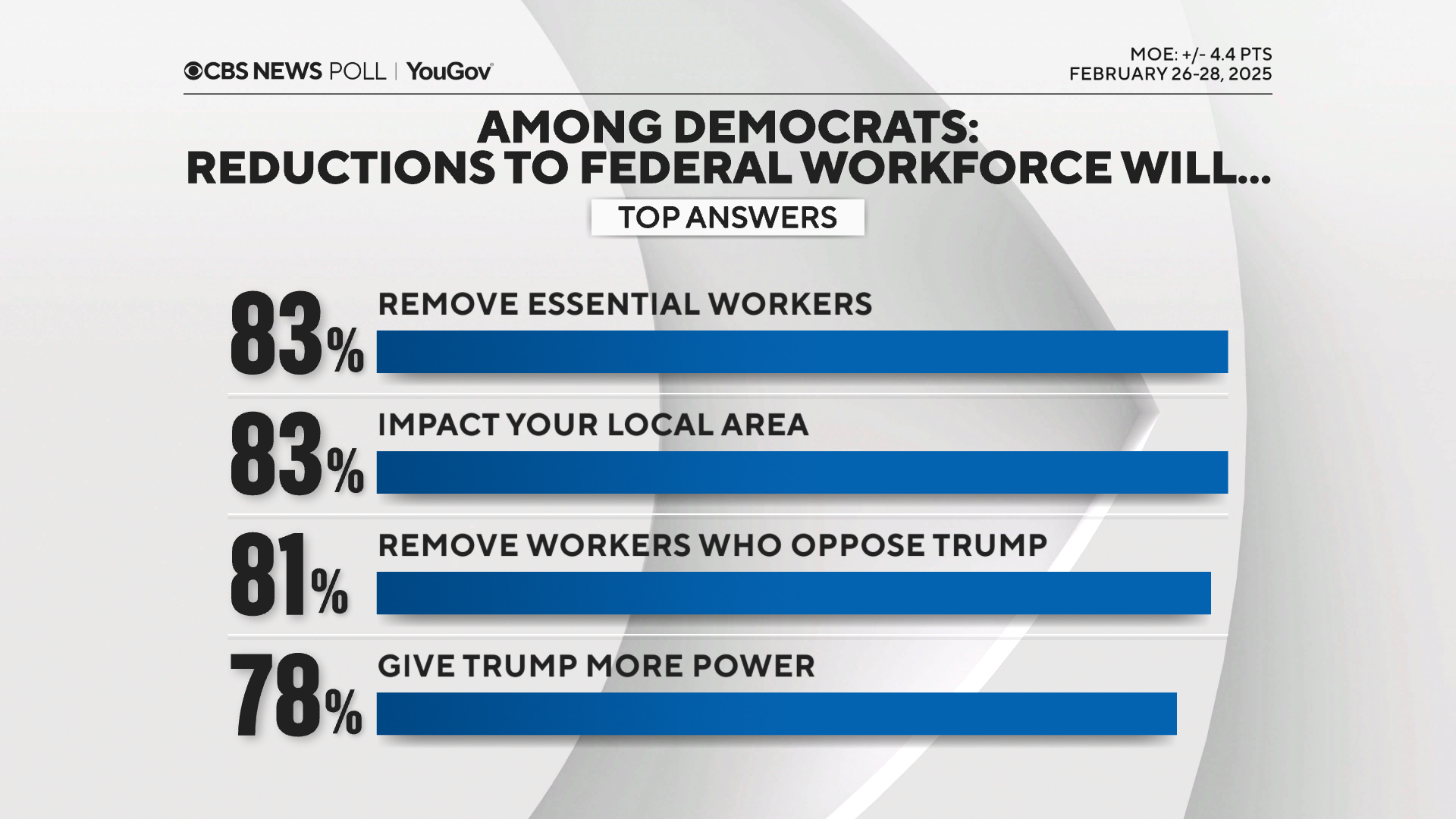
DOGE and Elon Musk’s efforts divide the nation, though, as Americans foresee an impact from dismissing federal workers. Half the country thinks this will cut their services and remove essential people. Half think it’ll save money.
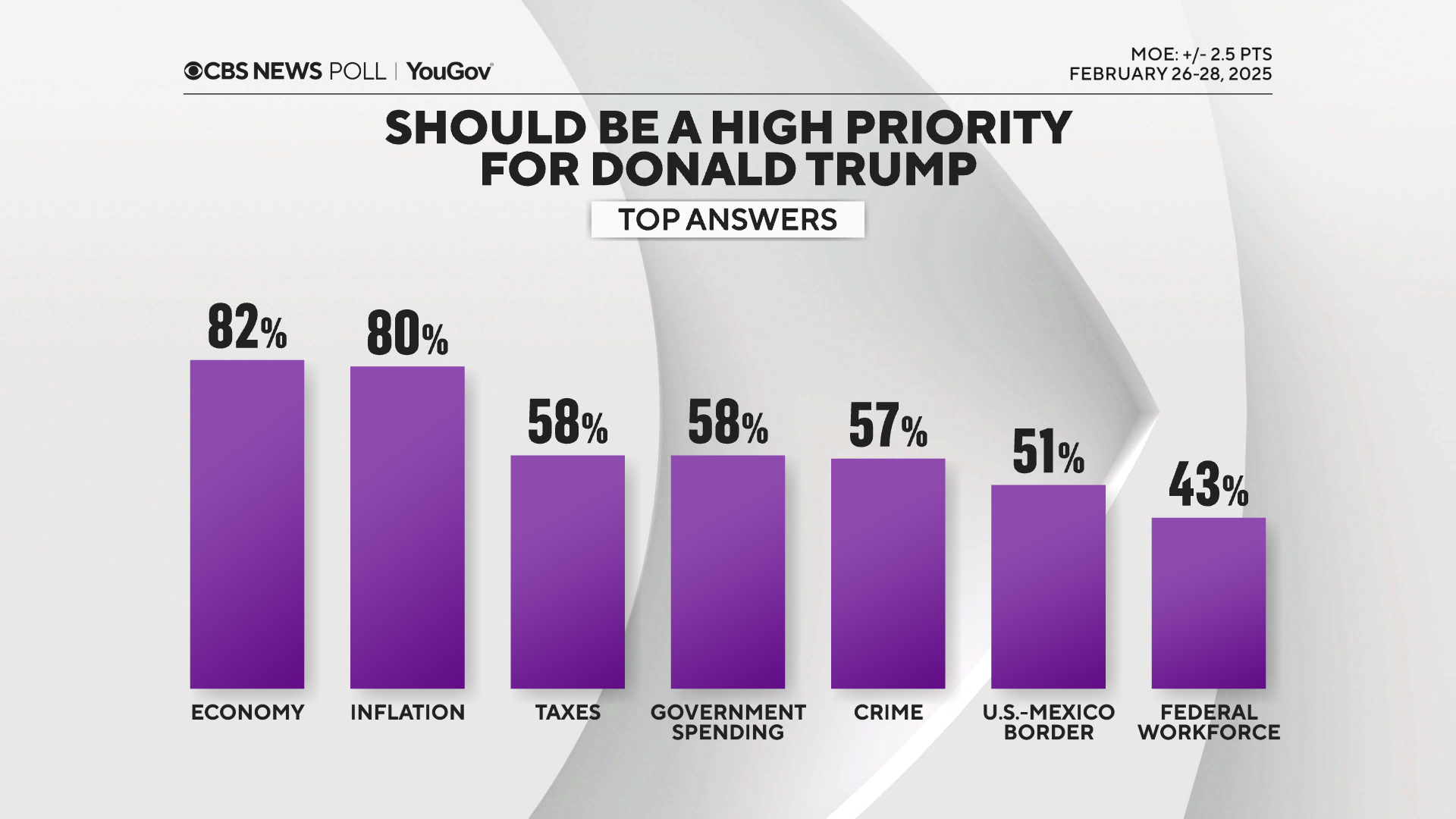
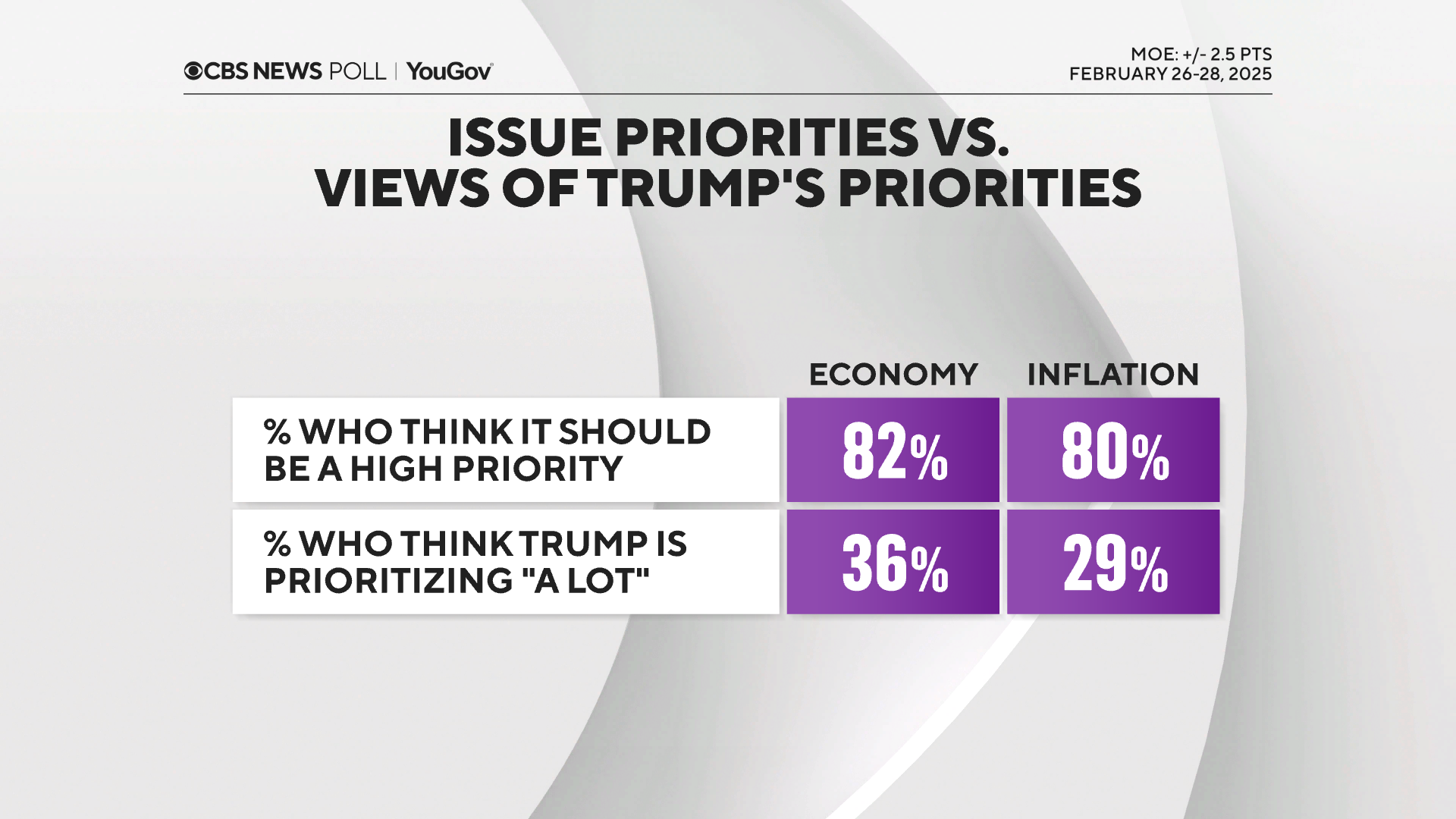
Either way, it isn’t the main issue they want Mr. Trump focused on. They overwhelmingly say he should prioritize inflation and the economy, and far fewer think he actually is.
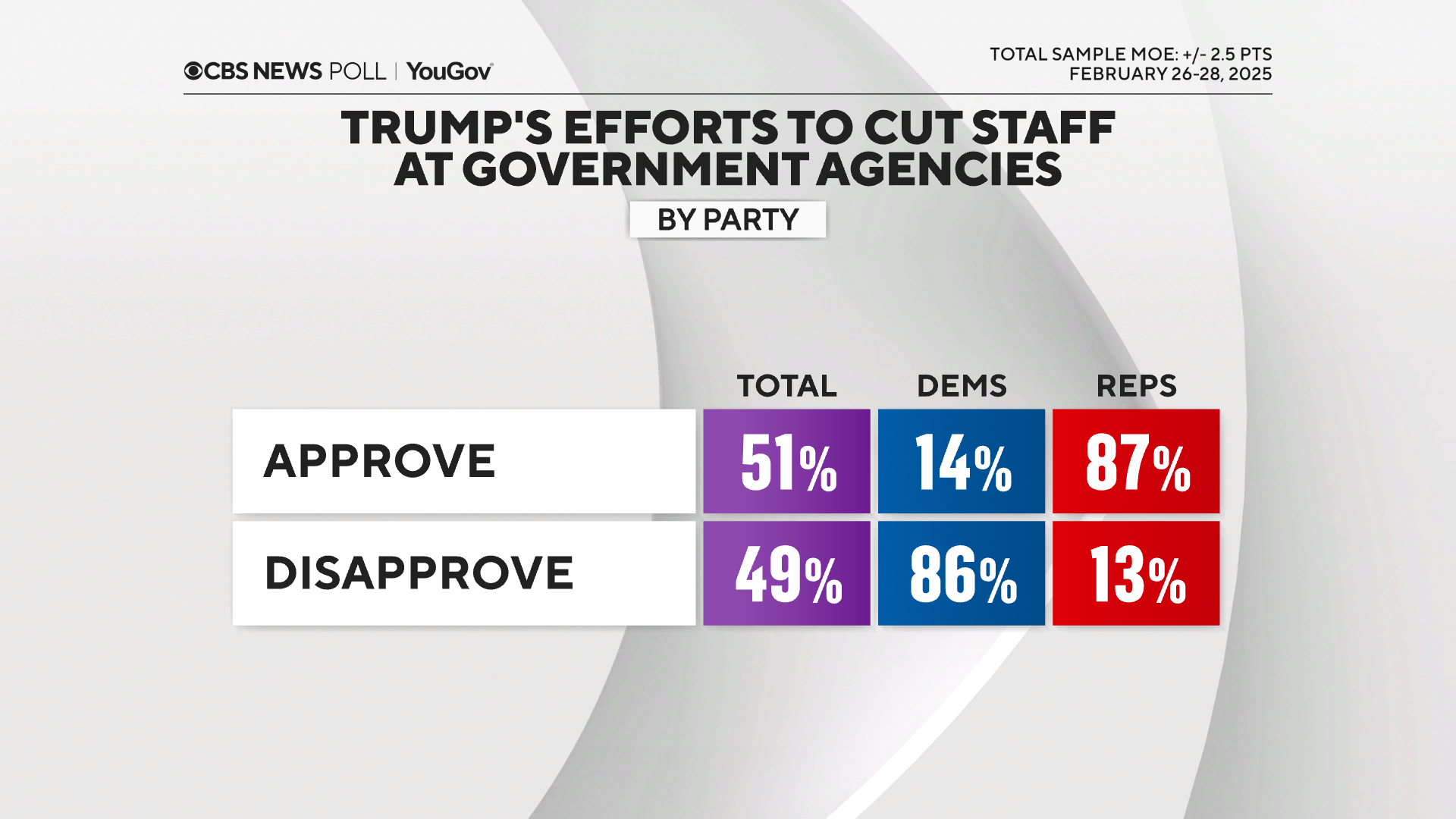
The people who think Mr. Trump is changing the government for the better — who include a lot of Republicans and people who voted for him — overwhelmingly approve of things like his policies on deportation and his efforts to reduce the federal workforce. They would specifically give Elon Musk and DOGE a lot of influence.
Those who see major changes for the worse — most Democrats and those who didn’t back him — go the other way on all of this. Most of them don’t think Musk and DOGE ought to have any influence. They see reductions in the workforce as eliminating essential workers and as having the effect of consolidating Mr. Trump’s power.
Most Americans see a wide range of potential impacts from the federal workforce reductions.
For most Republicans, these reductions will lead to efficiencies and savings.
For Democrats, it’ll remove essential workers, and they also see political impacts: removing workers who don’t support him and conferring more power on Mr. Trump.
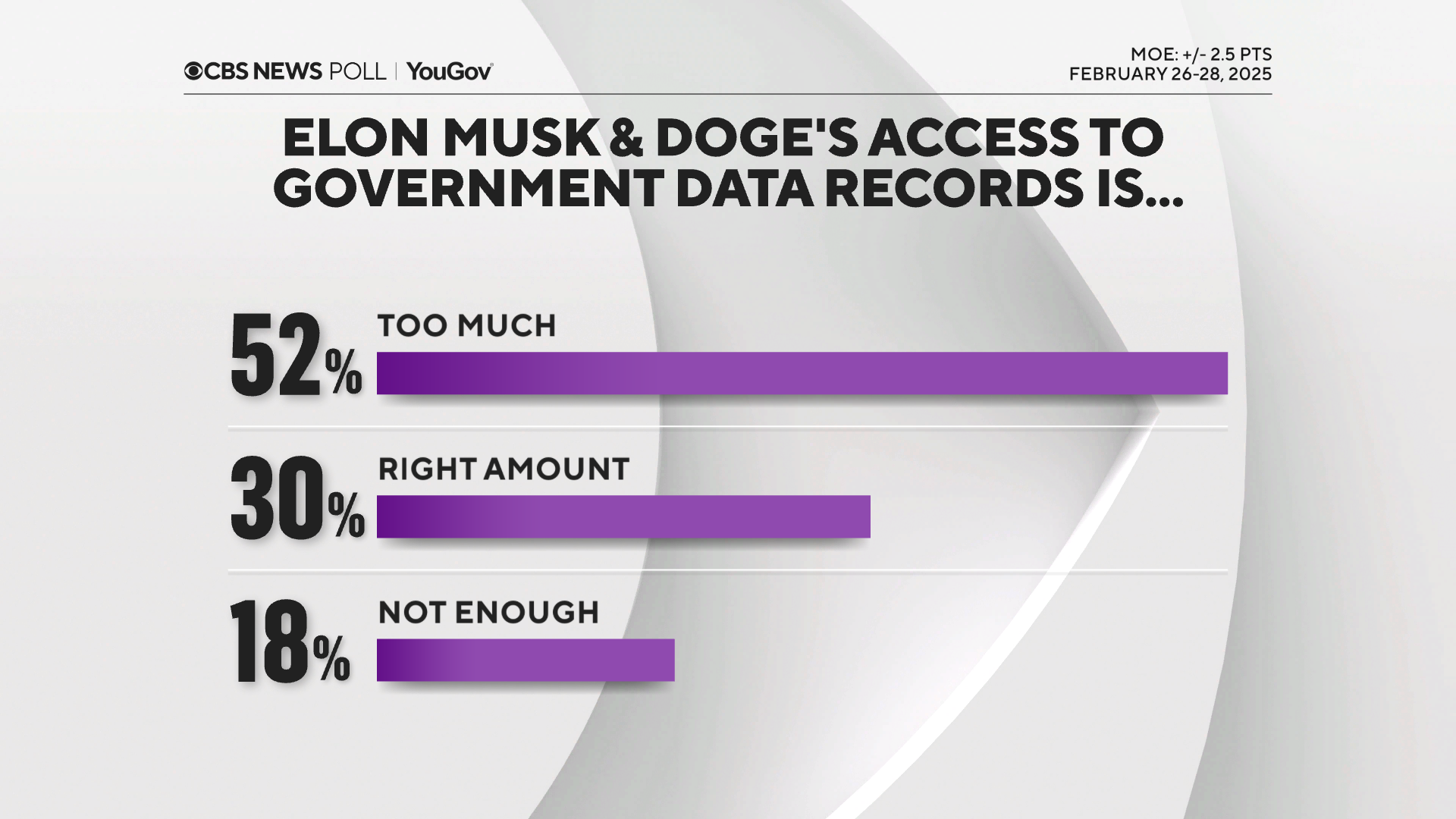
The public is on balance wary of Musk and DOGE’s access to government agency data records. Democrats and independents think he has too much access, but Republicans either say he has the right amount or would give him more.
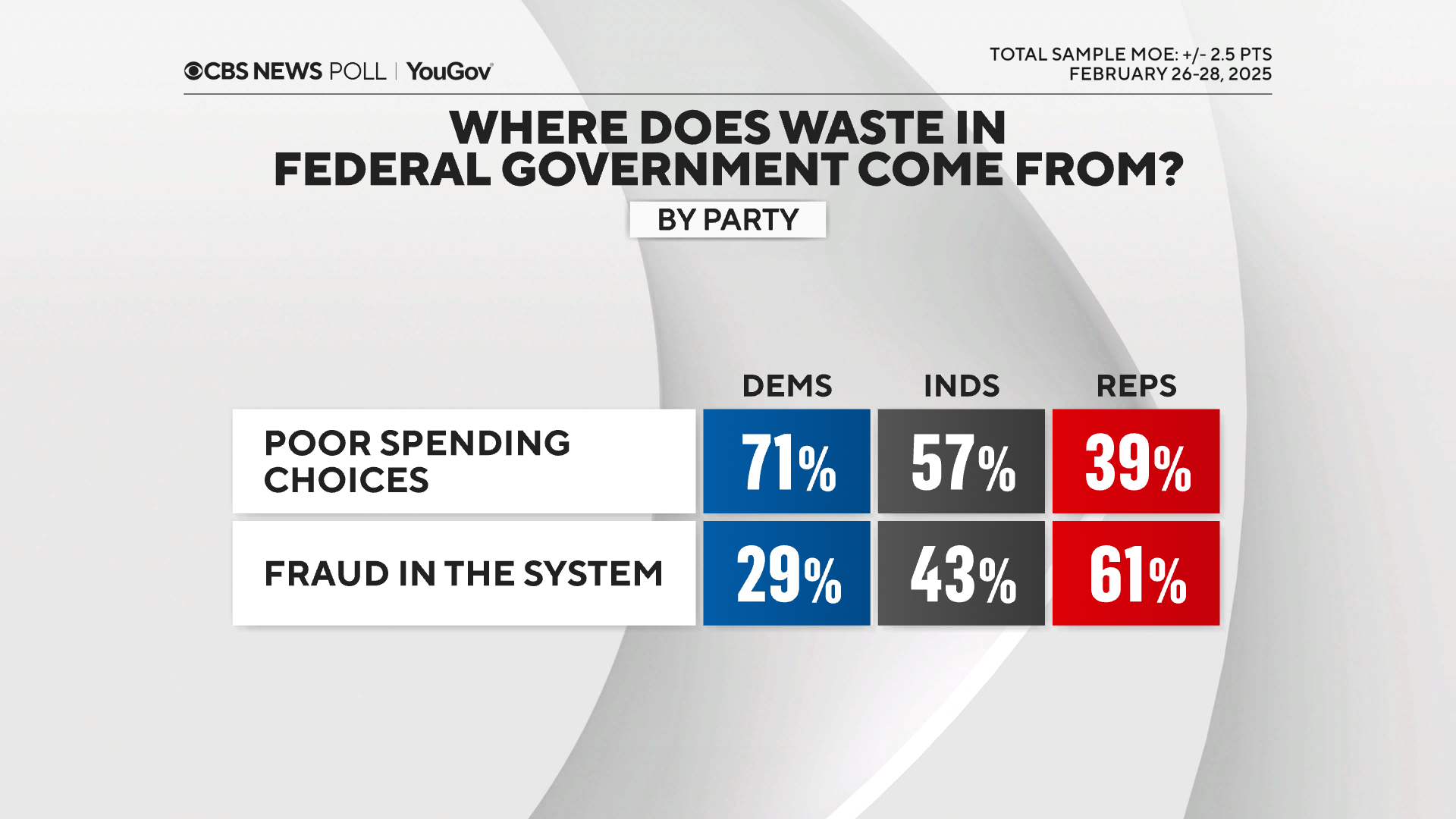
That said, most do think there is at least some waste in the federal government, and that view crosses party lines. But they differ on how much and what causes it: Republicans think there is a lot, mostly caused by fraud in the system, while Democrats think there is only some, mostly caused by poor spending decisions.
Is Trump prioritizing what people want?
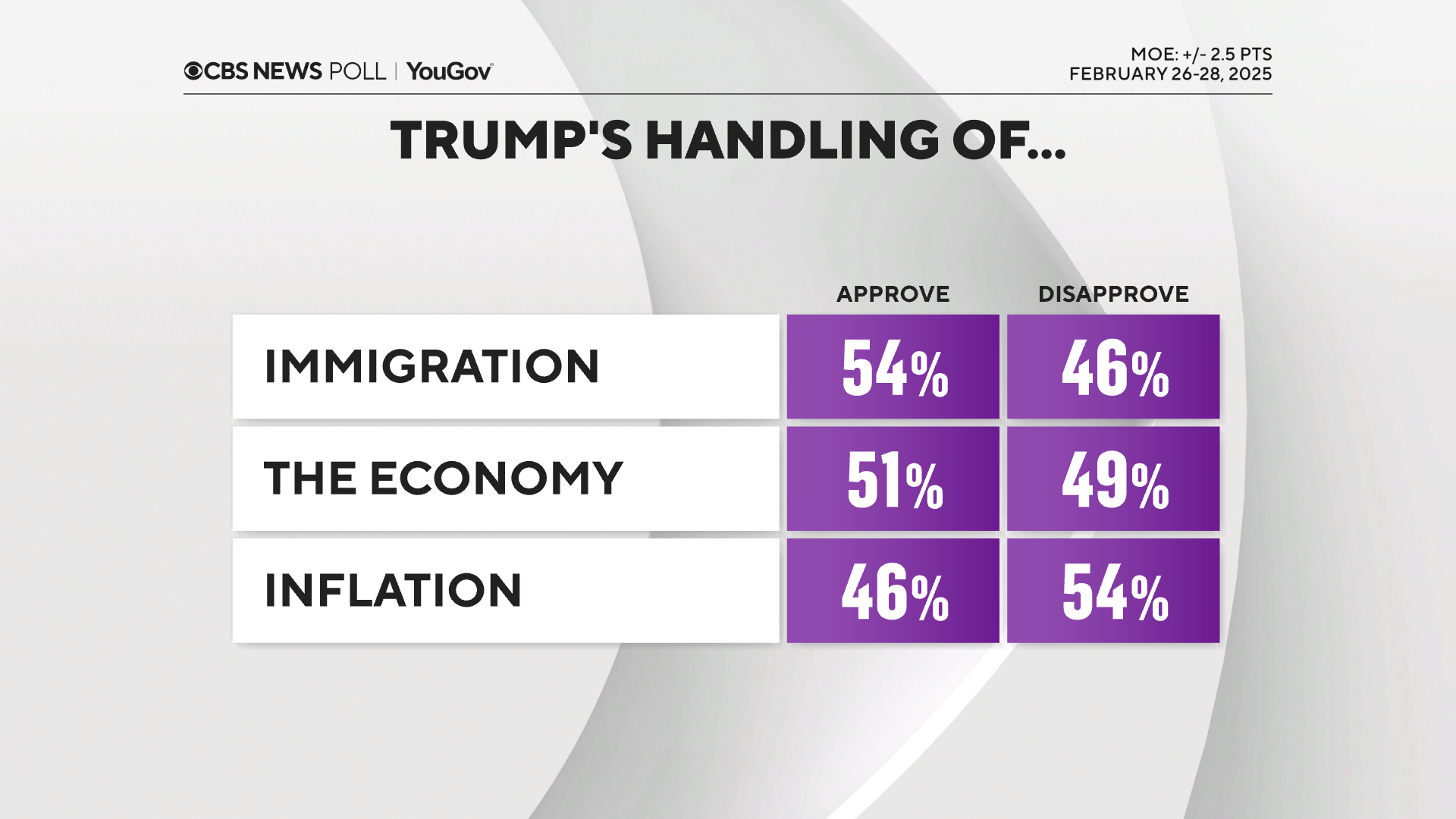
Mr. Trump gets narrowly positive ratings for handling the economy, but not inflation specifically.
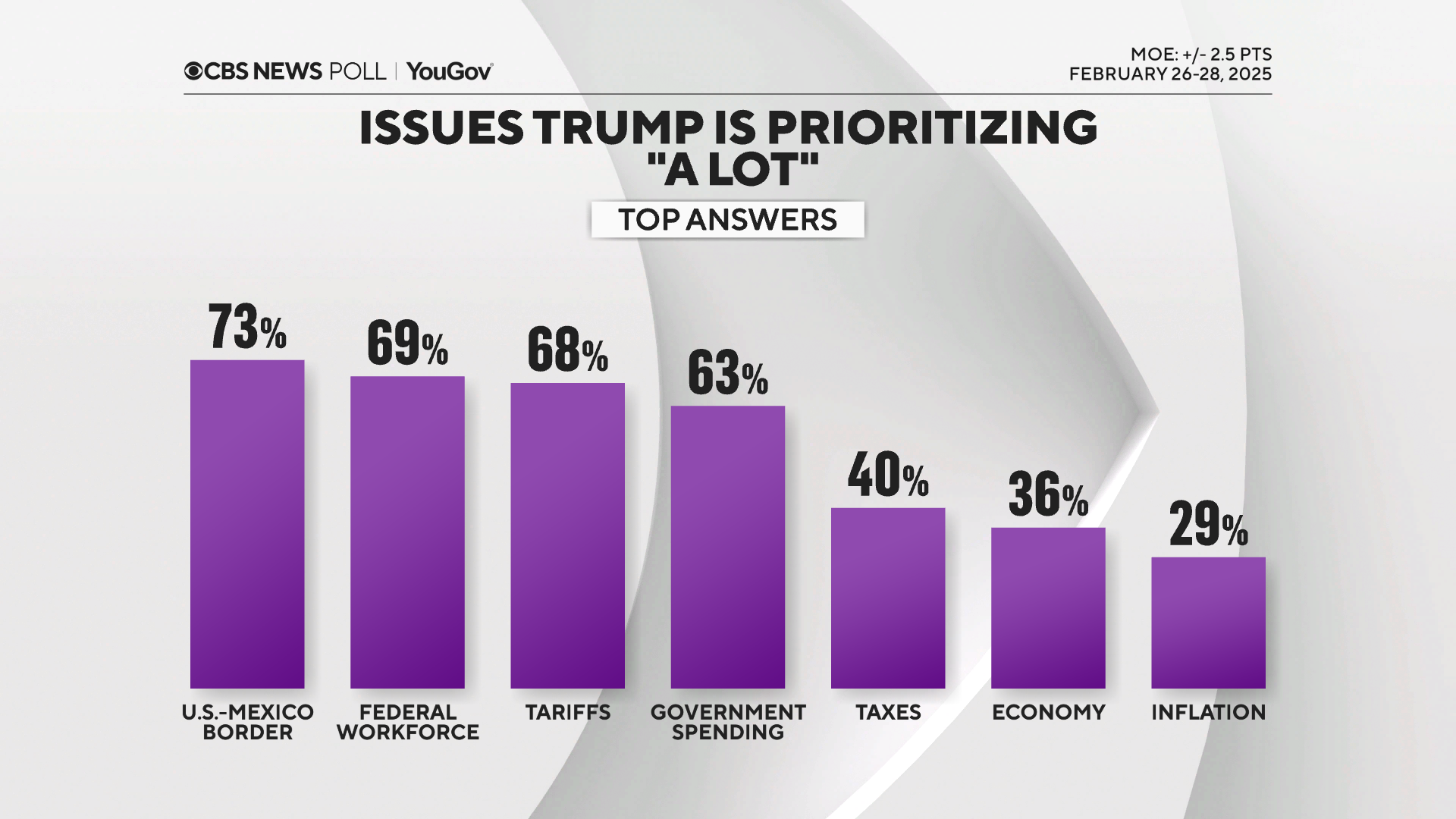
There’s a big difference between what Americans think Mr. Trump ought to give high priority and what they think he is prioritizing.
They overwhelmingly want Mr. Trump focused on the economy and inflation. That cuts across partisan lines. (Perhaps no surprise there, as they’ve been among Americans’ top issues for years.)
The percent who think he is giving a lot of priority to the economy and inflation, though, is far lower.
Most think he is prioritizing the border, the federal workforce and tariffs, more so than inflation. And his policies aren’t seen as driving down food and grocery prices.
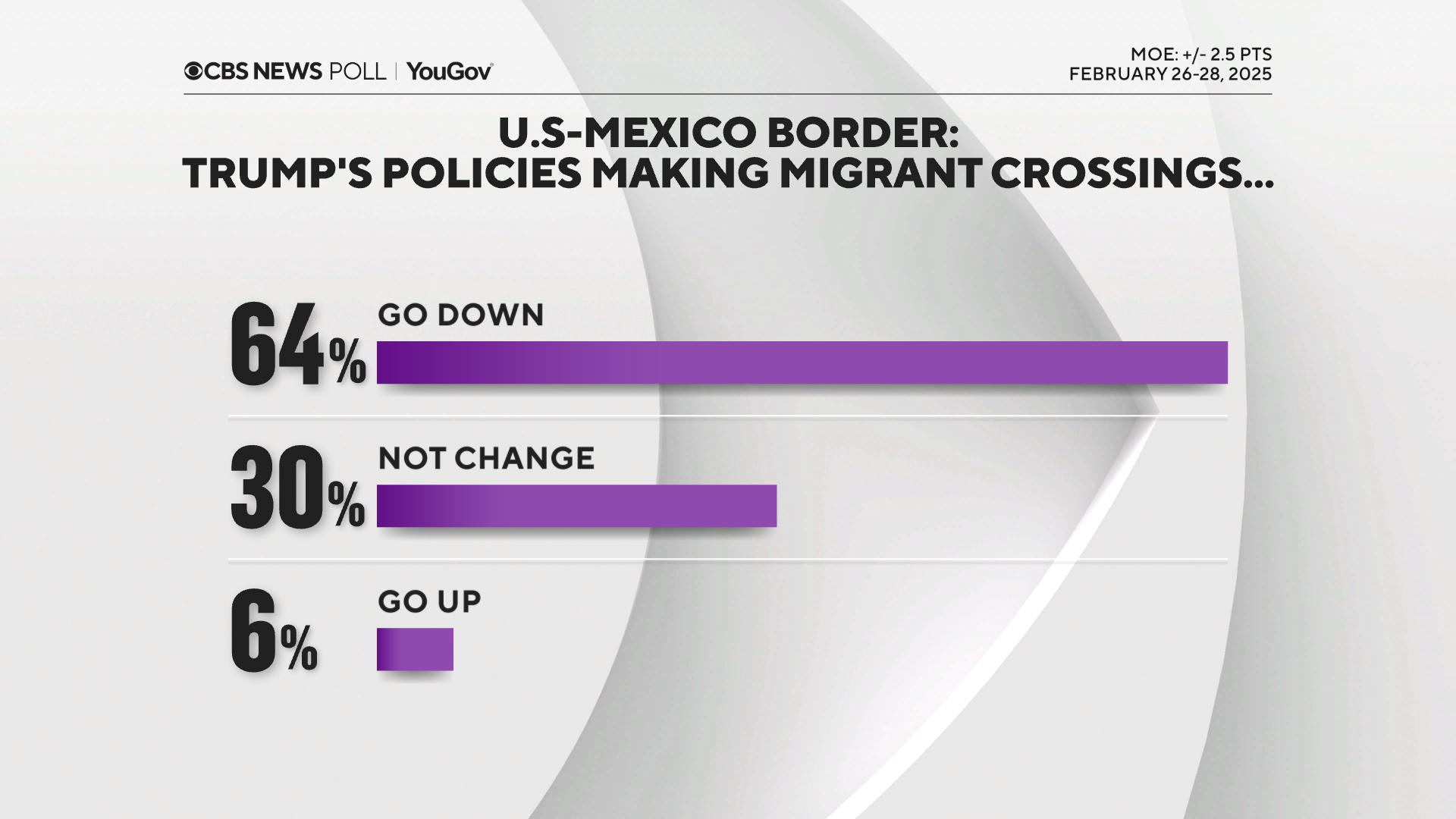
The focus on the border does help him politically: he gets approval on his handling of immigration, and most continue to back his deportation policy. Most say his policies are reducing the number of migrants crossing the border.
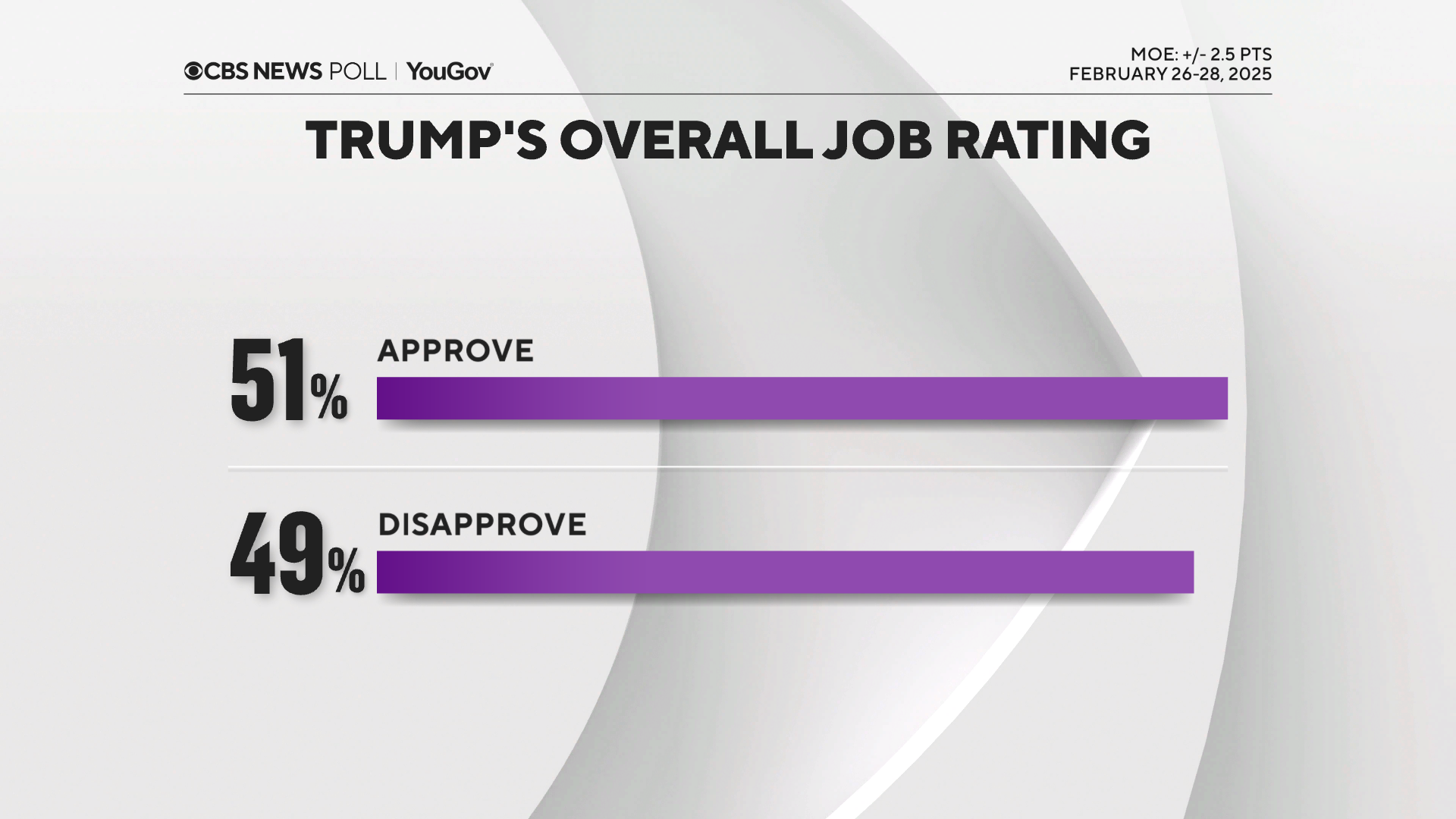
That all leaves Mr. Trump’s approval rating in positive territory, but more closely divided than a couple of weeks ago.
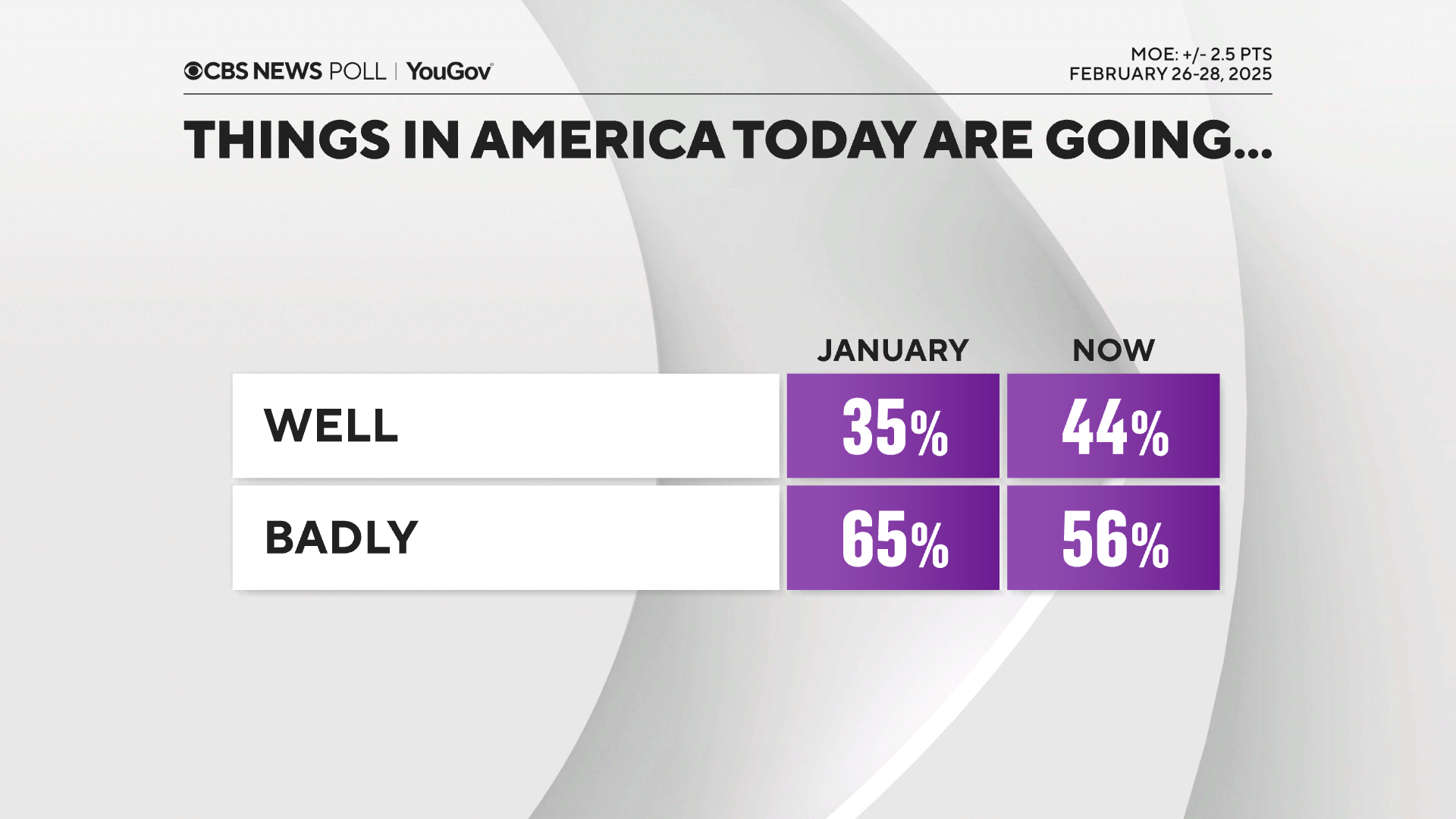
In all, Republicans now overwhelmingly think things in the country are going at least somewhat well, which has driven up the overall percentage of Americans who are saying that since Mr. Trump took office.
Changes in international relations
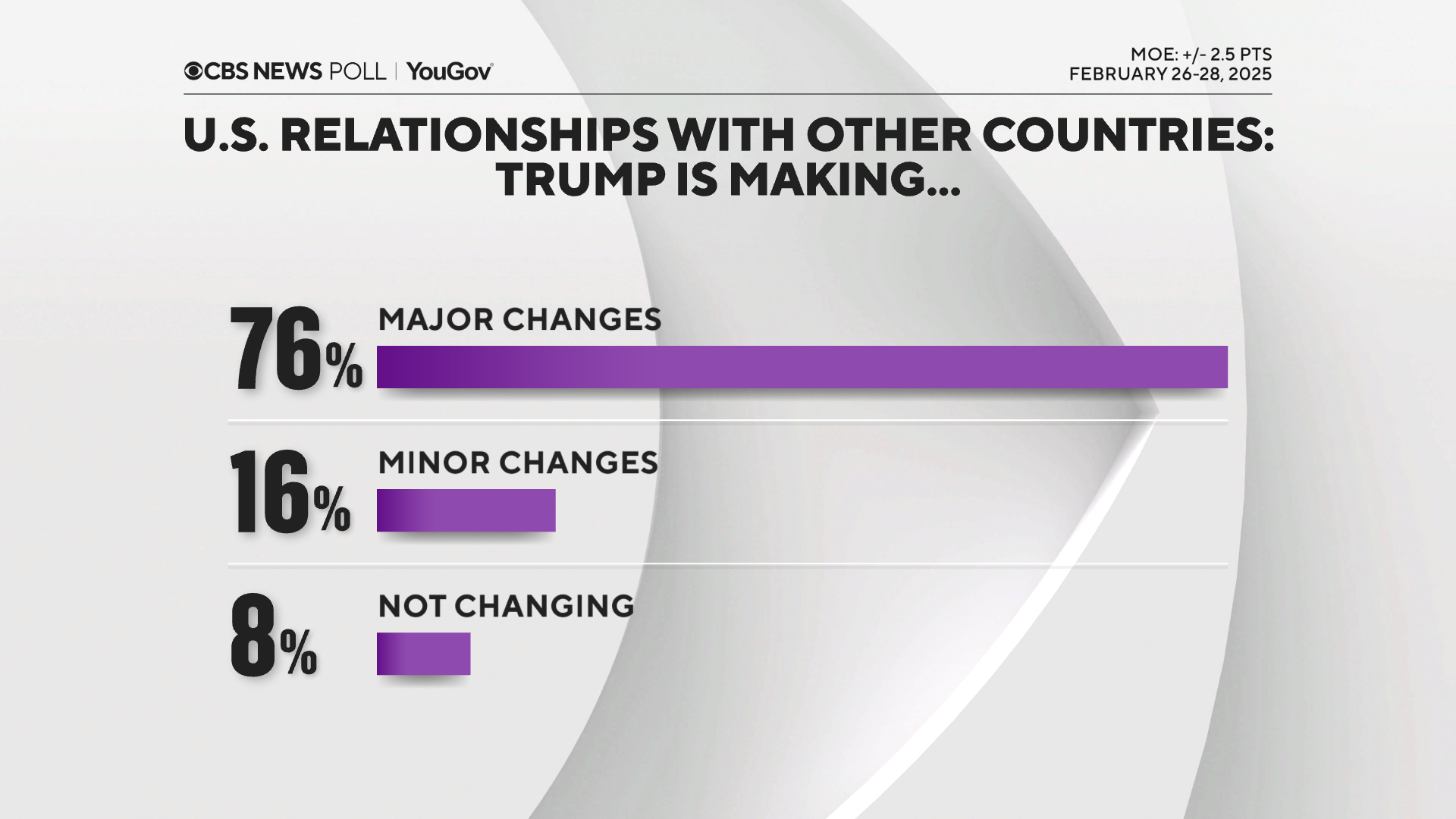
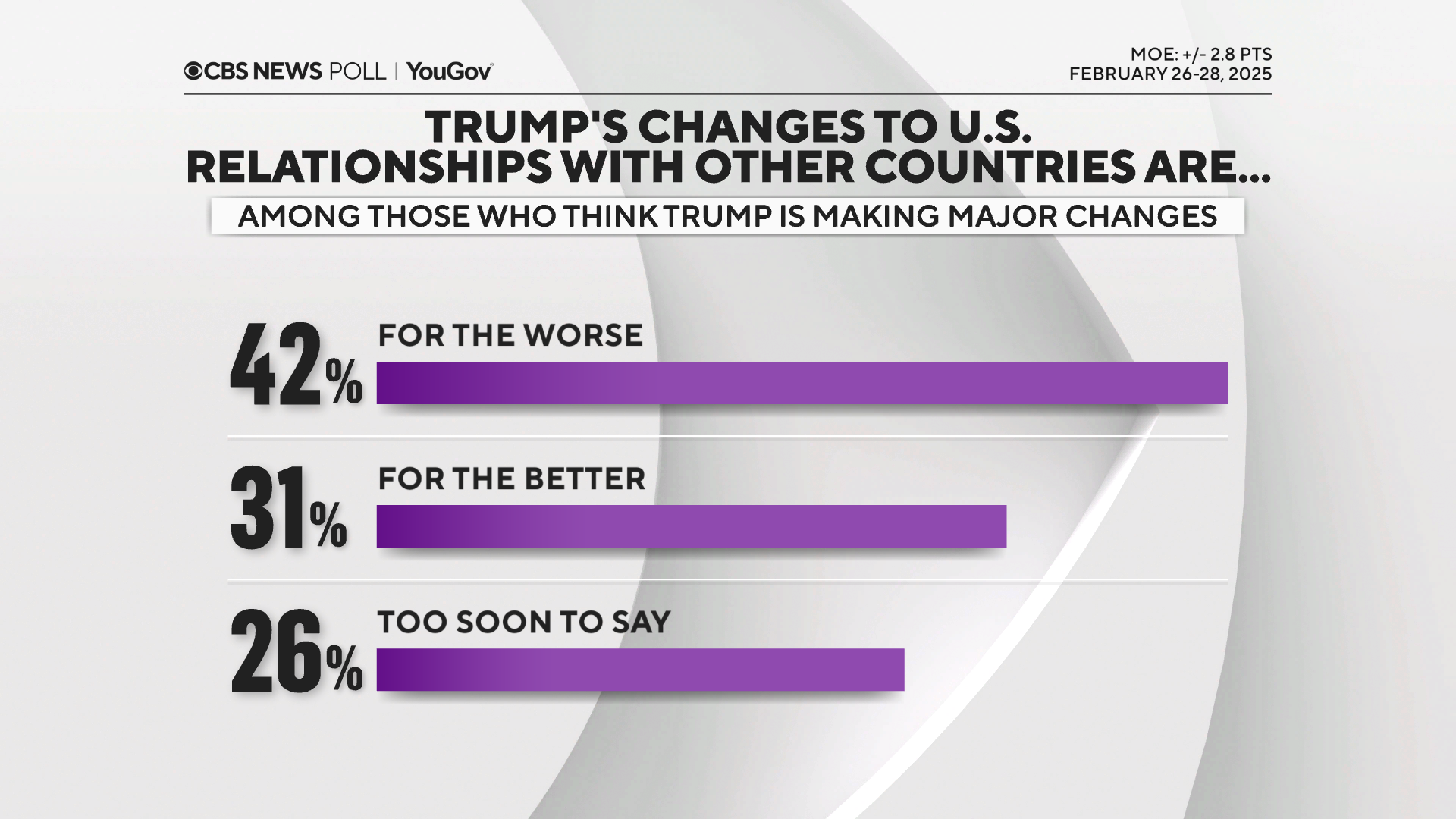
Americans also think there are major changes happening with U.S. international relations. And again here, a split on whether that is better or worse.
Interviewing for the poll was almost entirely conducted prior to the Oval Office meeting between Mr. Trump and Ukrainian President Volodymyr Zelenskyy.
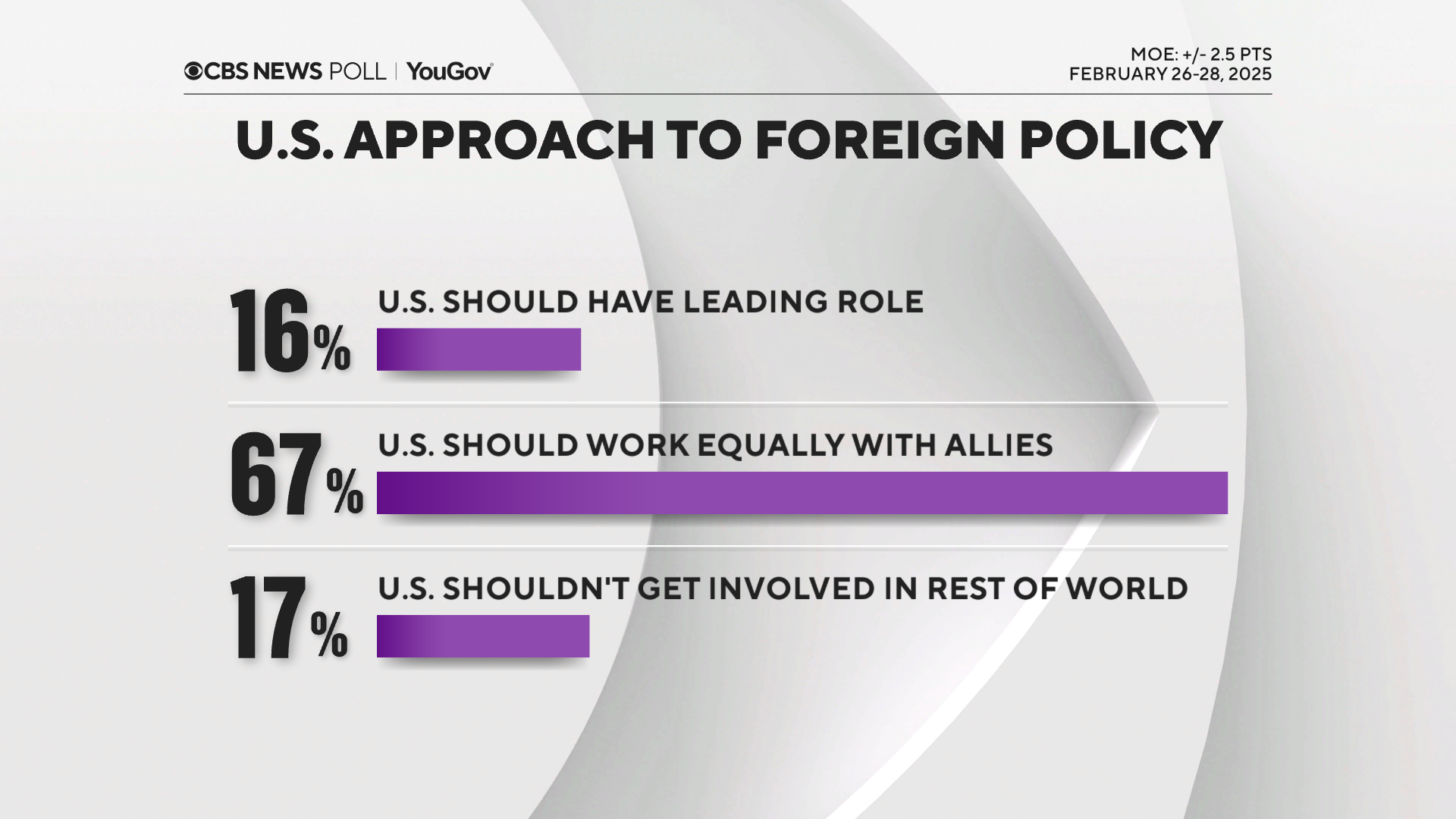
Americans overall want to remain engaged on the world stage. Though few think the U.S. should take the leading role in the world, most do think it should work alongside its allies.
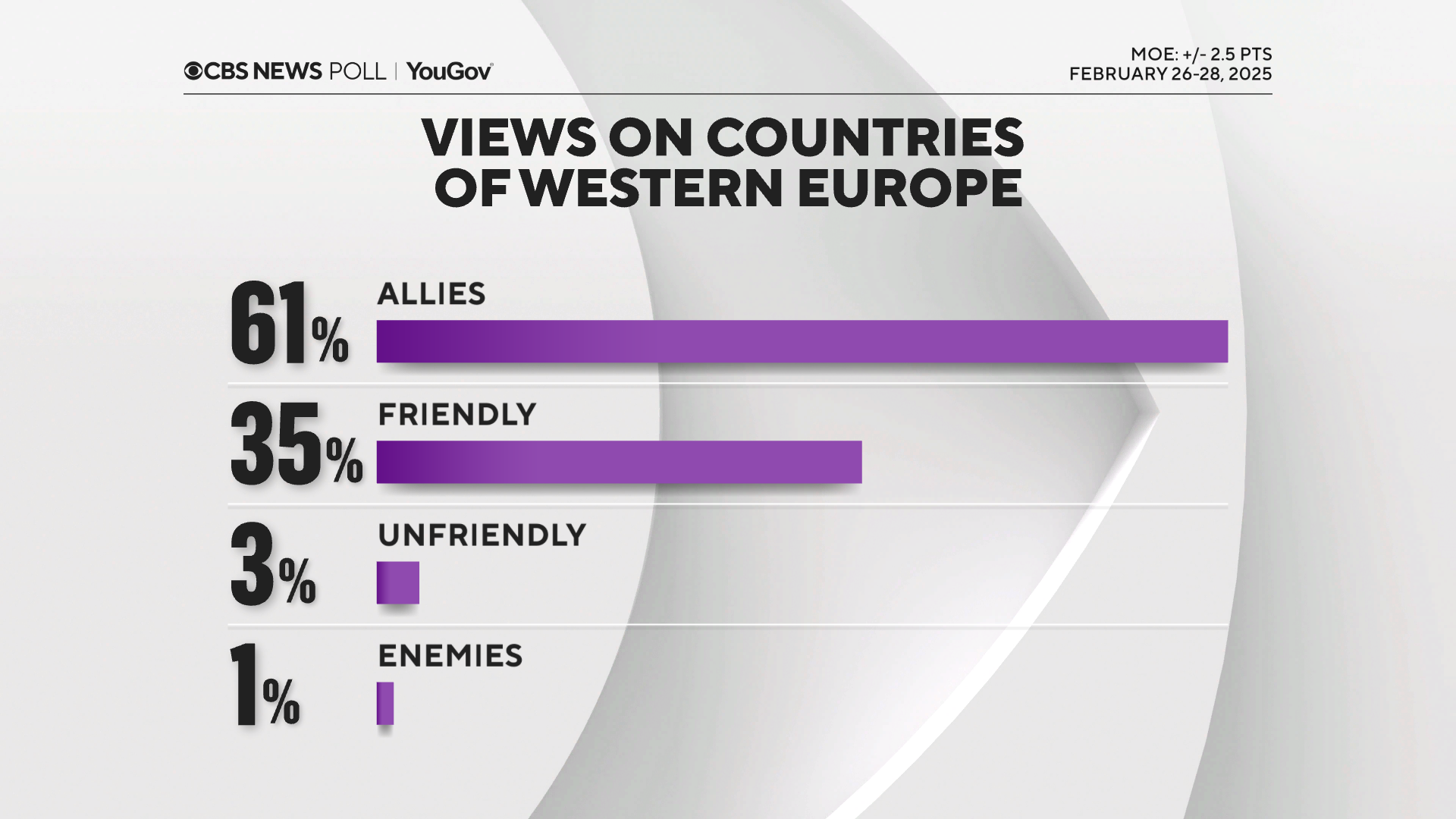
And most see the nations of Western Europe collectively (Great Britain, France, Germany and Italy) as allies of the U.S.
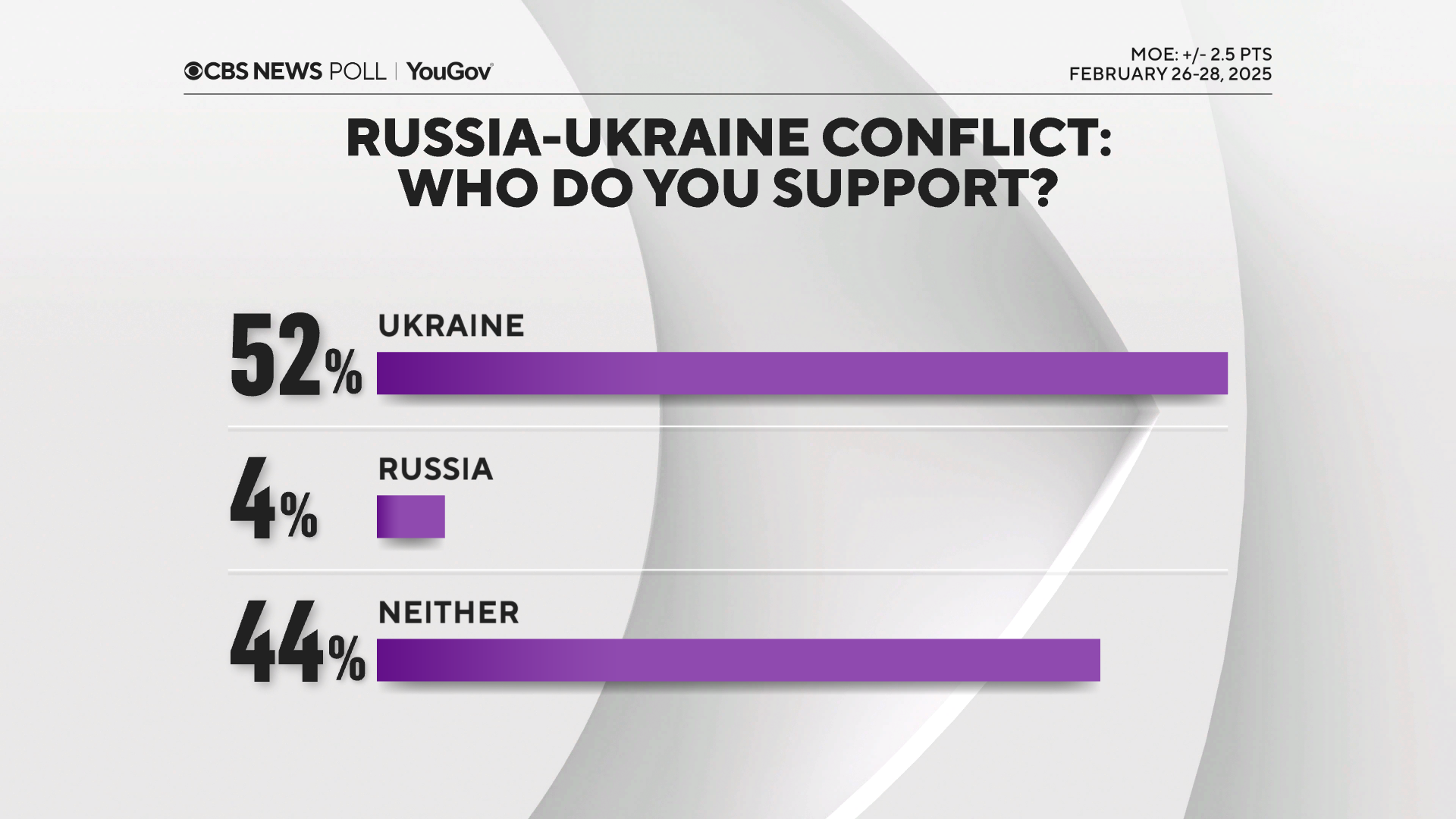
Half of Americans say they back Ukraine in the conflict with Russia, almost half are neutral.
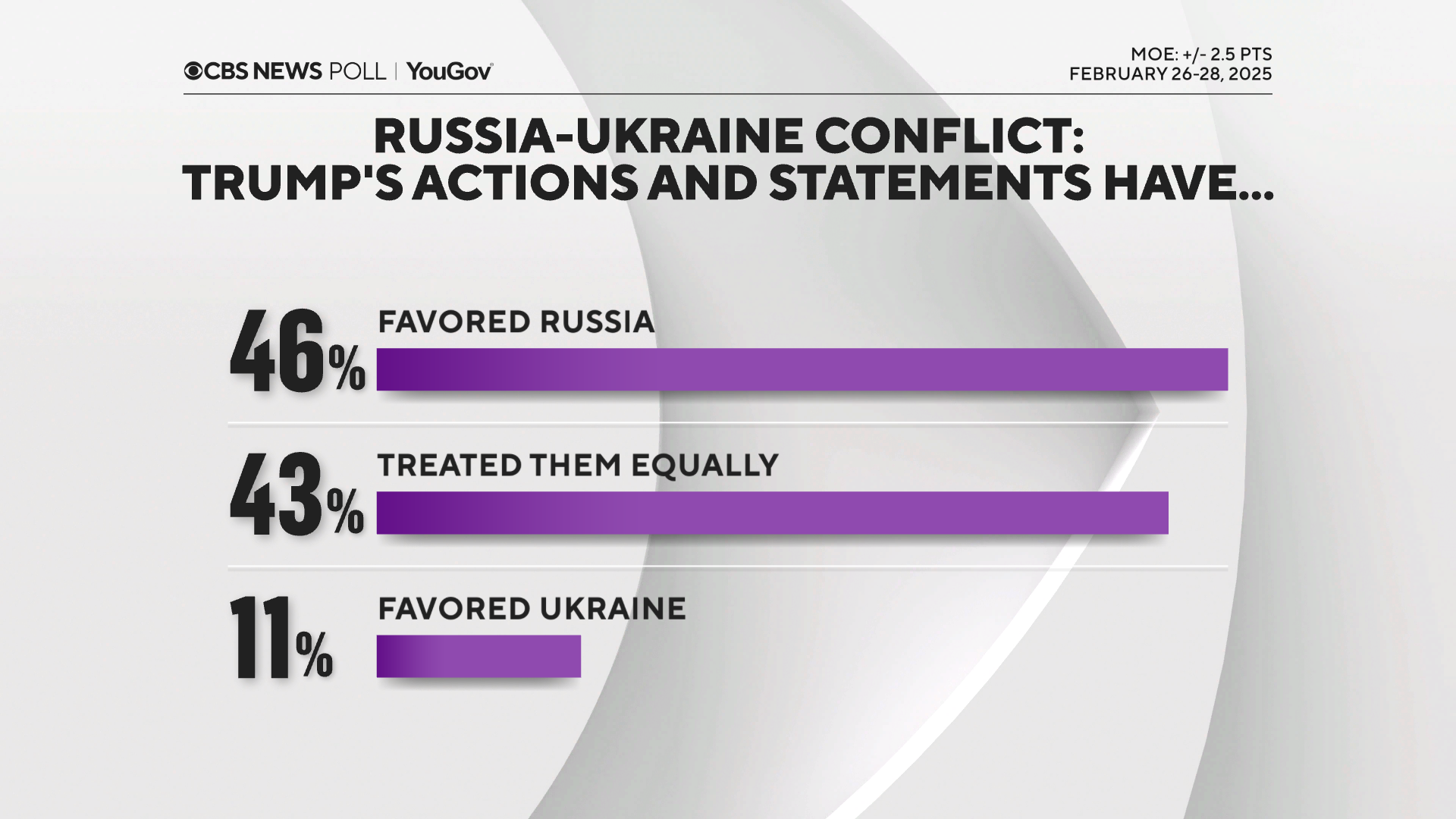
In interviews largely conducted prior to the Trump-Zelenskyy meeting, few Americans thought Mr. Trump favored Ukraine in the Ukraine-Russia conflict.
Those who personally support Ukraine overwhelmingly say Mr. Trump favored Russia, while those who don’t pick a side overwhelmingly say he’s treated them equally.
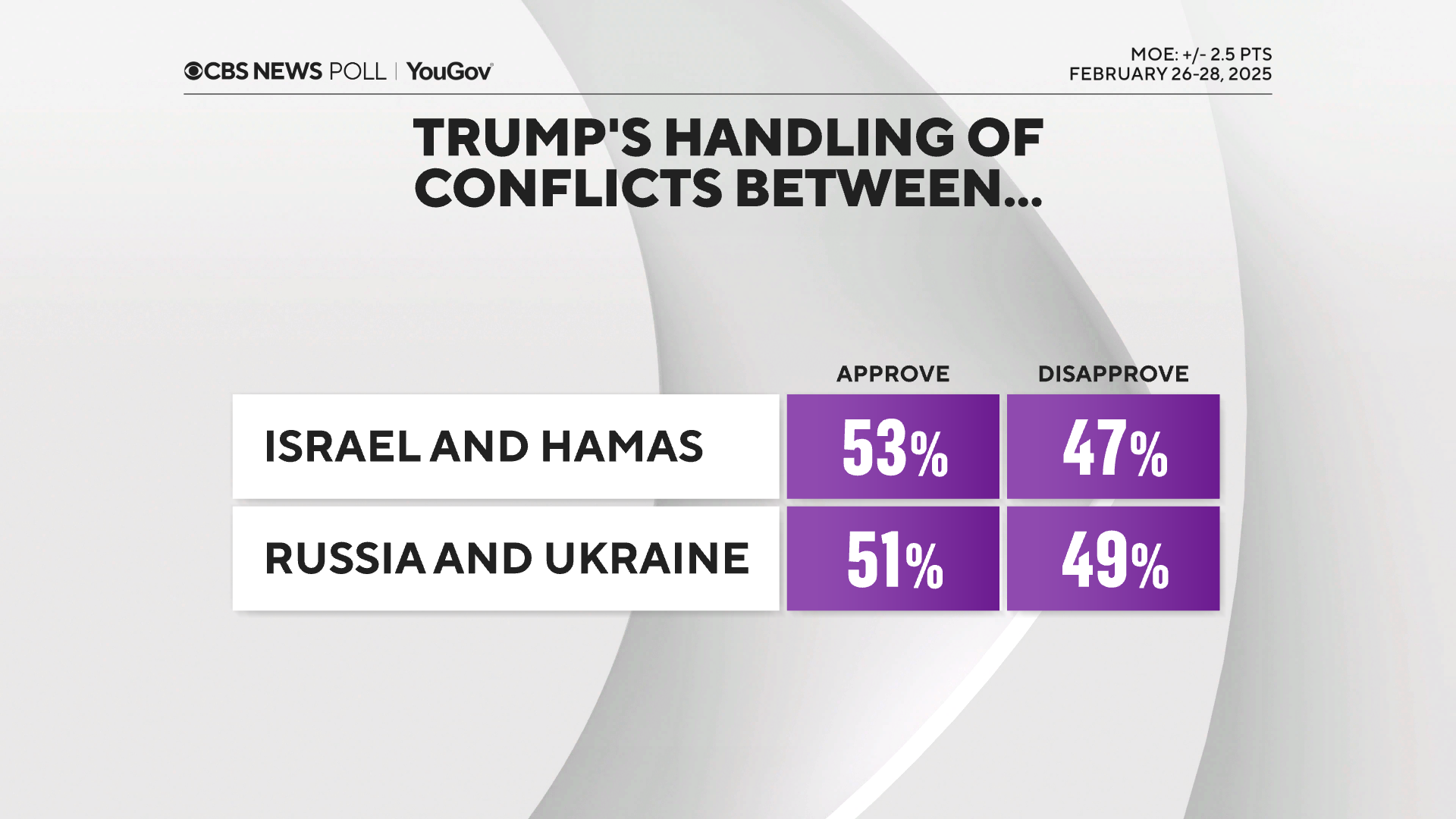
His handling of the conflict is largely split along party lines.
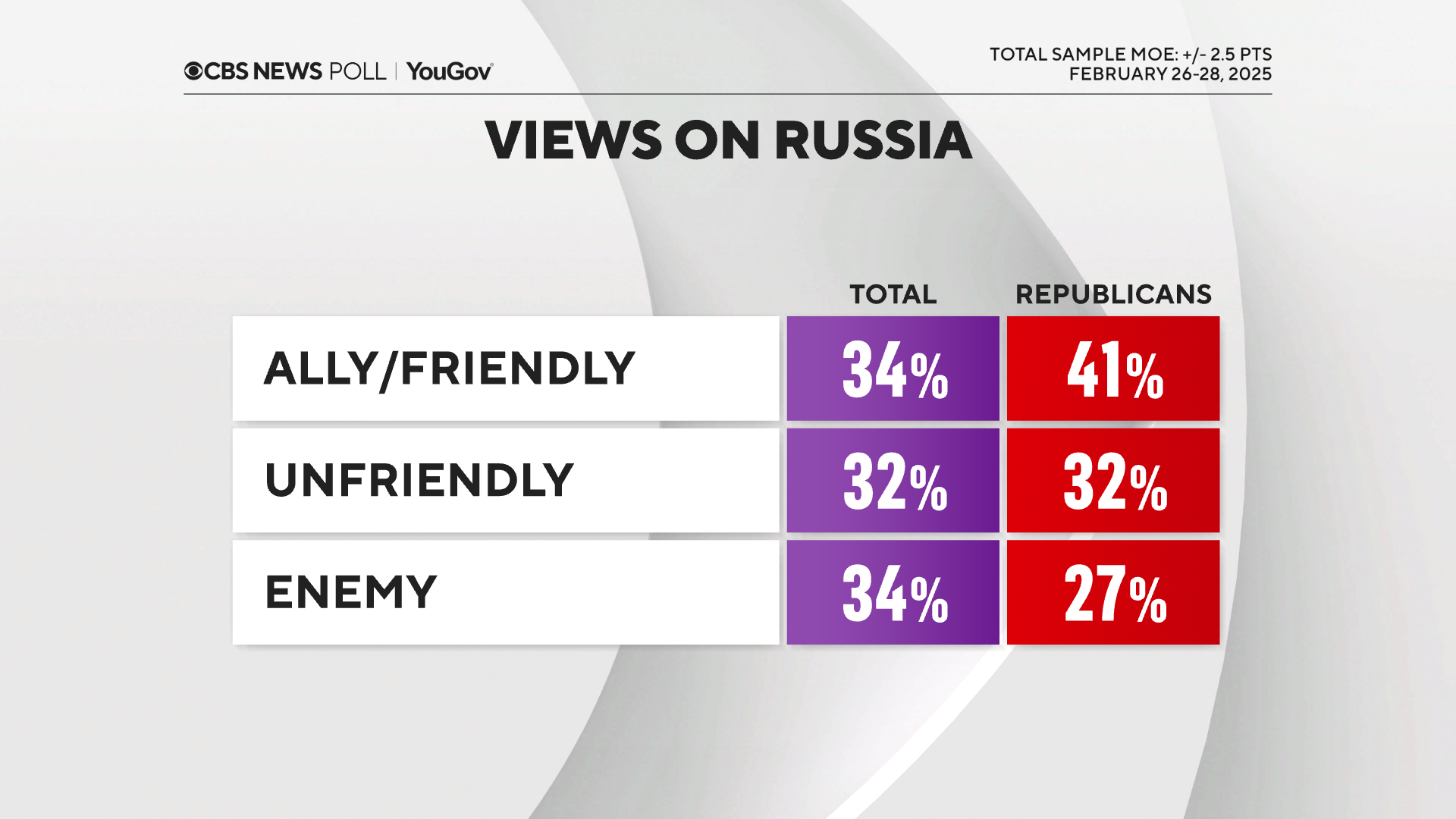
Most Americans do continue to see Russia as unfriendly or an enemy. Republicans are comparably less inclined to see it as an enemy than are Americans overall.
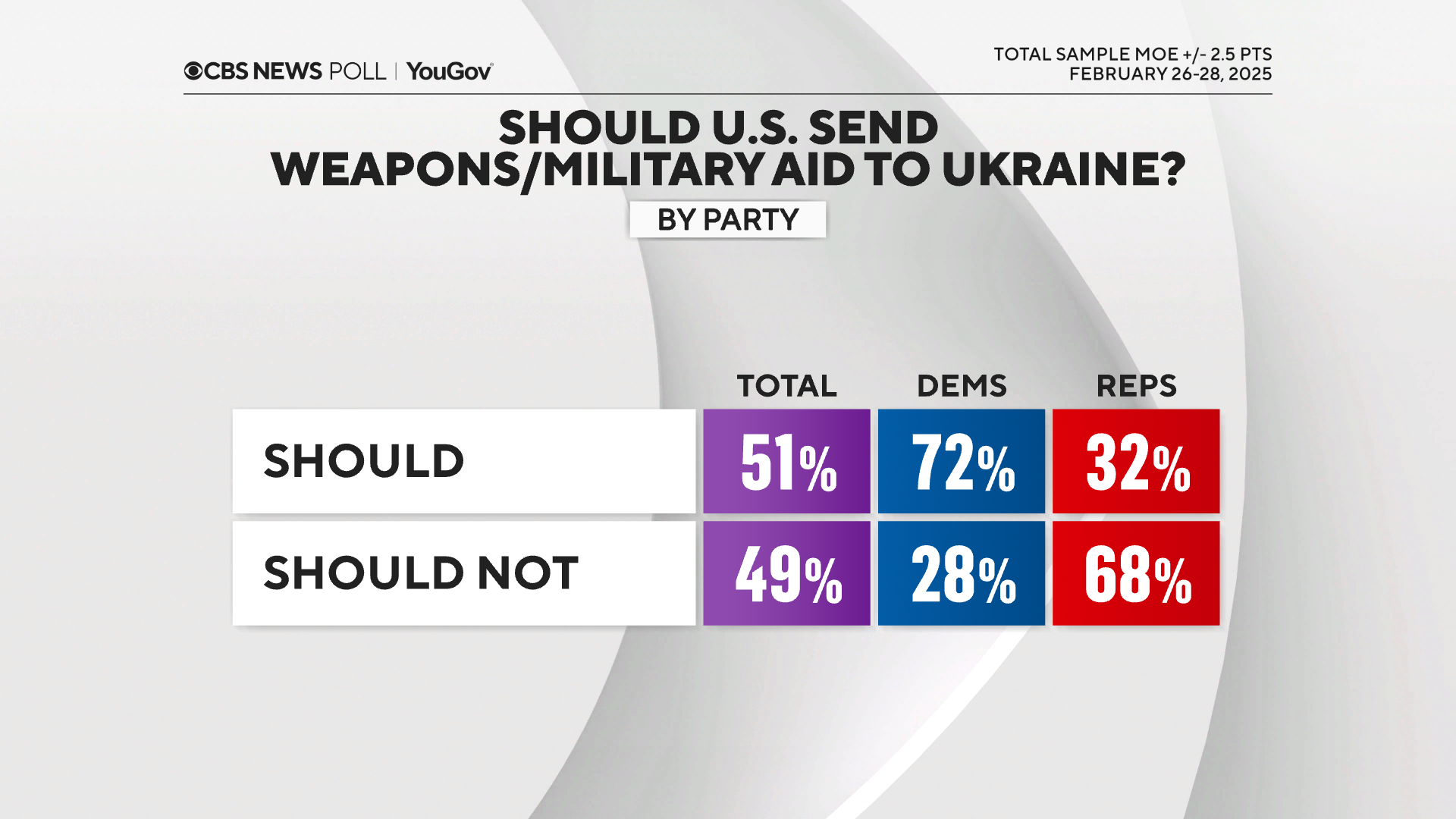
The nation continues to divide along partisan lines over military aid to Ukraine.
This CBS News/YouGov survey was conducted with a nationally representative sample of 2,311 U.S. adults interviewed between Feb. 26-28, 2025. The sample was weighted to be representative of adults nationwide according to gender, age, race, and education, based on the U.S. Census American Community Survey and Current Population Survey, as well as 2024 presidential vote. The margin of error is ±2.5 points.
But before he signed a minerals agreement that Trump badly wanted, Zelenskyy asked to visit the White House. He wanted the U.S. president to commit to future military support.
The conversation did not go his way. A stunning dispute between the leaders and Vice President JD Vance broke out. In the televised meeting, Trump said he was “gambling” with the lives of millions of people. Zelenskyy left without signing the deal.
Allies and critics alike say that Zelenskyy was baited into the argument. Now, Ukraine’s military alliance with the United States is in doubt.
“He’s looking for something that I’m not looking for. He’s looking to go on and fight, fight, fight,” Trump said later. “We’re looking to end the death.”
Trump said he was not interested in talking with Zelenskyy again unless the Ukrainian leader was ready to end the bloodshed. Zelenskyy said in an interview just before he left town that he wants peace, too. That’s why he came to United States.
“Americans are the best of our friends. Europeans are the best of our friends. Putin with Russia, they’re enemies,” Zelenskyy told Fox News. “And it doesn’t mean that we don’t want peace. We just want to recognize the reality, the real situation.”
Yet, it has been clear since Trump’s administration began negotiating with Russia that the U.S. and Ukraine have different interpretations on what constitutes a fair and durable peace agreement. Ukraine wants all of its land back plus security guarantees and NATO membership. The U.S. has said NATO membership is off the table and suggested Russia will get to keep some of the territory it forcibly took.
The U.S. president has said frequently that he just wants the killing to stop. He has been reticent to explicitly promise Ukraine additional military support. What he did offer to back this week was a proposal that would put European peacekeepers on the ground in Ukraine.
He stopped short of saying the U.S. would come to their aid if peacekeepers came under attack. Such an assurance is viewed as a critical component of a potential deal by European countries and Ukraine. Trump has said the minerals deal that would put American workers on the ground in Ukraine is its own guarantee.
Zelenskyy admitted the meeting went poorly with Trump. However, the relationship with the U.S. can still be salvaged, he insisted in the interview on Fox News.
He said the leaders have “to be very honest” with one another in peace talks.
“I heard from President Trump a lot of time that he will stop the war, and I hope he will,” Zelenskyy added. “We need to pressure him with Europe, with all the partners. And I think this dialogue had to be a little bit earlier to understand where we are.”
‘Don’t take the bait’
Zelenskyy met with a bipartisan group of senators on Capitol Hill before he met with Trump. The group included Republican Sen. Lindsey Graham, a close Trump ally and Ukraine backer who stood outside the White House after Zelenskyy departed and briefed the press.
Graham told reporters that he warned Zelenskyy at the breakfast, “Don’t take the bait.” But after what he saw in the Oval, he said Zelenskyy made it “almost impossible to sell to the American people that he’s a good investment” and may need to resign from office.
“I think the relationship between Ukraine and America is important, vitally important. But can Zelenskyy do a deal with the United States? After what I saw, I don’t know,” Graham, R-S.C., said.
Appearing on MSNBC, Sen. Mark Kelly, D-Ariz., who was also in the morning meeting, said the Oval Office brawl was a “complete and utter mess.” Kelly said the exchange was a “gift to Putin” that makes the U.S. look weak.
The negotiation should have taken place behind closed doors, he said. “We had a good meeting with the president. We talked about a lot of issues. We didn’t do it in front of cameras intentionally,” Kelly added.
Trump seemed to relish in the public nature of the spat.
“I think it’s good for the American people to see what’s going on. I think it’s very important. That’s why I kept this going so long. You have to be thankful,” he said.
Max Bergmann, the director of the Europe, Russia, and Eurasia program at the Center for Strategic and International Studies, said it was a “nightmare” scenario that played out on camera.
“The whole posture of that meeting, I think, was to set up Ukraine as being totally unreasonable,” he said.
Without U.S. support, Europe will now need to do more to support Ukraine, the Obama-era State Department official said. “For the United States, I think what it also means is, in some ways, the end of the transatlantic alliance as we know it,” he added.
Rift opens between U.S. and Ukraine
Trump’s warmth to Russia has been chilling for U.S. allies, and they rallied behind Ukraine in the aftermath of Friday’s fight.
“Today, it became clear that the free world needs a new leader. It’s up to us, Europeans, to take this challenge,” said European Union foreign policy chief Kaja Kallas.
Kallas said Europe would enhance its support for Ukraine so it could continue to fight back.
“There is one aggressor: Putin’s Russia. And a people who have been attacked: the Ukrainians. Faced with this situation and for the sake of our collective security, what’s needed is Europe. Now,” French minister of foreign affairs Jean-Noël Barrot also said.
Trump has repeatedly suggested that Ukraine invited the attack by pursuing NATO membership — an argument used as justification for the illegal land grab by Russia.
Ukraine restarted its bid for membership in the alliance in direct response to Russian President Vladimir Putin’s annexation of Crimea in 2014, when former U.S. President Barack Obama was in office.
“Nobody stopped him. He just occupied and took,” Zelenskyy said Friday in the Oval Office.
Zelenskyy was responding to a comment from Vance that better diplomacy could have prevented the war. A ceasefire didn’t stop Russia from launching a full-scale invasion into the country three years ago, Zelenskyy said. “What kind of diplomacy, JD, you are speaking about? What do you mean?”
Vance told him in response, “I think it’s disrespectful for you to come into the Oval Office to try to litigate this in front of the American media.”
The argument spiraled from there.
Trump said later, as he left the White House for a weekend in Florida, that Zelenskyy “overplayed his hand.”
“Either we’re going to end it or let him fight it out, and if he fights it out, it’s not going to be pretty,” Trump said. “Because without us, he doesn’t win.”