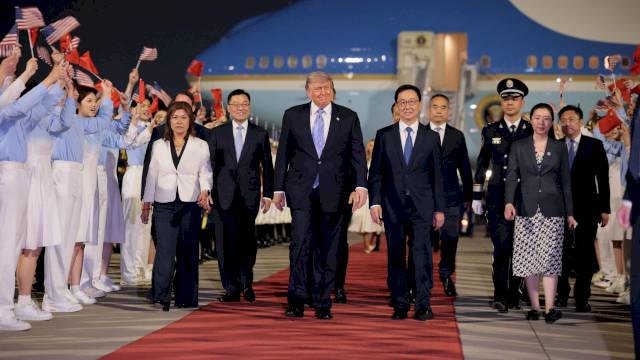
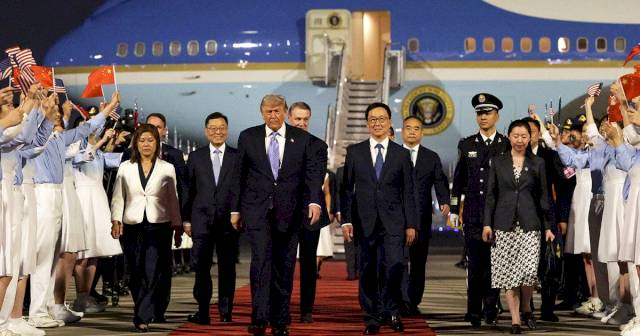
US President Donald Trump arrived in Beijing on Wednesday afternoon for a high-stakes meeting with Chinese President Xi Jinping.
ADVERTISEMENT
ADVERTISEMENT
Trump said a few hours before his arrival that he would ask Xi to “open up” China to American firms as he heads to Beijing on Wednesday for a high-stakes summit that will also bring up the Iran war.
In a sign of Trump’s focus on business, Nvidia chief Jensen Huang boarded Air Force One during a stopover in Alaska, with Tesla’s Elon Musk also travelling on the presidential plane to China.
“I will be asking President Xi, a Leader of extraordinary distinction, to ‘open up’ China so that these brilliant people can work their magic, and help bring the People’s Republic to an even higher level!” Trump wrote on social media after departing from Washington.
A host of other top CEOs, including Apple’s Tim Cook, will also be in Beijing for the visit, the first by a US president to China in nearly a decade.
But Trump’s ambitions to ramp up trade will have to contend with political frictions over Taiwan and the war in the Middle East, which already delayed the trip from March.
As he departed the White House, Trump said he expected a “long talk” with Xi about Iran, which sells most of its US-sanctioned oil to China.
But he also downplayed disagreements, telling reporters that “I don’t think we need any help with Iran” from China and that Xi had been “relatively good” on the topic.
Yet Beijing is growing impatient for peace, with China’s foreign minister urging his Pakistani counterpart on Tuesday to step up mediation efforts between Iran and the United States.
‘Big deal’
This week’s trip, the first since Trump visited Beijing in 2017, will involve highly anticipated talks with Xi on Thursday and Friday.
The packed itinerary includes a state banquet in Beijing’s Great Hall of the People and a tea reception.
Trump said on Monday he would speak to Xi about US arms sales to Taiwan, the self-governing democracy claimed by China, a departure from historic US insistence that it will not consult Beijing on its support to the island.
China’s controls on rare earth exports, AI rivalry and the countries’ raucous trade relationship are also among the topics expected to be taken up by the heads of the world’s top two economies.
The two sides are set to discuss extending a one-year truce in their tariff war, which Trump and Xi reached during their last meeting in South Korea in October.
The tense buildup to the superpower summit was already visible on the streets of Beijing, with police monitoring major intersections and checking the ID cards of passengers on the metro, journalists in the city saw.
“It’s definitely a big deal,” said Wen Wen, a 24-year-old woman travelling from the eastern city of Nanjing, when asked by the AFP news agency about Trump’s visit.
“Some progress will certainly be made,” she said, noting that she hopes China and the United States can ensure “lasting peace” despite “recent instability in the global situation.”
‘Very good relationship’
The United States and China have long sought to stabilise their relationship despite increasingly seeing each other as adversaries in trade and geopolitics.
Trump has repeatedly touted a strong personal relationship with Xi, which he insisted on Monday would prevent a Chinese invasion of Taiwan.
“I think we’ll be fine. I have a very good relationship with President Xi. He knows I don’t want that to happen,” he said.
Trump’s trip will be closely scrutinised by Taiwan and Asian allies for any sign of weakening US support.
Beijing has grown more confident and assertive since Trump’s 2017 trip and the US president finds himself in a weakened position as he seeks a way out of his Iran war.
But the summit also comes at an uncertain time for China’s economy, which has struggled in recent years with sluggish domestic spending and a protracted debt crisis in the once-booming property sector.
WASHINGTON — President Donald Trump is unlikely to get the “big, fat, hug” he’s envisioning from China’s notoriously straitlaced leader, President Xi Jinping, when he is in China for a two-day, pomp-filled visit and talks on Iran.
A firm handshake and a ceremonial red carpet is more like it. And lots of arm-twisting over U.S. military support for Taiwan.
“We are working together smartly, and very well! Doesn’t that beat fighting???” Trump said of the authoritarian leader in April. “He’s a great gentleman. I find him to be an amazing man,” Trump told reporters May 11.
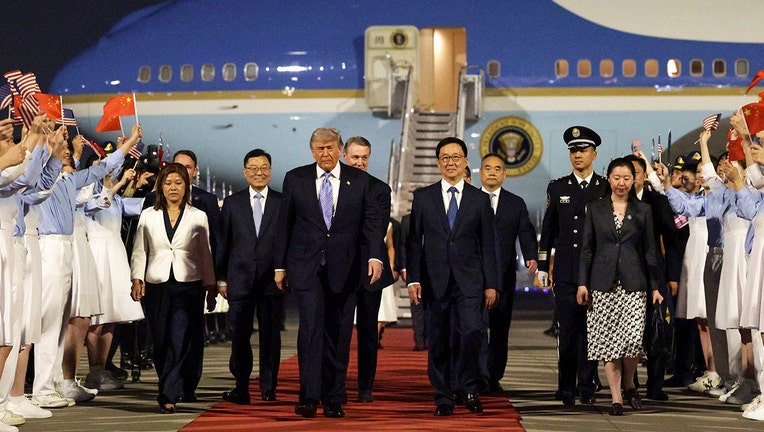
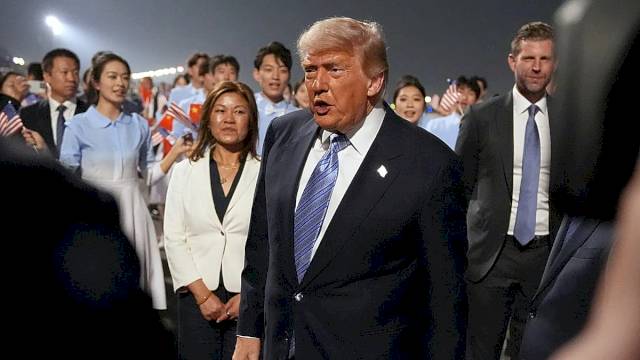
Trump landed in Beijing on May 12 to pomp and pageantry, receiving red carpet treatment as he walked off Air Force One. Members of the Chinese honor guard lined the red carpet ‒ one side holding small China flags, the other side American flags ‒ as China’s vice president Han Zheng greeted Trump, who was the last U.S. president to visit China in 2017.
Trump’s aggressive tariff agenda, the ongoing U.S. war in Iran, the future of tech and U.S. military support for Taiwan are among the issues expected to take centerstage at Trump’s face-to-face meeting with Xi.
“We are working together smartly, and very well! Doesn’t that beat fighting???” Trump said of the authoritarian leader in April. “He’s a great gentleman. I find him to be an amazing man,” Trump told reporters May 11.
Trump prioritizes his relationships with world leaders and views his rapport with them “as one of his special skills and his unique strengths,” said Alexander Gray, who was Asia director, and later, chief of staff, on the National Security Council in Trump’s first administration.
But, Gray said, “The president is also very mindful of the fact that, in many ways, what Xi Jinping and the Chinese Communist Party want is 180 degrees different from what the United States wants.”
China is America’s top economic rival – and Beijing is closely aligned with Moscow and Tehran, two longtime U.S. foes with whom it’s involved in armed conflict directly or indirectly.
Administrations and lawmakers of both U.S. political parties have taken aggressive steps to wean the United States off Chinese-made products since the coronavirus pandemic exposed supply chain vulnerabilities. For the better part of last year, Trump and Xi were engaged in an ugly trade war.
“You can respect somebody as a leader but also be their competitor and in some instances be their adversary,” said Kelly Ann Shaw, one of the negotiators of the U.S.-China trade agreement during Trump’s first administration.
Trump wants a stable relationship with China, current and former U.S. officials say, while the United States simultaneously prepares for long-term economic competition with Beijing.
The Chinese government also emphasized a desire to “expand cooperation and manage differences in the spirit of equality, respect and mutual benefit” ahead of the upcoming meeting.
Iran tops agenda for Trump
The war in Iran and the continued closure of the Strait of Hormuz will be the major items on the menu for Trump, with the U.S. leader declaring the ceasefire on “massive life support” and calling Iran’s latest proposal to end the conflict a “piece of garbage.”
Asked May 12 what message Trump has for Xi on Iran, he said: “We’re going to have a long talk about it. I think he’s been relatively good, to be honest with you. You look at the blockade. No problems. They get a lot of their oil from that area; we’ve had no problems.”
Trump has spoken to Xi multiple times about Chinese support for Iran and Russia, and those conversations will continue, said a U.S. official who previewed the trip for reporters.
The leaders are also expected to announce aircraft and agricultural purchasing agreements and potentially joint boards of trade and investments. Tesla’s Elon Musk, Apple’s Tim Cook and Boeing’s Kelly Ortberg are among more than a dozen CEOs who were invited to join Trump on the trip, according to the White House’s list.
Trump has also said he plans to bring up the detentions of Chinese pastor Ezra Jin Mingri and businessman Jimmy Lai, the former publisher of the independent, Hong Kong-based newspaper Apple Daily.
“People would like him out, and I’d like to see him get out, too,” Trump said of Lai on May 11. “So, I’ll bring him up again.”
Xi expected to raise Taiwan
For China, the potential sale and delivery of $25 billion worth of arms and other defensive equipment to Taiwan is top of mind.
Taiwan’s legislature approved the spending last week after a protracted battle. The United States has approved, but not shipped, $11 billion worth of the weapons. Trump suggested this week that he’s open to blocking future sales.
“I’m going to have that discussion with President Xi. President Xi would like us not to,” Trump said May 11. “That’s one of the many things that I’ll be talking to him about.”
Gray, the National Security Council chief of staff in Trump’s first term, said he doesn’t believe there’s even a small possibility of the president changing U.S. policy toward Taiwan.
“One of the things the president does is before he goes into these engagements, he puts lots of different things on the table in order to keep everyone guessing,” Gray said.
Secretary of State Marco Rubio, who’s traveling with Trump to China, said last week that the United States has not changed its position, Gray pointed out.
“So I have no reason to think that anything would change this time just as it hasn’t changed over the last 10 years of Trump’s time in public life.”
Broadly speaking, the Chinese government wants the United States to back away from Biden-era pledges to support Taiwan in the event of a military conflict and adhere to the “one-China” policy. Taiwan views itself as independent but China seeks to reunite with the democratically-governed territory. American intelligence previously said Xi instructed his military to be ready to conduct an invasion as soon as 2027.
Trump said in August 2025 that Xi told him he would not invade Taiwan during his White House term. The intelligence community further assessed in March that China does not currently plan to invade, Reuters reported, and wants to control the island without using force.
In the Oval Office ahead of his trip, Trump suggested that even the prospect of a military conflict that could pull in the United States and regional allies like Japan was reason enough to maintain positive relations with Beijing.
“I have a very good relationship with President Xi, because I don’t want that to happen,” Trump said.
Competition, not confrontation
Elsewhere in Washington, concerns are growing that military assets moved in response to the war in Iran and the vast amount of weapons launched against the Middle Eastern nation has massively set America back in the event of a future military conflict with China – the only adversary Pentagon officials have held up as able to compete with the United States.
“My concern is all the assets that are used in Iran, the missiles, the forward deployed units, diplomatic capital are absent now from the Indo-Pacific,” Sen. Jack Reed, the top Democrat on the Armed Services Committee, told reporters May 12. “The Chinese are quite aware of that.”
Sen. Mark Kelly, a Democrat from Arizona, said on “Face the Nation” two days prior that Pentagon briefings on the expenditures of munitions in the Iran war had left him shocked – and worried.
“That means the American people are less safe, whether it’s a conflict in the Western Pacific with China or somewhere else in the world,” Kelly said.
In attacking Iran, the U.S. military may have expended more than half of its inventory of weapons considered key to defending against China’s missile capabilities, according to an analysis by the Center for Strategic and International Studies. Roughly 2,500 Marines stationed in Japan were deployed to the war months ago. Half of the military’s deployed aircraft carriers and their accompanying warships are engaged in the Iran war, after the USS George H.W. Bush replaced the USS Gerald R. Ford in the Middle East.
“We have patiently accumulated over time these capabilities,” Kurt Campbell, the deputy secretary of state under former President Joe Biden, said of military weapons and personnel moved out of Asia.
“It has been vacated. It is all back in the Middle East. Once you lose it, it’s very hard to get it back,” he told reporters at a May 8 briefing.
U.S. President Donald Trump participates in an arrival ceremony at Beijing Capital International Airport during his visit to the country, in Beijing, China, May 13, 2026.
Evan Vucci | Reuters
U.S. President Donald Trump has landed in Beijing for a highly anticipated presidential summit with his Chinese counterpart, Xi Jinping.
Trump is being accompanied on the trip by a group of executives from some of America’s most valuable companies, including Tesla CEO Elon Musk and Nvidia boss Jensen Huang.
The president was greeted on the tarmac by a brass band and flag wavers, who performed as he descended the steps of Air Force One.
On Thursday, Trump is scheduled to participate in a welcome ceremony and hold a bilateral meeting with Xi, before touring the historic Temple of Heaven and attending a state banquet.
He will leave China on Friday, following tea and a working lunch with Xi.
The high-stakes talks between the two leaders are expected to cover tariffs, rare earths, AI, the Iran war and Taiwan. Experts are anticipating that Trump and Xi may announce large Chinese orders of American planes and soybeans when the meetings are concluded.
In a Truth Social post on Monday, Trump said he expected “great things” to come out of the summit.
Sen. Steve Daines, R-Mont., who just travelled to China with a congressional delegation, said Wednesday on CNBC’s “Squawk Box” that it is “in both leaders’ interest to keep the relationship stable, and to de-escalate, not decouple.”
“We hope to see some kind of trade deals come out, I think it will be Boeing, beef and beans,” Daines said.
President Donald Trump is greeted by Chinese youth, a military honor guard and military band as he departs Air Force One at Beijing Capital International Airport on May 13, 2026 in Beijing, China. President Trump is meeting with President Xi Jinping
President Donald Trump arrived in Beijing Wednesday for a highly anticipated summit with Chinese President Xi Jinping this week.
Trump and Xi are meeting in a two-day summit on May 14 and 15. Trump’s trip was initially delayed so he could help steward the U.S. and Israeli war against Iran. The United States and Israel launched the attacks against Iran on Feb. 28.
Xi and Trump’s meeting is shaping Beijing’s approach to the Iran conflict even as the world’s top crude oil importer, reliant on the Middle East for half its fuel, seeks to protect its energy supplies.
Despite Trump’s trip to China being planned for months, it started to unravel as he pressured Beijing and other world leaders to use their military force to protect the Strait of Hormuz.
Citing Chinese state media, Reuters noted that both the U.S. and China have expressed willingness to “promote the healthy, stable and sustainable development of China-U.S. economic and trade relations.”
Why is Trump in China?
What’s next:
President Donald Trump’s visit to China is seen as a chance to fortify a delicate trade truce between the U.S. and China, but it has become complicated in Trump’s attempt to find a resolution to the war in Iran.
Reuters reported that the meeting between Trump and Chinese leader Xi Jinping will have a narrow focus, avoiding topics, including AI governance and market access.
After pressing China and other nations to send warships to secure access to Middle Eastern oil, Trump indicated in March that his travel plans depended on Beijing’s response, though he explained at the time that the U.S. didn’t need help from the allies that rejected his request.
Reuters reported that the U.S. naval blockade of Iranian ports is a direct and growing threat. China has participated in diplomatic activity and refrained from strong criticism of Trump’s conduct of the war so that the summit can happen.
In April, Xi addressed the Iran war with a four-point peace plan that called for upholding peaceful coexistence, national sovereignty, the international rule of law and balancing development and security.
CEOs and top executives joining Trump in China
Local perspective:
Over a dozen CEOs and top executives are part of the U.S. delegation with PresidentDonald Trump in China.
The following companies are in the delegation:
Apple (Tim Cook)
Blackrock (Larry Fink)
Blackstone (Stephen Schwarzman)
Boeing (Kelly Ortberg)
Cargill (Brian Sikes)
Citi (Jane Fraser)
Cisco (Chuck Robbins)
Coherent (Jim Anderson)
GE Aerospace (H Lawrence Culp)
Goldman Sachs (David Solomon)
Illumina (Jacob Thaysen)
Mastercard (Michael Miebach)
Meta (Dina Powell McCormick)
Micron (Sanjay Mehrotra)
Qualcomm (Cristiano Amon)
Tesla/SpaceX (Elon Musk)
Visa (Ryan McInerney)
US sanctioned China ahead of summit
Dig deeper:
The Associated Press reported that Secretary of State Marco Rubio and Treasury Secretary Scott Bessent have recently called on China to use its influence to help reopen the Strait of Hormuz.
On May 8, the State Department announced it was sanctioning four entities, including three China-based firms, for furnishing sensitive satellite imagery that allows Iranian military strikes against U.S. forces in the Middle East.
Meanwhile, the Treasury Department moved to target Chinese oil refineries accused of buying oil from Tehran, and shippers of oil. According to the AP, the sanctions curtail organizations from the U.S. financial system and punish anyone who does business with them.
Beijing has called the sanctions “illegal unilateral pressure” and enacted a blocking statute that outlaws any Chinese entity from recognizing or complying with the sanctions.
China and the US want to avoid a return to a tariff war
Big picture view:
On May 11, President Donald Trump minimized differences with China over Iran and reinforced that Xi wants to see the Strait of Hormuz reopened. “He’d like to see it get done,” Trump said of the Chinese leader.
The Associated Press reported that Xi also has plenty of reasons not to let differences over Iran impact other facets of the relationship.
China imports roughly half of its crude oil and nearly one-third of its natural gas from Middle Eastern countries impacted by the closure of the strait, the AP reported, referencing China’s General Administration of Customs.
In April, Trump threatened to enforce a 50% tariff on China after reports that Beijing was preparing to deliver a shipment of new air defense systems to Iran, but he later backed away from the threat.
The Source: Information for this story was provided by The Associated Press and Reuters. This story was reported from Washington, D.C.
We’ve detected unusual activity from your computer network
To continue, please click the box below to let us know you’re not a robot.
Why did this happen?
Please make sure your browser supports JavaScript and cookies and that you are not blocking them from loading. For more information you can review our Terms of Service and Cookie Policy.
Need Help?
For inquiries related to this message please contact our support team and provide the reference ID below.
By submitting, you consent that you are at least 18 years of age and to receive information about MPR’s or APMG entities’ programs and offerings. The personally identifying information you provide will not be sold, shared, or used for purposes other than to communicate with you about MPR, APMG entities, and its sponsors. You may opt-out at any time clicking the unsubscribe link at the bottom of any email communication. View our
 ADVERTISEMENT