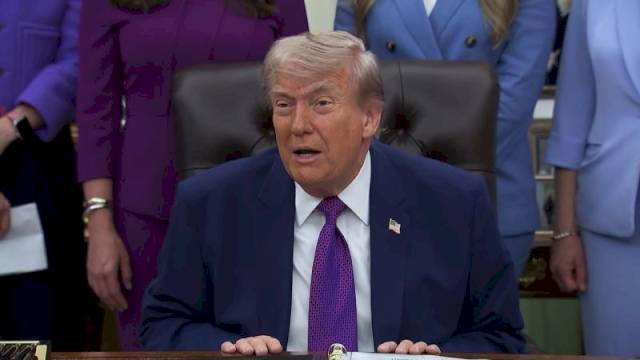
Ceasefire with Iran is on “massive life support,” Trump says
2:07
• Ceasefire takes strain: Some aides to President Donald Trump said he is now more seriously considering resuming combat operations in Iran. Trump said the ceasefire is on “life support” after he rejected Iran’s counterproposal to end hostilities.
• Trump’s China trip: A major decision on how to proceed is unlikely to be made before Trump’s departure to China today, sources said. An adviser to Iran’s supreme leader warned Trump he should not mistake the current lack of fighting as a victory as he heads to Beijing.
• Oil crisis: The oil market won’t return to normal this year if the Strait of Hormuz doesn’t reopen soon, a Saudi oil giant warned. The US released 53.3 million barrels of oil from the Strategic Petroleum Reserve to loan energy firms, as part of a global effort to stabilize oil prices.
President Donald Trump said Tuesday he is confident Iran will stop enriching uranium and abandon any effort to build a nuclear weapon, even as negotiations between Washington and Tehran remain at an impasse.
“100% they’re going to stop,” Trump said during an interview on WABC’s “Sid and Friends in the Morning” when asked whether he believed Iran could be prevented from enriching uranium and developing a bomb.
Trump said he has been directly engaged with Iranian officials during the talks.
“I deal with them,” Trump said. “And they said that we’re going to get the dust. I call it the nuclear dust because it’s appropriate. And we’re going to get it.”
The president also said the US does not need to move quickly toward a deal.
“We’re not going to rush anything, we have a blockade,” Trump said.
The remarks come a day after Trump said the ceasefire between the US and Iran is on “massive life support” following Tehran’s latest counterproposal, which he described as “simply unacceptable.”
Kuwait arrested what it said were four members of Iran’s Islamic Revolutionary Guards Corps (IRGC) who were attempting to infiltrate the Gulf Arab country to “carry out hostile acts,” state-run Kuwait’s News Agency (KUNA) reported.
The four attempted to enter the country on May 1 aboard a fishing boat and clashed with Kuwaiti soldiers, which led to the injury of one soldier, KUNA said.
The incident, if confirmed, would be the first known attempted military infiltration by Iran into one of its neighbors during the war. KUNA named the four who were arrested, including their military ranks.
Kuwait’s interior ministry said the four confessed about being tasked by the IRGC to infiltrate Bubiyan Island, a major commercial and logistics hub, on May 1 “to execute the mission which includes conducting hostile acts against Kuwait.”
Kuwait was among the Gulf Arab countries struck by Tehran following the US-Israeli attacks on Iran.
A major gas facility in the United Arab Emirates (UAE) will not return to full operational capacity until 2027, after Iranian strikes hampered around 40% of its production, according to its operator.
ADNOC Gas said the Habshan site in Abu Dhabi – one of the world’s largest onshore gas processing facilities – is currently operating at “60% of the complex’s processing capacity” and is “working towards achieving 80% restoration by the end of 2026, with full capacity restored in 2027.”
The Habshan energy facility came under Iranian bombardment in April, triggering a fire that killed one person, according to local media.
Since Iran began attacking Gulf nations in response to the US-Israeli assault in February, the UAE said its air defense has intercepted 550 ballistic missiles, nearly 30 cruise missiles, and more than 2,200 drones.
In its statement Tuesday, ADNOC Gas reported a net income of $1.1 billion in the first quarter of 2026, marking an 8% decline from the previous quarter. The state-owned company cited “increased regional uncertainty and difficult market conditions, which have caused major disruption in the energy sector and to maritime movements through the Strait of Hormuz.”
Iran’s blockade of the strait, a vital trade route, has caused energy prices to skyrocket by disrupting Gulf oil exports. The world’s top oil exporter, Saudi Aramco, warned on Monday that the oil market will not return to normal until next year if the reopening of the waterway is delayed for a few more weeks.
This food truck owner in Los Angeles says she has taken a huge hit from the fluctuations in fuel and food prices since the beginning of the war in Iran.
Food truck feels the pinch from rising gas and food prices
Anabel Martinez, the owner of Eagles Tacos in Los Angeles, says her food truck business has taken a huge hit from the fluctuations in fuel and food prices since the beginning of the war in Iran. CNN’s Julia Vargas Jones speaks to Martinez about how she has been handling the economic turmoil and how she feels about the war.
Food truck feels the pinch from rising gas and food prices
1:46
The longer the Iran war lasts and the more damaging its economic fallout, the better off the global economy may be in the long run.
It’s a hard-to-square possibility, especially with the war’s large number of human casualties. War is ugly, cruel and deeply painful, and the economic harms of this one have hurt billions of people around the globe – many of them in devastating ways.
Nevertheless, the world could undergo some fundamental and necessary changes as a result of the war’s destruction.
It is almost certain to harden and diversify its energy supply chain as a result, preventing a single 23-mile-wide waterway from becoming a chokepoint for the global economy and allowing Iran to shut off the global oil market.
And the harder the economy falls, the greater the incentive to make those necessary changes.
A few hundred miles from where Chinese leader Xi Jinping will roll out the red carpet for President Donald Trump this week, a shadowy ecosystem has long been at work pumping billions of dollars into Iran’s economy – now helping keep Tehran afloat in defiance of the US.
These are the ports, pipelines, and oil refineries of Shandong province and its borderlands, where the hulking architecture of oil storage tanks and spindly profiles of smokestacks jut up from barren, coastal flatlands.
Here, so-called “teapot refineries” – small, independent oil companies that operate with the permission of Beijing – quietly process US-sanctioned Iranian crude into gas, diesel and petrochemicals for the world’s second largest economy.
Now, as Washington looks to cut Tehran’s financial lifelines and force it to capitulate to end the war, these activities are being yanked out of the margins and onto the negotiating table between Trump and Xi.
Tensions around this trade are deepening – playing out against a backdrop in which Beijing seeks stability in its relationship with the US, but also holds close economic and diplomatic ties with Iran.
The industry in Shandong province cropped up decades ago to feed off the Shengli oilfields in the Yellow River delta, but now they import heavily from overseas – processing roughly a fifth of the oil China consumes.
And the source of those imports? Often sanctioned crude, analysts say.
China doesn’t acknowledge importing Iranian crude in its customs data, and the origins of the imported oil has already been obscured upstream. But Beijing also rejects what it calls “unilateral” US sanctions and has ordered companies not to comply with Washington’s sanctions on refineries.
The oil shock is accelerating a divergence of economic fortunes across the region. One is driven by tech giants and the promises of artificial intelligence. The other is darkened by fuel scarcity and rising prices that threaten a humanitarian crisis.
As the disproportionate impact of oil shortages in Asia widens the divide, economists warn that the phenomenon has significant ramifications for monetary policy, political stability, and future economic growth across the continent – and other parts of the world that rely on it for trade.
Asia, which is heavily reliant on the Middle East for energy, has borne the initial brunt of higher prices driven up since shipping stalled in the Strait of Hormuz. But the impact isn’t spread evenly.
Advanced, tech-heavy economies in East Asia like Japan, South Korea and Taiwan have bigger fuel reserves to draw on, as well as the cash to pay higher prices to secure more stocks.
Meanwhile, nations like India, the Philippines and Thailand, whose growth is dominated by traditional manufacturing and services, are facing greater struggles to secure fuel and offset slowing economic activity.
The stark contrast has become known as the “K-shaped economy.” The term refers to a steepening deviation between upper and lower economic classes, popularized after the Covid-19 pandemic disproportionately hit underprivileged groups. Economists said the war in Iran is having a similar effect.
Oil prices are climbing and stock markets retreating after US President Donald Trump said the ceasefire with Iran was on “life support,” with some aides saying he was considering a possible resumption of major combat operations.
Brent crude, the global oil benchmark, ticked up 2.5% to $106.8 a barrel. WTI, the US benchmark, rose 3% to $101 a barrel.
Trump called Iran’s latest counterproposal to end the war “a piece of garbage.” Tehran’s terms reportedly include sanctions relief and the recognition of its sovereignty over the Strait of Hormuz, ordinarily a conduit for around a fifth of the world’s oil and natural gas supply.
If the reopening of the strait is delayed by a few more weeks, the oil market won’t return to normal until next year, Saudi Aramco, the world’s top oil exporter, warned yesterday. “Markets are also pricing rising chances of lasting disruption,” with Brent futures for oil deliveries in six months’ time rising 2.5% to $89.5 a barrel yesterday, according to Deutsche Bank analysts.
Meanwhile, equity markets are under pressure this morning. S&P 500 and Nasdaq futures point to a weaker open, after notching fresh records yesterday. Dow futures are flat. Major indexes in London, Paris and Frankfurt traded lower by around 0.5-1%, “as fears of re-escalation resurface, deepening inflationary worries,” according to Neil Wilson, a strategist at Saxo bank.
In Asia, South Korea’s KOSPI index led declines, with Deutsche Bank analysts ascribing the 2.3% drop to comments by a senior official who floated the idea of a “citizen dividend” on excess profits linked to artificial intelligence.
If you’re shopping for your favorite Calbee chips in Japan and see that familiar bag in black and white – it’s not a printing mistake.
The Japanese snack maker said on Tuesday it will temporarily change the packaging to grayscale and ditch its typically bright and eye-catching colors in stores nationwide because of supply chain disruptions from the Iran war.
The move comes in response to “supply instability affecting certain raw materials amid ongoing tensions in the Middle East,” the company said in a statement.
The new packaging will apply to 14 products from May 25 and won’t affect product quality, Calbee said.
The stripped-down packaging might mean shoppers need to rely more on the words on the packets, rather than the colors, when quickly grabbing their favorite flavors from supermarket shelves. Usually, regular Calbee consumers would know that the red bag is for lightly salted potato chips, while the yellow packets with green labels are for seaweed flavor fans.
The company didn’t specify exactly which shortages had prompted the change. But a spokesperson from the Japanese government said it had “received no reports of immediate supply issues regarding printing ink or naphtha, and we recognize that the necessary volume for Japan as a whole is being secured.”
Naphtha is a petroleum byproduct sometimes used in parts of the ink manufacturing process.
H.R. McMaster, former national security adviser during President Donald Trump’s first term, predicts the military campaign against Iran will restart and says, “I think the regime is making another huge mistake, they’re driving past another off-ramp.”
H.R. McMaster says he expects full-scale military action to resume after Trump call’s Iran’s proposal ‘garbage’
5:28
An Israeli airstrike on a house in southern Lebanon killed six people and wounded seven, Lebanon’s National News Agency reported on Tuesday.
The attack took place on Monday night in the town of Kfardounine. The injured were taken to hospitals in the city of Tyre.
Israel and Hezbollah, the Iranian-backed paramilitary group, have continued to exchange fire, which have intensified in recent days, despite a ceasefire deal between the Lebanese and Israeli governments. The trucewas intended to pave the way for peace talks. Israel and the militant group have repeatedly accused one another of violating the agreement.
The cumulative toll from Israeli attacks since March 2 stood at 2,869 killed and 8,730 wounded, according to the Lebanese Health Ministry.
The US Department of Energy announced the release of 53.3 million barrels of oil from the Strategic Petroleum Reserve (SPR) on Monday to loan energy firms, part of a global effort to stabilise oil prices following the US-Israeli war with Iran.
The latest release is part of a larger US commitment to add 172 million barrels to the global market. That pledge, announced in March as part of an International Energy Agency (IEA) initiative involving more than 30 countries, aimed to add approximately 400 million barrels of oil to the global market.
Iran’s closure of the Strait of Hormuz, a vital waterway which carried 20% of the world’s oil and natural gas supply prior to the conflict, has raised oil prices and caused inflationary pressure across the global economy. Crude prices are up around 45%, or some $30 a barrel, since the war started.
To date, approximately 35 million barrels have been delivered to the market from the SPR, according to the energy department.
The US SPR is the world’s largest supply of emergency crude oil. The reserve has been maintained by the federal government since 1975 to help protect the US economy from major disruptions in petroleum supply.
While some producers, including Saudi Arabia and the United Arab Emirates, have found alternative routes for their exports, around 10-12 million barrels of crude remain choked off from global markets per day, according to analysts.
World oil consumption was around 103 million barrels per day last year based on preliminary estimates from the US Energy Information Administration.
US President Donald Trump said the ceasefire with Iran is on “life support” after he rejected Tehran’s counter-proposal to the US plan to end the war.
Trump heads to China later today, where Iran will be one of many talking points in his high-stakes summit with leader Xi Jinping. China has long been a close ally of Iran and is the main importer of Iranian oil.
A major decision on Iran is unlikely to be made before Trump’s departure to China, according to sources.
Here’s what to know about negotiations:
The deadlock again delays the reopening of the Strait of Hormuz, an oil trade chokepoint crucial to global energy supplies.
Here’s the latest on the economic crisis:
Oil crisis: The oil market won’t return to normal this year if the strait doesn’t reopen soon, a Saudi oil giant warned.Even if it were to reopen now, Saudi Aramco warns it would “still take months for the market to rebalance,” CEO Amin Nasser told analysts on a conference call.
US prices: Trump said he intends to suspend the federal gas tax amid soaring prices at the pump. But pausing the the levy won’t do much to relieve drivers’ pain, multiple experts told CNN. American consumers are facing a $37 billion hit from the spike in gasoline and diesel prices, according to research from Brown University.
Stranded seafarers: Oman’s foreign minister said there is an “urgent need” to free ships stranded near the strait following a meeting with the head of the International Maritime Organization. There are as many as 20,000 seafarers trapped at sea in what the UN has called a humanitarian crisis.
President Donald Trump has grown increasingly frustrated with how the Iranians are handling negotiations to end the war, and some Trump aides say that he is now more seriously considering a resumption of major combat operations than he has in recent weeks.
Trump has grown impatient with the continued closure of the Strait of Hormuz, as well as what he perceives as division in Iranian leadership that is preventing them from making substantial concessions on nuclear talks, sources familiar with the discussions said. The latest response from Iran, which Trump has deemed both “totally unacceptable” and “stupid,” has led several officials to question whether Tehran is willing to take on a serious negotiating position, they said.
There are different camps within the administration that are recommending alternating paths for how to proceed, the sources said. Some, including officials in the Pentagon, have argued for a more aggressive approach to pressuring the Iranians to the table — including targeted strikes that further weaken Tehran’s position. Others, however, are still pushing to give diplomacy a fair shot, the sources said.
Many in Trump’s orbit want Pakistani mediators to be far more direct in their communications with the Iranians. Some Trump officials have long questioned whether the Pakistanis are aggressively conveying Trump’s displeasure with the state of talks, as Trump has done publicly. Some administration officials also believe that Pakistan is often sharing a more positive version of the Iranian position with the US than what reflects reality, two of the sources said.
There has been an intense push by countries throughout the region and by Pakistan to convey to the Iranians that Trump is frustrated and this is the last chance for them to seriously engage in diplomacy, but it does not appear that Iran is listening or taking anyone seriously, a regional official said Monday.
This official said that the US and Iran are operating on two different tolerances and timelines in their approach to negotiations, and Tehran has withstood economic pressure for decades.
Trump met with again with his national security team at the White House on Monday to discuss options moving forward. Sources familiar with the talks say a major decision on how to proceed is unlikely to be made prior to the president’s departure to China, which is slated for Tuesday afternoon.
This is CNBC’s Morning Squawk newsletter. Subscribe here to receive future editions in your inbox.
Happy Tuesday. If you’re a big Amazon user, your orders could soon arrive much faster. The e-commerce titan this morning announced plans to roll out 30-minute delivery in dozens of U.S. cities.
Here are five key things investors need to know to start the trading day:
1. Selective hearing
Jaap Arriens | Nurphoto | Getty Images
President Donald Trump didn’t mince words about Iran’s counteroffer yesterday, telling reporters that Tehran’s proposal to end the war was “garbage” and that the ceasefire was “on life support.” But Wall Street appeared to look past signs that the conflict could reignite, focusing instead on the artificial intelligence trade.
US President Donald Trump boards Air Force One before departing Palm Beach International Airport in West Palm Beach, Florida, on March 1, 2026, on his way back to Washington, DC.
Mandel Ngan | Afp | Getty Images
Trump will head to China this week to meet with Chinese President Xi Jinping. CNBC’s Kevin Breuninger explains what’s at stake for the Iran war, Taiwan and trade at the Beijing summit.
Trump invited executives from a swath of major companies to join the delegation to China, a White House official told CNBC. The group includes Tesla‘s Elon Musk, Apple‘s Tim Cook, Meta‘s Dina Powell McCormick and Micron‘s Sanjay Mehrotra. Outside of tech, Citigroup‘s Jane Fraser, Boeing‘s Kelly Ortberg and Goldman Sachs‘ David Solomon are also on the list.
Cisco CEO Chuck Robbins was invited but cannot attend due to the company’s earnings, according to a spokesperson. Several companies with interests in China including Nvidia, Disney and General Motors also didn’t have representation on the White House’s list.
3. Microsoft’s word
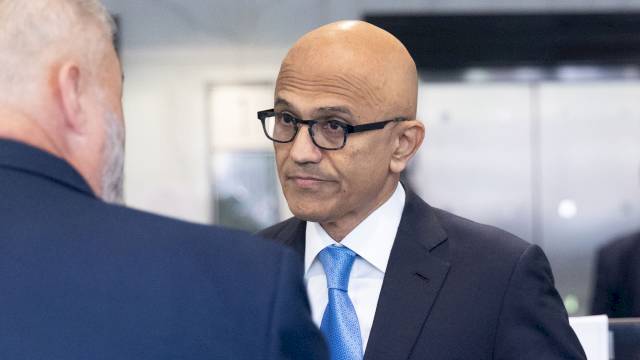
Microsoft CEO Satya Nadella arrives to court at the Ronald V. Dellums Federal Building on May 11, 2026 in Oakland, California.
Benjamin Fanjoy | Getty Images
Microsoft CEO Satya Nadella took the stand yesterday in the ongoing trial between Musk and OpenAI CEO Sam Altman. Musk named Microsoft as a defendant in his 2024 lawsuit against OpenAI, accusing the company — a major backer of OpenAI — of aiding the AI startup’s alleged breach of its charitable trust.
In his hours-long testimony, Nadella said Musk never contacted him to express concern that Microsoft’s investments in OpenAI violated special terms or commitments. The Microsoft CEO also said that he never demanded OpenAI’s board reinstate Altman after the startup’s board fired the CEO in 2023.
Former OpenAI co-founder Ilya Sutskever took the witness stand after Nadella, followed by Bret Taylor, chairman of the board at OpenAI. Altman is expected to take the stand today.
Get Morning Squawk directly in your inbox
4. Pumping the breaks
Signage at a General Motors Co. Chevrolet dealership in Colma, California, US, on Friday, Jan. 23, 2026.
David Paul Morris | Bloomberg | Getty Images
General Motors is slashing hundreds of salaried information technology employees in a bid to cut costs. As CNBC’s Michael Wayland reports, the reductions began yesterday and are mainly focused on workers in Michigan and Texas.
GM said in a statement that it is “transforming” its IT arm to “better position the company for the future.” The Detroit-based automaker is still hiring IT workers despite the reductions.
GM didn’t specifically mention AI in its announcement, but the cuts come amid a wave of tech layoffs related to AI. Still, National Economic Council Director Kevin Hassett told CNBC yesterday that there is “no sign in the data that AI is costing anybody their job right now.”
5. Oil change
Grace Cary | Moment | Getty Images
Trump and congressional Republicans are proposing a suspension of the federal gas tax as fuel prices surge ahead of the midterm elections.
The president told reporters yesterday that he would “reduce” the tax of 18.4 cents per gallon — where it’s stood since 1993. Trump cannot unilaterally enact a gas tax holiday since Congress oversees taxation, but Sen. Josh Hawley, R-Mo., and Rep. Anna Paulina Luna, R-Fla., both said they’d introduce bills in their respective chambers to suspend the tax.
Meanwhile, Kalshi traders aren’t expecting relief at the pump. The odds of prices topping $5 per gallon exceeded 60% on the platform yesterday afternoon.
The Daily Dividend
April home sales data from the National Association of Realtors disappointed analysts yesterday, as higher mortgage rates weighed on buyers. Here’s what else the NAR reported for April:
Median price of sold homes: $417,700
Average time on market: 32 days
Year-over-year inventory growth: 1.4%
— CNBC’s Kevin Breuninger, Justina Lee, Sam Meredith, Spencer Kimball, Lee Ying Shan, Sean Conlon, Tobias Burns,Michael Khouw,Kai Nicol-Schwarz, Yun Li, Megan Cassella,Jordan Novet,Ashley Capoot,Garrett Downs, Ananya Chetia and Diana Olick contributed to this report.
Davis Giangiulio assisted in the production of this newsletter. Josephine Rozzelle edited this edition.
Disclosure: CNBC and Kalshi have a commercial relationship that includes a CNBC minority investment.
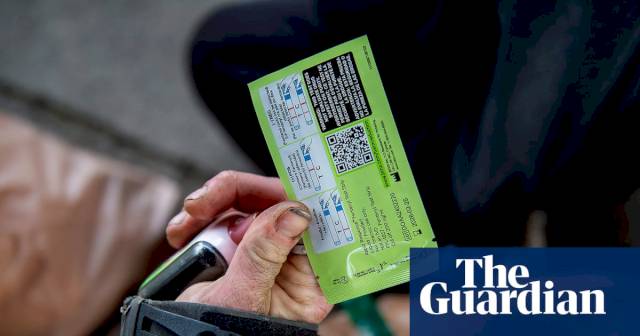
The Trump administration’s decision to restrict use of federal funds for fentanyl test strips, in what officials described as a “clear shift away from harm reduction”, could have fatal consequences, experts and critics have warned.
The Substance Abuse and Mental Health Services Administration (Samhsa) issued an open letter in April ordering an end to the use of its funding for all substance testing strips, including fentanyl, xylazine and medetomidine, the latest novel street drug to wreak havoc across the US.
The letter claimed that testing strips facilitate “illicit drug use” and are “incompatible with federal laws”.
But the move could substantially reduce the availability of drug-testing strips for people at risk of overdose amid an ever-changing drug supply, harm reduction advocates warned.
“It’s going to kill people,” said Maia Szalavitz, a New York Times columnist and the author of Undoing Drugs: The Untold Story of Harm Reduction and the Future of Addiction. “God forbid you should have a safe supply of something that might get you high.”
She described the pro-abstinence US Department of Health and Human Services (HHS) secretary, Robert F Kennedy Jr, as “somebody who represents himself as being in recovery” but is in fact “the worst thing that has happened to the addictions field for decades and decades”.
Use of federal funds to purchase fentanyl test strips was first permitted in 2021 by the Biden administration in an effort to reduce overdose deaths from the inadvertent consumption of the potent synthetic opioid fentanyl, which drug dealers mix into heroin with other drugs to increase their profits.
At the time, the interim Samhsa leader said the decision “will save lives”. But, the new administration has a more anti-drug ideological bent, said Szalavitz.
“What we keep hearing from the administration is that they believe that fentanyl test strips promote drug use,” said Daniel Fishbein, policy manager of federal affairs for the Drug Policy Alliance advocacy group. “Based on the research that I’ve reviewed, that’s simply not the case.”
However, in the National Drug Control Strategy published last week, the White House offered a completely different view – suggesting a fragmentation of views and influence across the administration. “Rapid test strips and similar technologies that detect fentanyl and other drugs are an important tool that should be legal,” it said.
Yet in light of the Samhsa guidance, some states have already paused statewide purchasing and distribution of fentanyl test strips to comply with the new guidance, which Fishbein described as a “180-degree turn” after Samhsa said in July that its funding could be used in such a way.
“These are tools that can be used to help people make more informed decisions about their drug use,” he added.
Emanuel Sferios, the founder of non-profit DanceSafe, a leading supplier of testing strips, said the move was an attack on the philosophy of harm reduction, which acknowledges that people will take drugs and therefore the most rational and humane course of action is to ensure they do so as safely as possible.
When Biden allowed federal grant recipients to use funds for fentanyl test strips, which cost less than a dollar each, DanceSafe’s sales swiftly quintupled, he said.
“We now have these reactionary, anti-drug authoritarians in control who don’t see the value of harm reduction and how the approach has saved so many lives,” said Sferios, who now heads the non-profit Grassroots Harm Reduction, another test strip distributor. “In those small places where you can still find heroin, these are absolutely lifesaving strips.”
It is generally difficult for people who use drugs to find pure heroin on the streets of the US, given the widespread introduction of the more dangerous opioid fentanyl, which even in tiny quantities can kill people with no opioid tolerance.
Now, after the flesh-destroying drug xylazine was mixed into the supply several years ago, the potent sedative medetomidine – which has excruciating withdrawal symptoms – is becoming more prevalent.
But medetomidine withdrawal can lead to a heart attack, and some people who use drugs may not have been aware the sedative was in their system had it not been for the test strips available at harm reduction hubs across major cities.
“Three programs that purchase [test strips] from us are scrambling right now to get other funding sources,” said Sferios. “This is going to be very significant.”
The Kentucky Harm Reduction Coalition was reportedly informed it would be losing a $400,000 federal grant. It distributed almost 50,000 fentanyl test strips in the first three months of the year and only has a month’s supply left.
Congress only recently recognized the value of drug-testing strips in a December law signed off by Donald Trump. The Support for Patients and Communities Reauthorization Act authorizes state and tribal opioid response grantees to facilitate “access to products used to prevent overdose deaths by detecting the presence of one or more substances, such as fentanyl and xylazine test strips”.
“The new guidance is a violation of congressional intent,” said Fishbein. “Test strips are supported by Congress as a public health tool.”
Last year, the president issued an executive order which also banned the use of federal grant funding on safer drug-consumption facilities, which first opened in the US in 2021 in New York City. Within two years, they had reversed 1,000 overdoses.
“No HHS funding can be used to support ‘overdose hotlines’ that have a primary function of facilitating illicit drugs use by providing people using drugs a virtual or telephonic companion while they are using drugs,” the Samhsa letter said.
The Biden administration was applauded for backing some public health measures which contributed to a significant decline in overdose deaths, by 26% from 2023 to 2024. But even while almost 80,000 people die from overdoses each year, Samhsa has cut $350m in addiction and overdose prevention funding since Trump came to office.
In recent weeks, however, Trump surprised drug reform advocates in issuing an executive order to accelerate research and widen access to psychedelic therapies, while removing cannabis from the strictest drug control bracket.
A HHS spokesperson said access to overdose reversal medications such as naloxone was being expanded and that it was critical that taxpayer funds went on “effective, commonsense solutions that have been proven to keep people out of an endless cycle of addiction and save lives and moves them into a life of recovery”.
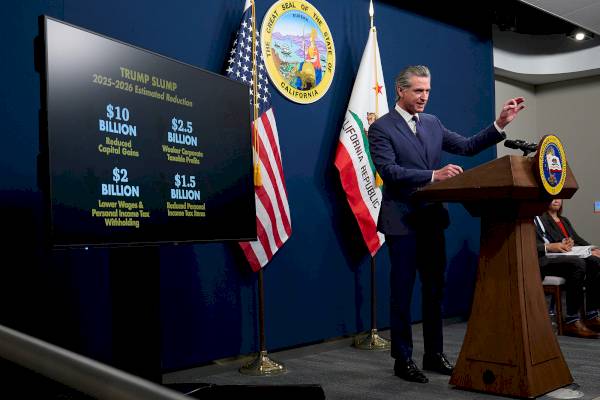
Gov. Gavin Newsom addresses the media while unveiling his revised 2025-26 budget proposal in Sacramento on May 14, 2025. Photo by Fred Greaves for CalMatters
The state Assembly’s Democratic leadership published a remarkable bit of political fiction last week, a “budget road map” that essentially blames President Donald Trump for California’s multibillion-dollar deficits.
The document declares that “state revenues are surging,” which may be true, but then continues: “Yet the fiscal picture ahead is anything but easy. Because of the Trump administration’s failed policies, health care costs are climbing. Republicans in Washington are ripping away federal funding. And a White House that’s lurching — from unprecedented foreign policy miscalculations to reckless tariffs — makes an already difficult job balancing the budget significantly more challenging.”
Nowhere does the document acknowledge that the state has a “structural deficit” that has plagued the budget for four years, ever since Gov. Gavin Newsom declared in 2022 that the state had a $97.5 billion surplus based on what the administration later acknowledged to be a $165 billion, four-year error in forecasting revenues. It had assumed that a one-time surge in revenues would be permanent.
The Legislature embraced the revenue estimate and the surplus declaration without question and sharply increased spending. When the assumed revenues didn’t materialize, they were left with obligations that outstripped real revenues by $20 billion or more each year.
The gaps, $125 billion so far, have been papered over with a variety of what officials called “solutions,” most of which solved nothing other than postponing the day of fiscal reckoning. They included off-the-books loans, spending deferrals and accounting gimmicks.
READ NEXT
Newsom has pledged to finally balance the state’s books in his revised 2026-27 budget that will be unveiled this week and to not leave the chronic deficit for his successor. But how he would do that without raising taxes remains a mystery.
The state Senate leadership’s budget outline embraces tax increases of some kind, probably on corporations, while the Assembly’s version says, “Fixing the long-term budget will take a combination of cost controls and new revenue.”
While Trump’s name is invoked repeatedly in the Assembly’s “budget road map” as a major factor in the state’s budget dilemma, not only does the problem predate Trump by several years but the reductions in federal aid, mostly affecting health care, don’t impose any legal obligation on the state to fill in the gaps. Moreover, Newsom and the Legislature have made their own health care reductions.
One of the biggest items in that 2022 spending surge after Newsom’s wrongheaded surplus declaration was the extension of Medi-Cal health care coverage to all adult undocumented immigrants. The coverage took effect in 2024 but in 2025, officials said it was costing $6.2 billion more than expected, so enrollment was frozen.
Backfilling today’s federal reductions would be costly, and health care advocates are ramping up pressure on Capitol politicians to do it, but the underlying structural deficit is a far bigger nut to crack.
Revenues are running higher than projected in the current fiscal year. The Legislature’s budget analyst, Gabe Petek, has upgraded estimates of revenue from sales taxes and personal and corporate income taxes by $25 billion over two years but adds, “we continue to caution that these surging revenues likely are not sustainable. This suggests it would be prudent to approach the state budget as if we are at or near a revenue peak.”
Petek’s office also notes that about half of any revenue surge would automatically go to schools, so the impact on the larger budget deficit would be marginal.
The danger is that the Capitol’s politicians may not only blame Trump for the problem they created four years ago, but they’ll seize on the revenue surge as a painless cure — in other words repeating what got them in trouble in the first place.
READ NEXT
Dan Walters is one of most decorated and widely syndicated columnists in California history, authoring a column four times a week that offers his view and analysis of the state’s political, economic,… More by Dan Walters
Recent polls indicate growing frustration with President Donald Trump’s handling of the economy.
A new CNN poll conducted by survey research poll SSRS finds that 77% – including a majority of Republicans – say that Trump’s policies have increased the cost of living in their own community, CNN reported on Tuesday, May 12. The news outlet also reported that Trump’s approval rating stands at 30% on the economy.
Earlier this month, on May 6, an NPR/PBS News/Marist poll found that the majority of Americans say their local cost of living is not very affordable (44%) or not affordable at all (12%). The poll also states that 61% of residents nationally disapprove of how President Trump is handling the economy, up slightly from 58% in March.
Donald Trump approval ratings today
Here’s the latest data:
Ballotpedia has Trump with a 40% approval rating.
RealClearPolitics has Trump with a 40.5% approval rating.
The New York Times has Trump with a 38% approval rating.
The Economist/YouGov poll has Trump at 37% approval.
CNN/SSRS has Trump with a 35% approval rating.
USA Today contributed to this story.
Natassia Paloma may be reached at npaloma@gannett.com, @NatassiaPaloma on x; natassia_paloma on Instagram, and Natassia Paloma Thompson on Facebook.