Live Updates
Venezuela tense as Europe pushes back on Trump’s Greenland claims
” data-timestamp-html=”
” data-check-event-based-preview data-is-vertical-video-embed=”false” data-network-id data-publish-date=”2026-01-06T11:37:26.366Z” data-video-section=”world” data-canonical-url=”https://www.cnn.com/2026/01/06/world/video/venezuela-caracas-gunfire-anti-aircraft-fire-ldn-digvid” data-branding-key data-video-slug=”venezuela-caracas-gunfire-anti-aircraft-fire-ldn-digvid” data-first-publish-slug=”venezuela-caracas-gunfire-anti-aircraft-fire-ldn-digvid” data-video-tags data-breakpoints=”{“video-resource–media-extra-large”: 660}” data-display-video-cover=”true” data-details data-track-zone=”live-story-lede” data-sticky-anchor-pos=”bottom”>
Gunfire and anti-aircraft fire seen overnight in Caracas
00:43 • Source: CNN
Gunfire and anti-aircraft fire seen overnight in Caracas
00:43
• On the ground: Venezuela remains on edge following the capture of ousted leader Nicolás Maduro. Security forces were seen patrolling the streets, and gunfire and anti-aircraft fire were reported over the capital of Caracas overnight. A Venezuelan ministry spokesperson said “no confrontation occurred.” Sigue nuestra cobertura en español.
• Renewed focus on Greenland: Leaders from major European powers expressed support for Greenland and Denmark in a joint statement issued earlier today after President Donald Trump said the US “needs” the island.
• What’s next for Venezuela?: Opposition leader María Corina Machado has vowed to return home “as soon as possible,” but White House aide Stephen Miller dismissed calls for the US to install her as Maduro’s replacement. Trump said he considers himself in charge of Venezuela.
• Not-guilty plea: Maduro and his wife pleaded not guilty to drug and weapons charges yesterday and chose not to immediately fight their detention.

The Trump administration is facing scrutiny at home and abroad after launching a military operation in Venezuela that lead to the ousting of leader Nicolás Maduro.
US lawmakers are starting to be briefed on the operation, while the administration tries to persuade oil executives to drill in Venezuela.
As the situation develops in Venezuela, here’s a look at what’s happening this week:
- Both the House and Senate are expected to receive closed-door briefings on the operation tomorrow. The Senate will hold a members-only classified briefing at 10 a.m. ET in the Senate’s SCIF, according to a source and a notice sent to Senate offices. The House is expected to have a similar briefing.
- The Senate is set to vote midweek — likely Thursday — on a measure to limit President Donald Trump’s war powers in Venezuela.
- US Energy Secretary Chris Wright will meet with oil executives this week to discuss US companies once again standing up drilling for oil in Venezuela, according to an Energy Department spokesperson.
CNN’s Ella Nilsen, Adam Cancryn, René Marsh, Sarah Ferris and Manu Raju

Venezuelan Attorney General Tarek William Saab announced Tuesday the appointment of three officials to investigate the “dozens” of deaths resulting from the US attack on the country, which led to the capture of President Nicolás Maduro and his wife.
“We, as the Public Prosecutor’s Office, have appointed three prosecutors to investigate the dozens of innocent civilian and military casualties that occurred during this war crime, this unprecedented aggression against the Venezuelan homeland,” Saab said at an event notifying the Attorney General’s Office, the Comptroller General’s Office, and the Public Prosecutor’s Office of the start of a new five-year term for Parliament.
To date, the Venezuelan government has not specified the number of dead or wounded during the attacks.

Senate Judiciary Ranking Member Dick Durbin, who is also a senior member of Senate Democratic leadership, said he has “mixed feelings” about Secretary of State Marco Rubio after he was briefed on the Venezuela operation Tuesday morning.
Durbin and the top Republican on the Senate Judiciary Committee, Chairman Chuck Grassley, were briefed over the phone by Attorney General Pam Bondi after they released a statement on Monday expressing their frustration that they were not included in last night’s briefing for a select group of top lawmakers.
“I’ve got mixed feelings. Marco is a personal friend of mine, and we’ve worked together in the Gang of Eight. We had a number of things we worked on over the years,” said Durbin. “Having said that, he has been loyal to President Trump, which you might expect. But when I voted for him, I had no idea the extent that the president would push him when it came to decision making. I have mixed feelings about his future.”
Rubio was confirmed 99-0 in January 2025, with the support of every Senate Democrat.
Durbin also was clear that, despite the administration’s denials, he believes the US is engaging in a regime change in Venezuela.
“That term is freighted with a lot of politics, and there’s been a lot of sad chapters in our nation’s history with the rubric of regime change. So, they’re careful to say what they’re doing, but their explanations don’t make sense at this point,” he told reporters. “It’s about narco-terrorism, and it was about oil, then it was about regime change. Let’s get down to the bottom line here: We’re on the line with a country now that has 30 million people and no real leadership. That’s not a good recipe for a stable future.”

Cuba’s government on Tuesday released the identities of the 32 Cuban agents who worked in the security apparatus of the Venezuelan government and died during Saturday’s attack by the United States in Caracas.
“Thirty-two Cubans, victims of a new criminal act of aggression and state terrorism, perpetrated against our sister the Bolivarian Republic of Venezuela by the United States, lost their lives in combat and after fierce resistance,” the Ministry of the Armed Forces said as it shared the list, which includes two colonels, a lieutenant colonel, four majors and other military ranks, aged between 26 and 67.
Cuban President Miguel Díaz-Canel ordered two days of official mourning from Monday, during which flags are at half mast and the majority of public acts suspended.
According to the leader, the Cubans “were fulfilling missions in representation of the Revolutionary Armed Forces and the Ministry of the Interior, on the request of the corresponding bodies of that country (Venezuela).” He related that they died “after fierce resistance, in direct combat against the attackers and as a result of the bombings of installations” during the capture of President Nicolás Maduro and his wife.
Cuba and Venezuela, two close allies, have since 2000 maintained a comprehensive cooperation agreement that allows thousands of Cuban doctors and professionals in education, sport, and other sectors to remain in the South American country, but until now neither of the two has acknowledged the work of intelligence or security agents, which was an open secret.
Given that the Venezuelan government has not divulged the total number of casualties in Saturday’s military intervention, it is not known what percentage of those killed the 32 Cubans represent.
Sen. Ruben Gallego said that he is introducing a resolution to prevent the US from invading Greenland.
“WAKE UP. Trump is telling us exactly what he wants to do. We must stop him before he invades another country on a whim,” Gallego said in a post on X,.
“I’m introducing a resolution to block Trump from invading Greenland. No more forever wars.”
Under the War Powers Act, the Senate will have to consider this resolution on the floor in the near future. The Senate is set to vote in a Venezuela War Powers resolution later this week.

Senators who attended last night’s classified briefing on the US military operation in Venezuela are reacting to the controversial move by the Trump administration.
Some said the briefing raised more questions, while others now feel more assured about the administration’s decision.
- Senate Majority Leader John Thune said he is more comfortable and confident that the US has a plan for how to operate in that country and said he understands that the new acting President Delcy Rodriguez is “practical” and “pragmatic.”
- Senate Minority Leader Chuck Schumer said that top administration officials had “no real answers” on the future of Venezuela and US involvement during last night’s classified briefing. “For two long hours, we heard yesterday from the administration, and what we heard was little more than wishful thinking and no real answers,” Schumer said. He said he was “troubled” by Trump officials’ answer on potential action in other nations in the Western Hemisphere, and added that senators and members of Congress were told there is “no cost estimate” for action relating to Venezuela.
- Democratic Sen. Jeanne Shaheen of New Hampshire echoed concerns from fellow lawmakers that the Trump administration lacks clarity on its plans for Venezuela. “In terms of what comes next and the actions that are going to secure the goals that the administration seems to be articulating for Venezuela, there were there were not a lot of details,” she said.
Russia’s foreign ministry has slammed the “blatant neocolonial threats and armed aggression” carried out against Venezuela over the weekend, without directly naming the United States.
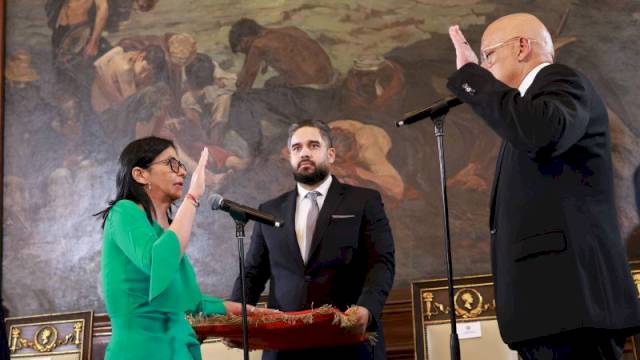
In a statement, the ministry welcomed the swearing in of Delcy Rodríguez as Venezuela’s acting president, saying that it demonstrates Caracas’ determination to, among other things, “ensure unity,” “curb the risks of a constitutional crisis,” and “create the necessary conditions for the further peaceful and stable development of Venezuela.”
The foreign ministry also said it was ready to provide “the necessary support” to its “friend Venezuela.”
“We firmly believe that Venezuela must be guaranteed the right to determine its own destiny without any destructive external interference,” it said.
Some context: Russia and Venezuela are close allies. After the US’s attack on Venezuela on Saturday, the Russian foreign ministry condemned what it called an “act of armed aggression against Venezuela,” calling any “excuses” given to justify such actions “untenable.”
After Washington tightened trade sanctions on Caracas in mid-2024, Venezuela has relied more heavily on other partners, including Moscow. Russian President Vladimir Putin stated in May last year that trade with Venezuela grew by 64% in 2024.
CNN’s Svitlana Vlasova and Billy Stockwell and CNNE’s Mauricio Torres, Gonzalo Zegarra and Germán Padinger contributed to this reporting.
The White House reiterated that Greenland would be better protected by the US after European leaders expressed support for Denmark and the Danish territory.
The European leaders said in their statement that “Greenland belongs to its people.”
“It is for Denmark and Greenland, and them only, to decide on matters concerning Denmark and Greenland,” the leaders of France, Germany, Italy, Poland, Spain, Britain and Denmark wrote.
Venezuelans are entering a time of uncertainty following the US military operation that ousted leader Nicolás Maduro.
While some are relieved to have Maduro no longer in power, there is also growing anxiety about what the US’ role will be in the country moving forward.
Here’s a brief history of Venezuela and key moments that led to Maduro’s rise and eventual downfall:
” data-timestamp-html=”
” data-check-event-based-preview data-is-vertical-video-embed=”false” data-network-id data-publish-date=”2026-01-06T15:30:16.172Z” data-video-section=”world” data-canonical-url=”https://www.cnn.com/2026/01/06/world/video/venezuela-history-politics-chavez-maduro-robertson-vrtc” data-branding-key data-video-slug=”venezuela-history-politics-chavez-maduro-robertson-vrtc” data-first-publish-slug=”venezuela-history-politics-chavez-maduro-robertson-vrtc” data-video-tags data-breakpoints=”{“video-resource–media-extra-large”: 660}” data-display-video-cover=”true” data-vertical-orientation=”true” data-details>
A brief history of Venezuela’s politics
CNN’s Nic Robertson explains a brief history of Venezuela’s political landscape after the US captured Venezuelan President Nicolás Maduro and President Donald Trump said the US will “run” the country.
02:02 • Source: CNN
A brief history of Venezuela’s politics
02:02
” data-timestamp-html=”
” data-check-event-based-preview data-is-vertical-video-embed=”false” data-network-id data-publish-date=”2026-01-06T15:55:10.193Z” data-video-section=”world” data-canonical-url=”https://www.cnn.com/2026/01/06/world/video/us-greenland-denmark-jarlove-intv-ctw-010609aseg1-cnni-world-fast” data-branding-key data-video-slug=”us-greenland-denmark-jarlove-intv-ctw-010609aseg1-cnni-world-fast” data-first-publish-slug=”us-greenland-denmark-jarlove-intv-ctw-010609aseg1-cnni-world-fast” data-video-tags=”cnni-fast” data-breakpoints=”{“video-resource–media-extra-large”: 660}” data-display-video-cover=”true” data-details>
Danish lawmaker speaks to CNN about Trump’s Greenland threats
04:33 • Source: CNN
Danish lawmaker speaks to CNN about Trump’s Greenland threats
04:33
The United States is “almost starting a war with an allied country” in its pursuit of Greenland, Danish parliament member Rasmus Jarlov told CNN’s Becky Anderson today.
“It is quite shocking that a person who’s in charge of this completely illegitimate land claim on Greenland knows so little about the history and the background of why Greenland belongs to Denmark,” Jarlov said, referencing White House deputy chief of staff Stephen Miller, who last night said that nobody would fight the US if it tried to seize the autonomous Danish territory.
For context: US President Donald Trump has renewed his public calls for the autonomous Danish territory after the capture of Venezuelan President Nicolas Maduro.
While the US has said it needs Greenland for security purposes, Jarlov pointed out that the country already has “exclusive and full military access” to the island. “So this talk about needing Greenland for security is complete nonsense,” he added.
Should the US attack Greenland militarily, Denmark “will defend it, and in that case, we would be at war,” Jarlov said.
CNN’s Francisca Marques contributed to this reporting.
The attack on Venezuela has already come at a heavy cost for Cuba, with the government reporting in a social media post that 32 of its citizens were killed during the US military operation.
Ousted Venezuelan leader Nicolás Maduro’s inner circle of bodyguards were Cuban. Saturday’s operation appears to be the first time in decades that the former Cold War-era foes have engaged in combat. Now, the Cuban government is wondering if it could be the next country targeted by the Trump administration.
Watch to learn more about what could be next for Cuba amid escalating tensions:

” data-timestamp-html=”
” data-check-event-based-preview data-is-vertical-video-embed=”false” data-network-id data-publish-date=”2026-01-06T14:03:01.181Z” data-video-section=”world” data-canonical-url=”https://www.cnn.com/2026/01/06/world/video/venezuela-cuba-connection-whats-next-vrtc” data-branding-key data-video-slug=”venezuela-cuba-connection-whats-next-vrtc” data-first-publish-slug=”venezuela-cuba-connection-whats-next-vrtc” data-video-tags=”vertical” data-breakpoints=”{“video-resource–media-extra-large”: 660}” data-display-video-cover=”true” data-vertical-orientation=”true” data-details>
The Venezuela-Cuba connection: What’s next for Havana?
CNN’s Patrick Oppmann explains what’s next for Cuba as political turmoil rocks the country’s close ally, Venezuela, after the US capture of Nicolás Maduro.
01:51 • Source: CNN
The Venezuela-Cuba connection: What’s next for Havana?
01:51

The president of Mexico, Claudia Sheinbaum, called Tuesday for a “fair trial” for the ousted president of Venezuela, Nicolás Maduro, who was captured on January 3 along with his wife, Cilia Flores, in Caracas after a US military intervention, and then transferred to New York, where they face drug trafficking charges.
“In this case, now that President Maduro has been detained, what one asks for is always a fair trial. That is what must be requested, so that truly in everything, for everyone and in any circumstance – and in this particular case – there must be speed and justice,” the president said during her morning press conference.
Sheinbaum reiterated Mexico’s position of rejecting US intervention, stating that “regardless” of one’s opinion of Maduro’s presidency or the Venezuelan government, her government condemns Washington’s “invasion.”
“We must recover our history, our constitution, and what each one says about it,” she said.
She recalled that Mexico defends “non-intervention, the peaceful resolution of disputes,” and noted that even “if a country is very small internationally, we are all equal.”
“That is why we speak of the legal equality of states. International cooperation for development, which is what I mentioned yesterday. The best way to help a country is international cooperation for development. Respect, protection, and promotion of human rights,” she asserted.
Since Maduro’s detention on January 3, Mexico has expressed its rejection of Washington’s military intervention in Venezuela and has defended the sovereignty of nations.
On Sunday, it issued a joint statement with Brazil, Chile, Colombia, Spain, and Uruguay rejecting “the military actions unilaterally carried out on Venezuelan territory” and expressing “concern about any attempt at governmental control, administration, or external appropriation of natural or strategic resources.”

Venezuela’s Attorney General Tarek William Saab demanded the release of ousted Venezuelan leader Nicolás Maduro, saying that he has “diplomatic immunity.”
The attorney general urged Alvin K. Hellerstein, the US judge in charge of Maduro’s case, to “respect international law and proceed to recognize the lack of jurisdiction of the court under his command to try the leader of a sovereign nation, like the Venezuelan homeland, who is protected by diplomatic immunity, I repeat, as head of state.”
Saab also urged Hellerstein to “cease all human rights violations that have been carried out against the president, his wife, and obviously against the Venezuelan people.”
Maduro and his wife Cilia Flores pleaded not guilty yesterday in their first court appearance in New York.
Follow our live coverage in Spanish of the situation in the country.
” data-timestamp-html=”
” data-check-event-based-preview data-is-vertical-video-embed=”false” data-network-id data-publish-date=”2026-01-06T16:44:51.704Z” data-video-section=”us” data-canonical-url data-branding-key data-video-slug=”bolton-machado-venezuela-trump-latam-intl” data-first-publish-slug=”bolton-machado-venezuela-trump-latam-intl” data-video-tags data-breakpoints=”{“video-resource–media-extra-large”: 660}” data-display-video-cover=”true” data-details>
Bolton: Trump administration making ‘big mistake’ by choosing not to support opposition leader María Corina Machado
01:51 • Source: CNN
Bolton: Trump administration making ‘big mistake’ by choosing not to support opposition leader María Corina Machado
01:51
The Trump administration’s recent rhetoric about Greenland in light of its actions in Venezuela is harming American security, according to John Bolton, US President Donald Trump’s former national security adviser.
When asked by CNN’s Kate Bolduan about comments made by White House deputy chief of staff Stephen Miller yesterday that “nobody’s gonna fight the United States militarily over the future of Greenland,” Bolton said that Miller was making a “simple-minded statement.”
“This is a self-inflicted wound by the Trump administration. It harms American security. It does not enhance it by this kind of talk about Greenland,” Bolton continued.
On Venezuela: Bolton also reiterated that the Trump administration was making a “big mistake” by choosing not to support opposition leader María Corina Machado as the new leader of Venezuela.
Machado and fellow opposition leader Edmundo González “are the people who can help provide stability,” Bolton said, not those who were a part of the regime ran by ousted President Nicolás Maduro.
” data-timestamp-html=”
” data-check-event-based-preview data-is-vertical-video-embed=”false” data-network-id data-publish-date=”2026-01-06T16:31:01.954Z” data-video-section=”us” data-canonical-url data-branding-key data-video-slug=”trump-helicopters-venezuela-operation-latam-intl” data-first-publish-slug=”trump-helicopters-venezuela-operation-latam-intl” data-video-tags data-breakpoints=”{“video-resource–media-extra-large”: 660}” data-display-video-cover=”true” data-details>
President Trump describes ‘complex’ Venezuela operation
00:37 • Source: CNN
President Trump describes ‘complex’ Venezuela operation
00:37
President Donald Trump on Tuesday celebrated the capture of ousted Venezuelan leader Nicolás Maduro, boasting that the high-risk operation proved the US has the “most fearsome” military in the world.
“We had a lot of boots on the ground, but it was amazing,” he said during a speech at a House GOP retreat in Washington, DC. “It was brilliant tactically.”
Trump recounted several operational details to Republican lawmakers, indicating the US cut electricity to major parts of Venezuela just before entering the country. That gave the military the element of surprise as it approached Maduro’s compound.
“And think of it, nobody was killed,” Trump said. “And on the other side, a lot of people were killed.”
Trump went on to criticize Democrats for airing concerns about the decision to capture Maduro, complaining that few in the party were congratulating him.
“At some point they should say, you know, ‘You did a great job,’” he said. “‘Thank you, congratulations.’ Wouldn’t it be good?”
” data-timestamp-html=”
” data-check-event-based-preview data-is-vertical-video-embed=”false” data-network-id data-publish-date=”2026-01-06T08:01:48.736Z” data-video-section=”world” data-canonical-url data-branding-key data-video-slug=”colombia-petro-trump-ward-lkl-010602a-seg1-cnni-world-fast” data-first-publish-slug=”colombia-petro-trump-ward-lkl-010602a-seg1-cnni-world-fast” data-video-tags data-breakpoints=”{“video-resource–media-extra-large”: 660}” data-display-video-cover=”true” data-details>
Colombian president condemns U.S. threat of military intervention
01:57 • Source: CNN
Colombian president condemns U.S. threat of military intervention
01:57
Colombian Foreign Minister Yolanda Villavicencio confirmed Tuesday that she will submit a note of protest to the United States over threats made by President Donald Trump against Colombian President Gustavo Petro.
“The meeting we will have today with the US representative is to present our note of rejection of these offenses, which are not only directed at President Gustavo Petro,” the foreign minister said. “We want them to understand that he is our democratically elected president. An offense against the president is an offense against our country,” she added.
On Sunday, Trump described Petro as “a sick man who likes making cocaine and selling it to the United States, and he’s not going to be doing it very long.”
When pressed by a reporter on whether those comments meant there could be an “operation” in Colombia in the future, Trump responded, “Sounds good to me.” Petro subsequently refuted Trump’s claims and defended his government’s record on combating drug trafficking in a lengthy post on X.
Villavivencio rejected the US “aggression” against Venezuela over the weekend and said that, while Bogotá maintains its non-recognition of the country’s 2024 elections, it respects the Venezuelan legal system that led to Delcy Rodríguez taking office as acting president after Maduro’s capture.
The minister said she has been in contact with the Venezuelan government, without giving details of those conversations, and said that Colombia has not received asylum requests from Chavista leaders.
CNN’s Tim Lister and Hira Humayun contributed to this report.
Venezuelan security forces detained 14 journalists in the capital on Monday, including reporters who were covering the swearing-in of the country’s national assembly, according to the national press union.
In a post on X, the SNTP reported that 13 foreign journalists and one Venezuelan journalist were detained on Monday in Caracas before later being released.
The union said that journalists had their equipment and messaging apps checked.

Tensions are high on the ground in Venezuela following the capture of now ousted leader Nicolas Maduro, while some of the focus diplomatically has shifted to the US’ claims on Greenland, which have provoked a strong pushback from Europe.
If you’re just joining us, catch up on the latest developments:
- Patrols in Caracas: Rights groups are reporting checkpoints and media repression as security forces patrol the streets of Venezuela’s capital city.
- UN concerns: The United Nations has said it is “deeply worried” about what comes next for Venezuela and said that the military operation “undermined a fundamental principle of international law.”
- US Congress briefings: The full House and Senate are expected to receive closed-door briefings on the US’ Venezuela operation from top Trump administration officials tomorrow.
- On Greenland: In a joint statement, leaders from major European powers have expressed support for Denmark and Greenland, saying the Arctic island belongs to its people, following renewed interest by US President Donald Trump in taking over the Danish territory. Yesterday, White House deputy chief of staff Stephen Miller told CNN that Greenland “obviously” should be a part of the US.
- Reaction in Latin America: Colombian President Gustavo Petro has warned that Trump is aiming to turn Latin American nations into colonies of the US. Read more about what Venezuelans are saying in Caracas. And follow our live coverage in Spanish of the situation in the country here.
CNN’s Catherine Nicholls, Sarah Ferris, Manu Raju, Jack Guy contributed to this report.
” data-timestamp-html=”
” data-check-event-based-preview data-is-vertical-video-embed=”false” data-network-id data-publish-date=”2026-01-06T01:33:02.890Z” data-video-section=”world” data-canonical-url=”https://www.cnn.com/2026/01/05/world/video/stephen-miller-greenland-part-of-us-trump-venezuela-tapper-digvid-vrtc” data-branding-key data-video-slug=”stephen-miller-greenland-part-of-us-trump-venezuela-tapper-digvid-vrtc” data-first-publish-slug=”stephen-miller-greenland-part-of-us-trump-venezuela-tapper-digvid-vrtc” data-video-tags=”vertical” data-breakpoints=”{“video-resource–media-extra-large”: 660}” data-display-video-cover=”true” data-vertical-orientation=”true” data-details>
Miller says Greenland should ‘obviously’ be a part of US
Stephen Miller asserts Trump administration’s position is Greenland should be part of the US.
02:09 • Source: CNN
Miller says Greenland should ‘obviously’ be a part of US
02:09
The full House and Senate are expected to receive closed-door briefings on the US’ Venezuela operation tomorrow.
The Senate will hold a members-only classified briefing at 10 a.m. ET in the Senate SCIF (sensitive compartmented information facility), according to a source familiar with the meeting and a notice sent to Senate offices.
The briefing will be led by Secretary of State Marco Rubio, Defense Secretary Pete Hegseth, Attorney General Pam Bondi, CIA Director Ratcliffe and Joint Chiefs Chairman Dan Caine.
The House is also expected to receive a similar classified briefing.
The Gang of Eight and top Republicans and Democrats from key House and Senate committees were briefed yesterday, but the fuller meeting this week will allow a wider swath of lawmakers to pose questions about the legality of the operation, future US involvement in Venezuela, and more amid questions over the propriety of the Trump administration’s actions.

The US’ attack on Venezuela and its capture of ousted President Nicolás Maduro over the weekend drew headlines worldwide and drew international attention – both positive and negative.
Just a few days after the strike, focus has also shifted to Greenland, a self-governing territory of Denmark. The Arctic island’s strategic location between Europe and North America makes it a critical site for the US ballistic missile defense system. Its mineral wealth also aligns with Washington’s ambition to reduce reliance on Chinese exports.
On Sunday, US President Donald Trump repeated his claim that his country “need(s) Greenland” from a security perspective.
White House deputy chief of staff Stephen Miller said yesterday that the formal position of the Trump administration is that “Greenland should be part of the United States.”
These remarks came following US military action on foreign soil, and were met with consternation from European allies.
Denmark’s Prime Minister Mette Frederiksen warned that there would be consequences should the US try to seize Greenland, saying in televised remarks that “if the US chooses to attack another NATO country militarily, everything stops, including NATO and thus the security that has been provided since the end of World War II.”
In a joint statement released today, the leaders of France, Germany, Italy, Poland, Spain, the United Kingdom and Denmark reiterated that “Greenland belongs to its people. It is for Denmark and Greenland, and them only, to decide on matters concerning Denmark and Greenland.”
CNN’s Rhea Mogul, Kit Maher, Tim Lister and Matthew Chance contributed to this reporting.
Leave a Reply