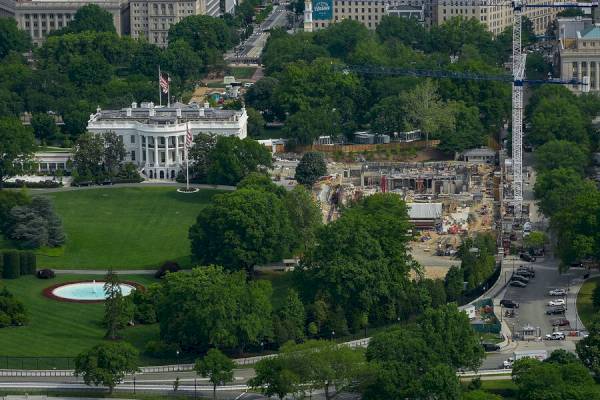
“We need the ballroom” for the White House, President Donald Trump asserted to reporters late on April 25, less than two hours after a gunman tried to storm a hotel ballroom where the president was about to speak.
“That’s why Secret Service, that’s why the military are demanding it,” he said from the White House briefing room, following an alleged assassination attempt at the Washington Hilton. “They’ve wanted the ballroom for 150 years.”
There’s no evidence that that’s the case, but the point is clear: President Trump’s planned 90,000-square-foot, highly secure White House ballroom – at the moment still a hole in the ground where the East Wing once stood – is an animating focus of his second term.
Why We Wrote This
Congress may now put $1 billion toward the ballroom project, which has so far been funded through private donations. It reflects President Donald Trump’s effort to leave a physical legacy as well as meet a genuine need.
It’s both a symbol of his desire to create an enduring physical legacy at the heart of American power and an effort to fulfill a genuine need for a larger event space on the White House campus. The project also includes an underground national-security complex.
Ethics experts say the ballroom is a key example of pay-to-play behavior, with wealthy donors and corporations appearing to curry favor with the administration by donating to a favored presidential project.
Some of the donors are known – including major firms in finance, tech, defense, and cryptocurrency – while others remain undisclosed. Some, such as Amazon, Microsoft, and Nvidia, have business before the administration, for example in helping to shape policy around artificial intelligence.
But the project also represents the stunning fashion in which Mr. Trump has shattered norms around presidential power, in tearing down the East Wing of the White House last October without advance authorization, ignoring seeming conflicts of interest with private donors, and then trying to secure permission for the new structure only after it was underway.

A worker drinks water as construction continues on a planned White House ballroom in the area of the former East Wing, seen through a window in the East Room, in Washington, May 4, 2026.
“President Trump’s approach to ethics seems to be to ask for forgiveness rather than permission,” says Ann Skeet, senior director of leadership ethics at the Markkula Center for Applied Ethics at Santa Clara University.
How the new ballroom will be paid for appears to be in flux. Until last month’s shooting at the Hilton, where Mr. Trump was attending the White House Correspondents’ Association dinner, the $400 million White House ballroom was going to be fully covered by private donations.
Now, after the latest apparent assassination attempt on Mr. Trump, public funding is on the table. One bill introduced by a group of Republicans, led by South Carolina Sen. Lindsey Graham, a Trump ally, would authorize $400 million to fund construction of the ballroom and the national-security-related facility below it. Senator Graham says national park user fees and customs fees would offset the costs.
Another GOP senator, Rand Paul of Kentucky, filed a joint resolution last week to authorize construction of the ballroom and the below-ground security facility, but not to fund the project. “My bill just says it’s authorized, and if he has the private money to do it, he can move forward,” Senator Paul told a Louisville TV station.
A third proposal, released Tuesday by Senate Judiciary Committee Chair Chuck Grassley of Iowa, would allocate $1 billion for enhanced Secret Service security, including the “East Wing Modernization Project,” as part of the Republicans’ funding bill for immigration enforcement. The legislative text says the money may not be used for “non-security elements” of the project.
The flurry of legislation has fueled conspiracy theories that the latest alleged assassination attempt was staged to help Mr. Trump gain congressional approval and funding for his ballroom. But the funding aspect may not fly, political analysts say, given the optics around taxpayer money going to a presidential ballroom during a midterm campaign dominated by voter concerns about the cost of living.
Last week, for security reasons, the Department of Justice asked U.S. District Judge Richard Leon to lift his block on ballroom construction. The U.S. Court of Appeals for the District of Columbia Circuit had already temporarily blocked Judge Leon’s ruling, allowing ballroom construction to proceed into June.
Mr. Trump’s goal is to complete the new ballroom – and the secure military complex directly beneath it – before he leaves office in January 2029.
Almost twice the size of the main White House edifice, the ballroom is meant to accommodate much larger events (up to 1,000 people) than the current mansion can (up to 250 people).
Over the decades, U.S. presidents have pitched tents on the White House’s South Lawn for larger events, hardly the elegant setting one might expect from the most powerful country in the world.
Changes to the White House are hardly unheard of. In 1948, President Harry S. Truman added a balcony to the south-facing side of the mansion. In the early 1960s, first lady Jacqueline Kennedy oversaw renovations to the White House funded with private donations.
But Mr. Trump, a real estate developer by profession, has plans much grander than a simple home renovation project. Beyond criticisms of Mr. Trump’s taste, ethical questions have swirled around donations to the ballroom – starting with the identity of donors and what they might be getting in return for their largesse.
Under the project’s fundraising contract, recently disclosed after the watchdog group Public Citizen sued for its release, many donors remain anonymous at their request. But a list of more than three dozen donors was released by the White House last fall, though the amounts of the donations were not revealed. Some donors, such as chipmaker Nvidia, revealed voluntarily that they donated to the White House ballroom.
In response to a query from the Monitor, a White House official said that contracts related to the White House executive residence have never been posted, for security reasons.
In the world of Trump fundraising, as overseen by the president’s chief campaign finance operative, Meredith O’Rourke, there are many other projects collecting donations.
“This is so much bigger than the ballroom,” says Kedric Payne, senior director of ethics at the Campaign Legal Center in Washington. “There are so many other projects he’s raising money for in the same manner.”
Mr. Payne points to the Trump presidential library in Miami; The Trump Kennedy Center in Washington; the planned Garden of Heroes honoring noteworthy Americans, also in Washington; and Freedom 250, the celebration of the nation’s 250th birthday.
In some cases, such as the presidential library, private donations are the standard route for funding. The John F. Kennedy Center for the Performing Arts, now dubbed The Trump Kennedy Center, also has a long history of private fundraising – appropriately so, say ethics experts who stress that transparency on who is donating is essential to maintaining trust.
And in a way, Mr. Trump can’t win. He gets criticized for soliciting private donations for public projects, but he also gets criticized when Congress tries to fund such projects.
Kathleen Clark, a law professor and expert on government ethics at Washington University in St. Louis, sees the need for Congress to assert itself and exercise more oversight over the president.
“He is coercively extracting money from [donors] to fund his pet projects, and he’s done so without, at this point, any authorization or appropriation from Congress,” Professor Clark says.
Leave a Reply