Live Updates
Trump arrives in China ahead of crucial Xi meeting
” data-timestamp-html=”
” data-check-event-based-preview data-is-vertical-video-embed=”false” data-network-id data-publish-date=”2026-05-13T12:27:34.018Z” data-video-section=”politics” data-canonical-url=”https://www.cnn.com/2026/05/13/politics/video/trump-arrives-in-beijing-digvid” data-branding-key data-video-slug=”trump-arrives-in-beijing-digvid” data-first-publish-slug=”trump-arrives-in-beijing-digvid” data-video-tags data-breakpoints=”{“video-resource–media-extra-large”: 660}” data-display-video-cover=”true” data-details data-track-zone=”live-story-lede” data-sticky-anchor-pos=”bottom”>
China rolls out red carpet treatment as Trump arrives for high-stakes visit
3:04 • Source: CNN

China rolls out red carpet treatment as Trump arrives for high-stakes visit
3:04
• Arrival in Beijing: US President Donald Trump arrived in China’s capital and was welcomed with a ceremony replete with pomp and pageantry for the start of a high stakes visit carrying global consequences, as the world’s two largest economies frame their trade relationship.
• High-stakes talks: After Trump’s first night in Beijing, he will meet with Chinese leader Xi Jinping to discuss a range of thorny issues including tech, trade and Taiwan.
• Iran’s shadow: The US-Israeli war with Iran, and ensuing global energy crisis, looms over the trip. Trump is expected to encourage Xi to push China-ally Iran to reopen the Strait of Hormuz, a chokepoint vital to oil trade, and agree to a peace deal.
• CEO caravan: Traveling with Trump are top officials and more than a dozen business leaders including Tim Cook and Elon Musk. Catch up on all the key developments here.
US President Donald Trump will begin two days of high-stakes talks with Chinese leader Xi Jinping in Beijing on Thursday morning local time (Wednesday night ET).
Here’s a look ahead at what’s on Trump’s schedule for the first day of his trip:
- At 8 a.m. local time (8 p.m. ET Wednesday), Trump is set to participate in executive time. This will be closed to press.
- Two hours later, at 10 a.m. local time (10 p.m. ET Wednesday) Trump will by greeted by Xi at the Great Hall of the People in Beijing. A short while later, the pair will participate in a meeting, which will be open to press.
- Later in the day, at 6 p.m. local time (6 a.m. ET Thursday), the two leaders will participate in a state banquet. This will also be open to press.
We’ll make sure to bring you updates from these events as we get them.
When Donald Trump won the US presidency in 2016, he promised to confront China, rebalance trade and bring back American jobs. On returning to Washington in 2025 for a second term, he launched an even more aggressive tariff war against Beijing that some feared would cripple China’s economy.
But the world’s second-largest economy has displayed striking levels of durability.
It expanded by a better-than-expected 5% in 2025, which extended into the first quarter of this year as exporters successfully pivoted to markets outside the United States, as China’s push for technological self-sufficiency began to bear fruit in chips and advanced mechanical products.
Chinese leader Xi Jinping has not merely played defense – he was one of the few world leaders to respond in kind to Trump’s tariffs.
He turned the tide of the trade war by weaponizing China’s dominance over rare earths – critical elements necessary for everything from consumer electronics to vehicles and fighter jets.
The leverage paved the way for the two leaders’ summit in South Korea last October, which resulted in agreements for a temporary truce in which both nations suspended the most punitive tariffs and export controls.
As Trump lands in Beijing on Wednesday – for his first visit in nearly a decade – the two powers appear to have moved on from the tit-for-tat escalation that dominated much of 2025 to focusing on stability in bilateral relations.

China prides itself on its strict adherence to diplomatic etiquette and political choreography.
But talks with a president as unpredictable as Trump present a huge logistical challenge for a government obsessed with precision and predictability.
“The Chinese are very, very meticulous. They want to plan everything very exactly,” said William Klein, a retired US diplomat who helped arrange Trump’s 2017 visit and is now a senior partner at strategic communications consultancy FGS Global.
But diplomats need only to look at the US leader’s recent meeting with his Japanese counterpart where he joked about Japan’s WWII attack on Pearl Harbor to gauge the risks.
“I think the spontaneity will be what the president says during the meetings and there is no way to control that,” said Sarah Beran, a former senior US diplomat who helped arrange Trump’s previous visit to China in 2017 and Xi’s meeting with Biden in 2023.
US President Donald Trump has now arrived in Beijing, China for two days of high-stakes talks with Chinese leader Xi Jinping, which will start Thursday morning local time.
The visit is the first from an American president since Trump’s last trip in 2017, and is taking place after years of intensifying rivalry between the world’s largest economies and the US war with Iran, a close partner of China’s.
Here’s what’s been happening in the last hour:
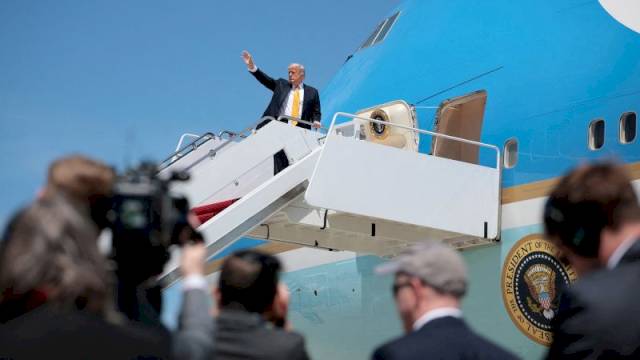
- Trump landed in Beijing aboard Air Force One around 7:50 p.m. local time (7:50 a.m. ET). Three hundred Chinese children dressed in blue and white uniforms waved American and Chinese flags as Trump descended the steps of the plane.
- He was greeted by Chinese Vice President Han Zheng, who is widely seen as Xi’s envoy for diplomatic events and who last year attended Trump’s presidential inauguration.
- Other officials on the ground included US Ambassador to China David Perdue, his counterpart Chinese Ambassador to the US Xie Feng, and China’s executive vice minister of foreign affairs, Ma Zhaoxu, the White House said.
- Trump, his son, Eric Trump, and daughter-in-law, Lara Trump, then participated in an arrival ceremony which featured a red carpet, a military honor guard and a military band.
- The hashtag #WelcomeTrumpToChina was the top trending topic on China’s social media platform Weibo as the leader’s plane touched down.
CNN’s Betsy Klein and Sylvie Zhuang contributed to this reporting.

Though the meeting between President Donald Trump and Chinese leader Xi Jinping is expected to cover a wide range of topics (trade, Taiwan, nuclear treaties and more), one issue will hang over the entire affair: the war in Iran.
The war, which has sparked a historic global oil crisis, forced Trump to reschedule this Beijing trip, which was originally slated for March – weeks after the US and Israel launched their attack on Iran.
Now, more than two months into the conflict, Trump has yet to strike a peace deal and is considering resuming combat operations, according to some of his aides, after describing the current ceasefire as on “massive life support.”
Amid the chaos, China, with close ties to both Iran and Pakistan (which hosted one round of failed peace talks) has quietly emerged as a potential mediator. In April, Trump said he believed Beijing played a role in getting Iran to negotiate a ceasefire – though Chinese officials stayed tight-lipped about their involvement.
And on Tuesday, Iran’s ambassador to China told Iranian state media, “China can be an important force for reducing tensions between Tehran and Washington.” He added that Beijing was “not merely an economic partner” but part of Iran’s “political balancing” against external threats.
Trump is expected to encourage Xi to help apply pressure to Tehran, especially around reopening the Strait of Hormuz. However, the Chinese leader is also in a stronger negotiating position now – with Trump embroiled in an increasingly unpopular war.
For his part, Trump downplayed how much he needs Beijing in ending the war, telling reporters on Tuesday before his flight: “I don’t think we need any help with Iran.”
The hashtag #WelcomeTrumpToChina was the top trending topic on China’s social media platform Weibo on Wednesday as US President Donald Trump’s plane touched down in Beijing.
Many of the comments were positive, such as “Welcome!” and “Cooperation could lead to win-win!” — the latter an oft-repeated diplomatic phrase from the Chinese government about the importance of mutually beneficial outcomes.
Trump’s Chinese nickname “Chuan Jianguo” was also popping up across Chinese social media.
Literally “Trump the Country Builder,” it is a mocking suggestion that the US president’s isolationist foreign policy and divisive domestic agenda has helped Beijing overtake Washington on the global stage.
CNN’s Joyce Jiang in Beijing contributed to this report.
” data-timestamp-html=”
” data-check-event-based-preview data-is-vertical-video-embed=”false” data-network-id data-publish-date=”2026-05-13T13:04:05.475Z” data-video-section=”world” data-canonical-url data-branding-key data-video-slug=”trump-arrival-beijing-intl-dsk” data-first-publish-slug=”trump-arrival-beijing-intl-dsk” data-video-tags data-breakpoints=”{“video-resource–media-extra-large”: 660}” data-display-video-cover=”true” data-details>
Beijing rolls out the red carpet for Trump’s arrival
0:40 • Source: CNN

Beijing rolls out the red carpet for Trump’s arrival
0:40
Beijing rolled out the literal and figurative red carpet for President Donald Trump as he arrived in China Wednesday evening local time.
Three hundred Chinese children dressed in blue and white uniforms and waved American and Chinese flags as Trump descended the steps of Air Force One. He was also joined on the tarmac by his son, Eric Trump, and daughter-in-law, Lara Trump.
In a sign of the importance of the trip, Trump was greeted at the base of the steps by Chinese Vice President Han Zheng, dispatched by China leader Xi Jinping to lead the welcome delegation. Han is widely seen as Xi’s envoy for diplomatic events and attended Trump’s 2025 inauguration.
Han and Trump walked the red carpet together as the children chanted in Mandarin, “Welcome, welcome, enthusiastically welcome.” The US president offered a fist pump before boarding a waiting motorcade.
The highway route leaving the airport was decorated with American and Chinese flags. And city skyscrapers were lit up with Chinese characters meaning: “Beijing Welcome.”

President Donald Trump has just landed in Beijing to an arrival ceremony replete with the pomp and pageantry the US president is known to appreciate.
In a show of the importance of the trip, China’s leader Xi Jinping has dispatched a high-level official to lead the welcome delegation — Chinese Vice President Han Zheng.
Han is widely seen as Xi’s envoy for diplomatic events and last year attended Trump’s presidential inauguration. He is a retired member of the Politburo Standing Committee, the Chinese Communist Party’s top-most decision making body.
Other officials on the ground include US Ambassador to China David Perdue, his counterpart Chinese Ambassador to the US Xie Feng, and China’s executive vice minister of foreign affairs, Ma Zhaoxu, according to the White House.
The US president will also be met by 300 Chinese youth in matching blue and white uniforms who marched along the tarmac holding Chinese flags, along with a military honor guard and a military band.
Xi will formally welcome Trump on Thursday morning local time.

US President Donald Trump has just landed in Beijing, China, for two days of high-stakes talks with Chinese leader Xi Jinping.
The president is now expected to take part in a brief arrival ceremony at the airport. We’ll bring you updates from that as we get them.
He is not expected to meet Xi until Thursday morning local time (Wednesday evening ET).

President Donald Trump is arriving in China with a plane full of top US officials and close aides, business leaders, and even family members.
The president is joined in Beijing by members of his national security and economic team, including Secretary of State Marco Rubio, Defense Secretary Pete Hegseth, and Trade Representative Jamieson Greer, who traveled aboard Air Force One, along with Treasury Secretary Scott Bessent, who is arriving via Seoul, South Korea where he held trade talks with his Chinese counterpart ahead of the leader-level meetings.
And more than a dozen high-profile business leaders are along for the trip, including Apple’s Tim Cook, Tesla’s Elon Musk, Boeing’s Kelly Ortberg, Meta’s Dina Powell McCormick, who served in Trump’s first administration, as well as executives from Blackrock, Blackstone, Cargill, Citi, Coherent, GE Aerospace, Goldman Sachs, Illumina, Mastercard, Micron, Qualcomm, and Visa.
Nvidia CEO Jensen Huang was spotted boarding Air Force One when it refueled in Alaska. Musk later said on X that he and Huang were the only business leaders on the presidential plane.
Brett Ratner, the Hollywood director responsible for the “Rush Hour” franchise and most recently, the first lady’s eponymous documentary, “MELANIA,” is also traveling with the president. The documentary marked Ratner’s first major project since 2017, when he was accused of sexual misconduct by numerous women. Ratner has denied the allegations.
Trump and Chinese leader Xi Jinping are widely expected to roll out a series of new trade deals, and could discuss plans for a US-China board of trade and US-China board of investment.
The US delegation also includes the president’s son, Eric Trump, and daughter-in-law, Lara Trump. Lara Trump, who served as Republic National Committee co-chair during the 2024 campaign and now hosts a show on Fox News, has emerged as the de-facto Trump family spokesperson during the president’s second term, in the absence of the president’s daughter, Ivanka Trump, who was a senior adviser during his first term but has kept a much lower profile this term.
First lady Melania Trump joined the president for his 2017 China trip but did not travel with the president this time around.
Fox News’ Sean Hannity was also spotted aboard Air Force One en route to Beijing.
CNN’s Kit Maher and Aileen Graef contributed to this report.

Beijing authorities have abruptly closed a popular historic tourist attraction overlooking Tiananmen Square, where Chinese leader Xi Jinping is expected to host a welcome ceremony for US President Donald Trump.
The Zhengyangmen Archery Tower, an imposing 600-year old building once part of Beijing’s historic city wall, will be closed to the public Thursday for “cooperating important events,” according to an official notice published on its WeChat social media account on Wednesday.
The notice did not offer details or make reference to the upcoming Trump visit, widely considered the most important diplomatic event in Beijing this year.
City views: Once serving as an important military fortress guarding the southern entry into Beijing’s inner city, the tower is now a popular tourist attraction, with hundreds of daily visitors climbing to the top of the 35-foot tall building to appreciate its panoramic views of Tiananmen Square, the Great Hall of the People, and the mausoleum of China’s founding father Mao Zedong.
The notice apologized to visitors who had already booked tickets for Thursday and promised full refunds. Beijing’s capital museum, which also overlooks Tiananmen Square, is closed for the entire week for “important events’ security task,” according to its WeChat account.

Trump’s visit to China in 2017 seems like a lifetime ago in the span of US-China relations.
The first Trump administration’s trade war had yet to upend supply chains and reshape the relations between the world’s leading economic powerhouses.
Trump’s vitriol during the Covid-19 pandemic had yet to send relations into a bitter downward spiral. And a raft of restrictions on American high tech and tech funding going into China – as well as limits on Chinese tech in the US – were not yet in effect.
Now, Trump is landing in a country that has transformed in the face of these historic frictions.
Beijing in the intervening years has taken vast efforts to insulate itself from global shocks and tensions with the world’s largest economy.
It’s diversified its overseas trade partners to be less reliant on the American market and spurred its domestic firms to race to dominate emerging areas like AI and green technologies, while catching up on high-end chips and other sectors where China lags.
It’s also marshalled an upgrade of its industrial sector to ensure its place in manufacturing’s automated future, supercharging its export juggernaut along the way.
All this has only deepened its rivalry for tech dominance with the US – which is also more warily eyeing China’s massive global trade surplus.
But it’s also made Beijing more confident in its own place on the global stage – and relative to the US.
That confidence was on show when, a little more than a year ago, Beijing fought back against US levies – ratcheting up tit-for-tat tariffs against America and leveraging its hold over rare earth supply chains to show its strength. And it’s sure to be on show in the coming days.
This time around, with Trump in his court, Xi may feel more assured that he’s achieved one longstanding goal of China’s: being seen as an equal by the US.
The last time US President Donald Trump visited Beijing in November 2017, he was given a lavish and historic welcome.
He and first lady Melania Trump joined Chinese leader Xi Jinping and first lady Peng Liyuan for a tour of the Forbidden City, the historic palace that housed Chinese emperors and their families for almost 500 years.
Then they enjoyed dinner inside the Forbidden City – an exceptional honor not granted to any foreign leader since the founding of the People’s Republic in 1949.
Trump was also treated to a series of cultural events and a grand welcoming ceremony in front of the Great Hall of the People, in the very heart of the Chinese capital.
It remains to be seen whether this trip will match the pomp and circumstance of last time.
But already there are significant events on Trump’s schedule. He and Xi will attend a welcome ceremony Thursday morning, then tour the Temple of Heaven – a UNESCO World Heritage Site – before enjoying a state banquet.

Top trade delegations from the US and China held talks in South Korea on Wednesday, Chinese state media reported, ahead of the much-anticipated summit between US President Donald Trump and Chinese leader Xi Jinping.
The delegations were headed by US Treasury Secretary Scott Bessent and Chinese vice premier He Lifeng.
Donald Trump’s arrival in Beijing will mark a critical moment for the world’s most consequential bilateral relationship.
The visit is the first from an American president since Trump’s last trip in 2017 – and is playing out against a backdrop of what’s been years of intensifying rivalry between the world’s largest economies – and more recently, the US war with Iran, a close partner of China’s.
Trump’s two days of talks with Chinese leader Xi Jinping, which start on Thursday morning local time, are a rare opportunity for the men to discuss, face-to-face, frictions ranging from technology and trade to Taiwan – all issues with the potential to cause global knock-on effects if not managed well.
Iran shadow: The meetings could also play a role in how the US-Iran conflict might end.
Beijing, as a close partner of Tehran, is emerging as a potential peace broker, despite Trump’s insistence he doesn’t need China to end the war.
Trade: Outcomes of the wider China-US talks could include headline deals in areas like agriculture or aviation and headway in stabilizing trade relations or opening doors for further investment and market access between the two countries.
Relationships: But another key element is something less tangible: the rapport between the two men, who are set to spend hours together across formal meetings, a state banquet, a visit to the imperial-era Temple of Heaven, and tea at Zhongnanhai, the compound housing China’s leadership.
Trump has had an outsize role in reshaping America’s relationship with China during his time as leader – starting with a trade war in his first term that upended global supply chains and supercharged a US-China rivalry.
Now, the tone he and Xi set in two days of meetings could dictate the course of the relationship between the world’s two largest economies for years to come.
President Donald Trump had hoped to focus on US economic priorities with Chinese leader Xi Jinping, but the Iran war — and his failed efforts at a peace deal — will complicate the US president’s prior goals. CNN’s Betsy Klein reports from Beijing.

” data-timestamp-html=”
” data-check-event-based-preview data-is-vertical-video-embed=”false” data-network-id data-publish-date=”2026-05-13T02:01:54.281Z” data-video-section=”politics” data-canonical-url=”https://www.cnn.com/2026/05/12/politics/video/donald-trump-visits-beijing-xi-jinping-betsy-klein-vrtc-digvid” data-branding-key data-video-slug=”donald-trump-visits-beijing-xi-jinping-betsy-klein-vrtc-digvid” data-first-publish-slug=”donald-trump-visits-beijing-xi-jinping-betsy-klein-vrtc-digvid” data-video-tags data-breakpoints=”{“video-resource–media-extra-large”: 660}” data-display-video-cover=”true” data-vertical-orientation=”true” data-details>
Iran war looms over Trump’s China visit
President Donald Trump had hoped to focus on US economic priorities with Chinese President Xi Jinping, but the Iran war — and his failed efforts at a peace deal — will complicate the US president’s prior goals. CNN’s Betsy Klein reports from Beijing.
1:19 • Source: CNN

Iran war looms over Trump’s China visit
1:19
As US President Donald Trump prepared to depart for his trip to Beijing, he made various remarks about the topics that might come up during his meeting with Chinese leader Xi Jinping.
- On Iran: Trump said he would have a “long talk” with Xi about the Iran war, but downplayed the idea that he would need China’s assistance in ending the conflict. He added that the financial stresses of Americans are not top of mind for him as he pushes to make a peace deal with Iran, and that the top priority is preventing Iran from having a nuclear weapon. “I don’t think about Americans’ financial situation,” he said.
- On detainees: Trump said he would bring up two sensitive figures currently in detention: Jimmy Lai, a former Hong Kong media tycoon and high-profile government critic who was sentenced to 20 years in prison earlier this year; and Ezra Jin Mingri, a Christian pastor who was swept up in a mass crackdown across various congregations last October.
- On Taiwan: The issue “always comes up” in these conversations, Trump said, adding that he believed Xi would raise the issue “more than I will.” The US Defense Department announced a $12.4 million military sale to Taiwan late Tuesday as Trump was departing for Beijing. China’s ruling Communist Party has vowed to “reunify” with Taiwan, despite having never controlled the self-governing, democratic island.
” data-timestamp-html=”
” data-check-event-based-preview data-is-vertical-video-embed=”false” data-network-id data-publish-date=”2026-05-12T20:25:20.760Z” data-video-section=”business” data-canonical-url=”https://www.cnn.com/2026/05/12/business/video/trump-iran-american-financial-situtation-deal-digvid-vrtc” data-branding-key data-video-slug=”trump-iran-american-financial-situtation-deal-digvid-vrtc” data-first-publish-slug=”trump-iran-american-financial-situtation-deal-digvid-vrtc” data-video-tags data-breakpoints=”{“video-resource–media-extra-large”: 660}” data-display-video-cover=”true” data-vertical-orientation=”true” data-details>
Trump: I don’t think about Americans’ financial situation
President Trump was asked on Tuesday to what extent Americans’ financial situation was motivating him to make a deal with Iran.
0:28 • Source: CNN

Trump: I don’t think about Americans’ financial situation
0:28
Leave a Reply