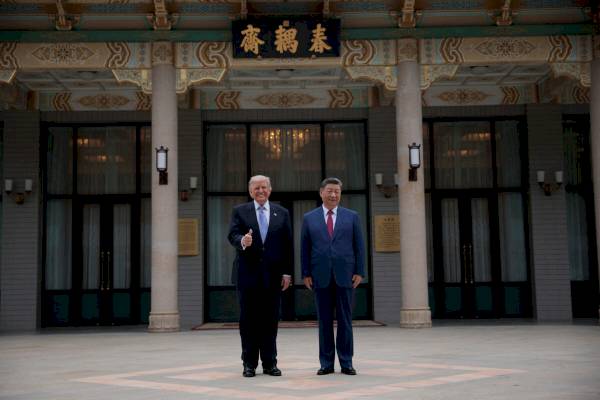
When Xi Jinping and Donald Trump met in Beijing in mid-May 2026, the summit served as a critical stress test for a global system fatigued by tariff wars, technological decoupling and hardening geopolitical rhetoric. Expectations were mixed: while a definitive breakthrough was always unlikely, the spectre of a complete breakdown in economic dialogue — and with it, an unchecked escalation of the trade and technology wars — hung heavy over the global economy.
The immediate assessment of the summit revealed a glaring gap in US diplomatic capacity — a vulnerability that Beijing was uniquely positioned to exploit.
As Susan Shirk argues in the first of this week’s three lead articles, the Trump administration’s hollowing out of the US diplomatic and national security bureaucracy has resulted in severe ‘diplomatic malpractice’. Stripped of Asia expertise which typically orchestrates the gruelling mid-level preparatory negotiations, Washington entered the summit flying blind. This institutional vacuum allowed a better-prepared Beijing to ‘fill the void’, manoeuvring Trump into making Taiwan a central point of leverage. By explicitly referring to US arms sales as a transactional ‘negotiating chip’, even as he affirmed the usual US policy of strategic ambiguity, Trump ‘shattered the confidence of Taiwan and other Asian allies’.
Yet, to evaluate the summit solely through the lens of Washington’s tactical blunders or the absence of a comprehensive joint communique is to miss the broader, medium-term stabilisation in US–China relations it achieved. Even the US war with Iran was not allowed to throw that objective off course. Given the toxic baseline of the relationship, the summit successfully established a much-needed floor under a rapidly deteriorating bilateral dynamic.
As Sourabh Gupta points out in our second lead article, the summit represents a return to ‘leader-led diplomacy’, nudging the relationship toward a framework of ‘constructive strategic stability’. As President Xi set out in detail, this framework rests on four progressive tiers: positive stability centred on cooperation, benign stability defined by healthy competition, normalised stability where differences remain controllable, and enduring stability that allows for predictable peace.
By charting a US–China Board of Trade and a Board of Investment, the two leaders have created some institutional scaffolding designed to ‘compartmentalise and regulate competition’ within this framework. For Gupta, the summit offered a ‘spring of hope’, signalling that pragmatic areas of mutual gain — such as agricultural procurement, aircraft orders and a continuation of the truce on rare earth export controls and tariffs — can serve as stabilising ballasts against confrontational political pressures in Washington.
Jia Qingguo, in the third of our lead articles, echoes this pragmatic assessment. Against a backdrop where ‘getting tough on China remains a political consensus in Washington’ and bilateral relations have been defined by ‘comprehensive confrontation’, Jia argues that the summit was a success precisely because it halted the downward spiral in relations. Reaching agreement on this ‘constructive strategic stability’ and confirming a schedule of reciprocal visits, including Xi’s return to Washington in September 2026, shifts the bilateral paradigm from outright conflict to managing differences.
But, as Jia cautions, while medium-term stabilisation has been achieved, the underlying structural risks remain acute.
This is where the international community must apply a healthy dose of geopolitical realism in responding to the summit’s outcomes. The ‘constructive strategic stability’ championed in (and especially by) Beijing is a tactical holding pattern driven in part by intertwined political and economic challenges facing the Trump administration. The macroeconomic and geopolitical drivers that forced the United States and China into a systemic rivalry in the first place remain unresolved.
Washington’s bipartisan anxiety over China’s rapid ascent up the high-tech value chain is a structural reality that presidential handshakes cannot simply wave away. Conversely, Beijing’s highly securitised, state-led drive for techno-economic self-sufficiency is an existential defensive mechanism designed specifically to insulate the Chinese economy from US containment. The tariff truces and aircraft purchases celebrated in Beijing are merely bandages applied to a lingering wound. High-tech decoupling, export controls and supply chain bifurcation are set to endure as features of the global macroeconomic landscape.
For the rest of the world, and particularly for the Global South and middle powers in the Asia-Pacific region, the summit offers a complex warning.
On one hand, the stabilisation of the US–China relationship provides breathing room. A pause in the escalation of the trade and technology wars relieves immediate pressure on global supply chains. On the other hand, the summit lays bare the unreliability of the United States as an institutional guarantor of the regional security order. If Washington’s Asia policy is to be driven by executive whims and a hollowed-out bureaucracy, where long-standing security assurances are traded like commodities, allies and partners can no longer default to a strategy of quiet reliance on US deterrence.
The fragile equilibrium established in Beijing demonstrates that while outright conflict is not inevitable between the world’s two superpowers, genuine cooperation will remain transactional and highly constrained. Policymakers globally must navigate this ‘constructive stability’ with clear eyes. Wholesale decoupling may have been temporarily averted, but the structural realities of a bifurcated global economy and the necessity for middle powers to rigorously diversify their own economic and strategic dependencies have never been more pronounced.
The EAF Editorial Board is located in the Crawford School of Public Policy, College of Law, Policy and Governance, The Australian National University.
Leave a Reply