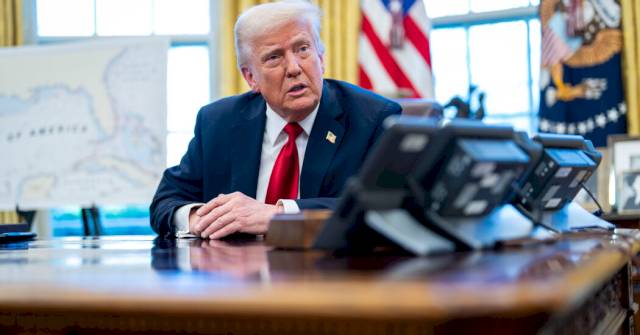

The attorney general indicates there will be no criminal inquiry into the Signal chat.
Image
Attorney General Pam Bondi signaled on Thursday that there was unlikely to be a criminal investigation into the sharing of military operation details in an unsecured text group, declaring that the specifics of when fighter jets would depart and when bombs would fall were “not classified.”
Ms. Bondi, speaking at a news conference in Virginia, was asked about the public debate surrounding Defense Secretary Pete Hegseth after he sent details of a coming attack on rebels in Yemen to senior administration officials in a Signal group chat that accidentally included a magazine editor.
“It was sensitive information, not classified, and inadvertently released,” Ms. Bondi said, while praising the military operation that ensued.
“What we should be talking about is, it was a very successful mission,” she said, before quickly accusing Democrats from previous administrations of mishandling classified information.
“If you want to talk about classified information, talk about what was in Hillary Clinton’s home,” she said. “Talk about the classified documents in Joe Biden’s garage, that Hunter Biden had access to.”
The Justice Department opened investigations into Mrs. Clinton and Mr. Biden in those instances, but neither ultimately faced criminal charges. She did not mention the prosecution of Mr. Trump over his handling of classified documents after his first term in office — a case which was ultimately abandoned when he won a second term.
In this case, Ms. Bondi seemed to be ruling out any similar investigation to determine all the facts.
Dating back to at least the Reagan administration, the government has considered the details of “military plans, weapons, or operations” to be classified.
Under federal law, it is possible for people to be charged with crimes for mishandling national defense information that is not classified, but such prosecutions are very rare.
This month, hours before the military strikes against Houthi targets, Mr. Hegseth texted the group the plan of attack, including the time at which “the first bombs will definitely drop.”
After the attack was carried out, the details of the text conversation were revealed by Jeffrey Goldberg, the editor in chief of The Atlantic, who was accidentally included in the conversation among the senior officials.
Mr. Hegseth and other senior officials have argued that the information he shared was not classified, and that it was ultimately up to his department to decide what of its information should be considered classified.
National security experts said that argument fails a test of basic common sense about the danger of letting military plans leak before an operation, and that it goes against longtime practice among military and intelligence agencies.
Democratic lawmakers sparred over the issue with Trump administration officials at a congressional hearing Wednesday.
Tulsi Gabbard, the director of national intelligence, told the House intelligence committee that “no sources, methods, locations or war plans” were shared.
In the same hearing, Representative Joaquin Castro, Democrat of Texas, scoffed at claims that the information was not classified. “You all know that’s a lie,” he said. “It’s a lie to the country.”
Advertisement

Under Trump, the Kennedy Center’s classical offerings will (mostly) go on.
Image
The Kennedy Center’s flagship opera company and symphony orchestra announced Thursday that they plan to present robust and fairly typical programs next season, the first full season since President Trump took over the institution.
But one prominent work was missing from the lineup: Gregory Spears and Greg Pierce’s “Fellow Travelers,” an opera set in the 1950s about two men working for the government who become lovers. The work was withdrawn by its creators because of concerns about Mr. Trump’s takeover, according to a letter obtained by The New York Times.
Washington National Opera said the 2025-26 season would include classics like Verdi’s “Aida” and less commonly heard works like “Treemonisha,” an opera by the ragtime composer Scott Joplin. The National Symphony Orchestra is planning warhorses by Tchaikovsky and Shostakovich and world premieres by Carlos Simon, the Kennedy Center’s composer in residence; Valerie Coleman; and others.
In a sign of the political sensitives at the Kennedy Center, the leaders of the opera and the symphony declined to be interviewed about the new season.
The center has been in flux since Mr. Trump purged its previously bipartisan board of Biden appointees and had himself elected chairman. The president’s actions have prompted an outcry, leading some artists to cancel engagements there in protest. The musical “Hamilton” scrapped a planned tour there next year.
The classical field, in which seasons are planned years in advance, has largely been unaffected. But the creators of “Fellow Travelers,” an opera based on the 2007 novel by Thomas Mallon, confirmed this week that they were pulling the work, which was supposed to have its Washington premiere next year.
The creators said in a recent letter to Washington National Opera that Mr. Trump’s takeover ran counter to the values of “freedom and liberty for all people” that are highlighted in the opera. “We have made the impossibly difficult decision that the Kennedy Center is not a place the team feels comfortable having the work presented,” said the letter.
In a statement, the leaders of Washington National Opera, Tim O’Leary and Francesca Zambello, said they were disappointed by the decision to withdraw “Fellow Travelers.”
“We deeply regret that the creative team of ‘Fellow Travelers’ has decided to deprive W.N.O. audiences of the chance to experience this opera,” Mr. O’Leary and Ms. Zambello said. “Art and music have the power to rise above division and bring people together to find common ground. The W.N.O. has long been a place for everyone to enjoy the power of the opera and it will remain a place for patrons of all backgrounds and beliefs.”
“Fellow Travelers,” which is set in Washington and premiered at Cincinnati Opera in 2016, will be replaced by a new production of Robert Ward’s “The Crucible.” It will be conducted by Robert Spano as part of his inaugural season as the opera company’s music director.
The season announcement came as the Kennedy Center undergoes significant change under Richard Grenell, a former ambassador to Germany, whom Mr. Trump appointed as the Kennedy Center’s new president.
This week, the center gutted a community outreach program known as Social Impact, firing several employees and deleting some references to the program on its website. The program had worked to expand the audience for opera and symphony performances; to commission works by underrepresented voices; and to “advance justice and equity.” (The Trump administration has shuttered many diversity-themed efforts across the federal government.)
Marc Bamuthi Joseph, who was dismissed as a vice president at the center who oversaw Social Impact, lamented the end of the programs. “They were wildly successful, they were growing, there was a positive trajectory,” he said in an interview. “There was no evidence at all that the programs were a detriment to the institution.”
The Kennedy Center did not respond to a request for comment about the cuts. But Donna Arduin, the center’s new chief financial officer, wrote in a letter to staff on Wednesday that the center was facing serious fiscal challenges.
“The road out of this economic environment will not be easy and the shift will be felt across the center,” she wrote.
Mr. Grenell, in a social media post on Wednesday, said the center would begin by “cutting executive pay and downsizing the staff where possible.”
Despite the upheaval, many artists and employees have chosen to stay on. The conductor Gianandrea Noseda recently renewed his contract as music director of the National Symphony through at least 2031.
And Mr. Simon, the center’s composer in residence, said in an interview that he would maintain his affiliation, saying he felt his music could “reflect what’s happening in the world — unapologetically.” Mr. Simon, who will premiere a double concerto for violin and cello next season with the National Symphony, said he felt he had creative freedom at the center.
“Now is not the time to pull back,” he said. “Now is the time for artists to create.”

Musk targeted FEMA. Storm-battered communities are paying a price.
A post from Elon Musk last month trumpeted a supposedly startling discovery by his team of government cost-cutters: The Federal Emergency Management Agency had provided $59 million to house undocumented immigrants in New York City. The money, he declared, was “meant for American disaster relief and instead is being spent on high end hotels for illegals!”
But if Mr. Musk’s goal was to funnel more FEMA money to disaster aid, the fallout from his declaration had the opposite effect.
A pair of Trump administration orders, issued soon after the Feb. 10 social media post, aimed to block any agency money from helping undocumented immigrants and “sanctuary” jurisdictions protecting them left FEMA staff without sufficient guidance about how to proceed, effectively freezing payments on billions of dollars in disaster grants, according to two people briefed on the process and an internal document viewed by The New York Times.
While the freeze did not stop aid going directly to disaster survivors, it has disrupted payments to states, local governments and nonprofits, with ramifications felt across the country.
Advertisement


Kennedy plans to lay off 10,000 workers at Health and Human Services.
Image
The Trump administration on Thursday announced a layoff of 10,000 employees at the Health and Human Services Department, as part of a broad reorganization designed to bring communications and other functions directly under the purview of Health Secretary Robert F. Kennedy Jr.
The layoffs are a drastic reduction in personnel for the sprawling health department, which now employs about 82,000 people and touches the lives of every American through its oversight of medical care, food and drugs. Together with previous layoffs and departures, the move will bring the department down to about 62,000 employees, the agency said.
The restructuring will include creating a new division called the Administration for a Healthy America. “We’re going to do more with less,” Mr. Kennedy said, even as he acknowledged it would be “a painful period for H.H.S.”
The 28 divisions of the health agency will be consolidated into 15 new divisions, according to a statement issued by the department. Mr. Kennedy announced the changes in a YouTube video. The staff cuts, reported earlier by The Wall Street Journal, are being made in line with President Trump’s order to implement the Department of Government Efficiency’s shrinking of the federal work force.
Mr. Kennedy said rates of chronic disease rose under the Biden administration even as the government grew. He pitched the changes as a way to refocus the agency on Americans’ health, but did not outline any specifics on how he would mediate rates of diabetes, heart disease or any other condition.
The reorganization will cut 3,500 jobs from the Food and Drug Administration, which approves and oversees the safety of a vast swath of the medications and consumer products people eat and rely on for well-being, according to an H.H.S. fact sheet. The cuts are said to be administrative, but some of the roles support research and monitoring of the safety and purity of food and drugs, as well as travel planning for inspectors who investigate overseas food and drug facilities.
The Centers for Disease Control and Prevention will also have its work force cut by about 2,400 employees, and will narrow its focus to “preparing for and responding to epidemics and outbreaks,” the fact sheet said. The C.D.C. also does work on H.I.V./AIDS, tobacco control, maternal health and the distribution of vaccines for children. The National Institutes of Health will lose 1,200 staff members, and the agency that administers Medicare and Medicaid is expected to lose 300.
All of those agencies have campuses outside of Washington and tend to operate under their own authority, and Mr. Kennedy has been at odds with all of them. Mr. Kennedy assailed them, and other parts of the department, in his video.
“When I arrived, I found that over half of our employees don’t even come to work,” he claimed. “H.H.S. has more than 100 communications offices and more than 40 I.T. departments and dozens of procurement offices and nine H.R. departments. In many cases, they don’t even talk to each other. They’re mainly operating in silos.
The plan also includes collapsing 10 regional H.H.S. offices into five.
Dr. Robert Califf, the F.D.A. administrator during the Biden administration, said his team worked with staff to drum up support for an 8,000 person reorganization to change how its divisions for food and facility inspections operate. Given how morale-crushing the second Trump administration has been for the department, with many staff members laid off on the false premise that their performance was subpar, the effort could be all the more challenging.
“If you are coming to work sick to your stomach, as Russell Vought said he wanted them to,” he said, referring to the head of the Office of Management and Budget, “then people are not going to be able to collaborate as well. They’ll be suspicious of each other, right?”
Mr. Califf said such a sudden and massive reduction in staff and reorganization could also disrupt services and safety oversight that the public relies on.
Mr. Kennedy also suggested in the video that the changes would help his team get more access to data, a prospect that has been fraught, given Mr. Kennedy’s long history of manipulating figures to advance arguments about the harm of vaccines that have widely been deemed safe.
“In one case, defiant bureaucrats impeded the secretary’s office from accessing the closely guarded databases that might reveal the dangers of certain drugs and medical interventions,” Mr. Kennedy said.
Mr. Kennedy said the new division, the Administration for a Healthy America, would combine a number of agencies focused on substance abuse treatment and chemical safety, as well as the agency that administers courts that handle federal claims over vaccine injuries.
“We’re going to consolidate all of these departments and make them accountable to you, the American taxpayer and the American patient,” Mr. Kennedy said. “These goals will honor the aspirations of the vast majority of existing H.H.S. employees who actually yearn to make America healthy.”
Attorney General Pam Bondi declared Thursday that information about a pending military operation in Yemen that was mistakenly shared with a journalist in a Signal group chat was “not classified.” Speaking at a news conference, Bondi said: “It was sensitive information, not classified, and inadvertently released.” She added: “If you want to talk about classified information, talk about what was in Hillary Clinton’s home.” National security veterans have previously said the details of a pending military operation, such as those sent to the group chat by Defense Secretary Pete Hegseth, match the type of information that is meant to be classified.
Image
The declaration, coming from the nation’s top law enforcement official, suggests there will be no criminal investigation of the pending attack plans that Hegseth shared in the Signal chat group.
The Trump administration will announce a massive layoff today of 10,000 employees at the Department of Health and Human Services, as part of a dramatic reorganization designed by Health Secretary Robert F. Kennedy Jr., according to a White House official. The layoffs, first reported by The Wall Street Journal, amount to a drastic reduction in personnel for the health department, which now employs about 80,000 people.
The Journal also reported that the reorganization would bring communications and other functions across the department’s various agencies directly under Kennedy’s authority. Those agencies include the Centers for Disease Control and Prevention, the Food and Drug Administration and the National Institutes of Health, which all have campuses outside of Washington and tend to operate under their own authority.
Advertisement

The Trump administration deflects blame for the Signal leak at every turn.
Image
It was a hoax. The information wasn’t classified. Somehow the journalist got “sucked into” the Signal chat, either deliberately or through some kind of technical glitch.
In the days since the editor in chief of The Atlantic revealed he had been inadvertently included in a group chat of top U.S. officials planning a military strike on Houthi militants in Yemen, senior members of the Trump administration have offered a series of shifting, sometimes contradictory and often implausible explanations for how the episode occurred — and why, they say, it just wasn’t that big a deal.
Taken together, the statements for the most part sidestep or seek to divert attention from the fundamental fact of what happened: Defense Secretary Pete Hegseth used Signal, an unclassified commercial app, to share sensitive details about an imminent attack in an extraordinary breach of national security.
Here’s a look at the main players and what they’ve said about what happened, and how much their reasoning matches up with what transpired.
President Trump said the Atlantic’s article was a “witch hunt” and called the journalist a “total sleazebag.”
President Trump told reporters on Wednesday that the fervor over the Atlantic’s article was “all a witch hunt,” suggesting that perhaps Signal was faulty, and blaming former President Joseph R. Biden Jr. for not having carried out the strike on Yemen during his administration.
“I think Signal could be defective, to be honest with you,” he said, after complaining that “Joe Biden should have done this attack on Yemen.” The fact that he didn’t, Mr. Trump added, had “caused this world a lot of damage and a lot of problems.” While the Trump administration has criticized Mr. Biden for not being aggressive enough against the Houthis, his administration led allied nations in several attacks on Houthi sites in Yemen in 2024.
Mr. Trump has insisted that no classified information was shared among the members of the group, including the editor of The Atlantic, Jeffrey Goldberg — and that it wasn’t uncommon for members of the government to use Signal for official business.
But he has also spent a lot more energy disparaging Mr. Goldberg and The Atlantic than defending his national security officials.
“I happen to know the guy is a total sleazebag,” Mr. Trump said of Mr. Goldberg on Tuesday, speaking to reporters from the Cabinet Room. He added: “The Atlantic is a failed magazine, does very, very poorly. Nobody gives a damn about it.”
The president and the secretary of defense have the ability to assert, even retroactively, that information is declassified. Former national security officials have said they were skeptical that the information shared by Mr. Hegseth ahead of the March 15 strike was not classified, given its specificity and the life-or-death ramifications.
Mr. Hegseth said the details he shared were not technically “war plans.”
“No names. No targets. No locations. No units. No routes. No sources. No methods. And no classified information,” Mr. Hegseth wrote Wednesday on X. He added: “We will continue to do our job, while the media does what it does best: peddle hoaxes.”
In seeking to discredit The Atlantic, the White House has insisted that the information shared on Signal was not a “war plan,” as the headline on the initial story called it, but an “attack plan.” National security experts say this is very likely a distinction without a difference.
According to the messages released by The Atlantic, Mr. Hegseth included time stamps and other secret details in his messages, hours before the attack began — all of which could have upended the strikes had they fallen into the wrong hands.
Image
Michael Waltz, the national security adviser, suggested the journalist may have been ‘sucked into’ the group chat.
On Fox News, Mr. Waltz laid into Mr. Goldberg, calling him “scum” and suggesting that he might have intentionally managed to insert his number into Mr. Waltz’s phone.
Mr. Goldberg has said he was inadvertently added to the Signal group chat by Mr. Waltz.
Mr. Waltz said that he was “not a conspiracy theorist,” but that he was suspicious about how Mr. Goldberg “somehow gets on somebody’s contact and then gets sucked into this group.”
“Have you ever had somebody’s contact that shows their name and then you have somebody else’s number there?” Mr. Waltz added, noting that “it looked like someone else.” He also said “we’re trying to figure out” whether the journalist was added to the group deliberately or through “some other technical mean.”
The host, Laura Ingraham, seemed confused by his responses, asking him if a staff member might have made such an error. Mr. Trump told NBC News on Tuesday that “it was one of Michael’s people on the phone. A staffer had his number on there.”
On Fox, Mr. Waltz insisted that “a staffer wasn’t responsible.”
“Look, I take full responsibility, I built the group,” he said, while also insisting he had never texted Mr. Goldberg and that he wasn’t on his phone at the time of the chat. He said that Elon Musk, the tech billionaire who is a Trump adviser, had some of “the best technical minds” looking into what might have happened.
Tulsi Gabbard, the spy chief, said she wasn’t really involved.
Ms. Gabbard told members of Congress on Wednesday that the messages proved she wasn’t involved in sharing or discussing any of the details related to the strike.
“What was shared today reflects the fact that I was not directly involved with that part of the Signal chat” she said in testimony before the House Intelligence Committee.
According to the messages published in The Atlantic, Ms. Gabbard weighed in early in the exchange to name Joe Kent, who has been a top aide to Ms. Gabbard as he awaits Senate confirmation to lead the National Counterterrorism Center, as her representative to coordinate meetings. She did not text again until the end of the chat, writing “Great work and effects!” following the strike.
Image
John Ratcliffe, the C.I.A. director, insisted he personally did nothing wrong.
Mr. Ratcliffe defended his actions on Wednesday while expressing indignation at how The Atlantic had characterized certain information he had posted to the Signal group.
“Those messages were revealed today and revealed that I did not transmit classified information,” Mr. Ratcliffe told members of the House Intelligence Committee. He accused Mr. Goldberg of having misrepresented a detail from his contributions to the exchange.
Mr. Goldberg, he said, “indicated that I had released the name of an undercover C.I.A. operative in that Signal chat. In fact, I had released the name of my chief of staff, who is not operating undercover.”
“That was deliberately false and misleading,” Mr. Ratcliffe concluded.
In the original article, Mr. Goldberg did not refer to that person as an undercover operative, but as an “active intelligence officer.” In the second article, in which he published the Signal group’s messages, he said the C.I.A. requested that Mr. Goldberg not publish his name, so he did not. The C.I.A. likes to keep its officers’ names secret so they can still take future assignments overseas.
Steve Witkoff, Mr. Trump’s special envoy to the Middle East, said he didn’t have his phone on him as the plans were under discussion.
Mr. Witkoff’s only contribution to the Signal chat was one message that he sent after the strike. It was just five emojis: two prayer hands, one muscle, and two American flags.
The Wall Street Journal’s editorial board on Tuesday wrote that Mr. Witkoff had been in Russia at the time that plans to strike Yemen were being discussed on the Signal group.
Mr. Witkoff acknowledged that he was visiting Moscow at the time, but in a post on social media denied that he had his phone with him, saying he only had “a secure phone provided by the government for special circumstances when you travel to regions where you do not want your devices compromised.”
Image
Secretary of State Marco Rubio said the incident was a “big mistake” and suggested it could inspire reforms.
Mr. Rubio said it was obvious that someone had made a “big mistake” by including a journalist in the Signal group.
“Someone made a big mistake and added a journalist. Nothing against journalists, but you ain’t supposed to be on that thing,” Mr. Rubio told reporters while traveling in Jamaica.
“I think there will be reforms and changes made” as a result of the mistake, he added.
But otherwise, he echoed the argument voiced by others in the administration that because no war plans had been disclosed in the Signal group, the concerns were being overblown.
“There were no war plans on there,” Mr. Rubio told reporters. He said the chat was intended to keep Trump’s aides informed of the operations so they could talk with their counterparts in other countries about the strikes.
Edward Wong contributed reporting.

Judge extends a pause on firings of probationary workers for 5 days.
Image
A federal judge in Maryland on Wednesday extended a temporary pause in the Trump administration’s efforts to fire probationary workers at more than a dozen federal agencies by five days.
The judge, James K. Bredar of the Federal District Court in Maryland, said he needed more time to determine whether a longer-term halt to the government’s firing of probationary employees should apply to the entire country or be restricted to certain states while the case proceeds.
Nineteen states and the District of Columbia sued the federal government, arguing they were irreparably harmed when the government fired thousands of probationary employees en masse in February, leaving states to face unemployment spikes without warning. Judge Bredar’s order earlier this month called for the workers’ reinstatement.
During a hearing on Wednesday, Judge Bredar said he was wary of issuing a longer halt to the government’s firings that would apply to the entire country when 31 states have decided not to participate in the case. He cited recent criticism that district courts had exceeded their authority in ordering nationwide halts to Trump administration programs. Of the lawsuit’s plaintiffs, all of the attorneys general are Democrats.
Lawyers for the states and Washington, D.C., say that when the administration conducts mass firings, as it did in February, the harm can spill over to other states, even if they are not joining this lawsuit. This is why a preliminary injunction needs to apply to more than just the participants, one of the lawyers, Virginia Anne Williamson with the Maryland Attorney General’s Office, said on Wednesday.
For example, if a preliminary injunction were restricted to the states that brought the lawsuit, the federal government could resume firing probationary employees in Virginia, which is not part of the suit. But in the case of an employee who works in Virginia and lives in Maryland, which is a party in the lawsuit, Maryland suffers from the firings, the suit argues, because it could have to provide support services for its unemployed resident.
“This is murky,” Judge Bredar said on Wednesday, adding that the court “has to wade into the swamp here and figure out if it can’t draft something more restrictive than across the country.”
Judge Bredar’s reinstatement order, issued on March 13, overlaps with court-mandated reinstatements of probationary employees in two other cases.
Many of the agencies have reinstated employees and issued back pay for the time between their firings and the court orders. Most agencies are placing the reinstated employees on administrative leave, which the Trump administration has told the court is part of the process of returning them to their jobs.
The Department of Housing and Urban Development, however, is not providing back pay to the fired workers, said Ashaki Robinson, president of the local American Federation of Government Employees union representing workers at that agency. Ms. Robinson said that could change if Judge Bredar made back pay part of a future order.
Leave a Reply