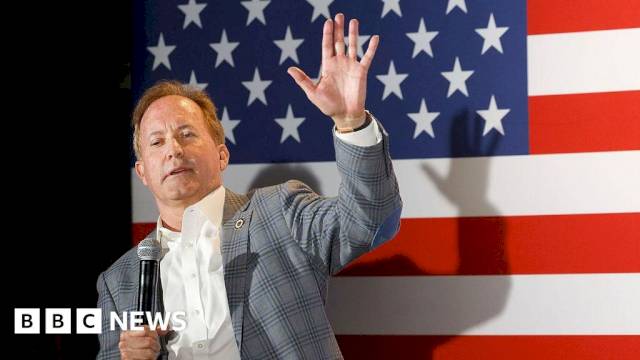
US President Donald Trump has endorsed Texas Attorney General Ken Paxton in his bid to unseat incumbent Senator John Cornyn in next Tuesday’s Republican primary run-off race.
By siding with Paxton, Trump is supporting a Texas politician who has long been a close ally of the president – but also one who comes with considerable political baggage.
Many Democrats have viewed Paxton as the weaker of the two candidates and relish what they believe is an opportunity to flip a Senate seat in a state that has a long history of electing Republicans.
Trump’s move may also anger Cornyn’s fellow Senate Republicans, many of whom have served with the Texan for decades and view him as a friend and ally.
Trump, however, appears to have different preferences.
The president is supporting a Texas politician who has long been a close ally of the president.
As attorney general, he backed Trump’s efforts to overturn the results of the 2020 presidential election.
Paxton also travelled to New York City to rally for Trump during his 2024 trial – and conviction – over hush-money payments to adult film actress Stormy Daniels.
Like Trump, Paxton has a political history marked by scandal and legal challenges – and has established a reputation as a survivor.
He recently settled a federal corruption indictment without admitting misconduct.
In 2023, he was impeached by the Republican-controlled Texas legislature for fraud and obstruction of justice – but acquitted in a state Senate trial.
Last year, his wife filed for divorce amid allegations that Paxton had had multiple affairs.
“I know Ken well, have seen him tested at the highest and most difficult levels, and he is a winner!” Trump wrote on his Truth Social website.
“John Cornyn is a good man, and I worked well with him, but he was not supportive of me when times were tough.”
This is not the first recent example of Trump backing a challenger against an incumbent Republican.
Watch: Can a Republican win an election while at war with Trump?
Those Republicans, however, had made clear breaks with the president.
Cassidy voted to convict Trump on impeachment charges in his 2021 Senate impeachment trial.
Massie irked the president for voting against key parts of his legislative agenda, including military operations in Venezuela and Iran.
By contrast, the 74-year-old Cornyn served in the Senate Republican leadership from 2012-24 and is viewed as a party loyalist – albeit one more allied to the Republican establishment.
But he didn’t endorse Trump’s re-election bid until January 2024 – well over a year after the president entered the race – a delay that Trump also noted in his endorsement post.
During the campaign, Paxton had highlighted Cornyn’s votes for new gun regulation and accused him of being insufficiently aggressive in supporting immigration enforcement along the Texas-Mexico border.
Cornyn’s side focused on Paxton’s past political and legal scandals and perceived personal shortcomings.
Getty Images
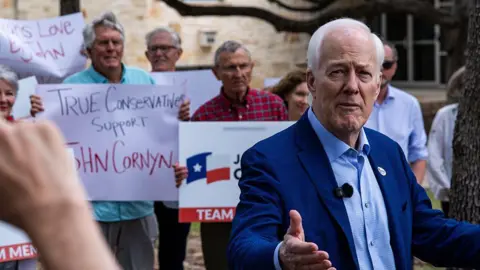
US Senator John Cornyn has served in Senate Republican leadership from 2012 to 2024 and is viewed as a party loyalist.
Early voting is already under way in Texas for what polls had indicated was a close run-off race.
In their original matchup in early March, Cornyn had finished narrowly ahead of Paxton, but short of the 50% necessary to secure the nomination – despite outspending Paxton by more than $65m.
A day after those results, Trump promised to endorse a candidate and urge the other to drop out.
Months passed, however, before the president finally weighed in.
By siding with Paxton, he may have delivered a fatal blow to Cornyn’s electoral chances.
The winner of Tuesday’s primary will go on to face Democrat James Talarico, a Texas state legislator who secured his party’s nomination over congresswoman Jasmine Crockett without a run-off.
It has been 32 years since a Democratic candidate won a statewide election in Texas, although Beto O’Rourke’s 2018 Senate campaign came within 215,000 votes of ousting Senator Ted Cruz with more than eight million ballots cast.
Trump won the state in 2024 by 14%, but public opinion polls suggest a close contest heading into November’s general election vote.
WASHINGTON (AP) — Is there a future in politics for Republicans who cross President Donald Trump?
The signs this year suggest no, and Trump has convinced his voters to defeat his adversaries again and again. The next test of the president’s power to extract retribution is on Tuesday, when Rep. Thomas Massie of Kentucky faces a Trump-backed primary challenger.
Massie has been a thorn in the president’s side for pushing for the release of the Jeffrey Epstein files, opposing the war with Iran and voting against Trump’s signature tax legislation last year.
Here are some things to watch as voters in Alabama, Georgia, Idaho, Kentucky, Oregon and Pennsylvania cast ballots on Tuesday.
Will Trump’s endorsement continue to carry the day?
Trump has repeatedly shown that Republican primary voters will follow his lead, even as his popularity wanes with the broader electorate.
In Kentucky, he’s supporting first-time candidate Ed Gallrein over Massie, who has been in office since 2012. Massie is trying to convince Republicans that they can support both himself and Trump at the same time, a proposition that has been tried unsuccessfully in other races around the country.
On Saturday, Republican Sen. Bill Cassidy of Louisiana failed to even make the runoff, unable to repair his relationship with Trump five years after voting to convict him during his second impeachment trial. And earlier this month, Trump successfully dislodged five of seven Indiana Republicans he targeted for voting against his redistricting plan.
Trump is flexing his influence in other places on Tuesday as well.
In the race for Georgia governor, Trump is backing Lt. Gov. Burt Jones in an unexpectedly ugly battle for the Republican nomination. Jones, who comes from a wealthy Georgia family, has given his campaign $19 million. But billionaire Rick Jackson, a health care tycoon, has put more than $83 million of his fortune into the race. Trump’s endorsement power has rarely been tested against that level of lopsided spending.
Trump stayed on the sidelines of Georgia’s Senate race, leaving a crowded field of hopefuls seeking to take on Democratic Sen. Jon Ossoff, who’s running unopposed for his party’s nomination. But in Alabama, Trump endorsed Rep. Barry Moore for Senate to replace Tommy Tuberville, who is running for governor.
A test for Shapiro in Pennsylvania
It’s no secret that Pennsylvania Gov. Josh Shapiro may run for the White House.
But on Tuesday, the Democrat’s political clout will be tested in his home state, where he’s working to elect a slate of House candidates that he thinks will give his party the best chance to flip Republican seats in the fall.
Shapiro’s endorsed candidates include Paige Cognetti, mayor of Scranton; Bob Brooks, president of the state firefighters’ union; and Janelle Stelson, a former television news personality who narrowly lost two years ago.
As popular as he may be, Shapiro’s endorsements haven’t scared off Democratic rivals, who are fighting to defeat the governor’s picks — and perhaps send a message that he’s not as strong as he’d like to be with the 2028 presidential contest looming.
Politically homeless in Georgia?
Georgia is about to feature a fresh case study in the divergent paths available to Republicans who defy Trump.
Secretary of State Brad Raffensperger and former Lt. Gov. Geoff Duncan were among the few Republicans to speak out against Trump’s attempt to overturn his 2020 loss.
Both are now running for governor — Raffensperger as a Republican and Duncan as a Democrat — and both are trying to convince voters to look past things they said in the past.
Raffensperger is spending millions of his own money trying to reintroduce himself to Republicans by reminding them of his long career in conservative politics before defying Trump.
Duncan, meanwhile, is trying to convince Democratic voters that they can trust him after renouncing his prior opposition to abortion rights, gun control and the expansion of Georgia’s Medicaid program.
The primaries will go to a runoff on June 16 if nobody gets 50% of the vote on Tuesday.
Chaos in Alabama?
Confusion may reign across Alabama on Tuesday as votes cast in four of the state’s seven congressional districts may not be counted.
That’s because Republican Gov. Kay Ivey moved just last week to postpone the primaries until Aug. 11, emboldened by the recent U.S. Supreme Court decision that hollowed out the Voting Rights Act. Republicans across Alabama, Louisiana and Tennessee are now scrambling to redraw congressional boundaries to eliminate some majority-Black U.S. House districts to maximize their political advantage.
Over the weekend, thousands of civil rights activists rallied in Alabama against the changes, but the redistricting plan is moving forward.
That means that ballots cast Tuesday in primaries for Alabama’s 1st, 2nd, 6th and 7th congressional districts will be voided, the secretary of state says, while state officials restore a previous set of Republican-drawn district boundaries.
You’d be excused for being confused. Alabama voters will still choose nominees Tuesday as planned for the 3rd, 4th and 5th congressional districts, as well as for U.S. Senate and a full slate of state and local offices.
Rep. David Scott’s death is a reminder of Democratic gerontocracy
The late Rep. David Scott, D-Ga., was the fourth Democrat to die in office this term, fueling a growing restlessness on the left over the party’s aging leadership. Scott, who was 80 when he died, was seeking a 13th term.
Scott’s name will appear on the ballot alongside five other candidates running in the Democratic primary, but votes for him will not be counted. Whether someone wins on Tuesday or the race goes to a runoff on June 16, the Democratic nominee is almost certain to win the general election in a district that tilts overwhelmingly toward the Democrats.
A special election on July 28 will decide who finishes the remainder of Scott’s term, with a runoff on Aug. 25 if nobody gets a majority.
A free press is a cornerstone of a healthy democracy.
Acting Attorney General Todd Blanche on Tuesday wouldn’t rule out the possibility that violent rioters at the U.S. Capitol on Jan. 6, 2021, will be considered for payouts from a new $1.776 billion fund to compensate individuals who believe they were targeted politically. Testifying before Congress for the first time since taking the reins of the Justice Department last month, Blanche defended the “Anti-Weaponization Fund” while Democrats blasted it as an illegal abuse of power.
Trump said he is holding off on a military strike on Iran planned for Tuesday because “serious negotiations” are underway to end the war. Trump said he had planned “a very major attack” but put it off — “for a little while, hopefully, maybe forever.” He said America’s allies in the Gulf asked him to wait for two to three days because they feel they are close to a deal with Iran.
Republican voters in northern Kentucky will choose between U.S. Rep. Thomas Massie and challenger Ed Gallreinin Tuesday’s House primary, another test of Trump’s power over his party after he handpicked Gallrein to take on the incumbent. Follow live updates of Tuesday’s primary elections.
Vance seizes opportunity to say he’s focused on his current job, not a presidential campaign
The vice president remarked on a reporter referring to him as a “potential future candidate” to say: “I’m not a potential future candidate. I’m a vice president.”
“I really like my job, and I’m going to try to do as good of a job as I can,” Vance said.
The vice president has said similar when brushing aside questions about whether he will run for the White House in 2028.
Vance says Pope Leo XIV’s AI views will ‘have some influence,’ but doesn’t necessarily agree
Vance said that the expected encyclical from Pope Leo XIV on artificial intelligence will be “very important” and “have some influence,” but he said he may or may not agree with its findings.
Vance noted that the previous Pope Leo led the Roman Catholic church during the industrial revolution and a transformation that, “according to a lot of people, led to the rise of fascism and communism in Europe.”
Vance said the Trump administration wants to take a “pro-innovation” approach to AI and outpace other countries in developing the technology.
But the vice president said the administration wants to protect people’s data and privacy as AI is developed for both the economy and national security.
“I’m not going to get ahead of the executive order or any other actions that are going to come out, but we’re trying to balance those two things” regarding innovation and protecting people’s privacy, Vance said.
Vance says no part of DOJ fund will go to Trump, his family
As he defended the new Justice Department weaponization fund, the vice president said unequivocally that neither the president, his administration, nor his family will benefit from the new $1.8 billion pot of money.
“Is a dollar of this money going to the Trump administration? No,” Vance said. “Is a dollar of this money going to Donald Trump personally? No. Is a dollar of this money going to Donald Trump’s family? No.”
Vance said that anyone can apply to be compensated from the fund and defended using taxpayer money for it.
“Whenever the United States government incurs legal expenses, it pays out those legal expenses,” Vance said.
Vance says Iran would be ‘first domino’ in race by countries to get nuclear weapons
Vice President JD Vance resurrected the Cold War-era “domino theory” to justify the Iran war, saying that a failure to stop that country’s nuclear ambitions would lead to other countries pursuing atomic weapons.
“If you have every country in the world scrambling to try to get a nuclear weapon, it would make us all much less safe,” Vance told reporters at the White House briefing. “And Iran would really be the first domino.”
During the Cold War with the Soviet Union, U.S. policymakers argued that if a country went communist, it could cause neighboring nations to fall like dominoes into communism as well.
This led to efforts to contain the spread of communism and resulted in American interventions in Vietnam and other nations.
The Vietnam War lasted nearly 20 years.
Vance backs Paxton endorsement
With his briefing coming shortly after Trump’s endorsement in the Texas Senate primary, the vice president stressed that Paxton will be a “great senator for the people of Texas.”
Echoing Trump’s endorsement statement, Vance noted that he has known Cornyn for a long time, but that ultimately, Paxton was the one who was there for the president.
“I think the message that people should take from this is fundamentally, you have got to serve the people who sent you,” Vance said. “And if you don’t do that, you’re going to find yourself out of step with voters or out of step with the president of the United States. And that’s not a good place to be politically.”
Vance briefing underway
The vice president began his turn in the White House press briefing room on Tuesday by making a joke about what reporters to avoid.
“I’ve got my cheat sheet here, so I know who to call on, most importantly, who not to call on,” Vance quipped. (Rubio, during his stint at the lectern, made a similar joke.)
In his opening remarks, Vance announced that he would deliver the commencement address at the U.S. Air Force Academy next week and touted the work of his anti-fraud task force.
Rubio heads to NATO FMs meeting as European angst over Trump reliability, US troop levels grow
The secretary of state will travel this week to a NATO foreign ministers meeting in Sweden, where U.S. plans to reduce troop levels in Europe, coupled with Trump’s often inconsistent stance on the alliance, have raised concerns as the world grapples with the fallout from the war with Iran and rising energy prices.
The Department of State said Tuesday that Rubio would attend the NATO meeting in Helsingborg on Friday before traveling on to India, where he plans to visit four cities, including Kolkata, Agra, Jaipur and New Delhi.
In Sweden, Rubio will call “for increased defense investment and greater burden sharing in the alliance,” the department said in a statement. It added that he would also focus on Arctic issues. The statement did not mention Greenland by name, but Trump has rankled Europeans with persistent talk of taking over the Danish territory.
Trump endorses AG Paxton in Texas Republican primary, boosting his challenge to incumbent Sen. Cornyn
Trump has endorsed Texas Attorney General Ken Paxton, supercharging his effort to oust incumbent Sen. John Cornyn in a Republican primary runoff.
Paxton and Cornyn qualified for the May 26 runoff after a March 3 primary, while Congressman Wesley Hunt finished third and did not advance.
Although the four-term Cornyn has backed Trump’s agenda in Washington, Paxton pitched himself as a political warrior for the Make America Great Again movement. Trump’s endorsement Tuesday puts him at odds with his party’s establishment, which is convinced Cornyn is the better candidate for November’s general election.
The runoff has been shaping up as a bitter and expensive battle for the future of the Republican Party.
The Democrats nominated Texas State Rep. James Talarico as their Senate candidate.
Rubio says US will ‘lean into’ Ebola response, notes WHO was late to identify outbreak
In a brief appearance before reporters, Secretary of State Marco Rubio said the Trump administration would “lean into” Ebola response efforts “pretty heavy” with a priority on funding 50 emergency clinics in affected areas.
“It’s a little tough to get to because it’s in a rural area. So, it’s a kind of confined and hard-to-get-to place in a war-torn country, unfortunately.”
The U.S. has so far contributed $13 million to the effort and Rubio said more would be coming.
Rubio said, adding that the lead agencies in the response would be the Centers for Disease Control and the World Health Organization, which Trump withdrew from last year and which Rubio complained had been “a little late to identify this thing, unfortunately.”
JUST IN: Trump endorses Paxton in Texas Republican primary, boosting his challenge to incumbent Sen. Cornyn
State Department raises travel alert warnings for Ebola-hit countries, neighbors
The State Department is strongly urging Americans against any travel to the Congo, South Sudan and Uganda after the outbreak of a rare Ebola virus strain there and advising Americans to reconsider visiting Rwanda.
The heightened advisories date back to Sunday when the World Health Organization declared the outbreak an international public health emergency. The advisories expand on similar warnings issued on May 15 by the Centers for Disease Control and Prevention, which is taking the lead on the U.S. response to the virus.
Of the four, only South Sudan had previously been identified as a Level 4 – Do Not Travel – country due to unrest. Congo and Uganda had previously been identified as Level 3 – Reconsider Travel – and Rwanda as Level 2 – Exercise Increased Caution. Level 4 is the most severe warning that the State Department issues.
Reports that Iran retains access to missile sites are inaccurate, US commander says
Adm. Brad Cooper, the top U.S. military leader in the Middle East, was questioned about reports on Iran’s missile capabilities during Tuesday’s hearing before the House Armed Services Committee.
The New York Times and other publications have reported that U.S. intelligence assessments have found that Iran regained access to many of its missile sites and underground facilities following U.S. and Israeli military strikes.
Cooper, the leader of U.S. Central Command, said the reports were inaccurate. He did not elaborate.
Republicans largely steer clear of compensation fund during Blanche questioning
Republicans pressed acting Attorney General Todd Blanche about violent crime, drug enforcement and other conventional Justice Department topics.
But for the most part, they’re steering clear of the Justice Department’s creation of a new $1.776 fund created to compensate allies of President Trump who say they’ve been mistreated by the criminal justice system and Democrats. That’s in contrast to their Democratic counterparts, who routinely pressed Blanche on the fund.
The primary exception on the GOP side was Sen. Susan Collins of Maine, who asked Blanche about the fund.
Trump says he’s going to be making an endorsement Tuesday in Texas Republican Senate race
The president said he would be making an announcement in the early afternoon in the contest between incumbent Sen. John Cornyn or state Attorney General Ken Paxton, “And I hope you find it good.”
Trump didn’t say who he would endorse but said, “I’ve pretty much always known who I was going to endorse.”
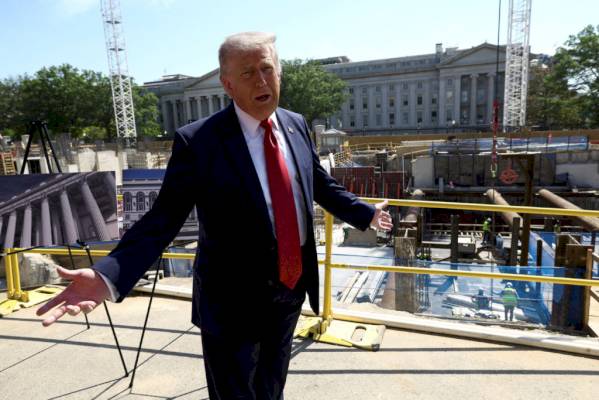
President Donald Trump speaks as he tours Ballroom construction around the outside the White House, Tuesday, May 19, 2026, in Washington. (AP Photo/Jacquelyn Martin)
President Donald Trump speaks as he tours Ballroom construction around the outside the White House, Tuesday, May 19, 2026, in Washington. (AP Photo/Jacquelyn Martin)
CENTCOM chief pushed by lawmaker on whether the Iran war is actually over
During a hearing Tuesday, Democrat Rep. John Garamendi asked Adm. Brad Cooper whether the Pentagon’s assessment is that hostilities between Tehran and Washington have been halted since the ceasefire was announced last month.
Cooper continued to testify that the U.S. remained in a ceasefire despite several attacks from both sides in the last several weeks.
“That’s not my question,” Garamendi said. “My question was is the military assessment that hostilities have ceased since April?” Cooper responded that was his assessment but added that “Iran pushes it.”
Trump says China’s president promised to not send weapons to Iran
There have been reports that China, which has close ties to Iran, has considered sending weapons for use in the conflict against the United States.
But Trump says Chinese President Xi Jinping assured him that wasn’t the case.
“He promised that he’s not sending any weapons,” Trump told reporters after he was asked about the reports.
The leaders held two days of in-person talks last week in Beijing.
China’s foreign ministry has denied the reports.
Senate Majority Leader John Thune says he’s ‘not a fan’ of the settlement fund
Thune told reporters he isn’t sure how the administration intends to use it, but said “I don’t see a purpose for that.”
Thune’s comments come after Louisiana Sen. Bill Cassidy, who lost reelection in a GOP primary Saturday, called it a “slush fund” on Monday.
“We are a nation of laws,” Cassidy said. “You can’t just make up things.”
It is unclear, though, if Republicans will try to block the funding.
Congressman said he doesn’t trust admiral’s answer on Iran school bombing
The House Armed Services Committee’s ranking Democrat pressed the top U.S. military leader in the Middle East for information on the bombing of a school that killed more than 165 people when the U.S. and Israel launched the Iran war.
Adm. Brad Cooper, who leads U.S. Central Command, said the bombing is still under investigation. He said the strike was complex, noting how the school was on a missile site operated by Iran’s paramilitary Revolutionary Guard.
Cooper said he’s committed to transparency once the investigation is complete. But Democratic Rep. Adam Smith of Washington said, “I do not trust that answer.”
Smith said he respects Cooper, but accused Defense Secretary Pete Hegseth of showing a “callous disregard” for protecting civilian life.
Blanche again doesn’t rule out possibility of Jan. 6 rioters getting paid from compensation fund
Under questioning from Sen. Jeff Merkley, an Oregon Democrat, Blanche said he “will definitely encourage the commission” responsible for deciding on the payouts to “take everything into account.”
He also said he’ll commit to “making sure that the commissioners are effectively doing their jobs and that includes setting your guidelines.”
But he declined to explicitly rule out the idea that people implicated in the violence of Jan 6. could apply for payments from the fund, which was set up to pay people who believe they’ve been mistreated by the criminal justice system.
US imposes sanctions on European flotilla organizers
The U.S. Treasury Department imposed sanctions against four people aboard an aid flotilla bound for the Gaza Strip organized by the Popular Conference for Palestinians Abroad, also subject to U.S. sanctions.
Included in the sanctions are a group of European activists: Saif Abu Keshek, Jaldia Abubakra Aueda, Hisham Abdallah Sulayman Abu Mahfuz and Mohammed Khatib.
Israel has recently intercepted dozens of aid flotillas after more than 50 vessels departed from the port of Marmaris, Turkey, last week in what the organizers of the Global Sumud Flotilla described as the final leg of their planned journey to Gaza’s shores.
In a statement, Treasury Secretary Scott Bessent called the flotilla “pro-terror” and “a ludicrous attempt to undermine President Trump’s successful progress toward lasting peace in the region.”
Trump says he’s giving Iran days to make progress in negotiations to avoid resumption of strikes
The president said he was giving Iran “two or three days,” but then suggested he might give Iran a week.
“Maybe Friday, Saturday, Sunday, something, maybe early next week. A limited period of time,” he said.
The president said he “was an hour away from making the decision” to launch strikes on Tuesday before calling them off Monday.
Trump says he was ‘an hour away’ from ordering strikes on Iran
Asked how close he was to striking Iran and ending a fragile ceasefire, Trump on Tuesday said he was “an hour away” from making the call.
“I was an hour away from making the decision to go today,” Trump told reporters at the White House.
He said the strikes “would have been happening right now” if he hadn’t held off. “The ships are all loaded, they’re loaded to the brim,” he added.
Trump on Monday announced he was holding off on military strikes planned for Tuesday because “serious negotiations” were underway to end the war.
Trump says Cuba is calling the US for help ‘and we’ll do that’
The president told reporters Cuba may not need a change in regime to address his concerns but said if he wanted to, “I can do that.”
He didn’t offer many details about what he wanted from Cuba but said: “That’s not going to be hard for us to solve.”
Cuba’s economic and energy crises have deepened this year after the U.S. invaded Venezuela in early January, halting critical oil shipments from the South American country. Then in late January, Trump threatened to impose tariffs on any country that sells or provides oil to the island.
A severe gas shortage has persisted and widespread blackouts continue across the island.
Trump takes reporters to ballroom construction site
President Donald Trump tours Ballroom construction around the outside the White House, Tuesday, May 19, 2026, in Washington. (AP Photo/Jacquelyn Martin)
President Donald Trump tours Ballroom construction around the outside the White House, Tuesday, May 19, 2026, in Washington. (AP Photo/Jacquelyn Martin)
“This is a room that’s been wanted for 150 years by presidents,” Trump said of the ballroom.
Trump has renderings of the building on easels as he explains the various components, including what he calls a “drone-free” roof.
“One thing doesn’t work without the other,” he said.
Trump said the ballroom will be paid for by donors and himself. Republicans in Congress are grappling with a $1 billion funding request to cover all the security elements.
Blanche pledges transparency in fund payouts
The acting attorney general said the Justice Department is committed to “full transparency” in providing public information about beneficiaries of the new fund meant to compensate allies of President Trump who say they were mistreated by the criminal justice system.
Blanche said in response to a question at the Senate budget hearing that there are privacy laws that mandate some information be kept quiet, but that otherwise, the department intended to be transparent.
Blanche suggests Jan. 6 rioters will be eligible to apply for compensation from the fund
Democratic Sen. Chris Van Hollen pressed Blanche on the creation of the fund during a budget hearing and asked him directly whether Jan. 6 rioters involved in crimes of violence could apply for payment from the fund.
“As was made plain yesterday, anybody in this country is eligible to apply if they believe they were a victim of weaponization,” Blanche said.
The decisions on payouts will be made a five-member commission appointed by Blanche.
Blanche defends the creation of the fund as having precedent
In response to questions from Sen. Susan Collins, a Maine Republican, he said that though the fund was “unusual,” it’s not unprecedented.
He said the fund was similar in structure to one created during the Obama administration to compensate Native American farmers who alleged they were victims of racial discrimination.
Blanche said the fund will not be limited to Republicans or to people who were investigated or prosecuted by the Biden administration.
He also said he expected the payouts, which will be decided by a five-member commission, to be a matter of public record.
Senate Democrat calls new Anti-Weaponization Fund a ‘pure theft of public funds’
Sen. Chris Van Hollen, a Maryland Democrat, castigated acting Attorney General Todd Blanche over the new $1.8 billion fund meant to compensate allies of President Trump who feel they’ve been unjustly targeted by the criminal justice system.
Van Hollen called the Anti-Weaponization Fund announced Monday a “pure theft of public funds.”
He told Blanche he was “still acting as the president’s personal lawyer” and not the acting attorney general that he is.
Blanche’s first Congressional hearing as acting attorney general gets underway
Tuesday’s hearing is meant to address the Trump administration’s budget request for the Justice Department. But it’s likely to delve into other controversies that have escalated concerns about the erosion of the law enforcement agency’s tradition of independence from the White House.
Will Trump’s endorsement continue to carry the day in Tuesday’s primaries?
He’s repeatedly shown that Republican primary voters will follow his lead, even as his popularity wanes with the broader electorate.
In Kentucky, he’s supporting first-time candidate Ed Gallrein over Massie, who’s been in office since 2012. Massie is trying to convince Republicans they can support both himself and Trump at the same time, a proposition that’s been tried unsuccessfully in other races around the country.
In the race for Georgia governor, Trump is backing Lt. Gov. Burt Jones in an unexpectedly ugly battle for the Republican nomination. Jones, who comes from a wealthy Georgia family, has given his campaign $19 million. But billionaire Rick Jackson, a health care tycoon, has put more than $83 million of his fortune into the race. Trump’s endorsement power has rarely been tested against that level of lopsided spending.
Is there a future in politics for Republicans who cross Trump?
The signs this year suggest no, and Trump has convinced his voters to defeat his adversaries again and again. The next test of the president’s power to extract retribution is Tuesday, when Rep. Thomas Massie of Kentucky faces a Trump-backed primary challenger.
Massie has been a thorn in the president’s side for pushing for the release of the Jeffrey Epstein files, opposing the war with Iran and voting against Trump’s signature tax legislation last year.
Meanwhile, Georgia is about to feature a fresh case study in the divergent paths available to Republicans who defy Trump.
Secretary of State Brad Raffensperger and former Lt. Gov. Geoff Duncan were among the few Republicans to speak out against Trump’s attempt to overturn his 2020 loss. Both are now running for governor — Raffensperger as a Republican and Duncan as a Democrat — and both are trying to convince voters to look past things they said in the past.
Trump’s tough-talk foreign policy is hitting a wall with Iran as it grips Strait of Hormuz
President Trump has considered himself an effective dealmaker above all else, but he appears to have hit a wall with Iran as his tough talk, threats and even military action haven’t moved Tehran from its long-established positions.
With shifting goals that make it difficult to judge the status of the U.S. effort, Trump and his top aides have insisted the U.S. has already won the war and that Iran is ready to reach an agreement in the wake of escalating U.S. threats during a tenuous ceasefire.
But Trump once again backed down, saying Monday that he’d put plans for an imminent resumption of attacks on hold at the request of Gulf Arab states because “serious negotiations are now taking place, and that, in their opinion, as Great Leaders and Allies, a Deal will be made, which will be very acceptable to the United States of America, as well as all Countries in the Middle East, and beyond.”
Crucially, Iran still has a chokehold on the Strait of Hormuz, the vital shipping lane for global oil supplies, even as the U.S. military has enforced its own blockade on Iranian ports.
Putin visits China to reaffirm Russia ties as Xi also seeks stable US relations after Trump summit
Russian President Vladimir Putin is traveling to China to meet with Chinese leader Xi Jinping less than a week after President Trump wrapped up his own trip to Beijing.
Putin is scheduled to be in China on Tuesday and Wednesday in a visit likely to be closely watched as Beijing seeks to maintain stable relations with the United States while also preserving strong ties with Russia.
The Kremlin has said Putin and Xi plan to discuss economic cooperation between the two countries, but also “key international and regional issues.” The visit coincides with the 25th anniversary of the Sino-Russian Treaty of Friendship signed in 2001.
China is a key trading partner for Russia, especially after Moscow’s full-scale invasion of Ukraine in 2022. Beijing has said it is neutral in the conflict while maintaining trade ties with the Kremlin despite economic and financial sanctions by the U.S. and Europe.
Trump says he’s called off Iran strike planned for Tuesday at request of Gulf allies
Trump said he is holding off on a military strike on Iran planned for Tuesday because “serious negotiations” are underway to end the war.
“There seems to be a very good chance that they can work something out. If we can do that without bombing the hell out of them, I’d be very happy,” Trump said at the White House on Monday evening, after first making the announcement in a social media post.
Trump said he had planned “a very major attack” but put it off — “for a little while, hopefully, maybe forever.” He said America’s allies in the Gulf asked him to wait for two to three days because they feel they are close to a deal with Iran.
Trump has been threatening for weeks that the ceasefire reached in mid-April could end if Iran did not make a deal, with shifting parameters for striking such an agreement. Over the weekend he warned, “For Iran, the Clock is Ticking, and they better get moving, FAST, or there won’t be anything left of them.”
What to know about Trump’s nearly $1.8B fund to compensate allies claiming political targeting
Trump’s allies who believe they have been wrongly investigated and prosecuted could soon have access to a nearly $1.8 billion compensation fund, the Justice Department announced Monday.
Acting Attorney General Todd Blanche said in a statement that the “Anti-Weaponization Fund” will represent “a lawful process for victims of lawfare and weaponization to be heard and seek redress.” Blanche’s statement made no mention of how investigations and prosecutions of Trump’s political opponents under his watch have exposed the Justice Department to the same claims of politicized law enforcement that he has said he opposed.
The fund is in keeping with Trump’s long-running claims that the Justice Department during the Biden administration was weaponized against him, even though then-President Joe Biden himself was scrutinized during that time.
Trump told reporters at the White House on Monday the fund is dedicated to “reimbursing people who were horribly treated.”
US Rep. Thomas Massie’s GOP primary in Kentucky is the latest test of Trump’s power over the party
Rep. Thomas Massie, R-KY, speaks to reporters after a Kentucky Educational Television (KET) debate, Monday, May 4, 2026, in Lexington, Ky. (AP Photo/Jon Cherry)
Rep. Thomas Massie, R-KY, speaks to reporters after a Kentucky Educational Television (KET) debate, Monday, May 4, 2026, in Lexington, Ky. (AP Photo/Jon Cherry)
Republican voters in northern Kentucky will choose between U.S. Rep. Thomas Massie and challenger Ed Gallrein in Tuesday’s House primary, another test of President Donald Trump’s power over his party after he handpicked Gallrein to take on the incumbent.
The primary race turned white hot in the final stretch. Massie brought in a phalanx of other Republicans, including Rep. Lauren Boebert, in an attempt to show voters that they could support both him and Trump. Trump ratcheted up his social media attacks on Massie, calling him “an obstructionist and a fool,” and Gallrein shared a stage with Defense Secretary Pete Hegseth on Monday.
Trump has tightened his grip on the Republican Party in his second term, successfully purging those who deviate from his agenda, but Massie is one of the last and most outspoken holdouts. A Massie defeat on Tuesday would serve as one of the most powerful demonstrations yet of Trump’s influence over Republican voters.
The matchup has become the most expensive U.S. House primary in history.
Blanche will face questions from lawmakers over a nearly $1.8B fund to compensate Trump allies
Acting Attorney General Todd Blanche will appear on Capitol Hill Tuesday for his first congressional testimony since taking the reins at the DOJ as the law enforcement agency faces intense scrutiny over its plans to create a $1.776 billion fund to pay allies of the Republican president who believe they were targeted politically.
Blanche’s testimony before a Senate appropriations subcommittee follows Monday’s announcement about the creation of the “Anti-Weaponization Fund,” which critics decried as an illegal abuse of power designed to line the pockets of Trump supporters with taxpayer dollars.
Tuesday’s hearing is meant to address the Trump administration’s budget request for the Justice Department but is likely to delve into other controversies that have escalated concerns about the erosion of the law enforcement agency’s tradition of independence from the White House.
President Donald Trump endorsed Texas Attorney General Ken Paxton for Senate, dealing a massive political blow to longtime Sen. John Cornyn as he faces off against Paxton in an upcoming Republican primary runoff.
“Ken is a true MAGA Warrior who has ALWAYS delivered for Texas, and will continue to do so in the United States Senate,” Trump wrote in a lengthy post on Truth Social.
Of the incumbent, meanwhile, Trump wrote, “John Cornyn is a good man, and I worked well with him, but he was not supportive of me when times were tough.”
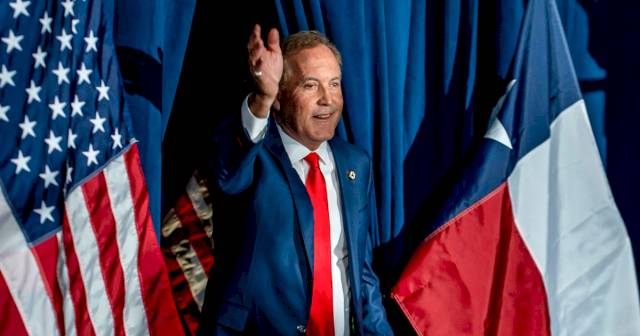
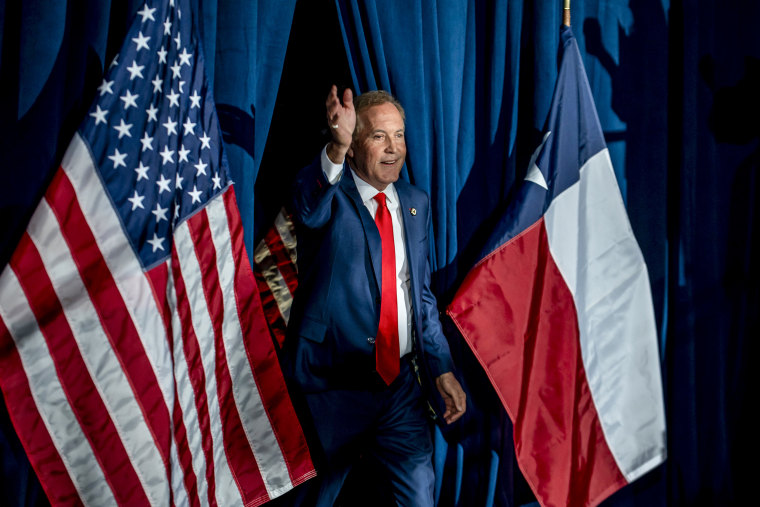
Ken Paxton on March 3, 2026, in Dallas.Sergio Flores / Getty Images filer
Cornyn and Paxton advanced to a May 26 runoff after neither candidate won a majority of the vote in the March 3 primary, with the four-term senator narrowly ahead of Paxton, 42%-41%.
The nominee will take on Democrat James Talarico in the fall. While Trump won Texas by 14 points in 2024, Democrats have long sought to win the Lone Star State, and they believe they could have a shot this year as Trump’s approval rating has dropped.
Trump’s endorsement is the most powerful one there is in a GOP primary, and the president’s decision to back Paxton could put an end to Cornyn’s long political career, marked by more than two decades in the Senate following stints as state attorney general, state Supreme Court justice and a district court judge.
Last weekend, another Republican senator, Louisiana’s Bill Cassidy, lost his primary after Trump endorsed an opponent, Rep. Julia Letlow, who advanced to a GOP runoff.
A late play
Paxton posted on social media that he is “incredibly honored” to have Trump’s support. “I look forward to championing his America First agenda in the Senate!” he wrote. “Texas, get out and VOTE!
Trump’s backing of Paxton, after early voting in the runoff began Monday, comes after weeks of speculation about whether the president would weigh in on the race. He had seemed ready to back Cornyn after the March primary, but he later tied his endorsement to passage of the SAVE America Act, a proposal overhauling the nation’s voting laws.
Paxton said he would consider dropping out of the race if Senate leadership agreed to nix the 60-vote threshold to end debate on legislation, known as the filibuster, in order to pass the measure.
Cornyn responded to Trump’s endorsement in a statement on X noting that he has supported Trump’s agenda and that the president “has consistently called me a friend in this race.”
“It is now time for Texas Republican voters to decide if they want a strong nominee to help our GOP candidates down ballot and defeat Talarico in November, or a weak nominee who jeopardizes everything we care about.”
Steve Bannon, a longtime Trump ally who worked in his first administration and has backed Paxton, said that the Paxton campaign sent Trump polling showing him ahead in the primary. In addition, Bannon said Trump allies made sure that past negative comments Cornyn had made about Trump over the years were top of mind.
A person close to Trump also pointed to Paxton’s trajectory in recent polling as a factor in the president’s endorsement, as well as recent successes for his endorsees in other primaries.
“He has had some big recent wins, I think he both likes the attention and is feeling a moment,” the person said.
Bannon also noted how the endorsement came despite Senate Majority Leader John Thune and numerous other senators urging the president to back Cornyn.
“This is as much a vote of no confidence in John Thune as it is a vote of confidence in Ken Paxton,” Bannon said.
Thune responded to Trump’s endorsement, telling reporters on Tuesday afternoon, “It’s his decision.”
A source familiar with Trump’s decision said Thune’s positions on the proposed Justice Department’s “anti-weaponization fund” and the White House ballroom helped push the president toward endorsing Paxton. Thune told reporters Tuesday morning that he was “not a big fan” of the proposed fund. And Thune has cautioned that numerous Senate Republicans are skeptical about the ballroom money, although he got behind the $1 billion request last week after a closed-door briefing by the Secret Service director.
A Republican in operative involved in Senate races added that they believed Trump just wanted to be on winning side of the runoff and he was moved to weigh in based on recent polling — and also that the president was taking an opportunity to needle Thune.
“He saw the way the winds were blowing, but the f— you to Thune is an added bonus,” the operative said.
GOP senators worry about a competitive race
Cornyn and allies made the case that he represented the party’s best chance at holding onto the Senate seat and avoiding any drag on the rest of the Republican ticket in Texas, given Paxton’s personal and professional controversies.
Paxton was impeached on bribery and corruption charges in 2023, though the state Senate acquitted him. Meanwhile, Paxton’s wife announced last year that she was divorcing Paxton on “biblical grounds.”
“I refuse to allow a flawed, self-centered, and shameless candidate like Ken Paxton risk everything we’ve worked so hard to build over these many years,” Cornyn said on March 3 after the runoff matchup became clear. “There is simply too much at stake in this midterm election for our state and for our country. The final two years of President Trump’s agenda hangs in the balance.”
Trump’s endorsement didn’t land well with Republican senators, leaving many of them perplexed and bewildered. Even some Trump allies fretted that it would hurt the party’s standing in the fall election.
After Trump’s endorsement Tuesday, Sen. Lindsey Graham, R-S.C., said he worries the Texas Senate race will be “three times more expensive” for Republicans trying to defeat Talarico if Paxton is the nominee.
“You don’t have to be a rocket scientist to figure out the pathway for Paxton is there, but it’s more uphill,” Graham told reporters.
Republican Sen. Susan Collins of Maine, who is running in her own battleground race this year, said of Paxton, “I don’t understand it. He is an ethically challenged individual. John Cornyn is an outstanding senator and deserved, in my judgment, the president’s support. Obviously, it’s the president’s call, but I’m disappointed that he did it.”
Not everyone shares that view though. Rep. Wesley Hunt, who finished third in the initial Republican Senate primary in March, also endorsed Paxton on Tuesday soon after Trump made his pick.
A Republican operative described the situation, and the potential competitive race in Texas, as the result of a long-term “epic botch job” by the White House.
“We spent $100 million” in this primary “and now we’re going to have to spend more,” the operative said, also raising the specter that drag from Paxton down the ticket could lead to the GOP losing some of the Texas congressional districts it redrew last year. Waiting so long to endorse and allowing a divisive primary to simmer, the operative added, created a situation where “Democrats will smell more blood in the water and direct more money to Talarico,” forcing Republicans to respond with more that could have gone into other races across the Senate battlefield.
Despite concerns about Paxton from senators and others inside the Republican Party, Trump told NBC News in mid-March, as he weighed his endorsement, that he viewed both Cornyn and Paxton as candidates who could win in November. Trump called Talarico “so weak.”
Paxton has criticized Cornyn’s work on a bipartisan gun bill after multiple mass shootings, including one at a Uvalde, Texas, elementary school, as well as Cornyn’s past criticisms of the president. In 2023, Cornyn said Trump’s “time has passed him by,” suggesting Trump wasn’t the most electable presidential candidate in 2024. He did eventually endorse Trump. Cornyn also said that the criminal charges alleging that Trump mishandled classified documents were “very serious.”
Paxton has also repeatedly touted his unwavering support for Trump.
“I want to tell you, the last time I felt this kind of energy in one room, I was actually at Mar-a-Lago when President Trump announced he was running again in 2024. I don’t know if you remember, but it was right after the midterms, and everyone was turning on the president, the establishment, the media and most Republican elected officials in America were lining up against him. Not me,” Paxton told his supporters on primary night.
Paxton later added that it was time to send Sen. Ted Cruz, R-Texas, and Trump “some reinforcements” in Washington.
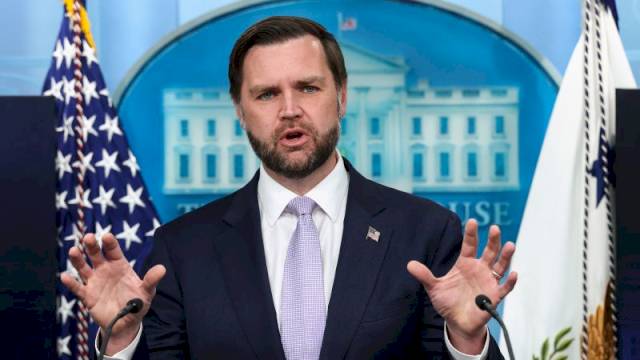
Vice President JD Vance speaks at White House press briefing
• NOW: Vice President JD Vance is holding a press briefing from the White House.
• Iran war: President Donald Trump told reporters that he was “an hour away” from making the decision to launch new strikes on Iran before he postponed an attack yesterday at the request of three Arab states in the Persian Gulf. Meanwhile, the head of US Central Command was pressed on Capitol Hill about plans to end the United States’ conflict with Iran..
• Justice Department fund: In testimony before a Senate appropriations panel, acting Attorney General Todd Blanche denied that the creation of a $1.776 billion fund to compensate Trump allies who claim they were targeted by the previous administration is unprecedented or unwarranted.
Vice President JD Vance said that Russia taking possession of Iran’s enriched uranium as part of negotiations to end the war is “not currently” the US plan.
“That is not currently our plan. That has never been our plan. I’ve seen some reporting on that. I don’t know where it comes from,” Vance told reporters at a White House briefing on Tuesday.
Vance suggested such an arrangement would likely face resistance from both Washington and Tehran.
“So, that is not currently the plan of the United States government. The Iranians have not raised it. My sense is that it’s not something the Iranians would be particularly excited about, and I know the president isn’t particularly excited about it either,” he added.
But the vice president said he would not make pre-commitments in a negotiation “on any particular topic.”
Vice President JD Vance said he continues to see fractures within Iran’s leadership and that Tehran’s negotiating position is unclear as the Trump administration works toward a deal to end the war.
“The Iranians aren’t themselves quite clear in what direction they want to go to, they also are just a fractured country,” Vance told reporters at the White House.
Vance said it wasn’t clear whether the divisions were the product of bad communication or bad faith, but that the result was a muddled process.
“I will say with confidence it’s sometimes hard to figure out exactly what it is that the Iranians want to accomplish out of the negotiation,” he said.
Vice President JD Vance is holding a briefing at the White House.
We’ll bring you updates as we get them.
A senior Pentagon official declined to say whether the Trump administration would rule out putting US boots on the ground in Iran and did not say whether it would seek congressional authorization to restart operations against Tehran.
“Are we reinitiating offensive combat operations?” Rep. Patrick Ryan asked during a House Armed Services Committee hearing Tuesday.
“Of course, that decision is the president’s to make,” responded Daniel Zimmerman, assistant secretary of defense for international security affairs.
“Is that an option that’s been briefed to him?” Ryan asked.
“Well, Mr. Congressman, it’s his decision to make,” Zimmerman said.
“Are you planning to ask Congress this time for a declaration or an authorization now that we’re almost three months in?” Ryan pressed.
“As you know, right now there are negotiations going on at the highest order to try to achieve a long-term solution,” Zimmerman said. He also declined to say whether one of the options going forward would put US military forces on the ground in Iran, saying President Donald Trump “retains the options at his disposal.”
Trump told reporters earlier that the restarting of military operations against Iran was “an hour away” before he called it off after speaking with Gulf nation leaders.
The US military’s commander of forces in the Middle East got into a heated exchange with Democratic Rep. Seth Moulton, in which Moulton pressed him repeatedly on the success of the United States’ war with Iran thus far.
Moulton pressed Adm. Brad Cooper, commander of US Central Command, about the change of leadership in Iran, oil sanctions, and the Strait of Hormuz — which Cooper repeatedly said were policy decisions that he was not involved in as a military commander.
“What’s the plan now? What’s the plan now to actually win this war? Because it feels like we’re losing. We don’t have a nuclear deal, we don’t have the strait open, the president has called for unconditional surrender, is that part of the plan?” Moulton said.
“Congressman, we achieved all our military objectives, we are presently in a ceasefire, we’re executing a blockade, and we’re prepared for a broad range of contingencies,” Cooper said.
“I think it’s an entirely inappropriate statement from you sir, with all due respect,” Cooper responded.
“It’s not a statement; it’s a question,” Moulton said.
Several GOP senators expressed uneasiness with the possibility that January 6 rioters could get money from the nearly $1.8 billion fund the Justice Department announced to compensate those who felt they had been targeted by previous administrations.
“I was here on January 6th. This was not a peaceful protest, it was a riot. It was a bad, bad day for our country,” Sen. Mike Rounds told CNN Tuesday. “Look, if you’re going to put together a fund, then let’s make sure that there’s a judicial oversight to it.”
Rounds said he had “no sympathy” for those who stormed the Capitol, and noted while the Trump administration can do what they want, “in Congress, we still control the purse strings.”
Top GOP appropriator Sen. Susan Collins said she has more questions about the fund after acting Attorney General Todd Blanche told her Tuesday that there were “no limitations” on claims made to DOJ.
“I don’t know what the criteria are going to be at this point, but certainly it raises a lot of important questions that need to be answered. It is highly irregular, and this is not something that should be put in place without a lot more scrutiny,” she told CNN.
Asked if she personally thought January 6 rioters should be eligible, Collins responded, “I do not, if they have been convicted. I do not. If they engaged in violence against police officers, I do not.”
Sen. Lisa Murkowski said Blanche’s testimony “has actually raised more questions for me than answered them,” in terms of “where this 1.8 billion comes from, the commission, how it’s determined, the eligibility, so a lot that we need to know.”
Asked by CNN if she’s comfortable with January 6 rioters receiving money, she firmly said, “no.”
President Donald Trump said he thinks the US war with Iran is popular and that even if it’s not, stopping Tehran from having a nuclear weapon is a worthwhile mission.
“Look, everyone tells me it’s unpopular, but I think it’s very popular when you, when they hear that it’s having to do with nuclear weapons, weapons that could take out Los Angeles, could take out major cities very quick,” he told reporters at the White House on Tuesday.
“Whether it’s popular or not popular, I have to do it, because I’m not going to let the world be blown up on my watch,” Trump said. “It’s not going to happen.”
Trump also called higher oil prices, which have led to some GOP concerns heading into the midterms, “peanuts.”
“And this is peanuts, and I appreciate everybody putting up with it for a little while. It won’t be much longer, but you could have, frankly, there is so much oil out there,” he said.
A recent CNN poll showed 77% – including a majority of Republicans – say that Trump’s policies have increased the cost of living in their own community
Senate Majority Leader John Thune said this morning that he’s “not a big fan” of the $1.776 billion fund for allies of the president that was announced this week.
The Department of Justice on Monday announced the creation of the fund to compensate President Donald Trump’s allies who claim they were unfairly targeted by the previous administration.
Thune was asked whether there should be guardrails to ensure January 6, 2021, rioters aren’t compensated from the proposed fund.
“My assumption is that, based on some of the blowback that’s come since this was announced, that there would be a significant amount of attention paid to it,” he said, noting he expects that scrutiny to happen during the annual appropriations process that is just getting started.
Lawmakers have so far been hesitant to publicly back the fund.
This post has been updated with additional reporting.
President Donald Trump expressed frustration with the parliamentarian and her decision on the White House ballroom funding in a call to Senate Majority Leader John Thune, according to a source familiar with the matter.
It comes after Senate Democrats said Saturday the provision that funds Trump’s ballroom in the GOP’s latest budget bill was deemed out of order by the Senate parliamentarian – the chamber’s rules referee – marking a major blow to the president’s priority.
The White House has said the money would be put toward security for the East Wing project. The ballroom funding totals about $220 million, according to a memo sent from the White House to members of Congress, but comes as part of a $1 billion security funding request.
Thune refused to comment to reporters on the content of any discussion with Trump over possibly firing the parliamentarian.
But when asked by CNN if he might fire her or move to override her decision, the Republican leader said, “I haven’t had any discussions or conversations about that.”
This post has been updated with additional reporting.
CNN’s Ted Barrett contributed to this post.
In his first appearance before Congress since taking the reins of the Justice Department, acting Attorney General Todd Blanche was big on civility, but short on details as he faced tough questions from members of both parties about the nearly $1.8 billion he announced will be available to people who believe they have been wrongly targeted by the Justice Department.
Blanche is still effectively auditioning to be Trump’s permanent Attorney General and while the president likes his officials to adopt a combative posture when challenged, Blanche maintained a mostly congenial tone throughout the hearing.
At the outset, Blanche conceded that the fund is “unusual,” but dodged questions about specifics and whether even those who assaulted law enforcement officers on January 6, 2021 would be eligible for a payout.
His largely civil appearance was a contrast to his predecessor former Attorney General Pam Bondi’s last appearance before Congress, which garnered attention because of her over-the-top exchanges with lawmakers.
Acting Attorney General Todd Blanche said the administration is seeking $10.3 billion for the Bureau of Prisons, making the case that the agency “remains under-resourced.”
The current $8.1 billion budget is insufficient, Blanche told congressional lawmakers, adding that the bureau “risks insolvency without additional support.”
When asked by Sen. Jeanne Shaheen, a New Hampshire Democrat, to explain how he plans to use the additional funds, Blanche said it would go toward staff retention by paying employees more to “make it worthwhile for them to stay.”
Sen. Jerry Moran, a Kansas Republican, also pressed Blanche on the Bureau of Prisons, asking him to describe the issues at the agency.
Blanche went on to again emphasize the need to invest in staff retention, stating that there is a 20% vacancy rate for corrections officers. He told lawmakers that $450 million from the requested funding will be used “to attack the vacancy rate.”
“A lot of money” will also be used for safety and structural repairs, Blanche added.
President Donald Trump teased an endorsement in the race for US Senate in Texas, saying it will come later Tuesday after remaining neutral in the race.
Sen. John Cornyn and Texas Attorney General Ken Paxton are embroiled in a competitive Republican primary runoff set for May 26. Trump said two months he would “soon” endorse one of the candidates.
“I’m going to be making an endorsement at about 12:30, 1 o’clock today for the big race, the Senate race in Texas, and I hope you find it good,” Trump told reporters at the White House on Tuesday.
He added: “There are those that say whoever I endorse is going to win. I don’t know if that’s true, but historically, that’s absolutely true.”
Trump said he has had his “mind made up for a long time” on his candidate, but declined to say who he would endorse.
He later added that he “pretty much always” had known who he would choose.
“I just thought this was a good time, you know, the voting starting,” he told CNN’s Alayna Treene.
Some context: While Democrats haven’t won statewide in Texas since 1994, they have a Senate nominee in state Rep. James Talarico who is energizing liberals ahead of the November midterms and raising massive sums. Republicans long wanted to avoid a damaging runoff that could make things easier for Talarico, in part by having Trump boost one candidate and pressure the other to back down.
President Donald Trump praised a daylong prayer event in Washington that had been attended by administration officials, tying his priorities directly to efforts to revitalize enthusiasm for Christianity.
“Christianity, it’s a great thing for our country,” he told reporters at the White House on Tuesday. “The successes that we’ve had have been based on Christianity and religion, so I’m very proud of that.”
Trump’s remarks followed a prayer event over the weekend held as part of the nation’s 250th anniversary celebrations, which featured appearances from Trump officials and Republican lawmakers. The event prompted some criticism over the appearance of blurring lines between religion and politics.
But Trump hailed it as a “beautiful day,” while taking credit for making religion more popular.
“You look at churches today, they’re full,” he said. “You go back two, three years, nobody was going. So we’re very happy.”
President Donald Trump said Tuesday that he was on the verge of launching new strikes on Iran before he postponed the attack yesterday at the request of three Arab states in the Persian Gulf.
“I was an hour away; we were all set to go,” he told CNN’s Alayna Treene at the White House. “It would’ve been happening right now.”
Trump wrote Monday on Truth Social that he postponed the attack after the leaders of the United Arab Emirates, Saudi Arabia and Qatar urged him to hold off in hopes of advancing negotiations toward a diplomatic solution.
The president said he spoke with the Arab states over two days while contemplating renewed strikes, saying, “We’re all working together.” He said the nations called him to say that “they made a lot of progress” toward negotiations with Iran.
Pressed on leaders’ concerns that renewed US strikes could prompt Iran to retaliate against their nations, Trump acknowledged that it remained a risk.
“They still have a little capacity,” he said of Iran’s ability to attack others in the Middle East. “Not much, but they have a little.”
Trump added that he was willing to wait until later this week to see whether talks progressed, but continued to warn that he could resume combat operations.
“We may have to give them another big hit,” he said of Iran.
This post has been updated with additional information.
CNN’s Aileen Graef contributed to this post.
President Donald Trump put a limited timeline on his decision to temporarily pause planned attacks on Iran as negotiators in the region work toward a potential peace deal.
Trump, who has grown increasingly frustrated with the state of negotiations, said in a social media post Monday that he will “hold off” on a Tuesday plan to attack Iran, citing a request from the leaders of Qatar, Saudi Arabia and the United Arab Emirates. On Tuesday, he said that would last for “a limited period of time.”
He continued, “I’m saying two or three days, maybe Friday, Saturday, Sunday, something, maybe early next week — a limited period of time. Because we can’t let them have a new nuclear weapon.”
President Donald Trump unexpectedly corralled reporters to view construction of his sprawling East Wing ballroom Tuesday, pitching the security necessity as congressional funding is in jeopardy.
The provision in the GOP’s latest budget bill that that would fund security for the ballroom was recently deemed out of order by the Senate parliamentarian, marking a major blow to the president’s priority. Trump expressed frustration with the parliamentarian in a call with Senate Majority Leader John Thune, CNN reported earlier Tuesday.
The president attempted to explain the distinction between different funding mechanisms for the ballroom, which the White House has said would be funded by private donors, including Apple, Amazon, Lockheed Martin, and Meta.
“This is a gift. This is not going to be paid for by the taxpayer,” Trump said over the loud noise of the construction site.
But the White House is also seeking $220 million to put toward security for the project, according to a memo it sent to members of Congress.
Congress, Trump said, “is approving money for security.” He added: “It may go, some of it may go here for additional security. I don’t know, but Congress is approving money.”
Trump pointed to security features including “very powerful concrete” and “drone capacity,” describing the ballroom on top as a “shield.”
There have been few details released about what officials have previously described as a “top-secret” underground project to rebuild the White House bunker, but CNN has reported that the space is likely being reimagined and replaced with new technology to counter evolving threats.
Trump said Tuesday the new complex would also include a military hospital, research facilities and meeting rooms, noting that the size of the new space was doubled “at the request of the military.”
Acting Attorney General Todd Blanche, when asked about whether the Justice Department had an open investigations related Jeffrey Epstein, said sharply: “He’s dead.”
“Any investigation into potential other bad guys will always be open if we have evidence that supports in any way, shape, or form that we can make a case,” Blanche added when asked about the case tied to his predecessor Pam Bondi’s firing.
When pressed, Blanche said he wouldn’t base investigations off political affiliation, something Democratic lawmakers remain unconvinced about.
“This president has repeatedly spoken of an enemies list that he wants to go after, and I must say it’s one of the symbols of the breakdown of a democratic republic,” Democratic Sen. Jeff Merkley said following Blanche’s commitment to nonpartisanship.
Acting Attorney General Todd Blanche said that anyone who feels they were unfairly prosecuted can submit a claim to the newly establish anti-weaponization fund, including those who accuse the President Donald Trump and Republican-led Justice Department of wrongdoing.
When the Justice Department announced the nearly $1.8 billion fund Monday, it was quickly criticized as a way to enrich the president’s allies and supporters who were prosecuted by the Biden administration, US Capitol rioters and others.
Under questioning from Republican Sen. Susan Collins, Blanche said that the fund is “not limited to Republicans, it’s not limited to the Biden weaponization, it’s not limited in any way, scope or form to January 6 or to Jack Smith” Blanche said. “There’s no limitation on the on the claims.”
Democratic Sen. Chris Van Hollen pushed Blanche on his answer, asking whether those who assaulted law enforcement at the January 6, 2021, US Capitol riot could apply.
“As was made plain yesterday, anybody in this country is eligible to apply if they believe they were victim weaponization,” Blanche said.
Blanche also said that it would be up to the commissioners of the fund to decide whether those convicted assaulted law enforcement at the Capitol riot could receive a payment.
“I will definitely encourage the commissioners to take everything into account when determining who should get compensation,” Blanche said.
“But why not this specific issue of [being] convicted of violent acts against police officers,” Democratic Sen. Jeff Merkley asked. “You feel they should get compensation after being convicted of violent acts”
Acting Attorney General Todd Blanche said that members of President Donald Trump’s family will not be able to receive money from the massive new settlement fund that was born out of a lawsuit Trump brought against the federal government.
The assurance to Democratic Sen. Chris Coons comes a day after the Justice Department said Trump, one of his sons, and the Trump Organization — all of whom were plaintiffs in the case — “will receive a formal apology but no monetary payment or damages of any kind” as part of the settlement, which established a nearly $1.8 billion fund of taxpayer money for people who say they were wrongly targeted by previous administration to tap into.
Blanche went on to say that “anybody can apply” to receive money from the fund, but that it would be up to a five-member commission to determine who will actually benefit from it.
Acting Attorney General Todd Blanche equated the anti-weaponization fund announced by Justice Department, styled as an agreement to resolve President Donald Trump’s $10 billion lawsuit against IRS, to an Obama-era fund set up in a case brought by Native American farmers alleging discrimination by the Department of Agriculture that offered funding to organizations supporting those tribal communities.
But there are key differents between the two programs:
For one, the tribal fund arose from a longrunning lawsuit and court-supervised settlement. Trump dropped his case against the IRS abruptly, while the judge was raising doubts that it was a legitimate legal dispute that belonged in the court.
Secondly, the court in the tribal case played a role in monitoring the initial settlement and approving the fund that was later set up in it. The new fund from Trump allies contemplates no such judicial oversight.
Finally, the tribal program was aimed at funding organizations that served the farmers and ranchers that brought the original lawsuit against the USDA.
The new fund will not be limited to people who claim they were weaponized in Trump-related probes, as Blanche himself emphasized Tuesday,
WASHINGTON (AP) — Returning to the U.S. Capitol after a stinging primary reelection loss, Republican Sen. Bill Cassidy of Louisiana said Monday evening that he has no regrets about his “momentous” vote to convict President Donald Trump on impeachment charges five years ago.
“I voted to uphold the Constitution. It may have cost me my seat, but who cares?” Cassidy told reporters in the Capitol. “I had the privilege of voting to uphold the Constitution, isn’t that a great thing?”
Cassidy lost his seat in his state’s Republican primary Saturday after Trump endorsed one of his opponents, and after years of trying to convince his voters that he was still supportive of the president even though he had voted to convict Trump in a Senate impeachment trial after the Jan. 6, 2021, attack on the Capitol.
But after years of curtly dodging questions about his impeachment vote — and often saying nothing at all when pressed in the Capitol hallways — Cassidy now says he feels “great.”
“You’re looking at a man who loves his country, who feels very, very good about how I serve my country and my Constitution and my fellow Americans,” Cassidy said. “Wouldn’t all of us want to say, I voted to support the Constitution on something momentous? That’s the way I feel about it. I’m very pleased about it.”
He now joins a club of Republican lawmakers who have crossed Trump and lost. It remains unclear whether he will join GOP colleagues like North Carolina Sen. Thom Tillis, who has become more outspoken since he announced his retirement last year. Cassidy wouldn’t directly criticize Trump on Monday evening, saying that “people want me to say negative things, but I’m saying positive things.”
Still, he did hint that he may have more to say, telling reporters he is undecided on how he will vote on the next Democratic measure to halt the Iran war and criticizing a new nearly $1.8 billion fund to compensate Trump allies who believe they have been unjustly investigated and persecuted — potentially including people who were prosecuted and later pardoned for their roles in the Jan. 6 Capitol attack.
Cassidy’s Senate colleagues respond with stony silence
As Cassidy reflected on his two terms in the Senate, his GOP colleagues still loyal to Trump were mostly quiet or dispassionate about his loss.
“Bill’s loss was predictable, and Bill knew it,” said his Louisiana colleague, Republican Sen. John Kennedy.
Kennedy said Cassidy decided to run anyway, “and I respect that, and I thank him for his service. We’re running on to a runoff now and we’ve got two fine people in the runoff.”
Cassidy’s vote to convict Trump five years ago “was an issue, there’s no question,” Kennedy said.
South Carolina Sen. Lindsey Graham, one of Trump’s closest allies, said on NBC’s “Meet the Press” Sunday that “those who try to destroy Trump politically, stand in the way of his agenda, are going to lose.”
Trump agreed, posting over the weekend on social media that “it’s nice to see that his political career is OVER!”
Only Alaska Sen. Lisa Murkowski, one of six other Republicans who voted to convict Trump in his second impeachment trial, said she regrets that Cassidy won’t be returning to the Senate.
His defeat “certainly has implications for us here,” she said. “I’ve appreciated working with him and his leadership.”
Cassidy’s path since impeachment has been fraught
Until Saturday, Cassidy was also silent on most controversies involving Trump. And he worked hard to show that he was supportive of the president, most significantly by eventually supporting the nomination of Health and Human Services Secretary Robert F. Kennedy Jr. even after questioning Kennedy’s skepticism of vaccines. As a doctor and the chairman of the Senate Health, Education, Labor and Pensions Committee, Cassidy’s vote was crucial.
Cassidy wouldn’t say Monday if he regretted that vote. He compared the vote to a bad date in high school and said “life is lived forward.”
He was more outspoken about Trump’s new “anti-weaponization fund,” which is part of a settlement that resolves the president’s lawsuit against the Internal Revenue Service over the leak of his tax returns.
While other Republicans dodged questions on the fund as they returned to Washington on Monday evening, telling reporters they didn’t know enough about it or just declining to weigh in, Cassidy said he doesn’t see any precedent for it.
“We are a nation of laws,” Cassidy said. “You can’t just make up things.”
Congress should have a say, he said, adding that people he met on the campaign trail “are concerned about making their own ends meet, not about putting the slush fund together without a legal precedent.”
Cassidy says he is ‘at peace’ with his vote, but it followed him
Cassidy’s support for Trump’s conviction in the February 2021 impeachment trial was a surprise, after the mild-mannered doctor had been mostly supportive of — or at least reluctant to challenge — Trump through his first term. He wrestled with how to vote for days beforehand and declined to comment on the trial before casting his vote.
He was one of seven Republicans to vote to convict as the Senate eventually acquitted Trump. The only other two remaining in the Senate are Murkowski and Maine Sen. Susan Collins, who is up for reelection as well in her much more moderate state.
Cassidy said after the vote in 2021 that he was “at peace” with his decision. But it dogged him for the full five years, and became much more of an issue when Trump was reelected and Cassidy was running again.
When asked Monday if he would run for office again, Cassidy made a subtle dig at Trump’s efforts to overturn his 2020 presidential election loss and his false claims that led to the Jan. 6 attack on the Capitol by his supporters.
“I respect democracy,” Cassidy said. “So right now that door just seems to be shut.”
Associated Press writers Steven Sloan, Joey Cappelletti and Stephen Groves contributed to this report.
A free press is a cornerstone of a healthy democracy.

 Getty Images
 Getty Images
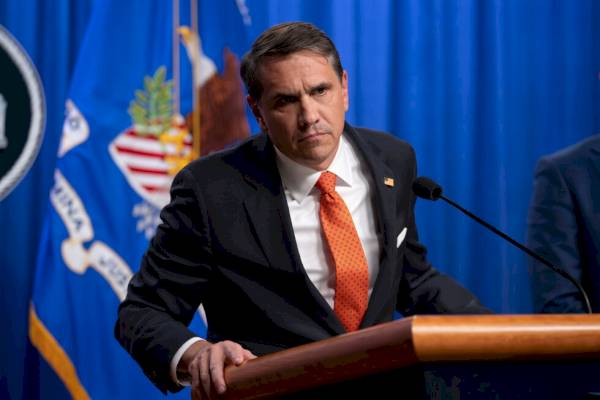




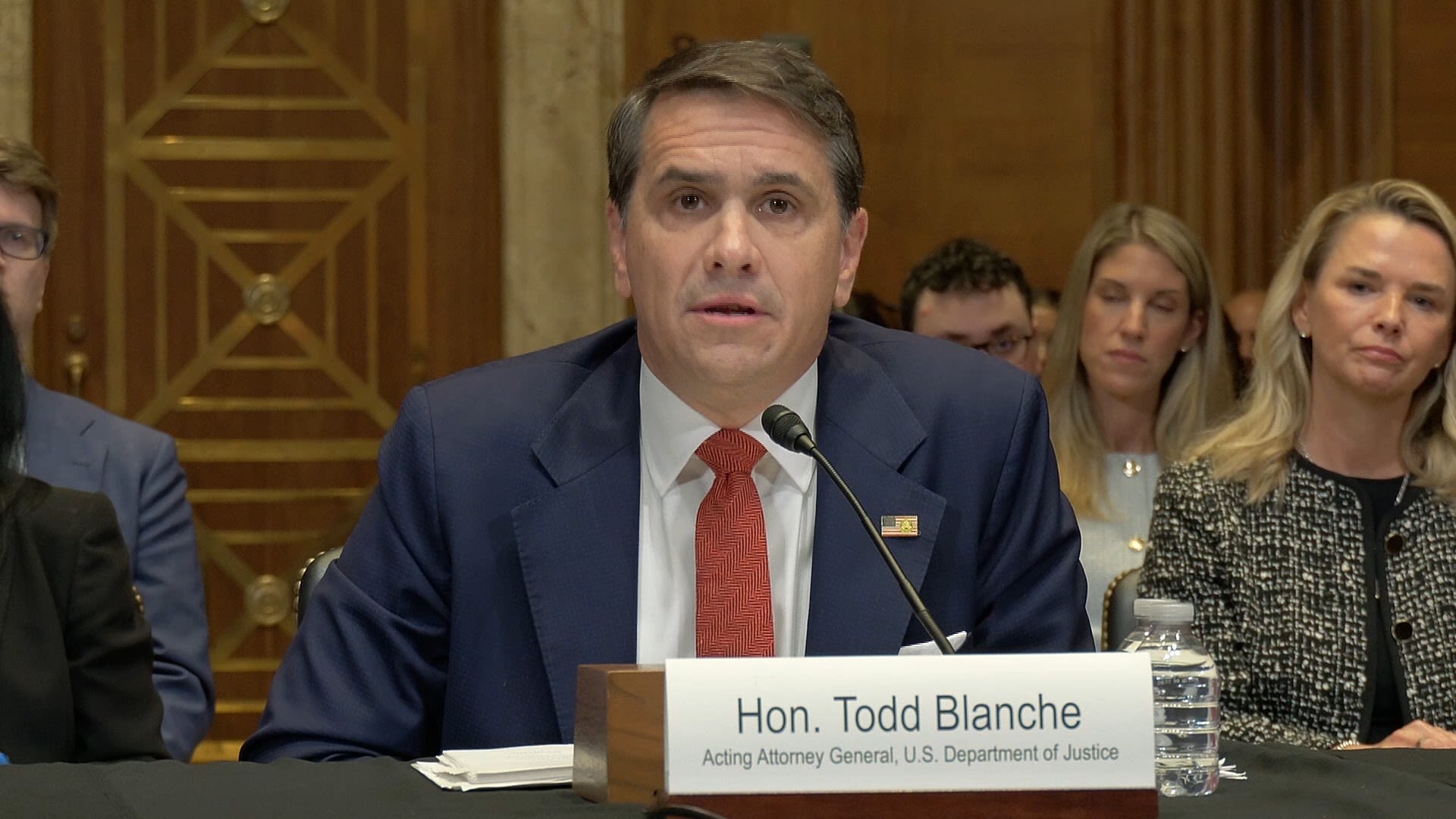 Acting Attorney General Todd Blanche said that anyone who feels they were unfairly prosecuted can submit a claim to the newly establish anti-weaponization fund, including those who accuse the President Donald Trump and Republican-led Justice Department of wrongdoing.