Author: admin

  • Trump calls off AI executive order over concern it could weaken US tech edge – AP News

    Trump calls off AI executive order over concern it could weaken US tech edge – AP News

    WASHINGTON (AP) — President Donald Trump called off plans to sign a new executive order on artificial intelligence hours before an expected White House ceremony Thursday because he said he was worried the measure could dull America’s edge on AI technology.

    Trump said he was postponing the Oval Office event with tech industry executives because he did not like what he saw in the order’s text. “We’re leading China, we’re leading everybody, and I don’t want to do anything that’s going to get in the way of that lead,” Trump told reporters.

    The order would have established a framework for the government to vet the national security risks of the most advanced AI systems before their public release, according to a person familiar with the White House’s deliberations with the tech industry but not authorized to speak about it publicly. The directive was being characterized as a voluntary collaboration with participating U.S.-based tech companies, including Anthropic, OpenAI and Google, the person said.

    The push for some kind of government action to review leading AI systems follows growing concern within the banking industry and other institutions about the leaps in AI’s abilities to find cybersecurity vulnerabilities in the world’s software.

    Treasury Secretary Scott Bessent and outgoing Federal Reserve Chair Jerome Powell convened an urgent meeting with Wall Street CEOs in April, warning them about the cybersecurity risks posed by Anthropic’s AI model, Claude Mythos.

    The meeting, urgently assembled at the Treasury Department’s headquarters, was intended to ensure that banks were aware of the risks associated with the models, Bessent said at CNBC’s “Invest in America Forum” in Washington in April. “This new Anthropic model is very powerful,” he said. “Some banks are doing a better job in cybersecurity than others, and we want to have the ability to convene them and talk about what is best practices and where they should be heading.”

    That led some allies of the Republican president to propose better methods for getting those AI tools in the hands of trusted cybersecurity experts.

    Trump’s hopes for AI have run up against voters’ fears of its impact

    Trump had pledged to undo the AI safety regulations set by his predecessor, Democratic President Joe Biden. Trump’s administration has viewed the AI sector as an engine to help deliver on his pledges to expand the economy and he has promoted its major players at events at the White House and around the world. Last week, Trump had tech CEOs in tow for a summit with China’s Xi Jinping.

    Trump’s ambitions for the sector have collided with the fears of voters over the impact of the technology on American life, jobs and electricity bills. Republicans themselves are divided over whether to embrace the AI industry or side with voters who express skepticism about the technology.

    Also complicating the government’s interest in working with Anthropic on cybersecurity is the government’s ongoing legal fight with the company. Trump in February ordered all U.S. agencies to stop using Anthropic’s chatbot Claude after an unusually public clash between the Pentagon and CEO Dario Amodei.

    There are competing factions within the administration, said Serena Booth, a computer science professor at Brown University and former AI policy fellow in a Democratic-led Senate committee.

    “We do see this kind of public fighting,” she said. ”‘We will release an executive order. No, we won’t. We’re going to sign it this afternoon. Oh, the signing is canceled.’ I think this whiplash is because we’re seeing these fractures.’”

    Some of those divides are balancing what Booth said is a “reasonable idea” to test the most capable AI models before their public release, with a concern that government scrutiny, if it takes too long, could burden AI developers.

    “It does come at a potential very large cost to innovation and speed of development,” she said. “There is, I think, a real risk here and I do see both sides.”

    The White House has pushed back against state laws seeking to regulate AI, saying the measures could curb growth. A new executive order that could have been perceived as government screening of commercial AI models would have signaled a significant shift in the administration’s approach.

    At the same time, similar screening is already happening. Trump’s Commerce Department announced earlier this month that it signed agreements with Google, Microsoft and Elon Musk’s xAI to evaluate their most powerful AI models before their public release, building on previous agreements the Biden administration made with Anthropic and OpenAI. But the announcement later disappeared from the Commerce Department website.

    White House describes a balance between safety and innovation

    At a White House press briefing Tuesday, Vice President JD Vance declined to discuss specifics from the order but said the administration wants to promote innovation while also addressing cybersecurity threats and data privacy.

    “The president wants us to be pro-innovation. He wants us to win the AI race against all other countries in the world,” he said. Vance added, “We also want to make sure that we’re protecting people.”

    Asked about new models that could pose security risks, Vance said the administration is taking a collaborative approach with tech companies.

    “It also does have some downsides,” he said, “and we’re trying to balance that safety against innovation.”

    A former White House tech policy adviser who was a lead author of Trump’s AI policy roadmap said the disagreements likely represent “healthy tension” in an administration that has long been wary of regulating the “frontier AI” companies like Anthropic, OpenAI and Google.

    “They don’t want to do it because it’s politically risky in a million different ways,” said Dean Ball, now at the Foundation for American Innovation. Ball said he would welcome an executive order that would get those companies working more closely with the government on cybersecurity but “ultimately, I’m fine with them taking time to get this right.”

    —-

    O’Brien reported from Providence, R.I. Associated Press writer Fatima Hussein contributed to this report.
  • Trump shifts between diplomacy and threats in Iran standoff – Al Jazeera

    Trump shifts between diplomacy and threats in Iran standoff – Al Jazeera

    In a week that began with Donald Trump revealing he was just an hour away from “making the decision” to resume attacks on Iran, the United States president has oscillated between expressing hope for a lasting ceasefire and threatening military escalation.

    Trump’s mixed messaging has also coincided with a renewed flurry of diplomacy, with Iran as of Thursday saying it had received and was reviewing Washington’s response to Tehran’s latest ceasefire proposal.

    Recommended Stories

    list of 3 items

    end of list

    Trump, meanwhile, appeared to indicate an appetite for a third option: a prolonged, grinding conflict.

    On Thursday, he reposted a New York Post op-ed by Richard Goldberg, a senior adviser at the Foundation for Defense of Democracies, a pro-Israel think tank that has long supported military action against Tehran.

    The article titled “Here’s how to crush Tehran in three moves,” called on the US to “sustain blockade and accompanying economic warfare”, “remake the world in America’s energy dominance image”, and “order the US military to forge a path through the Strait of Hormuz to restore freedom of navigation on our terms, not Tehran’s”.

    The post came after US media widely reported that Trump and Prime Minister Benjamin Netanyahu were at loggerheads during a phone call on Tuesday about the future of the Iran war.

    Netanyahu reportedly pushed the US to resume attacks, while Trump resisted new strikes in hopes of reaching a deal.

    Trump did not confirm the report, but when asked on Wednesday, he said of Netanyahu: “He’s a very good man, he’ll do whatever I want him to do.”

    What has Trump said this week?

    The Trump administration has continually sent broad and at times contradictory messages on Iran, even preceding the war.

    The US and Israel began their attacks on February 28 amid ongoing US-Iran negotiations on Tehran’s nuclear programme. An agreement for the current pause in fighting, which began on April 8, came after Trump released some of his most bellicose threats of the conflict, saying a “whole civilisation will die” if a deal was not reached.

    “If you’re sitting in Tehran, you’re not sure if the president is actually serious about getting a deal, because every day, every few hours, the president changes his position, threatens Iranians with a strike,” Sina Azodi, an assistant professor of Middle East politics at The George Washington University, told Al Jazeera.

    “They can’t really decide whether the US actually wants to deal or it wants war,” he said, adding that Trump’s continued preference for “negotiation on air” makes it harder for Tehran to agree to concessions in private.

    The unpredictability has continued this week.

    Trump on Sunday threatened that the “clock is ticking” for Iran, the latest instance of the US signalling an end to the current halt to fighting, which has run parallel to an ongoing naval blockade of Iran’s ports.

    But on Monday, Trump said any renewed attacks had been put “on hold” pending a request from Qatar, Saudi Arabia and the United Arab Emirates. Trump said “serious negotiations” were taking place.

    The statement came as Iran’s semi-official Tasnim News Agency reported on Monday that Iran has submitted a revised 14-point peace plan to end the war.

    On Tuesday, Trump told reporters he had been “an hour away from making the decision” to resume attacks, but instead agreed to give Iran a few “days” to return to negotiations.

    “Maybe Friday, Saturday, Sunday – something – maybe early next week; a limited period of time,” he said at the time. “We may have to give them another big hit. I’m not sure yet.”

    On Wednesday, Trump continued to signal the US could go either way.

    “We’re in the final stages of Iran. We’ll see what happens. Either have a deal, or we’re going to do some things that are a little bit nasty, but hopefully, that won’t happen,” he told reporters.

    He added, “If we don’t get the right answers, it goes very quickly. We’re all ready to go.”

    Strategic dilemma?

    While Trump’s supporters have characterised his everything-on-the-table approach as part of a wider “mad man” foreign policy approach, others have said it reflects the president’s entrenched dilemma as he tries to claim a convincing victory in the conflict.

    Maintaining the current situation – or escalating into new attacks – risks continued knock-on effects to the US economy, driving tanking approval on how Trump has handled the war.

    Meanwhile, the administration is likely aware that any deal reached with Iran on its nuclear programme must be seen as going beyond the former President Barack Obama-era Joint Comprehensive Plan of Action (JCPOA), from which Trump withdrew in 2018, according to Omar Rahman, a fellow at the Middle East Council on Global Affairs.

    That comes as Tehran has found a “coercive instrument of extraordinary power” in its ability to assert control over the Strait of Hormuz, Rahman wrote in a post on Thursday, boosting their leverage in any talks.

    “Amid this stalemate, the escalation trap beckons,” Rahman wrote, “offering the slim promise that applying more force can alter the equation in Trump’s favor.”

    On Thursday, the impasse appeared to continue, with Trump promising to take possession of Iran’s stockpile ⁠of highly enriched uranium, a prospect Tehran has repeatedly said is a non-starter.

    He also again rejected the prospect of Tehran imposing a toll for the Strait of Hormuz, another of Iran’s previous demands.

  • Federal court dismisses Trump’s lawsuit over Maine voter rolls – Maine Morning Star

    Federal court dismisses Trump’s lawsuit over Maine voter rolls – Maine Morning Star

    The U.S. District Court in Maine delivered a blow to President Donald Trump’s Department of Justice Thursday, granting the state’s motion to throw out the federal government’s lawsuit over Maine refusing to turn over sensitive voter data. 

    Further, Chief U.S. District Judge Lance Walker concluded that the government’s stated purpose for the request — to ensure compliance with federal voter laws — is insufficient. Such an interpretation of federal law, Walker wrote in his ruling, “would take a sledgehammer to the balance Congress struck when it required states to create and maintain computerized lists of registered voters in the first place.”  

    “Under our Constitution, states are the primary regulators and administrators of elections for federal office, unless Congress passes legislation that preempts that framework,” Walker wrote. “And Congress’s power to do even that is itself subject to limitations.”

    Maine Secretary of State Shenna Bellows twice rejected requests from the Trump administration for Maine’s full, unredacted voter rolls — among other information and the DOJ responded with a lawsuit in September. Attorney General Aaron Frey, on behalf of the state, asked the district court to dismiss the lawsuit in December.

    Bellows said in a statement that Thursday’s ruling affirms that the states are in charge of elections. 

    “Let me clear – Trump and the DOJ may continue to try to interfere with free and fair elections run by the states,” said Bellows, who is also running for governor. “We will not let them.”

    Eight rulings have now sided with states pushing back against Trump’s attempted data grabs, after the ruling in Maine along with another in Wisconsin on Thursday. 

    In making its demands, the DOJ had cited the Civil Rights Act to assess compliance with the National Voter Registration Act of 1993 and Help America Vote Act. 

    “If the Department of Justice wants to enforce HAVA and the NVRA, it must use the pre-suit investigation and enforcement mechanisms that Congress provided in those statutes,” Walker wrote, adding, “which do not contemplate production of the unredacted computerized list to the Attorney General so that he might loom over the shoulder of the state election official to point out and demand the correction of inaccuracies in the list.”

    Independent Journalism for All

    As a nonprofit newsroom, our articles are free for everyone to access. Readers like you make that possible. Can you help sustain our watchdog reporting today?

  • Republicans cancel votes amid fight over Trump’s ‘anti-weaponization’ fund – NBC News

    Republicans cancel votes amid fight over Trump’s ‘anti-weaponization’ fund – NBC News

    WASHINGTON — Objections to the Trump administration’s controversial anti-weaponization fund prompted Senate Republican leaders on Thursday to punt a vote on a GOP package to fund ICE and Border Patrol until June, two GOP sources familiar with the discussions told NBC News.

    Senate Majority Leader John Thune, R-S.D., had aimed to get the reconciliation package through the Senate and onto the House before the Memorial Day holiday. But GOP senators emerged from a closed-door briefing with top Justice Department officials about the weaponization fund with more questions than answers, and it became clear that Republicans did not have consensus on moving forward.

    Administration officials “need to help with this issue, because we have a lot of members who are concerned, obviously, about the timing, but also about the substance,” Thune told reporters after canceling votes.

    Asked by NBC News how much the weaponization fund played into postponing the reconciliation vote, Thune replied: “Well, that’s a big issue.”

    The Justice Department has said it plans to make $1.776 billion in taxpayer money available for the fund. Given Democratic opposition, the only method of passing that through Congress would be to add it to the immigration “reconciliation” package, which can pass with only Republican votes.

    “I think the administration is putting itself in a bad spot,” Sen. Bill Cassidy, R-La., said after the private briefing.

    Thursday’s briefing with Acting Attorney General Todd Blanche and others lasted over an hour and a half, and Republicans emerged tight-lipped and appeared frustrated, saying they are working on how they could put guardrails on the anti-weaponization fund.

    To ease GOP concerns, DOJ officials had circulated a one-page fact sheet about the weaponization fund, explaining where the money would come from, who would oversee disbursements, and who was eligible. DOJ said as part of Trump’s legal settlement with the agency, the president, his sons, and the Trump Organization would receive an apology but no monetary payment; they also cannot receive any payouts from the fund.

    “This is about seeking accountability for all Americans who were victims of lawfare and weaponization: millions of Americans whose online speech was censored at the behest of the government, parents silenced at schoolboards, Senators whose records were secretly subpoenaed, churchgoers targeted by the FBI, and so on,” the fact sheet said.

    “There is no partisan restriction: Democrats can submit claims, too,” according to DOJ.

    The Republican-only reconciliation bill would provide about $70 billion in funds for Immigration and Customs Enforcement (ICE) and Border Patrol, two agencies that were left out of the bipartisan government funding package earlier this year amid Democratic demands to impose restraints on Trump’s aggressive enforcement tactics.

    Another wrinkle in Republicans’ efforts to pass the bill: $1 billion in funding requested by President Donald Trump for security measures related to his White House ballroom. It faces significant Republican resistance.

    House GOP leaders were waiting for the Senate to send over the funding package. But with the Senate heading for the exits, the House is now following suit and canceled votes on Friday. Congress plans to take off next week for the Memorial Day holiday and return to Washington the first week of June.

    Trump has said he wanted Congress to send the ICE and border patrol funding package to his desk by June 1. But with lawmakers leaving town, it’s clear they will now blow past that deadline.

    “It’s going to be important to execute on actually getting this thing done and across the finish line,” Thune said, noting that Congress still needs to renew a foreign spying program.

    “It was something that was supposed to be very narrow, targeted, focused, clean, straightforward,” he said of the immigration funding package, “and it got a little bit more complicated this week.”

  • Design plan for 250-foot “Arc de Trump” is approved, but 4 lions on the base are now gone – CBS News

    Design plan for 250-foot “Arc de Trump” is approved, but 4 lions on the base are now gone – CBS News

    / CBS/AP

    Add CBS News on Google

    The U.S. Commission of Fine Arts on Thursday approved the design for the triumphal arch that President Donald Trump wants built at an entrance to the nation’s capital, a key step in the project’s process.

    Commissioners, all appointed by Mr. Trump, acted despite overwhelming public opposition to the 250-foot arch, one of several projects that Trump is pursuing alongside a White House ballroom to leave his imprint on Washington.

    “The building is beautiful,” the commission’s chairman, Rodney Mims Cook Jr., said shortly before the vote on a design revised slightly from what was presented to the federal agency in April.

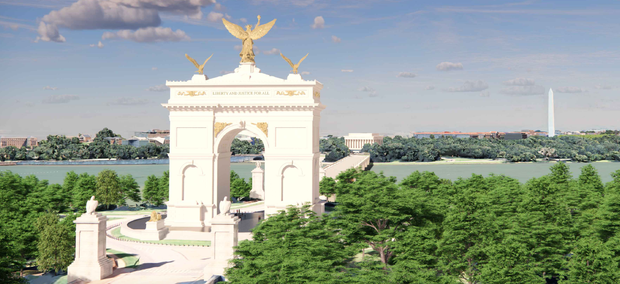
    The arch would stand 250 feet tall from its base to a torch held aloft by a Lady Liberty-like figure on top of the structure. The statue would be flanked on top by two gilded eagles, but the four lions envisioned as guarding the base are now gone. The phrases “One Nation Under God” and “Liberty and Justice for All” would be inscribed in gold lettering atop either side of the monument.

    screenshot-2026-04-16-at-2-07-29-pm.png
    Rendering of Trump triumphal arch that would sit between Lincoln Memorial and Arlington Cemetery submitted by Interior Dept. to Commission on Fine Arts, April 16, 2026.

    A public observation deck on top would provide 360-degree views of the surroundings.

    The commission’s vice chairman, architect James McCrery II, said in April that he preferred the arch without the figures on top, which would have reduced the arch’s height by about 80 feet. Critics of the project argue the arch would dominate the skyline and disrupt views from the Lincoln Memorial to Arlington National Cemetery.

    At 250 feet, the arch would be significantly taller than the 99-foot Lincoln Memorial, which sits across Memorial Bridge. The Washington Monument is 555 feet.

    Commissioners were told at Thursday’s meeting that Mr. Trump considered the suggestion to remove the statue on top “but elected not to pursue such an option.”

    screenshot-2026-04-10-at-2-38-41-pm.png
    A rendering of President Trump’s proposed Independence Arch.

    McCrery recommended doing away with the lions on the base and objected to plans for an underground tunnel for pedestrians to get to the arch, which would be built on a traffic circle. Both design elements have been removed.

    Preliminary surveys and testing of the site began last week.

    A group of veterans and a historian have sued the Trump administration in federal court to block construction on grounds that the arch would disrupt the sightline between the Lincoln Memorial and Arlington House at Arlington National Cemetery, among other reasons. So far, the judge has yet to intervene. 

    The commission received about 1,000 public comments. CFA secretary Thomas Luebke said that “100% of the comments were against the project,” reading one that criticized the arch’s scale. It said the arch would “assert itself as a dominant vertical element in a skyline that has resisted such intrusions.”

    The Republican president and his interior secretary, Doug Burgum, have argued Washington is the only major Western world capital without such an arch. Burgum’s department includes the National Park Service, which manages the plot where Mr. Trump wants to put the arch.

    In a post to Truth Social last month, the president said it “will be the GREATEST and MOST BEAUTIFUL Triumphal Arch, anywhere in the World.”

    The president has said some of his other projects, such as adding a blue coating to the interior of the Lincoln Memorial Reflecting Pool, will beautify the city in time for July 4 celebrations of America’s 250th birthday.

    Trump’s rehab of the Reflecting Pool is also the subject of a court challenge brought by The Cultural Landscape Foundation, which said the administration’s moves to repaint the bottom of the Reflecting Pool blue without first undergoing relevant reviews ran afoul of federal preservation laws governing historic sites.

    The nonprofit group argued in a lawsuit filed last week that the changes at the Reflecting Pool are part of Trump’s broader effort to push through dramatic renovations in Washington without proper reviews and undermine the tone of the area.

    “No consulting parties have been notified, engaged, or given an opportunity to participate,” attorneys representing TCLF wrote in a 26-page complaint. “This latest desecration of the reflecting pool is part of a pattern — epitomized most notably by the rush to destroy the East Wing of the White [House] — in which this Administration willfully disregards legal limits established by Congress.”

    A hearing in the case was scheduled for later Thursday in federal court in Washington.

    Trump said Thursday he did not need approval from Congress for the arch.

    “No, we’re doing it,” Trump said of building the arch. “The land is owned by … the Interior Department, we don’t need anything from Congress.”

    In:

  • Trump rolls back Biden-era refrigerant rules in push to lower grocery costs – USA Today

    Updated May 21, 2026, 2:53 p.m. ET

    WASHINGTON — The Trump administration on May 21 overhauled two Biden-era Environmental Protection Agency rules for refrigerants in a push the White House claims will lower grocery costs for consumers.

    One action, reported first by USA TODAY, delays deadlines for groceries and other companies to phase out the use of climate-damaging hydrofluorocarbons for refrigeration under the 2023 Technology Transitions Rule.

    Hydrofluorocarbons, used for refrigeration and cooling, are considered “super pollutants” that, although short-lived in the atmosphere, are more powerful than carbon dioxide.

    The move is expected to make more refrigerants ‒ the key chemical compounds in freezers, refrigerators and air-conditioning systems ‒ available for supermarkets, homeowners and other businesses, which the White House estimates will produce $900 million in savings, including $800 million at groceries.

    The EPA also took steps to amend the 2024 Emissions Reduction and Reclamation program to exempt all road refrigerant appliances used to transport goods from new leak requirements for hydrofluorocarbons. The White House projects an additional $1.5 billion in savings from this change.

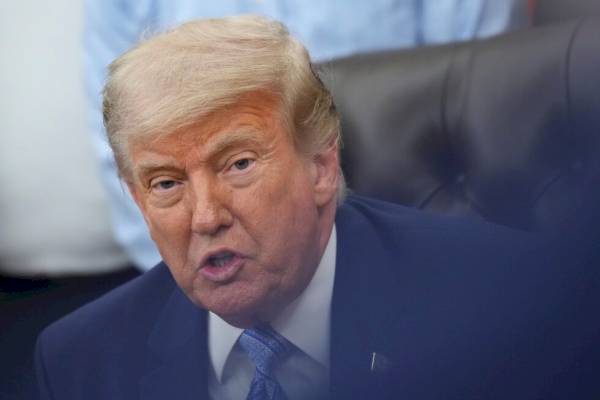
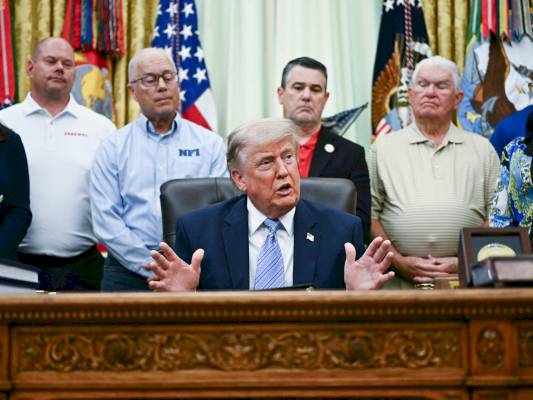
    President Donald Trump speaks during an announcement with U.S. Environmental Protection Agency (EPA) Administrator Lee Zeldin (not pictured) in the Oval Office at the White House, in Washington, D.C., U.S., May 21, 2026.

    No formal guarantees from grocery stores to pass savings to customers

    Trump announced the EPA changes at an Oval Office event, with executives from Kroger, Piggly Wiggly Fareway Stores and other grocery chains standing behind the president.

    Although grocery companies have not made any binding commitments to pass the cost-savings to consumers, Kroger CEO Greg Foran said his company is “right in the middle of doing that at the moment.”

    “We’re concerned about the cost of living. It makes a big difference when you get your pricing right,” Foran said.

    Sitting behind the Resolute Desk, Trump railed on the refrigerant regulations as a “tremendous burden” and “a tremendous cost” that was driving up food prices at grocery chains. He said grocery stores have been forced to shift to energy-efficient refrigerators that he claimed don’t work as well.

    “It was a very catastrophic thing that they did,” Trump said, adding that he plans to later repeal the entire rule phasing out hydrofluorocarbons in refrigerants. “We have to get rid of the law that was signed quite a while ago, because ultimately we want to make it permanent.”

    Trump brushes off environmental impact

    When the hydrofluorocarbon phaseout was approved under former President Joe Biden in 2023, the EPA warned of greenhouses gases that have “global warming potentials that can be hundreds to thousands of times greater than that of carbon dioxide.”

    The Biden-led EPA estimated the rule would reduce emissions equal to 876 million tons of carbon dioxide through 2050, producing $50.4 billion savings through climate-change mitigation and an additional $5.4 billion in savings by shifting to cheaper hydrofluorocarbon substitutes.

    Trump, who has gutted much of Biden’s climate agenda, brushed off environmental concerns. “It’s not going to have any impact on the environment,” Trump said.

    EPA Administrator Lee Zeldin, who was on hand for the White House event, said the refrigerant rules adopted by the Biden administration “didn’t protect human health or the environment and instead piled on costly, unattainable restrictions beyond what the law requires.”

    “Our actions allow businesses to choose the refrigeration systems that work best for them, saving them billions of dollars. This will be felt directly by American families in lower grocery prices,” Zeldin said in a statement.

    LITTLE ROCK, ARKANSAS - JANUARY 22: A customer shops at Kroger on January 22, 2026 in Little Rock, Arkansas. A massive winter storm is expected to bring frigid temperatures, ice, and snow to millions of Americans across the nation. (Photo by Will Newton/Getty Images)

    The Trump administration has repealed or overhauled an assortment of Biden and Obama-era environmental and climate rules as part of an aggressive deregulation agenda.

    The latest moves come as the Trump administration is working to highlight actions aimed at reducing costs for Americans amid surging inflation that poses a political liability for Republicans ahead of the November midterm elections.

    The consumer price index surged 3.8% in April, the largest increase in inflation in three years, as a result of increasing oil costs stemming from the U.S. war in Iran.

    Grocery prices were up 2.9% in April over the previous year after increasing 0.7% from the previous month.

    Reach Joey Garrison on X @joeygarrison.

  • Opinion | Trump and Fox News are trapped in a doom loop on Iran – MS NOW

    Opinion | Trump and Fox News are trapped in a doom loop on Iran – MS NOW

    By  Matt Gertz

    President Donald Trump’s Iran war is a global strategic debacle and a domestic economic disaster that has taken his public support to new depths. With the president’s job approval hitting second-term lows, some Republicans are warning that he may hurt the party’s chances of retaining control of Congress in November’s midterm elections.

    But even as some MAGA pundits are sounding the alarm about the war and its political implications, Fox News’ coverage of the Iran war remains consistently glowing. Trump is depicted on the network as a steely-eyed negotiator who had “the courage, the wisdom, the fortitude to confront this Nazi-like regime,” in the words of one host. He now “holds the cards” against Iranian officials who are “grasping at straws,” a Fox correspondent said. On rare occasions when Fox hosts buck that narrative and express concern about the war’s impact on the country and the GOP, they quickly pivot back to the pro-war propaganda Trump craves.

    In 2020, Fox’s executives and stars faced a network near-death experience due to a rare moment of honesty.

    Fox’s lockstep promotion of Trump’s war reflects two crucial factors: The influence of current and former Fox hosts on the Trump administration, and the network’s desperate desire to hold on to its MAGA viewership at all costs. And because Trump’s own worldview is shaped by the network telling him that he’s engaged in a globally historic victory that just needs more time — and perhaps further escalation — the result is a doom loop without a clear exit.

    In Trump’s first term, his obsessive consumption of Fox’s programming turned the network’s hosts and correspondents into prominent participants in national politics. That pattern has intensified in his second term: Trump has selected more than two dozen former Fox personalities to fill top roles in his administration, leaned on current Fox stars for counsel and seemingly ordered policy changes like the deployment of Immigration and Customs Enforcement agents to U.S. airports based on segments that caught his eye.

    Network hosts like Sean Hannity, Mark Levin and Brian Kilmeade have long supported military strikes against Iran, and over the first few months of the year, they repeatedly used their programs to urge Trump to take action. But since their predictions of a quick and easy resolution gave way to a quagmire, they have been unable to respond coherently. Instead, when not praising Trump for his bravery in starting the war, they suggest risky escalations they say will end it — from a special ops mission to seize Iran’s uranium to the targeted assassinations of more Iranian leaders.

    Not all of Fox’s personalities, however, have track records of hardcore neoconservatism or an ideological interest in annihilating the Iranian regime. But the network is more deeply invested than ever in appealing to their MAGA audience.

    In 2020, Fox’s executives and stars faced a network near-death experience due to a rare moment of honesty. When Fox’s decision desk called the state of Arizona for Joe Biden on election night in 2020, the result was a debacle: Trump lashed out at Fox, furious that the network had damaged his attempts to falsely declare victory. As viewers switched to alternative right-wing channels, Fox hosts course-corrected by platforming bizarre lies and conspiracy theories about purported election fraud. Subsequent defamation lawsuits against Fox led to the publication of internal communications, which showed network executives and hosts panicking at declining ratings, making their peace with promoting voter fraud claims they knew were untrue and seeking to punish Fox personalities who refused to get with the program.

    When Trump turns on his TV, he sees Fox’s hosts and correspondents telling him he’s doing a great job in Iran.

    Those misdeeds have already cost Fox a $787.5 million settlement with Dominion Voting Systems, and a $2.7 billion lawsuit from Smartmatic is ongoing. But for the network’s leaders, the big takeaway was apparently that telling the truth to the viewers poses a bigger risk than telling them what they already want to hear.

    Applying that lesson to the Iran war makes it easy to understand Fox’s ongoing support for the increasingly unpopular conflict. Trump retains an iron grip on his party’s base, allowing him not only to oust dissident GOP officials but to retain Republican support for positions the rest of the country abhors. A New York Times/Siena poll found last week that while just 30% of respondents overall believe Trump was right to go to war with Iran, 70% of Republicans support his decision. Other polls show similar schisms between GOP sentiment and that of the public at large. Right-wing pundits who have struck out on their own, like former Fox hosts Tucker Carlson and Megyn Kelly, can build out a sufficient audience by appealing to the 20%-30% of Republicans who oppose the Iran war, but Fox, a large company with much higher overhead costs, refuses to risk alienating the party’s majority.

    This is the dichotomy of Fox’s influence in the age of Trump: Its hosts are more powerful than ever because they have a direct line to the president. But once he makes a decision, they can do little more than cheer the president lest they lose their audience.

    The result is that when Trump turns on his TV, he sees Fox’s hosts and correspondents telling him he’s doing a great job in Iran, rather than expressing concern for the war’s impact on the country or party. As the network’s flattery deepens Trump’s unwillingness to back down, it becomes ever more difficult to see how this cycle ends.

    Matt Gertz

    Matt Gertz is a senior fellow at Media Matters for America, a progressive research center that monitors the U.S. media. His work focuses on the relationship between Fox News and the Republican Party, media ethics and news coverage of politics and elections.

  • Key federal agency approves the design plan for Trump’s Washington arch – AP News

    Key federal agency approves the design plan for Trump’s Washington arch – AP News

    WASHINGTON (AP) — The U.S. Commission of Fine Arts on Thursday approved the design for the triumphal arch that President Donald Trump wants built at an entrance to the nation’s capital, a key step in the project’s process but one that has no immediate bearing on the timeline for construction.

    Commissioners, all appointed by Trump, acted despite overwhelming public opposition to the 250-foot arch, one of several projects the Republican president is pursuing alongside a White House ballroom to leave his imprint on Washington.

    At the White House, Trump told reporters he thought the vote was “fantastic” adding that “we’re the only important and major city that doesn’t have one.”

    The commission only oversees designs and has no role in the actual construction or funding of the arch or any other project it considers. Preliminary surveys and testing of the arch site began last week. The National Capital Planning Commission, a separate federal agency that approves construction on federal land, has the arch on the agenda at its June meeting.

    Trump had said last year that the arch could be paid for with private donations left over from the ballroom project. A cost estimate for the arch is still being calculated, but a mix of taxpayer and private money is expected to be used to pay for it, according to a White House official, who spoke on condition of anonymity because the president has not publicly discussed the project’s cost.

    “The building is beautiful,” said the commission’s chairman, Rodney Mims Cook Jr., shortly before the vote on the slightly revised design. Commissioners had suggested several changes when they first reviewed the design in April. Some were made by the Harrison Design architecture firm and approved on Thursday.

    Trump keeps statue but removes the lions

    The arch would stand 250 feet tall (76 meters) from its base to a torch held aloft by a Lady Liberty-like figure on top of the structure, flanked by two gilded eagles. But four lions envisioned as guarding the base were removed. The phrases “One Nation Under God” and “Liberty and Justice for All” would be inscribed in gold lettering atop either side of the monument.

    A public observation deck on top would provide 360-degree views of the region. The arch would have an exterior made of granite.

    The commission’s vice chairperson, architect James McCrery II, said in April that he preferred the arch without the figures on top, which would have reduced the height by about 80 feet (24.4 meters). Critics argue that the arch would dominate the skyline and disrupt carefully designed views between the Lincoln Memorial and Arlington National Cemetery.

    It would be more than twice as tall as the Lincoln Memorial, which is 99 feet (30 meters) tall, and close to half the height of the Washington Monument, at about 555 feet (169 meters) tall.

    Nicolas Charbonneau, a director at Harrison Design, told commissioners that Trump considered their recommendation to remove the statue “but elected not to pursue such an option” because he wants the arch to celebrate America and the living.

    “This makes it distinct from monuments like the Jefferson and Lincoln Memorials,” Charbonneau said.

    McCrery had also recommended nixing the ground-level lion statues along with an underground tunnel for pedestrians to get to the arch, which would be built on a busy traffic circle. The design approved Thursday has no lions and incorporates pedestrian crosswalks. A platform the arch would have been built on also has been removed.

    Public opposition doesn’t sway the commission

    Ten people who testified Thursday, including on behalf of organizations such as the National Trust for Historic Preservation and the DC Preservation League, opposed the arch on grounds that it is too big. They said the project needed to be approved by Congress because it would be built on federal land and that it would disrupt the sightline between the Lincoln Memorial and Arlington House at Arlington National Cemetery that was created to symbolize reunification after the Civil War.

    A group of veterans and a historian have sued the Trump administration in federal court to block the arch construction over concerns about disruptions to the sightline.

    Despite the arguments by preservationists, historians and others, Trump asserted Thursday that he does not need Congress to approve the arch. It’s the same justification he’s given for moving ahead quickly with the ballroom project last year.

    Cook, the commission chairman, pushed back after listening to the testimony and noted the limitations of building anything new on the National Mall.

    “Washington is not a static city. It must grow,” Cook said.

    Trump’s work on the Lincoln Memorial

    The president has said some of his other projects, including adding a blue coating to the interior of the Lincoln Memorial Reflecting Pool, will beautify the city in time for July 4 celebrations of America’s 250th birthday.

    That project is also the subject of a court challenge brought by The Cultural Landscape Foundation, which said repainting the bottom of the Reflecting Pool blue without first undergoing relevant reviews runs afoul of federal preservation laws governing historic sites.

    The nonprofit group argued in a lawsuit filed last week that the changes at the memorial to Abraham Lincoln are part of Trump’s broader effort to push through dramatic renovations in Washington without proper reviews and undermine the tone of the area.

    A hearing in the case was underway Thursday in federal court in Washington.