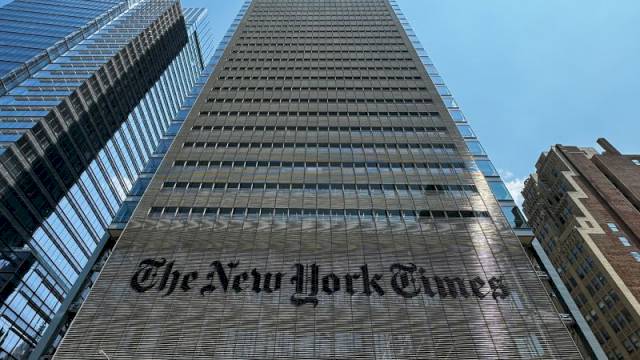
The New York Times’ careful, clinical story about President Donald Trump showing “signs of fatigue” and facing “realities of aging in office” came out two weeks ago. But the story still seems to be on the president’s mind.
On Tuesday night, Trump lashed out at the Times again in a 488-word Truth Social post, writing, “After all of the work I have done with Medical Exams, Cognitive Exams, and everything else, I actually believe it’s seditious, perhaps even treasonous, for The New York Times, and others, to consistently do FAKE reports in order to libel and demean ‘THE PRESIDENT OF THE UNITED STATES.’ They are true Enemies of the People, and we should do something about it.”
Trump assails the news media all the time, but his invocation of “treason” and his ominous threat — “we should do something about it” — stood out to some journalists.
I wondered if Trump’s rage was in response to some forthcoming story about his health. Maybe, I thought, the Times had sent him a new request for comment, and he was lashing out about it? But I asked around, and as far as I can tell, he wasn’t trying to preempt some new story currently in the works. Instead, it seems, the Nov. 25 article by Katie Rogers and Dylan Freedman just really got under his skin.
Rogers and Freedman analyzed Trump’s schedules and found that he “has fewer public events on his schedule and is traveling domestically much less than he did by this point during his first year in office, in 2017, although he is taking more foreign trips.”
“And when he is in public, occasionally, his battery shows signs of wear,” the reporters wrote.
Trump, 79, responded to the article by calling Rogers “ugly, both inside and out,” and bragging in all caps about working hard. The White House has described his health as “excellent” and “exceptional.”
On Wednesday morning, the Times addressed the president’s latest broadside by saying journalists are simply doing their jobs.
“Americans deserve in-depth reporting and regular updates about the health of the leaders they elect,” the Times said.
“Mr. Trump welcomed our reporting on the age and fitness of his predecessors; we’re applying the same journalistic scrutiny to his vitality,” the Times continued. “Our reporting is heavily sourced, based on interviews with people close to the president and with medical experts. We won’t be deterred by false and inflammatory language that distorts the role of a free press.”
Trump’s palpable frustration with scrutiny of his health — along with his attempt to convince people he’s near-superhuman — mirrors the behavior of strongmen throughout history.
“Autocratic leaders rely on the creation of an illusion that they will be around forever, that’s how they create fear and obedience,” said Anne Applebaum, the author of “Autocracy, Inc.”
“We know that Putin and Xi have both had health issues too, and we have no knowledge of the details,” Applebaum said.
Trump’s doctors have been comparatively forthcoming, issuing multiple memos about the president’s physicals, though some outside medical experts have raised doubts about the credibility of some of the assertions.
As for Trump’s suggestion that the news coverage is “perhaps even treasonous,” Times publisher A.G. Sulzberger dealt with that back in 2019, the first time Trump leveled such an accusation at the publication.
In an op-ed for a rival, the Wall Street Journal, Sulzberger wrote, “The Founders considered it the gravest of crimes. Tossing the charge around is irresponsible and wrong.”
Trump is currently suing both the Times and the Journal for defamation, in unrelated cases, and both papers have said they will vigorously contest his claims.
Leave a Reply