Author: admin

  • The Trump phone has finally arrived. Here’s what the reviews are saying. – mashable.com

    The Trump phone has finally arrived. Here’s what the reviews are saying. – mashable.com

    After months of waiting, Trump Mobile’s American smartphone (AKA the Trump Mobile T1 AKA the Trump Phone) is finally in the hands of consumers — or, at least, a select few journalist reviewers who spent their own hard earned money to procure one.

    Trump Mobile CEO Pat O’Brien previously announced the devices would start shipping last week, and it appears the promise was at least partially kept, as tech journalists began receiving devices a few days ago.

    Just a little recap: The Trump Phone was announced last June, marketed as a gold “Made In America” Android device that would run a user only $500. The company then opened up a $100 preorder for the device. Shortly after, users realized the “Made In America” label was too good to be true, and as the release deadline was pushed further and further, many believed it would all turn out to be a scam. The device’s Terms & Conditions were an even bigger mystery, including a stipulation that Trump Mobile couldn’t guarantee the device would ever be released. A totally normal thing to include.

    The Verge then reported on an official FCC listing that seemed to confirm O’Brien’s comments. A few days later, Trump Mobile execs confirmed to the press that customer data was leaking onto the open internet, due to a third-party platform provider.

    At least the phone is here.

    Unboxing the Trump Phone

    Our colleagues over at CNET have done the full unboxing, and it is, contrary to popular belief, real: A golden smartphone complete with etched American flag logo (but only 11 stripes instead of 13).

    Mashable Light Speed

    It comes in a sleek black box emblazoned with the same minimalist flag motif — kind of like those baseball caps your uncle wears — and reads only “assembled in the USA,” not made in the USA, so jury is still out on the phone’s manufacturing origins. Inside the box is a wall plug, braided USB-C cord, and a SIM card tool, CNET reported.

    The device’s camera bump is marked with the Trump Mobile logo (that is, just the words “Trump Mobile”). It’s longer than an iPhone 17, NBC News reported, and has a slim screen bezel with a camera cutout. It looks, to the trained eye, nearly identical to the 2024 HTC U24 Pro, similar to mockups released earlier this year.

    The Trump Phone specs: Storage, performance, headphone jack?

    The phone comes with 512 GB of storage and — wait a minute — a headphone jack?! That’s right; as the public yearns for the days of analogue tech, Trump Mobile is bringing back the jack.

    The device has a 6.78-inch AMOLED screen and a 50-megapixel front-facing camera. It runs off a 5,000-mAh battery and uses an unnamed Snapdragon mobile platform.

    According to initial testing by CNET’s Patrick Holland, the phone has an 8-core processor, which he theorizes is the Snapdragon 7 Gen 3. He compares the Trump Mobile phone’s performance on standard benchmark tests to 2020-2022 Android phones, like the Galaxy Z Fold 2.

    The CNET team will be posting live reviews of the phone as they test it over the weekend. Said NBC’s Brian Cheung: “It works like any other phone.”

    T1 comes with Truth Social preloaded. Duh.

    Last but not least, the phone comes with the Truth Social app automatically downloaded to every user’s home screen.

    And that is fine, because there is absolutely nothing weird about the U.S. President creating his own social media platform for free speech and then having it preinstalled directly onto a communication device branded with his last name.

  • ‘United States of the Middle East?’: Trump posts US flag covering Iran – Al Jazeera

    ‘United States of the Middle East?’: Trump posts US flag covering Iran – Al Jazeera

    Latest Truth Social post comes amid ‘delicate diplomacy’, expert says, as US and Iran indicate progress in talks.

    Washington, DC – President Donald Trump has posted a photo of the United States flag covering the map of Iran, with the question: “United States of the Middle East?”

    The post on Truth Social on Saturday represented another potentially incendiary message from Trump amid ongoing negotiations for a more lasting ceasefire in the US-Israeli war with Iran, experts said.

    Recommended Stories

    list of 3 items

    end of list

    It carries the potential to roil both regional allies and foes alike given Washington’s past intervention in the Middle East, most notably during the US invasion of Iraq from 2003 to 2011, as well as the Trump administration’s push to increase its influence abroad.

    The sentiment also appears to run counter to the Trump administration’s repeated statements that it is not seeking a prolonged occupation of Iran. The US has maintained it is not seeking outright regime change in its war, which it launched alongside Israel on February 28, but that it would welcome such change as a byproduct of the military campaign.

    Even for a president known for outlandish social media posts and conflicting messaging on the war, the post could have implications for ongoing negotiations aimed at a more lasting ceasefire, according to Vali Nasr, professor of international affairs and Middle East studies at Johns Hopkins University.

    He pointed to Trump’s threat in early April that an “entire civilisation will die” if Iran did not agree to a deal at the time. Hours later, both sides agreed to a pause in fighting.

    That pause has held since, save for a handful of flare-ups, with the US continuing to blockade Iranian ports and Tehran effectively closing the Strait of Hormuz.

    “First he declared he wanted to eradicate Iran’s civilisation now he is declaring that he wants to turn Iran into an American property,” Nasr wrote on X.

    “It is this kind of grotesque behaviour that undermines diplomacy and unites Iranians in defence of their country,” he added. “In the middle of delicate diplomacy he casts doubts on America’s true intentions.”

    The White House did not immediately respond to a request for comment.

    Fragile negotiations continue

    On Saturday, both US and Iranian officials indicated a new deal may be within reach.

    Trump told CBS News both sides were “getting a lot closer”. US Secretary of State Marco Rubio said an update could be coming shortly, the broadcaster reported.

    Iranian Foreign Ministry spokesperson Esmaeil Baghaei said the two sides were “currently working to finalise” a memorandum of understanding, and that “the opinions have been converging”.

    Still, there have been no official announcements related to key sticking points in the standoff, including the future of Iran’s nuclear programme, the fate of its highly enriched uranium stockpile, and its future influence over the Strait of Hormuz.

    Trump regularly uses his Truth Social account, which he launched after being briefly banned from Twitter, now X, in the wake of the 2020 election, to make major announcements, attack political enemies, and post AI-generated images and videos.

    The foreign policy of his second term has been defined by efforts to grow US influence abroad, particularly in the Americas. That has included the military abduction of Venezuelan leader Nicolas Maduro, continued threats against Cuba, and vows to take control of Greenland, the semi-autonomous Danish territory in the North Atlantic.

    The Trump administration has adopted the term the Donroe Doctrine, a reference to the 1823 Monroe Doctrine, which sought to diminish European influence in the Western Hemisphere.

    On Saturday, Trump also posted an image of his face peering over a mountain range in Greenland.

    “Hello, Greenland!” it said.

  • Trump meeting with Gulf leaders as he weighs latest Iran proposal to end the war – news8000.com

    Trump meeting with Gulf leaders as he weighs latest Iran proposal to end the war – news8000.com

    (CNN) — US President Donald Trump met with Gulf and other regional leaders Saturday afternoon to review Iran’s latest proposal to end the war, a source familiar with the matter said, as mediators emerged from sessions in Tehran suggesting they had drawn closer to reaching a framework for a possible deal.

    The regional leaders encouraged Trump to accept a framework agreement with Iran during their call earlier, according to a person briefed on the discussion. The person described the conversation as encouraging.

    Another source from the region called the talks positive.

    “The call was very positive. Good progress is being made. Regional leaders were supportive of the progress and of the breakthrough President Trump achieved with the talks,” a regional diplomat on the call told CNN.

    Trump, speaking to Axios in a phone interview, described the chances of reaching an agreement with Iran as a “solid 50/50” before the call with Gulf and other regional leaders, adding that he could decide by Sunday whether to resume military action against Iran.

    The president said the talks could either lead to a “good” deal or result in the US choosing to “blow them to kingdom come.”

    Earlier Saturday, US and Iranian officials suggested that they may be closer to reaching a framework agreement to end the war after mediators from Qatar and Pakistan held talks in Tehran. One regional source said the US and Iran were moving closer to an agreement to work toward a more detailed deal in the future.

    “There may be news later today. I don’t have news for you at this very moment, but there might be some news a little later today. There may not be. I hope there will be, but I’m not sure yet,” US Secretary of State Marco Rubio told reporters in New Delhi on Saturday.

    Trump’s call Saturday was expected to include Gulf leaders and officials from Pakistan, Turkey and Egypt, a source from the region told CNN. Trump told Axios he also planned to speak with envoy Steve Witkoff and adviser Jared Kushner, his son-in-law. Vice President JD Vance, meanwhile, was spotted arriving at the White House Saturday.

    Israeli Prime Minister Benjamin Netanyahu has been in contact with US officials throughout Saturday evening and expects to speak with Trump later tonight, according to an Israeli source.

    Israel’s main concern is that there will be a narrow interim agreement that will extend the ceasefire, open the Strait of Hormuz and gradually ease sanctions on Iran, while not addressing the most critical points for Israel – the nuclear program and enriched uranium, the source said. The US continued to reassure Israel on the uranium issue.

    Netanyahu will convene a limited security consultation on Saturday evening with selected ministers and security officials to discuss the developments in Iran negotiations, an Israeli source told CNN.

    The mediation efforts come after Trump met with top US national security officials Friday to discuss his next steps in the war, including the possibility of resuming fighting.

    Rubio said diplomatic efforts remain underway behind the scenes, and Washington remains focused on making sure Iran cannot possess a nuclear weapon and addressing its stockpiles of enriched uranium.

    “Even as I speak to you now, there’s some work being done,” Rubio said. “There is a chance that, whether it’s later today, tomorrow, in a couple days, we may have something to say.”

    Trump also expressed optimism on Saturday, saying in an interview with CBS News he had seen a draft of Iran’s proposal, and that both sides are “getting a lot closer” to a deal, according to Nancy Cordes, a correspondent for the network.

    Trump did not say whether he will agree to the draft, saying “I can’t tell you before I tell them, right?”

    Meanwhile, Mississippi Sen. Roger Wicker and South Carolina Sen. Lindsey Graham, two GOP Iran hawks, expressed caution at Trump making a potential peace deal with Iran.

    Graham raised concerns about Iran being perceived as a dominant “force requiring a diplomatic solution,” which he says could have broad implications for the region.

    “This combination of Iran being perceived as having the ability to terrorize the Strait in perpetuity and the ability the inflict massive damage to Gulf oil infrastructure is a major shift of the balance of power in the region and over time will be a nightmare for Israel,” Graham posted on X Saturday.

    Wicker, who serves as chairman of the Senate Armed Services committee, believes the negotiations will “define” Trump’s legacy and urged the president to “finish what we started.”

    “His instincts have been to finish the job he started in Iran, but he is being ill advised to pursue a deal that would not be worth the paper it is written on,” Wicker wrote Friday, adding, “Further pursuit of an agreement with Iran’s Islamist regime risks a perception of weakness.”

    ‘A positive trajectory’

    Iran’s foreign ministry said Tehran has been focused on ⁠finalizing a ‌memorandum ⁠of understanding through the Pakistani-mediated talks.

    That memorandum would focus on ending the war, ending the US naval blockade of Iran and the release of Tehran’s blocked assets overseas, but not its nuclear program, Foreign Ministry spokesman Esmail Baghaei said Saturday.

    “Sanctions are definitely part of the negotiation topics, but since we are not discussing the nuclear issue at this stage, there will be no negotiation on the details of lifting sanctions either,” Baghaei was cited as saying by semi-official FARS news agency.

    Several regional sources told CNN that there was cautious optimism about negotiations.

    “Things are moving in a positive trajectory,” said one regional source.

    Iran’s ambassador to Pakistan, Reza Amiri Moghadam, similarly framed the talks with “conservative optimism” as a successful step forward.

    Another source with knowledge of the talks said, “the deadlock is over,” although it was not immediately clear if this was a reference to a deadlock over key sticking points or more simply on the text of a memorandum.

    Chief among the disagreements is what happens to Iran’s stockpile of highly enriched uranium, its domestic enrichment program and navigation through the Strait of Hormuz, which Tehran has effectively shut.

    Earlier this week, the source said there was also work underway regarding a potential unfreezing of Iranian assets.

    After meetings in Tehran on Friday and Saturday, Pakistan’s military chief Field Marshal Asim Munir left for Islamabad late in the afternoon local time. The Pakistan Military said the visit was “highly productive,” adding that the talks “contributed meaningfully towards the mediation process.”

    “The intensive negotiations over the last twenty four hours have resulted in encouraging progress towards a final understanding,” the military said in a statement.

    Baghaei said that 30- and 60-day timeframes had been included in a text of the memorandum, but it had not yet been finalized.

    “Over the past week, the viewpoints have been getting closer,” he said. “We must wait and see what will happen in the next three to four days.”

    Baghaei said ⁠any mechanism concerning ⁠the Strait of Hormuz should be agreed between ⁠Iran, Oman and the countries bordering the ⁠waterway, and that the United States “has nothing to do” ⁠with it.

    Iran’s chief negotiator, Mohammad Bagher Ghalibaf, struck a defiant note after his talks with Munir, warning that Iran “will not back down from the rights of our nation and country – especially when dealing with a party that has never shown sincerity and in which no trust exists.”

    “Our armed forces have rebuilt themselves during the ceasefire in such a way that if Trump makes the mistake of restarting the war, it will definitely be more crushing and bitter for America than the first day of the war,” Ghalibaf added, according to a report from Iran’s state broadcaster.

    The-CNN-Wire

    ™ & © 2026 Cable News Network, Inc., a Warner Bros. Discovery Company. All rights reserved.

    CNN’s Nic Robertson, Matthew Chance, Becky Anderson, Emily Condon, Billy Stockwell, Aleena Fayaz, Jeremy Diamond and Jennifer Hansler contributed to this report.
  • What will Trump do next with Iran? – NPR

    What will Trump do next with Iran? – NPR

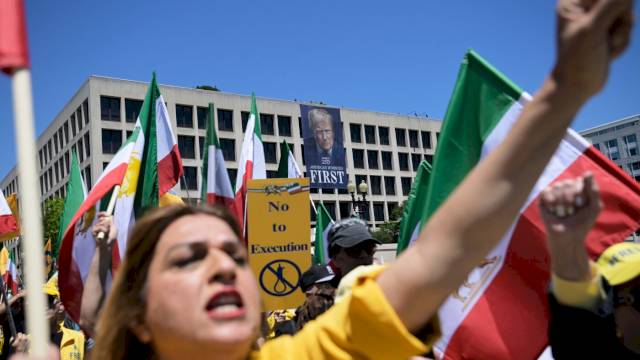
    A banner of President Donald Trump hangs over Iranian Americans and their supporters as they march from the U.S. Capitol to the World War II Memorial during a rally Saturday, May 16, 2026, in Washington.

    A banner of President Donald Trump hangs over Iranian Americans and their supporters as they march from the U.S. Capitol to the World War II Memorial during a rally Saturday, May 16, 2026, in Washington. Rod Lamkey/AP hide caption

    toggle caption

    Rod Lamkey/AP

    President Donald Trump has staked much of his political identity on his prowess as a dealmaker who is capable of bending adversaries to his will.

    But Iran, until now, has proved resistant to that approach. Since the United States and Israel launched military strikes on Iran in late February,

    a 38-day military campaign has given way to a fragile ceasefire, a mutual blockade centered on the Strait of Hormuz, and a cycle of stalled negotiations punctuated by Trump’s repeated threats to resume large-scale attacks.For more than six weeks now, the two countries have been locked in a standoff that has rattled global energy markets, regional stability, and Trump’s domestic political standing.

    It has left governments, militaries, corporations and communities around the world asking: ‘what will Trump do next?’

    On Monday, Trump announced he had called off a planned military strike at the request of Gulf Arab allies. He then said that “serious negotiations are now taking place,” adding that multiple regional partners — the United Arab Emirates, Qatar and Saudi Arabia — had told him they believed “a deal will be made, which will be very acceptable to the United States of America.”

    But even as he announced the pause, Trump told his military commanders to remain on standby for “a full, large-scale assault of Iran, on a moment’s notice, in the event that an acceptable Deal is not reached.” That marked the latest spin in what has become a recurring cycle for Trump during this conflict: a deadline, a threat, a pullback, another threat.

    Three of Trump’s core stated war aims — Iran abandoning its nuclear program, halting ballistic missile development, and ending support for Iran’s proxy forces in Gaza, Iraq, Lebanon, and Yemen — remain unmet.

    Iran’s response to this latest pause from the White House was hardly conciliatory.

    “Our armed forces’ fingers are on the trigger, while diplomacy is also continuing,” Mohsen Rezaei, a military adviser to Iran’s supreme leader, said on state television.

    Iran’s leverage over the Strait 

    Central to the impasse is the Strait of Hormuz, through which roughly one-fifth of the world’s oil and natural gas moved before the conflict began. Iran’s effective closure of the waterway, even as the U.S. continues to enforce its own blockade on Iranian ports, has sent energy prices higher worldwide and created a direct problem for American consumers.

    An analysis of average national gas prices by AAA shows they have increased more than 50% since the start of the conflict. An AP-NORC poll conducted this past week showed that only a third of Americans currently approve of Trump’s handling of the economy.

    Trump’s decision to utilize maximum economic and military pressure worked against Venezuela and placed severe strain on Cuba. But Iran presents a different challenge because of its ability to threaten one of the world’s most critical energy chokepoints.

    Another challenge is that both sides believe that playing the waiting game will ultimately work in their favor. Vali Nasr, a scholar of Iranian politics at Johns Hopkins University’s School of Advanced International Studies, told NPR’s Morning Edition that the current leadership in Tehran has drawn a sharp distinction between Trump’s military threats, which Iranian officials consider sincere, and his invitations to conduct diplomacy, which they do not.

    “Iran does not take him seriously when he says he wants to negotiate,” Nasr said, adding that Iranian officials have read U.S. diplomatic signals as a strategy designed to buy time and sow internal confusion rather than reach a genuine agreement. On several occasions, the U.S. and Israel have launched attacks against Iran amid negotiations.

    No clear endgame 

    On the question of whether the conflict could settle into a prolonged frozen standoff, Nasr said he was skeptical that the current impasse will hold.

    “The Strait of Hormuz cannot remain closed indefinitely, and the U.S. cannot maintain this blockade indefinitely,” he said, citing the toll on the broader global economy as well as the limits of America’s naval capabilities. “I don’t think we’re talking months — maybe a month.”

    Despite its battlefield losses, Iran has managed to keep its governing operations mostly intact and its grip on the Strait largely in place. But questions remain over Iran’s long-term nuclear ambitions that the country’s leaders have long insisted are civilian in nature. Trump has at times threatened to destroy them. But the government in Tehran is insistent on its right to develop peaceful nuclear energy.

    The White House, for its part, maintains that its current posture has been successful.

    “President Trump holds all the cards and wisely keeps all options on the table,” White House spokesperson Olivia Wales repeatedly insisted to reporters this week.

  • Trump Admin Fires Two More NYC Immigration Judges – New York Focus

    Trump Admin Fires Two More NYC Immigration Judges – New York Focus

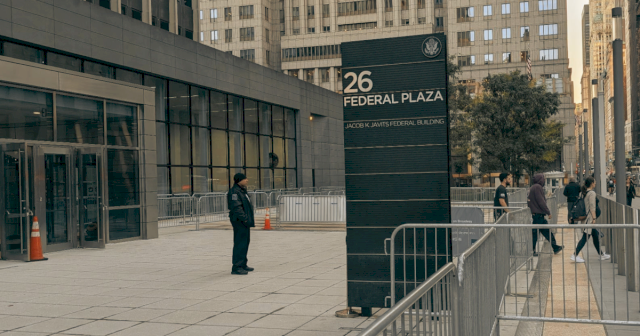
    Trump Administration Fires Two More New York City Immigration Judges as New Hires Take the Bench

    The Department of Justice has terminated more than 100 immigration judges since last year as it has pressured courts to order more deportations.

    Isabelle Taft   ·   May 23, 2026

    President Donald Trump’s Department of Homeland Security has carried out a recruitment campaign urging legal professionals to apply to become “deportation judges.” | Photo and illustration: New York Focus

    At New York Focus, our central mission is to help readers better understand how New York really works. If you think this article succeeded, please consider supporting our mission and making more stories like this one possible.

    New York is an incongruous state. We’re home to fabulous wealth — if the state were a country, it would have the tenth largest economy in the world — but also the highest rate of wealth inequality. We’re among the most diverse – but also the most segregated. We passed the nation’s most ambitious climate law — but haven’t been meeting its deadlines and continue to subsidize industries hastening the climate crisis.

    As New York’s only statewide nonprofit news publication, our journalism exists to help you make sense of these contradictions. Our work scrutinizes how power works in the state, unpacks who’s really calling the shots, and reveals how obscure decisions shape ordinary New Yorkers’ lives.

    In the last two decades, the number of local news outlets in New York has been nearly slashed in half, allowing elected officials and powerful individuals to increasingly operate in the dark — with the average New Yorker none the wiser.

    We’re on a mission to change that. Our work has already shown what can happen when those with power know that someone is watching, with stories that have prompted policy changes and spurred legislation. We have ambitious plans for the rest of the year and beyond, including tackling new beats and more hard-hitting stories — but we need your help to make them a reality.

    If you’re able, please consider supporting our journalism with a one-time gift or a monthly gift. We can’t do this work without you.

    Thank you,

    Akash Mehta
    Editor-in-Chief

    A photo of Akash Mehta.

  • Donald Trump Is Too Busy Posting Weird Memes to Go to Don Jr.’s Wedding – Mother Jones

    Donald Trump Is Too Busy Posting Weird Memes to Go to Don Jr.’s Wedding – Mother Jones

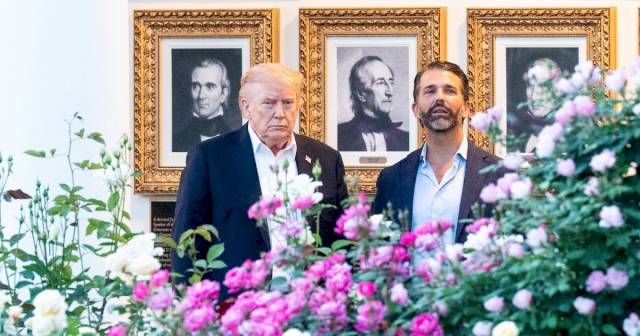
    President Donald Trump and his son Donald Trump Jr. standing in the West Colonnade of the White House in Washington, DC.

    President Donald Trump and his son Donald Trump Jr. standing in the West Colonnade of the White House in Washington, DC. Michael Brochstein/ZUMA Press

    Get your news from a source that’s not owned and controlled by oligarchs. Sign up for the free Mother Jones Daily.

    Donald Trump has made it known far and wide that, as president, with the weight of the world on his shoulders, he’s too busy to attend his son Don Jr.’s second wedding to Florida influencer Bettina Anderson in the Bahamas this weekend.

    Earlier this week, the president said that with “a thing called Iran” and “other things,” the timing of the nuptials was “not good.” He added with his trademark tact, family feeling, and care for choosing his words, “If I do attend, I get killed. If I don’t attend, I get killed—by the fake news, of course, I’m talking about.”

    As the wedding weekend began, the president continued to express his regrets on TruthSocial, saying that “circumstances pertaining to Government, and my love for the United States of America” did not allow him to attend. Thus far, those “circumstances” have involved the president posting a volley of weird stuff on TruthSocial, including a bunch of AI-generated images and some general seething at Stephen Colbert. 

    The president’s public schedule for the Memorial Day weekend is light, with a great deal of “executive time” on the docket. On Friday evening and Saturday morning, Trump devoted that time to posting several photographs of himself on TruthSocial, followed by an AI-generated image reading “GOLDEN DOME FOR THE WHITE HOUSE,” with a dome bathed in celestial light and surrounded by a clutter of satellites. He followed that up with a poorly Photoshopped image of himself looming like a harvest moon over a countryside dotted with houses and a mountain range, Trump’s fingers grasping one of its peaks. “Hello, Greenland!” the image read. (Apparently liking that image tremendously, Trump posted it again the following morning.) He also found time to post a tribute to late WWE wrestler Hulk Hogan, whom he mistakenly termed “the Huckster.” (Hogan was usually known by the nickname “the Hulkster,” but “huckster” might be a term Trump is more familiar with.)

    The president, who is, again, reportedly very busy, followed these important insights with a tribute to NASCAR driver Kyle Busch, who died unexpectedly last week, followed by an AI-generated video of himself throwing former Late Show host Stephen Colbert into a dumpster. Colbert, who has been an outspoken critic of Trump, hosted his last show on Thursday. CBS said last year that it would end Colbert’s contract and retire the Late Show franchise entirely, a decision the network improbably claimed was “purely financial.” It’s one of several recent TruthSocial posts Trump has posted about Colbert in recent days. On Friday morning, around 2 a.m, the president dubbed him a “total jerk,” adding at 9:37 a.m. that his “firing” was, as he put it, “the ‘Beginning of the End’ for untalented, nasty, highly overpaid, not funny, and very poorly rated Late Night Television Hosts. Others, of even less talent, to soon follow. May they all Rest in Peace!” 

    One could argue that these are not the actions of a man who’s too busy to attend his son’s wedding, or really, a man who’s busy at all. But given his recent, worryingly combative stance towards the Cuban government, his leering interest in Greenland, and a reported possibility that Trump will once again attack Iran, it is perhaps in everyone’s best interest that the president seems to be, for now, very, very busy posting on his phone.