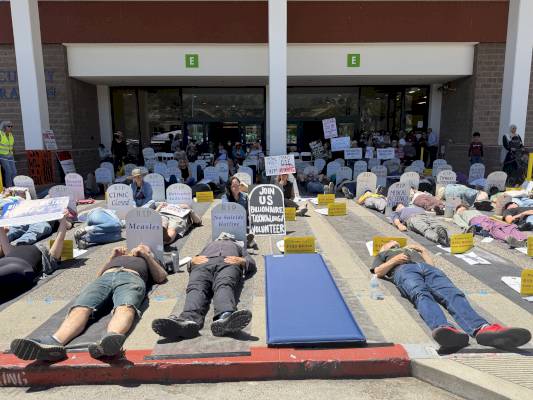
On Thursday afternoon in East Oakland, dozens of people lay side by side under the beating sun. Above their heads stood cardboard gravestones, some reading, “No suicide hotline,” “Died unhoused,” “Can’t afford insurance,” and “Rural hospital closed.”
Many of the people were hospital and ER staff and recipients of Medicare or Medi-Cal.
More than 100 of these East Bay residents staged a “die-in,” protesting President Donald Trump’s cuts to healthcare funding outside Oakland’s Eastmont Town Center.
H.R. 1 — formerly called the “One Big Beautiful Bill Act,” which Trump signed into law last July — includes cuts to Medicaid totaling nearly $1 trillion over the next decade. The Congressional Budget Office estimates nearly 12 million Americans may lose their medical insurance as a result.
In California, up to 2 million residents could lose their Medi-Cal coverage — California’s Medicaid program — including many low-income people, people with disabilities, older adults, children, and veterans, according to an analysis by the California Budget & Policy Center. Alameda County’s hospital system stands to lose hundreds of millions in Medicaid funding.
H.R. 1 also puts over 3 million households statewide at risk of losing food assistance due to cuts to the Supplemental Nutrition Assistance Program, called CalFresh in California. Around 179,000 people in Alameda receive these benefits. Last year, the county spent extra money on food aid to try to soften the blow.
Activists Brittanie Hernandez-Wilson, left, and Ciara Lovelace join Thursday’s demonstration against the Trump administration’s slashing of healthcare funding. Credit: Roselyn Romero/The Oaklandside
Some of the bill’s impacts are about to go into effect. Starting June 1, Californians ages 18 to 65 without children will only be able to keep their CalFresh benefits for more than three months if they can prove that they work up to 20 hours per week or 80 hours per month. (The state provides some exemptions.) This marks the first time since the COVID-19 pandemic that California will enforce this work requirement on CalFresh recipients.
Critics fear the Medicaid cuts will lead to hospitals and clinics shutting down, healthcare staff getting laid off or burnt out, and patients losing access to vital services or having to travel farther to receive healthcare.
The demonstrators in Oakland lay on, or held up, makeshift tombstones symbolizing people who could die, and services that could disappear, due to these cuts.
“These policies end up being more disabling than our own disabilities,” said Brittanie Hernandez-Wilson, an organizer with Hand in Hand, a nonprofit advocating for domestic workers. Hernandez-Wilson has a physical disability.
Gabriela Galicia, executive director of Street Level Health Project, said many immigrants and day laborers have already either lost medical insurance or have avoided seeking treatment due to fears of deportation or being unable to afford medical bills.
Protesters push for California billionaire tax
Demonstrators created 100 makeshift tombstones, each one representing $100 billion in federal healthcare funding cuts. H.R. 1 is estimated to reduce Medicaid funding by $1 trillion over 10 years. Credit: Roselyn Romero/The Oaklandside
Protesters also called on voters to approve the California Billionaire Tax Act, a proposed one-time 5% tax on anyone with a net worth exceeding $1 billion. This would apply to roughly 200 Californians and would raise an estimated $100 billion over five years, according to the Institute on Taxation and Economic Policy. The revenue would go toward healthcare and food assistance.
Demonstrators said the tax is necessary to backfill the programs that stand to lose funding under the Trump administration. Critics say they’re worried the tax would drive wealthy people out of California, resulting in revenue loss over time.
David Tobis, an organizer with Grand Lake Vigil, which holds weekly anti-Trump protests outside of Grand Lake Theatre, said he’s a Medicare recipient and demonstrates to protect healthcare coverage for older adults, people with disabilities, and low-income Black and brown people.
“Trump wants to privatize Medicare so people can make a profit off the elderly. It’s awful,” Tobis told The Oaklandside.
Ciara Lovelace, a counselor for patients at The Center for Independent Living in Berkeley and a Medi-Cal recipient, said she and other people with disabilities have endured “decades of our necks and backs being stepped on, trampled over, and essentially left to rot.”
“I just want folks to see us as humans, and unfortunately, we have to fight just to be seen as such,” she said. “But the fight will not die.”
This page either does not exist or is currently unavailable.
From here you can either hit the “back” button on your browser to return to the previous page, or visit the ABCNews.com Home Page. You can also search for something on our site below.
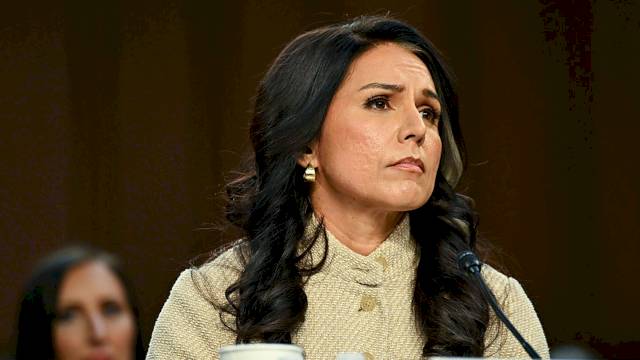
Tulsi Gabbard announced Friday she is resigning from her job as President Trump’s top intelligence official to help her husband cope with a rare form of bone cancer. She will officially depart Trump’s cabinet on June 30.
“My husband, Abraham, has recently been diagnosed with an extremely rare form of bone cancer,” Gabbard wrote in a resignation letter that Trump posted online on Friday. “At this time, I must step away from public service to be by his side and fully support him through this battle.” Gabbard’s husband, Abraham Williams, is a photographer based in her home state of Hawaii.
Gabbard’s departure as Trump’s Director of National Intelligence comes as he remains mired in a war with Iran for which Gabbard’s support was questioned. After Trump launched attacks against Iran in February, her public statements about intelligence assessments conflicted with Trump’s description of Iran’s nuclear capabilities. She stopped short of agreeing with Trump that Iran’s nuclear program posed an imminent nuclear threat.
Writing on Truth Social, President Trump said Gabbard “has done an incredible job, and we will miss her.” Aaron Lukas, Gabbard’s deputy, will take over as acting director, Trump said.
Gabbard served eight years representing Hawaii as a Democrat in the U.S. House of Representatives from 2017 to 2021. She first rose to political prominence within the Democratic Party over her outspoken skepticism of U.S. entanglements in foreign wars. She courted controversy when she opposed the U.S. military intervening in the Syrian civil war, and in 2017, met in person with Bashar Assad, Syria’s then dictator. She gained a reputation for taking public policy positions that echoed Russian propaganda.
Gabbard ran for president in the Democratic primaries in 2020. She left the Democratic party in 2022 criticizing the party of “anti-white racism” and being “hostile to people of faith and spirituality.” She then endorsed Trump in the 2024 election.
Gabbard has previously served in the national guard and is currently a lieutenant colonel in the U.S. Army reserves. She has deployed three times to the Middle East and Africa.
Trump’s decision to nominate Gabbard was criticized within the intelligence community, both for her history of controversial positions, as well as her lack of experience in intelligence. In her eight years in Congress, she never served on the House intelligence Committee.